
- Home
- »
- Biotechnology
- »
-
Biopharmaceuticals Manufacturing Consumables Testing Market Report, 2033GVR Report cover

Biopharmaceuticals Manufacturing Consumables Testing Market (2026 - 2033)
Size, Share & Trends Analysis Report By Service (Laboratory Testing, Custom Testing), By Raw Material (Formulation Excipients, API), By Region, And Segment Forecasts
Market Size, 2025
$709.9MMarket Estimate, 2026
$793.8MMarket Forecast, 2033
$1,866.4MCAGR, 2026–2033
13.0%Biopharmaceuticals Manufacturing Consumables Testing Market Summary
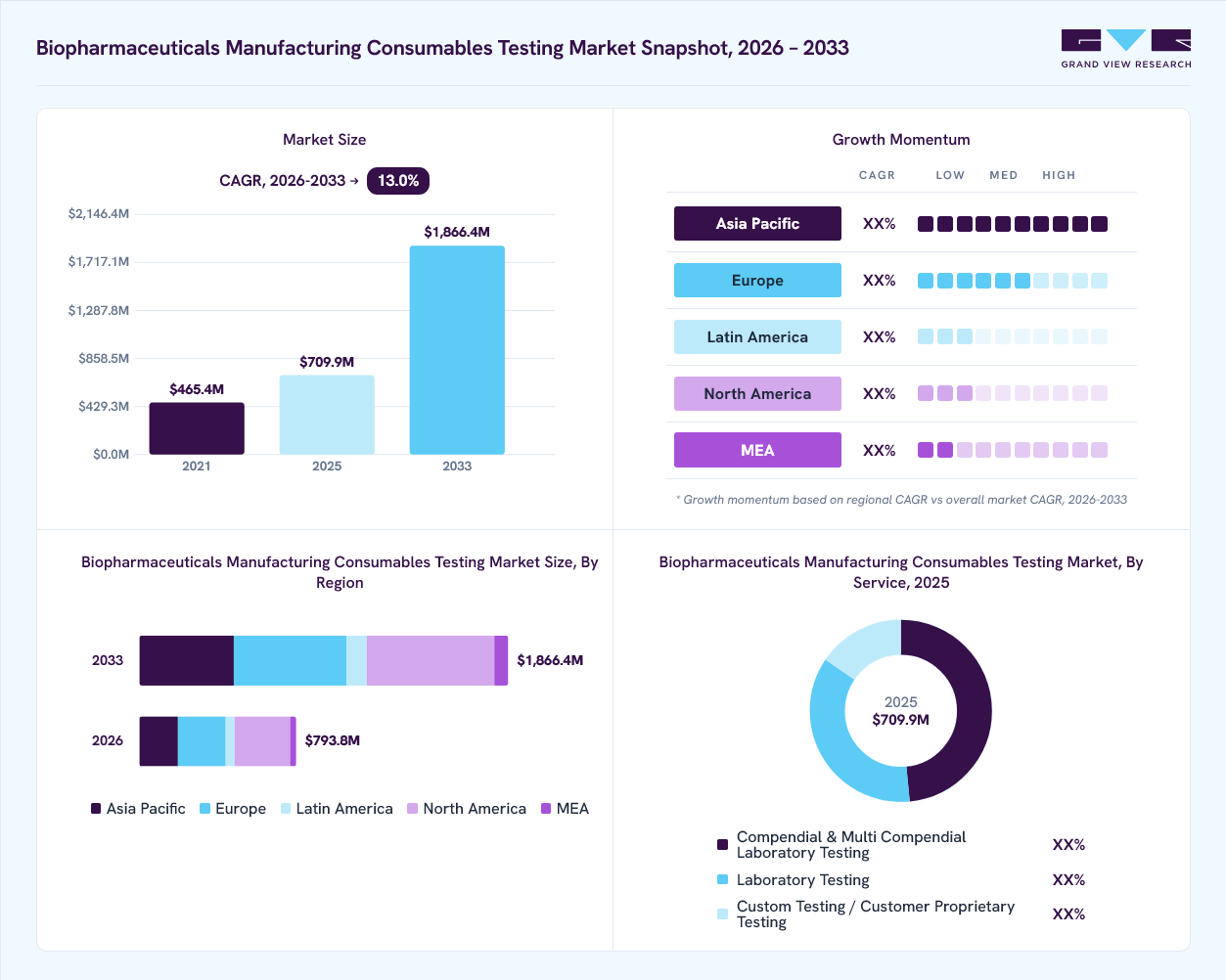
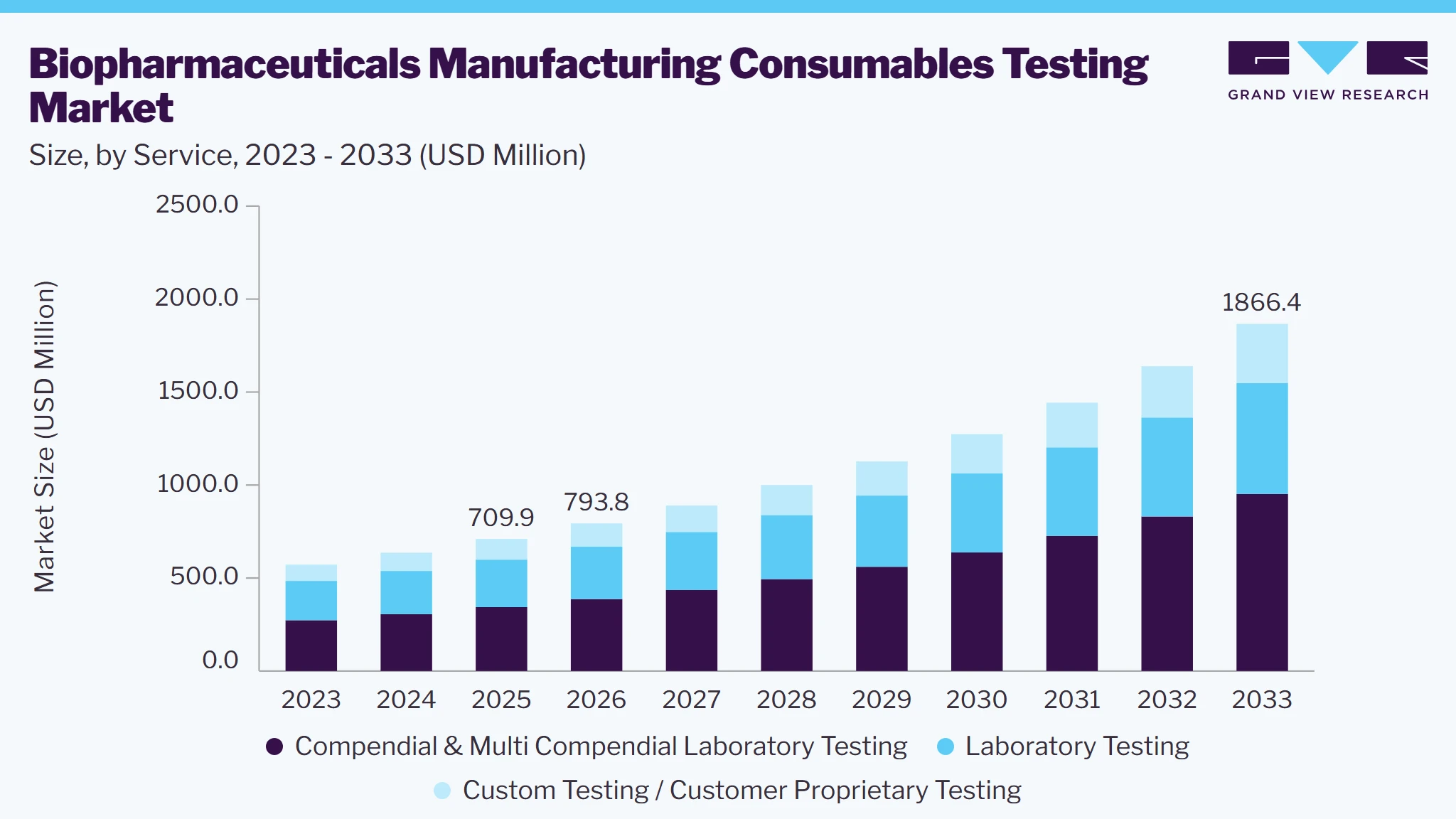
The global biopharmaceuticals manufacturing consumables testing market size was valued at USD 709.9 million in 2025 and is projected to grow from USD 793.8 million in 2026 to USD 1,866.4 million by 2033, at a CAGR of 13.0% from 2026 to 2033. The market in North America dominated with a revenue share of 35.4% in 2025. Successful and efficient biopharmaceutical manufacturing is largely dependent on the purity and quality of consumables used during production.
 Source: Grand View Research, IR Documents, Primary Interviews, Paid DatabasesTo learn more about this report,
 Download Free Sample Report
Key Market Trends & Insights
- By service: Compendial & multi compendial laboratory testing segment held the largest market share of 48.4% in 2025.
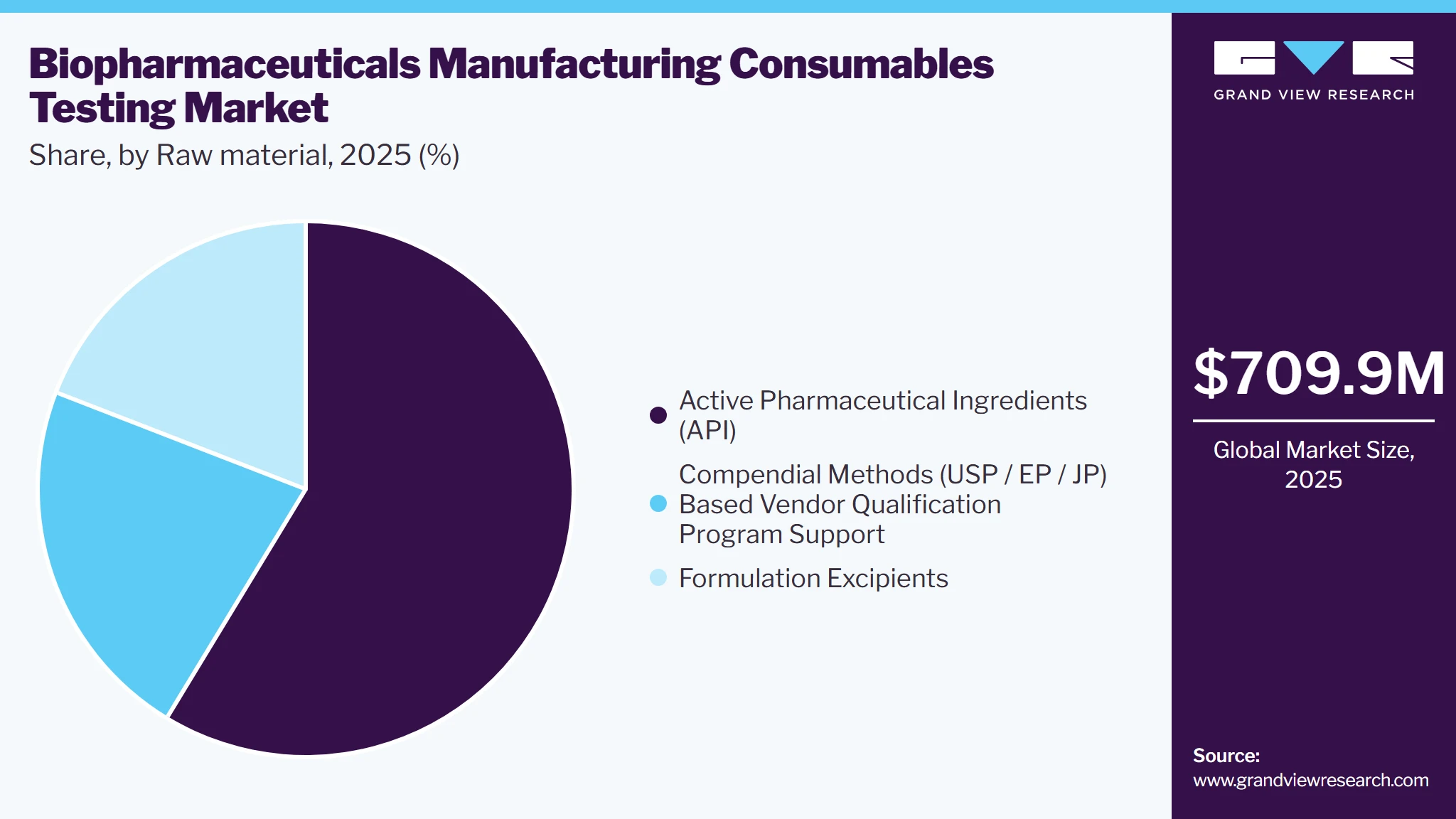
- By raw material: Active pharmaceutical ingredients (API) segment held the largest market share of 58.7% in 2025.
Regional Highlights
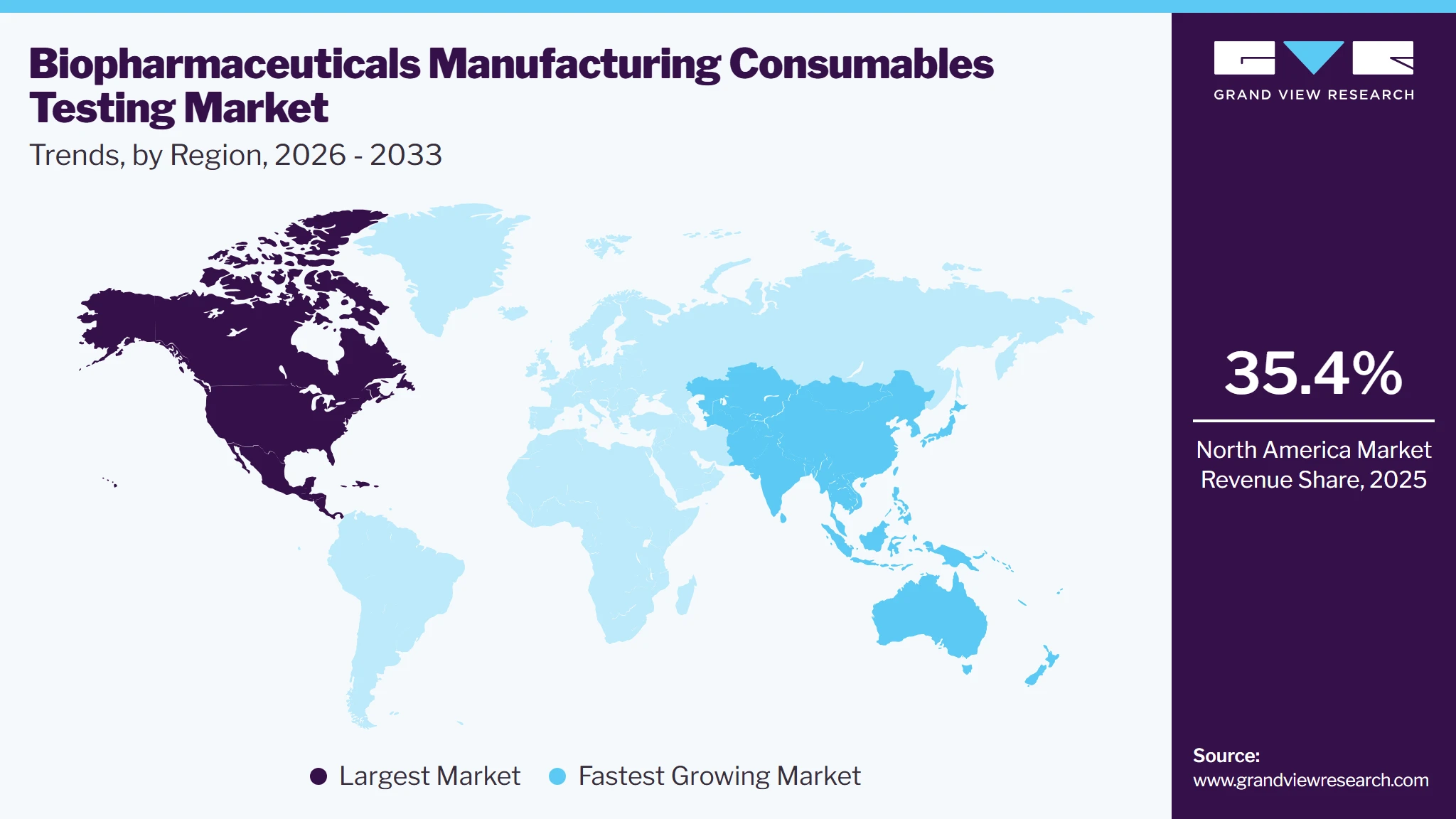
- Largest regional market: North America (35.4% revenue share, 2025)
- Fastest-growing regional market: Asia Pacific (highest CAGR, 2026-2033)
- By country: The U.S. held the largest market share in 2025.
Market Size & Forecast
- Market size in 2025: USD 709.9 Million
- Estimated market size in 2026: USD 793.8 Million
- Projected market size by 2033: USD 1,866.4 Million
- CAGR (2026-2033): 13.0%
GVR research-powered AIAsk Prism AI about the biopharmaceuticals manufacturing consumables testing marketGet cited answers from GVR research on market growth, segments, regulations and forecasts.Start with✓ Source-linked answers ✓ Market-specific context ✓ Traceable figuresExplore Prism AI ↗With growing issues about the quality of novel therapeutics, such as poor solubility, increase in molecular sizes, and poor absorption properties, there is a rise in focus on exploring the various attributes of excipients and other raw materials. Biopharmaceutical manufacturing consumables testing refers to the process of evaluating the quality and performance of materials used in the production of biopharmaceuticals, such as bioreactors, filtration systems, and chromatography columns. As the prevalence of chronic diseases such as cancer, autoimmune diseases, and neurological disorders increases, the demand for biopharmaceuticals grows, driven by their higher efficacy and specificity compared to traditional medications. Consequently, the healthcare industry is increasingly adopting biopharmaceuticals.
 To learn more about this report, Download Free Sample Report
Quality standards have gradually evolved to support biologics production. Constant improvement in regulatory standards for biologic production also encompasses using proper raw materials and their qualification assessment. Characterization of raw materials by vendors in co-operation and collaboration with players in the pharma and biopharmaceutical industry helps address issues associated with the manufacturing process, thereby facilitating the rapid launch of the final product in the market. These issues include the quality-by-design and bioavailability of products.
Furthermore, the continuous introduction of new technologies and advancements in existing technologies for efficient large molecule production are key drivers of this market. While some advancements are solely focused on biopharmaceutical production, the industry is also witnessing technological innovations supporting thorough quality check-based processing, from raw materials to finished drugs.
Effective testing and quality control of biopharmaceuticals manufacturing consumables is crucial because these materials significantly impact the final product's quality and safety. Moreover, the trend toward personalized medicine, which involves tailoring treatments to individual genetic profiles, necessitates using specialized biopharmaceuticals. Similarly, the rise of biosimilars, which requires extensive testing to ensure safety and efficacy, also drives the demand for high-quality consumables testing.
Market Dynamics
The biopharmaceuticals manufacturing consumables testing market is witnessing steady growth as biopharmaceutical manufacturers strengthen quality assurance practices to meet regulatory requirements and ensure product consistency. Growing production of monoclonal antibodies, vaccines, recombinant proteins, and cell and gene therapies has increased the need for comprehensive testing of raw materials, filters, media, single use systems, and other manufacturing consumables before their use in production. Manufacturers are also adopting advanced analytical technologies to improve process reliability, reduce contamination risks, and support regulatory compliance throughout the manufacturing lifecycle. Industry participants are responding by expanding analytical capabilities and strengthening collaborative innovation. For instance, in October 2025, Thermo Fisher Scientific partnered with AstraZeneca BioVentureHub to provide biotechnology companies with advanced analytical technologies, laboratory services, and manufacturing support, improving access to testing solutions for biologics development and production. This development reflects the industry's focus on enhancing quality control infrastructure and accelerating biologics manufacturing while supporting regulatory expectations for validated consumables and testing processes.
The growing production of biologics, biosimilars, vaccines, and advanced therapies is driving demand for rigorous testing of manufacturing consumables to ensure product quality, process consistency, and regulatory compliance. Biopharmaceutical manufacturers are increasingly adopting single use technologies, sterile filtration systems, and specialized media, making comprehensive testing of these consumables essential to minimize contamination risks and maintain manufacturing efficiency. Regulatory agencies continue to emphasize quality by design and risk based manufacturing practices, encouraging manufacturers to strengthen analytical testing throughout the production lifecycle. For instance, in May 2026, Agilent Technologies launched its Multi Attribute Method (MAM) Solution for biopharmaceutical quality control laboratories. The solution integrates liquid chromatography, high resolution mass spectrometry, software, columns, standards, and analytical consumables to enable routine monitoring of critical quality attributes during biologics manufacturing. This product launch strengthens analytical testing capabilities, supports regulatory compliance, and reinforces the growing adoption of advanced consumables testing solutions across biopharmaceutical manufacturing.
The adoption of advanced consumables testing solutions is restrained by the substantial investment required for analytical instruments, validation processes, and specialized technical expertise. Biopharmaceutical manufacturers must conduct comprehensive testing of raw materials, filters, media, and single use systems to comply with stringent regulatory requirements and ensure product quality throughout the manufacturing process. These activities increase operational costs and extend validation timelines, particularly for small and mid sized manufacturers with limited financial and technical resources. In addition, evolving global regulatory expectations require continuous updates to testing protocols, documentation, and quality management systems, adding further complexity to manufacturing operations. Dependence on highly skilled personnel and sophisticated laboratory infrastructure also limits the adoption of advanced testing technologies in cost sensitive environments. As a result, the financial and operational burden associated with consumables testing remains a key challenge for market growth, especially among emerging biopharmaceutical companies and contract manufacturers operating with constrained resources.
The increasing adoption of advanced biologics, biosimilars, and cell and gene therapies is creating opportunities for manufacturers to implement faster and more comprehensive consumables testing workflows. Biopharmaceutical companies are investing in modern quality control technologies that improve contamination detection, reduce batch release timelines, and strengthen compliance with global regulatory requirements. Growing demand for rapid microbiological testing and automated analytical solutions is expected to accelerate the adoption of specialized consumables testing across manufacturing facilities. For instance, in September 2025, FUJIFILM Wako Pure Chemical launched the RiboNAT Rapid Sterility Test, a rapid sterility testing kit designed for cell therapy manufacturing that significantly shortens sterility testing time compared with conventional methods while supporting faster product release and improved manufacturing efficiency. This product launch strengthens quality control capabilities and creates opportunities for advanced consumables testing across biopharmaceutical manufacturing workflows.
Analyst Perspective
The biopharmaceuticals manufacturing consumables testing market is expected to witness steady growth as manufacturers prioritize product quality, regulatory compliance, and process reliability across biologics production. The expanding pipeline of monoclonal antibodies, vaccines, biosimilars, and cell and gene therapies is increasing demand for analytical testing of raw materials, single use systems, formulation components, and other manufacturing consumables. Service providers are strengthening laboratory capabilities through automation, advanced analytical technologies, and rapid microbiological testing to support efficient manufacturing workflows. Increasing outsourcing of quality control activities to specialized testing organizations is further enhancing market opportunities, while evolving global regulatory standards continue to drive demand for comprehensive consumables testing services.
Service Insights
Based on service, the compendial & multi compendial laboratory testing segment led the market with the largest revenue share of 48.4% in 2025. This growth can be attributed to numerous providers offering services that are compliant with various compendia. The presence of region-specific pharmacopeias compels companies to perform full-monograph testing, which has been observed to be expensive, contributing to the high revenue of this segment.
The custom testing/customer proprietary testing segment is expected to grow at the fastest CAGR of 14.2% over the forecast period, owing to relatively fewer services in this segment. In addition, as biopharmaceuticals become more specialized, manufacturers require customized testing protocols to ensure product integrity and compliance with unique specifications. This demand is further amplified by adopting personalized medicine and biosimilars, necessitating highly specialized consumables testing. Moreover, changing customer requirements and the need for specific analysis for excipients are expected to lend this segment a much-needed boost in the coming years.
Raw Material Insights
Based on raw material, the active pharmaceutical ingredients (API) segment led the market with the largest revenue share of 58.7% in 2025. APIs are often mixed with excipients, also known as additives, to enhance the absorption, stability, and solution of the drugs. The use of API provides therapeutic advantages; drug products include several elements, such as coatings, to aid in delivery, patient adherence, and stability. According to PhRMA Org, the U.S. manufactured 53% of the USD 85.6 billion worth of APIs used in medicines consumed in 2021. The collaboration between API and drug consumables helps effectively to meet healthcare demands and improve patient results.
 To learn more about this report, Download Free Sample Report
The compendial methods (USP / EP / JP) based vendor qualification program support segment is expected to register the fastest CAGR of 14.8% from 2026 to 2033. This growth can be attribute to the need for standardized testing protocols and compliance with international pharmacopeia standards such as USP, EP, and JP. These methods ensure reproducibility and reliability, reducing regulatory risks. Compendial methods are often optimized and validated, providing the most accurate and précised result. It involves using set standards in pharmacopeia to evaluate raw materials. The utilization of USP standards allows hospitals to work with assurance and minimal chances of inaccurate outcomes.
Regional Insights
North America dominated the biopharmaceuticals manufacturing consumables testing market. with the largest revenue share of 35.4% in 2025, owing to a substantial number of biopharmaceutical manufacturing facilities in the region. In addition, the continuous development in the research and development industry is driving the demand for testing of consumables and making the region a global hub for the biopharmaceutical manufacturing industry. Furthermore, strategic acquisitions and investments in analytical equipment enhance testing capacities and contribute to market dominance.
 To learn more about this report, Download Free Sample Report
U.S. Biopharmaceuticals Manufacturing Consumables Testing Market Trends
The biopharmaceuticals manufacturing consumables testing market in the U.S. held the largest share in the North America region in 2025, driven by the development of advanced analytical equipment and methods, which leads to improvement in precise assessment of goods and testing capacities. In addition, the presence of key players, including major pharmaceutical companies, also drives market growth. Furthermore, the U.S. offers a favorable regulatory environment that encourages investment in consumables testing.
Asia Pacific Biopharmaceuticals Manufacturing Consumables Testing Market Trends
APAC biopharmaceuticals manufacturing consumables testing market is expected to grow at the fastest CAGR of 13.6% over the forecast period, owing to growing patient population, rising prevalence of chronic diseases, and rising R&D investments. In addition, the region provides a strong edge in terms of labor competitiveness when compared to other countries. Furthermore, competitive labor costs attract biopharmaceutical manufacturing, driving demand for consumables testing. Moreover, the increasing focus on quality control and regulatory compliance further boosts demand.
The biopharmaceuticals manufacturing consumables testing market in China led the Asia Pacific market and accounted for the largest revenue share in 2024, primarily driven by government support for biotechnology and a growing domestic market. In addition, increased focus on quality control and regulatory compliance boosts demand for consumables testing. Furthermore, this supports the development of biopharmaceuticals and encourages foreign investment in the sector. China's large patient population also fuels the need for reliable biopharmaceuticals, driving market expansion.
Europe Biopharmaceuticals Manufacturing Consumables Testing Market Trends
The Europe biopharmaceuticals manufacturing consumables testing market is expected to grow significantly over the forecast period, due to the strong establishment of biopharmaceutical sector including leading global pharmaceutical companies such as AstraZeneca, Novartis, and others. Furthermore, the region's stringent regulatory environment ensures high standards for testing, which in turn supports the development of innovative biopharmaceuticals. This environment fosters collaboration between manufacturers and testing providers.
The growth of the biopharmaceutical manufacturing consumables testing market in Germany is influenced by its robust pharmaceutical industry and stringent regulatory standards. In addition, the need for high-quality consumables testing to ensure compliance drives market expansion. This supports the country's pharmaceutical manufacturing sector, which is known for its quality and innovation. Moreover, Germany’s strong research environment and collaboration between industry and academia further contribute to the growth of consumables testing services.
Key Biopharmaceuticals Manufacturing Consumables Testing Company Insights
Some key companies in biopharmaceuticals manufacturing consumables testing market include Alcami Corporation, Merck KGaA, Catalent, Inc, Charles River Laboratories., and others. These service providers have formed strategic partnerships with various well-known biopharmaceutical companies worldwide. The companies are concentrating on complying with evolving regulatory needs and satisfying increasing demand.
-
Alcami Corporation provides pharmaceutical development and manufacturing services to small and mid-size pharmaceutical and biotechnology companies globally. The company's main services involve API development and manufacturing, clinical and commercial finished dosage form manufacturing, solid-state chemistry development, packaging and stability services, formulation development, and commercial finished dosage form manufacturing, packaging and stability services, as well as analytical development and testing services.
-
Agilent Technologies, Inc. operates in the life sciences and diagnostics segment, providing biopharmaceuticals manufacturing consumables testing solutions. The company manufactures and deals in various analytical instruments and consumables, including HPLC columns, standards, and reference materials. These products support the analysis of complex biotherapeutic molecules and critical quality attributes, facilitating quality control and testing in biopharmaceutical manufacturing processes.
Key Biopharmaceuticals Manufacturing Consumables Testing Companies
The following key companies have been profiled for this study on the biopharmaceuticals manufacturing consumables testing market.
-
Alcami Corporation
-
Merck KGaA
-
Eurofins Scientific
-
Agilent Technologies, Inc.
-
Charles River Laboratories.
-
Catalent, Inc
-
Element Materials Technology (Avomeen Analytical Services)
-
Pace Analytical Services, LLC
-
Nelson Laboratories, LLC (Gibraltar Laboratories)
Competitive Benchmarking
Category
Operating Strategies
Competitive Edge
Weakness
Well-Established Players (Merck KGaA, Eurofins Scientific, Agilent Technologies, Inc., Charles River Laboratories, Catalent, Inc., Alcami Corporation)
Focus on expanding biopharmaceutical manufacturing consumables testing portfolios through analytical testing, sterility and endotoxin testing, extractables and leachables analysis, raw material qualification, method development, and GMP compliant laboratory services. Emphasize strategic partnerships with biopharmaceutical manufacturers, expansion of global testing facilities, regulatory compliance, automation of analytical workflows, and investment in advanced quality control technologies to support biologics, biosimilars, and cell and gene therapy manufacturing.
Extensive global laboratory networks, broad analytical testing capabilities, strong expertise in GMP and regulatory compliance, established relationships with pharmaceutical and biotechnology companies, comprehensive service portfolios, and significant investments in advanced analytical technologies. Strong technical expertise and global presence enable efficient support for complex biologics manufacturing programs.
High capital investment required for laboratory infrastructure and advanced analytical platforms, lengthy regulatory qualification processes, dependence on biopharmaceutical manufacturing activity, and high operating costs associated with maintaining GMP compliant testing facilities. Complex service delivery models may also extend project timelines.
Emerging Players (Element Materials Technology (Avomeen Analytical Services), Pace Analytical Services, LLC, Nelson Laboratories, LLC (Gibraltar Laboratories))
Concentrate on expanding specialized analytical testing, sterility assurance, microbial testing, extractables and leachables studies, vendor qualification, and customized laboratory services for biologics manufacturing. Focus on strengthening regional laboratory capabilities, strategic collaborations with biotechnology companies, investment in niche testing expertise, and enhancing service flexibility to address evolving regulatory requirements.
Strong specialization in analytical and microbiological testing, flexibility in delivering customized testing solutions, faster response to client specific requirements, and ability to support emerging biopharmaceutical companies with targeted quality assurance services. Specialized expertise enables differentiation in high value testing applications.
Limited global laboratory footprint, comparatively narrower service portfolios, lower financial resources than multinational competitors, and dependence on strategic partnerships and regional customer bases for business expansion. Smaller operational scale may limit participation in large multinational biopharmaceutical manufacturing programs.
Recent Developments
-
In January 2025, Agilent Technologies is set to showcase its latest automated laboratory workflow solutions at the SLAS2025 International Conference & Exhibition. These solutions aim to boost lab productivity and reproducibility across various pipelines, from drug discovery to Biopharmaceuticals Manufacturing Consumables Testing and development. Agilent's automation includes sample preparation, auto dilution, and sample delivery, covering genomics, proteomics, and mass spectrometry. The company will also participate in discussions about robotic automation and its role in the future of laboratories, highlighting its commitment to advancing automation in the life sciences.
-
In September 2024, Pace Life Sciences broadened its offerings by acquiring Catalent's analytical services laboratory in Research Triangle Park, North Carolina. This acquisition strengthens Pace's network, adding expertise in small molecule Biopharmaceuticals Manufacturing Consumables Testing and analytical services to support pharmaceutical clients from early-stage development through commercialization. The expansion includes a team of scientists and enhances Pace's capacity to provide faster and more reliable solutions. With nine sites across the US and Puerto Rico, Pace Life Sciences offers services from analytical testing to early-stage drug product manufacturing.
-
In May 2024, Merck KGaA signed an agreement to acquire Mirus Bio, a life science company, for USD 600 million. Mirus Bio specializes in transfection reagents that are crucial for producing viral vectors used in cell and gene therapies. This acquisition aimed at enhancing Merck's integrated offerings for viral vector manufacturing, a key area in novel modalities. By combining Mirus Bio's technology with Merck's bioprocessing expertise, Merck aims to provide solutions for viral vector development and Biopharmaceuticals Manufacturing Consumables Testing, supporting customers in bringing cell and gene therapies to market. The deal is expected to close in the third quarter of 2024.
Biopharmaceuticals Manufacturing Consumables Testing Market Report Scope
Report Attribute
Details
Market size in 2025
USD 709.9 million
Estimated market size in 2026
USD 793.8 million
Projected market size by 2033
USD 1,866.4 million
Growth rate
CAGR of 13.0% from 2026 to 2033
Historical data
2021 - 2024
Forecast period
2026 - 2033
Quantitative units
Revenue in USD million/billion and CAGR from 2026 to 2033
Report coverage
Revenue forecast, company ranking, competitive landscape, growth factors, and trends
Segments covered
Service, Raw material, Region
Regional scope
North America; Europe; Asia Pacific; Latin America; MEA
Country scope
U.S.; Canada; Mexico; Germany; UK; France; Italy; Spain; Denmark; Sweden; Norway; Japan; China; India; South Korea; Australia; Thailand; Brazil; Argentina; South Africa; Saudi Arabia; UAE; and Kuwait
Key companies profiled
Alcami Corporation, Merck KGaA, Eurofins Scientific, Agilent Technologies, Inc., Charles River Laboratories, Catalent, Inc., Element Materials Technology (Avomeen Analytical Services), Pace Analytical Services, LLC, and Nelson Laboratories, LLC (Gibraltar Laboratories).
Customization scope
Free report customization (equivalent up to 8 analysts' working days) with purchase. Addition or alteration to country, regional & segment scope.
Pricing and purchase options
Avail customized purchase options to meet your exact research needs. Explore purchase options
Global Biopharmaceuticals Manufacturing Consumables Testing Market Report Segmentation
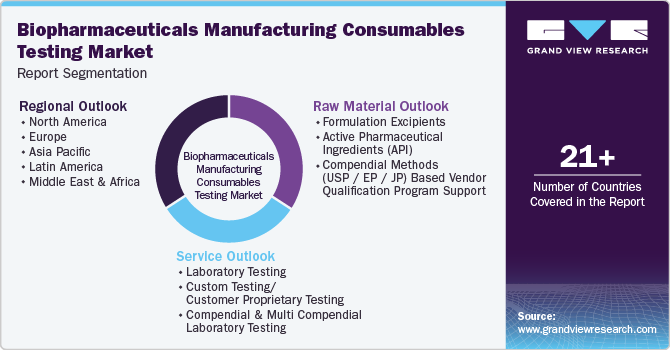
This report forecasts revenue growth at global, regional, and country levels and provides an analysis of the latest industry trends in each of the sub-segments from 2021 to 2033. For this study, Grand View Research has segmented the global biopharmaceuticals manufacturing consumables testing market report based on service, raw material, and region:
 To learn more about this report, Download Free Sample Report
-
Service Outlook (Revenue, USD Million, 2021 - 2033)
-
Laboratory Testing
-
Custom Testing / Customer Proprietary Testing
-
Compendial & Multi Compendial Laboratory Testing
-
-
Raw Material Outlook (Revenue, USD Million, 2021 - 2033)
-
Formulation Excipients
-
Active Pharmaceutical Ingredients (API)
-
Compendial Methods (USP / EP / JP) Based Vendor Qualification Program Support
-
-
Regional Outlook (Revenue, USD Million, 2021 - 2033)
-
North America
-
U.S.
-
Canada
-
Mexico
-
-
Europe
-
UK
-
Germany
-
France
-
Italy
-
Spain
-
Denmark
-
Sweden
-
Norway
-
-
Asia Pacific
-
Japan
-
China
-
India
-
Australia
-
South Korea
-
Thailand
-
-
Latin America
-
Brazil
-
Argentina
-
-
Middle East & Africa
-
South Africa
-
Saudi Arabia
-
UAE
-
Kuwait
-
-
Research Methodology
The biopharmaceuticals manufacturing consumables testing Market figures in this report are based on a proven research process that combines executive interviews with secondary research from proprietary databases, company filings, and recognized regulatory and institutional sources. Market size is built through value-chain sizing - reconciling supply-side and demand-side estimates - and triangulated with bottom-up and top-down approaches. Every estimate passes multiple levels of expert validation before publication, with each biopharmaceuticals manufacturing consumables testing Market segment quantified using the revenue-capture definitions in the table below.
Segment Definition
Segment - Service
Revenue capture definition
Laboratory Testing
Revenue is primarily captured through routine analytical testing services for manufacturing consumables, including sterility, endotoxin, bioburden, particulate matter, extractables and leachables, and physicochemical testing performed to support GMP biopharmaceutical production and batch release.
Custom Testing / Customer
Proprietary Testing
Market value is derived from customized analytical method development, validation, qualification, and proprietary testing services tailored to individual biopharmaceutical manufacturing processes, consumables, raw materials, and client specific quality assurance requirements.
Compendial & Multi
Compendial Laboratory Testing
Revenue flows from standardized testing services performed in accordance with global pharmacopeial standards, including USP, EP, JP, and other regulatory guidelines, supporting qualification of manufacturing consumables, raw materials, and compliance for commercial biopharmaceutical production.
Segment - Raw Material
Revenue capture definition
Formulation Excipients
Revenue is primarily captured through analytical testing services for formulation excipients used in biopharmaceutical manufacturing, including identity, purity, microbial quality, endotoxin, and physicochemical testing to ensure product quality, stability, and regulatory compliance.
Active Pharmaceutical
Ingredients (API)
Market value is derived from testing services for active pharmaceutical ingredients, including potency, impurity profiling, residual solvents, elemental impurities, microbial contamination, and stability assessments supporting GMP manufacturing and quality assurance.
Compendial Methods
(USP / EP / JP)
Based Vendor
Qualification Program Support
Revenue flows from vendor qualification and compliance testing services performed according to USP, EP, and JP compendial standards, including raw material verification, supplier qualification, analytical method execution, and documentation supporting regulatory compliance for biopharmaceutical manufacturing.
Estimation Model
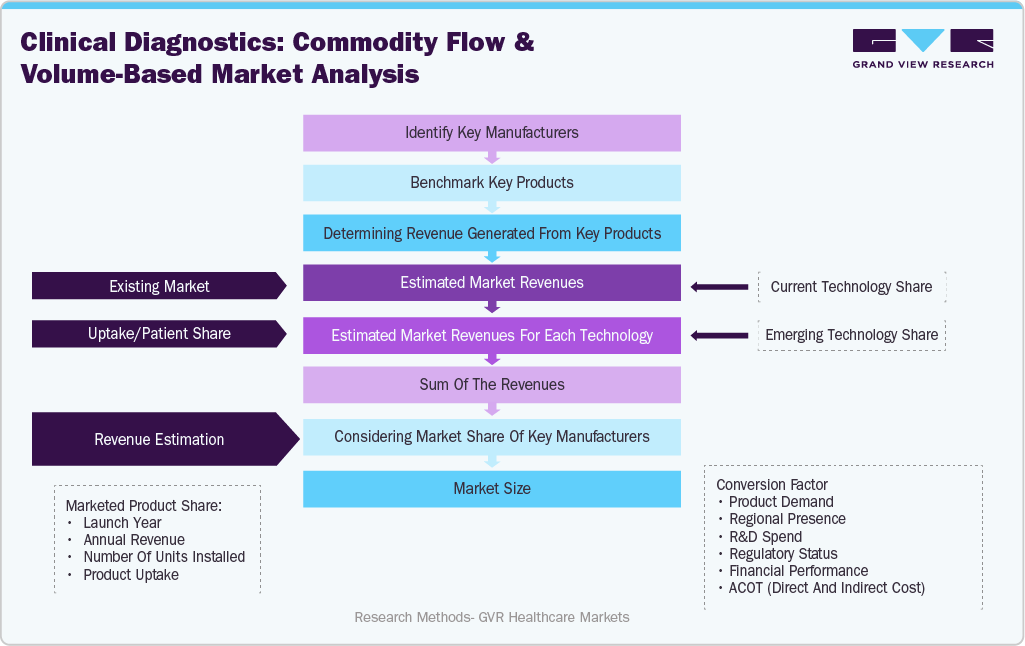
The biopharmaceuticals manufacturing consumables testing market was estimated using a bottom up approach by identifying key testing service providers, benchmarking their service portfolios, and analyzing revenues generated from consumables testing activities. Market estimates were validated by assessing technology adoption across biopharmaceutical manufacturing applications, evaluating the market share of leading companies, and consolidating segment wise revenues to determine the overall market size.
 To learn more about this report, Download Free Sample Report
Delivered Customizations
This report has been delivered with the following In-depth customizations
Client Request
Customization Delivered
Value Adds
Biopharmaceuticals Manufacturing Consumables Testing Competitive Landscape & Technology Assessment
Assessed the global biopharmaceuticals manufacturing consumables testing market across laboratory testing, custom testing, compendial testing, formulation excipients, API testing, and vendor qualification services. Evaluated leading service providers, analytical technologies, regulatory developments, laboratory capabilities, and competitive positioning across biopharmaceutical manufacturing applications.
Helped the client identify growth opportunities across analytical testing services, benchmark competitive capabilities, evaluate market positioning, and prioritize investments in advanced quality control technologies, GMP compliant testing, and specialized analytical services.
Biopharmaceuticals Manufacturing Consumables Testing Technology & Service Benchmarking Study
Delivered a comprehensive benchmarking of analytical testing platforms, sterility and endotoxin testing services, extractables and leachables studies, microbial testing, raw material qualification, and compendial testing capabilities. Evaluated service quality, laboratory automation, regulatory compliance, turnaround time, and differentiation across major testing providers.
Enabled the client to assess service competitiveness, identify technology gaps, benchmark laboratory performance, and prioritize investments in automated analytical platforms, rapid microbiological testing, and next generation quality assurance solutions.
Biopharmaceutical Manufacturing Testing Infrastructure & Commercialization Feasibility Assessment
Assessed global analytical laboratory infrastructure, GMP testing capabilities, regulatory pathways, contract testing networks, quality management systems, and commercialization strategies supporting consumables testing services. Evaluated testing capacity, outsourcing trends, laboratory readiness, and operational requirements across major regional markets.
Supported commercialization planning by identifying market entry opportunities, evaluating laboratory partnerships, optimizing outsourcing strategies, assessing regulatory compliance requirements, and strengthening long term scalability across the consumables testing market.
Frequently Asked Questions About This Report
The global biopharmaceuticals manufacturing consumables testing market is expected to grow at a CAGR of 13.0% from 2026 to 2033, reaching USD 1,866.4 million by 2033.
North America dominated with a 35.4% revenue share in 2025.
Some key players operating in the biopharmaceuticals manufacturing consumables testing market include Alcami Corporation, Merck KGaA, Eurofins Scientific, Agilent Technologies, Inc., Charles River Laboratories, Catalent, Inc., Element Materials Technology (Avomeen Analytical Services), Pace Analytical Services, LLC, and Nelson Laboratories, LLC (Gibraltar Laboratories).
Key factors that are driving the biopharmaceuticals manufacturing consumables testing market growth include expanding contract services offerings and innovations pertaining to robust analytical tools for testing raw materials.
Asia Pacific is the fastest-growing region over the forecast period.
The compendial & multi compendial laboratory testing segment led with a 48.4% revenue share in 2025
The active pharmaceutical ingredients (API) segment led with a 58.7% revenue share in 2025
The custom testing/customer proprietary testing segment is expected to grow at the fastest CAGR over the forecast period
The global biopharmaceuticals manufacturing consumables testing market size was valued at USD 709.9 million in 2025 and is estimated at USD 793.8 million for 2026.
About the Author(s)
Biotechnology Research Team
Healthcare · BiotechnologyThis report was authored by the biotechnology research team at Grand View Research - comprising two research analysts, one senior research analyst, and one industry expert - with specialized expertise in the biotechnology segment of the healthcare industry. All findings are based on proprietary healthcare databases, executive interviews, and regulatory analysis, subject to internal peer review prior to publication.
Last Updated:
Speak to Analyst

Customize this report to your needs - add regions, segments, or data points, with 20% free customization.
Or view our licence options:


ISO 9001:2015 & 27001:2022 Certified
We are GDPR and CCPA compliant! Your transaction & personal information is safe and secure. For more details, please read our privacy policy.


