
- Home
- »
- Paints, Coatings & Printing Inks
- »
-
Biopolymer Coatings Market Size Report, 2026-2033GVR Report cover

Biopolymer Coatings Market (2026 - 2033)
Size, Share & Trends Analysis Report By Product (Polysaccharide-based, Protein-based, Lipid-based, Bio-based Polyesters), By Technology (Water-based, Solvent-based, Hot-melt), By Substrate, By End Use, By Region, And Segment Forecasts
Market Size, 2025
$1.4BMarket Estimate, 2026
$1.5BMarket Forecast, 2033
$2.5BCAGR, 2026–2033
7.5%Biopolymer Coatings Market Summary
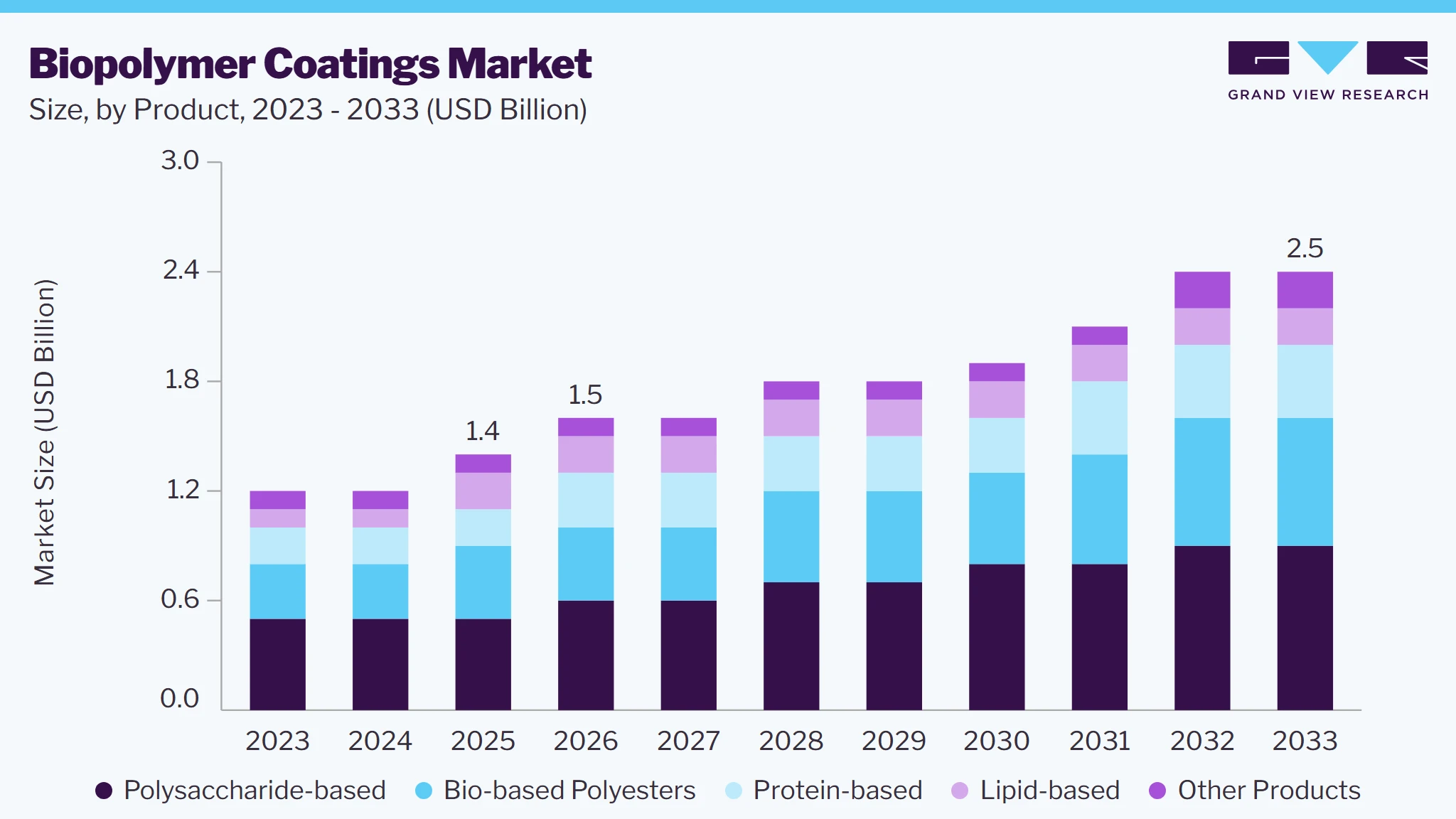
The global biopolymer coatings market size was valued at USD 1.4 billion in 2025 and is projected to grow from USD 1.5 billion in 2026 to USD 2.5 billion by 2033, at a CAGR of 7.5% from 2026 to 2033. Asia Pacific dominated the market, accounting for a revenue share of 33.0% in 2025. The industry is expanding as environmental priorities and material innovation accelerate the transition from fossil-derived coatings toward renewable and lower-impact alternatives.
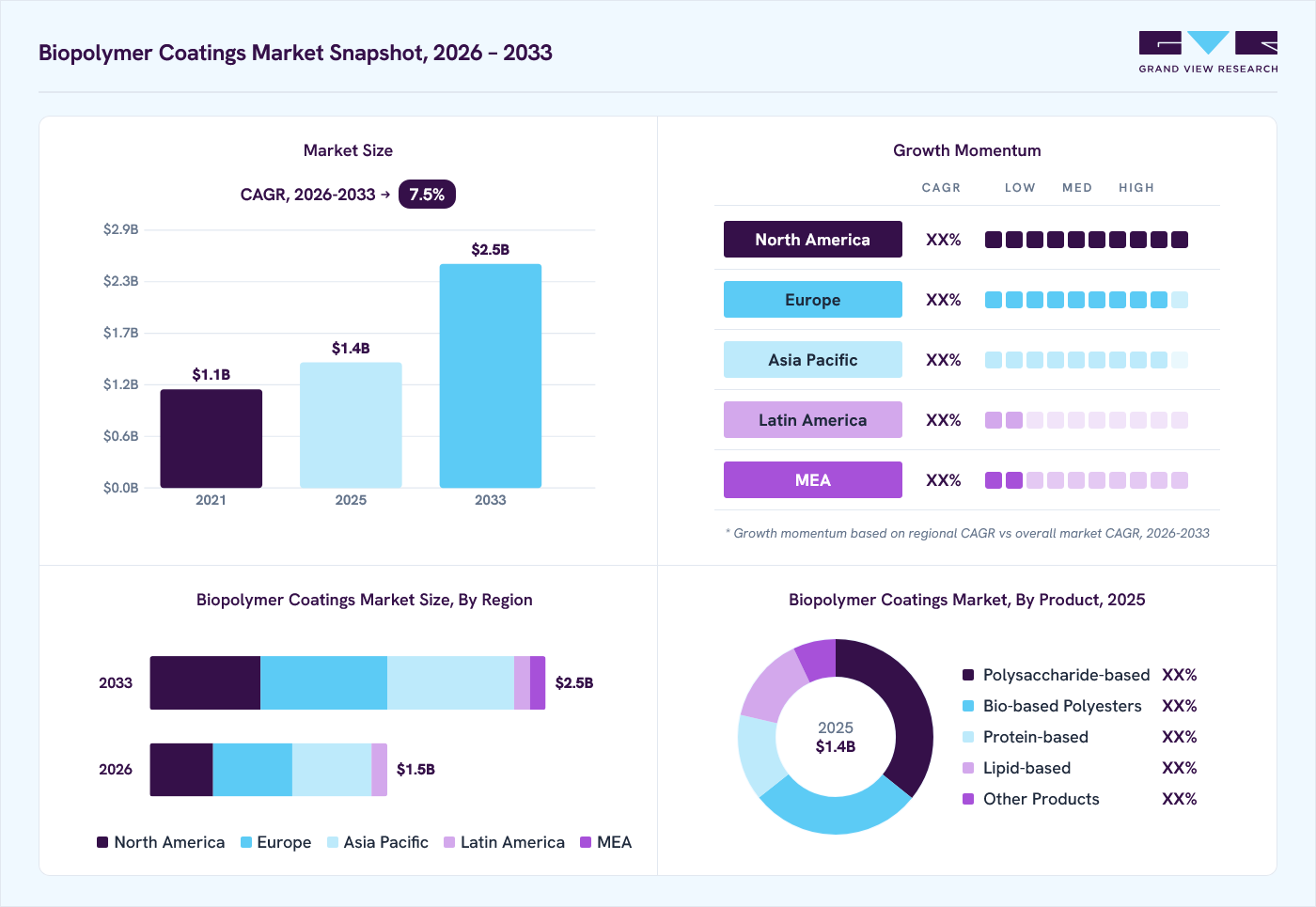 Source: Grand View Research, IR Documents, Primary Interviews, Paid DatabasesTo learn more about this report,
 Download Free Sample Report
 Key Market Trends & Insights
- By Product: Bio based polyesters segment is projected to record the fastest CAGR of 9.1% from 2026 to 2033.
- By Technology: Water-based segment led the market in 2025, accounting for 57.9% of total revenue.
- By End Use: Healthcare & pharmaceutical segment is projected to depict the fastest CAGR of 8.6% from 2026 to 2033.
- By Substrate: Paper & paperboard segment dominated the market in 2025, accounting for the largest revenue share of 46.6%.
Regional Highlights
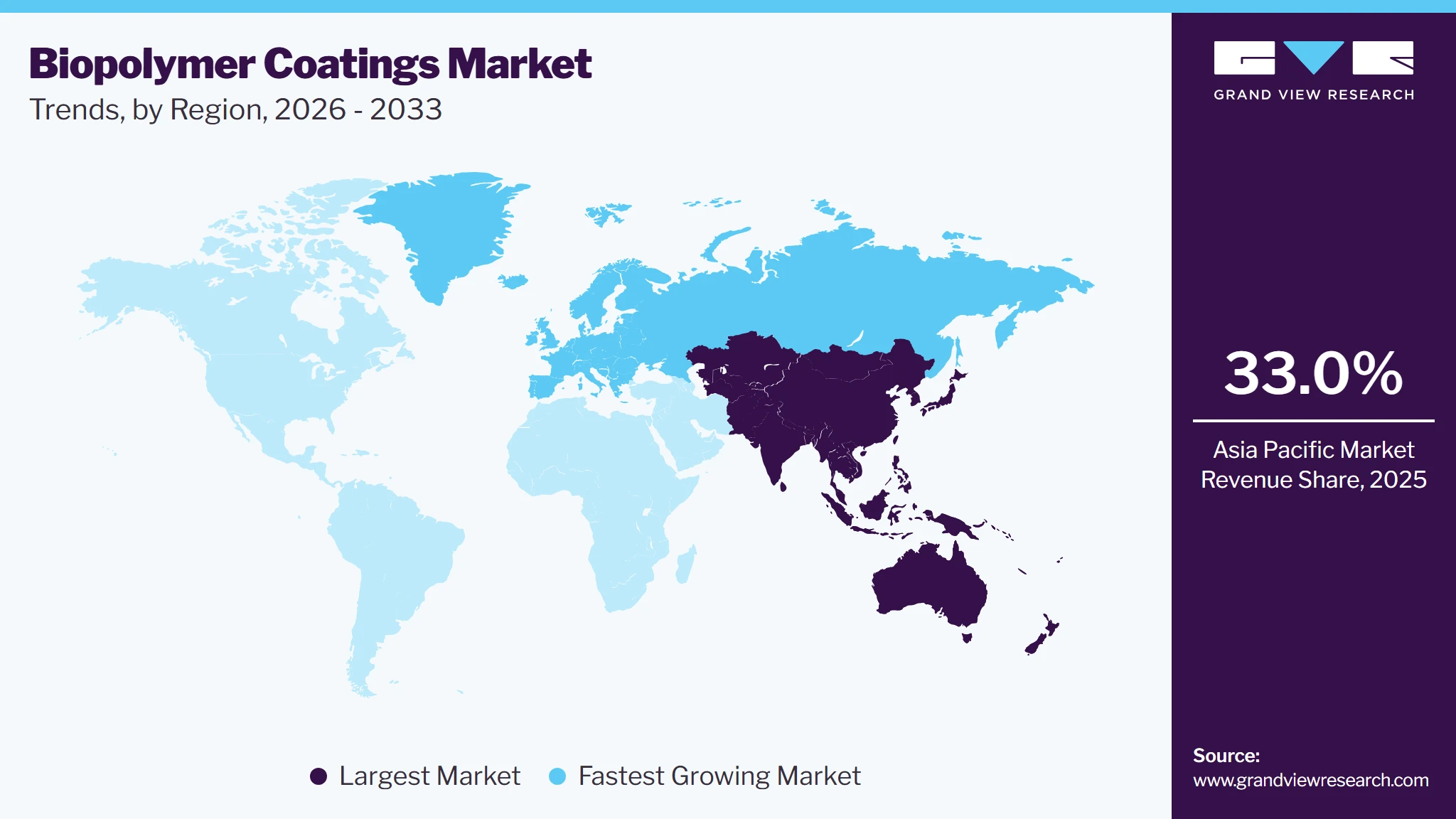
- Largest regional market: Asia Pacific (33.0% revenue share, 2025)
- Fastest-growing regional market: Europe (highest CAGR, 2026-2033)
Market Size & Forecast
- Market size in 2025: USD 1.4 Billion
- Estimated market size in 2026: USD 1.5 Billion
- Projected market size by 2033: USD 2.5 Billion
- CAGR (2026-2033): 7.5%
Three ways to get this report
Buy it, customize it, or ask a question.Ask an Analyst
A direct answer, usually in 1 working day
- AccessReport author, directly
- Reply timeWithin 1 working day
- No sales callDirect answer only
- FormatEmail reply
- CostFree, no cost
Get the Full Report
What the study covers
- FormatsPDF · Excel · Dashboard
- Timeline2026–2033 annual, 2025 base
- Coverage20+ countries, 5 regions
- Companies10+ key players profiled
Customize the Report
20% free customization
- IncludeCountries, segments, points
- TailorTo your product definition
- ExtendDeeper competitor detail
- OrA fully bespoke study
- Turnaround5–10 working days
Rising concern over plastic waste and the persistence of synthetic materials is changing how manufacturers evaluate coating solutions. Companies are placing greater emphasis on renewable feedstocks, reduced fossil resource consumption, and improved end-of-life characteristics when developing materials. Regulatory measures addressing waste generation and environmental impact are reinforcing this transition, while corporate sustainability commitments are translating environmental objectives into decisions on procurement and material selection. These conditions are creating sustained commercial interest in coatings that combine functional performance with improved environmental profiles.
 To learn more about this report, Download Free Sample Report
 The economic position of biopolymer coatings is strengthening as production volumes increase and supply chains for renewable raw materials mature. Greater manufacturing efficiency, optimized material consumption, and improved scalability are gradually reducing cost barriers. Investment in sustainable materials, stronger collaboration between material suppliers and manufacturers, and increasing commercial availability further reinforce adoption. Together, environmental pressure, improving economics, and stronger technical performance are establishing biopolymer coatings as an increasingly viable part of the broader coatings industry.
Market Dynamics
The biopolymer coatings market is gaining traction as manufacturers seek surface treatments compatible with evolving material recovery requirements. Conventional coating layers can complicate recycling and disposal when combined with different substrates. Demand is therefore shifting toward coating systems that provide necessary barrier and protective functions while enabling simpler material structures, efficient recovery, and improved end-of-life handling.
Packaging waste regulations are encouraging producers to reconsider coatings that interfere with recycling or create difficult-to-recover material combinations. Requirements concerning recyclability, waste reduction, and producer responsibility increase the commercial relevance of biopolymer coatings. Suppliers that demonstrate reliable performance alongside suitable recovery characteristics are gaining stronger opportunities for qualification across coated products subject to stricter environmental requirements.
Naturally derived feedstocks can vary in purity, molecular composition, moisture content, and functional behavior, affecting coating consistency between production batches. These differences can influence viscosity, adhesion, drying, and barrier performance. Manufacturers consequently require tighter raw material controls and formulation adjustments, increasing production complexity and limiting adoption in cases where customers demand highly standardized coating properties at large manufacturing volumes.
Manufacturers can develop higher-value biopolymer coatings that provide functions beyond basic surface protection. Incorporating antimicrobial compounds, antioxidants, freshness indicators, or controlled release ingredients creates differentiated solutions for performance-sensitive applications. Such formulations allow suppliers to compete through specialized functionality, develop proprietary coating systems, strengthen customer relationships, and capture premium opportunities instead of competing primarily on material price.
Market Concentration & Characteristics
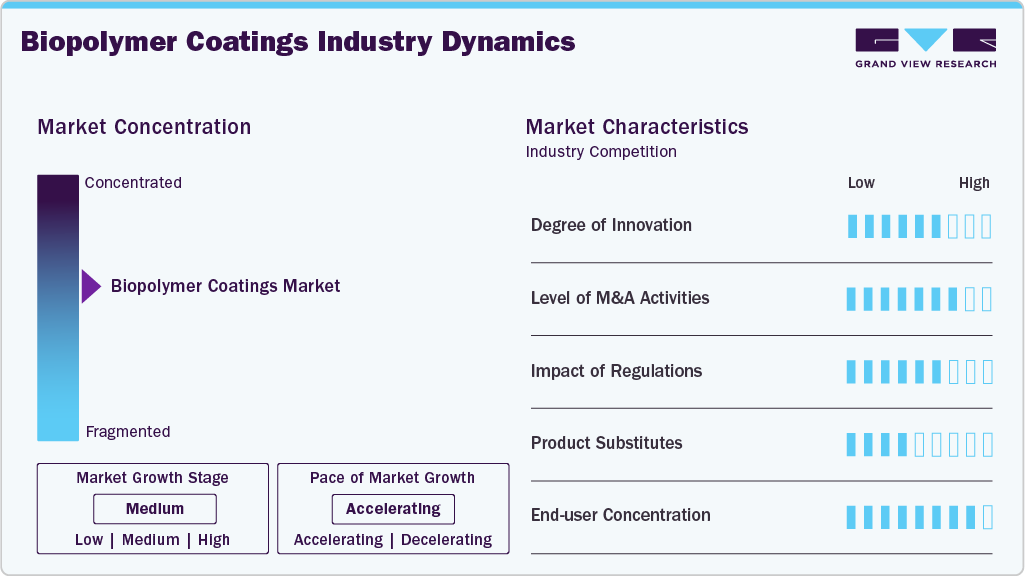
The biopolymer coatings market is fragmented, with established materials companies operating alongside specialized biopolymer developers and coating formulators. This structure exists because coating requirements vary considerably by performance needs, processing conditions, feedstock compatibility, and customer specifications, creating room for suppliers with specialized formulations and technical expertise.
 To learn more about this report, Download Free Sample Report
 The industry is characterized by intensive material development, customer-specific qualification, and close collaboration across the value chain. Commercial success requires consistent coating performance, reliable raw material quality, process compatibility, and regulatory compliance. These requirements encourage manufacturers to invest in formulation expertise, application testing, intellectual property, and partnerships with downstream customers to secure long-term commercial adoption.
Analyst Perspective
The biopolymer coatings market is progressing toward wider commercial adoption as performance reliability improves. Competitive positioning increasingly reflects formulation expertise, processing compatibility, and consistent quality. Cost competitiveness remains important against established conventional coatings. Closer collaboration between suppliers and manufacturers is improving commercial qualification. Continued improvements in production economics and material functionality are strengthening the market’s long-term commercial potential.
Product Insights
The polysaccharide-based segment dominated the market in 2025, accounting for 38.9% of total revenue. Its leading position reflects the broad availability of starch, cellulose, chitosan, alginate, and related renewable materials with strong film-forming characteristics. Their ability to provide oxygen and grease resistance, combined with established processing knowledge and accessible feedstock supply, encourages commercial utilization. Modification possibilities also allow manufacturers to tailor these materials for specific functional requirements.
The bio-based polyesters segment is projected to record the fastest growth, with a CAGR of 9.1% from 2026 to 2033. Increasing utilization of PLA, PHA, PBS, and related materials reflects their favorable mechanical properties, processability, and potential compatibility with existing converting operations. Their ability to deliver stronger moisture resistance than many naturally occurring polymers expands their suitability for demanding coating environments, encouraging manufacturers to develop higher-performance renewable formulations.
Technology Insights
The water-based segment led the market in 2025, accounting for 57.9% of total revenue. Water serves as an effective carrier for many naturally derived coating materials while reducing reliance on organic solvents during formulation and application. These systems also provide practical advantages through easier equipment cleaning, controlled viscosity, and compatibility with established coating lines. Increasing attention to workplace emissions and solvent handling further strengthens their commercial preference across high-volume manufacturing operations.
The hot melt segment is expected to grow at the fastest rate, with a CAGR of 8.2% from 2026 to 2033. Hot melt systems provide rapid solidification, high coating speeds, and limited drying requirements because they are applied in molten form without conventional liquid carriers. These characteristics can reduce the processing time and energy associated with solvent or water removal. Their suitability for continuous manufacturing encourages adoption where operational efficiency, strong adhesion, and rapid production throughput are important.
Substrate Insights
The paper and paperboard segment dominated the market, accounting for the largest revenue share of 46.6% in 2025. Paper surfaces often require additional protection because untreated fibers readily absorb moisture, oils, and other substances. Biopolymer coatings can create functional surface layers while preserving the lightweight characteristics of paper products. Strong consumption of coated fiber materials and established high-speed converting infrastructure, therefore generating substantial coating volumes, has reinforced the segment's revenue leadership.
The textiles segment is expected to grow at the fastest CAGR of 7.8% from 2026 to 2033. Biopolymer coatings are attracting interest for modifying fabric surfaces without substantially altering the underlying textile structure. Their use can introduce properties such as antimicrobial activity, controlled wettability, improved surface resistance, and functional ingredient delivery. Expansion of technical and performance textiles creates opportunities for specialized coating formulations that provide targeted functionality beyond the capabilities of untreated fabrics.
End Use Insights
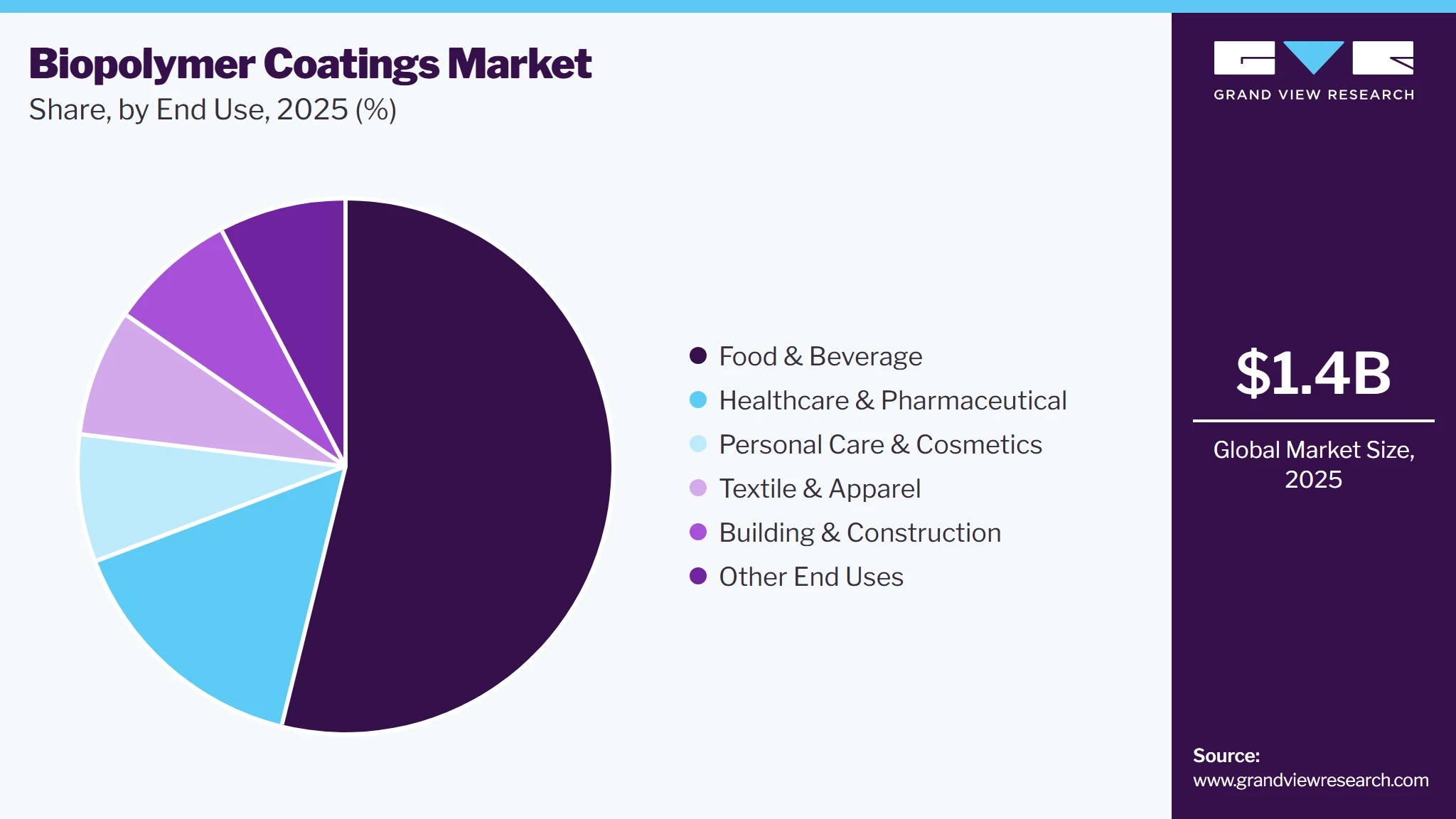
The food and beverage segment dominated the biopolymer coatings market in 2025, accounting for 49.6% of total revenue. High consumption reflects the need to protect packaged products against oxygen transfer, grease migration, moisture exposure, and quality deterioration. Coatings can provide these functions without adding thick protective layers, making them attractive for disposable and short lifecycle products. The growing emphasis on maintaining freshness while minimizing material use reinforces their commercial relevance in this industry.
 To learn more about this report, Download Free Sample Report
 The healthcare and pharmaceutical segment is expected to record the fastest growth, with a CAGR of 8.6% from 2026 to 2033. Growth reflects the increasing interest in biocompatible surface materials for pharmaceutical packaging, medical devices, wound care products, and controlled-delivery systems. Biopolymers can be engineered to interact safely with biological environments while carrying active compounds or controlling surface behavior, creating higher value applications where material functionality and safety requirements influence purchasing decisions.
Regional Insights
Asia Pacific held the largest share of the biopolymer coatings market in 2025, accounting for 33.0% of revenue. The region benefits from a substantial bio based polymer manufacturing base, expanding material availability, and established converting industries. Asia accounts for a significant portion of global bio-based polymer production capacity, strengthening access to coating feedstocks. Growing commercial use of renewable materials and increasing manufacturing capabilities reinforce the region’s leading revenue position.
 To learn more about this report, Download Free Sample Report
 The China biopolymer coatings market is growing due to the extensive manufacturing ecosystem and expanding domestic bio based materials industry. Government initiatives encourage the development of non-food biomass materials, biodegradable products, and associated processing technologies. Policies addressing plastic pollution and greener express delivery packaging are also strengthening downstream commercialization. China's ability to integrate material production with large-scale converting operations provides a favorable environment for translating biopolymer developments into commercially produced coating solutions.
North America Biopolymer Coatings Market Trends
The biopolymer coatings market in North America benefits from an established specialty chemicals industry, sophisticated coating formulation capabilities, and strong institutional interest in the commercialization of renewable materials. The region has extensive agricultural and forestry resources that can supply biological feedstocks for value-added material production. Well-developed testing, certification, and procurement frameworks also improve confidence in verified bio-based content, allowing coating suppliers to substantiate environmental claims and differentiate renewable formulations within mature industrial purchasing channels.
U.S. Biopolymer Coatings Market Trends
The biopolymer coatings market in the U.S. has direct institutional support through the USDA BioPreferred Program, which promotes the development and purchase of bio-based products. Federal purchasing requirements cover designated product categories, including paints, while third-party testing under ASTM D6866 verifies bio-based content. This creates a structured commercial pathway for suppliers seeking government procurement opportunities and provides recognized certification that helps buyers distinguish verified renewable products from unsupported environmental claims.
Europe Biopolymer Coatings Market Trends
The biopolymer coatings market in Europe is projected to grow at the fastest rate, with a CAGR of 7.7% from 2026 to 2033. Growth reflects increasingly stringent requirements surrounding packaging recyclability, material efficiency, and waste reduction. The EU Packaging and Packaging Waste Regulation introduces stronger design and recovery requirements while establishing provisions concerning bio based feedstocks and compostable materials. These regulatory changes encourage coating manufacturers and converters to evaluate material systems compatible with circular packaging objectives.
The Germany biopolymer coatings market is shaped by the country’s strong chemical engineering base, advanced materials research network, and established culture of resource-efficient manufacturing. Domestic producers possess significant expertise in polymer chemistry, surface treatment, and industrial process optimization, creating favorable conditions for the development of technically demanding renewable coatings. Close interaction between chemical companies, research institutions, equipment suppliers, and downstream manufacturers facilitates testing and qualification, helping promising formulations move from laboratory development toward industrial implementation.
Latin America Biopolymer Coatings Market Trends
The biopolymer coatings market in Latin America has considerable potential because of its extensive biological resource base and established agricultural processing industries. Sugarcane, starch crops, forestry resources, and agricultural residues provide diverse sources of renewable carbon that can be transformed into higher-value materials. This creates opportunities to connect existing biomass supply chains with local material production rather than relying entirely on imported feedstocks. Development remains uneven, however, as bioeconomy policy frameworks and commercialization capabilities differ considerably across countries.
Middle East Biopolymer Coatings Market Trends
The biopolymer coatings market in the Middle East and Africa is developing from a smaller commercial base, with adoption influenced by efforts to diversify manufacturing and reduce dependence on conventional resource-intensive industries. In the Middle East, investment in downstream chemicals and new material technologies provides infrastructure for introducing renewable formulations alongside established petrochemical capabilities. African markets offer longer-term potential through agricultural biomass availability, although fragmented processing infrastructure and limited local specialty material production constrain broader commercialization.
Key Biopolymer Coatings Company Insights
The two key dominant manufacturers in the biopolymer coatings market are BASF SE and NatureWorks LLC, with established biopolymer portfolios worldwide.
- BASF SE is a diversified chemical manufacturer with extensive expertise in polymers, performance materials, and coating technologies. Its biopolymer activities include the ecovio portfolio, developed for compostable and bio-based applications. The company focuses on functional barrier performance, processing compatibility, renewable material integration, and coating solutions for fiber-based packaging applications.
- NatureWorks LLC specializes in renewable polymer materials through its Ingeo biopolymer portfolio. The company develops polylactic acid materials for coating, packaging, films, fibers, and other applications. Within coatings, its activities focus on extrusion-coating grades for paper and paperboard, emphasizing adhesion, processing performance, heat-sealing capability, and utilization of renewable materials.
Key Biopolymer Coatings Companies
The following key companies have been profiled for the study on the biopolymer coatings market.
-
BASF SE
-
NatureWorks LLC
-
Novamont S.p.A.
-
TotalEnergies Corbion B.V.
-
Kuraray Co., Ltd.
-
Eastman Chemical Company
-
EcoSynthetix Inc.
-
Arkema S.A.
-
Solenis LLC
-
Michelman, Inc.
Company Categorization
Operating Strategies
Competitive Edge
Weaknesses
Mature Players: BASF SE, NatureWorks LLC, Novamont S.p.A., TotalEnergies Corbion B.V., Kuraray Co., Ltd., Eastman Chemical Company
- Major players emphasize dedicated biopolymer platforms such as ecovio, Ingeo, MATER-BI, Luminy PLA, PLANTIC, and Solus. Their strategies combine material development with application-specific grades for coating and lamination.
- Commercial activity centers on improving barrier performance, processing compatibility, renewable content, and end-of-life characteristics. Collaboration with converters and packaging manufacturers supports qualification of materials on established industrial coating equipment.
- These manufacturers benefit from established polymer science capabilities, commercial manufacturing infrastructure, application laboratories, and recognizable material platforms. Their technical resources enable optimization of coating grades for demanding processing conditions.
- Broad geographic operations and relationships with downstream manufacturers strengthen commercialization capabilities. Several companies also control important polymer technologies, enabling closer management of resin characteristics, formulation development, quality consistency, and application performance.
- Bio-based coating materials from major manufacturers can face cost pressure against established petroleum-derived coating systems. Specialized processing requirements and performance tradeoffs may also restrict substitution in applications demanding strong moisture barriers.
- Large organizations must address diverse customer specifications, certification requirements, and regional end-of-life infrastructure. Portfolio complexity can lengthen qualification cycles, while renewable feedstock economics may influence competitiveness across applications and markets.
Emerging Players: EcoSynthetix Inc., Arkema S.A., Solenis LLC, Michelman, Inc.
- These participants target specialized coating functions rather than relying primarily on large biopolymer resin platforms. EcoSynthetix emphasizes renewable biolatex binders, while Solenis and Michelman develop bio-based barrier coating formulations for fiber packaging.
- Arkema participates through renewable coating resins and formulation technologies. Their strategies emphasize application-focused innovation, customer trials, functional performance, and integration with existing coating processes to accelerate commercial qualification.
- Specialized formulation expertise allows these companies to address targeted requirements such as grease resistance, moisture protection, adhesion, printability, and renewable content. Their focused development approach supports customization for specific coating environments.
- EcoSynthetix brings renewable binder expertise, while Solenis and Michelman possess strong paper coating knowledge. Arkema contributes advanced resin chemistry, providing differentiated capabilities across waterborne and bio-based coating formulation technologies.
- These companies generally have narrower direct biopolymer portfolios than manufacturers operating dedicated PLA, starch-based, or compostable polymer platforms. Their market position can therefore concentrate on selected coating technologies or applications.
- Dependence on externally sourced biopolymers or renewable raw materials can reduce control over feedstock economics. Specialized formulations also require extensive substrate testing and customer qualification, which can slow adoption across standardized high-volume applications.
Recent Developments
- April 2026: Michelman introduced Nuvita Life 4002 and Nuvita Life 4605, bio based barrier coatings developed for fiber based food packaging. The coatings provide oil, grease, moisture, mineral oil, and heat sealing performance. Their fully bio based dry film composition supports recyclable and compostable packaging applications requiring functional protective surfaces.
- March 2026: Paramelt and UPM introduced a paper-based food packaging concept incorporating Aquavate Bio SB 2383, a water based coating containing bio based PHA. The coating provides grease resistance and heat sealing functionality while supporting compostability. The development expands the commercial application of biopolymer coatings within recyclable fiber-based food packaging formats.
Biopolymer Coatings Market Report Scope
Report Attribute
Details
Market Definition
The biopolymer coatings market comprises protective and functional coating materials formulated primarily from renewable biological polymers and applied across various substrates to enhance surface performance.
Market size in 2025
USD 1.4 billion
Estimated market size in 2026
USD 1.5 billion
Revenue forecast in 2033
USD 2.5 billion
Growth rate
CAGR of 7.5% from 2026 to 2033
Base year for estimation
2025
Historical data
2021 - 2024
Forecast period
2026 - 2033
Quantitative units
Revenue in USD billion and CAGR from 2026 to 2033
Report coverage
Revenue forecast, company ranking, competitive landscape, growth factors, and trends
Segments covered
Product, technology, substrate, end use, region
Regional scope
North America; Europe; Asia Pacific; Latin America; MEA
Country scope
U.S.; Canada; Mexico; Germany; UK; France; Italy; Spain; China; India; Japan; South Korea; Brazil; Argentina; Saudi Arabia; South Africa
Key companies profiled
BASF SE; NatureWorks LLC; Novamont S.p.A.; TotalEnergies Corbion B.V.; Kuraray Co., Ltd.; Eastman Chemical Company; EcoSynthetix Inc.; Arkema S.A.; Solenis LLC; Michelman, Inc.
Customization scope
Free report customization (equivalent up to 8 analysts’ working days) with purchase. Addition or alteration to country, regional & segment scope.
Pricing and purchase options
Avail customized purchase options to meet your exact research needs. Explore purchase options
Global Biopolymer Coatings Market Report Segmentation
This report forecasts revenue growth at global, regional, and country levels and provides an analysis of the latest industry trends in each of the sub-segments from 2021 to 2033. For this study, Grand View Research has segmented the global biopolymer coatings market report based on product, technology, substrate, end use, and region.
-
Product Outlook (Revenue, USD billion, 2021 - 2033)
-
Polysaccharide-based
-
Protein-based
-
Lipid-based
-
Bio-based Polyesters
-
Other Products
-
-
Technology Outlook (Revenue, USD billion, 2021 - 2033)
-
Water-based
-
Solvent-based
-
Hot-melt
-
Other Technologies
-
-
Substrate Outlook (Revenue, USD billion, 2021 - 2033)
-
Paper & Paperboard
-
Plastics
-
Metal
-
Wood
-
Textiles
-
Other Substrates
-
-
End Use Outlook (Revenue, USD billion, 2021 - 2033)
-
Food & Beverage
-
Healthcare & Pharmaceutical
-
Personal Care & Cosmetics
-
Textile & Apparel
-
Building & Construction
-
Other End Uses
-
-
Regional Outlook (Revenue, USD billion, 2021 - 2033)
-
North America
-
U.S.
-
Canada
-
Mexico
-
-
Europe
-
Germany
-
UK
-
Italy
-
Spain
-
France
-
-
Asia Pacific
-
China
-
India
-
Japan
-
South Korea
-
-
Latin America
-
Brazil
-
Argentina
-
-
Middle East & Africa
-
Saudi Arabia
-
South Africa
-
-
Research Methodology
The biopolymer coatings marketfigures in this report are based on a proven research process that combines executive interviews with secondary research from proprietary databases, company filings, and recognized regulatory and institutional sources. Market size is built through value-chain sizing-reconciling supply-side and demand-side estimates-and triangulated with bottom-up and top-down approaches. Every estimate passes multiple levels of expert validation before publication, with eachbiopolymer coatings segment quantified using the revenue-capture definitions in the table below.
Segment Definition
Segment -Product
Revenue Capture Definition
Polysaccharide-based
Revenue is captured from sales of coatings primarily formulated with starch, cellulose, chitosan, alginate, and related polysaccharides for barrier, protective, and functional applications.
Protein-based
Revenue is generated from sales of coatings primarily formulated with gelatin, casein, soy, whey, zein, and related protein-based polymers for protective and functional applications.
Lipid-based
Revenue is captured from sales of coatings based primarily on renewable lipids, waxes, and fatty acids used for moisture, water, grease, and surface protection.
Bio-based Polyesters
Revenue is generated from sales of PLA, PHA, PBS, and related bio-based polyester coatings used for extrusion coating, lamination, barrier, and protective applications.
Other Products
Revenue includes sales of specialty renewable polymers and hybrid bio-derived coating systems falling outside polysaccharide, protein, lipid, and bio-based polyester categories.
Segment - Technology
Revenue Capture Definition
Water-based
Revenue is captured from sales of aqueous biopolymer coating formulations applied to substrates for barrier, protective, sealing, and other functional surface properties.
Solvent-based
Revenue is generated from sales of biopolymer coatings using organic solvents as the primary carrier for film formation, adhesion, protection, and surface modification.
Hot-melt
Revenue is captured from sales of thermally processable biopolymer coatings supplied for molten application, extrusion coating, sealing, adhesion, and barrier functions.
Other Technologies
Revenue includes sales of biopolymer coatings using powder, reactive, radiation-curable, specialized deposition, and other technologies outside the primary technology categories.
Segment - Substrate
Revenue Capture Definition
Paper & Paperboard
Revenue is captured from biopolymer coatings sold for paper, paperboard, and molded fiber applications requiring grease, moisture, oxygen, sealing, or protective performance.
Plastics
Revenue is generated from biopolymer coatings applied to plastic films, sheets, containers, and components for barrier enhancement, adhesion, protection, printability, and surface modification.
Metal
Revenue is captured from biopolymer coatings applied to metal surfaces for corrosion protection, adhesion, barrier performance, surface protection, and other functional requirements.
Wood
Revenue is generated from biopolymer coatings used on wood and wood-derived surfaces for sealing, moisture protection, abrasion resistance, and functional surface treatment.
Textiles
Revenue is captured from biopolymer coatings applied to fabrics, fibers, nonwovens, and technical textiles for protection, moisture management, durability, and specialized functionality.
Other Substrates
Revenue includes biopolymer coatings sold for glass, ceramics, composites, biomedical materials, agricultural surfaces, and other specialty substrates requiring functional surface treatment.
Segment - End Use
Revenue Capture Definition
Food & Beverage
Revenue is captured from biopolymer coatings used in food and beverage packaging and contact applications for barrier, sealing, freshness, grease resistance, and protection.
Healthcare & Pharmaceutical
Revenue is generated from biopolymer coatings used in pharmaceutical packaging, medical devices, wound care, and drug delivery applications requiring protection, biocompatibility, or controlled release.
Personal Care & Cosmetics
Revenue is captured from biopolymer coatings used in cosmetic packaging, delivery systems, encapsulation, and specialty surfaces for protection, barrier performance, and functional modification.
Textile & Apparel
Revenue is generated from biopolymer coatings used in apparel, footwear, home textiles, nonwovens, and technical textiles for protection, durability, comfort, and functional performance.
Building & Construction
Revenue is captured from biopolymer coatings used on construction materials and building surfaces for moisture protection, sealing, adhesion, durability, and protective treatment.
Other End Uses
Revenue includes biopolymer coatings consumed in automotive, agriculture, electronics, consumer products, and other applications requiring renewable protective or functional surface treatments.
Estimation Model
Layer Name
Key Question
Content
Addressable Substrate Base Layer
What forms the demand base?
Identify global production and consumption volumes of materials suitable for biopolymer coating, including paper and paperboard, plastics, metals, wood, textiles, and specialty substrates. Production volumes are mapped across major manufacturing regions and relevant end-use industries. This layer establishes the physical substrate base on which functional coating materials can be commercially applied.
Biopolymer Coating Penetration Layer
Where are biopolymer coatings adopted?
Estimate the proportion of addressable substrate volume receiving biopolymer coatings rather than conventional petroleum-derived or uncoated surface treatments. Penetration is assessed according to application requirements, coating technology, regulatory suitability, processing compatibility, barrier performance, and commercial adoption across food and beverage, healthcare, personal care, textiles, construction, and other end uses.
Coating Consumption Intensity Layer
How much biopolymer coating is consumed?
Analyze average coating consumption per unit of treated substrate using coat weight, coated surface area, layer thickness, solids content, application efficiency, and processing losses. Consumption intensity is differentiated across polysaccharide-based, protein-based, lipid-based, and bio-based polyester systems, as well as water-based, solvent-based, hot-melt, and other coating technologies.
Price and Revenue Layer
How is market revenue quantified?
Convert estimated biopolymer coating consumption into market value using average realized prices for relevant coating resins, binders, compounds, and formulated systems. Pricing is differentiated by polymer chemistry, functional performance, technology, region, and application requirements. Revenue captures commercial sales of qualifying biopolymer coating materials used to create protective, barrier, sealing, adhesion, and other functional surface layers.
Delivered Customizations
This report has been delivered with the following In-depth customizations:
Client Request
Customization Delivered
Value Adds
Cross-Segmentation
Customized cross-analysis linking product types with technology, substrate, end use, and geography. The assessment maps polysaccharide, protein, lipid, and bio-based polyester coatings against water-based, solvent-based, and hot-melt systems, while identifying their relevance across paper and paperboard, plastics, textiles, healthcare, food and beverage, and other applications.
Enables identification of commercially significant segment combinations rather than evaluating each category independently. The analysis helps determine where specific biopolymer chemistries align with coating technologies, substrate requirements, and end-use performance needs, supporting more precise market targeting and portfolio planning.
Competitive Benchmarking
Comparative assessment of key biopolymer coating companies based on polymer chemistry, coating portfolio, technology positioning, substrate focus, application coverage, geographic presence, sustainability attributes, intellectual property, partnerships, and recent product developments. Benchmarking can distinguish diversified material companies from specialized bio-based coating formulators and technology-focused participants.
Provides clearer visibility into competitive positioning and differentiation across the market. The assessment supports competitor tracking, partnership screening, portfolio gap identification, and evaluation of company strengths across renewable content, barrier functionality, processing compatibility, application specialization, and commercialization strategies.
Opportunity Assessment
Detailed evaluation of opportunities across high-growth coating chemistries, application technologies, substrates, end uses, and regional markets. The analysis examines areas such as bio-based polyester coatings, functional barrier systems, fiber-based packaging, pharmaceutical applications, textile surface treatments, and specialized coatings offering antimicrobial, controlled-release, grease-resistant, or moisture-management properties.
Helps identify attractive areas for product development, market entry, application expansion, and strategic investment. Opportunity mapping highlights where regulatory requirements, material substitution, functional performance needs, and evolving end-user specifications create favorable conditions for differentiated biopolymer coating solutions and higher-value applications.
About the Author(s)
Paints, Coatings & Printing Inks Research Team
Bulk Chemicals · Paints, Coatings & Printing InksThis report was authored by the paints, coatings & printing inks research team at Grand View Research - comprising two research analysts, one senior research analyst, and one industry expert - with specialized expertise in the paints, coatings & printing inks segment of the bulk chemicals industry. All findings are based on proprietary bulk chemicals databases, executive interviews, and regulatory analysis, subject to internal peer review prior to publication.
Last Updated:
Speak to Analyst

Customize this report to your needs - add regions, segments, or data points, with 20% free customization.
Or view our licence options:


ISO 9001:2015 & 27001:2022 Certified
We are GDPR and CCPA compliant! Your transaction & personal information is safe and secure. For more details, please read our privacy policy.


