
- Home
- »
- Plastics, Polymers & Resins
- »
-
Bioprocess Containers Market Size, Share Report 2026-2033GVR Report cover
![Bioprocess Containers Market (2025 - 2033)Report]()
Bioprocess Containers Market (2025 - 2033)
Size, Share & Trends Analysis Report By Product (2D Bioprocess Containers, 3D Bioprocess Containers), By Application (Upstream Process, Downstream Process), By End Use, By Region, And Segment Forecasts
Market Size, 2024
$4.2BMarket Estimate, 2026
$5.2BMarket Forecast, 2033
$26.2BCAGR, 2025–2033
22.6%Bioprocess Containers Market Summary
The global bioprocess containers market size was valued at USD 4.2 billion in 2024 and is projected to grow from USD 5.2 billion in 2026 to USD 26.2 billion by 2033, at a CAGR of 22.6% from 2025 to 2033. Asia Pacific dominated the market, accounting for a revenue share of 36.6% in 2024. The industry is driven by the increasing demand for single-use technologies in biopharmaceutical manufacturing and the need for cost-effective, scalable, and contamination-free production processes.
Key Market Trends & Insights
- By product type: 2d bioprocess containers segment held the largest market share in 2024.
- By application: Upstream processes segment held the largest market share in 2024.
- By end use: Pharmaceutical & biopharmaceutical segment held the largest market share in 2024.
Regional Highlights
- Largest regional market: Asia Pacific (36.6% revenue share, 2024)
- By country: China held the largest market share in 2024
Market Size & Forecast
- Market size in 2024: USD 4.2 Billion
- Estimated market size in 2026: USD 5.2 Billion
- Projected market size by 2033: USD 26.2 Billion
- CAGR (2026-2033): 22.6%
Three ways to get this report
Buy it, customize it, or ask a question.Ask an Analyst
A direct answer, usually in 1 working day
- AccessReport author, directly
- Reply timeWithin 1 working day
- No sales callDirect answer only
- FormatEmail reply
- CostFree, no cost
Get the Full Report
What the study covers
- FormatsPDF · Excel · Dashboard
- Timeline2025–2033 annual, 2024 base
- Coverage20+ countries, 5 regions
- Companies10+ key players profiled
Customize the Report
20% free customization
- IncludeCountries, segments, points
- TailorTo your product definition
- ExtendDeeper competitor detail
- OrA fully bespoke study
- Turnaround5–10 working days
Rising biologics production and flexible facility requirements further fuel market growth. These containers, often made from polymer films, are increasingly replacing traditional stainless-steel systems due to their flexibility, lower capital costs, and reduced risk of cross-contamination. As biopharmaceutical companies scale up production to meet the rising demand for monoclonal antibodies, vaccines, and cell/gene therapies, especially post-COVID-19, single-use systems such as bioprocess containers offer a faster and more cost-effective solution for both upstream and downstream processes. For instance, companies such as Thermo Fisher Scientific Inc. and Sartorius AG are expanding their portfolios of disposable solutions to cater to this demand.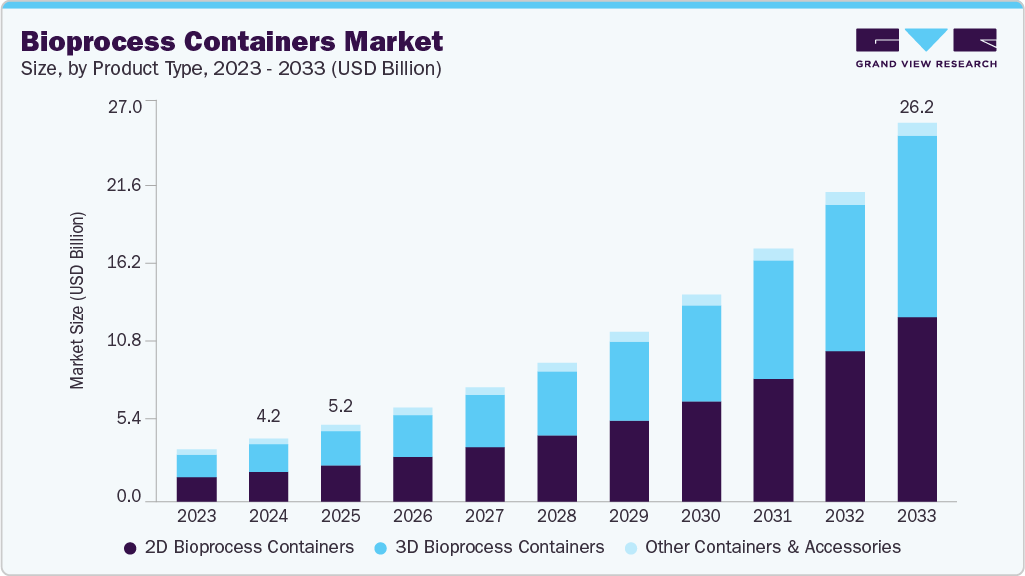
Another critical factor is the surge in contract manufacturing and research organizations (CMOs and CROs), which rely heavily on scalable and disposable solutions to serve multiple clients without lengthy sterilization procedures. These organizations benefit from the modularity and ease of changeover that bioprocess containers provide, allowing them to rapidly adapt to different biologics projects. This trend is particularly strong in emerging economies such as India, South Korea, and Brazil, where CMOs are investing in advanced single-use bioprocessing infrastructure to attract global biopharma clients.
The market is also being driven by stringent regulatory requirements for aseptic processing and contamination control. Regulatory agencies such as the FDA and EMA emphasize the need for validated sterile environments in biologics production. Bioprocess containers help ensure compliance by offering pre-sterilized, disposable systems that minimize the risk of contamination and reduce the burden of cleaning validation.
Market Dynamics
The global bioprocess containers market is experiencing rapid growth due to the increasing adoption of single-use technologies in biopharmaceutical manufacturing processes. Bioprocess containers are widely used for media preparation, buffer storage, cell culture handling, fluid transfer, and product transportation across upstream and downstream bioprocessing applications. The growing demand for biologics, biosimilars, vaccines, monoclonal antibodies, and cell & gene therapies is significantly increasing the need for sterile, flexible, and contamination-free processing systems. Compared to traditional stainless-steel systems, single-use bioprocess containers offer several operational advantages including lower capital investment, reduced cleaning requirements, shorter turnaround times, and improved manufacturing flexibility, making them highly preferred by pharmaceutical and biotechnology companies globally.
Another major market driver is the rapid expansion of contract manufacturing organizations (CMOs), contract development and manufacturing organizations (CDMOs), and biopharmaceutical research activities worldwide. These organizations increasingly rely on disposable bioprocessing systems to support multi-product manufacturing environments while minimizing contamination risks and improving operational efficiency. The growing focus on personalized medicine and small-batch biologics production is also accelerating demand for modular and scalable bioprocess container systems. In addition, stringent regulatory requirements related to aseptic processing, contamination control, and sterile manufacturing are encouraging the adoption of pre-sterilized disposable bioprocess containers across pharmaceutical production facilities. Technological advancements in multilayer polymer films, barrier materials, integrated sensors, and gamma-irradiated assemblies are further supporting market growth by improving product safety, durability, and compatibility with advanced bioprocessing applications.
One of the major restraints affecting the global bioprocess containers market is the growing concern regarding extractables, leachables, and material compatibility associated with single-use bioprocessing systems. Since bioprocess containers are commonly manufactured using polymer-based materials, pharmaceutical companies must conduct extensive testing and validation to ensure that packaging materials do not negatively impact sensitive biologic products. These validation procedures can increase operational complexity, regulatory burden, and overall production costs. Additionally, concerns related to plastic waste generation and disposal of single-use systems are creating environmental challenges for biopharmaceutical manufacturers, particularly as sustainability expectations continue to increase globally.
A major challenge in the bioprocess containers market is balancing strict sterility and contamination control requirements with increasing demand for sustainable and cost-efficient manufacturing solutions. Biopharmaceutical manufacturers require highly specialized bioprocess containers that can maintain product integrity, chemical compatibility, temperature resistance, and sterile conditions throughout complex manufacturing and transportation processes. Developing advanced single-use systems capable of handling high-volume biologics production, cryogenic applications, and evolving cell & gene therapy workflows requires substantial investments in material science, product engineering, and regulatory compliance.
Market Concentration & Characteristics
The market is characterized by a high degree of specialization and innovation, driven by the needs of the biopharmaceutical industry for scalable, flexible, and contamination-free solutions. The market is dominated by a few global players such as Thermo Fisher Scientific Inc., Sartorius AG, Saint-Gobain, and Merck, who maintain strong competitive advantages through technological expertise, integrated product portfolios, and long-term partnerships with biopharma companies. However, the industry also sees the entry of niche players offering tailored and cost-effective alternatives, especially in regional markets.
Customization and scalability are key characteristics of the industry, as bioprocess containers are used across a range of applications-from early-stage drug development to large-scale commercial production. The demand for flexible, modular, and single-use systems allows manufacturers to offer configurable solutions based on volume, connectivity, and compatibility with bioreactors and mixers. This flexibility supports the growing trend toward personalized medicine, small-batch production, and decentralized manufacturing models.
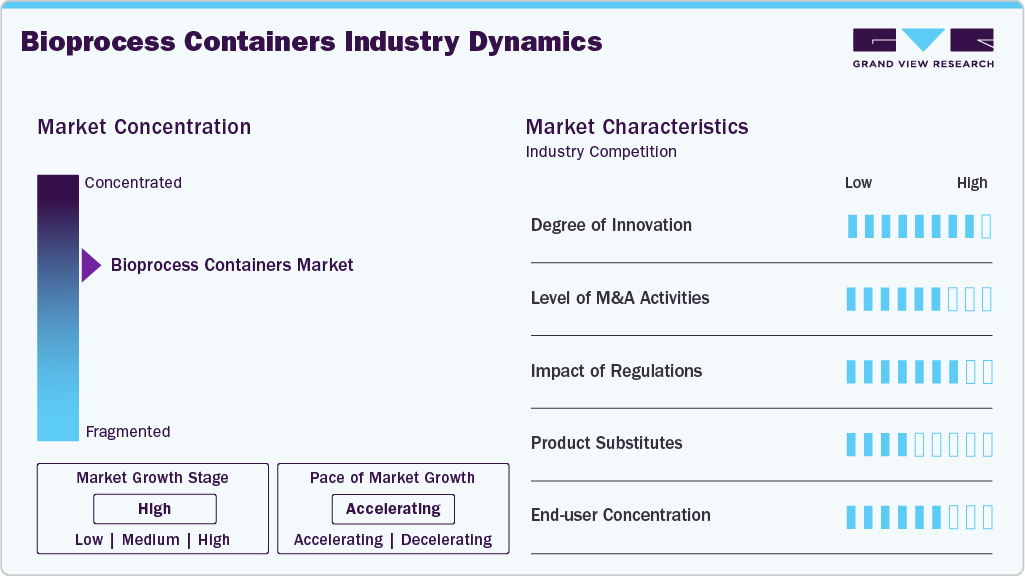
The market is influenced by global supply chain dynamics and raw material availability, particularly for high-grade polymer films and pharmaceutical-grade connectors. While outsourcing and contract manufacturing create opportunities, they also expose the market to logistical risks, such as those seen during the COVID-19 pandemic. Therefore, many major companies are investing in vertical integration and regional production hubs to enhance resilience and reduce lead times.
Product Insights
The 2D bioprocess containers segment recorded the largest revenue share of over 47.0% in 2024. 2D bioprocess containers are flat, single-use bags typically used for small-volume applications such as sampling, storage, mixing, and fluid transfer. These containers are made from multi-layer polymer films that offer chemical resistance, sterilizability, and compatibility with a wide range of biopharmaceutical substances. They are often integrated with tubing and connectors for ease of use in upstream and downstream processes.
The 3D bioprocess containers segment is expected to grow at the fastest CAGR of 23.6% during the forecast period. 3D bioprocess containers are cube-shaped or rectangular containers designed for larger volume applications, typically ranging from 50 liters to over 2,000 liters. These are used in bulk media and buffer preparation, storage, and transport. They are ideal for bioreactor feed, harvest collection, and intermediate product handling in biopharmaceutical production facilities. The rise in large-scale biologics and biosimilar production is significantly propelling the demand for 3D bioprocess containers.
Application Insights
The upstream processes segment recorded the largest revenue share of over 57.0% in 2024 and is expected to grow at the fastest CAGR of 23.3% during the forecast period. Upstream processes in the biopharmaceutical production workflow involve the initial stages of product development, including cell culture, fermentation, and media preparation. The demand for bioprocess containers in upstream processes is driven by the increasing adoption of single-use technologies in biologics manufacturing, particularly for monoclonal antibodies (mAbs) and cell and gene therapies. Furthermore, the growing trend of modular biomanufacturing and the need to accelerate time-to-market for therapeutics support greater use of disposable systems in upstream applications. The shift toward smaller batch sizes and personalized medicine also requires scalable and flexible upstream solutions.
Downstream processes involve the purification and recovery of biopharmaceutical products after fermentation or cell culture. This stage includes clarification, chromatography, and filtration. Bioprocess containers are used to store buffers, intermediates, and final drug substances under sterile and contamination-free conditions. These containers enhance operational efficiency by reducing manual handling and ensuring consistent product quality. The key driver for bioprocess container use in downstream processing is the growing complexity of biologic drug purification and the increasing need for cost-effective, closed-system solutions to mitigate contamination risks.
End Use Insights
The pharmaceutical & biopharmaceutical companies segment recorded the largest market share of over 60.0% in 2024. Pharmaceutical and biopharmaceutical companies are the largest consumers of bioprocess containers, using them in upstream and downstream bioprocessing activities such as media preparation, fermentation, harvest, and buffer storage. These companies rely heavily on single-use technologies to improve flexibility, reduce cross-contamination risks, and enable faster turnaround times between production cycles. The primary driver is the growing demand for biologics, including monoclonal antibodies, vaccines, and cell & gene therapies. Additionally, increasing the pipeline of biosimilars and personalized medicine, particularly in oncology and autoimmune diseases, is propelling the need for scalable, sterile, and disposable processing systems.
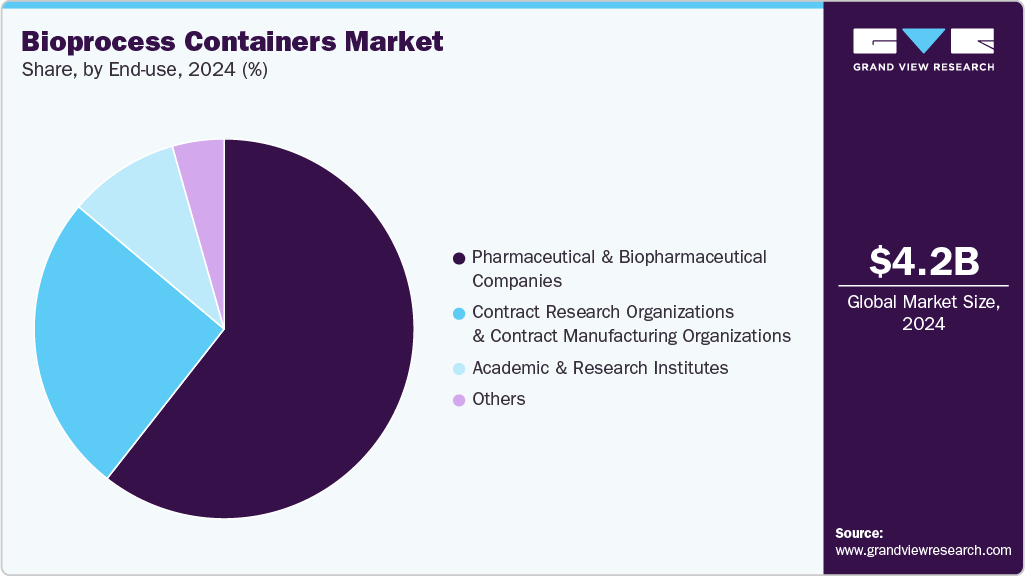
The CROs and CMOs segment is projected to grow at the fastest CAGR of 23.3% during the forecast period. CROs and CMOs utilize bioprocess containers for flexible and rapid deployment of biomanufacturing services across various scales. These organizations handle R&D, clinical trials, and manufacturing for multiple clients, making modular, single-use systems ideal for meeting diverse and dynamic client needs. The outsourcing trend in the pharmaceutical and biotech industries is a major driver. Companies seek to reduce in-house infrastructure costs and accelerate development timelines by partnering with CROs/CMOs. This outsourcing culture, combined with increased biologics development by small to mid-sized firms, fuels demand for disposable bioprocessing solutions to support multi-product and short-run production batches.
Regional Insights
North America bioprocess containers market is driven by strong biopharmaceutical R&D and high adoption of single-use technologies. The U.S. is a key contributor, with major biotech hubs fostering innovation in cell and gene therapies, monoclonal antibodies, and mRNA vaccines. The FDA’s supportive regulatory framework accelerates bioprocess container adoption, while increasing investments in pandemic preparedness sustain demand. Additionally, Canada’s growing biomanufacturing sector, supported by government initiatives such as the Biomanufacturing Strategy, further strengthens the region’s market position.
Asia Pacific Bioprocess Containers Market Trends
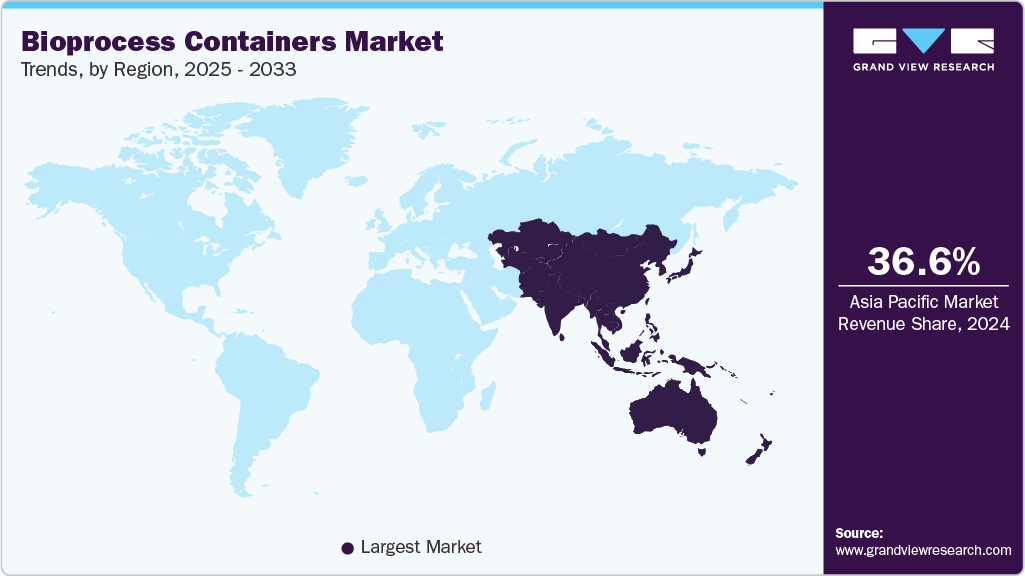
The bioprocess containers market in Asia Pacific dominated and accounted for the largest revenue share of over 36.0% in 2024 and is expected to grow at the fastest CAGR of 23.3% over the forecast period. This positive outlook is due to increasing biopharmaceutical production, government investments in healthcare infrastructure, and rising demand for biologics and biosimilars. Countries such as China, India, and South Korea are expanding their biomanufacturing capabilities, supported by favorable policies and growing contract manufacturing organizations (CMOs). For example, China’s "Made in China 2025" initiative promotes advanced biopharmaceutical manufacturing, while India’s thriving vaccine industry (e.g., Serum Institute, Biocon) fuels demand for single-use bioprocess containers. Additionally, the region’s cost advantages attract global biopharma companies to outsource production, further boosting market growth.
Europe Bioprocess Containers Market Trends
The bioprocess containers market in Europe is supported by a robust biopharmaceutical industry, stringent regulatory standards, and increasing focus on personalized medicine. Countries such as Germany, the UK, and Switzerland are leaders in biologics production, with companies such as Roche, Novartis, and Lonza driving demand for advanced single-use systems. The EU’s emphasis on reducing cross-contamination risks in biomanufacturing favors disposable bioprocess containers. Additionally, initiatives such as the European Commission’s Pharmaceutical Strategy promote domestic production resilience, further boosting market growth. The rise of cell and gene therapies in the region (e.g., CAR-T cell manufacturing) also contributes to the increasing adoption of bioprocess containers.
Key Bioprocess Containers Companies Insights
Key players operating in the bioprocess containers market are undertaking various initiatives to strengthen their presence and increase the reach of their products and services. Strategies such as expansion activities and partnerships are key in propelling the market growth.
Key Bioprocess Containers Companies:
The following are the leading companies in the bioprocess containers market. These companies collectively hold the largest market share and dictate industry trends.
- Thermo Fisher Scientific Inc.
- Merck
- Saint-Gobain
- ALLpaQ PACKAGING GROUP
- Parker Hannifin Corp
- Kiefel
- Sartorius AG
- BioPharma Dynamics Ltd
- Shandong Huazhilin Pharmaceutical Technology Co. ,Ltd.
- System-c Bioprocess
- CellBios
- ESI Ultrapure
- Entegris
- Liquidyne Process Technologies, Inc.
- Vonco Products, LLC
- 3CON Anlagenbau GmbH
Competitive Benchmarking
Operating Strategies
Competitive Edge
Weakness
Mature Players: Thermo Fisher Scientific Inc., Sartorius AG, Merck, Saint-Gobain, Parker Hannifin Corp
- Mature companies focus heavily on expanding single-use bioprocessing portfolios for biologics, vaccines, biosimilars, and cell & gene therapy manufacturing.
- Significant investments are being made in advanced polymer films, gamma-sterilized assemblies, integrated sensor technologies, and scalable disposable systems.
- Established players benefit from strong regulatory expertise, extensive biopharmaceutical customer relationships, and advanced material science capabilities.
- Large-scale manufacturing infrastructure and integrated product portfolios support reliable supply and comprehensive bioprocessing solutions.
- High R&D investments, validation requirements, and regulatory compliance costs can increase operational expenses.
- Large organizations may face slower adaptability to rapidly evolving biologics manufacturing technologies and changing sustainability expectations.
Emerging Players: ALLpaQ PACKAGING GROUP, Vonco Products, LLC, Liquidyne Process Technologies, Inc., BioPharma Dynamics Ltd, Entegris
- Emerging companies focus on customized single-use assemblies, flexible manufacturing capabilities, and niche bioprocessing applications.
- Many players are investing in specialized sterile packaging systems, advanced barrier materials, and customer-specific bioprocess solutions.
- Emerging players are generally more agile in responding to evolving bioprocessing requirements and specialized biologics applications.
- Strong focus on customization, technical flexibility, and niche innovation helps create differentiation in competitive markets.
- Smaller manufacturing scale and limited global reach may reduce competitiveness against established multinational suppliers.
- High certification costs, raw material dependency, and supply chain vulnerabilities can impact profitability and scalability.
Recent Developments
-
In November 2024, Sartorius AG, a biopharmaceutical industry partner, opened a new Center for Bioprocess Innovation in Marlborough, Massachusetts, designed to encourage collaboration and learning with customers and innovation partners.
-
In May 2022, ILC Dover launched its liquid single-use bioprocessing bags, designed for sterile liquid handling in the biotherapeutics and cell and gene therapy markets. These bags are highly configurable with various sizes, ports, and components to safely store and transfer buffers, media, and bulk cGMP products. Constructed from medical-grade Renolit 9101 film, which has low gas permeability and minimal extractables and leachables, the bags meet stringent BPOG, ISO, and USP standards. This launch expands ILC Dover’s comprehensive line of single-use solutions aimed at improving efficiency, sterility, and safety in biopharmaceutical manufacturing processes.
Bioprocess Containers Market Report Scope
Report Attribute
Details
Market size in 2024
USD 4.2 billion
Estimated Market size in 2026
USD 5.2 billion
Projected Market size by 2033
USD 26.2 billion
Growth rate
CAGR of 22.6% from 2025 to 2033
Historical data
2021 - 2023
Forecast period
2025 - 2033
Quantitative units
Revenue in USD million/billion, and CAGR from 2025 to 2033
Report coverage
Revenue forecast, competitive landscape, growth factors, and trends
Segments covered
Product, application, end use, region
States scope
North America; Europe; Asia Pacific; Latin America; Middle East & Africa
Country scope
U.S.; Canada; Mexico; Germany; France; UK; Italy; Spain; China; India; Japan; Australia; South Korea; Brazil; Argentina; South Africa; Saudi Arabia; UAE
Key companies profiled
Thermo Fisher Scientific Inc.; Merck; Saint-Gobain; ALLpaQ PACKAGING GROUP; Parker Hannifin Corp; Kiefel; Sartorius AG; BioPharma Dynamics Ltd; Shandong Huazhilin Pharmaceutical Technology Co., Ltd.; System-c Bioprocess; CellBios; ESI Ultrapure; Entegris; Liquidyne Process Technologies, Inc.; Vonco Products, LLC; 3CON Anlagenbau GmbH
Customization scope
Free report customization (equivalent up to 8 analyst’s working days) with purchase. Addition or alteration to country, regional, and segment scope.
Pricing and purchase options
Avail customized purchase options to meet your exact research needs. Explore purchase options
Global Bioprocess Containers Market Report Segmentation
This report forecasts revenue growth at the global, regional, and country levels and provides an analysis of the latest industry trends in each of the sub-segments from 2021 to 2033. For this study, Grand View Research has segmented the global bioprocess containers market report based on product, application, end use, and region:

-
Product Outlook (Revenue, USD Million, 2021 - 2033)
-
2D Bioprocess Containers
-
3D Bioprocess Containers
-
Other Containers & Accessories
-
-
Application Outlook (Revenue, USD Million, 2021 - 2033)
-
Upstream Processes
-
Downstream Processes
-
Process Developments
-
-
End Use Outlook (Revenue, USD Million, 2021 - 2033)
-
Pharmaceutical & Biopharmaceutical Companies
-
Contract Research Organizations & Contract Manufacturing Organizations
-
Academic & Research Institutes
-
Others
-
-
Region Outlook (Revenue, USD Million, 2021 - 2033)
-
North America
-
U.S.
-
Canada
-
Mexico
-
-
Europe
-
Germany
-
France
-
UK
-
Italy
-
Spain
-
-
Asia Pacific
-
China
-
India
-
Japan
-
Australia
-
South Korea
-
-
Latin America
-
Brazil
-
Argentina
-
-
Middle East & Africa
-
South Africa
-
Saudi Arabia
-
UAE
-
Delivered Customizations
This report has been delivered with the following In-depth customizations
Client Request
Customization Delivered
Value Adds
Regional Segmentation
Detailed analysis of the global bioprocess containers market across North America, Europe, Asia Pacific, Latin America, and Middle East & Africa, including country-level biologics production trends, pharmaceutical manufacturing capacity, CDMO expansion analysis, regulatory landscape, healthcare infrastructure, and regional growth outlook.
Identify high-growth regional markets and emerging biopharmaceutical manufacturing hubs. Support region-specific expansion planning, production optimization, and sourcing strategies. Enable understanding of regional regulatory frameworks, biologics manufacturing trends, and competitive intensity across pharmaceutical and biotechnology sectors.
Cross-Segmentation
Detailed market segmentation analysis by product type, workflow, material type, application, end-use industry, and container capacity, including volume and value analysis across major countries and regions. The study also covers upstream and downstream processing applications, single-use technologies, and advanced biologics manufacturing trends.
Enable identification of high-growth product categories and emerging bioprocessing applications. Support targeted product development, technology investment decisions, and market entry strategies. Help understand evolving manufacturing requirements across biologics, biosimilars, vaccines, and cell & gene therapy production.
Trade Assessment
Analysis of global trade flows, import-export trends, pharmaceutical-grade polymer supply dynamics, sterile component sourcing, tariff structures, regulatory compliance standards, and regional supply chain dependencies impacting the bioprocess containers market. The study further evaluates manufacturing shifts, raw material availability, and logistics challenges associated with global biopharmaceutical production.
Support supply chain risk assessment and sourcing strategy development. Identify major exporting and importing countries, regulatory bottlenecks, and raw material sourcing opportunities. Enable informed decisions related to procurement diversification, manufacturing expansion, and long-term supply chain resilience planning.
Frequently Asked Questions About This Report
The global bioprocess containers market size was valued at USD 4.2 billion in 2024 and is estimated at USD 5.2 billion for 2026.
Asia Pacific dominated with a revenue share of 36.6% in 2024.
2D bioprocess containers segment held the largest revenue share in 2024.
Upstream processes segment held the largest revenue share in 2024 and is the fastest-growing.
The global bioprocess containers market is expected to grow at a CAGR of 22.6% from 2025 to 2033, reaching USD 26.2 billion by 2033.
Pharmaceutical & biopharmaceutical segment held the largest revenue share in 2024, while CROs and CMOs is the fastest-growing segment.
Key players include Thermo Fisher Scientific Inc., Merck, Saint-Gobain, ALLpaQ PACKAGING GROUP, Parker Hannifin Corp, Kiefel, Sartorius AG, BioPharma Dynamics Ltd, Shandong Huazhilin Pharmaceutical Technology Co., Ltd., System-c Bioprocess, CellBios, ESI Ultrapure, Entegris, Liquidyne Process Technologies, Inc., Vonco Products, LLC, and Anlagenbau GmbH.
The bioprocess containers market is driven by the growing demand for single-use technologies in biopharmaceutical manufacturing and the need for cost-effective, contamination-free processing. Additionally, the rise of biologics, CMOs, and flexible production models accelerates market growth.
About the Author(s)
Plastics, Polymers & Resins Research Team
Bulk Chemicals · Plastics, Polymers & ResinsThis report was authored by the plastics, polymers & resins research team at Grand View Research - comprising two research analysts, one senior research analyst, and one industry expert - with specialized expertise in the plastics, polymers & resins segment of the bulk chemicals industry. All findings are based on proprietary bulk chemicals databases, executive interviews, and regulatory analysis, subject to internal peer review prior to publication.
Last Updated:
Speak to Analyst


Customize this report to your needs - add regions, segments, or data points, with 20% free customization.
Or view our licence options:


ISO 9001:2015 & 27001:2022 Certified
We are GDPR and CCPA compliant! Your transaction & personal information is safe and secure. For more details, please read our privacy policy.


