
- Home
- »
- Plastics, Polymers & Resins
- »
-
Blockchain-Enabled Packaging Market Size Report, 2033GVR Report cover
![Blockchain-Enabled Packaging Market (2026 - 2033)Report]()
Blockchain-Enabled Packaging Market (2026 - 2033)
Size, Share & Trends Analysis Report By Packaging Layer (Primary Packaging, Secondary Packaging, Tertiary Packaging), By Solution Type, By Identification Technology, By End Use, By Region, And Segment Forecasts
Market Size, 2025
$956.8MMarket Estimate, 2026
$1,056.3MMarket Forecast, 2033
$2,904.7MCAGR, 2026–2033
15.5%Blockchain-Enabled Packaging Market Summary
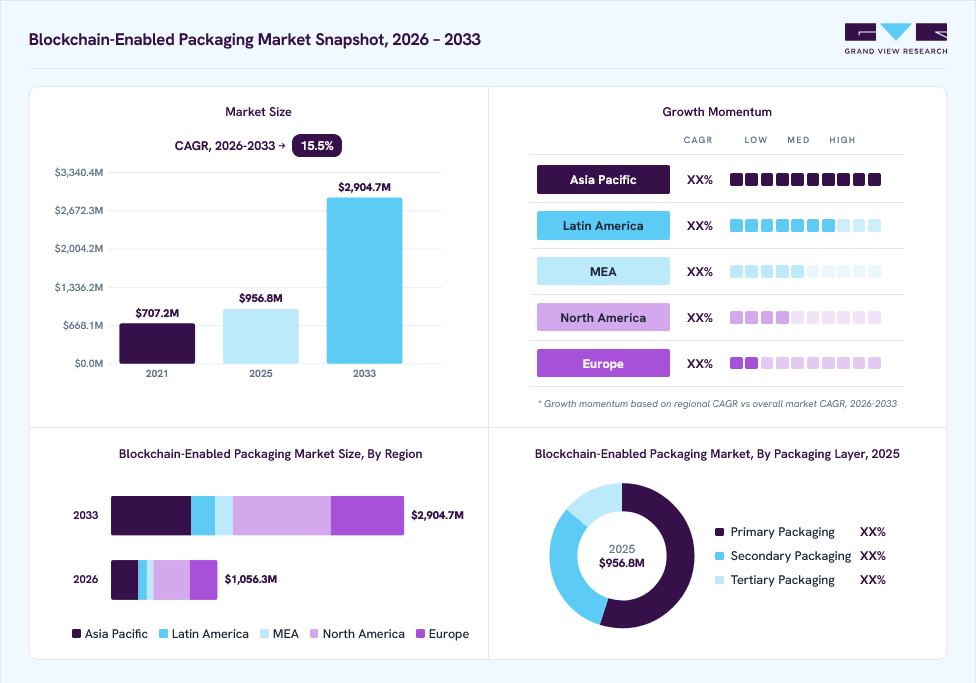
The global blockchain-enabled packaging market size was valued at USD 956.8 million in 2025 and is projected to grow from USD 1,056.3 million in 2026 to USD 2,904.7 million by 2033, at a CAGR of 15.5% from 2026 to 2033. The market in North America dominated with a revenue share of 34.2% in 2025. The market growth is primarily driven by the rising need for product authentication, anti-counterfeiting, supply chain transparency, real-time traceability, and regulatory compliance, particularly across pharmaceuticals, food & beverages, and consumer goods.
Key Market Trends & Insights
- By packaging layer: Primary packaging segment held the largest market share of 54.9% in 2025.
- By solution type: Lifecycle & circularity segment is expected to grow at the fastest CAGR of 16.1% from 2026 to 2033.
- By identification technology: QR & 2d codes segment held the largest market share of 46.2% in 2025.
- By end use: Pharmaceuticals & healthcare segment is expected to grow at the fastest CAGR of 16.2% from 2026 to 2033.
Regional Highlights
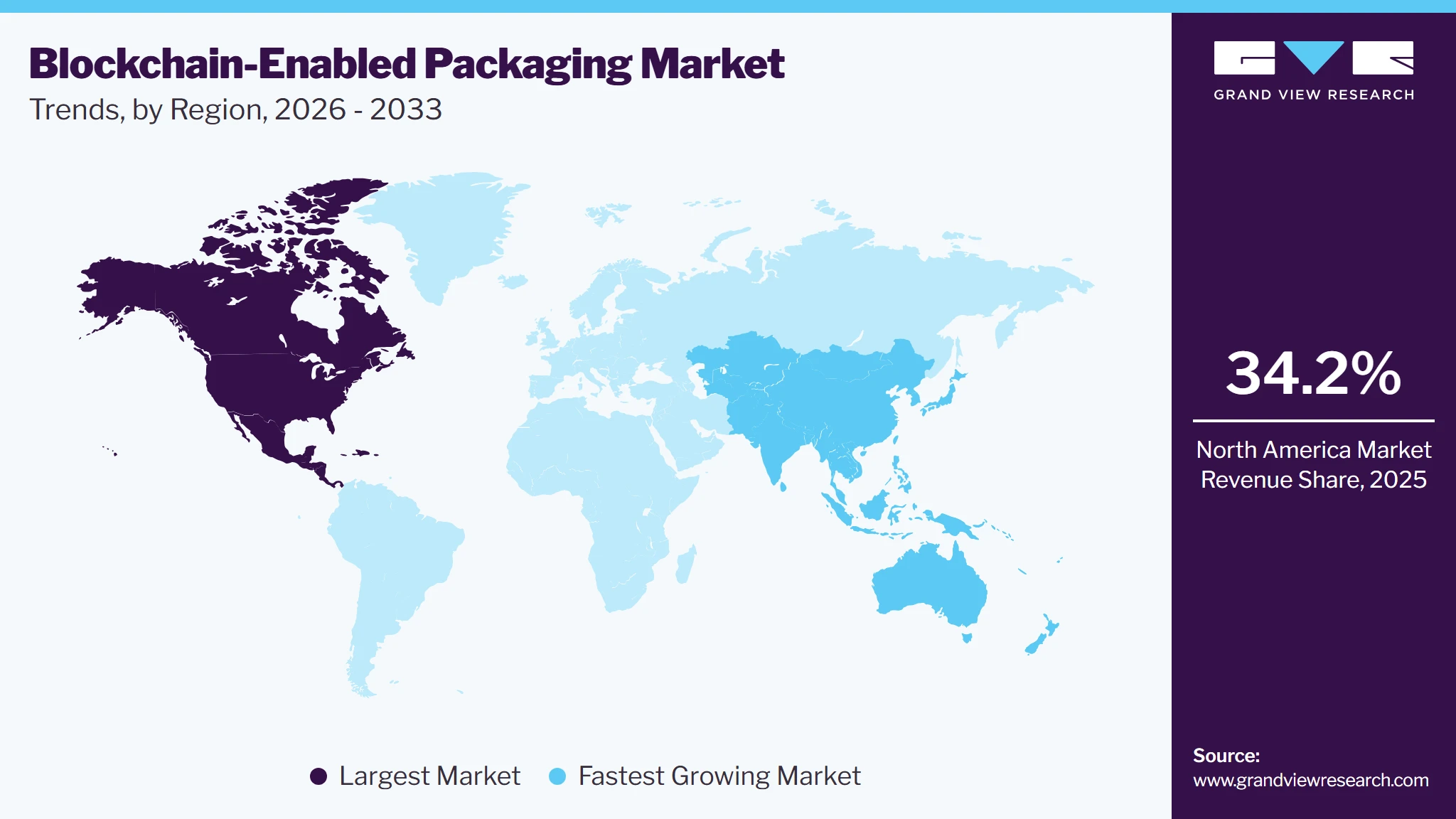
- Largest regional market: North America (34.2% revenue share, 2025)
- Fastest-growing regional market: Asia Pacific (highest CAGR, 2026-2033)
- By country: The U.S. held the largest market share in 2025
Market Size & Forecast
- Market size in 2025: USD 956.8 Million
- Estimated market size in 2026: USD 1,056.3 Million
- Projected market size by 2033: USD 2,904.7 Million
- CAGR (2026-2033): 15.5%
Growing e-commerce activity and increasing concerns over counterfeit products are further encouraging brands to integrate blockchain with smart packaging solutions. The blockchain-enabled packaging industry’s growth is driven by the increasing adoption of digital traceability, product authentication, and supply chain transparency across global packaging networks. As manufacturers, brand owners, retailers, and logistics providers increasingly seek real-time visibility of products throughout their distribution networks, blockchain-enabled packaging solutions are gaining importance. Primary packaging represents the largest segment, accounting for 54.9% of the market in 2025 and is projected to expand at a CAGR of 16.0% from 2026 to 2033, supported by the integration of QR codes, NFC, RFID, and other digital identification technologies directly onto product packaging.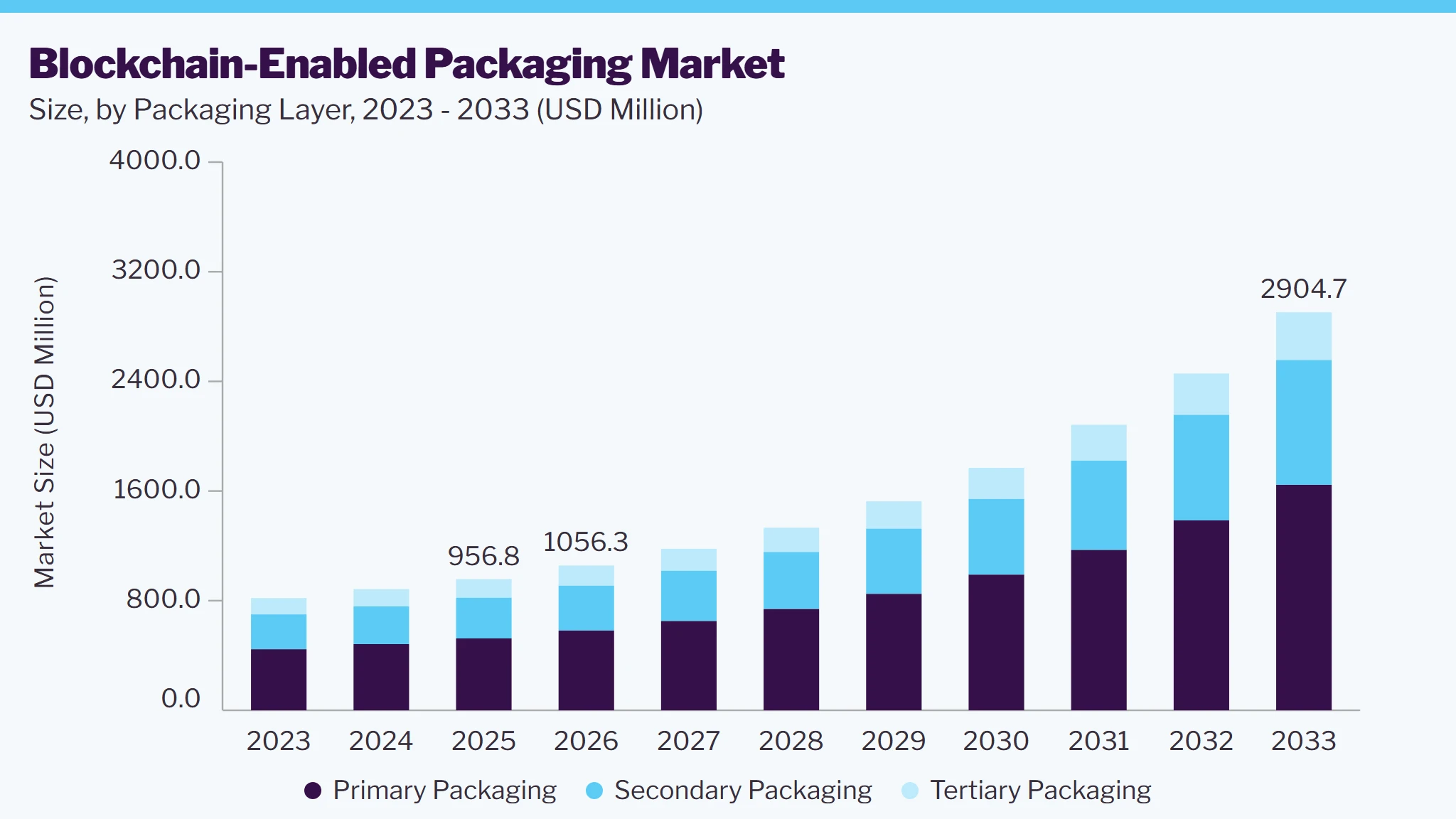
An increasing focus on anti-counterfeiting, regulatory compliance, and product provenance across sensitive supply chains is expected to support market growth in the coming years. Industries such as pharmaceuticals, food & beverages, luxury goods, and consumer products are increasingly adopting blockchain-enabled primary and secondary packaging to verify product authenticity, monitor product movement, and provide tamper-resistant transaction records. The pharmaceutical and healthcare sector is particularly significant, with the end-use segment projected to grow at a 16.2% CAGR from 2026 to 2033, driven by the need for secure product tracking and compliance throughout complex distribution networks.
The transition toward circular economy practices and digitally connected packaging systems is also contributing to market expansion. Blockchain-enabled packaging allows brands to maintain digital records of packaging usage, ownership, recycling, and product lifecycle information, supporting greater transparency in circular supply chains. This is reflected in the Lifecycle & Circularity solution segment, which is projected to register the fastest CAGR of 16.1% from 2026 to 2033. At the same time, QR and 2D codes remain the leading identification technology, accounting for 46.2% of market revenue in 2025, due to their scalability, low implementation cost, and compatibility with consumer-facing digital engagement.
For instance, the increasing integration of QR codes, RFID, NFC, and digital watermarks with blockchain platforms is enabling companies to create unique digital identities for packaged products and connect physical packaging with secure digital records. Such developments are expected to strengthen product authentication, improve supply chain visibility, enhance consumer trust, and support the broader adoption of blockchain-enabled packaging across primary, secondary, and tertiary packaging formats.
Market Dynamics
The blockchain-enabled packaging market is witnessing rapid growth, driven by increasing demand for supply chain transparency, product authentication, anti-counterfeiting, and digital traceability. Manufacturers, brand owners, retailers, and logistics providers are increasingly integrating blockchain with QR codes, RFID, NFC, and digital watermarks to create secure and verifiable product identities. Growing adoption across pharmaceuticals, food & beverages, luxury goods, and consumer products, along with increasing regulatory focus on product provenance and supply chain visibility, is supporting market expansion, while implementation complexity and integration costs remain key challenges.
The growing requirement for end-to-end product traceability, digital provenance, and product authentication is a major driver of the blockchain-enabled packaging market. Companies are increasingly adopting blockchain-connected packaging to securely record product information across manufacturing, distribution, and retail stages, enabling stakeholders to verify product origin and movement while reducing the risk of counterfeiting.
The increasing integration of QR codes, RFID, NFC, and digital watermarks with blockchain platforms is further supporting market adoption. These technologies enable brands to link physical packaging to secure digital records, improve supply chain visibility, and provide consumers with reliable product information. Rising demand for transparency across pharmaceuticals, food & beverages, luxury goods, and consumer products is therefore accelerating the deployment of blockchain-enabled packaging solutions.
A significant restraint for the blockchain-enabled packaging market is the high cost of technology integration and the complexity of data management. Implementing blockchain solutions across existing packaging lines, enterprise systems, and supply chain platforms can require substantial investment in digital infrastructure, cybersecurity, software, and skilled personnel. In addition, interoperability limitations between blockchain platforms and legacy systems can complicate information exchange. These factors may create barriers to adoption for smaller companies and organizations with limited digital capabilities.
A major opportunity for the blockchain-enabled packaging market lies in the growing adoption of smart packaging, digital product identities, and connected supply chains. Blockchain can enable secure digital records for product origin, ownership, lifecycle movement, and recycling activities, supporting greater transparency and accountability. Increasing demand for digitally verifiable products across pharmaceuticals, food & beverages, luxury goods, and retail is prompting brands to link physical packaging to digital information. The expansion of circular economy initiatives and digital traceability requirements is expected to further create opportunities for blockchain-enabled packaging solutions.
Market Characteristics
The blockchain-enabled packaging market is characterized by its technology-driven and value-added nature, with demand centered on product traceability, authentication, anti-counterfeiting, and supply chain transparency. The industry increasingly combines packaging formats with digital technologies such as QR and 2D codes, RFID, NFC, and digital watermarks to create unique digital identities for products. Manufacturers, brand owners, technology providers, and logistics companies are focusing on secure data exchange, real-time product visibility, and consumer engagement. Leading participants are investing in blockchain platforms, smart packaging technologies, and integrated digital solutions to strengthen supply chain efficiency and product integrity.
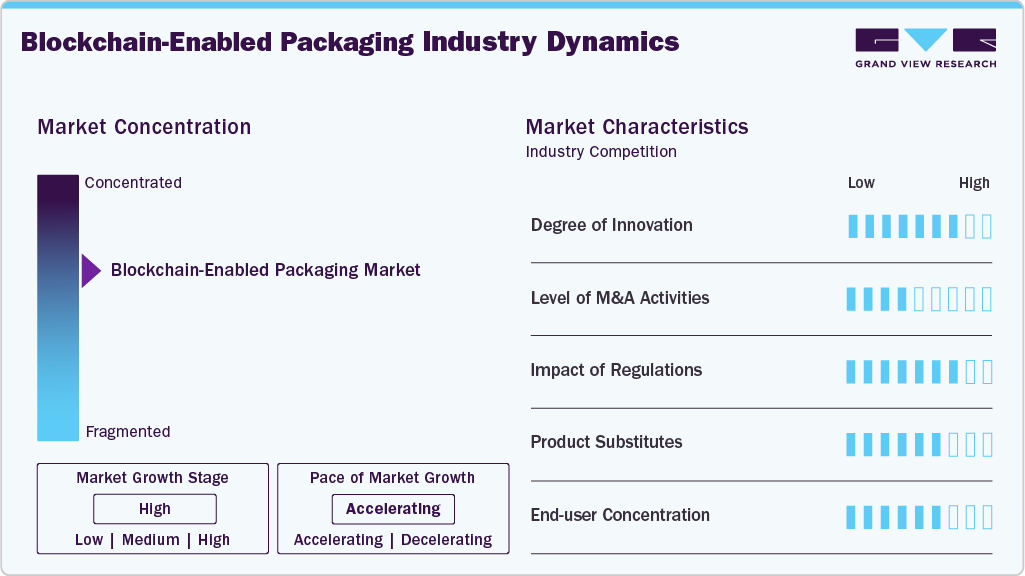
A defining feature of the blockchain-enabled packaging industry is its dependence on connected identification technologies and digital infrastructure, which enable physical packaging to interact with blockchain-based records. Primary packaging remains the dominant packaging layer as companies increasingly embed traceability and authentication capabilities directly onto products. The industry is also evolving toward lifecycle tracking and circularity, enabling businesses to record information on product movement, packaging usage, reuse, and recycling. Growing concerns over counterfeit products, regulatory requirements for traceability, and increasing adoption of digital supply chains are shaping technology development and investment decisions across the blockchain-enabled packaging ecosystem.
Analyst Perspective
The global blockchain-enabled packaging market has evolved from niche applications in product authentication and anti-counterfeiting to broader adoption of QR codes, RFID, NFC, digital watermarks, and blockchain-based traceability across food & beverages, pharmaceuticals, luxury goods, retail, and industrial products. Currently, the growing demand for supply-chain transparency, product provenance, regulatory compliance, and consumer trust is accelerating adoption. Looking ahead, the market is expected to witness strong double-digit growth through 2033, supported by digital product passports, circular economy initiatives, IoT integration, and increasing demand for secure, verifiable product information. Blockchain-enabled packaging is expected to become an important component of connected and intelligent packaging ecosystems.
Packaging Layer Insights
The primary packaging segment led the blockchain-enabled packaging market, accounting for the largest revenue share of 54.9% in 2025. Primary packaging represents the most direct point of interaction between the product and its digital identity, enabling brands to integrate blockchain-linked QR codes, RFID, NFC, and digital watermark technologies. Its dominance is supported by growing demand for product authentication, traceability, and consumer-level verification across pharmaceuticals, food & beverages, consumer goods, and luxury products. The segment is projected to grow at a CAGR of 16.0% during the forecast period.
The tertiary packaging segment is expected to grow at the significant CAGR of 13.3% during the forecast period. Tertiary packaging supports the tracking and verification of products during transportation, warehousing, and distribution, making blockchain integration valuable for improving logistics visibility and supply chain transparency. Increasing digitalization of logistics networks and the need for secure shipment tracking are supporting the adoption of blockchain-enabled solutions at the tertiary level.
Solution Type Insights
The traceability & provenance segment led the blockchain-enabled packaging industry, accounting for the largest revenue share of 38.7% in 2025. The segment is driven by growing demand for end-to-end product visibility, digital product identity, and secure tracking across manufacturing, distribution, and retail networks. Blockchain-enabled traceability allows companies to verify product origin, monitor movement, and improve supply chain transparency, particularly across pharmaceuticals, food & beverages, and consumer goods. The segment is projected to grow at a CAGR of 15.7% during the forecast period.
The lifecycle & circularity segment is expected to grow at the fastest CAGR of 16.1% during the forecast period. Blockchain-enabled solutions support the secure recording of product and packaging lifecycle information, including usage, ownership, reuse, recycling, and end-of-life activities. Increasing adoption of circular economy practices, digital product identities, and transparent sustainability initiatives is expected to accelerate demand for blockchain-based lifecycle management solutions.
Identification Technology Insights
The QR & 2D codes segment led the blockchain-enabled packaging market with the largest revenue share of 46.2% in 2025. QR and 2D codes are widely used due to their low implementation costs, ease of integration into packaging, and ability to connect products to blockchain-based digital records. Their growing application in product authentication, traceability, provenance verification, and consumer engagement across pharmaceuticals, food & beverages, and consumer goods is supporting segment growth. The segment is projected to grow at a CAGR of 15.7% during the forecast period.
The digital watermarks segment is expected to grow at the fastest CAGR of 16.1% during the forecast period. Digital watermarks provide discreet and secure product identification while enabling authentication, traceability, and lifecycle monitoring through digitally connected packaging systems. Growing concerns over counterfeiting, the demand for product-level visibility, and the adoption of advanced smart packaging technologies are expected to drive the expansion of digital watermark solutions in blockchain-enabled packaging.
End Use Insights
The food & beverages segment led the blockchain-enabled packaging industry with the largest revenue share of 33.9% in 2025. The segment is supported by growing demand for product provenance, authenticity verification, and supply chain transparency across food and beverage distribution networks. Blockchain-enabled packaging helps brands provide secure product information, strengthen consumer trust, and improve visibility from production to retail. The segment is projected to grow at a CAGR of 15.4% during the forecast period.
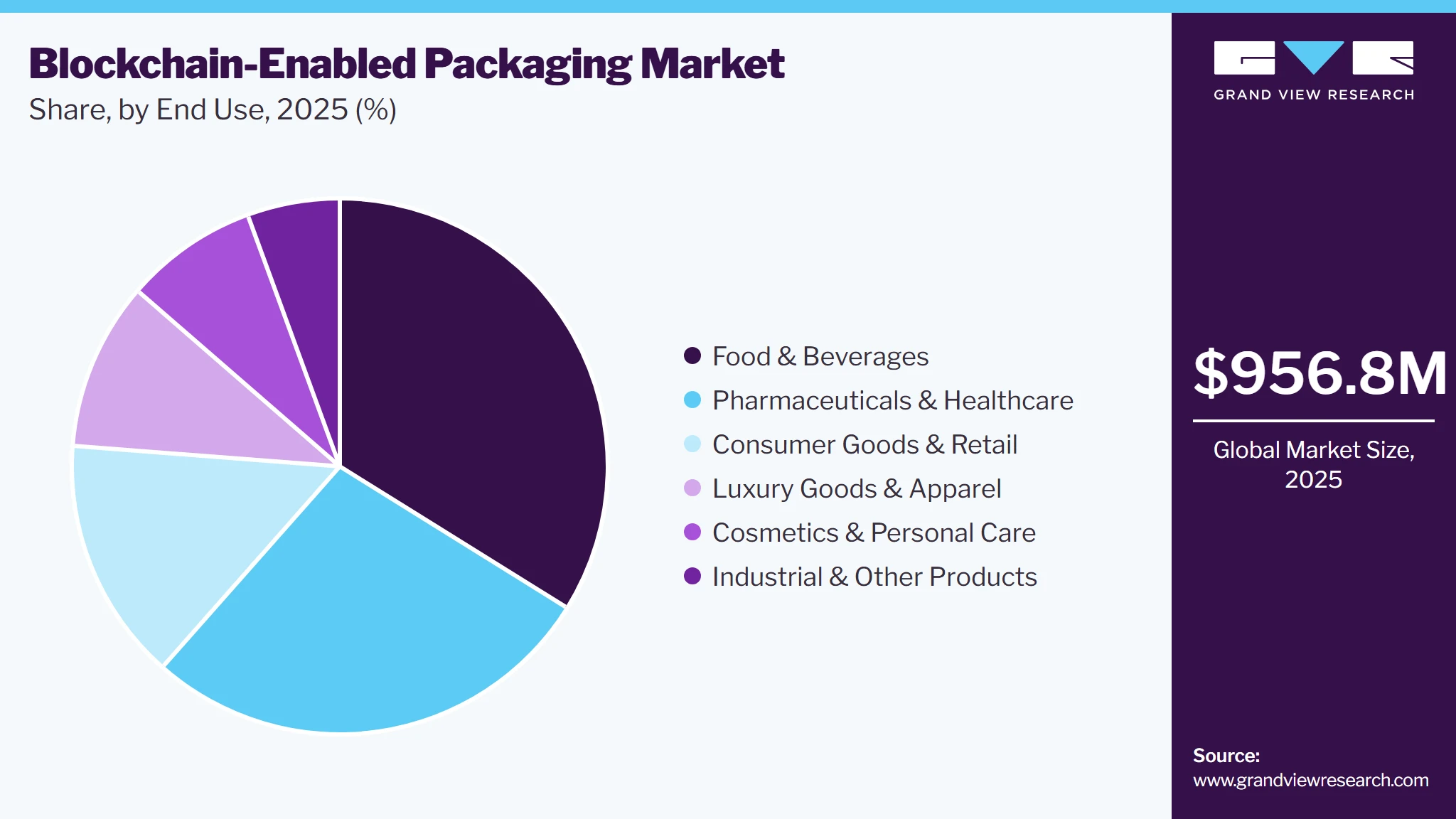
The pharmaceuticals & healthcare segment is expected to grow at the fastest CAGR of 16.2% during the forecast period. Growing concerns about counterfeit medicines, stringent traceability requirements, and the need for secure product verification are prompting pharmaceutical companies to adopt blockchain-enabled packaging solutions. Blockchain integration with smart identification technologies can support product authentication, supply chain monitoring, and regulatory compliance, creating strong growth potential across healthcare packaging applications.
Regional Insights
The North America blockchain-enabled packaging market is projected to maintain strong growth during the forecast period, supported by early adoption of digital supply chain technologies, advanced packaging infrastructure, and increasing demand for product authentication. The region accounted for the largest revenue share of 34.2% in 2025, reflecting strong adoption across pharmaceuticals, food & beverages, consumer goods, and retail. Increasing investments in smart packaging, blockchain platforms, and connected identification technologies are expected to sustain regional demand.
U.S. Blockchain-Enabled Packaging Market Trends
The U.S. blockchain-enabled packaging industry is expected to expand steadily, supported by widespread digitalization across manufacturing, logistics, and retail operations. Growing concerns over counterfeit products and increasing requirements for product traceability are encouraging brands to integrate blockchain with QR codes, RFID, NFC, and other identification technologies. Strong technology capabilities and the presence of established packaging and technology providers are further supporting market development.
Asia Pacific Blockchain-Enabled Packaging Market Trends
The Asia Pacific blockchain-enabled packaging industry is expected to grow at the fastest CAGR of 16.6% during the forecast period, with its revenue share increasing from 25.5% in 2025 to 27.4% by 2033. Rapid expansion of e-commerce, manufacturing, pharmaceuticals, organized retail, and digital logistics is creating strong demand for traceability and authentication solutions. Increasing investments in smart packaging infrastructure and blockchain technologies across emerging economies are expected to further accelerate regional growth.
The China blockchain-enabled packaging market is significant in Asia Pacific, supported by its large manufacturing ecosystem, expanding e-commerce sector, and rapidly developing digital supply chains. Increasing concerns regarding product authenticity and the need for transparent product tracking are encouraging companies to integrate blockchain with smart packaging technologies. Government-led digitalization initiatives and investments in advanced logistics infrastructure are expected to strengthen future adoption.
The blockchain-enabled packaging market in India is expected to witness strong growth over the forecast period, driven by the expanding e-commerce, pharmaceutical manufacturing, organized retail, and digital supply chain infrastructure. Rising demand for product authentication and traceability is encouraging brands to adopt QR-enabled and blockchain-connected packaging solutions. Increasing digitalization across manufacturing and logistics networks is expected to create further opportunities for market expansion.
Europe Blockchain-Enabled Packaging Market Trends
The Europe blockchain-enabled packaging industry is expected to witness consistent growth over the forecast period, driven by increasing emphasis on supply chain transparency, product provenance, and digital product identification. Pharmaceutical, food, luxury goods, and consumer product companies are increasingly exploring blockchain-enabled packaging to improve authentication and comply with evolving traceability requirements. The region's focus on circular economy practices is also driving demand for blockchain-based lifecycle and packaging-tracking solutions.
The Germany blockchain-enabled packaging market is important in Europe, supported by its strong manufacturing base, advanced logistics infrastructure, and emphasis on Industry 4.0 technologies. The increasing adoption of digitally connected supply chains and smart packaging solutions across the automotive, pharmaceutical, food, and industrial sectors is expected to support market expansion. Investments in supply chain digitalization are further creating opportunities for blockchain-based product tracking.
The blockchain-enabled packaging market in the UK is expected to develop steadily as brands increasingly focus on product authentication, digital traceability, and transparent supply chains. Demand from the pharmaceutical, food & beverage, retail, and luxury goods sectors is driving the adoption of connected packaging technologies. Growing interest in digital product information and circular packaging systems is also expected to support the adoption of blockchain-enabled solutions.
Latin America Blockchain-Enabled Packaging Market Trends
The Latin America blockchain-enabled packaging industry is projected to grow steadily during the forecast period, supported by increasing digitalization of supply chains and rising demand for product verification across food & beverages, pharmaceuticals, retail, and consumer goods. Growing e-commerce activity and efforts to improve product provenance are encouraging businesses to adopt connected packaging technologies. Increasing investments in logistics and digital infrastructure are expected to create additional market opportunities.
The Brazil blockchain-enabled packaging market is significant in Latin America, supported by its large consumer market, expanding food & beverage industry, pharmaceutical sector, and growing e-commerce ecosystem. Companies are increasingly seeking technologies that can improve product authenticity, supply chain visibility, and consumer engagement. Continued digital transformation across retail and logistics is expected to support the adoption of blockchain-enabled packaging.
The blockchain-enabled packaging market in Argentina is expected to experience gradual growth as businesses increasingly focus on supply chain transparency and product authentication. Demand from the food & beverage, pharmaceutical, and consumer product sectors is creating opportunities for blockchain-linked packaging solutions. Increasing digital adoption and the need to strengthen product provenance across distribution networks are expected to contribute to market development.
Middle East & Africa Blockchain-Enabled Packaging Market Trends
The Middle East & Africa blockchain-enabled packaging industry is expected to grow steadily over the forecast period, driven by expansion in retail, pharmaceuticals, food distribution, and logistics. Increasing investments in digital infrastructure and smart supply chains are creating demand for secure product identification and traceability. The adoption of blockchain-enabled packaging is expected to increase as businesses seek greater supply chain visibility and product authentication capabilities.
Key Blockchain-Enabled Packaging Company Insights
The blockchain-enabled packaging market is characterized by the integration of blockchain with digital identification, smart labels, serialization, RFID, NFC, QR codes, and connected packaging platforms. Leading participants are focusing on improving product visibility, authentication, supply-chain transparency, regulatory compliance, and consumer access to verified product information.
-
Avery Dennison is a major player in intelligent labeling and connected product technologies, offering solutions that combine RFID, digital identification, and connected packaging capabilities. Its technologies enable brands to assign digital identities to individual products, supporting inventory visibility, product authentication, traceability, and consumer engagement across packaging and retail supply chains.
-
Kezzler provides digital product identity and serialization solutions that enable products and packaging to be digitally connected throughout their lifecycle. Its platform supports traceability, supply-chain transparency, product information management, and digital product passport applications, making it relevant to blockchain-enabled packaging ecosystems.
Key Blockchain-Enabled Packaging Companies
The following key companies have been profiled for this study of the blockchain-enabled packaging market.
-
Avery Dennison
-
Kezzler
-
Tetra Pak International S.A.
-
OPTEL Group
-
Identiv Inc
-
DMRC LLC
-
Systech
-
Scantrust
-
Zircon Technologies
-
Zebra Technologies Corp.
-
Everledger Limited
Competitive Benchmarking
Category
Operating Strategies
Competitive Edge
Weakness
Established Players (Avery Dennison; Tetra Pak International S.A.; OPTEL Group; Zebra Technologies Corp.; Systech)
- Focus on expanding blockchain-enabled packaging solutions through smart labels, digital identification, traceability platforms, authentication technologies, and connected packaging systems.
- These companies invest in digital infrastructure, software integration, R&D, strategic partnerships, and global customer networks across food & beverages, pharmaceuticals, consumer goods, and retail applications.
- Strong global presence, established customer relationships, broad technology portfolios, advanced identification capabilities, and integration expertise enable these players to provide scalable packaging traceability and authentication solutions.
- Their extensive manufacturing and technology infrastructure also supports deployment across large supply chains.
- High technology investment requirements, complex integration with existing packaging and supply-chain systems, and dependence on customer adoption of digital platforms can increase implementation costs.
- Large organizational structures may also slow customization for highly specialized applications.
Emerging Players (Kezzler; Identiv Inc.; DMRC LLC; Scantrust; Zircon Technologies; Everledger Limited)
- Concentrate on blockchain-based product authentication, digital identities, serialization, supply-chain traceability, and connected packaging platforms.
- These companies emphasize specialized software solutions, QR and NFC-enabled identification, digital product passports, and partnerships with brands, manufacturers, and technology providers to expand adoption across targeted applications.
- Specialized blockchain, serialization, digital identity, and product traceability capabilities enable these companies to offer flexible, application-specific solutions.
- Their technology-focused business models and ability to develop customized platforms provide opportunities to address emerging requirements for transparency, anti-counterfeiting, and product lifecycle visibility.
- Smaller operational scale, comparatively limited global distribution networks, and dependence on partnerships or technology integration can constrain market reach.
- Limited resources compared with established packaging and technology companies may also affect large-scale deployment and long-term R&D investment.
Recent Developments
-
In July 2026, Avery Dennison announced that its AD CleanFlake™ RFID tags received RecyClass Technology Approval for PET bottle recyclability in Europe. The development strengthens the company’s position in connected and intelligent packaging by combining RFID-based digital identification with recyclable label technology, supporting improved packaging traceability and circularity.
-
In 2026, Kezzler was recognized by Gartner as a sample vendor for Digital Product Passports in two Hype Cycle reports. The recognition highlights the company’s growing focus on product-level traceability, digital identities, compliance, and transparency, which are key capabilities supporting blockchain-enabled and connected packaging ecosystems.
-
In 2026, OPTEL continued expanding its Optchain platform for multi-tier supply-chain visibility, ESG compliance, and product traceability. The platform increasingly addresses packaging-related data collection and regulatory requirements, including PPWR compliance and supplier-level information, strengthening the role of digital traceability infrastructure in packaging supply chains.
Blockchain-Enabled Packaging Market Report Scope
Report Attribute
Details
Market size in 2025
USD 956.8 million
Estimated market size in 2026
USD 1,056.3 million
Projected market size by 2033
USD 2,904.7 million
Growth rate
CAGR of 15.5% from 2026 to 2033
Base year for estimation
2025
Historical data
2021 - 2024
Forecast period
2026 - 2033
Quantitative units
Revenue in USD million and CAGR from 2026 to 2033
Report coverage
Revenue forecast, company ranking, competitive landscape, growth factors, and trends
Segments covered
Packaging layer, solution type, identification technology, end use, and region
Regional Scope
North America; Europe; Asia Pacific; Latin America; Middle East & Africa
Key companies profiled
Avery Dennison; Kezzler; Tetra Pak International S.A.; OPTEL Group; Identiv Inc.; DMRC LLC; Systech; Scantrust; Zircon Technologies; Zebra Technologies Corp.; Everledger Limited
Customization scope
Free report customization (equivalent up to 8 analysts working days) with purchase. Addition or alteration to country, regional & segment scope.
Pricing and purchase options
Avail of customized purchase options to meet your exact research needs. Explore purchase options
Global Blockchain-Enabled Packaging Market Report Segmentation
This report forecasts revenue growth at the global, regional & country levels and provides an analysis of the latest industry trends and opportunities in each of the sub-segments from 2021 to 2033. For this study, Grand View Research has segmented the blockchain-enabled packaging market report based on packaging layer, solution type, identification technology, end use, and region:
-
Packaging Layer Outlook (Revenue, USD Million, 2021 - 2033)
-
Primary Packaging
-
Secondary Packaging
-
Tertiary Packaging
-
-
Solution Type Outlook (Revenue, USD Million, 2021 - 2033)
-
Traceability & Provenance
-
Authentication & Anti-Counterfeiting
-
Lifecycle & Circularity
-
Condition & Compliance Verification
-
Consumer Engagement & Other Solutions
-
-
Identification Technology Outlook (Revenue, USD Million, 2021 - 2033)
-
QR & 2D Codes
-
RFID
-
NFC
-
Digital Watermarks
-
Other Technologies
-
-
End Use Outlook (Revenue, USD Million, 2021 - 2033)
-
Food & Beverage
-
Consumer Goods & Retail
-
Luxury Goods & Apparel
-
Pharmaceuticals & Healthcare
-
Cosmetics & Personal Care
-
Industrial & Other Products
-
-
Regional Outlook (Revenue, USD Million, 2021 - 2033)
-
North America
-
U.S.
-
Canada
-
Mexico
-
-
Europe
-
Germany
-
France
-
UK
-
Italy
-
Spain
-
-
Asia Pacific
-
China
-
India
-
Japan
-
South Korea
-
Australia
-
-
Latin America
-
Brazil
-
Argentina
-
-
Middle East & Africa
-
Saudi Arabia
-
UAE
-
South Africa
-
-
Research Methodology
The blockchain-enabled packaging market figures in this report are based on a proven research process that combines executive interviews with secondary research from proprietary databases, company filings, and recognized regulatory and institutional sources. Market size is built through value-chain sizing-reconciling supply-side and demand-side estimates-and triangulated with bottom-up and top-down approaches. Every estimate passes multiple levels of expert validation before publication, with each blockchain-enabled packaging segment quantified using the revenue-capture definitions in the table below.
Segment Definition
Packaging Layer
Revenue capture definition
Primary Packaging
Revenue generated from blockchain-enabled packaging solutions integrated directly with the packaged product, including QR and 2D codes, NFC tags, RFID labels, digital watermarks, and serialized identifiers. Includes solutions enabling product authentication, traceability, provenance verification, consumer engagement, and digital product identity at the individual package level.
Secondary Packaging
Revenue generated from blockchain-enabled technologies applied to cartons, cases, multipacks, and other secondary packaging formats to provide batch-level traceability, authentication, inventory visibility, supply-chain monitoring, and compliance verification. Includes connected packaging solutions that link multiple primary packages with shared digital records and product information.
Tertiary Packaging
Revenue generated from blockchain-enabled packaging solutions used on pallets, shipping containers, crates, bulk packaging, and other logistics packaging to support shipment tracking, supply-chain visibility, asset identification, condition monitoring, and transaction-level data sharing. Includes RFID, QR-based tracking, and blockchain-integrated logistics identification systems used across distribution and warehousing operations.
Solution Type
Revenue capture definition
Traceability & Provenance
Revenue generated from blockchain-enabled packaging solutions that provide end-to-end product traceability, origin verification, batch tracking, and immutable provenance records across the supply chain. Includes QR, RFID, NFC, and digital identity solutions integrated with blockchain platforms to improve product visibility and supply chain transparency.
Authentication & Anti-Counterfeiting
Revenue generated from blockchain-enabled packaging solutions designed to verify product authenticity, prevent counterfeiting, and protect brands. Includes serialized QR codes, NFC tags, RFID identifiers, digital watermarks, and blockchain-backed verification systems used to authenticate products throughout distribution and at the point of purchase.
Lifecycle & Circularity
Revenue generated from blockchain-enabled packaging solutions that track packaging throughout its lifecycle, including production, distribution, reuse, recycling, and disposal. Includes digital product passports, material traceability, reusable packaging tracking, recycling verification, and circular economy data management solutions.
Condition & Compliance Verification
Revenue generated from blockchain-enabled packaging solutions that record and verify product condition, handling history, regulatory information, and compliance data throughout the supply chain. Includes connected packaging technologies supporting temperature, location, handling, expiration, and regulatory documentation verification.
Consumer Engagement & Other Solutions
Revenue generated from blockchain-enabled packaging solutions focused on consumer interaction, product information access, loyalty programs, digital experiences, and other connected packaging applications. Includes QR- and NFC-enabled consumer engagement, digital storytelling, promotional campaigns, product information, and blockchain-supported customer interaction solutions.
Identification Technology
Revenue capture definition
QR & 2D Codes
Revenue generated from QR codes, Data Matrix, and other 2D identification technologies integrated into packaging to enable product authentication, traceability, digital product information, provenance verification, and consumer engagement. Includes serialized and blockchain-linked codes used across product and supply-chain applications.
RFID
Revenue generated from RFID tags, labels, readers, and related identification solutions used to provide automated product identification, inventory visibility, shipment tracking, authentication, and supply-chain traceability. Includes RFID technologies integrated with blockchain platforms for secure and transparent product data management.
NFC
Revenue generated from NFC-enabled labels, tags, and smart packaging solutions that provide contactless product authentication, consumer interaction, digital product information, and traceability. Includes NFC systems connected to blockchain-based digital identities and product records.
Digital Watermarks
Revenue generated from digital watermark technologies embedded within packaging artwork or materials to enable product identification, authentication, recycling identification, supply-chain tracking, and digital content access. Includes invisible or machine-readable watermarks linked with digital and blockchain-enabled product records.
Other Technologies
Revenue generated from other identification technologies used in blockchain-enabled packaging, including serialized barcodes, smart labels, connected sensors, IoT-enabled identifiers, and hybrid identification systems. Includes emerging technologies supporting product verification, traceability, condition monitoring, and supply-chain data exchange.
End Use
Revenue capture definition
Food & Beverages
Revenue generated from blockchain-enabled packaging solutions used for food and beverage products to provide ingredient provenance, batch traceability, product authentication, freshness information, recall management, and supply-chain transparency. Includes QR, RFID, NFC, and digital identification technologies integrated into food and beverage packaging.
Pharmaceuticals & Healthcare
Revenue generated from blockchain-enabled packaging solutions used for medicines, vaccines, medical devices, and healthcare products to support serialization, authentication, regulatory compliance, cold-chain visibility, and end-to-end product traceability. Includes connected packaging technologies that help prevent counterfeit healthcare products and improve supply-chain security.
Consumer Goods & Retail
Revenue generated from blockchain-enabled packaging solutions applied to consumer products and retail goods for product authentication, inventory tracking, provenance verification, warranty management, and consumer engagement. Includes smart packaging technologies that connect physical products with secure digital product records.
Luxury Goods & Apparel
Revenue generated from blockchain-enabled packaging solutions used for luxury products, fashion, footwear, and apparel to establish product authenticity, origin, ownership history, and brand protection. Includes QR, NFC, RFID, and digital identity solutions that help combat counterfeiting and provide consumers with verified product information.
Cosmetics & Personal Care
Revenue generated from blockchain-enabled packaging solutions used for cosmetics, skincare, fragrances, and personal care products to provide ingredient traceability, authenticity verification, product information, and consumer engagement. Includes connected packaging systems that strengthen brand transparency and support regulatory and sustainability requirements.
Industrial & Other Products
Revenue generated from blockchain-enabled packaging solutions used for industrial equipment, chemicals, automotive components, electronics, and other specialized products to support asset identification, supply-chain traceability, authentication, compliance verification, and lifecycle tracking. Includes smart identification and digital product record technologies deployed across industrial supply chains.
Estimation Model
Layer Name
Key Question
Description
End Use Industry Layer
What drives blockchain-enabled packaging demand?
Estimate demand from key industries, including food & beverages, pharmaceuticals & healthcare, consumer goods & retail, luxury goods & apparel, cosmetics & personal care, and industrial products that require secure packaging identification, traceability, authentication, and supply-chain visibility.
Packaging Adoption Layer
Where is blockchain-enabled packaging adopted?
Assess adoption across primary, secondary, and tertiary packaging based on requirements for product authentication, provenance tracking, inventory visibility, lifecycle management, compliance verification, and consumer engagement.
Technology & Solution Layer
Which technologies and solutions generate demand?
Evaluate adoption of QR & 2D codes, RFID, NFC, digital watermarks, and other identification technologies across traceability & provenance, authentication & anti-counterfeiting, lifecycle & circularity, condition & compliance verification, and consumer engagement solutions.
Revenue Layer
How is revenue generated?
Revenue is generated through the sale of blockchain-enabled packaging technologies, connected packaging solutions, identification systems, digital product identities, traceability platforms, authentication services, and related software and services used across packaging and supply-chain applications.
Delivered Customizations
We have successfully delivered the following deep-dive customizations
Client Request
Customization Delivered
Value Adds
Regional Segmentation Analysis
Detailed assessment of the blockchain-enabled packaging market across North America, Europe, Asia Pacific, Latin America, and Middle East & Africa, covering regional adoption of blockchain technologies, connected packaging infrastructure, regulatory developments, end-use demand, and growth outlook.
Enables clients to identify high-growth regions, assess regional technology adoption, understand regulatory opportunities, and prioritize market expansion strategies.
Cross-Segmentation Analysis
Comprehensive analysis across Packaging Layer (Primary Packaging, Secondary Packaging, Tertiary Packaging), Solution Type, Identification Technology, End Use, and regional markets, highlighting relationships between blockchain applications, packaging formats, technologies, and end-use industries.
Helps clients identify high-potential segment combinations, technology adoption opportunities, emerging application areas, and targeted customer segments.
Competitive Benchmarking
Comparative benchmarking of leading blockchain-enabled packaging companies based on solution portfolios, identification technologies, blockchain capabilities, traceability platforms, authentication solutions, R&D capabilities, industry coverage, geographic presence, partnerships, and strategic developments.
Enables clients to assess competitor positioning, identify technology gaps, benchmark innovation capabilities, and develop effective differentiation, partnership, and market expansion strategies.
Frequently Asked Questions About This Report
The global blockchain-enabled packaging market size was valued at USD 956.8 million in 2025 and is estimated to reach USD 1,056.3 million in 2026.
The global blockchain-enabled packaging market is expected to grow at a CAGR of 15.5% from 2026 to 2033, reaching USD 2,904.7 million by 2033.
The blockchain-enabled packaging market is primarily driven by increasing demand for product traceability, growing concerns regarding counterfeiting, rising supply-chain transparency requirements, adoption of smart packaging technologies, increasing digitalization of supply chains, and the growing need for secure product authentication and lifecycle tracking.
North America dominated the blockchain-enabled packaging market with a 34.2% revenue share in 2025.
Asia Pacific is the fastest-growing region in the blockchain-enabled packaging market, with a CAGR of 16.6% over the forecast period.
The lifecycle & circularity segment is the fastest-growing solution type in the blockchain-enabled packaging market, with a CAGR of 16.1% over the forecast period.
The traceability & provenance segment led the blockchain-enabled packaging market with a 38.7% revenue share in 2025.
The primary packaging segment led the blockchain-enabled packaging market with a 54.9% revenue share in 2025.
Key players in the blockchain-enabled packaging market include Avery Dennison, Kezzler, Tetra Pak International S.A., OPTEL Group, Identiv Inc., DMRC LLC, Systech, Scantrust, Zircon Technologies, Zebra Technologies Corp., and Everledger Limited.
About the Author(s)
Plastics, Polymers & Resins Research Team
Bulk Chemicals · Plastics, Polymers & ResinsThis report was authored by the plastics, polymers & resins research team at Grand View Research - comprising two research analysts, one senior research analyst, and one industry expert - with specialized expertise in the plastics, polymers & resins segment of the bulk chemicals industry. All findings are based on proprietary bulk chemicals databases, executive interviews, and regulatory analysis, subject to internal peer review prior to publication.
Last Updated:
Speak to Analyst


Customize this report to your needs — add regions, segments, or data points, with 20% free customization.
Or view our licence options:


ISO 9001:2015 & 27001:2022 Certified
We are GDPR and CCPA compliant! Your transaction & personal information is safe and secure. For more details, please read our privacy policy.


