
- Home
- »
- Advanced Interior Materials
- »
-
Brass Market Size, Share And Trends Report, 2026-2033GVR Report cover

Brass Market (2026 - 2033)
Size, Share & Trend Analysis Report, By Type (Brass Wires, Brass Rods), By Application (Electrical & Electronic Components, Machinery & Industrial Components, Plumbing & Sanitary, Automotive), By Region, And Segment Forecasts
Market Size, 2025
$9.8BMarket Estimate, 2026
$13.3BMarket Forecast, 2033
$18.6BCAGR, 2026–2033
5.0%Brass Market Summary
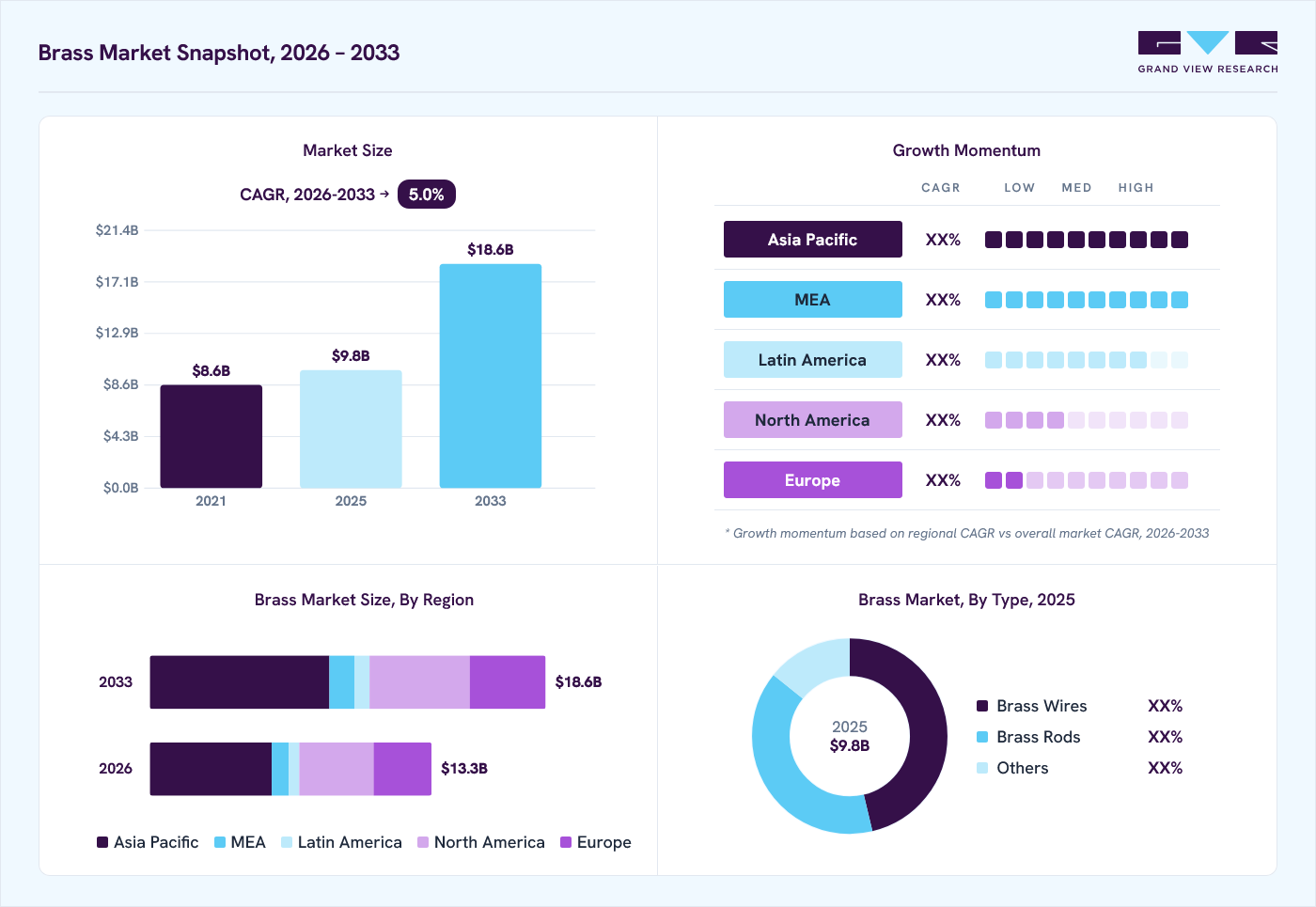
The global brass market size was valued at USD 9.8 billion in 2025 and is projected to grow from USD 13.3 billion in 2026 to USD 18.6 billion by 2033 at a CAGR of 5.0% from 2026 to 2033. Asia Pacific dominated the market, accounting for a revenue share of 43.0% in 2025. Increasing demand for corrosion-resistant, machinable, and durable metal components across construction, automotive, electrical and electronics, and industrial manufacturing applications is expected to support growth.
 Source: Grand View Research, IR Documents, Primary Interviews, Paid DatabasesTo learn more about this report,
 Download Free Sample Report
Key Market Trends & Insights
- By type: Brass wires accounted for the largest market revenue share of 46.2% in 2025.
- By application: Electrical & electronic components segment is anticipated to register the fastest CAGR of 5.3% from 2026 to 2033.
Regional Highlights
- Largest Region: Asia Pacific (43.0% revenue share, 2025)
- By country: China held the largest market share in 2025.
Market Size & Forecast
- Market Size in 2025: USD 9.8 Billion
- Estimated Market Size in 2026: USD 13.3 Billion
- Projected Market Size by 2033: USD 18.6 Billion
- CAGR (2026-2033): 5.0%
Three ways to get this report
Buy it, customize it, or ask a question.Ask an Analyst
Analyst response in 1 business day
- AccessReport author, directly
- Reply timeWithin 1 working day
- No sales callDirect answer only
- FormatEmail reply
- CostFree, no cost
Get the Full Report
What the study covers
- FormatsPDF · Excel · Dashboard
- Timeline2026–2033 annual, 2025 base
- Coverage20+ countries, 5 regions
- Companies10+ key players profiled
Customize the Report
20% free customization
- IncludeCountries, segments, points
- TailorTo your product definition
- ExtendDeeper competitor detail
- OrA fully bespoke study
- Turnaround5–10 working days
It offers a combination of strength, formability, thermal and electrical conductivity, and resistance to corrosion, making it suitable for plumbing fittings, valves, connectors, precision-engineered components, and architectural hardware. The growing demand for durable, corrosion-resistant metal components across construction, automotive, electrical and electronics, and industrial manufacturing is supporting the expansion of the global brass market. Brass offers excellent machinability, formability, thermal and electrical conductivity, and corrosion resistance, making it suitable for plumbing fittings, valves, connectors, fasteners, architectural hardware, and precision-engineered components. Increasing infrastructure development, expansion of electrical networks, and rising demand for reliable metal components in residential, commercial, and industrial applications are expected to support consumption.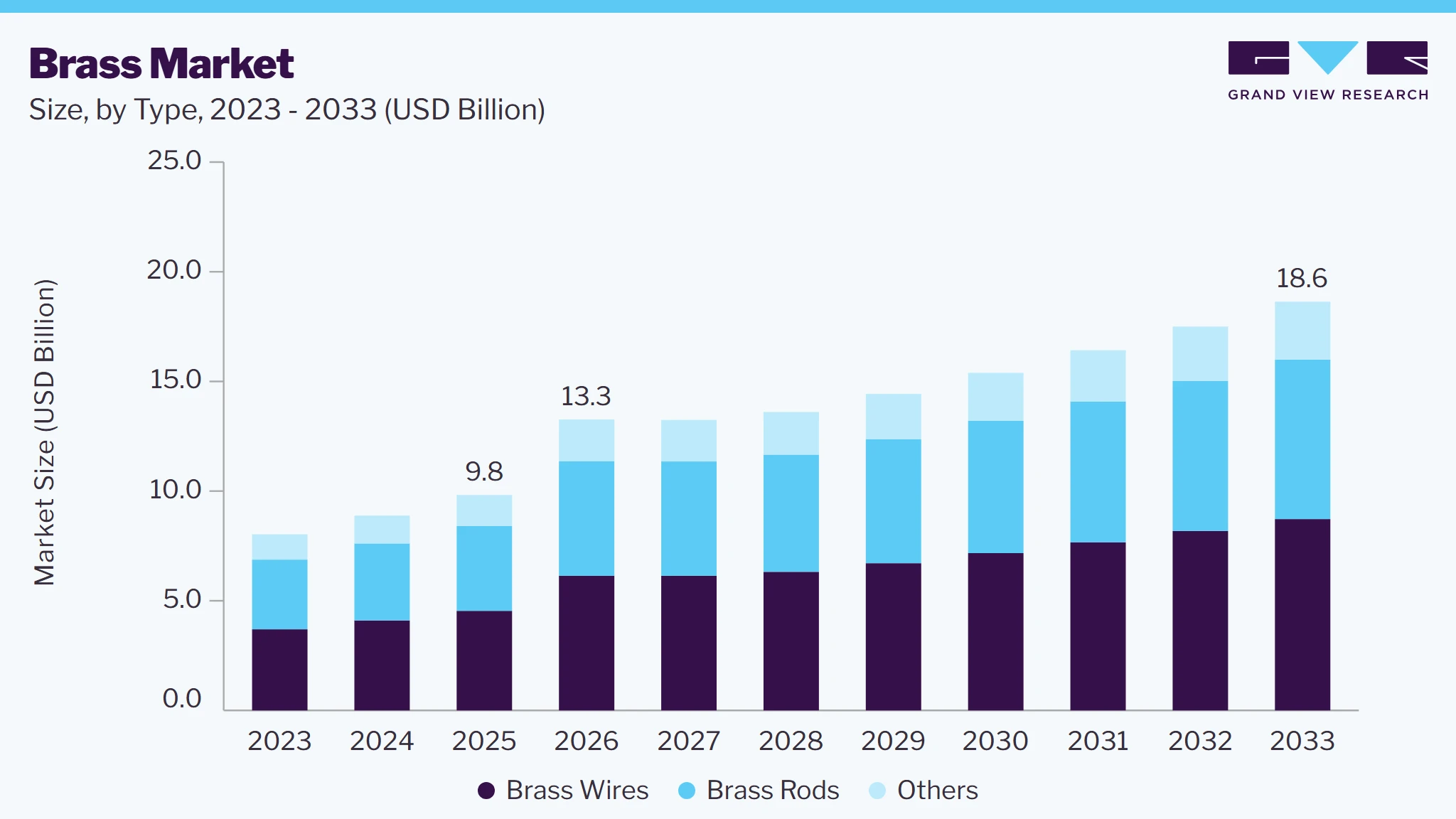 To learn more about this report, Download Free Sample Report
The expansion of automotive and industrial manufacturing is creating additional demand opportunities for brass products. Brass is used in fuel system components, radiator parts, terminals, sensors, bearings, gears, and other precision components that require dimensional stability and ease of machining. Growing vehicle production, increasing electrical content in automobiles, and the development of industrial automation systems are supporting demand for brass components. In addition, the expansion of machinery manufacturing and the need for reliable fluid-handling systems are contributing to the adoption of brass fittings, valves, and connectors across industrial applications.
Market Dynamics
The increasing use of brass components across construction, automotive, electrical and electronics, and industrial applications is a major driver of market growth. Brass combines strength, machinability, corrosion resistance, and attractive surface characteristics, making it suitable for products requiring reliable performance and precise manufacturing. In the construction sector, brass is used in plumbing systems, faucets, valves, door handles, locks, hinges, and decorative hardware. Rising residential and commercial construction activity, infrastructure modernization, and renovation projects are supporting demand for these products.
The expansion of electrical and electronic equipment manufacturing is also contributing to demand. Brass is used in electrical terminals, connectors, contact components, switchgear accessories, and precision fittings because of its conductivity, formability, and suitability for machining complex shapes. Increasing electrification, investment in power distribution infrastructure, and rising production of electronic equipment are creating opportunities for brass component manufacturers. In addition, automotive manufacturers use brass in selected electrical connectors, sensors, terminals, and fluid-handling components.
The production economics of brass are closely linked to the availability and pricing of copper and zinc, its principal alloying metals. Fluctuations in global copper and zinc prices can increase manufacturing costs and create uncertainty in procurement and inventory management. Changes in mining output, smelting capacity, energy costs, trade policies, and geopolitical conditions can influence raw material availability and pricing. These fluctuations can place pressure on brass manufacturers, particularly smaller producers with limited capacity to secure long-term supply contracts or pass higher costs on to customers.
The growing emphasis on resource efficiency and circular manufacturing presents opportunities for brass producers to expand the use of recycled raw materials. Brass is highly recyclable, allowing manufacturers to recover copper and zinc from manufacturing scrap and end-of-life products. The use of recycled brass can reduce dependence on primary metal supplies and support material efficiency, although the benefits depend on scrap quality, alloy composition, processing requirements, and prevailing metal prices. Investments in scrap sorting, alloy identification, metal recovery, and secondary refining can help manufacturers improve material utilization and strengthen supply-chain resilience.
Analyst Perspective
The brass market is positioned for steady growth, supported by rising demand for electrical and electronic components, plumbing and sanitary products, machinery, and automotive applications. Electrification, power distribution investment, and electronics manufacturing are supporting demand for brass wires, which hold the largest type share, while brass rods benefit from growth in machined and precision components. Electrical & electronic components remains the largest and fastest-growing application, and Asia Pacific, led by China and India, continues to be the largest and fastest-growing region. The adoption of lead-free alloys, greater use of recycled brass, and the management of copper and zinc price volatility are creating opportunities for manufacturers to expand their product offerings and regional presence.
Type Insights
The brass wires segment accounted for the largest revenue share of 46.2% in 2025 and is projected to grow at a CAGR of 5.1% from 2026 to 2033. Brass wires are drawn to close tolerances and are widely used in electrical and electronic components such as connectors, terminals, springs, and contact parts, as well as in fasteners and other drawn products. Their combination of electrical conductivity, formability, and corrosion resistance, together with rising electrification and electronics manufacturing, supports their commercial relevance.
Brass rods are widely used for machined and forged parts because of their free-cutting behavior, dimensional stability, and strength. They are a preferred feedstock for CNC-machined valves, fittings, fasteners, gears, and precision components in plumbing, machinery, and automotive applications. Growth will depend on industrial production, automation investment, adoption of lead-free alloys, and copper and zinc price movements.
Application Insights
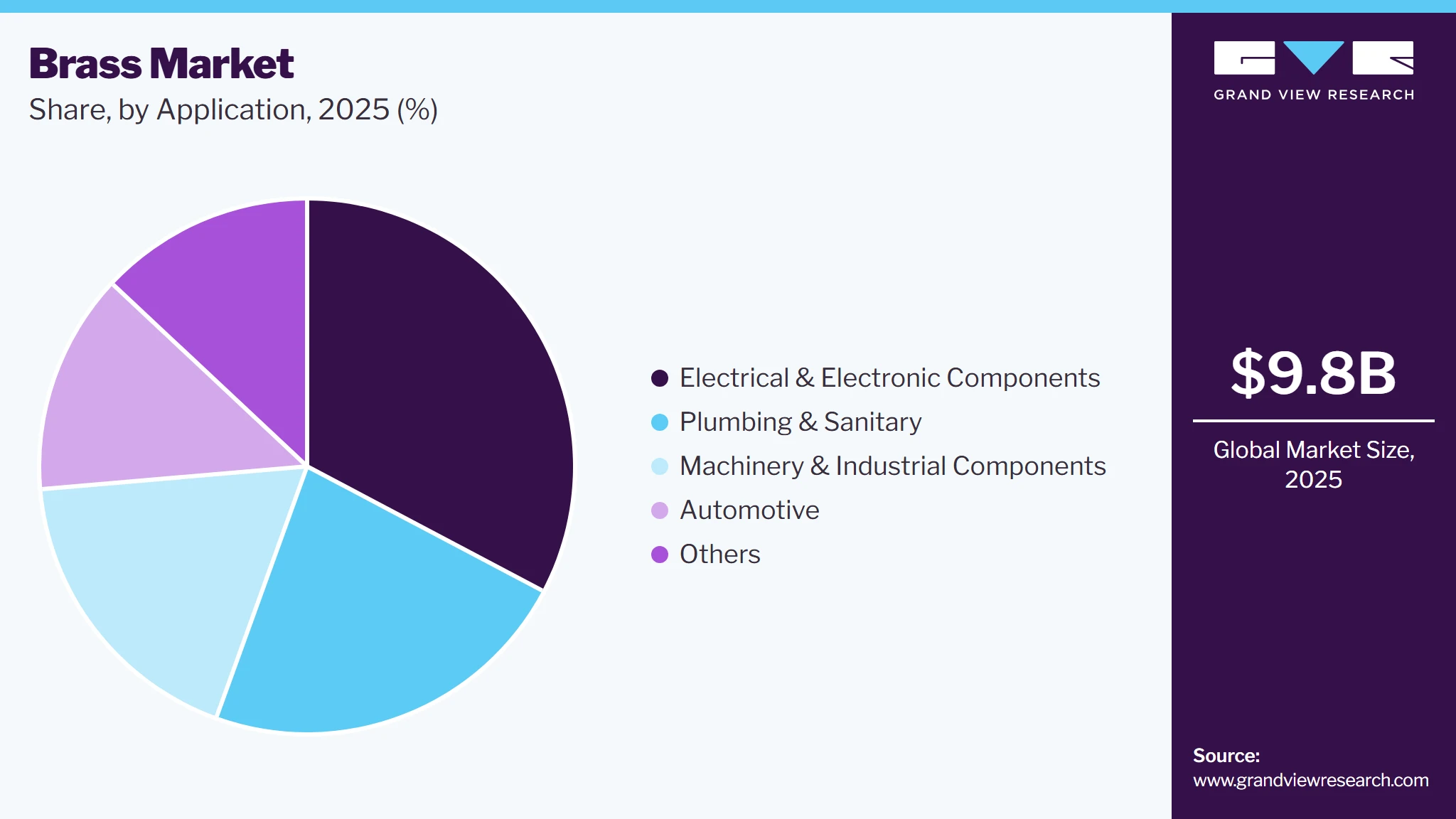
The electrical & electronic components segment dominated the market, with a revenue share of 32.7% in 2025, supported by electrification, expansion of power distribution networks, growth in electronic equipment manufacturing, and rising demand for connectors, terminals, and switchgear components.
The automotive segment, which accounted for a 13.3% share in 2025, is projected to grow at a CAGR of 4.7%, driven by increasing electrical content in vehicles, although the shift toward electric vehicles and the use of alternative materials may influence adoption in selected components.
 To learn more about this report, Download Free Sample Report
The plumbing and sanitary segment is driven by increasing demand for brass fittings, faucets, valves, pipe connectors, and other water distribution components across residential, commercial, and industrial buildings. Brass is widely preferred for its corrosion resistance, durability, machinability, and ability to withstand varying water pressure and operating conditions. Rising urbanization, housing construction, renovation activities, and investments in water supply and sanitation infrastructure are supporting demand. In addition, the growing emphasis on drinking water safety is encouraging the adoption of lead-free brass alloys, while demand for high-quality sanitary fittings and long-lasting plumbing systems continues to create opportunities for manufacturers.
Regional Insights
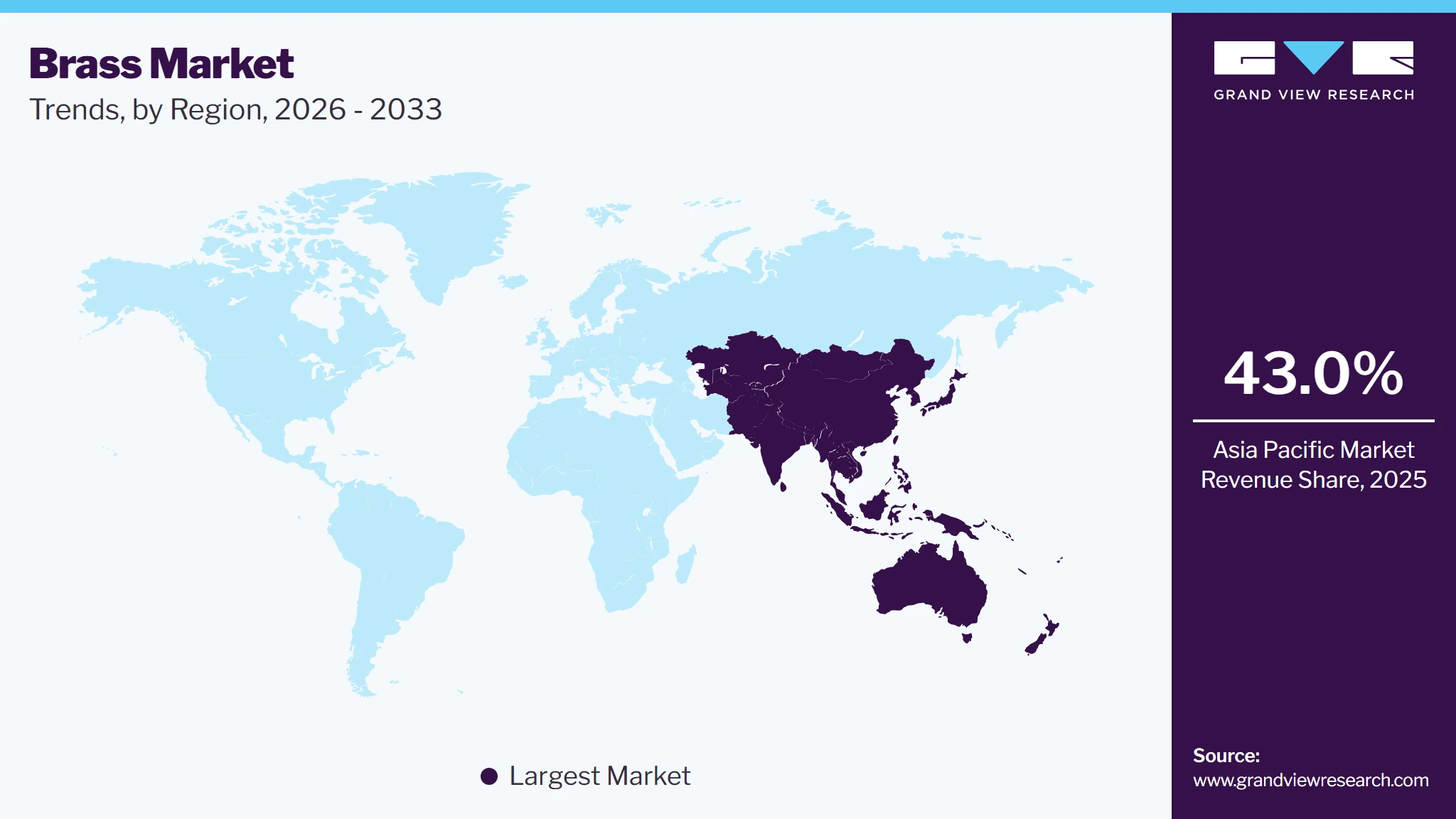
Asia Pacific dominated the brass market with the largest market revenue share of 43.0% in 2025. Asia Pacific benefits from a strong manufacturing base, rapid urbanization, and sustained investment in construction, electrical infrastructure, and industrial production. Rising demand for plumbing fittings, sanitary ware, electrical connectors, valves, and precision-engineered components is supporting regional consumption. China, India, Japan, and South Korea remain important contributors, driven by their established manufacturing industries, expanding infrastructure networks, and demand for durable metal components. Increasing adoption of recyclable materials and advancements in alloy processing are also supporting regional industry development.
 To learn more about this report, Download Free Sample Report
China Brass Market Trends
The brass industry in the China held the largest revenue share in 2025. China's demand is supported by its extensive electrical and electronics manufacturing base, large automotive industry, and continued investment in power distribution and urban infrastructure. Brass components are widely used in electrical connectors, plumbing and sanitary fittings, industrial machinery, valves, and precision-engineered products. The country's established metal processing capabilities and extensive manufacturing supply chains support production and consumption. Continued infrastructure modernization, industrial automation, and demand for high-quality components are expected to sustain growth.
Europe Brass Market Trends
Europe's demand is supported by established automotive, industrial machinery, electrical equipment, and construction industries. Brass is widely used in plumbing systems, heating equipment, valves, connectors, and precision components. Regulatory requirements for materials in contact with drinking water are encouraging the adoption of compliant lead-free and low-lead alloys. The region's established metalworking capabilities, scrap recovery infrastructure, and emphasis on resource efficiency further support the use of recycled brass and the development of specialized alloy products.
North America Brass Market Trends
North America benefits from demand across electrical infrastructure, plumbing and building products, automotive manufacturing, and industrial equipment. Modernization of power distribution networks, renovation of residential and commercial buildings, and investment in industrial facilities support consumption of brass fittings, connectors, valves, and precision components. Drinking-water safety requirements are encouraging the use of compliant alloy grades, while established recycling networks provide access to secondary copper and zinc.
Demand in the U.S. is supported by investment in electrical infrastructure, residential and commercial construction, industrial machinery, and automotive production. Brass is widely used in electrical terminals, connectors, plumbing fittings, faucets, valves, and precision-machined components. Replacement of aging water infrastructure and growing requirements for compliant drinking-water components are encouraging demand for suitable alloy grades.
Middle East & Africa Brass Market Trends
Demand across the Middle East and Africa is supported by urbanization, construction activity, water supply infrastructure, power distribution projects, and industrial development. Brass fittings, valves, plumbing components, and electrical connectors are used in residential and commercial buildings, water management systems, and industrial facilities. Investment in housing, tourism infrastructure, utilities, and industrial diversification, particularly in Gulf countries, is creating opportunities for suppliers. Import dependence, fluctuations in raw material prices, and differences in industrial development across countries influence regional supply and consumption patterns.
Latin America Brass Market Trends
Latin America's demand is influenced by residential construction, infrastructure modernization, water distribution projects, and industrial manufacturing. Brass is used in plumbing and sanitary fittings, electrical components, valves, connectors, and machinery parts. Urban housing development, renovation activity, and investment in utilities support consumption, while automotive and equipment manufacturing contribute to demand for precision components. However, currency fluctuations, variable economic conditions, dependence on imported materials in some countries, and volatility in copper and zinc prices can affect production costs and purchasing activity.
Key Brass Company Insights
Some of the key players operating in the market include Wieland Group, Aurubis AG, Poongsan Corporation, and others.
-
Wieland Group (Established in 1820) is a German manufacturer of semi-finished copper and copper alloy products headquartered in Ulm, with a portfolio that includes strips, sheets, tubes, rods, wires, and profiles. The company supplies brass rods and other brass products, including its Ecoline range of lead-free brass alloys designed for applications facing stricter lead limits, and has expanded its North American presence through acquisitions such as Global Brass and Copper, Scott Brass, and Farmers Copper. Its products serve electrical and electronics, automotive, plumbing, and industrial machinery customers.
-
Aurubis AG (Established in 1866 as Norddeutsche Affinerie) is a Hamburg-based multimetal company and the world's largest copper recycler. The company produces more than one million tons of copper cathodes annually and processes them into wire rod, continuous cast shapes, profiles, and rolled products made of copper and copper alloys, including brass products from its Stolberg operations. Its products supply electrical, electronics, automotive, and construction customers, supported by a service and sales network across Europe, Asia, and North America.
-
Poongsan Corporation (Established in 1968) is a South Korean manufacturer of fabricated copper and copper alloy products headquartered in Seoul. Its non-ferrous metals portfolio includes brass and other copper alloy sheets, strips, rods, bars, and wires, as well as connector materials, lead frame alloys, and coin blanks, alongside defense products. Its U.S. subsidiary, PMX Industries, supplies copper alloy strip to customers in North America.
Key Brass Companies
The following key companies have been profiled for this study on the brass market.
-
Aurubis AG
-
Diehl Metall Stiftung & Co. KG
-
KME Group S.p.A.
-
Luvata
-
Midland Industries
-
Mitsubishi Materials Corporation
-
Ningbo Jintian Copper (Group) Co., Ltd.
-
Poongsan Corporation
-
TS Brass
-
Wieland Group
Competitive Benchmarking
Category
Operating Strategies
Competitive Edge
Weakness
Established Players (e.g. Wieland Group, Aurubis AG, KME Group S.p.A., Mitsubishi Materials Corporation)
- Focus on integrated copper and copper alloy production, combining casting, extrusion, drawing, and rolling with in-house scrap recycling.
- Expand lead-free and application-specific alloy portfolios and strengthen service-center and distribution networks.
- Invest in recycling, energy efficiency, and regional capacity, including acquisitions, to secure supply and serve key customers.
- Large-scale production capacity, broad semi-finished product ranges, and global sales and service networks.
- Technical expertise in alloy development, precision processing, and compliance with drinking-water and electrical-grade specifications.
- Long-standing relationships with automotive, electrical, plumbing, and industrial OEM customers, and access to recycled raw material.
- Earnings are exposed to copper and zinc price volatility and to metal price pass-through lags.
- Energy-intensive operations and regulatory compliance increase cost and capital requirements.
- Exposure to cyclical end markets such as construction, automotive, and industrial machinery.
Emerging & Regional Players (e.g., Midland Industries, TS Brass)
- Focus on supplying brass rods, wires, fittings, and other forms for regional construction, plumbing, electrical, and industrial customers.
- Compete on price, customization, delivery speed, and local service, including cut-to-size and machined products.
- Expand through export partnerships, distribution networks, and certified lead-free product offerings.
- Flexibility in serving smaller orders and customized specifications.
- Potential cost advantages through regional sourcing, scrap availability, and proximity to customers.
- Opportunities to serve underserved regional markets and niche applications.
- Smaller scale and less purchasing power for copper and zinc than integrated producers.
- Dependence on purchased scrap or cathode, quality consistency, and compliance with evolving lead regulations.
- Lower brand recognition and potentially more limited international distribution than established producers.
Recent Development
-
In January 2026, Wieland acquired Techni-Cast, a California-based specialist in centrifugal casting of copper alloys, adding to a series of North American acquisitions that includes Global Brass and Copper, Scott Brass, and Farmers Copper. The transaction extends the group's casting and service capabilities for copper alloy customers in the region.
-
In April 2026, Aurubis AG marked its 160th anniversary, reaffirming its position as the world's largest copper recycler. The company produces more than one million tons of copper cathodes annually and processes them into wire rod, continuous cast shapes, profiles, and rolled products made of copper and copper alloys used across electrical, industrial, and construction applications.
Brass Market Report Scope
Report Attribute
Details
Market Definition
Market size represents the annual revenue generated from the sale of brass (copper-zinc alloy) semi-finished products, including brass wires, brass rods/bars, and other forms such as sheets, strips, tubes, castings, and forgings, across various types and applications.
Market size in 2025
USD 9.8 billion
Estimated market size in 2026
USD 13.3 billion
Projected market size by 2033
USD 18.6 billion
Growth rate
CAGR of 5.0% from 2026 to 2033
Base year for estimation
2025
Historical data
2021 - 2024
Forecast period
2026 - 2033
Quantitative units
Revenue in USD million/billion, volume in kilotons, and CAGR from 2026 to 2033
Report coverage
Revenue and volume forecast, competitive landscape, growth factors, and trends
Segments covered
Type, application, region
Regional scope
North America; Europe; Asia Pacific; Latin America; Middle East & Africa
Country scope
U.S.; Canada; Mexico; Germany; UK; France; Italy; China; India; Japan; South Korea; Brazil; GCC; South Africa
Key companies profiled
Aurubis AG; Diehl Metall Stiftung & Co. KG; KME Group S.p.A.; Luvata; Midland Industries; Mitsubishi Materials Corporation; Ningbo Jintian Copper (Group) Co., Ltd.; Poongsan Corporation; TS Brass; Wieland Group
Customization scope
Free report customization (equivalent up to 8 analysts working days) with purchase. Addition or alteration to country, regional & segment scope.
Pricing and purchase options
Avail customized purchase options to meet your exact research needs. Explore purchase options
Global Brass Market Report Segmentation
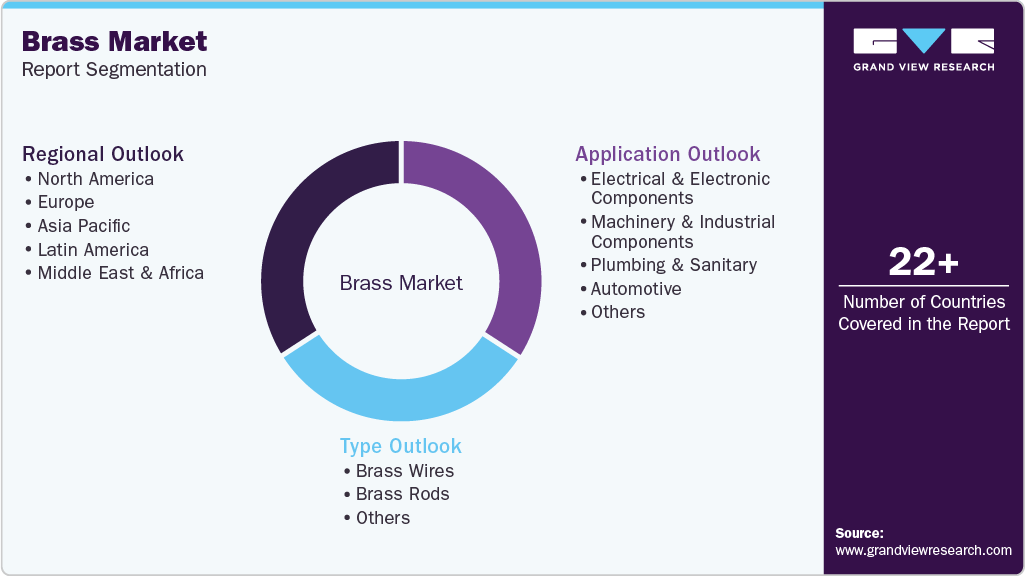
This report forecasts revenue and volume growth at global, regional, and country levels and provides an analysis of the latest industry trends in each of the sub-segments from 2021 to 2033. For this study, Grand View Research has segmented the global brass market report on the basis of type, application, and region.
 To learn more about this report, Download Free Sample Report
-
Type Outlook (Volume, Kilotons; Revenue, USD Million, 2021 - 2033)
-
Brass Wires
-
Brass Rods
-
Others
-
-
Application Outlook (Volume, Kilotons; Revenue, USD Million, 2021 - 2033)
-
Electrical & Electronic Components
-
Machinery & Industrial Components
-
Plumbing & Sanitary
-
Automotive
-
Others
-
-
Regional Outlook (Volume, Kilotons; Revenue, USD Million, 2021 - 2033)
-
North America
-
U.S.
-
Canada
-
Mexico
-
-
Europe
-
Germany
-
UK
-
France
-
Italy
-
-
Asia Pacific
-
China
-
India
-
Japan
-
South Korea
-
-
Latin America
-
Brazil
-
-
Middle East & Africa
-
GCC
-
South Africa
-
-
Research Methodology
The brass market figures in this report are based on a proven research process that combines executive interviews with secondary research from proprietary databases, company filings, and recognized regulatory and institutional sources. Market size is built through value-chain sizing-reconciling supply-side and demand-side estimates-and triangulated with bottom-up and top-down approaches. Every estimate passes multiple levels of expert validation before publication, with each brass segment quantified using the revenue-capture definitions in the table below.
Segment Definition
Type
Revenue Capture Definition
Brass Wires
The brass wires segment captures revenue generated from drawn brass (copper-zinc alloy) wire supplied in round, flat, and profiled forms across a range of tempers and diameters. It is primarily used in electrical and electronic components such as connectors, terminals, springs, and contacts, as well as in fasteners and other drawn products.
Brass Rods
The brass rods segment represents revenue generated from extruded and drawn brass rods and bars, including free-cutting, lead-free, and forging grades. It is used for CNC-machined and forged parts such as valves, fittings, fasteners, gears, and precision components in plumbing, machinery, and automotive applications.
Others
The others segment captures revenue generated from other brass semi-finished forms, including sheets, strips, plates, tubes, castings, forgings, and customized profiles. It is used in architectural and decorative hardware, heat exchangers, musical instruments, and specialty industrial applications.
Application
Revenue Capture Definition
Electrical & Electronic Components
The electrical & electronic components segment captures revenue generated from brass used in connectors, terminals, switches, contact components, switchgear accessories, and other conductive and precision components for power distribution, electronics, and electrical equipment.
Machinery & Industrial Components
The machinery & industrial components segment represents revenue generated from brass used in gears, bearings, bushings, valves, fasteners, and precision parts for industrial machinery, tooling, hydraulic and pneumatic systems, and process equipment where machinability and wear resistance are required.
Plumbing & Sanitary
The plumbing & sanitary segment captures revenue generated from brass used in fittings, valves, faucets, taps, manifolds, and connectors for residential, commercial, and industrial plumbing and water distribution systems, including lead-free grades for potable water.
Automotive
The automotive segment represents revenue generated from brass used in vehicle components such as radiator and fuel system parts, electrical connectors and terminals, sensors, fittings, and synchronizer rings, where corrosion resistance, conductivity, and machinability are required.
Others
The others segment includes revenue generated from brass used in architectural and decorative hardware, locks and hinges, musical instruments, marine fittings, ammunition components, and other applications not classified elsewhere.
Estimation Model
Layer Name
Key Question
Description
Industrial & Construction Demand Base Layer
What forms the demand base?
Identify global demand from major brass-consuming industries, including electrical & electronic components, machinery & industrial components, plumbing & sanitary, automotive, and other applications. Assess copper semis and brass-mill demand, construction and housing activity, electrical equipment and vehicle production, and industrial output to establish the total addressable demand for brass semi-finished products.
Brass End-Use Penetration Layer
Where is brass utilized?
Estimate penetration across key applications, including connectors and terminals, plumbing fittings and valves, machined industrial parts, and automotive components. Analyze adoption across product forms, including brass wires, brass rods, and other forms such as sheets, strips, tubes, castings, and forgings, based on application requirements, regional industry structure, and alloy specifications, including lead-free grades.
Brass Consumption Intensity Layer
How much brass is consumed?
Analyze consumption intensity based on production of electrical equipment, plumbing products, machinery, and vehicles, and brass content per unit. Evaluate usage according to alloy grade, product form, performance specifications, and processing requirements. Volumes are estimated in kilotons by region and country, with consumption intensity varying by application, local industry structure, and the share of recycled input.
Revenue Layer
How is revenue generated?
Quantify revenue by applying regional brass prices to consumption volumes across brass wires, brass rods, and others, and across electrical & electronic components, machinery & industrial components, plumbing & sanitary, automotive, and other applications. The benchmark price is built from the copper and zinc metal value (LME, CuZn37 basis) plus a net fabrication premium, adjusted by regional price factors, and is influenced by product form, alloy grade, processing costs, logistics, and regional supply-demand dynamics.
Delivered Customizations
We have successfully delivered the following deep-dive customizations
Client Request
Customization Delivered
Value Adds
Regional Price Differential Analysis
Comparison of brass prices across selected countries and regions, considering product form (brass wires, brass rods, and others), copper and zinc metal value, fabrication premiums, transportation expenses, import duties, and applicable handling costs. The analysis evaluates differences between domestic and imported products and examines the factors influencing regional price variations and landed costs.
Supports regional pricing decisions, supplier selection, and identification of cost-competitive sourcing locations. Help businesses evaluate export opportunities, optimize procurement strategies, and improve price competitiveness across target geographies.
Electrification & Infrastructure Project Pipeline
Assessment of announced, ongoing, and planned projects that drive brass demand, including power transmission and distribution upgrades, EV charging infrastructure, housing and water supply and sanitation programs, and industrial automation investments. The analysis examines project locations, development timelines, and potential consumption of brass wires, rods, and fittings to identify projects that may generate demand for brass.
Helps identify prospective demand centers and develop project-based sales pipelines. Supports early engagement with OEMs, fitting and valve manufacturers, contractors, and utilities while enabling better regional sales planning and customer targeting.
Price & Cost Analysis
Assessment of brass pricing by product form, alloy grade, region, and supply channel. The analysis considers copper and zinc price movements (LME), the CuZn37 metal-value build-up, fabrication and processing costs, scrap availability, transportation, and handling to understand the key factors influencing selling prices and procurement costs.
Supports pricing strategy, procurement negotiations, and cost planning. Help manufacturers evaluate cost drivers, distributors optimize margins, and buyers compare sourcing alternatives to improve purchasing efficiency and manage price volatility.
About the Author(s)
Advanced Interior Materials Research Team
Advanced Materials · Advanced Interior MaterialsThis report was authored by the advanced interior materials research team at Grand View Research - comprising two research analysts, one senior research analyst, and one industry expert - with specialized expertise in the advanced interior materials segment of the advanced materials industry. All findings are based on proprietary advanced materials databases, executive interviews, and regulatory analysis, subject to internal peer review prior to publication.
Last Updated:
Speak to Analyst

Customize this report to your needs - add regions, segments, or data points, with 20% free customization.
Or view our licence options:


ISO 9001:2015 & 27001:2022 Certified
We are GDPR and CCPA compliant! Your transaction & personal information is safe and secure. For more details, please read our privacy policy.


