
- Home
- »
- Advanced Interior Materials
- »
-
Brazed Plate Heat Exchangers Market, Industry Report 2033GVR Report cover
![Brazed Plate Heat Exchangers Market Size, Share & Trends Report]()
Brazed Plate Heat Exchangers Market (2025 - 2033) Size, Share & Trends Analysis Report By Product (Single Circuit, Multi Circuit), By Application (HVAC-R, Chemical & Petrochemical, Food & Beverage, Power Generation, Heavy Industry), By Region, And Segment Forecasts
- Report ID: GVR-3-68038-563-2
- Number of Report Pages: 100
- Format: PDF
- Historical Range: 2021 - 2023
- Forecast Period: 2025 - 2033
- Industry: Advanced Materials
- Report Summary
- Table of Contents
- Interactive Charts
- Methodology
- Download FREE Sample
-
 Download Sample Report
Brazed Plate Heat Exchangers Market Summary
The global brazed plate heat exchanger market size was estimated at USD 1,093.7 million in 2024 and is projected to reach USD 2,076.3 million by 2033, growing at a CAGR of 7.6% from 2025 to 2033. Rising demand for brazed plate heat exchangers in floor heating, economizers, oil coolers, condensers, refrigerant evaporators, super-coolers, and various other industrial applications is expected to drive the market.
Key Market Trends & Insights
- Europe dominated the brazed plate heat exchanger market with the largest revenue share of 33.2% in 2024.
- The brazed plate heat exchangers market in the UK is expected to grow over the forecast period.
- By product, the multi circuit dominated the brazed plate heat exchangers market in 2024, accounting for the highest revenue share of 65.8%.
- By application, the HVAC-R segment dominated the brazed plate heat exchanger industry in 2024, holding the largest revenue share of 24.1%.
Market Size & Forecast
- 2024 Market Size: USD 1,093.7 Million
- 2033 Projected Market Size: USD 2,076.3 Million
- CAGR (2025-2033): 7.6%
- Europe: Largest market in 2024
- Asia Pacific: Fastest growing market
Rising electricity prices over the past decade are driving industries to adopt low-power-consuming equipment, which is expected to boost the demand for brazed plate heat exchangers. These exchangers are gaining traction due to their compact size, energy efficiency, and ability to reduce operational costs. In particular, multi-circuit brazed plate heat exchangers are increasingly being used in industries with high production demands, as they offer enhanced performance while minimizing energy consumption.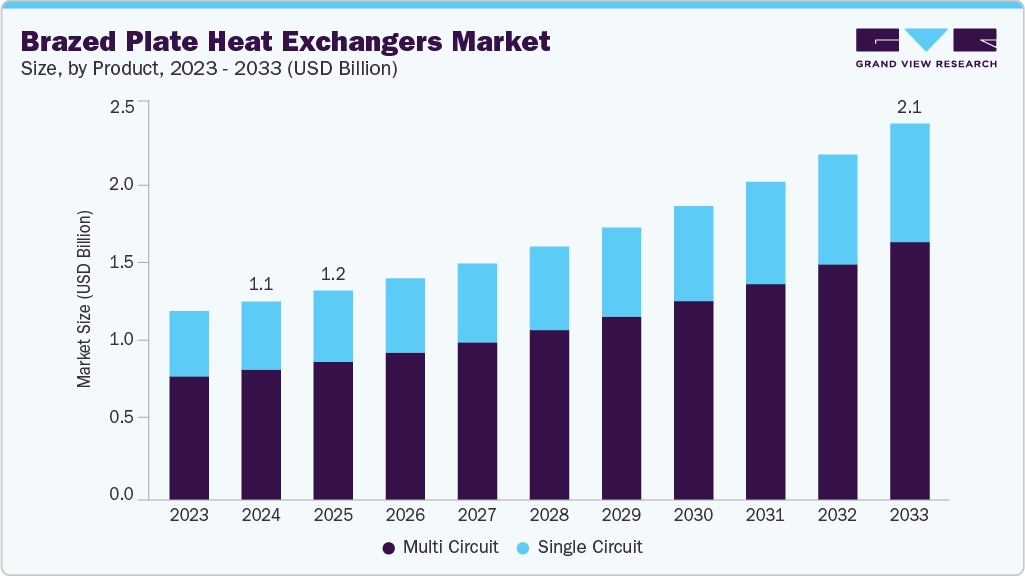
Market Concentration & Characteristics
The global brazed plate heat exchanger market is moderately fragmented, with several international and regional players competing. While large companies dominate with extensive product portfolios and distribution networks, smaller manufacturers offer niche solutions. Innovation, customization, and regional demand variations prevent any single company from holding a significantly dominant market share.
The brazed plate heat exchangers industry is witnessing significant innovation focused on enhancing thermal efficiency, compact design, and corrosion resistance. Manufacturers are integrating advanced materials, improved flow patterns, and digital monitoring features to meet the growing demand for energy-efficient and space-saving solutions. Innovations also support compatibility with low-GWP refrigerants and high-pressure applications, aligning with sustainability trends and emerging industry needs.
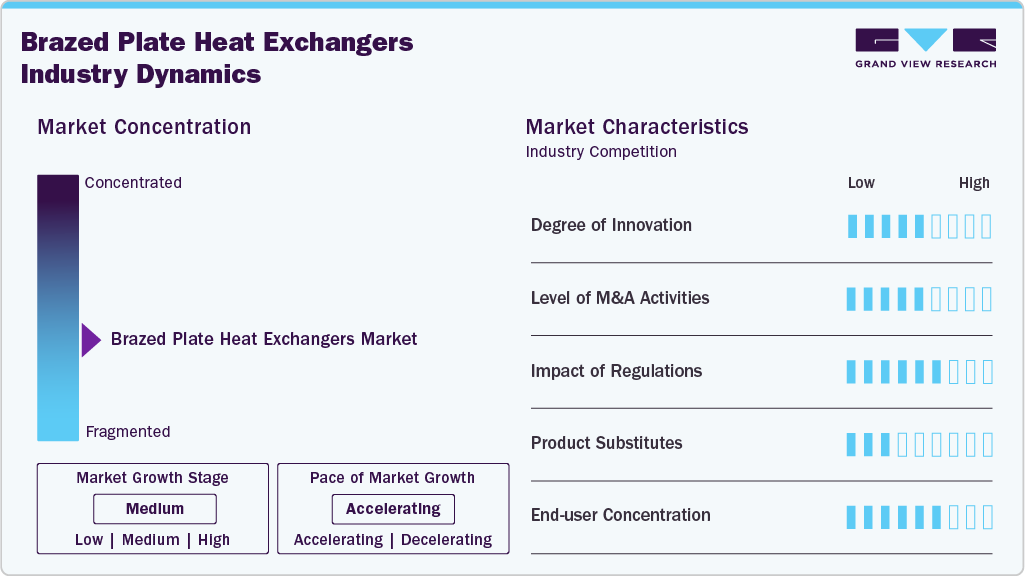
Mergers and acquisitions in the market for brazed plate heat exchangers are driven by the need to expand global reach, enhance production capabilities, and strengthen technological portfolios. Major players acquire smaller or specialized companies to access new customer bases and product lines. These activities help companies stay competitive, adapt to market changes, and accelerate growth in industries like HVAC, energy, and chemicals.
Environmental regulations promoting energy efficiency and lower emissions are significantly shaping the brazed plate heat exchangers market. Governments are enforcing standards that encourage the use of eco-friendly refrigerants and high-performance heat exchangers. Compliance with safety, material, and pressure handling regulations drives innovation and affects design and material choices, pushing manufacturers to develop more sustainable and regulation-compliant products globally.
Drivers, Opportunities & Restraints
A major driver for the brazed plate heat exchangers market is the increasing demand for energy-efficient and compact thermal systems in HVAC, refrigeration, and industrial applications. These exchangers offer high heat transfer efficiency and a smaller footprint compared to traditional types, making them ideal for modern systems. Rising environmental concerns and regulations promoting low-energy consumption further enhance their adoption across residential, commercial, and industrial sectors worldwide.
Growing use of renewable energy systems and district heating applications is an emerging opportunity in the market. As countries invest in sustainable infrastructure, the demand for efficient heat transfer solutions compatible with solar, geothermal, and waste heat recovery systems is rising. Expansion into developing markets, where industrialization and modernization are accelerating, also presents significant growth potential for manufacturers offering innovative, cost-effective exchanger solutions.
A key challenge for the brazed plate heat exchangers industry is performance limitations under high-fouling or extremely corrosive conditions. While efficient in clean applications, they are less suitable in industries involving contaminated fluids or demanding chemical processes. Additionally, the complexity of cleaning and maintenance, especially in sealed units, can limit their use in certain applications. Balancing compact design with durability and ease of serviceability remains an ongoing technical hurdle.
Product Insights
The multi circuit dominated the brazed plate heat exchangers market in 2024, accounting for the highest revenue share of 65.8%. This can be attributed to the increasing demand for energy-efficient HVAC systems and compact designs in commercial and industrial applications. Its ability to handle multiple refrigerant circuits within a single unit enhances performance and space savings, making it ideal for modern systems seeking cost-effective and sustainable thermal solutions.
The single circuit segment is expected to grow at a considerable CAGR of 6.6% from 2025 to 2033 in terms of revenue. This growth of the segment can be attributed to its cost-effectiveness, compact design, and efficient heat transfer capabilities. It is ideal for applications requiring consistent thermal performance, such as HVAC and refrigeration. Increasing demand for energy-efficient systems across residential and commercial sectors further drives their adoption and market expansion.
Application Insights
The HVAC-R segment dominated the brazed plate heat exchanger industry in 2024, holding the largest revenue share of 24.1%. This can be attributed to the rising demand for efficient thermal management in processing, pasteurization, and refrigeration. These heat exchangers offer compact design, high efficiency, and easy maintenance, ideal for hygienic applications. As the industry emphasizes energy savings, sustainability, and strict temperature control, brazed plate heat exchangers are increasingly favored for both small- and large-scale operations.
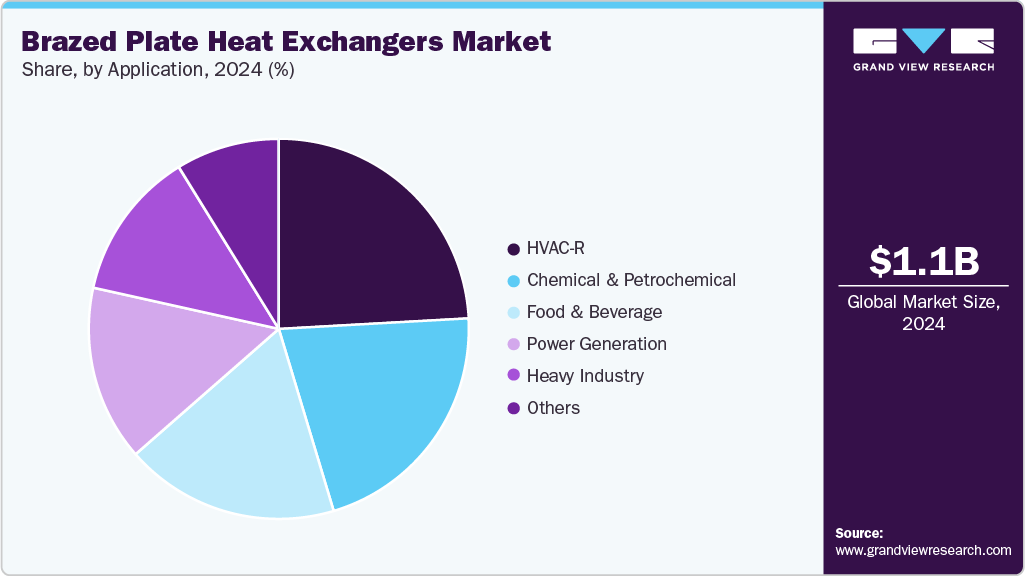
The food & beverage segment is expected to grow at a considerable CAGR of 8.4% from 2025 to 2033 in terms of revenue. The food & beverage segment is projected to expand due to the need for precise temperature control and hygienic processing. These heat exchangers offer efficient thermal performance, compact design, and easy cleaning, ideal for pasteurization, cooling, and fermentation processes. Increasing global demand for processed foods and beverages is further accelerating market adoption in this sector.
Regional Insights
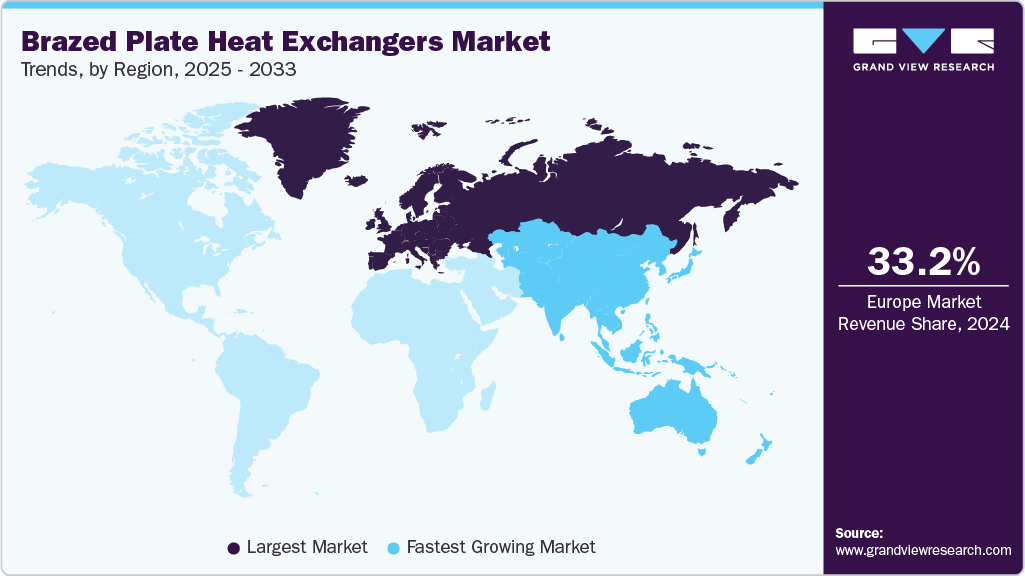
Europe dominated the brazed plate heat exchangers industry with a revenue share of 33.2% in 2024, driven by strict energy efficiency regulations, decarbonization goals, and demand for sustainable heating and cooling solutions. The region’s mature industrial base and emphasis on green technologies promote adoption in HVAC-R, power, and process industries. Government incentives and strong R&D infrastructure further support innovation and market expansion.
Germany’s brazed plate heat exchangers market is growing rapidly due to its advanced manufacturing sector, strong focus on energy efficiency, and transition toward renewable energy. The country's initiatives for low-carbon heating solutions and green building standards drive demand. Widespread use in industrial processes, district heating, and high-tech applications also contributes to consistent market growth and technological advancement.
The brazed plate heat exchangers market in the UK is expected to grow over the forecast period. Sustainability targets, electrification of heating systems, and energy-efficient building initiatives fuel the growth of the UK’s brazed plate heat exchanger industry. Rising adoption in commercial HVAC systems and industrial processing also supports the market expansion.
North America Brazed Plate Heat Exchangers Market Trends
The North America brazed plate heat exchanger industry is expected to grow at a 7.1% CAGR during the forecast period, driven by the rising demand in HVAC-R, power generation, and industrial applications. The region’s focus on energy efficiency, sustainability, and infrastructure modernization is encouraging adoption. Technological advancements and supportive government policies are also contributing to increased use across various sectors, further fueling market expansion.
U.S. Brazed Plate Heat Exchangers Market Trends
The brazed plate heat exchanger industry in the U.S. is expected to grow at a CAGR of 6.8% from 2025 to 2033. The U.S. is poised for strong growth due to its strong industrial base, growing HVAC-R demand, and emphasis on energy-efficient solutions. Expansion in sectors like data centers, food processing, and renewable energy is likely to boost market growth over the forecast period.
The Mexico brazed plate heat exchangers market is expected to grow over the forecast period. Mexicois anticipated to experience surging demand for brazed plate heat exchangers due to industrial expansion, increasing manufacturing activities, and rising demand for refrigeration and air conditioning systems. The country's integration into global supply chains and growth in the food processing and automotive industries are likely to enhance the market growth. Government incentives for energy efficiency and foreign investments are further supporting adoption and market development in the region.
Asia Pacific Brazed Plate Heat Exchangers Market Trends
The Asia Pacific brazed plate heat exchanger industry is expected to grow at an 8.9% CAGR during the forecast period, due to urbanization, industrialization, and expanding HVAC-R demand. Rising energy efficiency awareness, infrastructure development, and growing food processing and chemical industries support adoption. Government initiatives promoting sustainable technologies across countries like China, India, and Southeast Asia are further fueling market expansion and technological integration.
The China brazed plate heat exchangers market leads Asia Pacific,due to its vast industrial base, aggressive urban development, and growing HVAC-R and automotive sectors. Government policies promoting energy efficiency and emissions reduction support strong demand. Expansion in electronics, food processing, and renewable energy sectors further boosts market adoption, with local manufacturing capabilities enhancing cost-effectiveness and availability.
The brazed plate heat exchangers market in India is growing rapidly, driven by the growing HVAC-R needs, urbanization, and increasing investments in industrial infrastructure. Rising awareness of energy efficiency and government initiatives like "Make in India" and Smart Cities are propelling adoption. Growth in sectors such as food processing, pharmaceuticals, and chemicals also supports increased usage and market development across the country.
Middle East & Africa Brazed Plate Heat Exchangers Market Trends
The Middle East & Africa brazed plate heat exchanger industry is poised for steady growth due to the rising demand for efficient cooling systems in harsh climates, infrastructure development, and industrial expansion. Increasing adoption in HVAC-R, energy, and desalination projects supports growth. Government initiatives for energy efficiency, coupled with investments in food processing and manufacturing, are further accelerating market penetration across the region.
The Saudi Arabia brazed plate heat exchangers market is witnessing growth through large-scale infrastructure projects, expanding HVAC-R needs, and a focus on sustainable energy solutions under Vision 2030. High temperatures increase demand for efficient cooling systems. At the same time, investments in industrial diversification, food processing, and renewable energy contribute to the broader adoption and development of advanced heat exchanger technologies in the kingdom.
Central & South America Brazed Plate Heat Exchangers Market Trends
The brazed plate heat exchanger industry in Central & South America is growing steadily, driven by rising demand in the food processing and chemical industries. Urbanization, industrial expansion, and a growing focus on energy-efficient technologies support adoption. Government efforts to modernize infrastructure and increase sustainability are further contributing to the region's market development and technological integration.
The Brazil brazed plate heat exchangers market is anticipated to grow over the forecast period. Brazil is a key player in Central & South America, with its growth supported by its large industrial base, growing HVAC-R demand, and strong food and beverage sector. Government incentives for energy efficiency and infrastructure upgrades fuel adoption. Expansion in chemical processing, renewable energy, and manufacturing industries further boosts demand for compact, cost-effective, and efficient heat exchanger solutions.
Key Brazed Plate Heat Exchangers Company Insights
Some of the key players operating in the market include Alfa Laval, Danfoss, and Kelvion Holding GmbH.
-
Alfa Laval is a global provider of specialized products and engineering solutions, focusing on heat transfer, separation, and fluid handling. The company designs and manufactures brazed plate heat exchangers used in HVAC, refrigeration, power generation, and industrial applications. With a strong presence in various markets, Alfa Laval emphasizes energy efficiency, sustainability, and performance reliability.
-
Danfoss develops energy-efficient technologies and components used in refrigeration, air conditioning, heating, and industrial automation. Its brazed plate heat exchangers are designed to deliver high thermal performance with minimal space requirements, making them suitable for a wide range of applications, including HVAC systems and renewable energy installations.
Key Brazed Plate Heat Exchangers Companies:
The following are the leading companies in the brazed plate heat exchanger market. These companies collectively hold the largest market share and dictate industry trends.
- Alfa Laval
- Danfoss
- Kelvion Holding GmbH
- SWEP International AB
- Xylem Inc.
- API Heat Transfer
- AIC
- Hisaka Works, Ltd.
- Charts Industries, Inc.
- GEA Group Aktiengesellschaft
- Mersen Corporate Services SAS
- Dover Corporation
- Lummus Technology LLC
- General Electric Company (GE Vernova)
- Johnson Controls Inc.
Recent Developments
-
In May 2025, Danfoss launched the new CO₂/Water brazed heat exchanger (H48T-CH) using Micro Plate technology, designed for CO₂ transcritical systems. Ideal for heat recovery in supermarkets and hypermarkets, it offers efficient, single-phase thermal performance tailored for sustainable refrigeration solutions.
-
In April 2025, SWEP International AB introduced brazed plate heat exchangers made from CO₂-reduced steel, offering a more sustainable option for customers aiming to lower the carbon footprint of their heating systems. This launch supports environmentally conscious manufacturing and energy-efficient operations.
Brazed Plate Heat Exchangers Market Report Scope
Report Attribute
Details
Market size value in 2025
USD 1,153.9 million
Revenue forecast in 2033
USD 2,076.3 million
Growth rate
CAGR of 7.6% from 2025 to 2033
Historical data
2021 - 2023
Forecast period
2025 - 2033
Quantitative units
Revenue in USD million and CAGR from 2025 to 2033
Report coverage
Revenue forecast, company ranking, competitive landscape, growth factors, and trends
Segments covered
Product, application, region
Regional scope
North America; Europe; Asia Pacific; Central & South America; Middle East & Africa
Country scope
U.S.; Canada; Mexico; Germany; France; Italy; China; India; Japan; Brazil; Saudi Arabia; UAE
Key companies profiled
Alfa Laval; Danfoss; Kelvion Holding GmbH; SWEP International AB; Xylem Inc.; API Heat Transfer; AIC; Hisaka Works, Ltd.; Chart Industries, Inc.; GEA Group Aktiengesellschaft; Mersen Corporate Services SAS; Dover Corporation; Lummus Technology LLC; General Electric Company (GE Vernova); Johnson Controls Inc.
Customization scope
Free report customization (equivalent up to 8 analysts working days) with purchase. Addition or alteration to country, regional & segment scope.
Pricing and purchase options
Avail customized purchase options to meet your exact research needs. Explore purchase options
Global Brazed Plate Heat Exchangers Market Report Segmentation
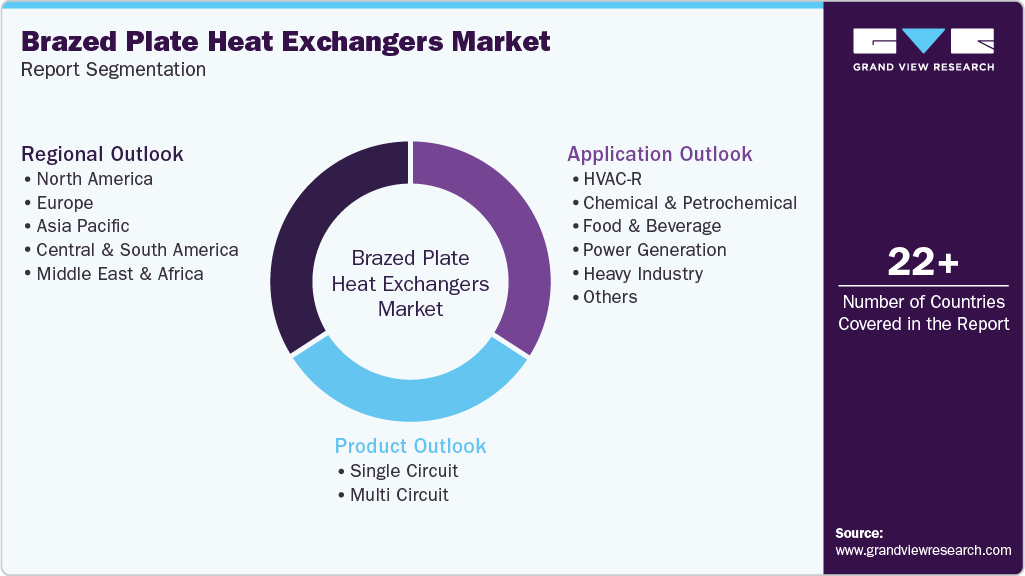
This report forecasts revenue growth at the global, regional, and country levels and provides an analysis of the latest industry trends in each of the sub-segments from 2021 to 2033. For this study, Grand View Research has segmented the global brazed plate heat exchangers market report based on product, application, and region:
-
Product Outlook (Revenue, USD Million, 2021 - 2033)
-
Single Circuit
-
Multi Circuit
-
-
Application Outlook (Revenue, USD Million, 2021 - 2033)
-
HVAC-R
-
Chemical & Petrochemical
-
Food & Beverage
-
Power Generation
-
Heavy Industry
-
Others
-
-
Regional Outlook (Revenue, USD Million, 2021 - 2033)
-
North America
-
U.S.
-
Canada
-
Mexico
-
-
Europe
-
Germany
-
France
-
Italy
-
-
Asia Pacific
-
China
-
India
-
Japan
-
-
Central & South America
-
Brazil
-
-
Middle East and Africa
-
Saudi Arabia
-
UAE
-
-
Frequently Asked Questions About This Report
b. The global brazed plate heat exchanger market size was estimated at USD 1,093.7 million in 2024 and is expected to be USD 1,153.9 million in 2025.
b. The global brazed plate heat exchanger market, in terms of revenue, is expected to grow at a compound annual growth rate of 7.6% from 2025 to 2033 to reach USD 2,076.3 million by 2033.
b. Multi circuit dominated the market in 2024, accounting for the highest revenue share at 65.8%. Brazed plate heat exchanger demand is expected to increase due to economic effectiveness, reduced carbon footprints, and increased energy efficiency, especially in applications for refrigeration, air conditioning, chillers, and heat pumps.
b. Some of the key players operating in the global brazed plate heat exchanger market include Tr Alfa Laval, Danfoss, Kelvion Holding GmbH, SWEP International AB, Xylem Inc., API Heat Transfer, AIC, Hisaka Works, Ltd., Chart Industries, Inc., GEA Group Aktiengesellschaft, Mersen Corporate Services SAS, Dover Corporation, Lummus Technology LLC, General Electric Company (GE Vernova), Johnson Controls Inc.
b. Key factors driving the global brazed plate heat exchanger market include rising demand for energy-efficient HVAC systems, industrial growth, urbanization, stricter environmental regulations, and increasing adoption in refrigeration, power generation, and food processing sectors, alongside advancements in compact heat transfer technologies.


Share this report with your colleague or friend.
Need a Tailored Report?
Customize this report to your needs — add regions, segments, or data points, with 20% free customization.


ISO 9001:2015 & 27001:2022 Certified
We are GDPR and CCPA compliant! Your transaction & personal information is safe and secure. For more details, please read our privacy policy.
Trusted market insights - try a free sample
See how our reports are structured and why industry leaders rely on Grand View Research. Get a free sample or ask us to tailor this report to your needs.













