
- Home
- »
- Advanced Interior Materials
- »
-
Bromine Market Size, Share And Trends Report, 2026- 2033GVR Report cover

Bromine Market (2026 - 2033) Size, Share & Trends Analysis Report By Derivative (Elemental Bromine, Calcium Bromide, Sodium Bromide), By Region (Europe, Asia Pacific, Middle East, Africa), And Segment Forecasts
Market Size, 2025
$2.1BMarket Estimate, 2026
$2.3BMarket Forecast, 2033
$3.3BCAGR, 2026–2033
5.5%Bromine Market Summary
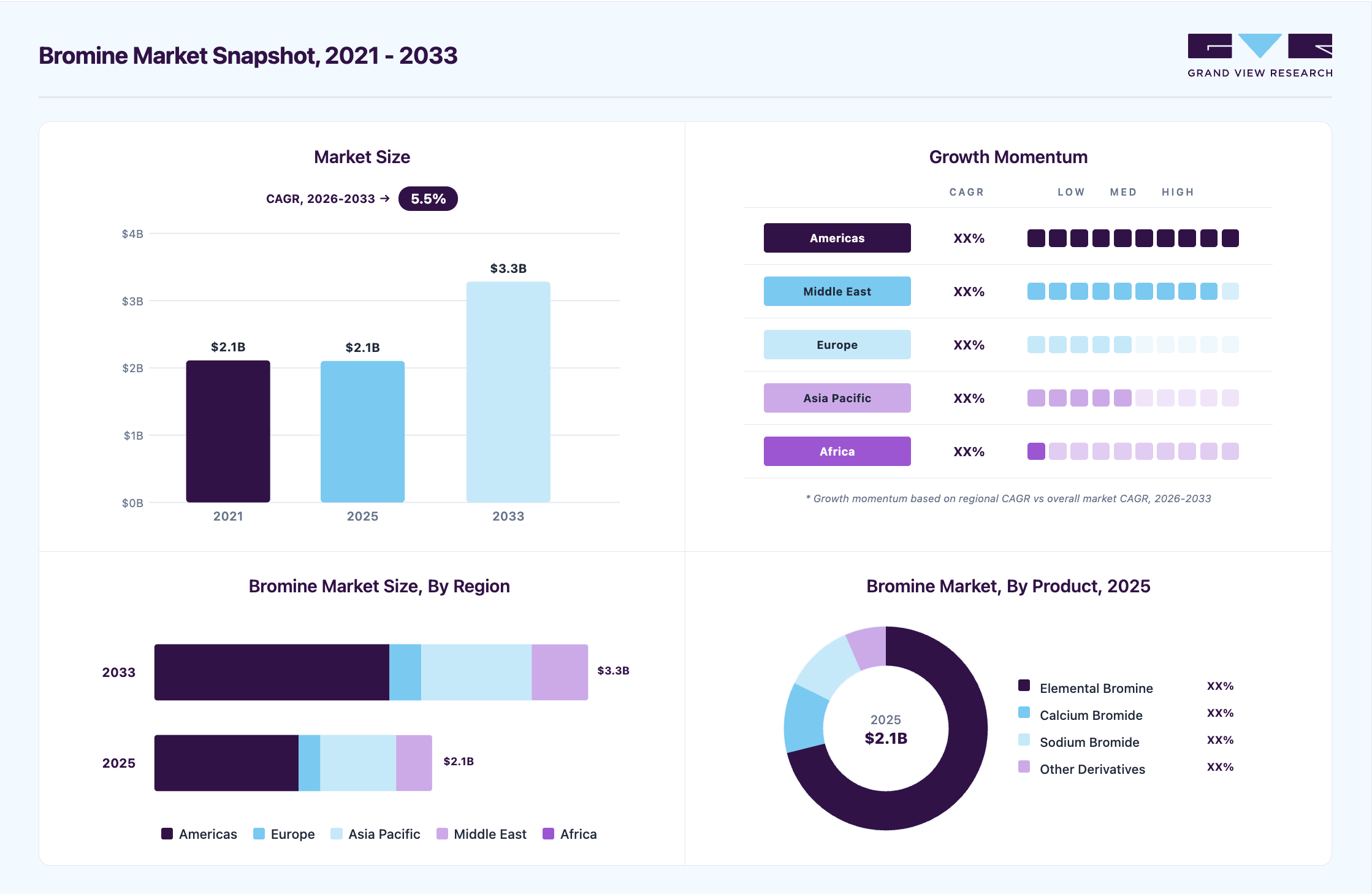
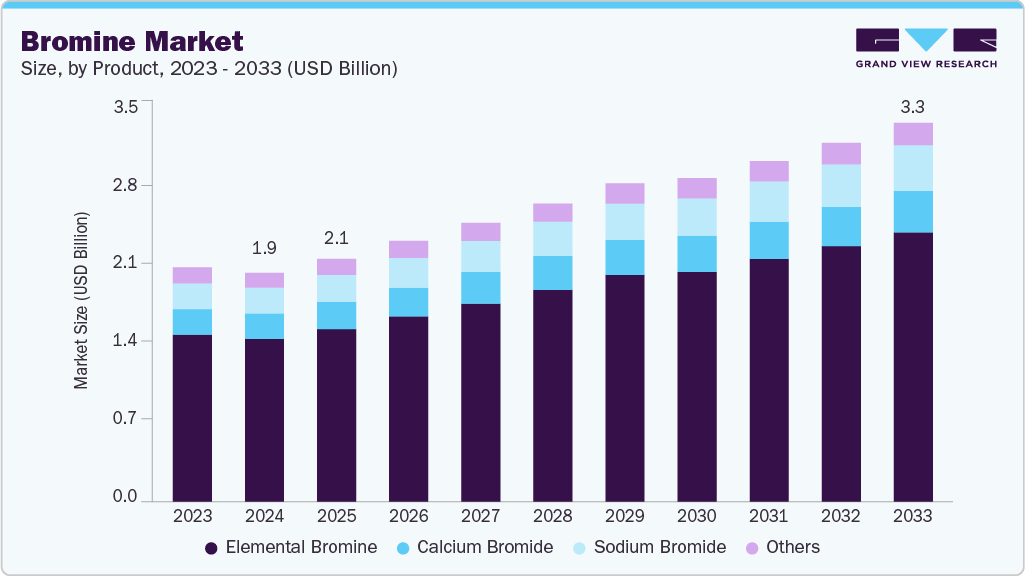
The global bromine market size was valued at USD 2.1 billion in 2025 and is projected to grow from USD 2.3 billion in 2026 to USD 3.3 billion by 2033, at a CAGR of 5.5% from 2026 to 2033. The market in Americas dominated with a revenue share of 51.9% in 2025. Bromine is widely used to produce flame retardants, particularly brominated flame retardants (BFRs), which are essential for enhancing fire safety in electronics, textiles, and construction materials.
 Source: Grand View Research, IR Documents, Primary Interviews, Paid DatabasesTo learn more about this report,
 Download Free Sample Report
 Key Market Trends & Insights
- By derivative: Elemental bromine accounted for the largest market revenue share of 71.1% in 2025.
Regional Highlights
- Largest regional market: Americas (51.9% revenue share, 2025)
- By country: The U.S. held the largest market share in 2025.
Market Size & Forecast
- Market size in 2025: USD 2.1 billion
- Estimated market size in 2026: USD 2.3 billion
- Projected market size by 2033: USD 3.3 billion
- CAGR (2026-2033): 5.5%
Three ways to get this report
Buy it, customize it, or ask a question.Ask an Analyst
Analyst response in 1 business day
- AccessReport author, directly
- Reply timeWithin 1 working day
- No sales callDirect answer only
- FormatEmail reply
- CostFree, no cost
Get the Full Report
What the study covers
- FormatsPDF · Excel · Dashboard
- Timeline2026–2033 annual, 2025 base
- Coverage20+ countries, 5 regions
- Companies10+ key players profiled
Customize the Report
20% free customization
- IncludeCountries, segments, points
- TailorTo your product definition
- ExtendDeeper competitor detail
- OrA fully bespoke study
- Turnaround5–10 working days
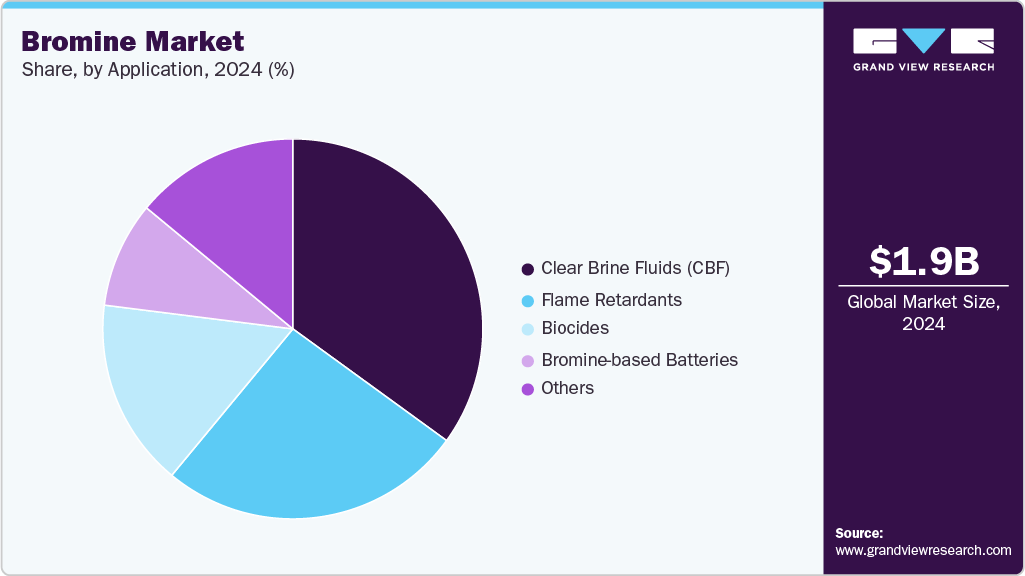
As global safety regulations become more stringent, particularly in developing economies where fire safety norms are being upgraded, the demand for bromine-based flame retardants is increasing steadily.Bromine-based drilling fluids, such as clear brine fluids (CBFs), are essential for deep and high-pressure oil wells. These fluids provide the necessary density to control pressure in the wellbore and are also non-damaging to the reservoir rock. As global energy demand continues to rise and exploration activities expand into more challenging environments, the consumption of bromine in this segment is expected to remain strong, particularly in the Middle East and the Americas.
 To learn more about this report, Download Free Sample Report
 The pharmaceutical and agrochemical industries also contribute significantly to the demand for bromine. In the pharmaceutical sector, bromine is used to synthesize several intermediates and active pharmaceutical ingredients (APIs), particularly for sedatives and analgesics. In agriculture, bromine compounds are used in fumigants and pesticides, especially in countries where soil-borne pathogens and pests impact crop productivity. Despite regulatory restrictions in certain regions, innovations in safer bromine-based chemicals continue to support growth in these end-use industries.
 To learn more about this report, Download Free Sample Report
 Water treatment is another important segment propelling the bromine market. Bromine-based biocides are increasingly preferred over chlorine in cooling towers, swimming pools, and industrial water systems due to their superior effectiveness in a wide pH range and lower odor profile. As industrialization intensifies and concerns over water hygiene rise globally, especially in emerging economies, the adoption of bromine compounds in water treatment is likely to see continued expansion.
Lastly, the market is positively impacted by the rising production and consumption of bromine in the Asia Pacific. China, India, and Southeast Asian countries have emerged as both major producers and consumers, driven by abundant brine deposits and growing industrial demand. Government initiatives supporting chemical manufacturing and infrastructure development further accelerate bromine consumption in the region. Overall, regulatory shifts, technological advancements, and regional economic growth continue to drive momentum in the global bromine market.
Market Dynamics
The bromine market was driven by the growing consumption of brominated flame retardants across electronics, electrical equipment, construction materials, and automotive components. Bromine compounds continued to play a critical role in improving fire safety performance in plastics, insulation materials, circuit boards, and consumer electronics. The increased production of electronic devices and the expansion of electrical infrastructure projects supported higher demand for flame-retardant additives across industrial manufacturing sectors.
Stringent fire safety regulations and building safety standards further strengthened demand for bromine in insulation systems, engineered plastics, and industrial materials. Manufacturers are increasingly focused on improving flame resistance performance in electronic and construction applications to comply with evolving safety requirements. In addition, rising urbanization and infrastructure development across the Asia Pacific and the Middle East sustained demand for bromine derivatives in industrial applications.
The bromine market faced constraints due to increased environmental scrutiny and regulatory restrictions on certain brominated flame retardants. Regulatory agencies across Europe and North America continued to impose stricter controls on specific brominated chemicals linked to environmental persistence and hazardous waste concerns. These regulations created compliance pressure for manufacturers and increased the need for reformulation and product substitution in several end-use industries.
The growing preference for halogen-free flame-retardant alternatives limited bromine demand growth in selected applications, particularly in the electronics and consumer goods sectors. Manufacturers faced rising investment requirements for sustainable product development, emission control systems, and environmental compliance measures. Volatility in bromine extraction costs and raw material availability also created operational challenges for producers operating in highly regulated markets.
Market Concentration & Characteristics
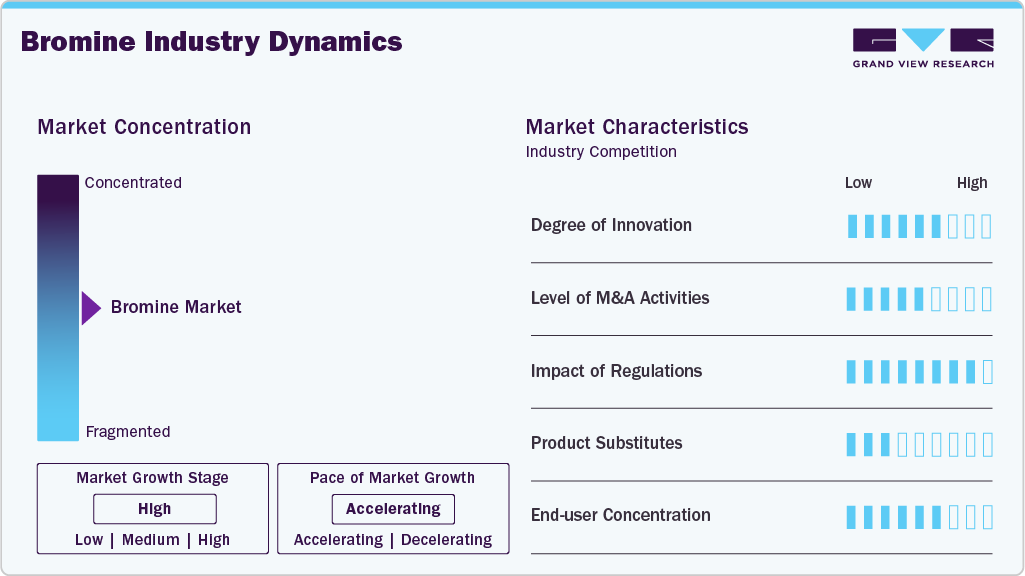
The market is moderately consolidated, characterized by the presence of multinational producers alongside regional manufacturers shaping the competitive landscape. These companies leverage integrated production facilities, strong distribution networks, and established access to natural bromine reserves. Key players are increasingly focusing on capacity expansions, investments in advanced bromine derivatives, and process optimization to improve efficiency and sustainability. Additionally, companies are strengthening regulatory compliance, enhancing supply chain reliability, and pursuing strategic partnerships to reinforce their competitive positioning in the global bromine market.
 To learn more about this report, Download Free Sample Report
 Leading players in the global bromine market are pursuing a combination of capacity expansions, product innovation, strategic partnerships, and sustainability-driven initiatives to strengthen their market presence. Companies engaged in bromine production and manufacturing are investing in advanced processing technologies and high-value brominated compounds to improve performance, efficiency, and environmental compliance. To meet rising demand across Asia Pacific and Latin America, several market participants are expanding production capacities, enhancing regional supply chains, and strengthening distribution networks to ensure reliable availability and support long-term market growth.
Derivative Insights
Elemental bromine is a precursor for brominated flame retardants (BFRs), clear brine fluids (CBFs), and numerous organic and inorganic bromine compounds. With the electronics industry expanding, the demand for BFRs like TBBPA and hexabromocyclododecane continues to rise, especially in Asia Pacific where electronics manufacturing hubs in China, South Korea, and Taiwan dominate global output.
Sodium bromide is anticipated to register the fastest CAGR over the forecast period. It is a dense, non-damaging fluid that helps control wellbore pressure in deep and high-temperature wells. As global energy demand grows and exploration moves into more complex geological environments, especially offshore, the demand for sodium bromide continues to increase. Additionally, when the element is combined with oxidizing agents like chlorine or ozone, it forms hypobromous acid, a highly effective biocide used to control bacterial growth in cooling towers, municipal water systems, and wastewater treatment plants.
Regional Insights
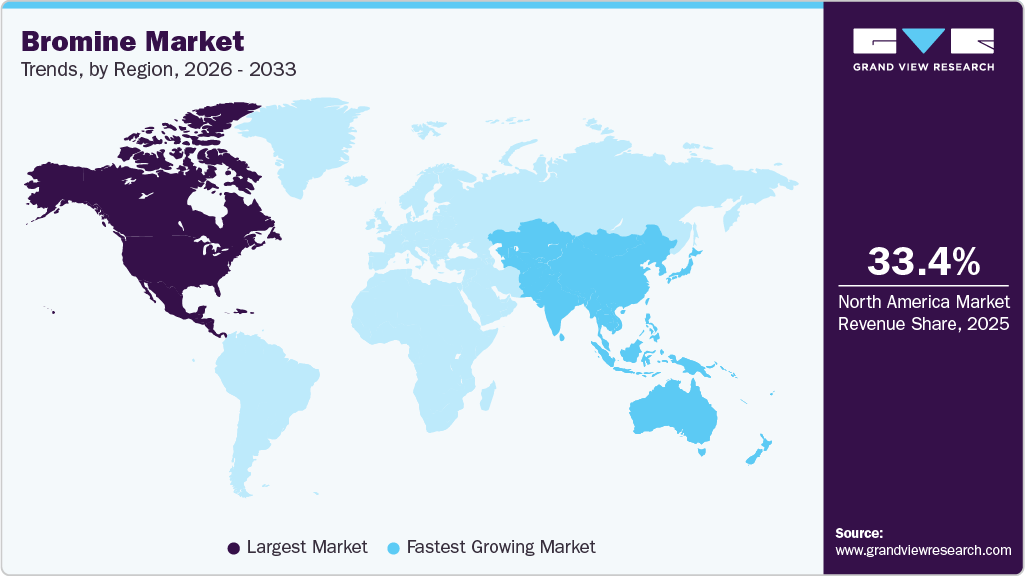
The Americas remained a dominant market in the global bromine market with a substantial revenue share of 51.9% in 2025. The market in Americas is growing steadily, driven by strong demand from the oil and gas and electronics sectors. Bromine is widely used to produce clear brine fluids, essential for controlling pressure in deep and high-temperature oil wells. As drilling activity increases in offshore and onshore regions, especially in the U.S., the need for bromine-based fluids has also risen. Additionally, brominated flame retardants are commonly used in electronics and construction materials to meet fire safety standards. With strict fire-prevention regulations in place across the region, these flame-retardants continue to support bromine consumption.
 To learn more about this report, Download Free Sample Report
 U.S. Bromine Market Trends
The U.S. accounted for over 98.5% value share in the Americas bromine market in 2025. The demand is strongly driven by the country’s continued investment in domestic energy production and infrastructure development. The push for energy independence has increased oil and gas drilling activities, especially in shale-rich regions and offshore basins. These operations create consistent demand for bromine-based inputs that support high-pressure and high-temperature drilling environments. Additionally, federal and state-level environmental policies aimed at reducing industrial emissions and improving water quality have encouraged industries to adopt bromine-based solutions, indirectly supporting the chemical demand.
Asia Pacific Bromine Market Trends
The Asia Pacific commanded a significant 27.2% share of the global market in 2025. It hosts nearly half of the world’s electronics output and a growing automotive industry, and there’s increasing demand for specialty chemicals that support innovation and compliance with environmental standards. Investments in clean technologies, advanced water purification, and energy-related chemical applications contribute to steady growth. Many bromine producers are capitalizing on cost efficiencies and local resource availability, helping anchor Asia‑Pacific’s position at the forefront of the global bromine landscape.
 To learn more about this report, Download Free Sample Report
 Middle East Bromine Market Trends
The Middle East market is anticipated to grow significantly over the forecast period, holding a value share of 13.0% in global demand for bromine in 2025, driven by strong demand from the oil and gas sector. Countries such as Saudi Arabia and the UAE continue to invest heavily in energy exploration and drilling activities, where bromine-based clear brine fluids are widely used to ensure operational safety and efficiency. The region’s expanding petrochemical and energy infrastructure supports sustained consumption of bromine and its derivatives. Additionally, the presence of major bromine producers in Israel and Jordan, supported by abundant natural reserves from the Dead Sea, strengthens regional supply and enhances the Middle East’s role in the global bromine market.
Europe Bromine Market Trends
In Europe, the growth of the bromine market is strongly influenced by the region’s commitment to environmental sustainability and chemical safety. Strict regulatory frameworks encourage developing and using safer, more environmentally friendly bromine compounds. This regulatory environment has pushed manufacturers to innovate in bromine-based solutions that meet evolving safety standards, especially in flame retardants and water treatment applications. The demand for advanced and cleaner chemical formulations has created a favorable landscape for bromine producers who can align with Europe’s sustainability goals.
Africa Bromine Market Trends
The Africa bromine market is growing steadily, supported by rising infrastructure development, urbanization, and industrial expansion across key economies. Increasing investments in construction projects and public utilities are driving demand for bromine-based chemicals used in flame retardants, water treatment solutions, and disinfectants. The need to improve access to clean water and sanitation further supports bromine consumption in municipal and industrial water treatment applications. As industrial activity expands and regulatory focus on fire safety and water quality strengthens, Africa is expected to offer gradual growth opportunities for bromine manufacturers over the forecast period.
Key Bromine Company Insights
Some of the key players operating in the market include ICL Group Ltd., Albemarle Corporation, and others
-
ICL Group Ltd. is a global specialty minerals and chemicals company headquartered in Israel, known as the world’s largest producer of elemental bromine and bromine compounds. ICL develops a wide array of bromine-based solutions catering to flame retardants, oil and gas, water treatment, and pharmaceuticals as part of its Industrial Derivatives division. The company emphasizes R&D-driven, environmentally safer polymeric and reactive flame retardants that align with global sustainability standards. Additionally, ICL has introduced innovative products like BromoQuel, which enables rapid neutralization of bromine spills through complexation methods, enhancing safety and ease of cleanup.
-
Albemarle Corporation, based in the U.S. and listed on the S&P 500, stands as one of the largest global producers of bromine and derivatives, sourcing from brine deposits in Arkansas and via a joint venture in Jordan. Albemarle’s Bromine Specialties business supplies high-performance derivatives for flame retardants, energy storage, pharmaceuticals, agriculture, and water treatment. Their vertically integrated operation, from brine extraction to refining and derivatives production, supports diverse industrial applications, particularly in specialty chemicals.
Key Bromine Companies:
The following key companies have been profiled for this study on the bromine market.
- ICL Group Ltd.
- Albemarle Corporation
- LANXESS AG
- Tosoh Corporation
- TETRA Technologies Inc.
- TATA Chemicals Ltd.
- Hindustan Salts Ltd.
- Honeywell International Inc.
- Gulf Resources Inc.
- Agrocel Industries Pvt Ltd.
- Satyesh Brinechem Pvt. Ltd.
Competitive Benchmarking
Operating Strategies
Competitive Edge
Weakness
Mature Players: ICL Group Ltd.; Albemarle Corporation; LANXESS AG; Tosoh Corporation; TETRA Technologies Inc.; Honeywell International Inc.; TATA Chemicals Ltd.
- Focused on integrated bromine extraction and downstream specialty chemical production.
- Expanded presence across flame retardants, water treatment, oil & gas, and industrial chemical applications.
- Invested in sustainable bromine recovery technologies and regulatory-compliant product development.
- Benefited from strong bromine resource access and large-scale production capabilities.
- Maintained diversified application presence across multiple industrial sectors.
- Leveraged advanced R&D capabilities for specialty bromine derivatives and high-performance formulations.
- Faced increasing environmental and regulatory compliance costs for brominated compounds.
- High dependence on industrial manufacturing and electronics demand cycles.
- Exposure to raw material extraction cost fluctuations and energy price volatility.
Emerging Players: Hindustan Salts Ltd.; Gulf Resources Inc.; Agrocel Industries Pvt Ltd.; Satyesh Brinechem Pvt. Ltd.
- Focused on regional bromine production and cost-competitive supply strategies.
- Targeted demand from water treatment, industrial chemicals, and intermediate applications.
- Expanded domestic distribution capabilities and selective export activities.
- Benefited from lower operating costs and regional customer proximity.
- Maintained flexibility in serving local industrial buyers and niche demand segments.
- Competitive pricing supports penetration in cost-sensitive applications.
- Limited global market presence and weaker downstream integration capabilities.
- Lower investment capacity in advanced bromine derivative technologies.
- Greater sensitivity to regulatory changes and raw material supply disruptions.
Recent Development
-
In April 2025, Tetra Technologies announced the completion of a definitive feasibility study for its Arkansas bromine project, detailing plans for a Phase I plant capable of producing 75 million pounds of bromine annually. The update confirmed the project’s economic viability and marked a significant step forward in expanding U.S.-based bromine capacity.
Bromine Market Report Scope
Report Attribute
Details
Market size in 2025
USD 2.1 billion
Market size value in 2026
USD 2.3 billion
Revenue forecast in 2033
USD 3.3 billion
Growth rate
CAGR of 5.5% from 2026 to 2033
Base year for estimation
2025
Historical data
2018 - 2024
Forecast period
2026 - 2033
Quantitative Units
Revenue in USD million, volume in kilotons, and CAGR from 2026 to 2033
Report coverage
Volume forecast, revenue forecast, competitive landscape, growth factors, and trends
Segments covered
Derivative, region
Regional scope
Americas; Europe; Asia Pacific; Middle East; Africa
Country scope
U.S.; Canada; Mexico; Brazil; Chile; Colombia; Costa Rico; Germany; Russia; UK; Italy; Spain; Turkey; Azerbaijan; Czech Republic; Hungary; Poland; Ukraine; China; India; Japan; South Korea; Thailand; Indonesia; Malaysia; Philippines; Australia; New Zealand; Qatar; Oman; Kuwait; Saudi Arabia; UAE; Israel; Morocco; Algeria; Nigeria; Kenya; South Africa
Key companies profiled
ICL Group Ltd., Albemarle Corporation, LANXESS AG, Tosoh Corporation, TETRA Technologies Inc., TATA Chemicals Ltd., Hindustan Salts Ltd., Honeywell International Inc., Gulf Resources Inc., Agrocel Industries Pvt Ltd., Satyesh Brinechem Pvt. Ltd.
Customization scope
Free report customization (equivalent up to 8 analysts working days) with purchase. Addition or alteration to country, regional & segment scope.
Pricing and purchase options
Avail customized purchase options to meet your exact research needs. Explore purchase options
Global Bromine Market Report Segmentation
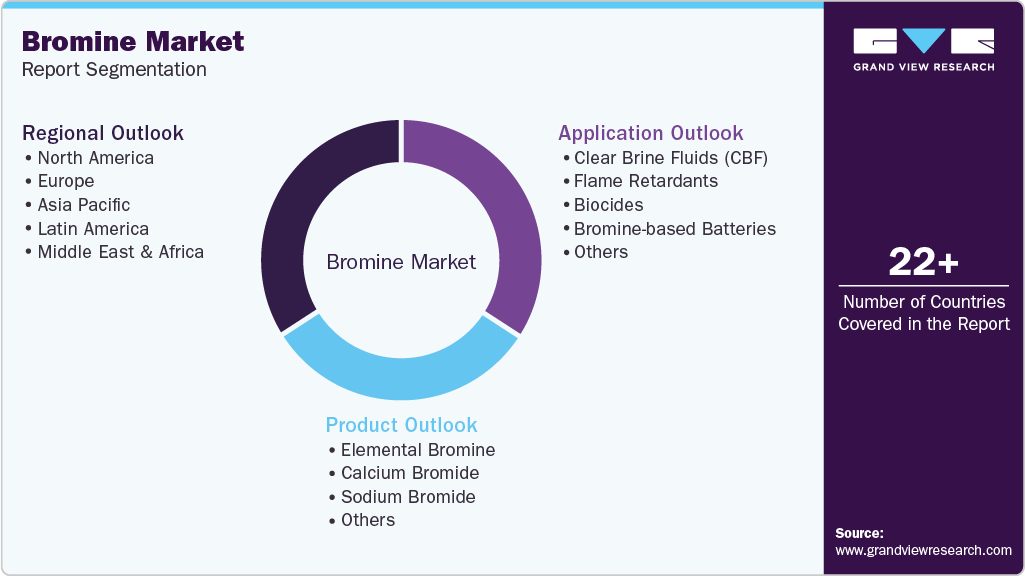
This report forecasts revenue and volume growth at global, regional, and country levels and provides an analysis of the latest industry trends in each of the sub-segments from 2018 to 2033. For the purpose of this study, Grand View Research has segmented the global bromine market report on the basis of derivative and region:
 To learn more about this report, Download Free Sample Report
 -
Derivative Outlook (Revenue, USD Million; Volume, Kilotons; 2018 - 2033)
-
Elemental Bromine
-
Calcium Bromide
-
Sodium Bromide
-
Other Derivatives
-
-
Regional Outlook (Revenue, USD Million; Volume, Kilotons; 2018 - 2033)
-
Americas
-
U.S.
-
Canada
-
Mexico
-
Brazil
-
Chile
-
Colombia
-
Costa Rico
-
-
Europe
-
Germany
-
UK
-
Italy
-
Spain
-
Turkey
-
Azerbaijan
-
Czech Republic
-
Hungary
-
Poland
-
Russia
-
Ukraine
-
-
Asia Pacific
-
China
-
Japan
-
India
-
South Korea
-
Thailand
-
Indonesia
-
Malaysia
-
Philippines
-
Australia
-
New Zealand
-
-
Middle East
-
Qatar
-
Oman
-
Kuwait
-
Saudi Arabia
-
UAE
-
Israel
-
-
Africa
-
Morocco
-
Algeria
-
Nigeria
-
Kenya
-
South Africa
-
-
Delivered Customizations
This report has been delivered with the following In-depth customizations
Client Request
Customization Delivered
Value Adds
Regional Segmentation
A comprehensive regional analysis of the bromine market was conducted across North America, Europe, Asia Pacific, Latin America, and the Middle East & Africa, with country-level assessment of bromine reserves, production activity, downstream chemical manufacturing, and industrial consumption trends. The study further examined regional demand patterns for elemental bromine, calcium bromide, sodium bromide, and other bromine derivatives across flame retardants, oil & gas, water treatment, and industrial applications.
Enabled identification of high-production regions and consumption-intensive industrial markets. Supported regional expansion planning, supply chain optimization, and strategic prioritization of countries with strong downstream bromine derivative demand.
Competitive Benchmarking
Key bromine manufacturers were benchmarked based on bromine extraction capabilities, derivative portfolio strength, downstream integration, production capacity, sustainability initiatives, export presence, and strategic investments in specialty bromine chemicals. The study also assessed competitive positioning across flame retardants, energy, water treatment, and industrial chemical applications.
Helped identify operational strengths, technology positioning, and competitive differentiation areas among major industry participants. Supported strategic planning related to partnerships, product expansion, and global market positioning.
Opportunity Assessment
Emerging growth opportunities in the bromine market were examined across energy storage systems, water treatment chemicals, clear brine fluids for oil & gas drilling, flame-retardant applications, and specialty bromine derivatives used in industrial processing. The study also reviewed the increasing demand for high-purity bromine compounds in advanced industrial applications.
Supported the identification of future investment areas and high-value downstream applications. Enabled development of long-term expansion strategies focused on specialty bromine chemicals and industrial innovation opportunities.
Frequently Asked Questions About This Report
Some of the key players of the global bromine market are ICL Group Ltd., Albemarle Corporation, LANXESS AG, Tosoh Corporation, TETRA Technologies Inc., TATA Chemicals Ltd., Hindustan Salts Ltd., Honeywell International Inc., Gulf Resources Inc., Agrocel Industries Pvt Ltd., and Satyesh Brinechem Pvt. Ltd.
The key factor that is driving the growth of the global bromine market is driven by the rising demand for bromine-based flame retardants, particularly in electronics, automotive, and construction industries, along with increasing use in water treatment, oil & gas drilling fluids, and pharmaceuticals.
The elemental bromine segment dominated the market with a revenue share of 71.1% in 2025.
The global bromine market size was estimated at USD 2.1 billion in 2025 and is expected to reach USD 2.3 billion in 2026.
The global bromine market is expected to grow at a compound annual growth rate of 5.5% from 2026 to 2033 to reach USD 3.3 billion by 2033.
Americas dominated with a revenue share of 51.9% in 2025.
About the Author(s)
Advanced Interior Materials Research Team
Advanced Materials · Advanced Interior MaterialsThis report was authored by the advanced interior materials research team at Grand View Research - comprising two research analysts, one senior research analyst, and one industry expert - with specialized expertise in the advanced interior materials segment of the advanced materials industry. All findings are based on proprietary advanced materials databases, executive interviews, and regulatory analysis, subject to internal peer review prior to publication.
Last Updated:
Speak to Analyst

Customize this report to your needs - add regions, segments, or data points, with 20% free customization.
Or view our licence options:


ISO 9001:2015 & 27001:2022 Certified
We are GDPR and CCPA compliant! Your transaction & personal information is safe and secure. For more details, please read our privacy policy.


