
- Home
- »
- Renewable Energy
- »
-
Building-integrated Photovoltaics Facade Market Report, 2033GVR Report cover

Building-integrated Photovoltaics Facade Market (2026 - 2033)
Size, Share & Trends Analysis Report By Type (Thin Film, Crystalline Materials), End-use (Residential, Commercial, Utility), By Region, And Segment Forecasts
Market Size, 2025
$4.6BMarket Estimate, 2026
$6.0BMarket Forecast, 2033
$40.9BCAGR, 2026–2033
31.4%Building-integrated Photovoltaics Façade Market Summary
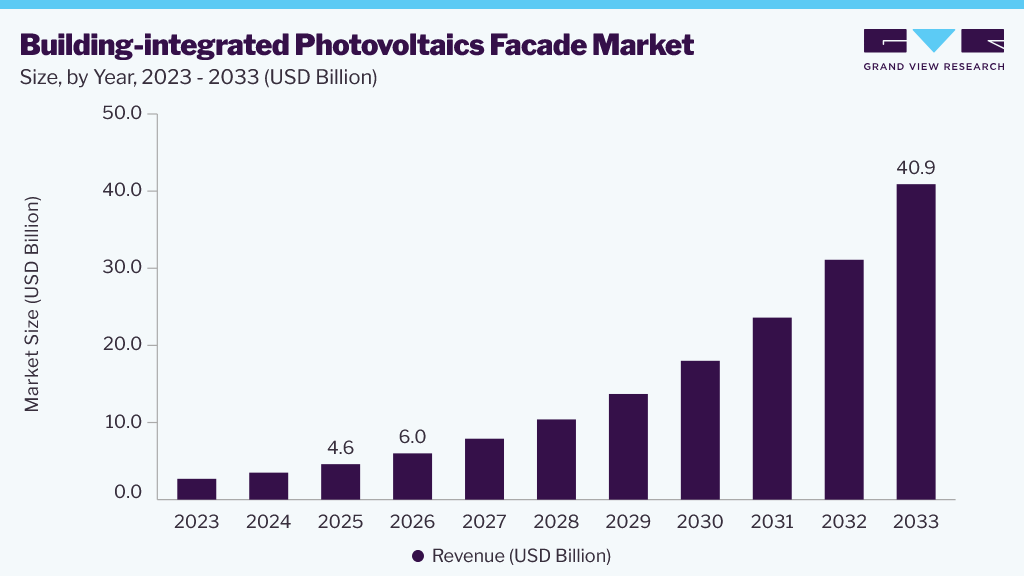
The global building-integrated photovoltaics facade market size was valued at USD 4.6 billion in 2025 and is projected to grow from USD 6.0 billion in 2026 to USD 40.9 billion in 2033, at a CAGR of 31.4% from 2026 to 2033. Europe dominated the market, accounting for a revenue share of 40.0% in 2025. Market growth worldwide is driven by the growing demand for renewable energy, intensifying environmental concerns, and increased government support through incentives and schemes. As a result, the adoption of sustainable construction practices is gaining momentum, fostering the adoption of building-integrated photovoltaics (BIPV) facades in the construction industry.
 Source: Grand View Research, IR Documents, Primary Interviews, Paid DatabasesTo learn more about this report,
 Download Free Sample Report
Key Market Trends & Insights
- By type: The crystalline materials segment dominated the market and accounted for a share of more than 82.0% in 2025.
- By end-use: The commercial & industrial segment accounted for the largest market revenue share of approximately 45.0% in 2025.
Regional Highlights
- Largest regional market: Europe (40.0% revenue share, 2025)
- Fastest-growing regional market: Asia Pacific (highest CAGR, 2026-2033)
Market Size & Forecast
- Market size in 2025: USD 4.6 Billion
- Estimated market size in 2026: USD 6.0 Billion
- Projected market size by 2033: USD 40.9 Billion
- CAGR (2026-2033): 31.4%
Three ways to get this report
Buy it, customize it, or ask a question.Ask an Analyst
Analyst response in 1 business day
- AccessReport author, directly
- Reply timeWithin 1 working day
- No sales callDirect answer only
- FormatEmail reply
- CostFree, no cost
Get the Full Report
What the study covers
- FormatsPDF · Excel · Dashboard
- Timeline2026–2033 annual, 2025 base
- Coverage20+ countries, 5 regions
- Companies10+ key players profiled
Customize the Report
20% free customization
- IncludeCountries, segments, points
- TailorTo your product definition
- ExtendDeeper competitor detail
- OrA fully bespoke study
- Turnaround5–10 working days
The global BIPV market is witnessing significant growth, driven by the increasing demand for environment-friendly and zero-emission buildings. The emphasis on renewable energy has led to a surge in the adoption of solar energy systems, particularly in residential areas, as consumers become more aware of the environmental benefits of BIPV.
The commercial sector is also expected to play a crucial role in driving market growth, as businesses seek to optimize their architecture and reduce energy consumption. The rapid advancements in the construction and building industry are also contributing to the expansion of the BIPV market. Moreover, supportive government policies and initiatives aimed at reducing carbon emissions are further encouraging the adoption of BIPV. For instance, the European Commission announced additional funding support under its sustainable buildings and energy-efficiency initiatives, encouraging the integration of renewable energy technologies.
The integration of photovoltaics into facades is expected to increase in the coming years, driven by government subsidies and electricity sharing initiatives. Moreover, the aesthetic appeal and variety of tailored options available in the market are also driving the use of BIPV in building facades. For instance, In August 2025, Fraunhofer FEP announced significant progress in its Design-PV project, developing decorative photovoltaic façade elements that are visually indistinguishable from conventional façade materials while retaining up to 80% of the performance of standard PV modules. As a result, the BIPV market is poised for significant growth, with numerous opportunities for businesses and individuals to capitalize on the trend towards sustainable construction practices.
Analyst Perspective
The market for building-integrated photovoltaics (BIPV) façades is projected to experience strong growth, fueled by the growing implementation of net-zero energy structures, strict carbon reduction objectives, and heightened need for visually integrated renewable energy options. Authorities and regulatory agencies are encouraging sustainable construction via funding schemes, energy-efficiency requirements, and green building initiatives, fostering favorable conditions for market growth. Moreover, innovations in photovoltaic façade materials are enhancing design versatility, energy production efficiency, and aesthetic value, rendering BIPV systems increasingly appealing for both commercial and residential uses. Initiatives such as Fraunhofer FEP’s Design-PV project emphasize the industry’s direction towards integrating functionality and aesthetics. This is anticipated to accelerate the implementation of energy-producing façades in contemporary construction endeavors globally.
Type Insights
The crystalline materials segment dominated the market and accounted for a share of more than 82.0% in 2025, driven by the exceptional durability of BIPV systems in challenging weather conditions and robust structure. Moreover, the declining cost of crystalline silicon cells will lower installation costs, making BIPV a more viable option for building owners.
Thin film segment is expected to register the fastest CAGR of more than 33.0% during the forecast period due to rapid technological advancements in product development. Thin film BIPVs are particularly suited for applications where weight constraints exist, offering a viable solution for building integration. Its flexibility also enables installation on curved surfaces, providing a competitive advantage. For instance, in July 2025, NEXT Energy Technologies completed the first installation of its transparent organic photovoltaic glass facade.
End Use Insights
The commercial & industrial segment accounted for the largest market revenue share of approximately 45.0% in 2025 due to the growing recognition of eco-friendly infrastructure that produces no emissions. BIPV installations enhance the visual attractiveness of commercial buildings and result in significant cost savings on power usage, leading to increased adoption within the commercial sector. For instance, in May 2026, ClearVue Technologies secured a contract to supply building-integrated photovoltaic (BIPV) glazing for the Rio Business Centre. The project involves the installation of approximately 800 suqre meter of integrated solar facade, with an estimated capacity of 169 kW, expected to generate around 139 MWh of electricity annually.
The utility segment is projected to grow at the fastest CAGR of approximately 32.0% over the forecast period. Governments worldwide have enforced strict targets and objectives regarding renewable energy to decrease carbon emissions and support sustainable energy options. This has generated a high need for BIPV solutions. Countries are investing in renewable energy projects such as BIPV facades to reach carbon neutrality goals. For instance, Singapore continues to advance its Singapore Green Building Masterplan, which aims to green 80% of buildings by 2030. Moreover, BIPV facades produce renewable energy at the location, decreasing dependence on grid electricity and energy expenses for utility companies.
Regional Insights
North America building-integrated photovoltaics facade market was identified as a lucrative region in 2025. Strong demand for visually appealing solar energy systems in buildings, fueled by rising construction activities, is expected to drive BIPV sales. The US and Canada are key drivers of market growth in North America, contributing to the overall expansion of the region’s BIPV market.
 To learn more about this report, Download Free Sample Report
U.S. Building-integrated Photovoltaics Facade Market Trends
The building-integrated photovoltaics facade market in the U.S. is expected to grow rapidly in the coming years. The U.S. residential sector is poised to drive demand for BIPV installations, fueled by a growing consumer base with high disposable income and a preference for integrated solutions in both residential and commercial buildings. This trend is expected to accelerate demand in the future, presenting opportunities for market growth.
Europe Building-integrated Photovoltaics Facade Market Trends
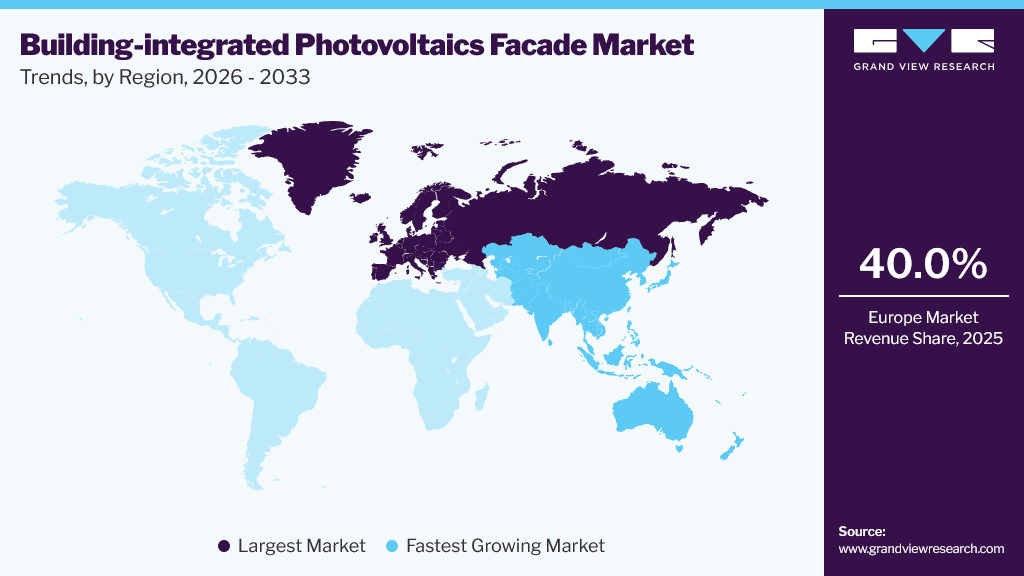
Europe building-integrated photovoltaics facade market led the global building-integrated photovoltaics facade market with a revenue share of approximately 40.0% in 2025. The market is expanding as customers increasingly prioritize green practices, driven by stricter environmental regulations and growing demand for energy-efficient buildings. Germany and Italy are at the forefront of adopting solar energy, leading to a higher adoption of BIPV solutions, which will drive market growth in the coming years.
The building-integrated photovoltaics facade market in Germany dominated the Europe building-integrated photovoltaics facade market in 2025.Germany has been a leader in renewable energy adoption, particularly in solar power. The government has implemented various policies and incentives, including subsidies and feed-in tariffs, to promote BIPV adoption. Germany’s strong research and development infrastructure has driven advancements in BIPV technology, enhancing efficiency, aesthetics, and integration capabilities.
Asia Pacific Building-integrated Photovoltaics Facade Market Trends
The Asia Pacific building-integrated photovoltaics facade market is anticipated to witness the fastest growth of over 32.0% over the forecast period. Governments in the Asia Pacific region are increasingly promoting renewable energy through policies and incentives, driving demand for solar power. The region’s booming construction industry provides opportunities to integrate BIPV solutions into new buildings and renovations, fueling market growth. Rising energy demand from increasing populations and economic expansion further supports market expansion.
The building-integrated photovoltaics facade market in China held a substantial market share in 2025. China, Japan, and South Korea have implemented measures promoting solar power, enhancing the financial viability of BIPV solutions. This boosts market expansion, fueled by increasing construction and rising energy demand from growing populations and economies.
Key Building-integrated Photovoltaics Facade Market Company Insights
Some key companies in the building-integrated photovoltaics facade market include AGC Inc.; Heliatek GmbH; AVANCIS GmbH; Hanergy Thin Film Power Group Europe; ISSOL sa; and others. Manufacturers are adopting strategies such as new product development, partnerships, and collaborations to enhance market presence and meet evolving demands of architects and construction contractors.
-
Heliatek GmbH is a provider and producer of organic photovoltaic products, working in the development of organic electronics. The company offers roll-to-roll vacuum and inert atmosphere processes for manufacturing OPV films, enabling construction partners and building materials industry to integrate green solar technology into various building surfaces.
-
AVANCIS GmbH is a manufacturer of thin-film solar panels, providing high-performance PV modules for various applications, including electricity-generating facades, roofs, and open areas. The company also offers expert guidance on energy-efficient construction planning, enabling architects, builders, and property owners to optimize their building’s energy efficiency and sustainability.
Key Building-integrated Photovoltaics Facade Companies
The following key companies have been profiled for this study on the building-integrated photovoltaics facade market:
-
AGC Inc.
-
Heliatek GmbH
-
AVANCIS GmbH
-
Hanergy Thin Film Power Group Europe
-
ISSOL sa
-
Onyx Solar Group LLC.
-
Maxeon Solar Technologies, Ltd.
-
SUNOVATION GmbH
-
Polysolar
-
Ertex Solar
Recent Developments
-
In August 2025, Fraunhofer FEP made significant progress in developing aesthetically appealing solutions for building-integrated photovoltaics. The company introduced roll-to-roll nanoimprint lithography enable solar modules for seamless integration into building facades without compromising the design.
-
In July 2025, NEXT Energy Technologies completed the first installation of a large-format transparent organic photovoltaic (OPV) façade at its California headquarters. The installation features six transparent photovoltaic (PV) windows, each measuring 40 by 60 inches, for a total of 100 square feet of NEXT’s proprietary energy-generating glass.
Building-integrated Photovoltaics Facade Market Report Scope
Report Attribute
Details
Market size in 2025
USD 4.6 billion
Estimated market size in 2026
USD 6.0 billion
Projected market size by 2033
USD 40.9 billion
Growth rate
CAGR of 31.4% from 2026 to 2033
Base year for estimation
2025
Historical data
2021 - 2024
Forecast period
2026 - 2033
Quantitative units
Revenue in USD billion, and CAGR from 2026 to 2033
Report coverage
Revenue forecast, company ranking, competitive landscape, growth factors, and trends
Segments covered
Type, end use, region
Regional scope
North America; Europe; Asia Pacific; Latin America; Middle East & Africa
Country scope
U.S.; Canada; Mexico; UK; Germany; France; Italy; China; India; Japan; Australia; Brazil; Argentina; South Africa; Saudi Arabia; UAE
Key companies profiled
AGC Inc.; Heliatek GmbH; AVANCIS GmbH; Hanergy Thin Film Power Group Europe; ISSOL sa; Onyx Solar Group LLC.; Maxeon Solar Technologies, Ltd.; SUNOVATION GmbH; Polysolar; Ertex Solar
Customization scope
Free report customization (equivalent up to 8 analysts working days) with purchase. Addition or alteration to country, regional & segment scope.
Pricing and purchase options
Avail of customized purchase options to meet your exact research needs. Explore purchase options
Global Building-integrated Photovoltaics Facade Market Report Segmentation
This report forecasts revenue growth at global, regional, and country levels and provides an analysis of the latest industry trends and opportunities in each of the sub-segments from 2021 to 2033. For this study, Grand View Research has segmented the building-integrated photovoltaics facade market report based on type, end use, and region:
- Type Outlook (Revenue, USD Billion, 2021 - 2033)
- Thin Film
- Crystalline Materials
- Others
- End use Outlook (Revenue, USD Billion, 2021 - 2033)
- Residential
- Commercial & Industrial
- Utility
- Regional Outlook (Revenue, USD Billion, 2021 - 2033)
- North America
- U.S.
- Canada
- Mexico
- Europe
- UK
- Germany
- France
- Italy
- Asia Pacific
- China
- India
- Japan
- Australia
- Latin America
- Brazil
- Argentina
- Middle East and Africa (MEA)
- South Africa
- Saudi Arabia
- UAE
- North America
Frequently Asked Questions About This Report
The global building-integrated photovoltaics façade market size was valued at USD 4.6 billion in 2025 and is estimated at USD 6.0 billion for 2026.
The global building-integrated photovoltaics facade market is expected to grow at a CAGR of 31.4% from 2026 to 2033, reaching USD 40.9 billion.
Europe dominated with approximately 40.0% revenue share in 2025.
The crystalline materials building-integrated photovoltaics facade market segment accounted for the largest revenue share of approximately 82.0% in 2025.
Key players in the market include AGC Inc., Heliatek GmbH, AVANCIS GmbH, Hanergy Thin Film Power Group Europe, ISSOL sa, Onyx Solar Group LLC., Maxeon Solar Technologies, Ltd., SUNOVATION GmbH, Polysolar, Ertex Solar and others.
About the Author(s)
Renewable Energy Research Team
Energy & Power · Renewable EnergyThis report was authored by the renewable energy research team at Grand View Research - comprising two research analysts, one senior research analyst, and one industry expert - with specialized expertise in the renewable energy segment of the energy & power industry. All findings are based on proprietary energy & power databases, executive interviews, and regulatory analysis, subject to internal peer review prior to publication.
Last Updated:
Speak to Analyst

Customize this report to your needs - add regions, segments, or data points, with 20% free customization.
Or view our licence options:


ISO 9001:2015 & 27001:2022 Certified
We are GDPR and CCPA compliant! Your transaction & personal information is safe and secure. For more details, please read our privacy policy.


