
- Home
- »
- Advanced Interior Materials
- »
-
Butterfly Valve Market Size And Share Report, 2026-2033GVR Report cover

Butterfly Valve Market (2026 - 2033)
Size, Share & Trends Analysis Report, By Function (Manual, Electric-actuated, Pneumatic-actuated, Hydraulic-actuated), By End Use (Oil & Gas, Water & Wastewater Treatment), By Region, And Segment Forecasts
Market Size, 2025
$12.7BMarket Estimate, 2026
$13.2BMarket Forecast, 2033
$18.0BCAGR, 2026–2033
4.5%Butterfly Valve Market Summary
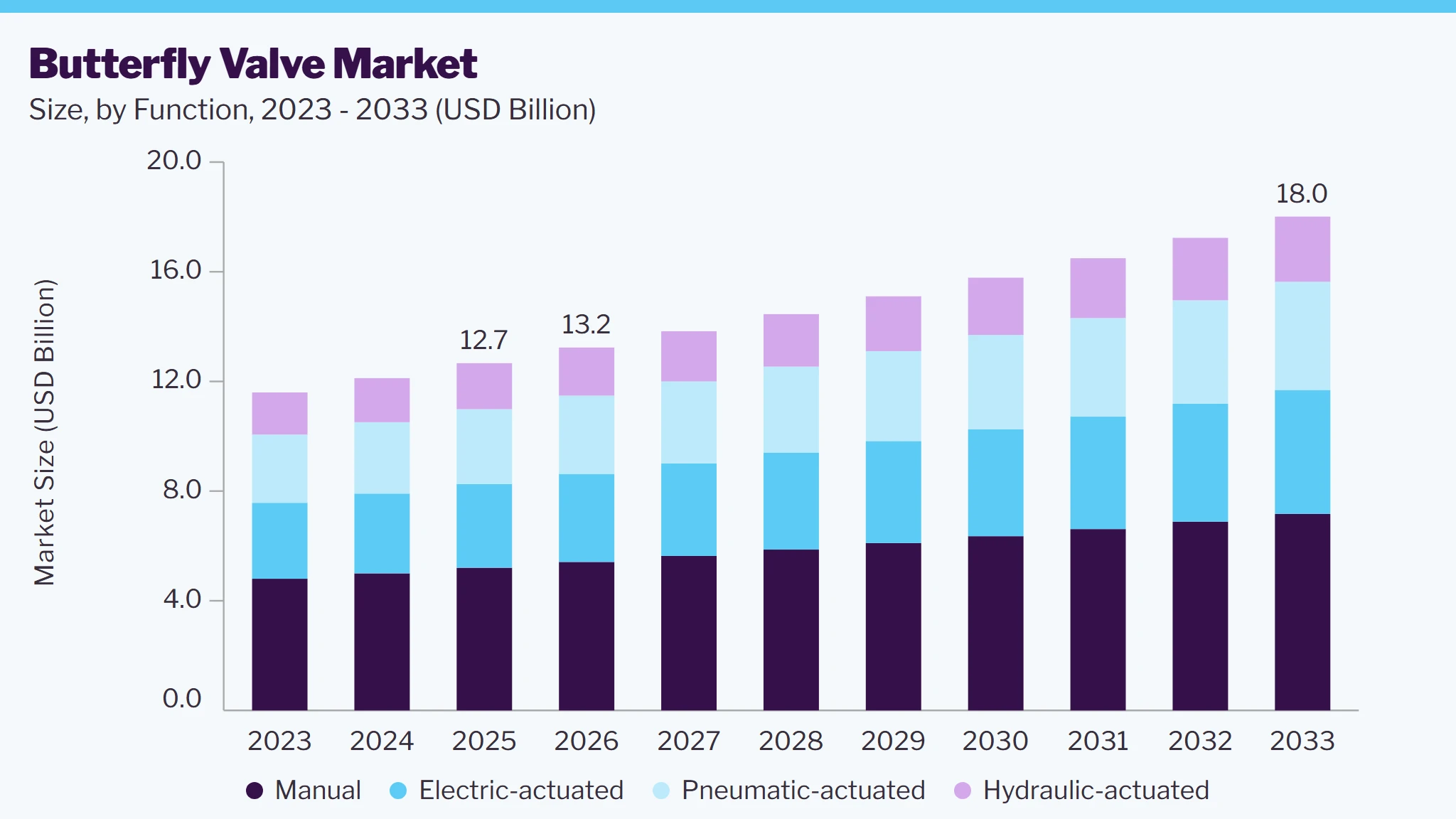
The global butterfly valve market size was valued at USD 12.7 billion in 2025 and is projected to grow from USD 13.2 billion in 2026 to USD 18.0 billion by 2033, at a CAGR of 4.5% from 2026 to 2033. Asia Pacific dominated the butterfly valve market with the largest revenue share of 45.0% in 2025. Butterfly valves are extensively used in upstream, midstream, and downstream operations for isolating and regulating flow.
 Source: Grand View Research, IR Documents, Primary Interviews, Paid DatabasesTo learn more about this report,
 Download Free Sample Report
Key Market Trends & Insights
- By function: Manual segment held the largest market share of 41.1% in 2025.
- By end use: Water & wastewater treatment segment held the largest market share of 37.7% in 2025.
Regional Highlights
- Largest regional market: Asia Pacific (45.0% revenue share, 2025)
- By country: China held the largest market share in 2025.
Market Size & Forecast
- Market size in 2025: USD 12.7 Billion
- Estimated market size in 2026: USD 13.2 Billion
- Projected market size by 2033: USD 18.0 Billion
- CAGR (2026-2033): 4.5%
Three ways to get this report
Buy it, customize it, or ask a question.Ask an Analyst
Analyst response in 1 business day
- AccessReport author, directly
- Reply timeWithin 1 working day
- No sales callDirect answer only
- FormatEmail reply
- CostFree, no cost
Get the Full Report
What the study covers
- FormatsPDF · Excel · Dashboard
- Timeline2026–2033 annual, 2025 base
- Coverage20+ countries, 5 regions
- Companies10+ key players profiled
Customize the Report
20% free customization
- IncludeCountries, segments, points
- TailorTo your product definition
- ExtendDeeper competitor detail
- OrA fully bespoke study
- Turnaround5–10 working days
As global energy demand continues to rise, especially in emerging economies, oil and gas exploration and production activities are witnessing considerable expansion. This, in turn, is propelling the requirement for reliable, compact, and cost-efficient flow control devices such as butterfly valves. In addition, the push for modernization and the integration of automated valves in oil and gas infrastructures are further boosting market growth. An increase in global investments in water treatment and wastewater management is acting as a major driver for the butterfly valve market. Governments and private stakeholders are increasingly focusing on upgrading water infrastructure to meet the needs of growing urban populations and comply with stringent environmental regulations. Butterfly valves, due to their durability, low-pressure drop, and ease of operation, are widely adopted in water treatment plants for flow isolation and control. The increased deployment of desalination plants in arid regions and the retrofitting of aging municipal water systems are also contributing to the upward trend in demand.
 To learn more about this report, Download Free Sample Report
The butterfly valve market is experiencing strong momentum from the chemical and power generation industries. In chemical manufacturing, where corrosive fluids and harsh operating conditions are common, butterfly valves offer an effective solution due to their resistance to a wide range of chemicals and their ability to handle high temperatures and pressures. Similarly, in power generation, particularly thermal and nuclear plants, these valves are essential for controlling steam and cooling water flow. As the global power demand escalates and new plants are established to diversify energy portfolios, the adoption of butterfly valves is expected to increase proportionally.
 To learn more about this report, Download Free Sample Report
Market Dynamics
The butterfly valve market is experiencing steady growth due to increasing investments in industrial infrastructure, water and wastewater treatment facilities, energy production, and process manufacturing. Butterfly valves are widely preferred for their lightweight design, compact structure, cost-effectiveness, and ability to provide efficient flow isolation and regulation across a broad range of applications. The growing adoption of industrial automation, smart valve technologies, and digital monitoring systems is further enhancing operational efficiency and reducing maintenance requirements. In addition, expanding investments in pipeline networks, desalination plants, and industrial process facilities are creating sustained demand for advanced butterfly valve solutions worldwide.
Growing investments in water supply and wastewater treatment infrastructure are a major factor driving the butterfly valve market. Governments and utilities across developed and emerging economies are expanding water distribution networks, upgrading aging pipelines, and constructing new treatment facilities to address increasing urbanization, industrialization, and water scarcity. Butterfly valves are widely used in these systems due to their low pressure drop, reliable shut-off capability, and ease of installation in large-diameter pipelines.
In addition, stricter environmental regulations and increasing emphasis on water conservation are encouraging industries to improve wastewater management and recycling processes. Municipal utilities and industrial facilities are adopting modern flow control equipment to enhance operational efficiency and comply with environmental standards. This continued investment in water infrastructure is expected to generate sustained demand for butterfly valves throughout the forecast period.
Despite their broad adoption, butterfly valves face limitations in high-pressure, high-temperature, and highly critical process applications where absolute sealing performance is essential. Industries such as petrochemicals, offshore oil & gas, and certain power generation processes often prefer ball, gate, or globe valves for demanding operating conditions. These application-specific limitations may restrict the adoption of butterfly valves in some industrial environments and moderate market growth.
The increasing shift toward industrial automation and digital process management presents a significant opportunity for the butterfly valve market. Manufacturers are integrating electric and pneumatic actuators, intelligent positioners, sensors, and Industrial Internet of Things (IIoT) connectivity into butterfly valves to enable remote monitoring, predictive maintenance, and real-time process optimization. As industries continue to modernize facilities and invest in smart manufacturing, demand for automated butterfly valve solutions is expected to rise, creating new growth opportunities for market participants.
Market Concentration & Characteristics
The global butterfly valve market exhibits moderate to high market concentration, characterized by the presence of several large multinational corporations alongside numerous regional players. Market leaders such as Emerson Electric Co., Flowserve Corporation, and AVK Group dominate through extensive distribution networks, strong R&D capabilities, and diversified product portfolios. The degree of innovation in the industry remains significant, driven by the need for enhanced performance, energy efficiency, and automation compatibility. Innovations include the integration of smart valve technologies, corrosion-resistant materials, and advanced sealing mechanisms, particularly in applications requiring high reliability such as oil & gas, water treatment, and chemical processing. These technological developments are pivotal in maintaining competitive advantage and catering to the evolving demands of end users.
 To learn more about this report, Download Free Sample Report
The market has seen a moderate level of mergers and acquisitions in recent years, aimed at geographic expansion, product diversification, and consolidation of technological expertise. Regulatory frameworks also play a considerable role in shaping the market, particularly concerning emissions, environmental safety, and industrial safety standards—especially in sectors such as water management and energy. Substitutes for butterfly valves, such as ball valves and gate valves, pose limited threat due to application-specific advantages that butterfly valves offer, including compact design and quick operation. Furthermore, end use concentration is moderately high, with sectors such as water & wastewater, oil & gas, and power generation constituting the majority of demand, thus influencing the market dynamics and product development priorities of key manufacturers.
Analyst Perspective
The butterfly valve market is expected to maintain steady growth over the forecast period, supported by increasing investments in industrial infrastructure, water and wastewater treatment, energy, and process industries. Rising demand for compact, lightweight, and cost-efficient flow control solutions, coupled with the growing adoption of industrial automation, is accelerating the deployment of electric and pneumatic actuated butterfly valves. Manufacturers are increasingly focusing on product innovation, corrosion-resistant materials, digital monitoring capabilities, and enhanced sealing performance to address evolving customer requirements. Additionally, infrastructure modernization, stricter environmental regulations, and expanding industrial activities in emerging economies are expected to create sustained growth opportunities, positioning the butterfly valve market for long-term expansion.
Function Insights
Based on function, manual segment led the market with the largest revenue share of 41.1% in 2025, driven by its cost-effectiveness and simplicity of operation. Manual butterfly valves require no external power source, making them an ideal choice in locations with limited access to electricity or in applications where automation is not necessary. This attribute significantly reduces both installation and operational costs, making manual valves an economical option for small- and medium-scale industries and water management facilities.
 To learn more about this report, Download Free Sample Report
The electric-actuated segment is expected to grow at fastest CAGR of 5.0% over the forecast period, driven by the increasing demand for automation across various industrial sectors. Industries such as oil and gas, water and wastewater treatment, power generation, and chemical processing are increasingly adopting electric-actuated butterfly valves to improve operational efficiency and process control. These valves offer precise modulation capabilities and remote operability, which enhance system responsiveness and reduce human intervention. The transition toward Industry 4.0 and the integration of smart technologies further support the deployment of electric-actuated valves, as they are well-suited for digital monitoring and automated control systems.
End Use Insights
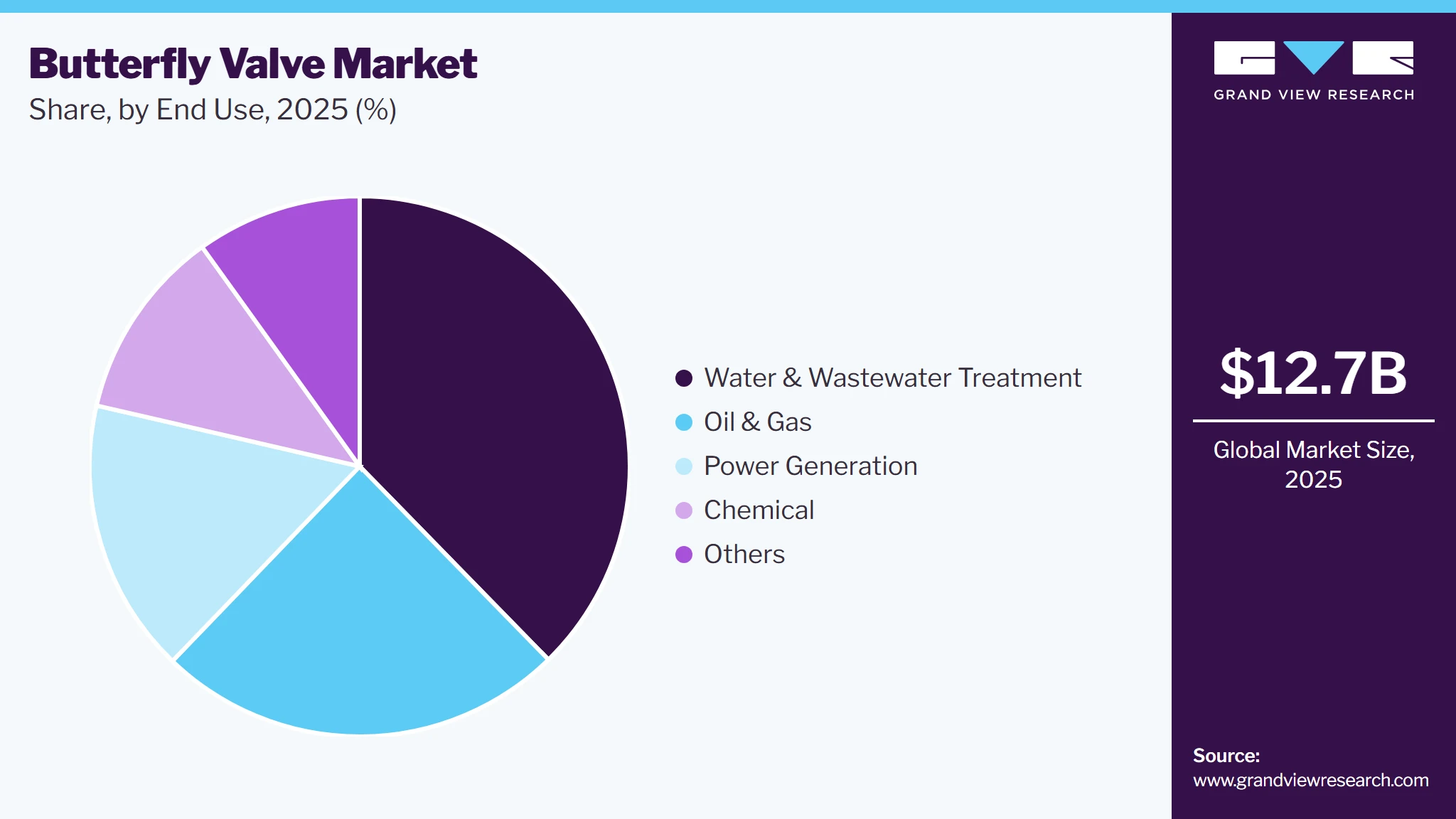
Based on end use, water & wastewater treatment segment led the market with the largest revenue share of 37.7% in 2025. Governments and municipal authorities across developed and developing countries are heavily investing in water treatment facilities, sewage systems, and desalination plants. Butterfly valves are widely used in these applications owing to their cost-effectiveness, compact design, and ability to regulate high-volume flow, making them ideal for managing large-scale water distribution and treatment systems.
Chemical segment is expected to grow significantly at CAGR of 4.7% over the forecast period, driven by stringent environmental and safety regulations across various regions which are compelling chemical companies to upgrade their infrastructure with high-performance and leak-proof valve systems. Butterfly valves, known for their compact design and reliable sealing capabilities, are increasingly preferred for use in critical processes to ensure compliance with regulatory standards and to mitigate the risk of chemical leaks or spills.
Regional Insights
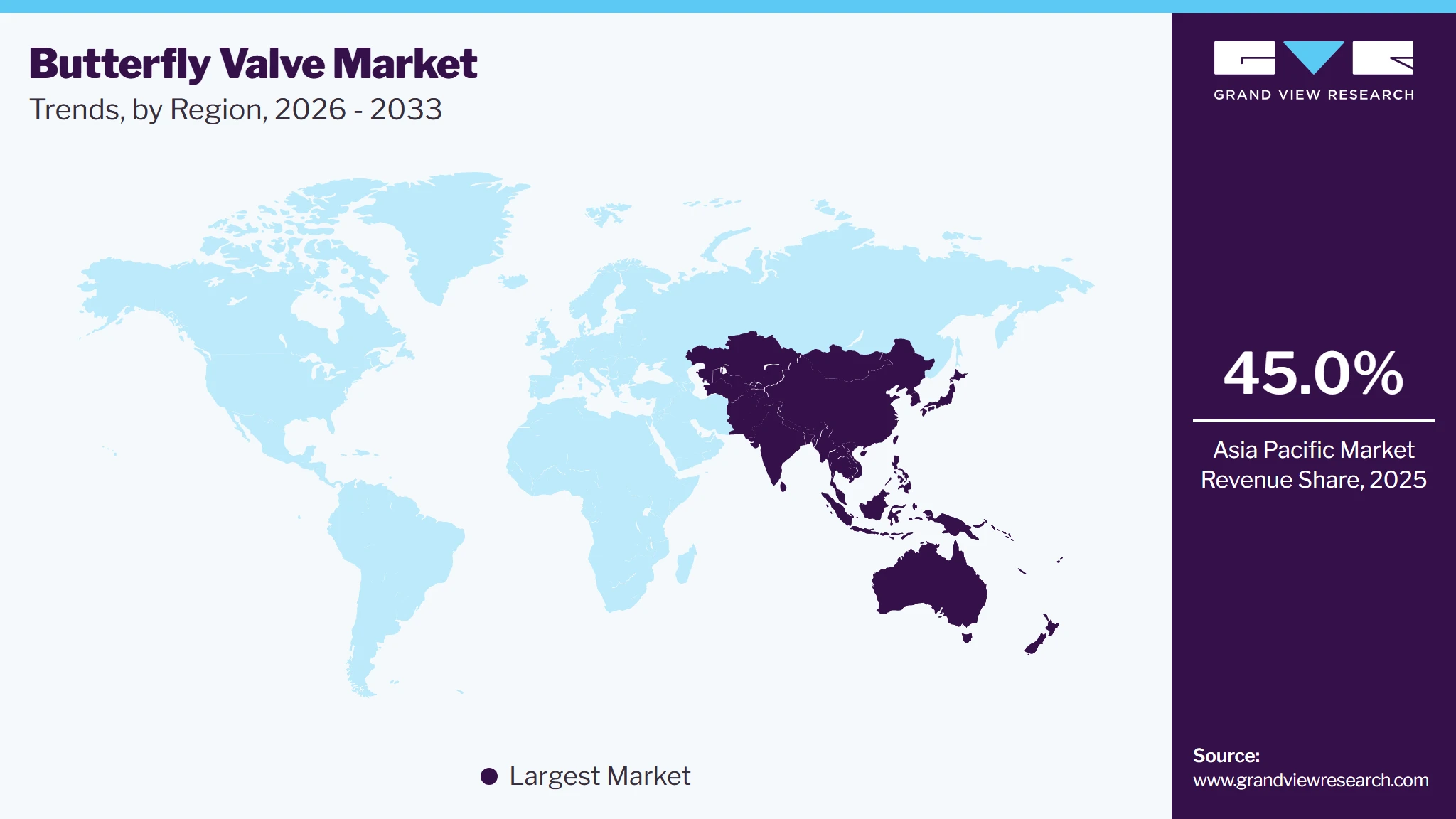
Asia Pacific dominated the butterfly valve market with the largest revenue share of 45.0% in 2025. The Asia Pacific butterfly valve market is experiencing robust growth due to rapid industrialization, urbanization, and increasing infrastructure development. Government-led initiatives focusing on expanding water treatment facilities and boosting energy production are significant contributors. The region’s strong manufacturing base, combined with rising investments in power and chemical sectors, is creating substantial demand for cost-effective and reliable valve solutions across emerging economies.
 To learn more about this report, Download Free Sample Report
China Butterfly Valve Market Trends
The butterfly valve market in the China held the largest share in the Asia Pacific region in 2025. In China, the butterfly valve market is driven by the country’s aggressive push towards infrastructure development and urban expansion. Major investments in power generation, especially renewable energy projects, and the continued growth of the chemical and petrochemical industries fuel the demand for high-performance butterfly valves. In addition, stringent government regulations aimed at improving environmental compliance and industrial safety standards are encouraging the adoption of advanced flow control technologies.
North America Butterfly Valve Market Trends
The butterfly valve market in North America is primarily driven by the modernization and expansion of water and wastewater infrastructure. Significant investments in industrial automation, especially within the oil & gas and power generation sectors, also contribute to market growth. In addition, growing environmental regulations necessitate the use of efficient flow control solutions, further supporting demand. The adoption of advanced valve technologies integrated with smart monitoring systems is accelerating in the region, enhancing operational efficiency and reliability across critical industries.
In the United States, the butterfly valve market benefits from substantial investments in shale gas exploration and petrochemical processing facilities. The country’s emphasis on upgrading aging infrastructure, including pipelines and water systems, has led to increased demand for durable and cost-efficient flow control products. Furthermore, the strong presence of key market players and consistent advancements in automation and industrial IoT (IIoT) solutions are fostering the adoption of smart butterfly valves across diverse end-use industries.
Europe Butterfly Valve Market Trends
The European butterfly valve market is supported by stringent environmental regulations and the widespread adoption of renewable energy systems. Demand is also rising due to ongoing upgrades in water management and wastewater treatment infrastructure. The region's emphasis on energy efficiency and sustainable industrial practices promotes the use of high-efficiency and low-leakage valve technologies. Moreover, the growth of the pharmaceutical and food & beverage sectors further strengthens market demand across key European countries.
In Germany, strong demand for butterfly valves stems from the country’s well-established engineering and manufacturing sectors. The ongoing energy transition, known as Energiewende, is driving investments in both renewable and conventional power generation facilities. In addition, Germany’s commitment to environmental sustainability and industrial innovation encourages the adoption of technologically advanced and environmentally compliant valve solutions in key process industries.
Latin America Butterfly Valve Market Trends
The butterfly valve market in Latin America is largely driven by expanding oil & gas exploration activities and the growth of water treatment infrastructure. Countries such as Brazil and Mexico are investing in energy and industrial projects that require reliable and economical flow control equipment. Despite economic fluctuations, increased foreign investment in the region’s industrial sectors and improving regulatory frameworks contribute to a favorable market environment.
Middle East & Africa Butterfly Valve Market Trends
In the Middle East & Africa, the butterfly valve market is influenced by extensive investments in oil & gas infrastructure, desalination plants, and power generation projects. The region's strategic focus on diversifying energy sources and improving water supply infrastructure supports market growth. In addition, the demand for valves resistant to extreme environmental conditions and corrosion is driving innovation and adoption of high-performance butterfly valves in this region.
Key Butterfly Valve Company Insights
Some of the key players operating in market include Alfa Laval Corporate AB, Curtiss-Wright Corporation
-
Alfa Laval Corporate ABoffers a wide range of hygienic and industrial butterfly valves designed for use in the food and beverage, pharmaceutical, and marine industries. Its valve solutions are known for reliability, ease of maintenance, and compatibility with automated control systems.
-
Curtiss-Wright Corporation in the butterfly valve segment provides engineered valve solutions primarily for critical service environments such as nuclear power plants and defense systems. Their product portfolio includes high-performance and triple offset butterfly valves designed for high-pressure, high-temperature, and severe service applications, ensuring safety and performance under demanding conditions.
Flowserve Corporation, Emerson Electric Co. are some of the emerging market participants in butterfly valve market.
-
Flowserve Corporation is U.S.-based provider of fluid motion and control products and services. The company’s butterfly valve offerings encompass resilient-seated, high-performance, and triple-offset designs that cater to a wide range of industries, including oil & gas, power, water, and chemicals. Flowserve’s butterfly valves are recognized for their robust engineering, long service life, and operational efficiency.
-
Emerson provides a broad selection of resilient-seated, high-performance, and triple offset butterfly valves designed for precision flow control in industries such as oil & gas, power generation, and water treatment. These valves are integrated with smart technologies to enable predictive maintenance and operational efficiency.
Key Butterfly Valve Companies
The following key companies have been profiled for this study on the butterfly valve market.
-
Alfa Laval Corporate AB
-
Curtiss-Wright Corporation
-
Flowserve Corporation
-
Emerson Electric Co.
-
Pentair PLC
-
Weir Group PLC
-
AVK Group A/S
-
Crane Company
-
Schlumberger Limited
-
Velan, Inc.
-
KSB SE & Co. KGaA
- Honeywell International Inc.
Competitive Benchmarking
Category
Operating Strategies
Competitive Edge
Weakness
Established Players (e.g., Flowserve Corporation, Emerson Electric Co., Crane Company, KSB SE & Co. KGaA, Bray International, Inc.,)
- Focus on developing high-performance and smart butterfly valves with advanced automation capabilities.
- Expand global presence through acquisitions, strategic partnerships, and strong distributor networks.
- Invest in R&D to enhance product reliability, efficiency, and compliance with international standards.
- Well-established global brands with extensive product portfolios across multiple industries.
- Strong engineering expertise, advanced manufacturing capabilities, and robust aftermarket services.
- Long-standing relationships with EPC contractors, utilities, and major industrial customers.
- Premium pricing compared to regional manufacturers.
- Higher operating and manufacturing costs.
- Slower response to localized market requirements due to complex organizational structures.
Emerging & Regional Players (e.g., AVK Group A/S, NIBCO Inc., Velan, Inc., KITZ Corporation, Alfa Laval AB, Pentair PLC, Weir Group PLC.)
- Focus on regional expansion and application-specific butterfly valve solutions.
- Strengthen distribution partnerships and manufacturing capabilities in high-growth markets.
- Offer customized and cost-effective products tailored to local industry requirements.
- Competitive pricing and greater flexibility in product customization.
- Strong presence in niche sectors such as water treatment, HVAC, and hygienic processing.
- Faster response to customer requirements and regional market trends.
- Limited global footprint compared to multinational competitors.
- Lower investment capacity for advanced digital and automation technologies.
- Smaller international service and distribution networks.
Recent Developments
-
In September 2024, Flomatic announced the expansion of its Sylax 3 Butterfly Valve series with the addition of a new 1 1/2 lug style model. Designed to deliver reliable and efficient flow control in compact systems, the newly introduced valve features a durable ductile iron body, a 316 stainless steel disc, and a stainless-steel stem. Engineered for bi-directional flow and dead-end service, it upholds the robust performance standards of the Sylax line.
Butterfly Valve Market Report Scope
Report Attribute
Details
Market size in 2025
USD 12.7 billion
Estimated market size e in 2026
USD 13.2 billion
Projected market size by 2033
USD 18.0 billion
Growth rate
CAGR of 4.5% from 2026 to 2033
Base year for estimation
2025
Historical data
2021 - 2024
Forecast period
2026 - 2033
Quantitative units
Revenue in USD billion and CAGR from 2026 to 2033
Report coverage
Revenue forecast, company ranking, competitive landscape, growth factors, and trends
Segments covered
Function, end use, region.
Regional scope
North America; Europe; Asia Pacific; Latin America; Middle East & Africa
Country scope
U.S.; Canada; Mexico; UK; Germany; France; Italy; Spain; China; India; Japan; South Korea; Brazil; Saudi Arabia
Key companies profiled
Alfa Laval AB; Curtiss-Wright Corporation; Flowserve Corporation; Emerson Electric Co.; Pentair PLC; Weir Group PLC; AVK Group A/S; Crane Company; Schlumberger Limited; Velan, Inc.; KSB SE & Co. KGaA; Honeywell International Inc.; Bray International, Inc.; KITZ Corporation; NIBCO Inc.
Customization scope
Free report customization (equivalent up to 8 analysts' working days) with purchase. Addition or alteration to country, regional & segment scope.
Pricing and purchase options
Avail customized purchase options to meet your exact research needs. Explore purchase options
Global Butterfly Valve Market Report Segmentation
This report forecasts revenue growth at global, regional, and country levels and provides an analysis of the latest industry trends in each of the sub-segments from 2021 to 2033. For this study, Grand View Research has segmented the global butterfly valve market report based on function, vehicle type and region.
 To learn more about this report, Download Free Sample Report
-
Function Outlook (Revenue, USD Million, 2021 - 2033)
-
Manual
-
Electric-actuated
-
Pneumatic-actuated
-
Hydraulic-actuated
-
-
End Use Outlook (Revenue, USD Million, 2021 - 2033)
-
Oil & Gas
-
Water & Wastewater Treatment
-
Power Generation
-
Chemical
-
Others
-
-
Regional Outlook (Revenue, USD Million, 2021 - 2033)
-
North America
-
U.S.
-
Canada
-
Mexico
-
-
Europe
-
Germany
-
UK
-
France
-
Italy
-
Spain
-
-
Asia Pacific
-
China
-
Japan
-
India
-
South Korea
-
-
Central & South America
-
Middle East & Africa
-
Research Methodology
The butterfly valve market figures in this report are based on a proven research process that combines executive interviews with secondary research from proprietary databases, company filings, and recognized regulatory and institutional sources. Market size is built through value-chain sizing - reconciling supply-side and demand-side estimates - and triangulated with bottom-up and top-down approaches. Every estimate passes multiple levels of expert validation before publication, with each butterfly valve segment quantified using the revenue-capture definitions in the table below.
Segment Definition
Function
Revenue Capture Definition
Manual
Revenue generated from the sale of manually operated butterfly valves that utilize hand levers, gear operators, or handwheels for opening, closing, and regulating fluid flow in water treatment, HVAC, irrigation, and general industrial applications without the need for external power.
Electric-actuated
Revenue generated from the sale of butterfly valves integrated with electric actuators that enable automated flow control, remote operation, and precise positioning across industrial process plants, water treatment facilities, power generation, and commercial infrastructure.
Pneumatic-actuated
Revenue generated from the sale of butterfly valves equipped with pneumatic actuators that use compressed air for rapid and reliable valve operation in oil & gas, chemical processing, manufacturing, and other automated industrial systems.
Hydraulic-actuated
Revenue generated from the sale of butterfly valves fitted with hydraulic actuators designed for high-force operation in large-diameter pipelines, high-pressure systems, marine, mining, hydroelectric, and other heavy industrial applications.
End Use
Revenue Capture Definition
Oil & Gas
Revenue generated from the sale of butterfly valves used for flow isolation and control in upstream exploration and production, midstream pipeline transportation and storage, and downstream refining, petrochemical, and gas processing facilities.
Water & Wastewater Treatment
Revenue generated from the sale of butterfly valves installed in municipal and industrial water supply networks, wastewater treatment plants, desalination facilities, irrigation systems, and water distribution infrastructure for efficient fluid management.
Power Generation
Revenue generated from the sale of butterfly valves utilized in thermal, hydroelectric, nuclear, and renewable power plants for controlling cooling water, process water, steam, and auxiliary fluid systems.
Chemical
Revenue generated from the sale of butterfly valves designed for chemical processing facilities to regulate the flow of corrosive chemicals, industrial gases, solvents, acids, alkalis, and other process fluids while ensuring safe and reliable operation.
Other
Revenue generated from the sale of butterfly valves across industries including food & beverage, pharmaceuticals, pulp & paper, mining, marine, HVAC, metals & mining, and other industrial sectors requiring efficient flow control and isolation solutions.
Estimation Model
Layer Name
Key Question
Description
Industry Assessment
What is the potential demand for butterfly valves across key industries?
Assess the demand for butterfly valves across oil & gas, water & wastewater treatment, power generation, chemical, and other industrial sectors by evaluating infrastructure development, industrial activity, and replacement requirements.
Product & Function Analysis
Which butterfly valve functions contribute the most to market demand?
Estimate demand by function, including manual, electric-actuated, pneumatic-actuated, and hydraulic-actuated butterfly valves, based on application requirements, automation trends, and operating conditions.
Regional & End-use Validation
How is market demand distributed across regions and end-use industries?
Validate estimates using regional industrial investments, manufacturing activity, infrastructure projects, regulatory developments, and adoption across major end-use industries.
Revenue Estimation
What is the total revenue generated by the butterfly valve market?
Estimate total market revenue by consolidating shipment volumes, product demand, replacement cycles, and sales across all functions, end-use industries, and geographic regions.
Delivered Customizations
This report has been delivered with the following In-depth customizations
Client Request
Customization Delivered
Value Adds
Regional Segmentation
Delivered a comprehensive regional analysis covering North America, Europe, Asia Pacific, Latin America, and Middle East & Africa, along with country-level insights for major markets. The report includes market size estimates, growth trends, demand drivers, regulatory landscape, industrial investments, and end-use adoption patterns across each region.
Enabled identification of high-growth regions, investment hotspots, and regional demand variations, supporting strategic market entry, expansion planning, and resource allocation.
Competitive Benchmarking
Delivered detailed profiling and benchmarking of leading butterfly valve manufacturers, including company overview, product portfolio, strategic initiatives, market positioning, competitive strengths, recent developments, and presence across key end-use industries.
Provided a clear understanding of the competitive landscape, helping clients evaluate competitors, identify market gaps, benchmark product offerings, and support partnership or acquisition decisions.
Opportunity Assessment
Delivered an in-depth assessment of current and emerging growth opportunities, including industrial automation, smart valve adoption, expansion of water & wastewater infrastructure, energy projects, and modernization of industrial facilities. The report also highlights key demand trends and future investment areas across major end-use sectors.
Helped prioritize high-potential business opportunities, align product development with evolving market demand, and support long-term growth, investment, and expansion strategies.
Frequently Asked Questions About This Report
The global butterfly valve market size was estimated at USD 12.7 billion in 2025 and is projected to grow from USD 13.2 billion in 2026.
The global butterfly valve market is expected to grow at a compound annual growth rate of 4.5% from 2026 to 2033 to reach USD 18.0 billion by 2033.
Some of the key players operating in the butterfly valve market include. Alfa Laval AB; Curtiss-Wright Corporation; Flowserve Corporation; Emerson Electric Co.; Pentair PLC; Weir Group PLC; AVK Group A/S; Crane Company; Schlumberger Limited; Velan, Inc.; KSB SE & Co. KGaA; Honeywell International Inc.; Bray International, Inc.; KITZ Corporation; NIBCO Inc.
The key factors that are driving the butterfly valve market include growing demand for industrial automation, rising infrastructure development, increased usage in water and wastewater treatment, and the need for cost-effective flow control solutions.
Asia Pacific dominated the global butterfly valve market with the largest revenue share of 45.0% in 2025, driven by rapid industrialization, infrastructure development, and expanding manufacturing activities.
The manual segment accounted for the largest revenue share of 41.1% in 2025, owing to its cost-effectiveness, ease of operation, and widespread use across water distribution, HVAC, and industrial applications.
The water & wastewater treatment segment held the largest revenue share of 37.7% in 2025, supported by increasing investments in municipal water infrastructure, wastewater treatment plants, and desalination projects.
China accounted for the largest share of the Asia Pacific butterfly valve market in 2025 due to its extensive manufacturing base, ongoing infrastructure investments, and strong demand from the water treatment, chemical, and energy sectors.
Asia Pacific is expected to register the fastest growth during the forecast period, supported by increasing industrial investments, urbanization, expansion of water infrastructure, and rising adoption of automated flow control systems.
About the Author(s)
Advanced Interior Materials Research Team
Advanced Materials · Advanced Interior MaterialsThis report was authored by the advanced interior materials research team at Grand View Research - comprising two research analysts, one senior research analyst, and one industry expert - with specialized expertise in the advanced interior materials segment of the advanced materials industry. All findings are based on proprietary advanced materials databases, executive interviews, and regulatory analysis, subject to internal peer review prior to publication.
Last Updated:
Speak to Analyst

Customize this report to your needs - add regions, segments, or data points, with 20% free customization.
Or view our licence options:


ISO 9001:2015 & 27001:2022 Certified
We are GDPR and CCPA compliant! Your transaction & personal information is safe and secure. For more details, please read our privacy policy.


