
- Home
- »
- Communications Infrastructure
- »
-
C4ISR Market Size, Share And Trends Report, 2026-2033GVR Report cover
![C4ISR Market (2026 - 2033)Report]()
C4ISR Market (2026 - 2033)
Size, Share & Trends Analysis Report By Component (Hardware, Software, Services), By Application (Command & Control, Communications, Computers, Electronic Warfare), By End Use, By Vertical, By Type, By Region, And Segment Forecasts
Market Size, 2025
$137.7BMarket Estimate, 2026
$144.1BMarket Forecast, 2033
$191.0BCAGR, 2026–2033
4.1%C4ISR Market Summary
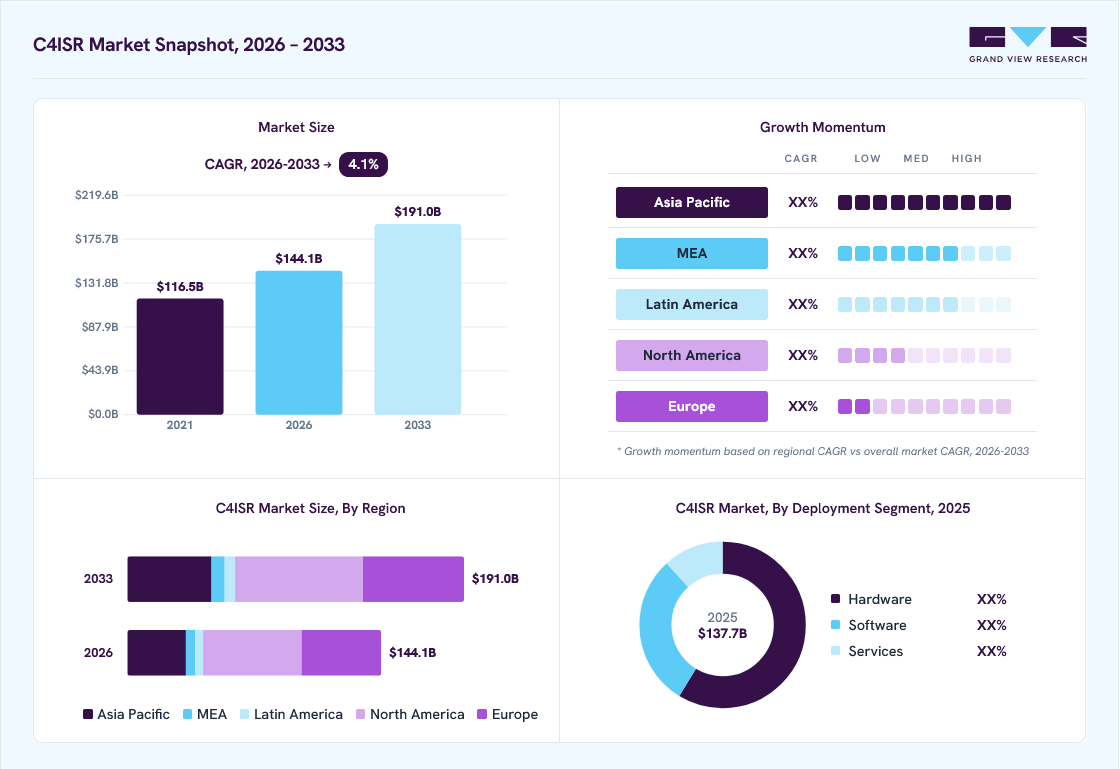
The global C4ISR market size was valued at USD 137.7 billion in 2025 and is projected to grow from USD 144.1 billion in 2026 to USD 191.0 billion by 2033, growing at a CAGR of 4.1% from 2026 to 2033. North America dominated the global market, accounting for the largest revenue share of 38.9% in 2025. The C4ISR market is primarily driven by the rising need for defense modernization and the adoption of network-centric and multi-domain warfare capabilities.
Key Market Trends & Insights
- By component: Hardware segment accounted for the largest share of 58.6% in 2025.
- By application: Intelligence, Surveillance and Reconnaissance (ISR) segment dominated the market, with a share of 42.5% in 2025.
- By end use: Air segment dominated the market, with a share of 35.8% in 2025.
- By vertical: Defense & military segment accounted for the largest share of 53.3% in 2025.
- By type: New installation segment dominated the market, with a share of 68.4% in 2025.
Regional Highlights
- Largest regional market: North America (38.9% revenue share in 2025)
- Fastest growing regional market: Asia Pacific (highest CAGR 5.3%, 2026-2033)
- By Country: The U.S. held the largest market share in 2025
Market Size & Forecast
- Market size in 2025: USD 137.6 Billion
- Estimated market size in 2026: USD 144.1 Billion
- Projected market size by 2033: USD 191.0 Billion
- CAGR (2026-2033): 4.1%
Furthermore, the increasing integration of advanced technologies such as artificial intelligence, cloud computing, autonomous systems, and space-based ISR is significantly enhancing real-time situational awareness and operational efficiency across defense forces worldwide.
As defense organizations and military forces embrace digital transformation, the demand for smarter, faster, and more integrated command and control systems is accelerating. Stakeholders are prioritizing cost-effective, real-time, and data-driven C4ISR solutions to enhance situational awareness, operational agility, and decision superiority. The widespread adoption of advanced sensors, AI, IoT, and secure communication technologies is enabling seamless information sharing, predictive threat analysis, and automated mission planning. There is also a strong push toward joint-force interoperability and multi-domain operations aligned with modern warfare doctrines. These evolving needs and technological advancements are driving significant growth in the C4ISR industry.
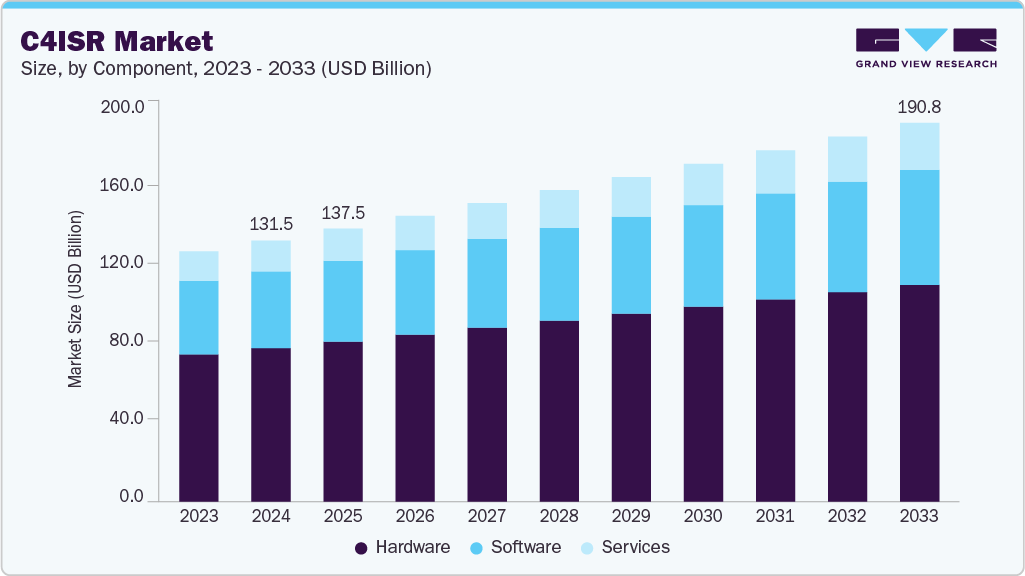
This growth is primarily driven by the increasing need for real-time situational awareness across air, land, sea, space, and cyber domains. As threats become more dynamic and asymmetric, military forces are prioritizing fast, data-enabled decision-making. Advanced sensor networks, AI-powered analytics, and integrated visualization tools play a central role in enhancing battlefield intelligence. These technologies allow commanders to gain a comprehensive operational picture and act with precision. The growing strategic focus on data dominance is expected to significantly drive demand for advanced C4ISR systems.
The increasing demand for mobile and tactical C4ISR solutions is being driven by the need for enhanced agility and responsiveness in fast-paced combat environments. Modern militaries are shifting from static command centers to mobile, rapidly deployable units equipped with compact and interoperable C4ISR systems. These solutions enable real-time data sharing, situational awareness, and secure communication in dynamic field conditions. The rise of expeditionary warfare and urban combat scenarios is further reinforcing the requirement for flexible, on-the-move C4ISR capabilities. As a result, defense forces are allocating greater resources toward field-deployable technologies to maintain operational superiority.
Market Dynamics
The C4ISR industry is rapidly evolving, driven by defense modernization programs, rising geopolitical tensions, and the shift toward network-centric and multi-domain warfare. Governments are increasingly investing in integrated command, control, communications, intelligence, surveillance, and reconnaissance systems to enhance real-time situational awareness and decision-making. Additionally, the market growth is further supported by the adoption of AI, cloud computing, autonomous systems, and space-based ISR technologies. These advancements are transforming defense operations into more connected, data-driven ecosystems with improved interoperability, speed, and operational efficiency.
The C4ISR market is strongly driven by global defense modernization initiatives, as countries increasingly upgrade their military infrastructure to address evolving security threats. Armed forces are shifting from traditional, platform-centric operations to network-centric and data-driven warfare models that rely on real-time information sharing and integrated command structures. This transition is increasing demand for advanced C4ISR systems that enable seamless coordination across land, air, naval, cyber, and space domains. Rising geopolitical tensions, border disputes, and threats of asymmetric warfare are further accelerating investments in next-generation command-and-control and intelligence systems.
Additionally, defense organizations are prioritizing interoperability and situational awareness, leading to higher adoption of integrated C4ISR platforms. Governments are investing in digital battlefields, secure communication networks, and AI-enabled decision-support systems to improve mission effectiveness and response speed. This sustained modernization push across developed and emerging economies is expected to remain a key structural growth driver for the market over the long term.
One of the major constraints in the C4ISR market is the high cost of developing, deploying, and maintaining advanced systems. C4ISR solutions require significant investments in hardware, software, sensors, communication networks, satellite systems, and cybersecurity infrastructure. In addition, long procurement cycles and strict defense budget allocations make it difficult for governments to rapidly adopt or scale new technologies. These high capital requirements can slow down adoption, particularly in developing or budget-constrained defense markets.
Furthermore, the complexity of integrating new C4ISR technologies with existing legacy defense infrastructure represents a significant challenge. Military organizations often operate heterogeneous systems built over decades, making interoperability a significant issue. Ensuring secure data exchange, standardized communication protocols, and seamless system integration requires extensive customization, testing, and compliance with strict defense regulations. These integration challenges can lead to deployment delays, increased project costs, and operational inefficiencies.
A major opportunity in the C4ISR market lies in the rapid integration of artificial intelligence, autonomous systems, and advanced analytics into defense operations. AI-enabled platforms are enhancing intelligence processing, predictive threat detection, and real-time decision-making, significantly improving operational efficiency and battlefield awareness. Autonomous drones, unmanned ground systems, and robotic surveillance platforms are also expanding the scope of intelligence gathering and reducing human risk in high-threat environments.
In addition, space-based ISR capabilities are creating new growth opportunities as governments invest in satellite constellations for persistent global surveillance, communication, and navigation. The increasing collaboration between defense agencies and commercial space companies is further accelerating access to high-resolution imagery and real-time data. Moreover, AI, autonomy, and space-based systems are reshaping the C4ISR ecosystem and unlocking long-term expansion opportunities across global defense markets.
Market Concentration & Characteristics
The C4ISR market is highly concentrated, with major defense contractors such as Lockheed Martin Corporation, Northrop Grumman, RTX Corporation, L3Harris Technologies, Inc., and General Dynamics holding significant market shares through long-term government contracts, extensive technology portfolios, and large-scale system integration capabilities. The market is highly innovation-driven, supported by continuous advancements in artificial intelligence, machine learning, cloud-enabled command systems, multi-domain operations, autonomous platforms, satellite communications, cybersecurity, and advanced sensor technologies.
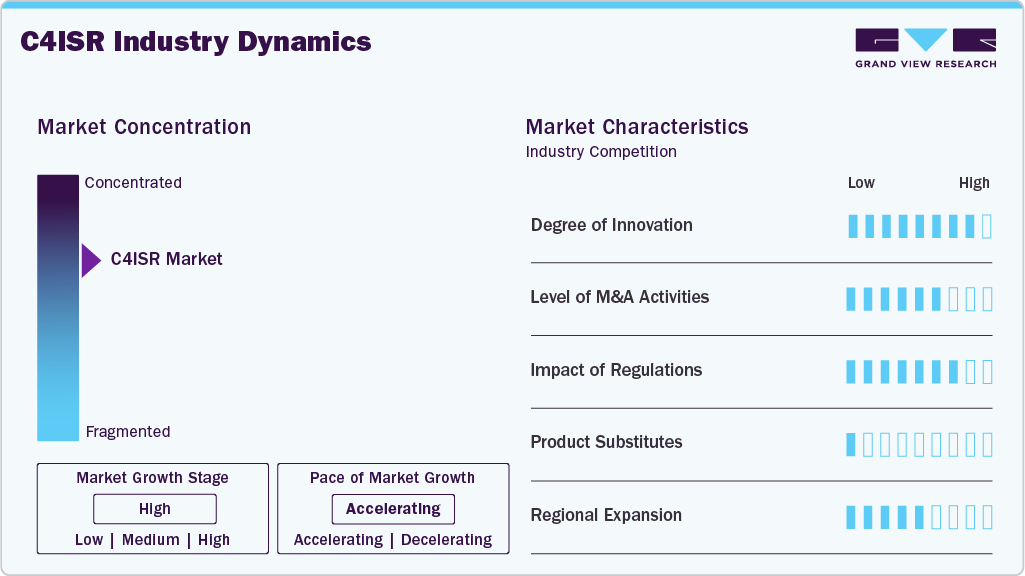
The industry is witnessing steady consolidation through mergers, acquisitions, strategic alliances, and government-industry partnerships as defense firms strengthen capabilities, expand integration expertise, and participate in large-scale modernization programs. Regulatory influence is high due to strict procurement rules, export controls, cybersecurity standards, and requirements for classified information, creating strong entry barriers while ensuring market stability. The threat of substitutes remains low, as C4ISR systems deliver mission-critical command, intelligence, surveillance, and communication functions with no effective alternatives. End-user concentration is moderate, with demand primarily driven by defense ministries, military forces, intelligence agencies, and homeland security organizations worldwide, resulting in a relatively concentrated but stable customer base.
Analyst Perspective
The C4ISR market is expanding, driven by increasing defense modernization programs, rising geopolitical tensions, growing demand for real-time battlefield situational awareness, and the rapid adoption of network-centric warfare capabilities. Military and security organizations worldwide are investing in advanced command-and-control systems, intelligence platforms, secure communications networks, and integrated surveillance technologies to enhance operational effectiveness and decision-making. The integration of artificial intelligence (AI), machine learning (ML), cloud computing, satellite communications, and autonomous ISR platforms is further accelerating market growth.
Component Insights
Based on component, the hardware segment led the market with the largest revenue share of 58.6% in 2025 and is expected to grow at a considerable CAGR over the forecast period, driven by the need for high-performance, mission-critical components that support real-time data acquisition, processing, and transmission. Technological advancements in radar systems, unmanned platforms, and signal intelligence hardware are enabling enhanced detection, tracking, and targeting capabilities. In addition, the push for modular and upgradable hardware is aligning with military modernization programs and lifecycle cost optimization strategies. These factors are expected to accelerate investment in next-generation C4ISR hardware across both developed and emerging defense markets.
The services segment is predicted to register the fastest CAGR of over 4.7% from 2026 - 2033, driven by the growing complexity of modern defense systems and the need for end-to-end operational support. Defense organizations are relying on system integration, training, maintenance, and lifecycle management services to ensure mission readiness and system uptime. As military forces adopt more software-defined and AI-enabled solutions, the role of professional and managed services becomes critical to optimize performance and interoperability. This growing reliance on outsourced expertise and support is expected to fuel sustained growth in the C4ISR services segment.
Application Insights
Based on application, the Intelligence, Surveillance and Reconnaissance (ISR) segment dominated the market with the largest revenue share of 42.5% in 2025, owing to the rising need for real-time threat detection and situational awareness. The integration of AI and machine learning in ISR systems enables faster data analysis, pattern recognition, and decision-making. This growing focus on data-driven intelligence and persistent monitoring is expected to drive robust expansion in the ISR segment of the C4ISR industry.
The electronic warfare segment is expected to register the fastest CAGR of 5.4% from 2026 - 2033, driven by increasing global investment in modernizing military capabilities to counter emerging electromagnetic threats. Nations are prioritizing EW upgrades to enhance jamming, spoofing, and signal interception in both offensive and defensive operations. Major defense firms are advancing cognitive EW solutions powered by AI for real-time spectrum dominance and adaptive threat response. In addition, high-value acquisitions and integrated platform development, such as L3Harris’s Viper Shield and Honeywell’s acquisition of CAES, are accelerating innovation across airborne and ground-based EW systems.
End Use Insights
Based on end use, the air segment led the market with the largest revenue share of 35.8% in 2025 and is expected to grow at a considerable CAGR over the forecast period. The rising demand for real-time aerial intelligence and high-altitude surveillance is fueling significant growth in the air segment of the C4ISR industry. Armed forces are increasingly utilizing advanced manned aircraft and UAVs integrated with cutting-edge sensors and secure communication systems. These airborne platforms provide critical capabilities for early threat detection, reconnaissance, and precision targeting across wide operational areas. As defense agencies prioritize faster, more flexible response capabilities, investment in technologically advanced airborne C4ISR systems is expected to surge.
The naval segment is predicted to foresee significant growth in the forecast period. The growing demand for enhanced maritime domain awareness and secure naval communications is driving growth in the naval segment of the C4ISR industry. Naval forces are increasingly equipping surface vessels and submarines with integrated radar, sonar, electronic warfare, and satellite communication systems. These technologies enable real-time tracking, threat detection, and coordinated command and control in both blue-water and littoral operations. As global maritime security challenges intensify, investments in advanced naval C4ISR capabilities are expected to accelerate.
Vertical Insights
Based on vertical, the defense & military segment dominated the market with the largest revenue share of 53.3% in 2025, primarily driven by the need for strategic dominance and mission-critical decision-making. Armed forces are prioritizing the deployment of integrated systems that enhance command, control, intelligence gathering, and operational coordination across multiple domains. The adoption of AI-enabled analytics, advanced surveillance technologies, and secure communication platforms is significantly improving battlefield efficiency and force readiness. This sustained focus on modernization and multi-domain operations is expected to propel long-term growth in the defense and military C4ISR segment.
The government segment is predicted to foresee significant growth in the forecast period, owing to the increasing need for national security, border surveillance, and critical infrastructure protection. The government segment is witnessing growing adoption of C4ISR solutions. Public agencies are investing in integrated communication, intelligence, and situational awareness systems to enhance coordination during emergencies and counter-terrorism operations. The integration of real-time data analytics, geospatial intelligence, and secure networks enables faster and more informed decision-making across civilian and defense departments. This rising emphasis on inter-agency collaboration and crisis preparedness is expected to drive steady growth in the government-focused C4ISR industry.
Type Insights
Based on type, the new installation segment dominated the market with the largest revenue share of 68.4% in 2025. The growing demand for new C4ISR installations is accelerating as defense forces modernize aging infrastructure and expand their operational capabilities. Countries are prioritizing the deployment of next-generation systems that integrate command, control, communications, and surveillance functions into unified platforms. These installations are often designed with modularity, scalability, and interoperability in mind to support evolving mission requirements. This growing focus on building future-ready digital command networks is expected to drive significant investment in new C4ISR deployments across global defense ecosystems.

The retrofit segment is expected to register the fastest CAGR of 4.4$ from 2026-2033, owing to the budgetary constraints and extended lifecycle of existing defense platforms, the demand for C4ISR retrofitting is steadily rising. Armed forces are upgrading legacy systems with advanced sensors, secure communication modules, and AI-enabled processing units to meet modern operational standards. These retrofits enable enhanced functionality and interoperability without the need for full system replacements, offering a cost-effective path to modernization. As defense agencies aim to bridge capability gaps and extend platform usability, investment in retrofit-focused C4ISR solutions is expected to grow significantly.
Regional Insights
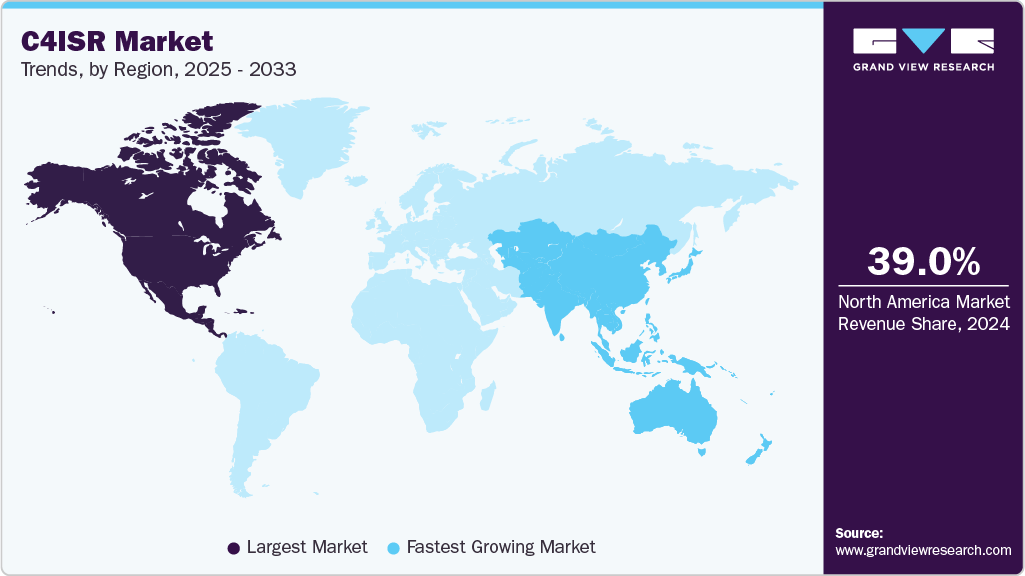
North America dominated the C4ISR market, accounting for the largest revenue share of 38.9% in 2025, primarily driven by extensive defense modernization programs and technological leadership. The North American market continues to see robust growth. The region is at the forefront of integrating AI, autonomous systems, and space-based ISR into its military command structures. Strong collaboration between defense contractors and government agencies is accelerating system development and deployment.
U.S. C4ISR Market Trends
The C4ISR market in the U.S. held the largest share in the North America region in 2025, driven by multi-domain operational strategies and a focus on global force projection. The U.S. remains the largest and most influential player in the market. Major investments are being channeled into advanced communications, cybersecurity-resilient networks, and next-generation satellite systems. The increasing emphasis on joint all-domain command and control (JADC2) is reshaping U.S. C4ISR architecture.
Europe C4ISR Market Trends
The Europe C4ISR industry is expected to grow at a CAGR of 3.4% from 2026 to 2033, owing to intensifying regional security threats and the push for defense autonomy. Europe is rapidly expanding its C4ISR capabilities. NATO-aligned forces are enhancing interoperability through integrated surveillance, reconnaissance, and secure communication platforms. National governments are also supporting homegrown C4ISR development to reduce reliance on external defense suppliers.
The Germany C4ISR industry is witnessing increasing growth in the regional market,owing to rising commitments to NATO interoperability and defense modernization. Germany is increasingly investing in integrated C4ISR solutions. The country is prioritizing upgrades in secure communication systems, real-time battlefield intelligence, and electronic warfare capabilities to enhance operational efficiency. Driven by geopolitical tensions in Eastern Europe and renewed focus on cyber resilience, Germany is accelerating the deployment of joint command systems and situational awareness platforms.
The UK C4ISR industry is witnessing increasing growth, primarily driven by its strategic pivot to multi-domain integration and space-based ISR. The UK is expanding investments in advanced C4ISR technologies. The British Armed Forces are focusing on digitizing command infrastructure, leveraging AI for ISR data fusion, and enhancing cyber-electromagnetic capabilities. Driven by its Global Strategic Defence Review, the UK is advancing toward a highly networked force capable of rapid deployment and decision-making.
Asia Pacific C4ISR Market Trends
The Asia Pacific C4ISR industry is expected to grow at the fastest CAGR of over 5.3% from 2026 to 2033. The increasing demand for situational awareness and force readiness in a volatile geopolitical climate is propelling the Asia Pacific market. Countries such as India, China, and Japan are investing in UAV-based ISR, battlefield digitization, and electronic warfare systems. Indigenous defense programs and military modernization efforts are further accelerating the deployment of integrated C4ISR frameworks.
The China C4ISR industry is witnessing increasing growth in the market, driven by its ambitions to become a global military superpower. China is significantly boosting its C4ISR capabilities across space, air, naval, and cyber domains. Owing to rising regional tensions and strategic competition with the U.S., the country is investing heavily in real-time satellite-based surveillance, battlefield networks, and AI-driven decision support. China's civil-military fusion approach further accelerates the integration of commercial innovation into its C4ISR infrastructure.
The Japan C4ISR industry is witnessing increasing growth in the market, owing to increasing threats from neighboring countries and regional missile developments. Japan is enhancing its C4ISR systems for national defense and early-warning capabilities. The government is prioritizing investments in secure data links, space-based reconnaissance, and integrated air defense networks. Primarily driven by strategic alignment with the U.S. and modernization goals under its defense white paper, Japan is adopting next-generation technologies to boost joint-force interoperability and operational readiness.
Key C4ISR Company Insights
Some of the key players operating in the market include Lockheed Martin Corporation and Northrop Grumman Corporation and among others.
-
Lockheed Martin Corporation is a global leader in aerospace, defense, and security, with a significant presence in the C4ISR domain. The company specializes in integrated command and control systems, advanced surveillance technologies, and secure communications platforms. Its products support multi-domain operations, including space-based ISR and cyber-hardened networks. Through programs like the Distributed Common Ground System and tactical data links, Lockheed Martin plays a pivotal role in modernizing global defense infrastructure.
-
Northrop Grumman Corporation is renowned for its advanced defense electronics and C4ISR capabilities. It offers integrated battle management systems, airborne ISR solutions, and mission-critical command networks. The company’s scalable and interoperable systems, such as the Global Hawk and Joint STARS, support real-time intelligence sharing and situational awareness. Northrop’s continuous innovation in sensor fusion and AI integration reinforces its leadership in network-centric warfare.
CACI International Inc. and Elbit Systems Ltd. are some of the emerging participants in the market.
-
CACI International Inc. is a fast-growing provider of mission technology and enterprise IT services, with growing capabilities in C4ISR. It develops secure ISR software, tactical communications, and AI-driven data exploitation platforms for defense intelligence agencies. The company’s strengths lie in signals intelligence (SIGINT), battlefield management, and counter-threat platforms. CACI’s continued investment in next-generation EW and cyber operations positions it as a competitive emerging player.
-
Elbit Systems Ltd., based in Israel, is gaining global attention for its innovative C4ISR solutions across land, sea, air, and cyber domains. It offers integrated command and control systems, real-time intelligence processing, and tactical communication networks. Elbit’s products, such as the DOMINATOR C4I suite, provide robust situational awareness and support for networked warfare. Its emphasis on modular, interoperable systems makes it increasingly attractive for modern defense forces.
Key C4ISR Companies:
The following key companies have been profiled for this study on the C4ISR market.
- BAE Systems, Inc.
- CACI International Inc.
- Elbit Systems Ltd.
- General Dynamics
- Kratos Defense & Security Solutions, Inc.
- L3Harris Technologies, Inc.
- Leonardo S.p.A.
- Lockheed Martin Corporation
- Northrop Grumman
- Rheinmetall AG
- RTX Corporation (Raytheon Technologies Corporation)
- Saab AB
- Thales
Competitive Benchmarking
Category
Operating Strategies
Competitive Edge
Weakness
Established Players (Lockheed Martin Corporation, Northrop Grumman, RTX Corporation, General Dynamics, L3Harris Technologies, Inc., BAE Systems, Inc., Thales, Leonardo S.p.A.)
- Focus on large-scale defense modernization programs by delivering integrated C4ISR solutions spanning command-and-control systems, secure communications, intelligence platforms, surveillance networks, electronic warfare, and multi-domain operations.
- Invest heavily in AI-enabled decision support, cloud-based battle management systems, cyber resilience, and space-based ISR capabilities.
- Extensive defense portfolios, strong relationships with military agencies, large R&D budgets, and proven capability to deliver complex, mission-critical systems.
- Strong global footprint, established supply chains, and expertise in integrating land, air, naval, cyber, and space domains provide significant competitive advantages.
- High dependence on government defense budgets and procurement cycles. Complex program execution and regulatory requirements can lead to lengthy sales cycles and cost overruns.
- Growing competition from agile technology firms and specialized defense innovators may challenge market share in emerging technology segments.
Emerging & Specialized Players (Elbit Systems Ltd., Saab AB, Rheinmetall AG, Kratos Defense & Security Solutions, Inc.)
- Focus on advanced ISR platforms, tactical communications, electronic warfare systems, autonomous systems, border surveillance, battlefield management, and unmanned solutions.
- Emphasize rapid innovation, modular architectures, and cost-effective modernization programs tailored to specific military requirements.
- Strong expertise in niche defense technologies, faster innovation cycles, and the ability to provide highly customized solutions.
- Competitive positioning in areas such as drones, tactical ISR, electronic warfare, and integrated battlefield systems enables differentiation from larger defense primes.
- Smaller scale and lower financial resources compared to major defense contractors.
- Limited participation in mega-programs and dependence on regional defense spending can constrain growth.
Recent Developments
-
In May 2025, Kontron launched the VX3406, a rugged 3U VPX Ethernet board tailored for defense and aerospace applications. It features six independent 1000BASE-T Ethernet ports with dedicated controllers, ensuring fault isolation and high-speed, conflict-free data transmission. Designed for C4ISR and unmanned systems, the board supports TSN standards for real-time, secure, and low-latency communication.
-
In February 2025, Sentinel Photonics expanded its European footprint by partnering with StarC4SYS in Romania and TBM Netherlands in the Benelux region. These strategic alliances will streamline the deployment of its LASERD detection systems and FROST retro-reflective protection solutions, enabling faster delivery and enhanced technical support for military and security clients. Through collaboration with local C4ISR and EW specialists, Sentinel is boosting its capacity to address evolving laser threats across key European markets.
C4ISR Market Report Scope
Report Attribute
Details
Market size value in 2025
USD 137.7 billion
Market size value in 2026
USD 144.1 billion
Revenue forecast in 2033
USD 191.0 billion
Growth rate
CAGR of 4.1% from 2026 to 2033
Base year for estimation
2025
Historical data
2021 - 2024
Forecast period
2026 - 2033
Quantitative units
Revenue in USD billion, and CAGR from 2026 to 2033
Report coverage
Revenue forecast, company ranking, competitive landscape, growth factors, and trends
Segments covered
Component, application, end use, vertical, type, region
Regional scope
North America; Europe; Asia Pacific; Latin America; MEA
Country scope
U.S.; Canada; UK; Germany; France; Italy; Spain; Russia; China; Japan; India; South Korea; Australia; Brazil; Mexico; KSA; UAE; South Africa
Key companies profiled
BAE Systems, Inc.; CACI International Inc.; Elbit Systems Ltd.; General Dynamics; Kratos Defense & Security Solutions, Inc.; L3Harris Technologies, Inc.; Leonardo S.p.A.; Lockheed Martin Corporation; Northrop Grumman; Rheinmetall AG; RTX Corporation (Raytheon Technologies Corporation); Saab AB; Thales
Customization scope
Free report customization (equivalent up to 8 analysts' working days) with purchase. Addition or alteration to country, regional & segment scope.
Pricing and purchase options
Avail customized purchase options to meet your exact research needs. Explore purchase options
Global C4ISR Market Report Segmentation
This report forecasts revenue growth at the global, regional, and country levels and provides an analysis of the latest industry trends in each of the sub-segments from 2021 to 2033. For this study, Grand View Research has segmented the global C4ISR market report based on component, application, end use, vertical, type, and region:
-
Component Outlook (Revenue, USD Billion, 2021 - 2033)
-
Hardware
-
Software
-
Services
-
-
Application Outlook (Revenue, USD Billion, 2021 - 2033)
-
Command & Control
-
Communications
-
Computers
-
Intelligence, Surveillance and Reconnaissance (ISR)
-
Electronic Warfare
-
-
End Use Outlook (Revenue, USD Billion, 2021 - 2033)
-
Ground
-
Naval
-
Air
-
Space
-
-
Vertical Outlook (Revenue, USD Billion, 2021 - 2033)
-
Defense & Military
-
Government
-
Commercial
-
-
Type Outlook (Revenue, USD Billion, 2021 - 2033)
-
New Installation
-
Retrofit
-
-
Regional Outlook (Revenue, USD Billion, 2021 - 2033)
-
North America
-
U.S.
-
Canada
-
-
Europe
-
UK
-
Germany
-
France
-
Italy
-
Spain
-
Russia
-
-
Asia Pacific
-
China
-
Japan
-
India
-
South Korea
-
Australia
-
-
Latin America
-
Brazil
-
Mexico
-
-
Middle East and Africa (MEA)
-
KSA
-
UAE
-
South Africa
-
-
Research Methodology
The C4ISR market figures in this report are based on a proven research process that combines executive interviews with secondary research from proprietary databases, company filings, and recognized regulatory and institutional sources. Market size is built through value-chain sizing - reconciling supply-side and demand-side estimates - and triangulated with bottom-up and top-down approaches. Every estimate passes multiple levels of expert validation before publication, with each C4ISR segment quantified using the revenue-capture definitions in the table below.
Segment Definition
Segment - Component
Revenue capture definition
Hardware
Revenue is generated from the sale of C4ISR hardware, including command-and-control consoles, communication devices, radios, radar systems, sensors, surveillance equipment, satellites, antennas, electronic warfare systems, servers, and networking infrastructure used to support military and security operations.
Software
Revenue is generated through licensing, subscriptions, and deployment of C4ISR software platforms, including battle management systems, command-and-control applications, intelligence analysis tools, cybersecurity solutions, data fusion platforms, AI-driven analytics, and mission planning software.
Services
Revenue is generated through consulting, system integration, deployment, training, maintenance, technical support, modernization, managed services, and lifecycle sustainment services associated with C4ISR systems and infrastructure.
Segment - Application
Revenue capture definition
Command & Control
Revenue is captured from the procurement, deployment, and maintenance of command-and-control systems that support operational planning, mission coordination, decision-making, and battlefield management.
Communications
Revenue is captured from secure communication solutions, including tactical radios, satellite communication systems, data links, communication networks, and related infrastructure that enable information exchange across defense operations.
Computers
Revenue is captured from computing infrastructure, data processing systems, servers, cloud-based platforms, edge computing solutions, and information management technologies supporting military operations.
Intelligence, Surveillance
& Reconnaissance (ISR)Revenue is captured from ISR platforms and technologies, including sensors, drones, satellites, radar systems, surveillance equipment, intelligence processing tools, and reconnaissance solutions.
Electronic Warfare
Revenue is captured from electronic warfare systems designed for signal intelligence, electronic attack, electronic protection, spectrum monitoring, jamming, and electromagnetic threat mitigation.
Segment - End Use
Revenue capture definition
Ground
Revenue is captured from C4ISR solutions deployed across land-based military and security operations, including tactical communication systems, command centers, armored vehicle electronics, and battlefield surveillance systems.
Naval
Revenue is captured from C4ISR technologies integrated into naval platforms, including warships, submarines, maritime surveillance systems, coastal monitoring networks, and naval communication infrastructure.
Air
Revenue is captured from airborne C4ISR platforms and systems, including military aircraft, helicopters, UAVs, airborne surveillance systems, reconnaissance platforms, and related communication technologies.
Space
Revenue is captured from satellite-based communication, intelligence, surveillance, navigation, missile warning, and space-domain awareness systems supporting defense and security missions.
Segment - Vertical
Revenue capture definition
Defense & Military
Revenue is captured from the procurement, deployment, modernization, and maintenance of C4ISR systems by armed forces and defense organizations for operational, intelligence, and combat missions.
Government
Revenue is generated from homeland security agencies, intelligence organizations, border security authorities, law enforcement bodies, and public safety agencies that invest in C4ISR capabilities.
Commercial
Revenue is generated from private-sector organizations that use C4ISR-related technologies for critical infrastructure protection, industrial security, maritime monitoring, aerospace operations, and cybersecurity applications.
Segment - Type
Revenue capture definition
New Installation
Revenue is captured from the procurement and deployment of newly installed C4ISR systems, communication networks, surveillance platforms, command centers, and supporting infrastructure.
Retrofit
Revenue is captured from the upgrade, integration, modernization, and enhancement of existing defense and security platforms with advanced C4ISR technologies, software, and communication capabilities.
Estimation Model
Layer Name
Key Question
Description
Defense & Security End-User Layer
Who are the potential C4ISR users?
Represents the total addressable base of defense and security organizations requiring command, control, communications, intelligence, surveillance, and reconnaissance capabilities. This includes military forces (Army, Navy, Air Force, Space Force), homeland security agencies, intelligence organizations, border security forces, coast guards, law enforcement agencies, and peacekeeping organizations across developed and emerging economies.
Platform & Technology Layer
What technologies enable C4ISR capabilities?
Includes core technologies such as command-and-control systems, tactical communication networks, satellite communications, intelligence platforms, radar systems, electro-optical/infrared sensors, unmanned systems, electronic warfare solutions, cybersecurity platforms, cloud computing, artificial intelligence, machine learning, big data analytics, and edge computing. These technologies facilitate real-time situational awareness, secure communications, target identification, and mission planning.
Application & Mission Layer
How are C4ISR solutions deployed and utilized?
Covers operational applications across military and security missions, including battlefield management, intelligence gathering, surveillance and reconnaissance, border monitoring, maritime domain awareness, cyber defense, counterterrorism operations, disaster response, peacekeeping missions, and multi-domain military operations.
Revenue Generation Layer
How is revenue generated?
Revenue is generated through defense procurement contracts, system integration projects, platform modernization programs, software licensing, maintenance and sustainment contracts, managed services, training programs, and lifecycle support services. Additional revenue streams arise from upgrades, cybersecurity enhancements, AI-enabled analytics, cloud-based command systems, and next-generation ISR capabilities.
Delivered Customizations
This report has been delivered with the following In-depth customizations
Client Request
Customization Delivered
Value Adds
Market Sizing, Competitive Landscape & Growth Opportunity Assessment
Conducted a comprehensive assessment of the global C4ISR market, including market size estimation, growth forecasts, technology adoption trends, defense modernization programs, and procurement spending across air, land, naval, and space domains, while analyzing regional demand patterns, government investments, and emerging battlefield digitization initiatives.
Enables informed market entry and expansion strategies, identifies high-growth defense programs and geographies, supports investment prioritization, strengthens competitive positioning, and uncovers opportunities arising from military modernization and network-centric warfare initiatives.
Technology Roadmap & Innovation Opportunity Assessment
Assessed emerging technologies influencing the C4ISR ecosystem, including artificial intelligence, machine learning, autonomous surveillance platforms, satellite-based ISR, quantum-resistant communications, advanced sensors, and cloud-based battle management systems. Evaluated technology readiness levels, adoption barriers, and future investment priorities across defense organizations.
Helps stakeholders anticipate future market shifts, prioritize R&D investments, accelerate innovation strategies, maintain technological superiority, and capitalize on next-generation defense and intelligence capabilities.
Regional Defense Spending & Program Opportunity Analysis
Evaluated defense budgets, modernization initiatives, military communication programs, ISR platform acquisitions, and command-and-control upgrades across North America, Europe, Asia-Pacific, the Middle East, and emerging defense markets. Identified key procurement programs, government funding priorities, and partnership opportunities.
Provides visibility into upcoming procurement opportunities, supports geographic expansion planning, improves resource allocation, enhances partnership strategies, and enables proactive engagement with defense agencies and prime contractors.
Frequently Asked Questions About This Report
The global C4ISR market is expected to grow at a CAGR of 4.1% from 2026 to 2033 to reach USD 191.0 billion by 2033.
Some key players operating in the C4ISR market include BAE Systems, Inc., CACI International Inc., Elbit Systems Ltd., General Dynamics, Kratos Defense & Security Solutions, Inc., L3Harris Technologies, Inc., Leonardo S.p.A., Lockheed Martin Corporation, Northrop Grumman, Rheinmetall AG, RTX Corporation (Raytheon Technologies Corporation), Saab AB, and Thales.
The market's growth can be credited to the rapid technological advancements driven by factors such as advancements in machine learning algorithms, the application of artificial intelligence, and increasing computing power. Subsequently, the IoT is increasingly being leveraged to enhance connectivity and interoperability within C4ISR systems.
North America dominated the market and accounted for over 38.9% share in 2025. The U.S. military is strategically investing significant resources to bolster its C4ISR capabilities, aiming to secure a decisive edge in the ongoing technological competition with adversaries. This substantial commitment reflects a key priority in the nation's warfare strategy, with substantial funds dedicated to the development of advanced C4ISR solutions.
Asia-Pacific is expected to register the fastest growth of over 5.3% from 2026 to 2033.
The hardware segment accounted for the largest market share of 58.6% in 2025.
Intelligence, Surveillance and Reconnaissance (ISR) segment held the largest revenue share of 42.5% in 2025.
Air segment accounted for the largest market share of 35.6% in 2025.
The global C4ISR market size was estimated at USD 137.7 billion in 2025 and is expected to reach USD 144.1 billion in 2026.
About the Author(s)
Communications Infrastructure Research Team
Technology · Communications InfrastructureThis report was authored by the communications infrastructure research team at Grand View Research - comprising two research analysts, one senior research analyst, and one industry expert - with specialized expertise in the communications infrastructure segment of the technology industry. All findings are based on proprietary technology databases, executive interviews, and regulatory analysis, subject to internal peer review prior to publication.
Last Updated:
Speak to Analyst


Customize this report to your needs — add regions, segments, or data points, with 20% free customization.
Or view our licence options:


ISO 9001:2015 & 27001:2022 Certified
We are GDPR and CCPA compliant! Your transaction & personal information is safe and secure. For more details, please read our privacy policy.


