
- Home
- »
- Specialty Glass, Ceramic & Fiber
- »
-
Carbon Fiber Tapes Market Size & Share Report, 2026-2033GVR Report cover

Carbon Fiber Tapes Market (2026 - 2033)
Size, Share & Trends Analysis Report By Resin Type (Dry Tapes, Prepreg Tapes), By End Use (Aerospace & Defense, Automotive), By Region (North America, Asia Pacific, Europe, Latin America, Middle East and Africa), And Segment Forecasts
Market Size, 2025
$3.6BMarket Estimate, 2026
$4.2BMarket Forecast, 2033
$13.8BCAGR, 2026–2033
18.5%Carbon Fiber Tapes Market Summary
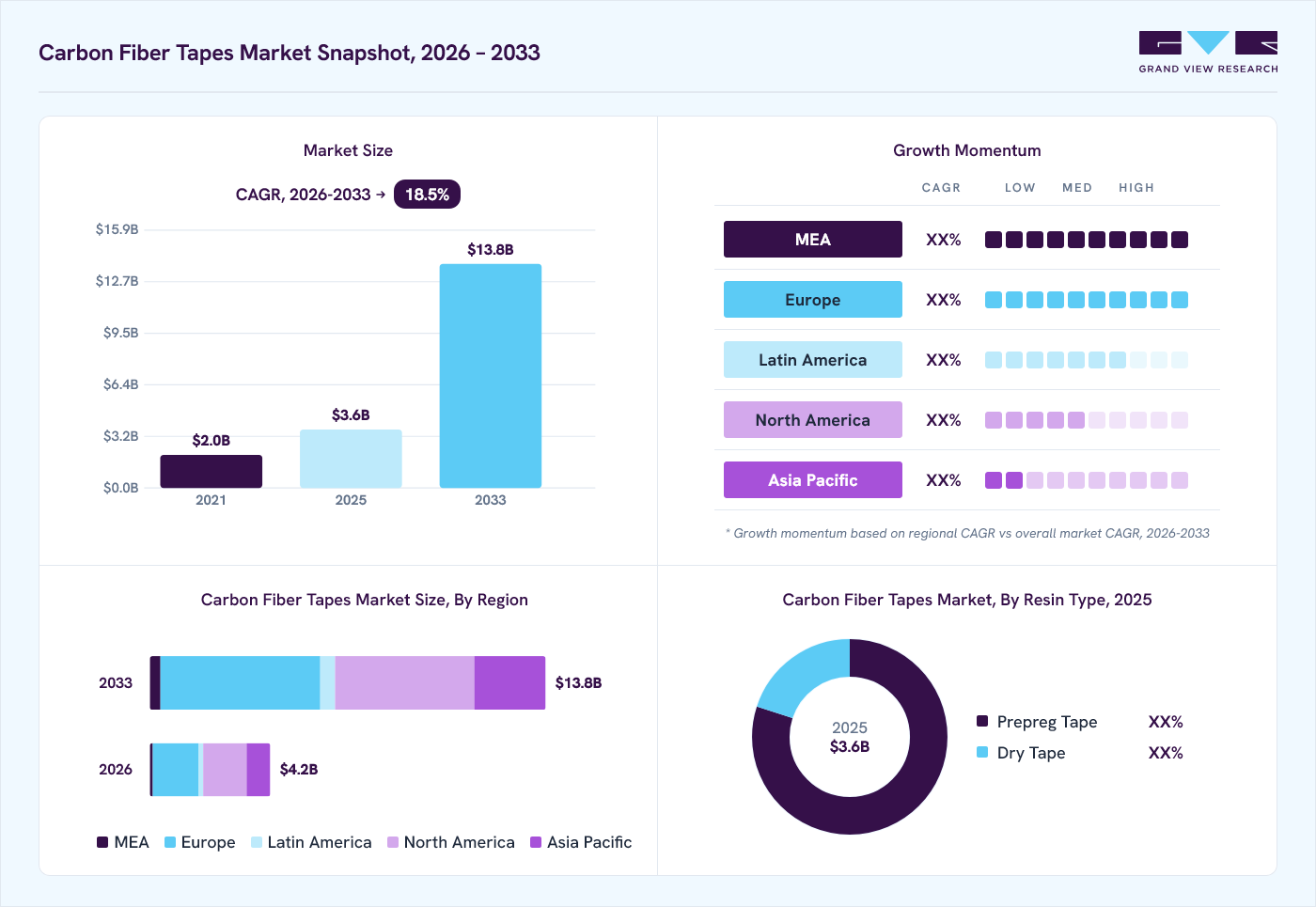
The global carbon fiber tapes market size was valued at USD 3.6 billion in 2025 and is projected to grow from USD 4.2 billion in 2026 to USD 13.8 billion by 2033, at a CAGR of 18.5% from 2026 to 2033. The market in Europe dominated with a revenue share of 37.7% in 2025. This growth can be attributed to the emergence of carbon fiber as one of the critical materials for enabling lightweight construction of automotive and aerospace components.
 Source: Grand View Research, IR Documents, Primary Interviews, Paid DatabasesTo learn more about this report,
 Download Free Sample Report
Key Market Trends & Insights
- By resin type: Prepreg tape segment held the largest market share of 80.0% in 2025.
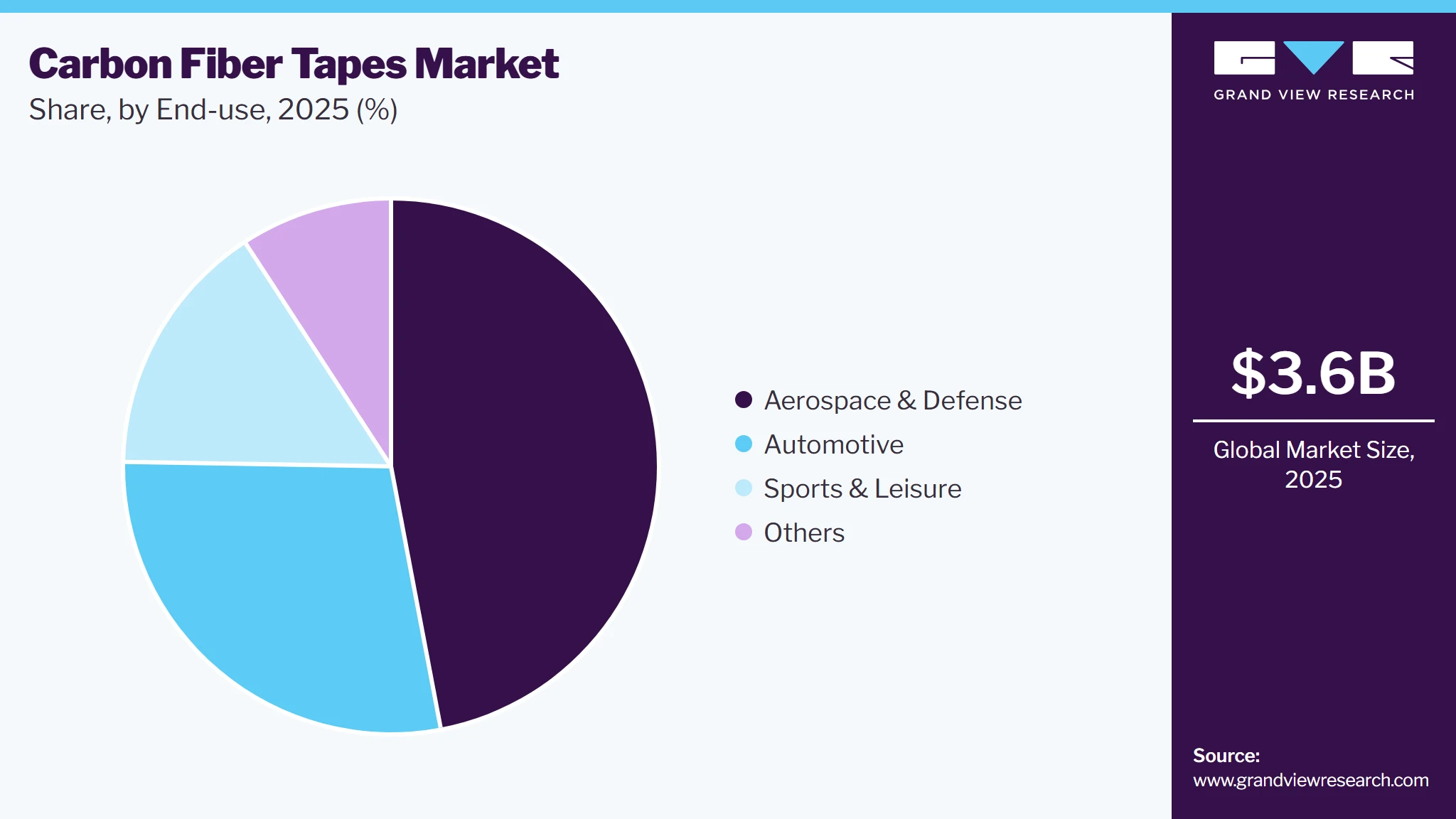
- By end use: Aerospace & defense segment held the largest market share of 47.0% in 2025.
Regional Highlights
- Largest regional market: Europe (37.7% revenue share, 2025)
- By country: Germany held the largest market share in 2025
Market Size & Forecast
- Market size in 2025: USD 3.6 Billion
- Estimated market size in 2026: USD 4.2 Billion
- Projected market size by 2033: USD 13.8 Billion
- CAGR (2026-2033): 18.5%
GVR research-powered AIAsk Prism AI about the carbon fiber tapes marketGet cited answers from GVR research on market growth, segments, regulations and forecasts.Start with✓ Source-linked answers ✓ Market-specific context ✓ Traceable figuresExplore Prism AI ↗
In addition, carbon fiber (CF) tape is one of the popular materials used for manufacturing composite parts for automotive and aerospace equipment. Furthermore, advancements in carbon fiber tapes expected to lead the incorporation of other properties such as de-icing, shielding, self-repair, energy storage, and stealth, thereby enabling the manufacturing of multi-functional carbon fiber tapes.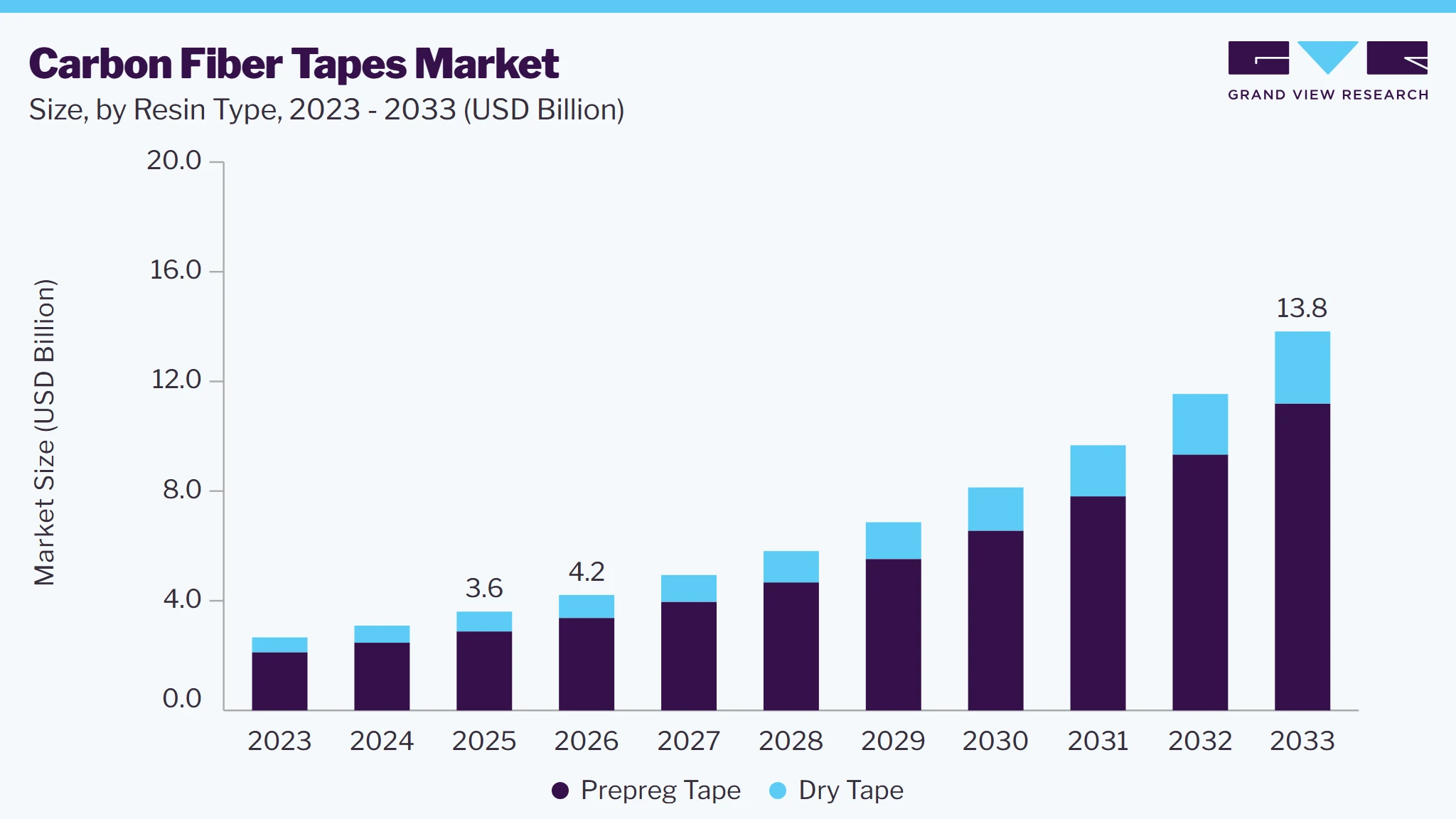 To learn more about this report, Download Free Sample Report
Carbon fiber tapes are recognized as clean energy technologies owing to their position as facilitating materials for several initiatives of the U.S. Department of Energy and Office of Energy and Renewable Energy. In addition, incorporation of this material also enables a weight reduction of vehicles in transportation applications leading to energy reduction through fuel savings.
The automotive industry is increasingly focused on producing low-emission, fuel-efficient vehicles, which has driven the demand for carbon fibers in structural components. These fibers are valued for their strength and cost-efficiency in manufacturing. Although automakers still use a combination of steel, aluminum, and composites based on specific needs, the growing use of carbon fiber in vehicles, especially in structural and semi-structural parts, is expected to accelerate market growth. Especially, cars such as the BMW i3 incorporate carbon-fiber-reinforced plastic. For economic reasons, small-market cars have been the initial focus for carbon fiber application. With advancements in manufacturing processes, the cost of carbon fiber components could decrease, promoting greater adoption in the automotive sector. Lightweight vehicles made with carbon fibers also contribute to energy savings and reduced costs, making the material even more appealing.
Furthermore, in aerospace, the use of carbon fiber tape has grown significantly in aircraft structures, including both civil and military aviation, as well as space technology. Carbon fibers have been crucial in aerospace applications for decades, starting with programs by NASA and the U.S. Department of Defense, due to their exceptional mechanical properties. Aircraft models such as the Airbus A380 and Boeing 787 primarily rely on carbon fiber. In defense, aircraft and helicopter programs, including the F-35 and Black Hawk, drive stable demand for the material. Moreover, the push for greener technologies and efficient propulsion systems is increasing the demand for carbon fiber in both new and upgraded aircraft structures.
Market Dynamics
The carbon fiber tapes market is witnessing steady growth driven by increasing demand for lightweight, high-strength materials across aerospace, automotive, wind energy, sporting goods, and industrial applications. Carbon fiber tapes, available in unidirectional (UD) and woven formats, offer excellent strength-to-weight ratio, stiffness, fatigue resistance, and corrosion resistance, making them suitable for structural reinforcement and composite manufacturing. Growing adoption of advanced composites to improve fuel efficiency, reduce emissions, and enhance product performance is accelerating market demand. In addition, technological advancements in automated fiber placement (AFP), automated tape laying (ATL), and thermoplastic composite processing are expanding the application scope of carbon fiber tapes across both high-volume and high-performance industries.
The growing emphasis on weight reduction and improved structural performance across transportation and industrial sectors is a key driver for the carbon fiber tapes market. Aerospace manufacturers are increasingly utilizing carbon fiber tapes in aircraft fuselages, wings, and interior components to reduce weight, improve fuel efficiency, and enhance durability. Similarly, automotive manufacturers are incorporating carbon fiber composites into electric vehicles and premium vehicles to extend driving range, improve energy efficiency, and meet stringent emission regulations.
Additionally, rapid growth in wind energy installations is driving demand for carbon fiber tapes in turbine blades, where lightweight materials with high stiffness enable the production of longer, more efficient blades. Increasing investments in renewable energy, expanding industrial automation, and rising adoption of advanced composite manufacturing technologies are further supporting market growth across developed and emerging economies.
The carbon fiber tapes market faces challenges due to the high cost of carbon fiber precursors, energy-intensive production processes, and specialized manufacturing technologies required for composite fabrication. Compared to conventional materials such as steel, aluminum, and glass fiber composites, carbon fiber tapes remain significantly more expensive, limiting their adoption in cost-sensitive applications. Moreover, composite manufacturing often requires advanced equipment, skilled labor, and stringent quality control procedures, increasing production costs and extending manufacturing timelines. Limited recycling infrastructure for carbon fiber composites and supply chain constraints for high-quality carbon fibers further pose challenges to broader market penetration.
The increasing production of electric vehicles (EVs) and the growing adoption of automated composite manufacturing technologies present significant opportunities for the carbon fiber tapes market. Automakers are actively seeking lightweight materials to offset battery weight, improve vehicle efficiency, and extend driving range, creating strong demand for carbon fiber tape-based structural components. Furthermore, advancements in thermoplastic carbon fiber tapes, automated fiber placement (AFP), and automated tape laying (ATL) technologies are enabling faster production cycles, lower manufacturing costs, and improved design flexibility. Growing investments in sustainable composite materials, recyclable carbon fiber solutions, and next-generation aerospace, defense, and renewable energy applications are expected to create substantial growth opportunities for manufacturers over the coming years.
Analyst Perspective
The carbon fiber tapes market is transitioning from a niche aerospace-focused segment toward a broader advanced composites market, supported by the growing commercialization of lightweight materials across automotive, wind energy, industrial, and high-performance consumer applications. Although high material and processing costs continue to limit adoption in mass-market applications, ongoing advancements in automated manufacturing technologies, thermoplastic composites, and scalable production processes are gradually improving cost competitiveness. Over the long term, demand is expected to be driven by structural lightweighting, electrification of transportation, and increasing investments in renewable energy infrastructure. Consequently, companies that can combine material innovation with manufacturing efficiency, secure long-term OEM partnerships, and expand their presence in emerging high-volume applications are likely to strengthen their competitive position and capture above-market growth.
Resin Type Insights
Based on resin type, the prepreg tape segment led the market with the largest revenue share of 80.0% in 2025 and is expected to grow at a CAGR of 18.7% over the forecast period. Unidirectional prepreg carbon fiber tapes are ideal for fabricating composite parts that require thick laminate construction and long-layup time. As a result, these tapes are highly suitable for infrastructure, industrial, medical, and sports & leisure applications. The use of prepreg tapes for manufacturing components offer exceptional strength properties and allows part uniformity and repeatability. In addition, the use of prepreg carbon fiber tapes bleeds lesser resin during the curing process, takes lesser curing time, and offers superior aesthetics thereby positively impacting the overall market growth.
The dry tape segment is expected to grow at a CAGR of 17.7% from 2026 to 2033. Dry tapes produce lesser mess during production and cater to tight tolerances for width and aerial weight, thus posing high growth opportunities. In addition, dry carbon fiber tapes offer a cost and production rate optimized taping solutions providing mechanical properties comparable with prepreg tapes without an autoclave. As a result, these tapes are well suited for automated production in a broader range of automotive, winter sports, aerospace & industrial applications.
End Use Insights
Based on end use, the aerospace & defense segment led the market with the largest revenue share of 47.0% in 2025 and is expected to grow at a CAGR of 17.4% over the forecast period. Rising use of CF materials in Boeing Dreamliner and Airbus 350 expected to offer positively influence the demand for carbon fiber tapes, thereby driving the overall market growth over the forecast period. Furthermore, carbon fiber tapes offer exceptional properties such as superior strength to weight ratio, and high impact resistance thus offers utility in manufacturing composite parts for the primary and secondary structure of the aircraft. In addition, the composite parts manufactured through automated laying up of tapes lead to the economical production of parts with superior aesthetics.
 To learn more about this report, Download Free Sample Report
The sports & leisure segment is expected to grow at a CAGR of 20.9% over the forecast period, owing to the increasing demand for lightweight, durable, and high-performance materials in sports equipment. In addition, carbon fiber tapes offer strength, flexibility, and reduced weight, making them ideal for use in items such as bicycles, tennis rackets, golf clubs, and other sporting goods. Furthermore, the rising popularity of high-performance sports, along with advancements in carbon fiber technology, is further fueling the adoption of carbon fiber tapes in the sports and leisure industry.
Regional Insights
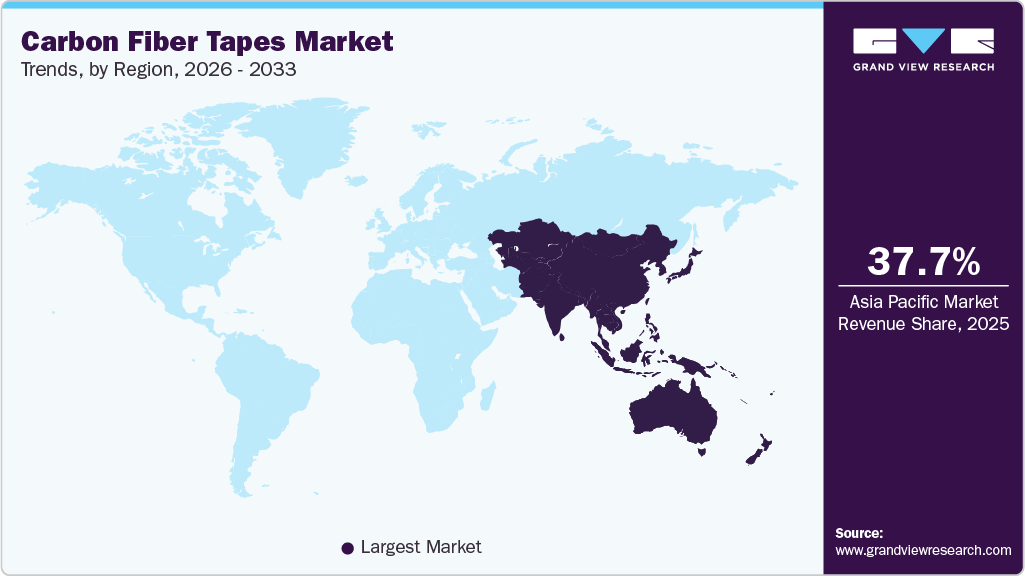
Europe dominated the carbon fiber tapes market with the largest revenue share of 37.7% in 2025. This growth can be attributed to the expanding automotive and aerospace industries, which increasingly use lightweight, high-strength materials for fuel efficiency and sustainability. In addition, stringent environmental regulations encouraging the use of eco-friendly materials in manufacturing also support demand. Furthermore, European countries are investing in the development of advanced carbon fiber technologies, further accelerating the adoption of carbon fiber tapes in various applications, including sports equipment and construction.
 To learn more about this report, Download Free Sample Report
The carbon fiber tapes market in Germany held the largest share in the Europe region in 2025, due to its strong automotive and aerospace sectors. Furthermore, the push for more energy-efficient and lightweight vehicles has driven the demand for carbon fiber components. Moreover, Germany’s extensive research and development initiatives, alongside its focus on sustainable manufacturing practices, are encouraging the use of carbon fiber tapes in industries such as automotive, aviation, and sports equipment, boosting market expansion.
Middle East & Africa Carbon Tapes Market Trends
The Middle East and Africa carbon fiber tapes market is expected to grow at a CAGR of 19.5% over the forecast period, owing to increasing infrastructure development, particularly in the construction and automotive sectors. In addition, the region's focus on sustainable building materials and fuel-efficient vehicles is driving the demand for lightweight materials such as carbon fiber tapes. Furthermore, the region's growing interest in motorsports and high-performance equipment further contributes to the rising adoption of carbon fiber technologies in sports and leisure products.
North America Carbon Tapes Market Trends
The carbon fiber tapes market in North America held for the significant revenue share in 2025, primarily driven by expanding primarily due to advancements in the aerospace, automotive, and renewable energy sectors. In the U.S., the emphasis on fuel efficiency, emission reduction, and lightweight construction in vehicles is driving the adoption of carbon fiber tapes. In addition, the region’s strong focus on innovation, coupled with government regulations supporting sustainable materials, is also fueling market growth. Furthermore, the increasing demand for carbon fiber-reinforced products in sports, aerospace, and defense industries is boosting the market.
U.S. Carbon Tapes Market Trends
The U.S. carbon fiber tapes market led the North American market for the highest revenue share in 2025, driven by its robust aerospace, automotive, and defense sectors. In addition, the demand for lightweight, high-strength materials for fuel-efficient and environmentally friendly vehicles is accelerating the adoption of carbon fiber tapes. Moreover, growing investments in renewable energy and infrastructure development are further driving demand. The U.S. is also home to leading research institutions and manufacturing innovations, which continue to enhance the utilization of carbon fiber tapes across industries.
Asia Pacific Carbon Tapes Market Trends
The carbon fiber tapes market in the Asia Pacific is experiencing rapid growth, driven by the booming automotive, aerospace, and manufacturing industries. Countries such as Japan and South Korea have a strong presence in the automotive sector, where carbon fiber is increasingly used for lightweight and energy-efficient vehicles. Furthermore, the growing sports and leisure industry, along with the rise of advanced infrastructure projects in countries such as India and China, is driving the demand for carbon fiber tapes in various applications.
Key Carbon Fiber Tapes Company Insights
The industry is competitive owing to the presence of several well-established market players with a strong foothold in the industry. The industry characterized by the long-term contract of manufacturers with the application industries. Moreover, the industry is witnessing a trend of forward integration, since the raw material suppliers are entering in to tapes manufacturing. The CF tapes industry is currently witnessing a limited production capacity. Key global carbon fiber tapes industry players are employing efforts to expand their production capacity. The rapidly extending scope for application of carbon fiber tapes in the various end-use industry will complemented by the increased production capacity, thereby heightening the overall sales revenue.
-
Evonik Industries manufactures advanced composites used in various industries such as automotive, aerospace, and sports. With a strong focus on innovation, Evonik supplies carbon fiber-based solutions that offer lightweight, high-strength properties, enhancing the efficiency and sustainability of its products. The company operates primarily in the chemicals and materials segment, offering a range of performance products including carbon fibers, composites, and specialty chemicals.
-
Hexcel Corporation produces carbon fiber, prepregs, honeycomb materials, and other composite solutions, catering to the need for lightweight, durable, and high-performance materials. Operating in the aerospace and automotive segments, the company focuses on delivering high-quality composites that contribute to fuel efficiency, reduced emissions, and improved performance in critical applications.
Key Carbon Fiber Tapes Companies:
The following key companies have been profiled for this study on the carbon fiber tapes market.
-
Evonik Industries
-
SABIC
-
Solvay
-
Hexcel Corporation
-
Royal Tencate
-
SGL Group
-
Teijin Limited
-
BASF SE
-
Celanese Corporation
-
Victrex
-
Cristex
-
Eurocarbon
-
PRF Composite Materials
-
TCR Composites
-
Sigmatex
Competitive Benchmarking
Category
Operating Strategies
Competitive Edge
Weakness
Established Players (Hexcel Corporation, Solvay, Teijin Limited, SGL Group, SABIC, BASF SE, Royal TenCate, Evonik Industries, Celanese Corporation, Victrex)
- Invest in advanced composite materials and carbon fiber tape technologies.
- Expand manufacturing capabilities and strengthen partnerships with OEMs.
- Focus on innovation through R&D and portfolio expansion.
- Strong global presence and established customer relationships.
- Broad product portfolios with advanced technical expertise.
- Large-scale manufacturing and robust distribution networks.
- High production and R&D costs.
- Dependence on cyclical end-use industries.
- Long qualification cycles for high-performance applications.
Emerging Players (Cristex, Eurocarbon, PRF Composite Materials, TCR Composites, Sigmatex)
- Develop customized carbon fiber tape solutions for niche applications.
- Focus on specialty composites and customer-specific product development.
- Strengthen market position through technical support and innovation.
- High flexibility and customization capabilities.
- Strong expertise in specialized composite applications.
- Faster response to customer requirements and emerging technologies.
- Limited production capacity and global reach.
- Narrower product portfolios than established players.
- Lower brand recognition and economies of scale.
Recent Developments
-
In January 2023, Asahi Kasei introduced a breakthrough in carbon fiber recycling with their new technology, which effectively recycles carbon fiber reinforced thermoplastic unidirectional tapes (CFRTP-UD tapes). This innovation aims to address the environmental challenges posed by carbon fiber waste. The company’s process enables the recovery and reuse of carbon fibers, potentially lowering production costs and promoting sustainability in industries such as automotive and aerospace, where carbon fiber tapes are heavily utilized for their lightweight, high-strength properties.
Carbon Fiber Tapes Market Report Scope
Report Attribute
Details
Market size in 2025
USD 3.6 billion
Estimated market size in 2026
USD 4.2 billion
Projected market size by 2033
USD 13.8 billion
Growth rate
CAGR of 18.5% from 2026 to 2033
Base year for estimation
2025
Historical data
2021 - 2024
Forecast period
2026 - 2033
Quantitative units
Volume in Million Square Meters, Revenue in USD million/billion and CAGR from 2026 to 2033
Report coverage
Revenue forecast, company ranking, competitive landscape, growth factors, and trends
Segments covered
Resin type, end use, region
Regional scope
North America; Europe; Asia Pacific; Central & South America; Middle East & Africa
Country scope
U.S., Canada, Mexico, Germany, UK, France, Italy, Spain, China, India, Japan, Southeast Asia, Brazil, and Argentina
Key companies profiled
Evonik Industries; SABIC; Solvay; Hexcel Corporation; Royal Tencate; SGL Group; Teijin Limited; BASF SE; Celanese Corporation; Victrex; Cristex; Eurocarbon; PRF Composite Materials; TCR Composites; Sigmatex.
Customization scope
Free report customization (equivalent up to 8 analysts' working days) with purchase. Addition or alteration to country, regional & segment scope.
Pricing and purchase options
Avail customized purchase options to meet your exact research needs. Explore purchase options
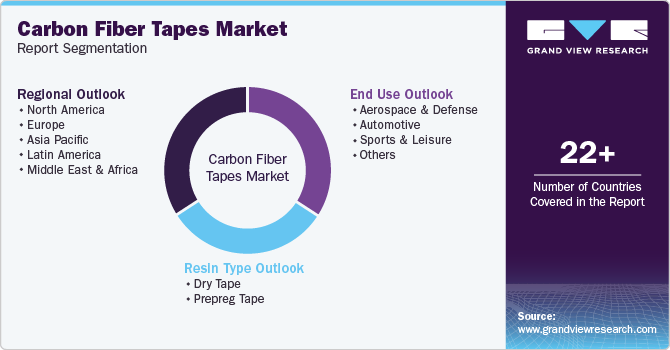
Global Carbon Fiber Tapes Market Report Segmentation
This report forecasts revenue growth at global, regional, and country levels and analyzes the latest industry trends in each sub-segment from 2021 to 2033. For this study, Grand View Research has segmented the global carbon fiber tapes market report based on resin type, end use, and region.
 To learn more about this report, Download Free Sample Report
-
Resin Type Outlook (Volume, Thousand Sq.M; Revenue, USD Million, 2021 - 2033)
-
Dry Tape
-
Prepreg Tape
-
-
End Use Outlook (Volume, Thousand Sq.M; Revenue, USD Million, 2021 - 2033)
-
Aerospace & Defense
-
Automotive
-
Sports & Leisure
-
Others
-
-
Regional Outlook (Volume, Thousand Sq.M; Revenue, USD Million, 2021 - 2033)
-
North America
-
U.S.
-
Canada
-
Mexico
-
-
Europe
-
Germany
-
UK
-
France
-
Italy
-
Spain
-
-
Asia Pacific
-
China
-
India
-
Japan
-
Southeast Asia
-
-
Latin America
-
Brazil
-
Argentina
-
-
Middle East and Africa
-
Research Methodology
The carbon fiber tapes market figures in this report are based on a proven research process that combines executive interviews with secondary research from proprietary databases, company filings, and recognized regulatory and institutional sources. Market size is built through value-chain sizing - reconciling supply-side and demand-side estimates - and triangulated with bottom-up and top-down approaches. Every estimate passes multiple levels of expert validation before publication, with each carbon fiber tapes segment quantified using the revenue-capture definitions in the table below.
Segment Definition
Segment - Resin Type
Revenue Capture Definition
Dry Tape
Revenue generated from the sale of non-impregnated (dry) carbon fiber tapes used in resin infusion, resin transfer molding (RTM), vacuum-assisted resin infusion (VARI), filament winding, and other composite manufacturing processes across aerospace, automotive, wind energy, industrial, marine, and sporting goods applications.
Prepreg Tape
Revenue generated from the sale of resin-impregnated (prepreg) carbon fiber tapes used in high-performance composite manufacturing for aerospace, automotive, defense, wind energy, industrial, and other structural applications requiring superior mechanical properties and consistent resin distribution.
Segment - End Use
Revenue Capture Definition
Aerospace & Defense
Revenue generated from the sale of carbon fiber tapes used in the production of commercial and military aircraft, helicopters, unmanned aerial vehicles (UAVs), spacecraft, satellites, missiles, and defense components for lightweight structural and interior applications.
Automotive
Revenue generated from the sale of carbon fiber tapes used in passenger vehicles, electric vehicles (EVs), commercial vehicles, motorsports, and specialty automotive applications for lightweight body structures, chassis components, battery enclosures, and structural reinforcements.
Sports & Leisure
Revenue generated from the sale of carbon fiber tapes used in sporting goods and recreational equipment, including bicycles, golf clubs, tennis rackets, hockey sticks, fishing rods, skis, snowboards, and other high-performance sports products.
Others
Revenue generated from the sale of carbon fiber tapes used in wind energy, marine, construction, industrial equipment, oil & gas, medical devices, robotics, consumer electronics, and other specialized composite applications requiring high strength, stiffness, and corrosion resistance.
Estimation Model
Layer Name
Key Question
Description
Composite Manufacturing Industry Assessment
What is the total addressable composite manufacturing base generating demand for carbon fiber tapes?
This layer evaluates composite production across key industries such as aerospace & defense, automotive, wind energy, sports & leisure, and industrial applications to establish the potential demand for carbon fiber tapes.
Carbon Fiber Tape Adoption Across End-use Industries
What proportion of composite components utilize carbon fiber tapes?
This layer assesses the penetration of carbon fiber tapes across structural and semi-structural applications based on lightweighting requirements, mechanical performance, manufacturing processes, and industry-specific performance standards.
Resin Type and Product Utilization Analysis
What share of demand is served by different carbon fiber tape types?
This layer analyzes the utilization of dry tapes and prepreg tapes across end-use industries based on manufacturing methods, resin systems, production efficiency, component complexity, and performance requirements.
Carbon Fiber Tapes Market Revenue
What revenue is generated from the sale of carbon fiber tapes globally?
This final layer estimates market revenue by combining carbon fiber tape demand volumes with average selling prices across resin types, end-use industries, and regional markets.
Delivered Customizations
This report has been delivered with the following In-depth customizations
CLIENT REQUEST
CUSTOMIZATION DELIVERED
VALUE ADD
Opportunity Assessment
Detailed assessment of growth opportunities across resin types, end-use industries, and manufacturing technologies, including analysis of lightweighting trends, aerospace production, EV adoption, wind energy expansion, automated composite manufacturing, and emerging high-performance composite applications.
Enables identification of high-growth application areas, emerging end-use opportunities, and strategic investment priorities across the carbon fiber tapes value chain.
Technology & Sustainability Assessment
Comprehensive evaluation of technological advancements and sustainability trends in the carbon fiber tapes market, including thermoplastic composite technologies, automated fiber placement (AFP), automated tape laying (ATL), recyclable carbon fiber solutions, advanced resin systems, and cost-efficient composite manufacturing processes.
Supports product innovation, technology roadmap development, sustainability initiatives, and competitive differentiation through advanced composite manufacturing capabilities.
Regional Segmentation Analysis
In-depth regional and country-level analysis covering market size, growth outlook, aerospace and automotive production, renewable energy investments, composite manufacturing ecosystem, competitive landscape, and carbon fiber tape adoption trends across key geographic markets.
Assists in identifying high-growth regions, optimizing expansion strategies, and understanding region-specific demand drivers, manufacturing capabilities, and investment opportunities.
Frequently Asked Questions About This Report
The global carbon fiber tapes market size was valued at USD 3.6 billion in 2025 and is estimated at USD 4.2 billion for 2026.
Key players in the industry include Teijin Limited (Japan), Zoltek Corporation (US), Hexcel Corporation (US), Mitsubishi Rayon Carbon Fibers and Composites (Japan), SGL Group, Royal TenCate (Netherlands), Solvay (Belgium), 3M (U.S.), SABIC, Cristrex, Sigmatex, BASF SE, PRF Composite Materials, Eurocarbon, TCR Composites, and others.
Key factors driving the carbon fiber tapes market growth include; replacement of metal components using advanced high strength and lightweight materials; development of automated tape laying parts production process.
The global carbon fiber tapes market is expected to grow at a CAGR of 18.5% from 2026 to 2033, reaching USD 13.8 billion by 2033.
Europe dominated the carbon fiber tapes market with a share of 37.7% in 2025. This is attributable to the presence of a robust manufacturing base for aerospace & defense sector.
The prepreg tapes led the carbon fiber tapes market and accounted for the largest revenue share of 80.0% in 2025.
The aerospace & defense led the carbon fiber tapes market and accounted for the largest revenue share of 47.0% in 2025.
Prepreg tapes are the fastest-growing segment of the carbon fiber tapes market.
Sports & leisure is the fastest-growing end use segment of the carbon fiber tapes market.
About the Author(s)
Specialty Glass, Ceramic & Fiber Research Team
Advanced Materials · Specialty Glass, Ceramic & FiberThis report was authored by the specialty glass, ceramic & fiber research team at Grand View Research - comprising two research analysts, one senior research analyst, and one industry expert - with specialized expertise in the specialty glass, ceramic & fiber segment of the advanced materials industry. All findings are based on proprietary advanced materials databases, executive interviews, and regulatory analysis, subject to internal peer review prior to publication.
Last Updated:
Speak to Analyst

Customize this report to your needs - add regions, segments, or data points, with 20% free customization.
Or view our licence options:


ISO 9001:2015 & 27001:2022 Certified
We are GDPR and CCPA compliant! Your transaction & personal information is safe and secure. For more details, please read our privacy policy.


