
- Home
- »
- Plastics, Polymers & Resins
- »
-
Cast Acrylic Sheets Market Size & Share Report, 2026-2033GVR Report cover

Cast Acrylic Sheets Market (2026 - 2033)
Size, Share & Trends Analysis Report Market By Thickness (<3 mm, 3-6 mm, 6-12 mm, 12-25 mm, >25 mm), By Application (Signage & Display, Architecture & Interior Design, Lighting, Furniture, Transportation), By Region, And Segment Forecasts
Market Size, 2025
$629.4MMarket Estimate, 2026
$661.5MMarket Forecast, 2033
$947.8MCAGR, 2026–2033
5.3%Cast Acrylic Sheets Market Summary
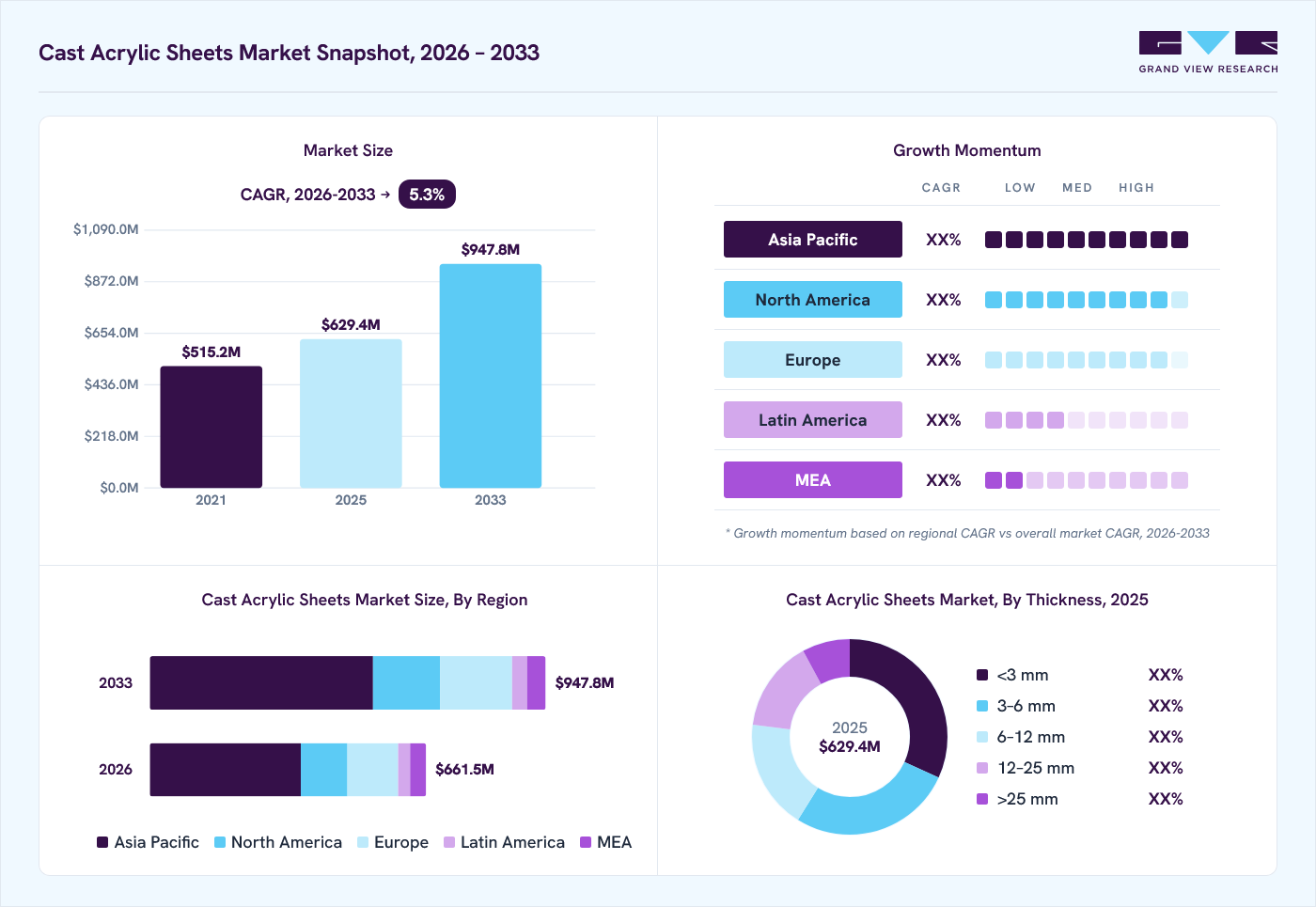
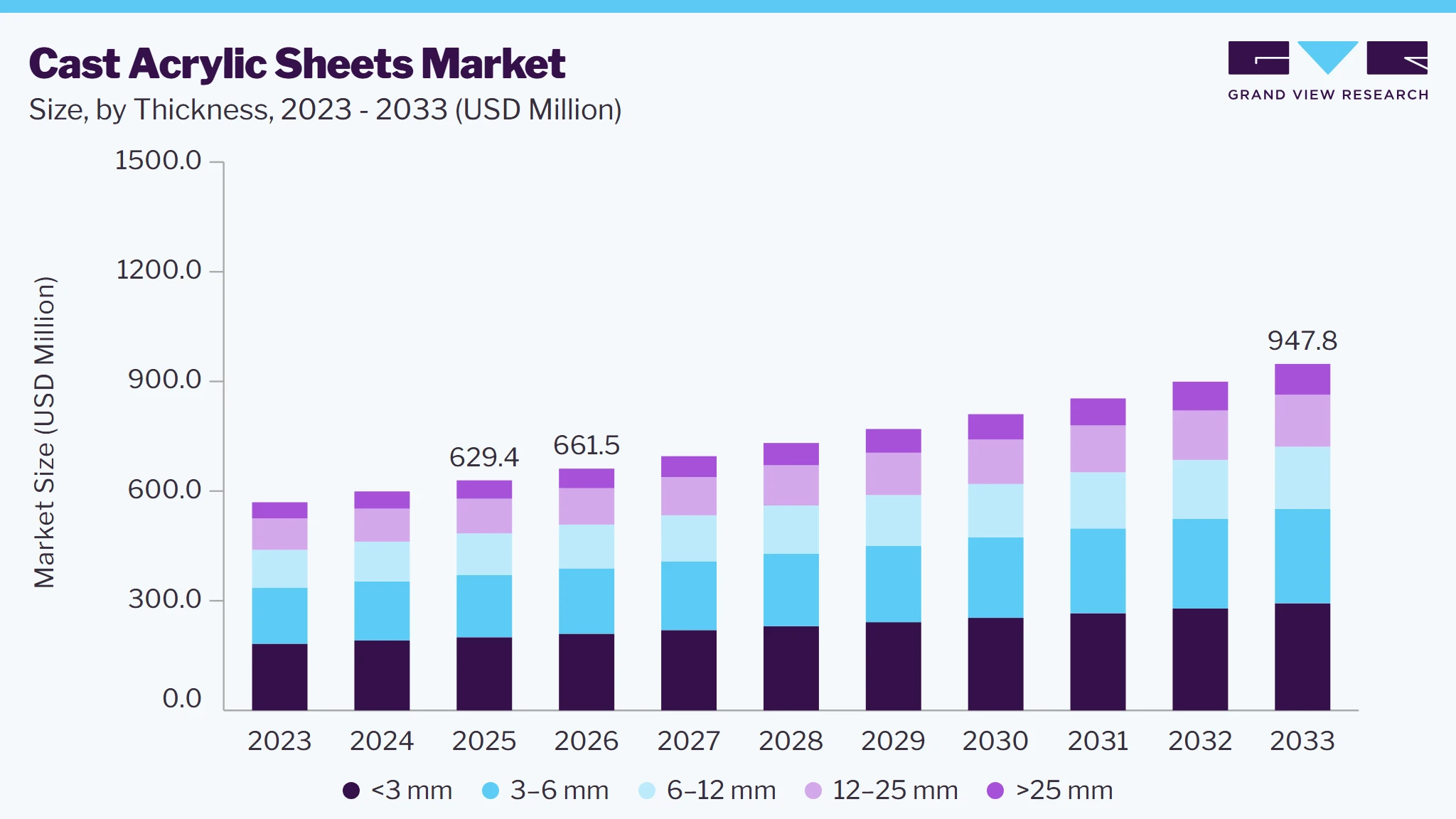
The global cast acrylic sheets market size was valued at USD 629.4 million in 2025 and is projected to grow from USD 661.5 million in 2026 to USD 947.8 million by 2033, at a CAGR of 5.3% from 2026 to 2033. The market in Asia Pacific dominated with a revenue share of 54.4% in 2025. The growing demand for lightweight, durable, and transparent materials in the construction, automotive, and signage industries is driving the cast acrylic sheet market.
 Source: Grand View Research, IR Documents, Primary Interviews, Paid DatabasesTo learn more about this report,
 Download Free Sample Report
 Key Market Trends & Insights
- By thickness: The <3 mm segment held the largest market share of 31.8% in 2025.
- By application: Signage & display segment held the largest market share of 27.9% in 2025.
Regional Highlights
- Largest regional market: Asia Pacific (54.4% revenue share, 2025)
- By country: China held the largest market share in 2025
Market Size & Forecast
- Market size in 2025: USD 629.4 Million
- Estimated market size in 2026: USD 661.5 Million
- Projected market size by 2033: USD 947.8 Million
- CAGR (2026-2033): 5.3%
Three ways to get this report
Buy it, customize it, or ask a question.Ask an Analyst
A direct answer, usually in 1 working day
- AccessReport author, directly
- Reply timeWithin 1 working day
- No sales callDirect answer only
- FormatEmail reply
- CostFree, no cost
Get the Full Report
What the study covers
- FormatsPDF · Excel · Dashboard
- Timeline2026–2033 annual, 2025 base
- Coverage20+ countries, 5 regions
- Companies10+ key players profiled
Customize the Report
20% free customization
- IncludeCountries, segments, points
- TailorTo your product definition
- ExtendDeeper competitor detail
- OrA fully bespoke study
- Turnaround5–10 working days
Increasing adoption of acrylic sheets as alternatives to glass, supported by their superior weather resistance, optical clarity, and fabrication flexibility, further strengthens market growth. Rising investments in commercial infrastructure, retail displays, and architectural applications are creating opportunities for manufacturers. Additionally, demand for customized colors, finishes, and thicknesses supports product innovation and market expansion.
 To learn more about this report, Download Free Sample Report
 The cast acrylic sheet market is shifting toward specialized products with enhanced optical, surface, and weathering performance. Manufacturers are developing colored, translucent, textured, matte, scratch-resistant, and light-diffusing grades for architectural, signage, lighting, and display applications. Demand is also moving toward application-specific sheet designs that combine aesthetics with functional performance. This trend is supported by acrylic's high transparency, UV resistance, durability, and fabrication flexibility, which enable greater design freedom than conventional glazing materials.
Market Dynamics
Increasing substitution of conventional glass with lightweight acrylic sheets is driving demand in construction and architectural applications. Cast acrylic sheets offer high optical clarity, lower weight, and greater design flexibility compared with glass, enabling easier handling, fabrication, transportation, and installation. These properties make acrylic suitable for applications such as windows, partitions, skylights, canopies, façades, and interior architectural features where reduced structural loading is important.
Acrylic sheets also provide strong resistance to ultraviolet radiation, weathering, and impact, supporting their use in demanding indoor and outdoor environments. Their ability to be thermoformed, machined, and customized into various shapes and colors further broadens their architectural applications. Growing emphasis on lightweight construction, energy-efficient building designs, and visually appealing structures is encouraging architects and contractors to consider acrylic as an alternative material where durability, aesthetics, and installation efficiency are important.
Competition from polycarbonate, glass, and other transparent plastics can constrain adoption of cast acrylic sheet in price-sensitive and performance-critical applications. Polycarbonate offers substantially higher impact resistance, while glass remains established in applications requiring high scratch resistance, thermal stability, or conventional glazing characteristics. Acrylic can also require careful design for thermal expansion and temperature exposure. These competing material properties can limit substitution opportunities and require manufacturers to differentiate through optical quality, weatherability, surface treatments, customization, and application-specific performance.
The development of recycled-content acrylic sheets presents an opportunity for manufacturers to address growing sustainability requirements without eliminating the performance advantages of PMMA (polymethyl methacrylate). Producers are introducing products containing substantial proportions of recycled acrylic while retaining recyclability, transparency, UV resistance, and durability. Such materials can support green building projects, retail interiors, signage, and architectural applications seeking lower material impacts. Expanding closed-loop recycling and recovery systems could further increase the use of recycled PMMA in premium sheet applications.
Market Concentration & Characteristics
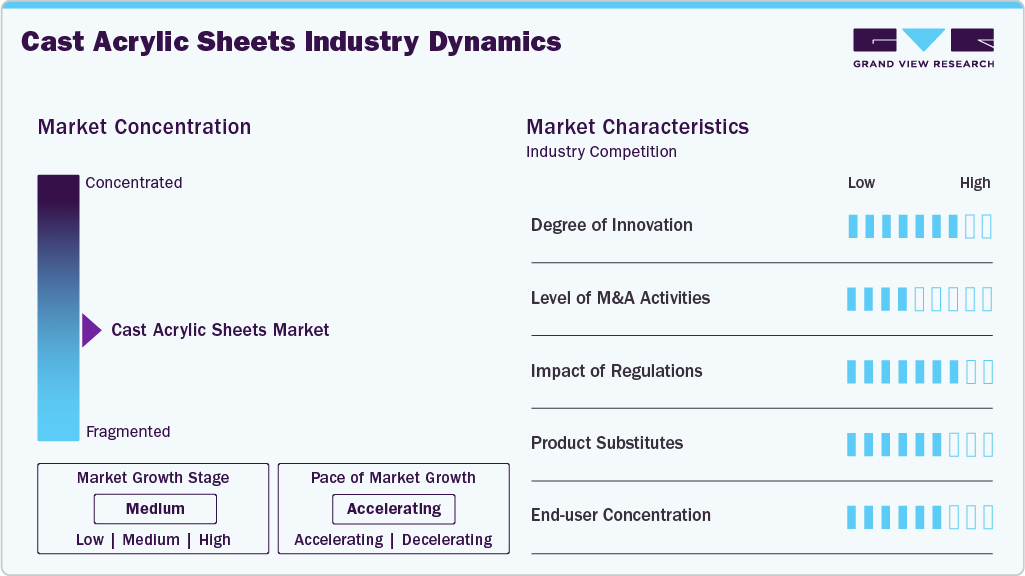
The market growth stage is medium, and growth is accelerating. The market exhibits fragmentation, with key players dominating the industry landscape. Major companies such as POLYVANTIS GmbH, Plaskolite LLC, 3A Composites GmbH, Aristech Surfaces LLC, part of Trinseo, Mitsubishi Chemical Corporation, Asia Poly Industrial Sdn. Bhd. / Asia Poly Holdings Berhad, Micalite Company Limited, UB Acrylic (M) Sdn. Bhd., SNV Polyplast Industries LLP, Arkema and others play a significant role in shaping the market dynamics. These leading players often drive innovation in the market by introducing new products, technologies, and materials to meet the industry's evolving demands.
 To learn more about this report, Download Free Sample Report
 Innovation in the cast acrylic sheet market is increasingly centered on material efficiency, recycled content, surface functionality, and application-specific performance. Manufacturers are developing sheets with improved weatherability, light diffusion, texture, color, and recycled PMMA content, while maintaining optical and processing characteristics. POLYVANTIS introduced a closed-loop PMMA recycling program in Europe in 2025, enabling fabrication offcuts to return to production. Its PLEXIGLAS proTerra range incorporates up to 90% reused raw materials, demonstrating movement toward circular material solutions
Regulations primarily influence cast acrylic sheets through chemical management, construction performance, environmental disclosure, and recycling requirements. In Europe, REACH requires companies to manage chemical risks and provide information on substances across the supply chain. The EU Construction Products Regulation 2024/3110 also strengthens requirements for performance, conformity, environmental information, and digital product passports for covered construction products. New 2026 EU rules establish reaction-to-fire performance classes. These requirements are increasing compliance, testing, documentation, and product-development obligations for acrylic sheet manufacturers.
Analyst Perspective
The cast acrylic sheets market is shifting from volume-led growth to a value-driven model centered on specialty performance, design flexibility, and sustainability. While core demand remains rooted in signage, architecture, lighting, and transportation, new opportunities are emerging from glass substitution and LED applications. To differentiate, manufacturers are expanding specialized grades, including light-diffusing, flame-retardant, scratch-resistant, and recycled-content options. Consequently, buyers are prioritizing optical consistency, weatherability, fabrication efficiency, and reliable supply over standard commodity offerings. Market leaders will stay ahead by integrating PMMA, advancing casting capabilities, adopting recycling technology, and providing global technical support. However, profitability remains at risk from raw material volatility, energy costs, overcapacity, and competition from alternative materials such as polycarbonate and glass. Ultimately, long-term competitive advantage will favor companies offering integrated, high-performance, and sustainable portfolios backed by localized service.
Thickness Insights
The <3 mm segment dominated the market across thickness segmentation in terms of revenue, accounting for 31.8% market share in 2025, and is forecast to grow at an 4.9% CAGR from 2026 to 2033. The <3 mm segment benefits from demand for lightweight, easily fabricated acrylic components in signage, displays, lighting, and interior applications. Thin cast acrylic reduces material consumption while retaining high optical clarity and suitability for cutting, printing, bonding, and laser processing. Current product offerings include thin continuous-cast grades designed for retail displays, wall features, illuminated signage, and decorative applications. The availability of recycled PMMA grades in thin sheet formats also supports demand where customers seek lower raw material consumption and improved sustainability credentials.
The >25 mm segment is expected to expand at a 6.7% CAGR in the cast acrylic sheet market over the forecast period. Demand for >25 mm cast acrylic sheets is supported by applications requiring substantial material thickness, rigidity, visual depth, and dimensional stability. These characteristics are relevant to premium architectural elements, furniture components, display structures, protective panels, and fabricated specialty parts. Thick acrylic also enables machining, polishing, edge finishing, and three-dimensional fabrication, creating distinctive visual effects. Compared with thin sheet grades, this segment is more specification-driven, with purchasing decisions influenced by optical uniformity, internal stress control, surface quality, fabrication performance, and customized dimensions.
Application Insights
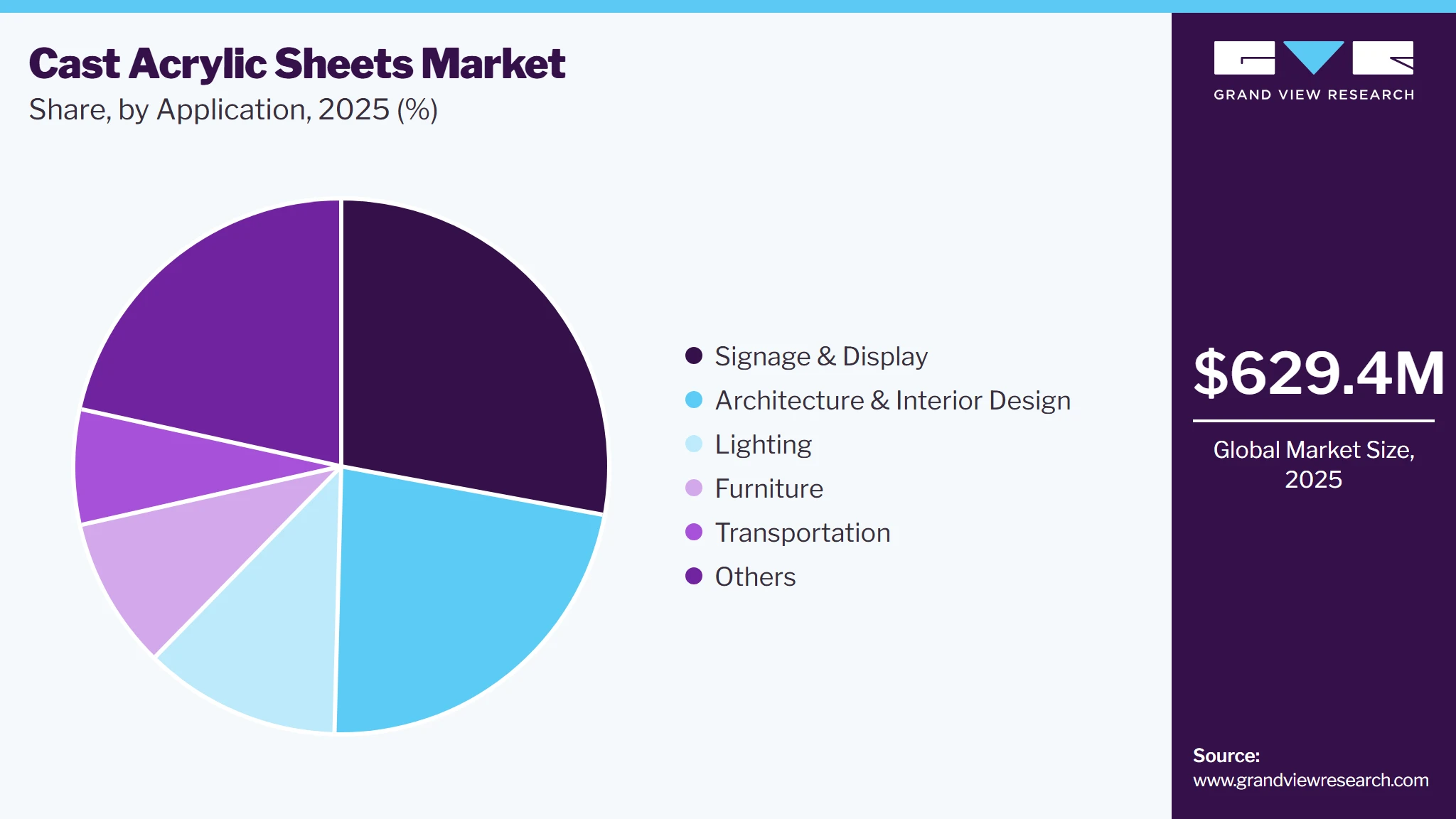
The signage & display segment led the market by application, accounting for 27.9% of revenue in 2025, and is projected to grow at an 5.1% CAGR from 2026 to 2033. Signage and display applications remain a technologically active area for cast acrylic sheets. Retailers, brands, and sign fabricators increasingly require materials that combine visual impact with efficient illumination and fabrication. Manufacturers now offer edge-lit, light-diffusing, fluorescent, frosted, and black-to-white illuminated acrylic grades. These products support wayfinding, channel letters, point-of-purchase displays, and illuminated advertising. Edge-lit acrylic can distribute LED illumination through the sheet, while specialized surfaces reduce glare or diffuse hotspots. This expands the use of acrylic beyond conventional flat signboards.
 To learn more about this report, Download Free Sample Report
 The architecture & interior design segment is expected to grow at the fastest CAGR of 5.8% over the forecast period. Architecture and interior design applications are expanding the functional role of cast acrylic from basic glazing to decorative and customized design elements. Designers use acrylic for partitions, wall features, furniture, doors, decorative panels, and lighting components because it combines transparency, low weight, color flexibility, and fabrication versatility. Current product portfolios include frosted, translucent, fluorescent, and edge-colored grades designed specifically for interior aesthetics. Such differentiated surfaces allow architects to create controlled light transmission and distinctive finishes without relying solely on conventional glass or opaque materials.
Regional Insights
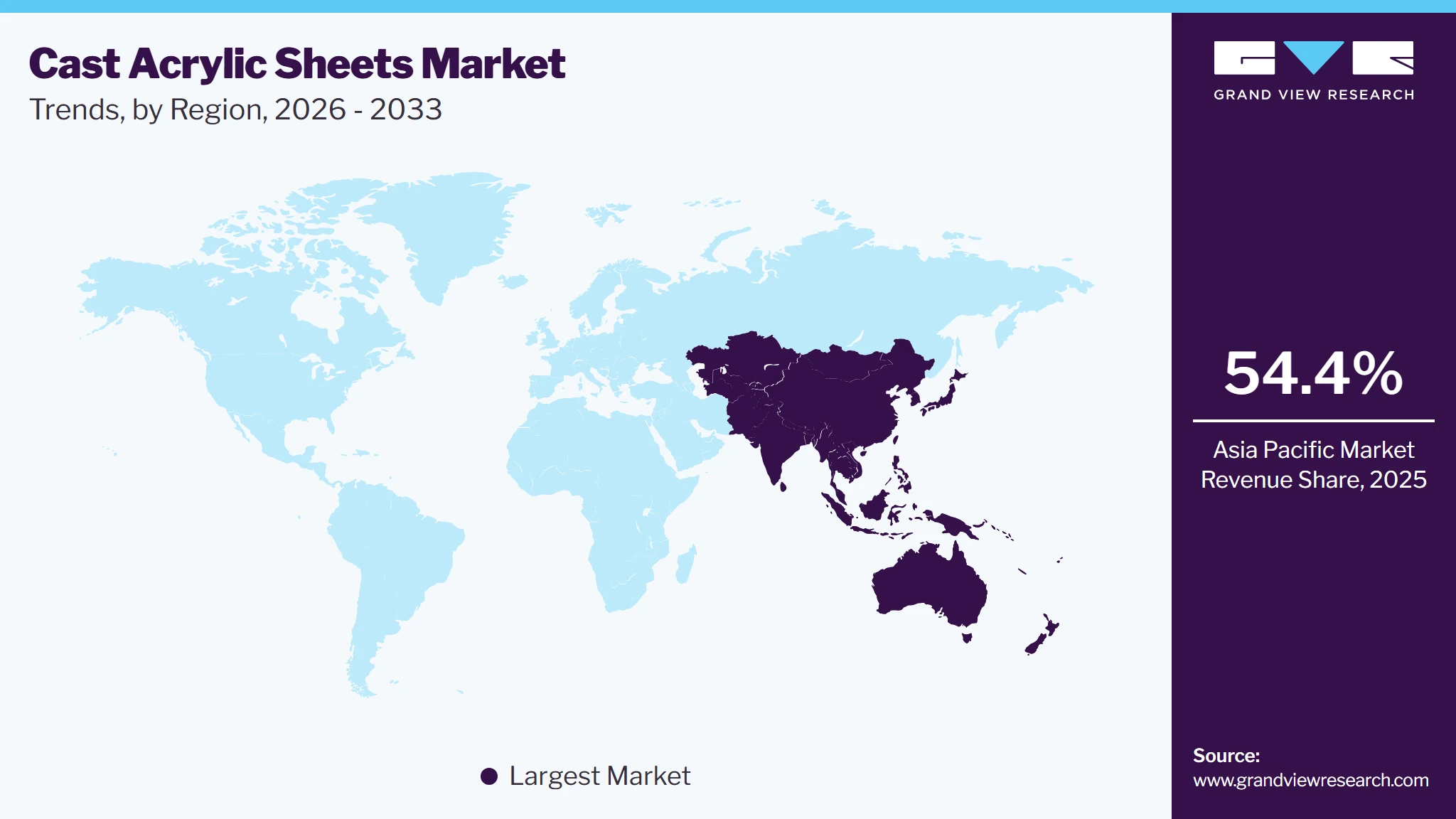
The Asia Pacific cast acrylic sheets industry held the largest revenue share of 54.4% in 2025. The region is expected to grow at a CAGR of 5.7% over the forecast period. Asia Pacific represents the largest regional demand center because it combines extensive PMMA production capacity with large construction, retail, signage, electronics, and automotive industries. China provides significant upstream and downstream integration, while India, Vietnam, and Indonesia add demand through urban development and commercial infrastructure. Japan and South Korea contribute higher-value applications requiring optical consistency and specialized light-diffusing grades. This combination of manufacturing scale and diversified end-use demand strengthens the region's position in cast acrylic sheets.
 To learn more about this report, Download Free Sample Report
 China Cast Acrylic Sheets Market Trends
China's role as both a major acrylic producer and manufacturing hub provides a strong structural driver for cast acrylic sheets. Domestic PMMA supply supports extensive downstream fabrication for construction, signage, retail displays, transportation, and industrial applications. According to National Bureau of Statistics of China in 2025, manufacturing investment increased 0.6%, while automobile investment rose 11.7%, indicating continued activity across important downstream sectors. However, overall fixed-asset investment declined 3.8%, making application-specific demand and export-oriented manufacturing increasingly important for sheet producers
North America Cast Acrylic Sheets Market Trends
North American demand for cast acrylic sheets is supported by sustained construction activity, commercial interiors, signage, and specialized glazing. The region also benefits from established PMMA manufacturing and fabrication infrastructure. Röhm’s Bay City, Texas MMA facility reached full four-reactor production in April 2026, strengthening regional feedstock availability for downstream acrylic applications. Canada provides an additional construction base, with total building investment reaching CAD 272.1 billion in 2025. These conditions support demand for fabricated and higher-performance cast acrylic grades.
U.S. Cast Acrylic Sheets Market Trends
The U.S. market benefits from continued investment in domestic automotive, electronics, and advanced manufacturing capacity. Glass-filled nylon is positioned to replace heavier materials in molded components where stiffness, dimensional stability, and heat resistance are required. The expansion of EV and battery manufacturing also creates demand for reinforced polyamide in housings, connectors, cooling systems, and electrical components. U.S. manufacturers are simultaneously increasing emphasis on lightweight and resource-efficient materials, supporting the use of engineering plastics across transportation and industrial applications.
Europe Cast Acrylic Sheets Market Trends
Europe's cast acrylic demand is increasingly linked to renovation, energy-efficient building upgrades, and higher-performance architectural materials. The revised Energy Performance of Buildings Directive requires national renovation plans and strengthens minimum performance requirements for buildings. The European Commission estimates that roughly 75% of EU buildings have poor energy performance and is targeting substantially higher renovation activity. These programs support demand for lightweight architectural components, glazing-related products, interior systems, and design materials where acrylic can provide optical clarity and fabrication flexibility.
Latin America Cast Acrylic Sheets Market Trends
Latin America's opportunity for cast acrylic sheets is closely tied to infrastructure modernization, commercial construction, transportation, and urban development. The Inter-American Development Bank estimates that the region requires approximately USD 1.60 trillion of infrastructure investment during 2025 to 2030, equivalent to 3.53% of regional GDP annually. Transport, water and sanitation, electricity, and telecommunications represent the largest investment requirements. Such projects can expand downstream demand for signage, protective glazing, architectural components, and fabricated acrylic products across major urban markets.
Middle East and Africa Cast Acrylic Sheets Market Trends
Demand across the Middle East and Africa is concentrated in construction-intensive markets, particularly Gulf economies, where large-scale urban, hospitality, tourism, and infrastructure developments create requirements for premium architectural materials. Saudi Arabia alone has approximately USD 1.9 trillion of planned and ongoing GCC project value for 2025 to 2030, including USD 577 trillion under construction. Cast acrylic benefits from applications in decorative interiors, façades, displays, partitions, and illuminated signage. South Africa also provides a regional manufacturing base for fabricated acrylic products.
Key Cast Acrylic Sheets Company Insights
Some of the key players operating in the market include POLYVANTIS GmbH and Plaskolite LLC
-
POLYVANTIS has a broad global PMMA sheet portfolio under its PLEXIGLAS and ACRYLITE brands, covering multiple colors, surface finishes, and application requirements. In April 2026, the company introduced PLEXIGLAS PMMA to India, expanding its presence in a major construction and design market. Its global distribution and established brand portfolio strengthen its position in the cast acrylic market.
-
Plaskolite maintains a diversified acrylic sheet portfolio spanning cell-cast, continuous-cast, and extruded PMMA products under its OPTIX brand. Its cell-cast range emphasizes fabrication performance and customized colors, while recycled acrylic products support sustainability-oriented applications. The company also provides cut-to-size and run-to-size services, strengthening its ability to serve customers in signage, displays, lighting, and specialty fabrication.
UB Acrylic (M) Sdn. Bhd. and SNV Polyplast Industries LLP are some of the emerging participants in the cast acrylic sheet market.
-
UB Acrylic specializes in cell-cast acrylic sheets and has operated since 1987. The company serves customers across more than 10 countries and focuses on product development, manufacturing efficiency, and quality improvement. Its international distributor network supports market penetration beyond Malaysia, while its dedicated specialization in acrylic sheets enables customized solutions for construction, interiors, and design applications.
-
SNV Polyplast focuses exclusively on 100% virgin cast acrylic sheets manufactured in India. Its Hindglas portfolio includes crystal-clear, opaque, translucent, fluorescent, frosted, and sanitaryware grades, allowing coverage across diverse fabrication and design requirements. The company has completed more than 500 projects and exports internationally, combining specialized product positioning with modern manufacturing technology and customized customer solutions.
Key Cast Acrylic Sheets Companies
The following key companies have been profiled for this study on the cast acrylic sheet market.
-
POLYVANTIS GmbH
-
Plaskolite LLC
-
3A Composites GmbH
-
Aristech Surfaces LLC, part of Trinseo
-
Mitsubishi Chemical Corporation
-
Asia Poly Industrial Sdn. Bhd. / Asia Poly Holdings Berhad
-
Micalite Company Limited
-
UB Acrylic (M) Sdn. Bhd.
-
SNV Polyplast Industries LLP
-
Arkema
Competitive Benchmarking
Operating Strategies
Competitive Edge
Weakness
Mature Players: POLYVANTIS GmbH, Plaskolite LLC, 3A Composites GmbH, Aristech Surfaces LLC, part of Trinseo, Mitsubishi Chemical Corporation, Asia Poly Industrial Sdn. Bhd. / Asia Poly Holdings Berhad, Micalite Company Limited, Arkema
- Maintain broad cast and continuous-cast acrylic sheet portfolios covering clear, colored, opal, translucent, textured, specialty, flame-retardant, impact-resistant, sanitaryware, lighting, and signage grades for construction, architecture, retail, transportation, industrial, and display applications.
- Invest in optical performance, weatherability, surface functionality, light diffusion, fire performance, recycled-content solutions, and application-specific acrylic grades.
- Expand through global manufacturing networks, regional distribution, technical support, product customization, and customer-specific sheet formats.
- Established acrylic processing expertise supports consistent optical clarity, weatherability, surface quality, dimensional stability, and fabrication performance across diverse sheet applications.
- Extensive product portfolios enable suppliers to address standard glazing and signage requirements as well as specialized needs involving light diffusion, flame retardancy, scratch resistance, impact performance, sanitaryware, and decorative finishes.
- Global production and distribution networks improve supply continuity, technical support, product qualification, and customer access across major acrylic-consuming regions.
- Large global manufacturing and R&D infrastructures can increase operating costs and create greater portfolio complexity than smaller acrylic-sheet specialists.
- Broad product portfolios expose mature suppliers to competition from polycarbonate, glass, extruded acrylic, and regional low-cost sheet manufacturers.
- Customized colors, textures, thicknesses, and specialty formulations can increase production complexity and inventory requirements.
Emerging Players: UB Acrylic (M) Sdn. Bhd., SNV Polyplast Industries LLP
- Focus on cell-cast acrylic sheets, virgin MMA-based formulations, customized colors, surface finishes, and application-specific products for signage, interiors, construction, lighting, sanitaryware, and display applications.
- Develop products emphasizing optical clarity, weathering resistance, surface quality, thermoforming, and fabrication performance. UB Acrylic manufactures sheets through mold casting, polymerization, annealing, and finishing processes using virgin MMA.
- Expand through distributor networks, export markets, regional manufacturing, customer-specific specifications, and specialized product development. UB Acrylic distributes products across more than 10 countries.
- Specialized cast acrylic focus enables greater attention to sheet quality, fabrication characteristics, thickness consistency, and application-specific requirements.
- Focused product portfolios support faster customization across colors, opacity, surface finish, light transmission, and sanitaryware requirements.
- Regional manufacturing positions provide proximity to Asian fabricators and distributors while supporting competitive production economics.
- Comparatively smaller manufacturing capacity and revenue scale can limit purchasing power, production flexibility, and ability to absorb raw-material price volatility relative to global acrylic suppliers.
- Narrower geographic manufacturing footprints create greater exposure to regional demand cycles, logistics costs, and supply-chain disruptions.
- Smaller product portfolios provide less coverage across highly specialized acrylic applications than diversified global suppliers.
Recent Developments
-
In October 2025, POLYVANTIS opened a new Technology Center in Shanghai, China, strengthening its innovation and customer-support capabilities in Asia. The facility became the company’s fifth technical center and supports product development, application engineering, and collaboration across high-growth markets, including displays and transportation.
-
In July 2025, POLYVANTIS launched a closed-loop PMMA recycling program in partnership with Pekutherm Kunststoffe GmbH. The initiative enables European fabricators and retailers to return PLEXIGLAS offcuts for recycling, with recovered PMMA reintegrated into production. The program supports circular material use and expands the company’s sustainable acrylic portfolio.
Cast Acrylic Sheets Market Report Scope
Report Attribute
Details
Market size in 2025
USD 629.4 million
Estimated market size in 2026
USD 661.5 million
Projected market size by 2033
USD 947.8 million
Growth rate
CAGR of 5.3% from 2026 to 2033
Historical data
2021 - 2025
Forecast period
2026 - 2033
Quantitative units
Revenue in USD million/billion, volume in Kilotons, and CAGR from 2026 to 2033
Report coverage
Revenue & volume forecast, competitive landscape, growth factors, and trends
Segments covered
Thickness, application, and region
Regional scope
North America; Europe; Asia Pacific; Latin America; Middle East & Africa
Country Scope
U.S.; Canada; Mexico; Europe; Germany; UK; France; Italy; Spain; China; India; Japan; South Korea; Australia; Brazil; Argentina; Saudi Arabia; UAE; South Africa
Key companies profiled
POLYVANTIS GmbH; Plaskolite LLC; 3A Composites GmbH; Aristech Surfaces LLC, part of Trinseo; Mitsubishi Chemical Corporation; Asia Poly Industrial Sdn. Bhd. / Asia Poly Holdings Berhad; Micalite Company Limited; UB Acrylic (M) Sdn. Bhd.; SNV Polyplast Industries LLP; Arkema
Customization scope
Free report customization (equivalent to up to 8 analyst working days) with purchase. Addition or alteration to country, regional & segment scope
Pricing and purchase options
Avail customized purchase options to meet your exact research needs. Explore purchase options
Global Cast Acrylic Sheets Market Report Segmentation
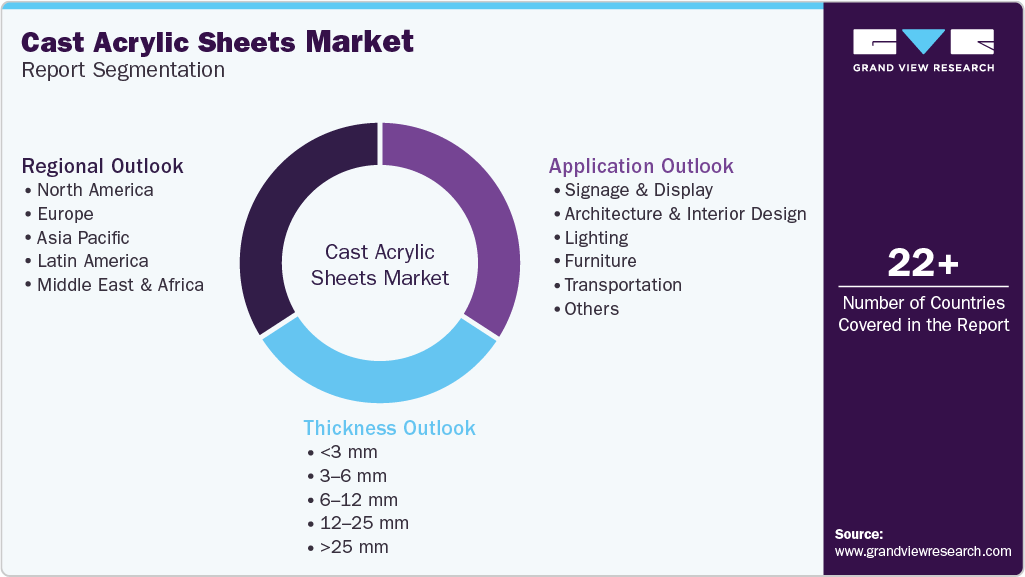
This report forecasts revenue growth at the global, regional, and country levels and provides an analysis of the latest industry trends across sub-segments from 2021 to 2033. For this study, Grand View Research has segmented the global cast acrylic sheets market report based on thickness, application, and region:
 To learn more about this report, Download Free Sample Report
 -
Thickness Outlook (Volume, Kilotons; Revenue, USD Million; 2021 - 2033)
-
<3 mm
-
3-6 mm
-
6-12 mm
-
12-25 mm
-
>25 mm
-
-
Application Outlook (Volume, Kilotons; Revenue, USD Million; 2021 - 2033)
-
Signage & Display
-
Architecture & Interior Design
-
Lighting
-
Furniture
-
Transportation
-
Others
-
-
Regional Outlook (Volume, Kilotons; Revenue, USD Million; 2021 - 2033)
-
North America
-
U.S.
-
Canada
-
Mexico
-
-
Europe
-
Germany
-
UK
-
France
-
Italy
-
Spain
-
-
Asia Pacific
-
China
-
India
-
Japan
-
South Korea
-
Australia
-
-
Latin America
-
Brazil
-
Argentina
-
-
Middle East & Africa
-
Saudi Arabia
-
UAE
-
South Africa
-
-
Research Methodology
The cast acrylic sheets marketfigures in this report are based on a proven research process that combines executive interviews with secondary research from proprietary databases, company filings, and recognized regulatory and institutional sources. Market size is built through value-chain sizing-reconciling supply-side and demand-side estimates-and triangulated with bottom-up and top-down approaches. Every estimate passes multiple levels of expert validation before publication, with eachcast acrylic sheetssegment quantified using the revenue-capture definitions in the table below.
Segment Definition
Thickness
Revenue capture definition
<3 mm
Revenue is captured through cast acrylic sheets below 3 mm thickness, designed for applications requiring low material weight, easy fabrication, and efficient material usage. These sheets are commonly used in signage, displays, decorative panels, lighting components, and thin interior elements. Demand is supported by requirements for optical clarity, flexibility in cutting and forming, and cost-efficient fabrication. Manufacturers supply clear, colored, translucent, and specialty grades where lower thickness provides adequate rigidity while reducing material consumption and component weight.
3-6 mm
Revenue is generated through cast acrylic sheets with thicknesses between 3 mm and 6 mm, providing a balance of rigidity, optical performance, impact resistance, and fabrication flexibility. These grades serve signage, illuminated displays, partitions, furniture components, lighting covers, and interior design applications. Demand is supported by applications requiring greater structural stability than thin sheets while retaining manageable weight and processing characteristics. Product selection depends on required transparency, surface finish, weatherability, color, light transmission, and forming requirements.
6-12 mm
Revenue is captured through cast acrylic sheets ranging from 6 mm to 12 mm, developed for applications requiring increased stiffness, durability, dimensional stability, and visual depth. These grades are used in architectural partitions, furniture, premium signage, display structures, lighting systems, and transportation components. Demand is supported by the replacement of heavier glass materials and the need for lightweight fabricated structures. Manufacturers offer clear, colored, translucent, textured, and specialty grades to meet specific aesthetic and functional requirements.
12-25 mm
Revenue is generated through cast acrylic sheets between 12 mm and 25 mm thickness, designed for applications requiring higher rigidity, structural stability, dimensional accuracy, and substantial material depth. These sheets are used in architectural elements, furniture, thick signage, display structures, protective components, and specialized transportation applications. Demand is supported by applications requiring machined edges, polished surfaces, greater structural integrity, and three-dimensional fabrication. Product selection is influenced by optical uniformity, internal stress control, surface quality, machining performance, and customized dimensions.
>25 mm
Revenue is captured through thick cast acrylic sheets exceeding 25 mm, primarily serving specialized applications requiring high rigidity, substantial material depth, dimensional stability, and premium optical performance. Applications include large architectural features, high-end furniture, aquarium structures, specialty glazing, display installations, and engineered components. Demand is more specification-driven than thinner sheet segments. Manufacturers focus on internal stress control, optical consistency, machining performance, edge finishing, and customized dimensions to meet demanding fabrication and structural requirements.
Application
Revenue capture definition
Signage & Display
Revenue is captured through cast acrylic sheets used in signage and display applications requiring high optical clarity, color consistency, light transmission, weather resistance, and fabrication flexibility. Applications include illuminated signs, channel letters, point-of-sale displays, retail fixtures, exhibition panels, and branded installations. Demand is supported by LED-based signage, retail modernization, and customized visual merchandising. Specialty grades with fluorescent, translucent, frosted, edge-lit, light-diffusing, and high-gloss surfaces enable manufacturers to address different illumination and design requirements.
Architecture & Interior Design
Revenue is generated through cast acrylic sheets used in architectural and interior applications requiring lightweight construction, visual appeal, transparency, durability, and design flexibility. Applications include partitions, wall panels, doors, glazing elements, decorative surfaces, room dividers, and architectural features. Demand is supported by the substitution of glass in selected applications and growing preference for customized colors, textures, translucency, and light effects. Designers select acrylic based on optical properties, weatherability, fabrication flexibility, surface finish, and integration with lighting systems.
Lighting
Revenue is captured through cast acrylic sheets used in lighting applications requiring controlled light transmission, diffusion, optical clarity, and resistance to yellowing. Applications include LED diffusers, light covers, illuminated panels, lenses, ceiling systems, and architectural lighting elements. Demand is supported by LED adoption and increasing requirements for uniform illumination with reduced glare and visible hotspots. Manufacturers offer opal, translucent, frosted, and light-diffusing grades with controlled transmission characteristics to support commercial, residential, retail, and architectural lighting designs.
Furniture
Revenue is generated through cast acrylic sheets used in furniture applications requiring aesthetic versatility, lightweight construction, durability, and ease of fabrication. Applications include tables, chairs, shelves, cabinet elements, decorative panels, partitions, and transparent furniture components. Demand is supported by contemporary interior design trends emphasizing transparency, color, layered visual effects, and customized forms. Acrylic enables cutting, polishing, thermoforming, bonding, and edge finishing, allowing furniture manufacturers and designers to develop complex shapes and premium surfaces while reducing weight compared with conventional glass.
Transportation
Revenue is captured through cast acrylic sheets used in transportation applications requiring low weight, optical clarity, weather resistance, impact performance, and design flexibility. Applications include vehicle glazing, interior panels, lighting components, partitions, instrument elements, and specialty transportation structures. Demand is supported by lightweighting initiatives and the use of transparent polymers in selected automotive, marine, rail, and specialty vehicle applications. Manufacturers develop grades with improved UV resistance, surface durability, thermal performance, and fabrication characteristics for demanding transportation environments.
Others
Revenue is generated through cast acrylic sheets used in additional applications, including sanitaryware, medical equipment, industrial components, protective barriers, recreational products, aquariums, and specialty fabricated structures. These applications require combinations of optical clarity, chemical resistance, dimensional stability, durability, and processing efficiency. Demand varies according to application-specific performance requirements, design complexity, and material substitution opportunities. Manufacturers provide customized thicknesses, colors, surface finishes, and specialty formulations to address mechanical, aesthetic, environmental, and fabrication requirements across diverse end-use industries.
Estimation Model
Layer Name
Key Question
Description
Top-Down Cast Acrylic Sheets Demand Assessment Layer
What defines overall market demand?
Establishes overall global demand for cast acrylic sheets across thickness ranges, including <3 mm, 3-6 mm, 6-12 mm, 12-25 mm, and >25 mm. The layer assesses consumption across signage and display, architecture and interior design, lighting, furniture, transportation, and other applications. It considers demand for clear, colored, translucent, textured, light-diffusing, specialty, and recycled-content acrylic sheets based on optical clarity, weather resistance, durability, lightweighting, fabrication flexibility, and glass substitution requirements.
Application Demand Validation Layer
Where is demand concentrated?
Maps demand across signage and display, architecture and interior design, lighting, furniture, transportation, and other applications. The assessment considers requirements such as optical clarity, light transmission, surface quality, weatherability, impact performance, dimensional stability, fabrication flexibility, color consistency, and design versatility. It validates application demand through commercial construction, retail development, advertising and signage installations, architectural projects, LED lighting adoption, furniture production, transportation manufacturing, and specialty fabrication activity.
Consumption-to-Revenue Conversion Layer
How is demand monetized?
Converts cast acrylic sheet consumption into market revenue using sheet thickness, dimensions, optical grade, surface finish, color, formulation, application requirements, production scale, manufacturing costs, supplier positioning, and prevailing pricing structures. The layer considers price variations between standard and specialty sheets, including light-diffusing, flame-retardant, impact-modified, scratch-resistant, sanitaryware, and recycled-content grades. Premiums associated with customized colors, specialty finishes, thick sheets, precision fabrication, and high-performance architectural applications are also evaluated.
Regional Demand Verification Layer
Where is demand validated?
Validates cast acrylic sheet demand across North America, U.S., Asia Pacific, China, Europe, Latin America, and Middle East & Africa. The assessment considers construction activity, commercial and retail development, signage production, architectural projects, LED lighting adoption, furniture manufacturing, transportation output, acrylic sheet production capacity, import and export patterns, raw material availability, and regional manufacturing investments. It also examines product qualification, sustainability initiatives, recycled PMMA adoption, supplier localization, and regional distribution strategies influencing cast acrylic sheet consumption.
Delivered Customizations
This report has been delivered with the following In-depth customizations
Client Request
Customization Delivered
Value Adds
Regional segmentation
Developed a detailed regional assessment covering North America, U.S., Asia Pacific, China, Europe, Latin America, and Middle East & Africa, with market-specific demand drivers, construction activity, manufacturing footprint, application trends, and regional supply dynamics.
Enables identification of regional demand concentration, growth pockets, manufacturing advantages, and differences in application adoption. Asia Pacific was assessed as a leading demand center, with 2025 market share estimates of approximately 48% in one current industry assessment.
Competitive benchmarking
Benchmarked POLYVANTIS, Plaskolite, 3A Composites, Aristech Surfaces, Mitsubishi Chemical, Asia Poly, Micalite, Arkema, UB Acrylic, and SNV Polyplast based on product portfolio, geographical presence, manufacturing capabilities, specialization, and market positioning. Companies were further differentiated into mature and emerging players.
Establishes a structured competitive framework covering global scale, specialized cast acrylic capabilities, regional strengths, portfolio breadth, and customization potential. The assessment also distinguishes diversified chemical companies from dedicated acrylic sheet manufacturers, improving interpretation of competitive positioning.
Opportunity assessment
Identified opportunities across recycled and circular PMMA, specialty light-diffusing grades, thick acrylic sheets, customized surface finishes, architectural applications, signage and displays, premium glazing, and emerging regional markets. The analysis also considered opportunities created by substitution of glass and demand for lightweight, weather-resistant, and design-oriented materials.
Converts market trends into actionable opportunity areas by linking product innovation with specific applications and regions. Current industry analysis highlights recycled feedstocks, specialty grades, customized surface treatments, and high-performance applications as important areas for future market development.
About the Author(s)
Plastics, Polymers & Resins Research Team
Bulk Chemicals · Plastics, Polymers & ResinsThis report was authored by the plastics, polymers & resins research team at Grand View Research - comprising two research analysts, one senior research analyst, and one industry expert - with specialized expertise in the plastics, polymers & resins segment of the bulk chemicals industry. All findings are based on proprietary bulk chemicals databases, executive interviews, and regulatory analysis, subject to internal peer review prior to publication.
Last Updated:
Speak to Analyst

Customize this report to your needs - add regions, segments, or data points, with 20% free customization.
Or view our licence options:


ISO 9001:2015 & 27001:2022 Certified
We are GDPR and CCPA compliant! Your transaction & personal information is safe and secure. For more details, please read our privacy policy.


