
- Home
- »
- Advanced Interior Materials
- »
-
Central And South America Geosynthetics Market Report 2033GVR Report cover

Central And South America Geosynthetics Market (2026 - 2033)
Size, Share & Trends Analysis Report By Application (Road & Pavements, Rail Roads, Drainage Systems, Soil Reinforcement & Erosion, Containment & Waste Water), By Region, And Segment Forecasts
Market Size, 2025
$1.2BMarket Estimate, 2026
$1.3BMarket Forecast, 2033
$2.1BCAGR, 2026–2033
6.8%Central And South America Geosynthetics Market Summary
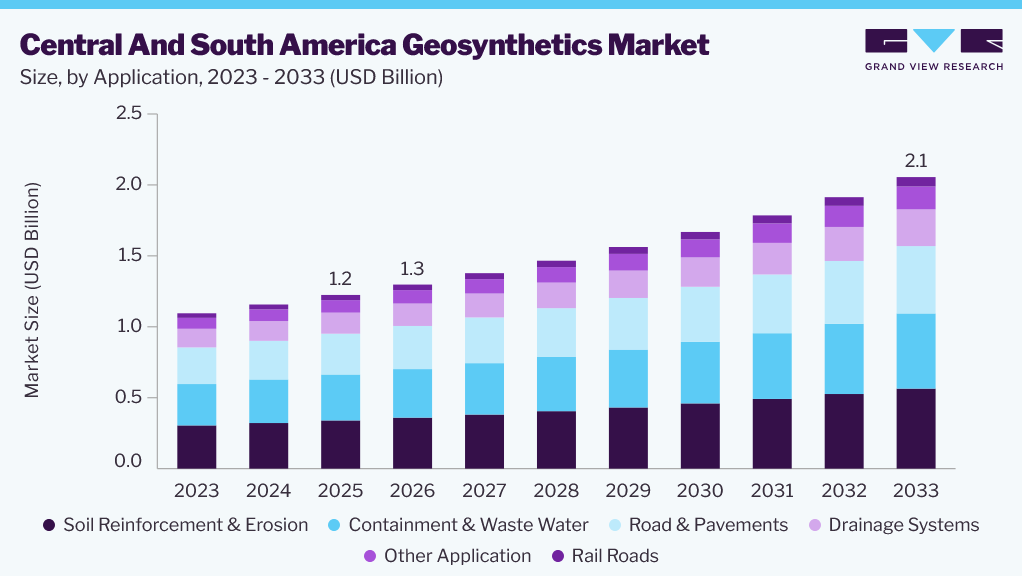
The Central and South America geosynthetics market size was valued at USD 1.2 billion in 2025 and is projected to grow from USD 1.3 billion in 2026 to USD 2.1 billion by 2033, at a CAGR of 6.8% from 2026 to 2033. This growth is attributed to the growing applications of geosynthetics in infrastructural applications such as the construction of railroads and roadways. Geosynthetics are used for base reinforcement, separation, and stabilization of roads and pavements.
Key Market Trends & Insights
- By application: Soil reinforcement & erosion segment dominated the market, with a revenue share of 27.8% in 2025.
Market Size & Forecast
- Market size in 2025: USD 1.2 Billion
- Estimated market size in 2026: USD 1.3 Billion
- Projected market size by 2033: USD 2.1 Billion
- CAGR (2026-2033): 6.8%
Three ways to get this report
Buy it, customize it, or ask a question.Ask an Analyst
Analyst response in 1 business day
- AccessReport author, directly
- Reply timeWithin 1 working day
- No sales callDirect answer only
- FormatEmail reply
- CostFree, no cost
Get the Full Report
What the study covers
- FormatsPDF · Excel · Dashboard
- Timeline2026–2033 annual, 2025 base
- Coverage20+ countries, 5 regions
- Companies10+ key players profiled
Customize the Report
20% free customization
- IncludeCountries, segments, points
- TailorTo your product definition
- ExtendDeeper competitor detail
- OrA fully bespoke study
- Turnaround5–10 working days
These products also find applications in subsurface drainage systems for dewatering, road base, and structure drainage. Geotextiles strengthen industrial units, car parks, and new roadways. Incorporating geosynthetics entails sustainable development, a small volume of earthwork, a low carbon footprint, and an increased rate of construction.Increasing infrastructural activities in Central & South America are likely to boost the use of geomembranes, geogrids, and geotextiles. Water and waste management are expected to remain the promising application segments for geomembranes in the region owing to the high prevalence of the offshore oil & gas industry in Brazil, Venezuela, and Argentina. In addition, the robust mining base in Chile, Brazil, Peru, and Colombia is likely to increase the need for wastewater treatment, thereby fueling the demand for geomembranes over the forecast period.
 Source: Grand View Research, IR Documents, Primary Interviews, Paid DatabasesTo learn more about this report,
 Download Free Sample Report
Brazil's rising developments in waste management, mining, transportation, and water resources will likely fuel the demand for geosynthetics over the forecast period. The growth in the Brazilian construction industry is likely to open new avenues for market growth in the next few years. A rise in hydraulic fracturing activities and a lack of proper waste management methods in the country are likely to promote the demand for geosynthetics, especially geotextiles and geomembranes, over the forecast period.
Market Dynamics
The Central and South America geosynthetics market is expected to grow steadily, driven by rising investments in transportation infrastructure, mining, water management, and environmental protection projects across the region. Increasing demand for ground stabilization, erosion control, drainage, and containment solutions is boosting the adoption of geotextiles, geomembranes, and geogrids. Government infrastructure initiatives, rapid urbanization, and growing focus on sustainable construction further support market growth. However, raw material price volatility and budget constraints for large-scale projects may limit expansion. Overall, continued infrastructure development and environmental sustainability efforts are expected to create favorable growth opportunities for the market.
Increasing investments in transportation and civil infrastructure projects are a major driver of the Central and South America geosynthetics market. Governments across the region are expanding road networks, railways, airports, ports, and urban infrastructure to support economic growth and improve connectivity. Geosynthetics are increasingly used in these projects for soil stabilization, reinforcement, drainage, erosion control, and pavement performance enhancement, helping improve the durability and cost-effectiveness of infrastructure.
The growing emphasis on resilient and sustainable construction is further accelerating the adoption of geotextiles, geogrids, geomembranes, and other geosynthetic materials. These products reduce maintenance requirements, extend the service life of infrastructure, and optimize the use of locally available soils, making them an attractive solution for large-scale public works. As infrastructure investments continue across the region, the demand for geosynthetics is expected to rise steadily throughout the forecast period.
Fluctuations in the prices of petroleum-based raw materials such as polypropylene, polyethylene, and polyester pose a significant restraint on the Central and South America geosynthetics market. Changes in crude oil prices, supply chain disruptions, and currency fluctuations can increase manufacturing costs and create pricing uncertainty for geosynthetic products. These cost pressures are particularly challenging for infrastructure projects operating under fixed budgets, leading to delayed procurement decisions or reduced adoption of advanced geosynthetic solutions. Consequently, raw material price volatility continues to impact market profitability and growth.
Increasing investments in water management, environmental protection, and climate resilience projects present a significant opportunity for the market. Rising concerns over water scarcity, flooding, landfill management, and soil erosion are driving the adoption of geomembranes, geotextiles, and drainage composites in reservoirs, canals, wastewater treatment facilities, mining containment systems, and waste disposal sites. Government initiatives and international funding for sustainable infrastructure and environmental conservation are further supporting demand, creating long-term growth opportunities for geosynthetic manufacturers across the region.
Analyst Perspective
The Central & South America geosynthetics market is evolving beyond traditional infrastructure applications, with increasing demand from mining, environmental protection, and water management projects. Brazil will remain the primary growth engine, while Chile and Peru will benefit from expanding mining investments and stricter environmental regulations. Although economic volatility and public spending cycles may create short-term fluctuations, growing emphasis on durable, cost-effective, and sustainable infrastructure is expected to support steady long-term market growth and increase the adoption of higher value geosynthetic solutions. Additionally, increasing investments in road rehabilitation, landfill development, and flood control projects are broadening the application scope of geosynthetics across the region. Manufacturers offering technically advanced products and engineering support are expected to strengthen their competitive position as demand shifts toward performance-driven solutions.
Application Insights
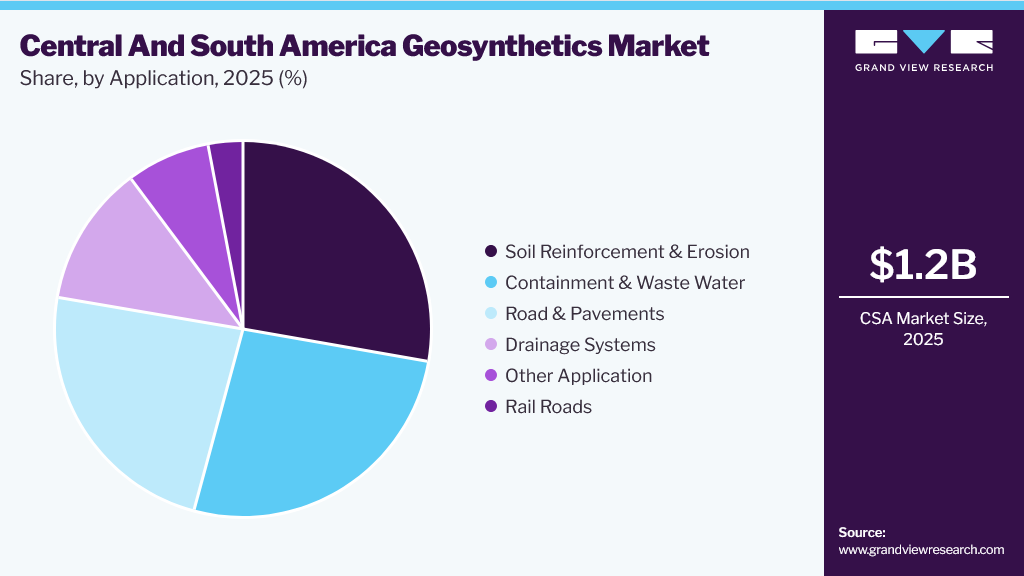
Based on application, the soil reinforcement & erosion segment led the market with the largest revenue share of 27.8% in 2025. The segment is further forecasted to grow at a CAGR of 6.2% till 2030. Geogrids and geotextiles are used for soil reinforcement as they prevent the intermixing of the soil and piping. In addition, they help preserve the strength of the construction aggregate. Soil erosion is a significant problem as it leads to loss of land, slope instability, and reservoir capacity due to silting. Geocells and geogrids play an essential role in shore protection and vegetative growth. The growing construction industry in Argentina and Brazil will likely increase the demand for geosynthetics in soil reinforcement soon.
 To learn more about this report, Download Free Sample Report
The railroads application segment is forecasted to grow at the fastest CAGR of 7.4% over the forecast period. Railroads use geotextiles as they act as separators & filters and help transmit water through lateral drainage. Geosynthetics are incorporated to reinforce tracks for stress reduction, which ensures long-term performance. Geosynthetic solutions are required for various applications such as track-bed separation, slope erosion control, structural drainage, embankment stabilization, tunnel drainage, and access road reinforcement in rail construction projects.
Country Insights
Central & South American countries such as Brazil, Peru, and Argentina have started economic revival as manufacturing net exports have returned to the pre-pandemic levels. Factors such as the influx of remittances, increasing food costs, and adequate governmental assistance in economic aid have helped economies improve their GDP growth.
Brazil Geosynthetics Market Trends
The Central and South America geosynthetics market in Brazil led the market with the largest revenue share of 27.6% in 2025. Brazil is one of the major developing countries in the Central & South American region. Major industries contributing to the country’s economic growth include automobile, oil & gas, agriculture, construction, iron & steel, and machinery & equipment. The construction industry in Brazil is anticipated to witness significant growth due to increasing efforts taken by the government to revive the economy, followed by improvement in consumer and investor confidence.
Panama Geosynthetics Market Trends
Panama geosynthetics market is expected to be the fastest-growing market for geosynthetics in the Central & South American region, with a compound annual growth of 7.4% over the forecast period. Panama's strategic location as a global logistics hub, with the Panama Canal acting as a key trade artery, has led to an uptick in infrastructure activities such as road construction, port development, and the canal's expansion. Geosynthetics, including geotextiles, geomembranes, and geogrids, are essential for reinforcing soils, controlling erosion, and improving the durability of roads, dams, and drainage systems, making them a critical component of Panama's infrastructure projects.
Argentina Geosynthetic Market Trends
Argentina geosynthetic market held a significant market revenue share in 2024. Argentina is rich in mineral resources, particularly lithium, copper, and gold, and the mining industry has been a significant contributor to the country's economy. Geosynthetics are widely used in mining applications, including tailings management, heap leaching, and erosion control. The use of geosynthetic liners and other materials in these processes helps mitigate environmental risks and improve operational efficiency, thus driving demand for geosynthetic products within the mining sector.
Key Central And South America Geosynthetics Company Insights
Some of the key players operating in the market include AGRU America, Inc., SOLMAX, HUESKER Group, and others:
-
AGRU America, Inc. is a manufacturer in the geosynthetic market, specializing in high-performance polymer products designed for various applications in civil engineering and environmental protection. The company offers a comprehensive range of geosynthetic solutions, including geomembranes, geotextiles, and geocomposites in landfill liners, water containment systems, and erosion control projects.
-
SOLMAX is a global provider of geosynthetic solutions, specializing in designing, manufacturing, and supplying high-performance geosynthetic products for various industries, including construction, mining, environmental, and infrastructure projects.
Key Central And South America Geosynthetics Companies
-
AGRU America, Inc.
-
SOLMAX
-
HUESKER Group
-
Minerals Technologies Inc.
-
Concrete Canvas Ltd
-
Officine Maccaferri SpA
-
NAUE GmbH & Co. KG
-
Raven Industries, Inc.
-
Strata Systems, Inc.
-
The Best Project Material Co., Ltd. (BPM)
Competitive Benchmarking
Category
Operating Strategies
Competitive Edge
Weakness
Established Players (AGRU America, Inc., SOLMAX, HUESKER Group, Minerals Technologies Inc., Officine Maccaferri SpA, NAUE GmbH & Co. KG, and Raven Industries, Inc.)
- Expand manufacturing capacity and strengthen distribution networks across Central and South America to support large-scale infrastructure, mining, and environmental projects.
- Invest in product innovation, sustainability, and technical consulting to deliver high-performance geosynthetic solutions tailored to regional applications.
- Strong brand recognition, diversified product portfolios, and established relationships with government agencies, EPC contractors, and industrial customers.
- Extensive R&D capabilities, global manufacturing footprint, and proven expertise in delivering complex geotechnical and environmental solutions.
- High operational and manufacturing costs may reduce pricing flexibility in highly competitive and cost-sensitive markets.
- Large organizational structures can slow decision-making and product customization for localized project requirements.
Emerging Players (Concrete Canvas Ltd, Strata Systems, Inc., and The Best Project Material Co., Ltd. (BPM))
- Focus on niche applications and cost-effective geosynthetic products to penetrate price-sensitive markets.
- Expand regional presence through partnerships, distributors, and project-specific collaborations while gradually broadening product portfolios.
- Greater operational flexibility enables faster response to changing customer requirements and regional market opportunities.
- Competitive pricing and specialized product offerings help gain traction in emerging infrastructure and environmental projects.
- Limited financial resources and smaller production capacities restrict expansion into large-scale infrastructure projects.
- Lower brand recognition and comparatively limited distribution networks reduce competitiveness against established global manufacturers.
Central And South America Geosynthetics Market Report Scope
Report Attribute
Details
Market size in 2025
USD 1.2 billion
Estimated market size in 2026
USD 1.3 billion
Projected market size by 2033
USD 2.1 billion
Growth rate
CAGR of 6.8% from 2026 to 2033
Base year for estimation
2025
Historical data
2021 - 2024
Forecast period
2026 - 2033
Quantitative units
Revenue in USD billion/million, Volume in million square meters, and CAGR from 2026 to 2033
Report coverage
Revenue forecast, company ranking, competitive landscape, growth factors, and trends
Segments covered
Application, country
Regional scope
Central & South America
Country scope
Brazil; Argentina; Chile; Colombia; Ecuador; Peru; Panama
Key companies profiled
AGRU America, Inc.; SOLMAX; HUESKER Group; Minerals Technologies Inc.; Concrete Canvas Ltd; Officine Maccaferri SpA; NAUE GmbH & Co. KG; Raven Industries Inc.; Strata Systems Inc., The Best Project Material Co., Ltd. (BPM)
Customization scope
Free report customization (equivalent up to 8 analysts' working days) with purchase. Addition or alteration to country & segment scope.
Pricing and purchase options
Avail customized purchase options to meet your exact research needs. Explore purchase options
Central & South America Geosynthetics Market Report Segmentation
This report forecasts revenue growth at regional & country levels and provides an analysis on the industry trends in each of the sub-segments from 2021 to 2033. For this study, Grand View Research has segmented the Central & South America geosynthetics market report on application, and country:
-
Application Outlook (Volume, Million Square Meters; Revenue, USD Million, 2021 - 2033)
-
Road & Pavements
-
Rail Roads
-
Drainage Systems
-
Soil Reinforcements & Erosion
-
Containment & Waste Water
-
Others
-
-
Country Outlook (Volume, Million Square Meters; Revenue, USD Million, 2021 - 2033)
-
Central & South America
-
Brazil
-
Argentina
-
Chile
-
Colombia
-
Ecuador
-
Peru
-
Panama
-
-
Research Methodology
The Central And South America geosynthetics market figures in this report are based on a proven research process that combines executive interviews with secondary research from proprietary databases, company filings, and recognized regulatory and institutional sources. Market size is built through value-chain sizing - reconciling supply-side and demand-side estimates - and triangulated with bottom-up and top-down approaches. Every estimate passes multiple levels of expert validation before publication, with each Central And South America geosynthetics segment quantified using the revenue-capture definitions in the table below.
Segment Definition
Segment - Application
Revenue capture definition
Soil Reinforcement & Erosion
Revenue generated from the sale of geosynthetics used for soil stabilization, slope reinforcement, embankment protection, and erosion control. This segment includes geotextiles, geogrids, geocells, and erosion control mats used in highways, retaining walls, riverbanks, mining sites, and land development projects.
Containment & Waste Water
Revenue generated from the sale of geosynthetics used for liquid and waste containment applications. This segment includes geomembranes, geosynthetic clay liners (GCLs), and geocomposites used in landfills, mining tailings, wastewater treatment plants, reservoirs, canals, and industrial containment systems.
Road & Pavements
Revenue generated from the sale of geosynthetics used in road construction and pavement rehabilitation to improve load distribution, extend pavement life, and reduce maintenance costs. This segment includes geotextiles, geogrids, and geocomposites used in highways, urban roads, airports, and industrial pavements.
Drainage Systems
Revenue generated from the sale of geosynthetics designed to facilitate water flow, filtration, and subsurface drainage. This segment includes drainage geocomposites, geonets, and nonwoven geotextiles used in retaining structures, tunnels, foundations, sports fields, landfills, and civil engineering projects.
Rail Roads
Revenue generated from the sale of geosynthetics used to reinforce railway foundations, improve ballast performance, and enhance track stability. This segment includes geotextiles, geogrids, and geocomposites used in freight rail, passenger rail, metro systems, and high-speed railway infrastructure.
Other Application
Revenue generated from the sale of geosynthetics used in applications beyond the primary categories, including agriculture, aquaculture, coastal protection, hydraulic structures, energy projects, landscaping, and sports infrastructure. This segment also includes customized geosynthetic solutions for specialized civil and environmental engineering applications.
Estimation Model
Layer Name
Key Question
Description
Infrastructure & Construction Demand Layer
What forms the demand base?
Identify the total demand for geosynthetics across major end-use applications including transportation infrastructure, water management, mining, waste management, agriculture, energy, and environmental protection. This layer establishes the addressable demand generated by new construction, rehabilitation, and maintenance projects across developed and emerging economies.
Application Penetration Layer
Where are geosynthetics utilized?
Estimate the penetration of geosynthetics across key applications such as soil reinforcement & erosion control, containment & wastewater, roads & pavements, drainage systems, railroads, and other civil engineering projects. Assess adoption levels based on infrastructure investment, engineering standards, regulatory requirements, and project complexity across regions.
Material Consumption Layer
How much geosynthetic material is consumed?
Analyze the volume of geosynthetics consumed by application, material type, and project category. Consumption is influenced by project size, infrastructure development, environmental regulations, replacement cycles, and the adoption of advanced geosynthetic solutions for long-term performance and sustainability.
Revenue Layer
How is market revenue generated?
Market revenue is quantified through the sale of geotextiles, geomembranes, geogrids, geocells, geosynthetic clay liners, geonets, and geocomposites across infrastructure, environmental, mining, water management, and transportation projects. Revenue is driven by increasing investments in civil engineering, urban development, sustainable construction, and maintenance of critical infrastructure.
Delivered Customizations
This report has been delivered with the following In-depth customizations
Client Request
Customization Delivered
Value Adds
Country Segmentation Analysis
Detailed market size, growth forecast, and demand analysis for Brazil, Argentina, Chile, Colombia, Ecuador, Peru, Panama, and Rest of Central & South America (RoCSA), including country-level infrastructure development, mining activities, environmental regulations, and investment trends.
Enabled identification of high-growth countries, country-specific demand patterns, and strategic expansion opportunities across the region.
Competitive Benchmarking
Comparative assessment of leading geosynthetics manufacturers based on product portfolio, application expertise, country-wise footprint, manufacturing capabilities, strategic initiatives, distribution network, revenue profile, and recent developments.
Supported competitive positioning, partnership evaluation, benchmarking against industry leaders, and identification of market differentiation opportunities.
Opportunity Assessment
Identification of high-growth opportunities across applications and countries, with focus on Soil Reinforcement & Erosion, Containment & Waste Water, Road & Pavements, Drainage Systems, Rail Roads, and Other Application, supported by infrastructure investments, mining expansion, environmental protection initiatives, and untapped regional markets.
Supported strategic investment decisions, market entry planning, application portfolio expansion, and long-term growth prioritization.
Frequently Asked Questions About This Report
Key factors driving the Central and South America geosynthetics market include rising infrastructure investments, expanding mining and water management projects, growing demand for soil reinforcement and erosion control, increasing adoption of sustainable construction practices, and supportive government infrastructure initiatives.
Brazil dominated the Central and South America geosynthetics market with a 27.6% revenue share in 2025.
Panama is the fastest-growing country in the Central and South America geosynthetics market with a CAGR of 7.8% over the forecast period.
Railroads are projected to be the fastest-growing application segment in the Central and South American geosynthetics market over the forecast period.
The Central and South America geosynthetics market size was valued at USD 1.2 billion in 2025 and is estimated at USD 1.3 billion for 2026.
The Central and South America geosynthetics market is expected to grow at a CAGR of 6.8% from 2026 to 2033, reaching USD 2.1 billion by 2033.
The soil reinforcement & erosion segment led the Central and South America geosynthetics market with a 27.8% revenue share in 2025.
Key players in the Central and South America geosynthetics market include AGRU America, Inc.; SOLMAX; HUESKER Group; Minerals Technologies Inc.; Concrete Canvas Ltd; Officine Maccaferri SpA; NAUE GmbH & Co. KG; Raven Industries Inc.; Strata Systems Inc.; The Best Project Material Co., Ltd. (BPM).
About the Author(s)
Advanced Interior Materials Research Team
Advanced Materials · Advanced Interior MaterialsThis report was authored by the advanced interior materials research team at Grand View Research - comprising two research analysts, one senior research analyst, and one industry expert - with specialized expertise in the advanced interior materials segment of the advanced materials industry. All findings are based on proprietary advanced materials databases, executive interviews, and regulatory analysis, subject to internal peer review prior to publication.
Last Updated:
Speak to Analyst

Customize this report to your needs - add regions, segments, or data points, with 20% free customization.
Or view our licence options:


ISO 9001:2015 & 27001:2022 Certified
We are GDPR and CCPA compliant! Your transaction & personal information is safe and secure. For more details, please read our privacy policy.


