
- Home
- »
- Advanced Interior Materials
- »
-
Centrifugal Fans Market Size And Share Report, 2026-2033GVR Report cover

Centrifugal Fans Market (2026 - 2033)
Size, Share & Trends Analysis Report By Type (Forward Curved Fans, Backward Curved Fans), By Capacity, By Drive Type, By Application, By End Use, By Region, And Segment Forecasts
Market Size, 2025
$7.4BMarket Estimate, 2026
$7.7BMarket Forecast, 2033
$10.6BCAGR, 2026–2033
4.6%Centrifugal Fans Market Summary
The global centrifugal fans market size was valued at USD 7.4 billion in 2025 and is projected to grow from USD 7.7 billion in 2026 to USD 10.6 billion by 2033, at a CAGR of 4.6% from 2026 to 2033.Asia Pacific dominated the market, accounting for a revenue share of 40.7% in 2025. The market is primarily driven by increasing demand in industrial sectors requiring efficient ventilation and air-handling systems.
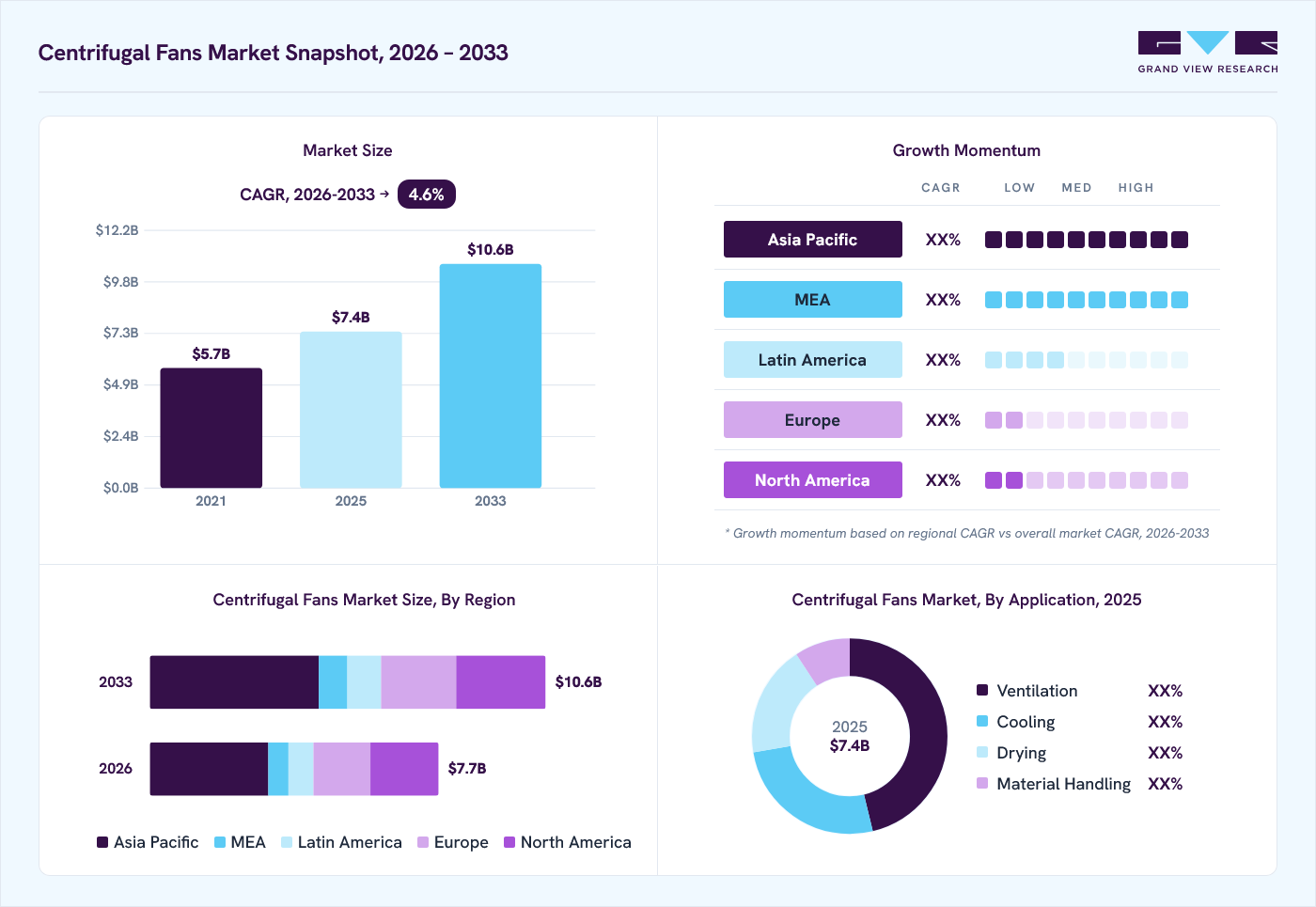 Source: Grand View Research, IR Documents, Primary Interviews, Paid DatabasesTo learn more about this report,
 Download Free Sample Report
Key Market Trends & Insights
- By type: Forward curved fans segment dominated the market, with a revenue share of 62.0% in 2025.
- By capacity: 5 kW to 20 kW segment held the largest market share of 42.2% in 2025.
- By driving type: Direct drive segment held the largest revenue share of 56.0% in 2025.
- By application: Ventilation segment accounted for the largest revenue share of 46.2% in 2025.
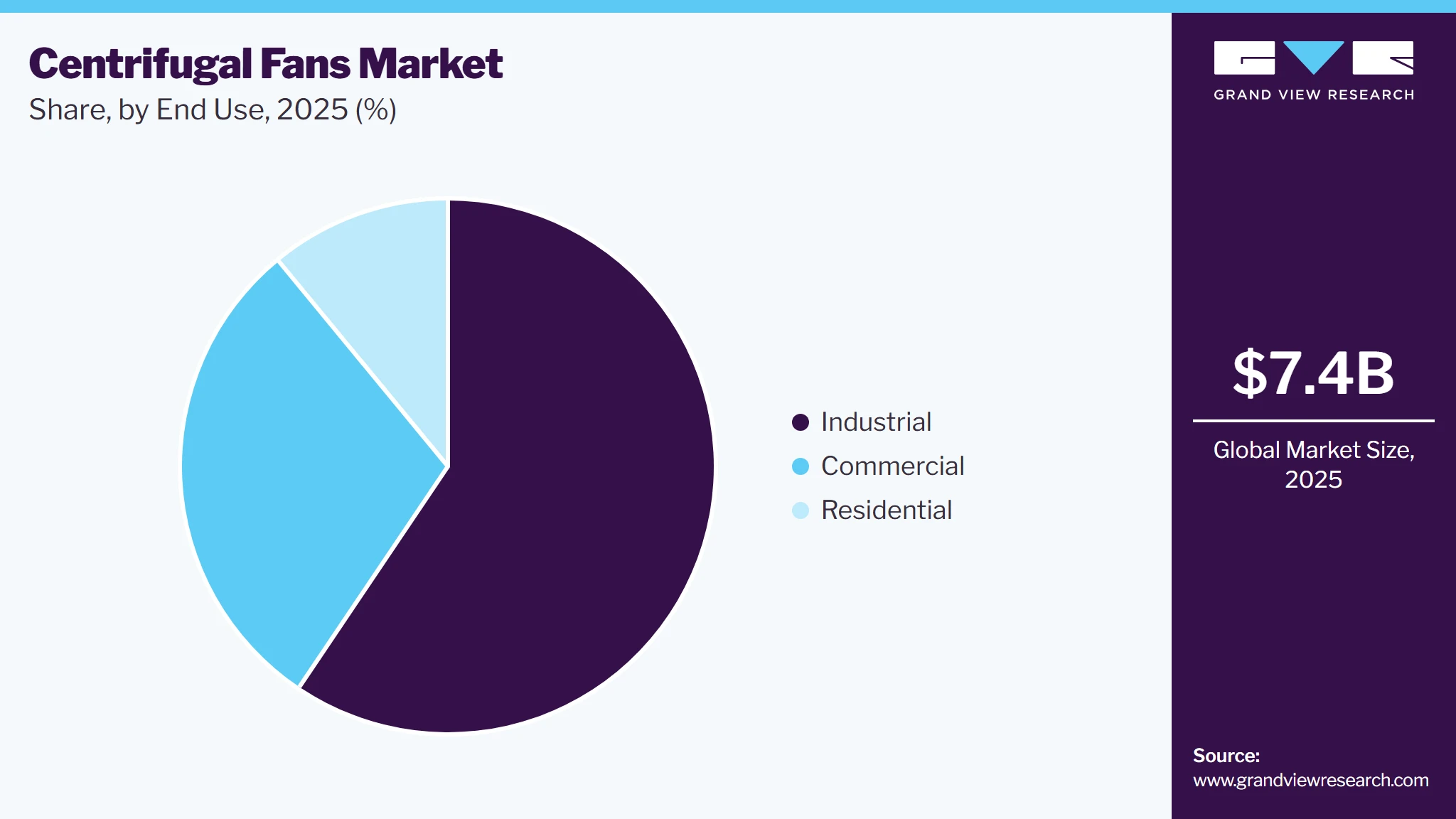
- By end use: Industrial segment dominated the market, with a revenue share of 59.4% in 2025.
Regional Highlights
- Largest regional market: Asia Pacific (40.7% revenue share, 2025)
- By country: China held the largest market share in 2025.
Market Size & Forecast
- Market size in 2025: USD 7.4 Billion
- Estimated market size in 2026: USD 7.7 Billion
- Projected market size by 2033: USD 10.6 Billion
- CAGR (2026-2033): 4.6%
Prism AI by Grand View Research Free to tryAsk a question about the centrifugal fans marketTry asking✓Every figure cited from GVR research Prefer the report? Download free sample →
Expansion in manufacturing and infrastructure projects is boosting the need for reliable fans in HVAC systems, pollution control, and boiler operations. Stringent energy-efficiency regulations are encouraging the adoption of advanced fan technologies, including high-performance impellers, variable-speed drives, and electronically commutated motors, which optimize airflow while reducing energy consumption.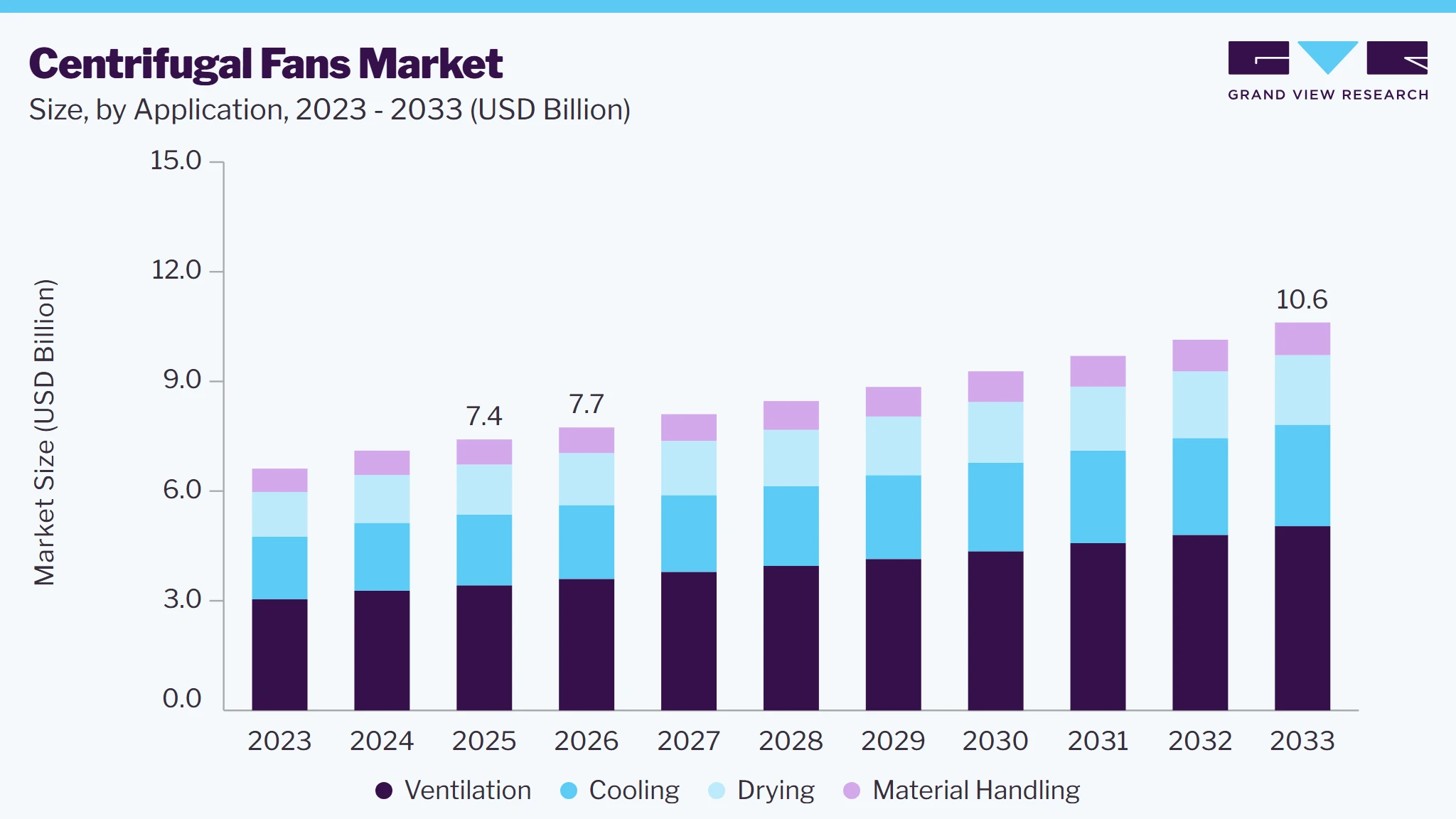 To learn more about this report, Download Free Sample Report
In addition, innovations such as IoT-enabled smart monitoring systems allow real-time performance tracking, predictive maintenance, and operational cost reduction, further increasing adoption. Growth in emerging regions, particularly the Asia-Pacific, is fueled by rapid industrialization and urbanization.The combination of technological advancements, regulatory compliance, and increasing industrial demand positions the centrifugal fans market for significant, long-term expansion globally.
Market Dynamics
The global centrifugal fans market is being driven by increasing investments in industrial infrastructure, expanding HVAC installations, and stricter workplace ventilation and air quality standards across manufacturing, commercial, and institutional facilities. Industries such as power generation, chemicals, cement, mining, food processing, and wastewater treatment continue to adopt centrifugal fans for reliable air movement, cooling, exhaust, and dust collection applications. Growing emphasis on energy efficiency is encouraging the replacement of conventional systems with high-performance fans incorporating variable frequency drives (VFDs), electronically commutated (EC) motors, optimized impeller designs, and IoT-enabled monitoring for predictive maintenance and lower operating costs.
Growing investments in manufacturing facilities, warehouses, commercial buildings, power plants, and process industries are increasing the demand for reliable air movement and ventilation systems. Centrifugal fans are widely used for exhaust, cooling, dust collection, and process air handling, making them an essential component in industrial operations. Stricter workplace air quality and emission control regulations are further accelerating product adoption.
The adoption of advanced centrifugal fan systems often requires significant upfront investment, particularly for large-scale industrial applications involving customized fan designs, high-capacity motors, automation systems, and specialized materials for corrosive or high-temperature environments. Beyond equipment costs, installation, commissioning, balancing, and routine maintenance add to the overall lifecycle expenditure. In addition, fluctuating prices of steel, aluminum, and other raw materials can impact manufacturing costs and profit margins, while intense competition from low-cost regional suppliers creates pricing pressure for established manufacturers.
A significant opportunity exists in the modernization of aging industrial ventilation systems and HVAC infrastructure across developed and emerging economies. Industries are increasingly replacing older centrifugal fans with advanced models offering improved aerodynamic efficiency, reduced noise and vibration, enhanced durability, and lower maintenance requirements. Furthermore, the growing adoption of Industry 4.0 is creating demand for smart centrifugal fans integrated with IoT sensors, predictive maintenance, remote monitoring, and automated airflow control systems.
Market Concentration & Characteristics
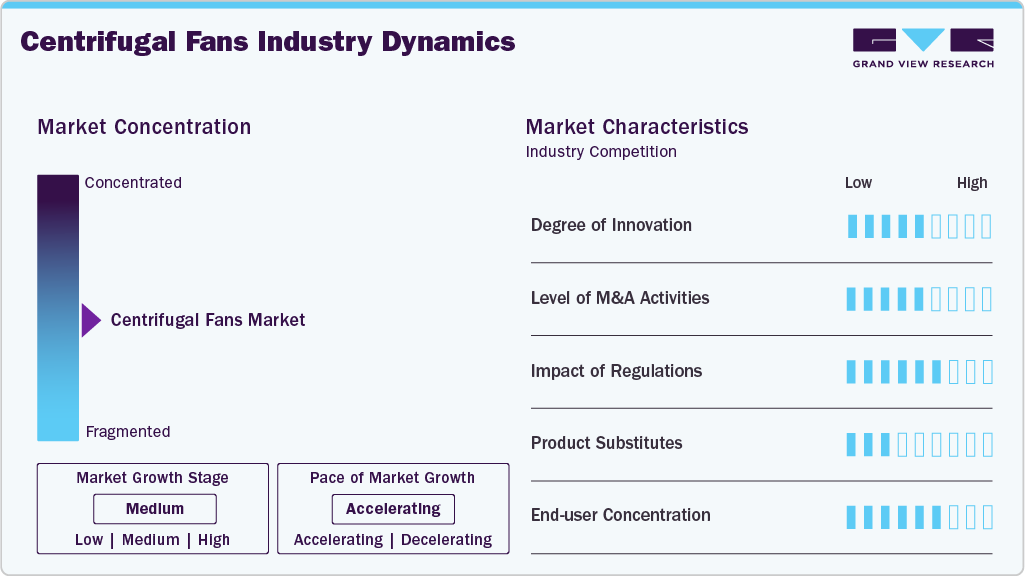
The centrifugal fans market is moderately fragmented with a wide mix of global manufacturers, regional producers, and specialized local companies, none of which hold a dominant market share. Large international brands offer technologically advanced, energy-efficient fans, while numerous mid-sized and smaller firms supply standard or customized models for specific industrial and HVAC applications. This diversity of product capabilities, pricing levels, and distribution networks spreads market power across many players.
Innovation in the market centers on improving energy efficiency, reducing noise, and enhancing airflow performance. Manufacturers are increasingly adopting advanced impeller designs, variable-speed drives, and electronically commutated motors to meet modern efficiency standards. Smart monitoring technologies, including IoT-based sensors for predictive maintenance, are also gaining traction. While innovation is progressive rather than disruptive, continuous upgrades in materials, design, and digital integration are steadily elevating product performance and operational reliability.
 To learn more about this report, Download Free Sample Report
M&A activity in the centrifugal fans market is moderate, driven by companies seeking to expand product portfolios, strengthen regional presence, and access advanced technologies. Larger manufacturers often acquire smaller firms specializing in niche applications or high-efficiency systems. These deals help companies enhance manufacturing capabilities, optimize supply chains, and accelerate innovation. Consolidation is influenced by rising competition, regulatory pressure for energy-efficient products, and growing demand from industrial, commercial, and HVAC sectors globally.
Regulations significantly shape the centrifugal fans market by enforcing stricter energy-efficiency and environmental performance standards. Governments and industry bodies require fans to meet specific efficiency ratings, noise limits, and emissions-related guidelines, pushing manufacturers to upgrade designs and adopt advanced motors. Compliance with building codes and HVAC efficiency standards further drives demand for high-performance fans. These regulatory pressures encourage innovation, raise product quality expectations, and influence purchasing decisions across industrial, commercial, and residential sectors.
Analyst Perspective
The centrifugal fans market is growing steadily as industries continue to invest in efficient air movement and ventilation systems that enhance operational performance and workplace safety. Demand is increasing across manufacturing, power generation, mining, cement, chemicals, food processing, and commercial buildings, where centrifugal fans are widely used for ventilation, dust collection, material handling, exhaust, and process cooling applications. In addition, growing emphasis on energy efficiency and regulatory compliance is encouraging end users to replace conventional systems with high-efficiency centrifugal fans equipped with direct-drive motors, variable frequency drives (VFDs), and intelligent monitoring capabilities. Technological advancements focused on improving airflow performance, reducing noise levels, and lowering energy consumption are further strengthening product adoption. As industrial facilities continue to modernize and prioritize sustainable operations, manufacturers offering reliable, energy-efficient, and application-specific centrifugal fan solutions are expected to benefit from sustained long-term market growth.
Drivers, Opportunities & Restraints
Expanding industrial and infrastructure sectors, which rely heavily on efficient ventilation, cooling, and air-handling systems are significantly driving the market. Growth in manufacturing, power generation, cement, mining, and HVAC applications increases the need for durable, high-performance fans. Moreover, rising focus on workplace safety and air quality encourages industries to adopt advanced ventilation systems, further supporting steady demand for centrifugal fans across diverse end use environments.
Increasing demand for energy-efficient and smart centrifugal fans is significantly creating opportunities for the market. As industries and commercial facilities prioritize reducing operational costs, fans equipped with variable-speed drives, optimized impeller designs, and IoT-based monitoring systems gain traction. Manufacturers that invest in such technologies can capture new market segments. Additionally, rapid industrialization in emerging economies and infrastructure modernization projects worldwide present strong growth prospects for high-efficiency centrifugal fan solutions.
High initial cost associated with advanced, energy-efficient centrifugal fans, which can discourage adoption among small and mid-sized businesses is being challenge in the market. Many industrial users continue relying on older, less efficient systems due to budget constraints. Furthermore, fluctuations in raw material prices affect production costs, while increasing regulatory requirements push manufacturers to upgrade designs continually. These factors create financial and operational pressures that hinder faster market adoption of modern fan technologies.
Type Insights
Based on type, the forward curved fans segment led the market with the largest revenue share of 62.0% in 2025. Forward curved fans segment dominated the market and accounted for a revenue share of 62.0% in 2024, due to rising demand in HVAC applications across commercial buildings, residential complexes, and light industrial facilities. Their compact size, low noise levels, and ability to deliver high airflow at low static pressure make them ideal for ventilation and air-conditioning units. As construction activities increase and energy-efficient HVAC systems become standard, adoption of forward curved fans is set to rise steadily in both new installations and retrofits.
Backward curved fans is emerging segment, as industries prioritize higher efficiency, lower energy consumption, and improved durability. These fans handle higher static pressures and offer better performance in demanding applications such as power plants, manufacturing facilities, and large HVAC systems. Their self-cleaning design and reduced risk of overloading make them suitable for continuous industrial operation. With increasing regulatory emphasis on efficiency, backward curved fans are becoming the preferred choice for heavy-duty ventilation needs.
Capacity Insights
Based on capacity, the 5 kW to 20 kW segment led the market with the largest revenue share of 42.2% in 2025. as industrial facilities, manufacturing plants, and large commercial buildings require higher-capacity ventilation and air-handling systems. These fans are ideal for medium to heavy-duty operations involving higher static pressure and continuous performance. As industries expand and modernize, demand for durable, energy-efficient fans in this capacity range is likely to rise, particularly in sectors such as chemicals, power generation, and large-scale HVAC installations.
The up to 5 kW centrifugal fans segment is projected to grow steadily, driven by increasing use in residential, small commercial, and light industrial applications. These lower-capacity fans are commonly used in compact HVAC units, ventilation systems, and localized cooling solutions. Their affordability, space efficiency, and ease of installation make them appealing for small businesses and housing projects. Rising construction activity and the adoption of energy-efficient building systems are expected to further support this segment’s expansion.
Drive Type Insights
Based on drive type, the direct drive segment led the market with the largest revenue share of 56.0% in 2025 in terms of revenue Direct drive segment continues to dominate the market and accounted for a revenue share of 56.0% in 2024,as industries prioritize energy efficiency, reduced maintenance, and compact system design. Direct drive fans eliminate belts and pulleys, resulting in lower energy losses, quieter operation, and improved reliability. Their increasing use in modern HVAC systems and industrial ventilation supports steady adoption. As facilities shift toward smart, efficient, and low-maintenance equipment, direct drive centrifugal fans is likely to continue gaining market share across commercial and industrial applications.
The belt drive segment is projected to grow moderately, driven by its suitability for applications requiring adjustable speeds and higher airflow flexibility. These fans remain preferred in industrial settings such as manufacturing plants, warehouses, and processing facilities where performance customization is important. Although maintenance needs are higher than direct drive systems, their ability to handle larger volumes and varying load conditions ensures continued demand, especially in heavy-duty ventilation and older facility retrofit projects.
Application Insights
Based on application, the ventilation segment led the market with the largest revenue share of 46.2% in 2025, as demand rises across industrial, commercial, and residential environments. Increasing focus on indoor air quality, workplace safety, and compliance with building ventilation standards boosts the need for efficient centrifugal fans. Expansion of manufacturing facilities and urban infrastructure further drives adoption. Energy-efficient and low-noise ventilation systems are increasingly preferred, supporting consistent growth of centrifugal fans used in air circulation, exhaust systems, and general building ventilation.
The cooling segment is projected to expand as industries require reliable heat dissipation for machinery, production processes, and HVAC equipment. Centrifugal fans are widely used for cooling electrical panels, boilers, generators, and process systems. Growth in manufacturing, data centers, and commercial buildings fuels demand for high-performance cooling solutions. As operational efficiency becomes a priority, companies increasingly adopt energy-efficient centrifugal fans to maintain optimal temperatures and prevent equipment overheating, supporting steady market growth.
End Use Insights
Based on end use, the industrial segment led the market with the largest revenue share of 59.4% in 2025. In terms of revenue. The industrial segment dominates the centrifugal fans market and accounted for a share of 59.4% in 2024, as manufacturing, processing, and heavy-duty industries rely on centrifugal fans for ventilation, cooling, dust control, and air-handling operations. Expansion in sectors such as chemicals, cement, food processing, and power generation increases demand for high-capacity, durable fans. Rising focus on energy efficiency, regulatory compliance, and workplace safety encourages industries to upgrade to advanced fan systems, supporting sustained growth across new installations and modernization projects.
 To learn more about this report, Download Free Sample Report
The residential segment is projected to grow steadily as demand increases for efficient ventilation and air-circulation systems in homes, apartments, and small buildings. Urbanization, rising housing construction, and greater awareness of indoor air quality drive adoption of compact, low-noise centrifugal fans. These fans are used in household HVAC units, bathroom exhausts, and kitchen ventilation. Energy-efficient building designs and the shift toward healthier indoor environments further support growth in the residential centrifugal fans market.
Regional Insights
North America centrifugal fans market growing at CAGR of 3.9% in 2024, due to expanding industrial modernization, strict energy-efficiency regulations, and increased adoption of advanced HVAC systems. Manufacturing, data centers, commercial buildings, and power plants are upgrading ventilation and cooling equipment, boosting demand for high-performance fans. Technological advancements, including smart monitoring and variable-speed drives, further support adoption, while ongoing investments in infrastructure and retrofitting projects continue to drive market expansion across the region.
U.S. Centrifugal Fans Market Trends
The U.S. centrifugal fans market is growing due to strong demand from manufacturing, data centers, commercial infrastructure, and environmental ventilation applications. Stringent energy-efficiency standards encourage industries to replace older systems with high-efficiency fans. Expansion of sectors like food processing, pharmaceuticals, and logistics also contributes to rising demand.
Mexico centrifugal fans market is growing due to growth in manufacturing, automotive production, food processing, and industrial facilities that require dependable ventilation and cooling solutions. Rising investments in industrial parks and commercial buildings are boosting HVAC system upgrades. Additionally, government initiatives encouraging energy-efficient technologies support adoption of modern centrifugal fans.
Europe Centrifugal Fans Market Trends
Europe is seeing steady growth in the centrifugal fans market driven by strict environmental and energy-efficiency regulations that encourage modernization of industrial ventilation systems. Expansion in manufacturing, chemical processing, commercial infrastructure, and cleanroom environments supports demand. The region’s focus on reducing emissions and optimizing energy use boosts adoption of advanced, high-efficiency fans. Ongoing retrofitting of older buildings and factories further contributes to consistent market expansion across major European countries.
Centrifugal fans market in UK is expanding as commercial buildings, manufacturing units, and infrastructure projects upgrade HVAC and ventilation systems. Strong energy-efficiency regulations and sustainability goals drive adoption of high-performance fans. Growth in data centers, pharmaceuticals, and food processing also supports increased demand. Retrofitting of aging facilities and rising focus on indoor air quality contribute to consistent market growth across residential, commercial, and industrial applications.
Asia Pacific Centrifugal Fans Market Trends
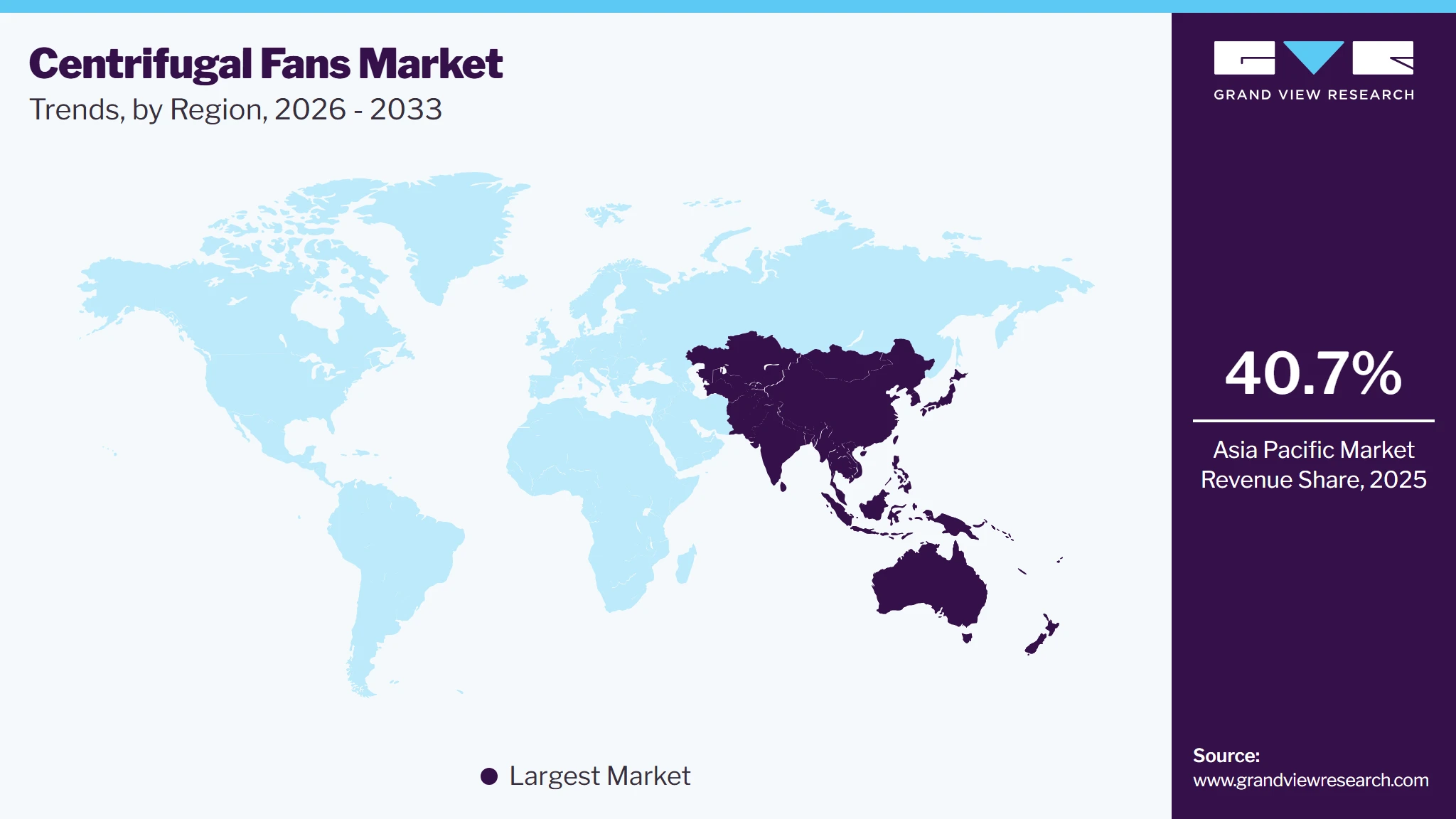
Asia Pacific dominated the centrifugal fans market with the largest revenue share of 40.7% in 2025, due to rapid industrialization, urbanization, and expansion of manufacturing sectors. Rising construction of commercial buildings, industrial plants, and residential complexes drives demand for advanced ventilation and cooling systems. Increasing investments in infrastructure, energy projects, and HVAC modernization further support growth. The region’s strong focus on improving air quality and energy efficiency also boosts adoption of modern centrifugal fans.
 To learn more about this report, Download Free Sample Report
The centrifugal fans market in China held the largest share in the Asia Pacific region in 2025. China centrifugal fans market is expanding rapidly, supported by its large-scale manufacturing base, industrial growth, and ongoing urban development. High demand from sectors such as electronics, automotive, cement, chemicals, and HVAC boosts adoption. Government policies promoting energy efficiency and environmental compliance encourage industries to upgrade ventilation systems. Rising construction of commercial and residential buildings also drives demand for high-performance centrifugal fans across both new installations and retrofit projects.
The centrifugal fans market in India is witnessing strong growth in the due to expanding manufacturing activity, infrastructure development, and increasing demand for efficient ventilation systems. Growth in sectors like cement, textiles, chemicals, and food processing drives adoption of industrial fans. Rising construction of commercial buildings and residential complexes boosts HVAC installations. Focus on energy-efficient equipment and air quality improvement further supports steady market expansion across the country.
Middle East & Africa Centrifugal Fans Market Trends
The Middle East and Africa centrifugal fans market is growing rapidly at 4.8% CAGR during forecast period, driven by industrial development, construction expansion, and increasing adoption of HVAC systems in commercial and residential buildings. Rising temperatures and demand for effective cooling solutions boost fan usage. Investments in oil and gas, mining, and infrastructure projects further support market expansion. Energy-efficiency initiatives and modernization efforts contribute to steady demand for advanced centrifugal fans.
Saudi Arabia centrifugal fans market is expanding as the country invests heavily in infrastructure, industrial development, and large-scale construction under Vision 2030. High demand for reliable ventilation and cooling systems in petrochemical plants, manufacturing facilities, and commercial buildings drives growth. Harsh climatic conditions increase the need for efficient HVAC systems. Regulatory emphasis on energy-efficient technologies supports rising adoption of advanced centrifugal fans across both new and existing facilities.
Latin America Centrifugal Fans Market Trends
Latin America’s centrifugal fans market is growing moderately, driven by expanding industrial activity, rising construction projects, and increased adoption of modern HVAC systems. Sectors such as mining, food processing, manufacturing, and commercial infrastructure rely heavily on reliable ventilation and cooling. As countries invest in energy-efficient technologies and upgrade older facilities, demand for high-performance centrifugal fans is expected to rise across the region.
Centrifugal fans market in Brazil is seeing growth due to strong industrial activity in mining, food processing, chemicals, and manufacturing. Infrastructure development and modernization of commercial buildings drive demand for efficient HVAC systems. Environmental regulations promoting better air quality and energy efficiency encourage industries to adopt advanced fan technologies. Continued investment in industrial expansion and retrofitting of older facilities supports steady market growth.
Key Centrifugal Fans Companies & Market Share Insights
Some of the key players operating in the market include Greenheck Fan, Johnson Controls, Mitsui Miike Machinery, Ebm-Papst, and others.
-
Greenheck Fan is a global manufacturer of air-movement and ventilation equipment, producing centrifugal fans, air handlers, and related HVAC components. The company focuses on functional design, air-system performance, and compliance with ventilation standards. Its products are used in commercial, industrial, and institutional buildings for air circulation, exhaust, and environmental control.
-
Johnson Controls develops building systems that include HVAC, ventilation, and air-handling equipment such as centrifugal fans. The company works on integrated building operations, automation, and temperature-control systems used in commercial and industrial facilities. Its focus includes energy management, system reliability, and meeting regulatory requirements for indoor air quality and building performance.
Key Centrifugal Fans Companies
The following key companies have been profiled for this study on the centrifugal fans market.
-
Greenheck Fan
-
Twin City Fan
-
Ebm-Papst
-
Air Systems Components
-
FläktGroup
-
New York Blower
-
Johnson Controls
-
Loren Cook
-
Systemair
-
Acme Fans
-
Zhejiang Shangfeng
-
Nortek Air Solutions
-
Mitsui Miike Machinery
-
Ventmeca
-
Yilida
Competitive Benchmarking
Category
Operating Strategies
Competitive Edge
Weakness
Established Players (e.g., Greenheck Fan, Twin City Fan & Blower, ebm-papst, FläktGroup, Systemair AB, The New York Blower Company)
- Focus on expanding high-efficiency centrifugal fan portfolios and strengthening global manufacturing and distribution networks.
- Invest in R&D, product innovation, and strategic partnerships to enhance performance and application coverage.
- Broad product portfolios, strong brand recognition, and extensive global sales networks.
- Advanced engineering capabilities with proven expertise in industrial, commercial, and HVAC applications.
- High capital expenditure for manufacturing expansion and continuous product innovation.
- Exposure to raw material price volatility and increasing competition from regional manufacturers.
Emerging & Regional Players (e.g., Loren Cook Company, Acme Engineering & Manufacturing Corporation, Zhejiang Yilida Ventilator Co., Ltd., Zhejiang Shangfeng Industrial Holdings Co., Ltd.)
- Focus on cost-competitive manufacturing and customized centrifugal fan solutions for regional and niche applications.
- Expand through regional distributors, OEM partnerships, and application-specific product offerings.
- Greater flexibility in product customization and faster response to customer requirements.
- Competitive pricing and strong regional market presence in targeted industries.
- Limited global brand recognition and international distribution networks.
- Smaller manufacturing scale and financial resources compared to established global competitors.
Recent Developments
-
In August 2025, ebm-papst introduced a new generation of RadiPac EC centrifugal fans for cleanroom filter-fan units used in semiconductor, medical, and aerospace environments. The updated design integrates EC motor technology and an improved impeller, enabling higher airflow, lower energy use, and reduced noise compared to earlier models.
-
In July 2025, Systemair AB agreed to acquire NADI Airtechnics Ltd., a Indian manufacturer of engineered industrial fans. NADI produces high-performance centrifugal blowers, axial and centrifugal fans, railway cooling fans, and specialized solutions used in carbon capture and other environmental applications. The acquisition strengthens Systemair’s presence in India, expands its industrial ventilation portfolio, and supports growing demand for efficient air-handling technologies across infrastructure, transportation, and sustainability-focused industries.
Centrifugal Fans Market Report Scope
Report Attribute
Details
Market size in 2025
USD 7.4 billion
Estimated market size in 2026
USD 7.7 billion
Projected market size by 2033
USD 10.6 billion
Growth rate
CAGR of 4.6% from 2026 to 2033
Base year for estimation
2025
Historical data
2021 - 2024
Forecast period
2026 - 2033
Quantitative units
Revenue in USD million/billion and CAGR from 2026 to 2033
Report coverage
Revenue forecast, company ranking, competitive landscape, growth factors, and trends
Segments covered
Type, capacity, drive type, application, end use, region
Regional scope
North America; Europe; Asia Pacific; Latin America; Middle East & Africa
Country scope
U.S.; Canada; Mexico; UK; Germany; France; Spain; Italy; China; Japan; India; Australia; South Korea; Brazil; Argentina; Saudi Arabia; South Africa; UAE
Key companies profiled
Greenheck Fan; Twin City Fan & Blower; ebm-papst; FläktGroup; The New York Blower Company; Systemair AB; Loren Cook Company; Acme Engineering & Manufacturing Corporation; Zhejiang Yilida Ventilator Co., Ltd.; Zhejiang Shangfeng Industrial Holdings Co., Ltd.
Customization scope
Free report customization (equivalent up to 8 analysts' working days) with purchase. Addition or alteration to country, regional & segment scope.
Pricing and purchase options
Avail customized purchase options to meet your exact research needs. Explore purchase options
Global Centrifugal Fans Market Report Segmentation
This report forecasts revenue growth at global, regional, and country levels and provides an analysis of the latest industry trends in each of the sub-segments from 2021 to 2033. For this study, Grand View Research has segmented the global centrifugal fans market report based on type, capacity, drive type, application, end use, and region.
-
Type Outlook (Revenue, USD Million, 2021 - 2033)
-
Forward Curved Fans
-
Backward Curved Fans
-
-
Capacity Outlook (Revenue, USD Million, 2021 - 2033)
-
Up to 5 kW
-
5 kW to 20 kW
-
20 to 50 kW
-
Above 50 kW
-
-
Drive Type Outlook (Revenue, USD Million, 2021 - 2033)
-
Direct Drive
-
Belt Drive
-
-
Application Outlook (Revenue, USD Million, 2021 - 2033)
-
Ventilation
-
Drying
-
Material Handling
-
Cooling
-
-
Centrifugal Fans End Use Outlook (Revenue, USD Million, 2021 - 2033)
-
Residential
-
Commercial
-
Industrial
-
-
Regional Outlook (Revenue, USD Million, 2021 - 2033)
-
North America
-
U.S.
-
Canada
-
Mexico
-
-
Europe
-
Germany
-
France
-
Italy
-
Spain
-
UK
-
-
Asia Pacific
-
China
-
India
-
Japan
-
South Korea
-
Australia
-
-
Latin America
-
Brazil
-
Argentina
-
-
Middle East and Africa
-
Saudi Arabia
-
UAE
-
South Africa
-
-
Research Methodology
The centrifugal fans market figures in this report are based on a proven research process that combines executive interviews with secondary research from proprietary databases, company filings, and recognized regulatory and institutional sources. Market size is built through value-chain sizing - reconciling supply-side and demand-side estimates - and triangulated with bottom-up and top-down approaches. Every estimate passes multiple levels of expert validation before publication, with each centrifugal fans segment quantified using the revenue-capture definitions in the table below.
Segment Definition
Type
Revenue Capture Definition
Forward Curved Fans
Revenue is generated from the sale of forward curved centrifugal fans designed for high airflow and low-pressure applications across HVAC systems, air handling units, and commercial ventilation installations.
Backward Curved Fans
Revenue is generated from the sale of backward curved centrifugal fans used in medium- to high-pressure applications requiring superior energy efficiency and durability across industrial ventilation, process air handling, and clean air systems.
Capacity
Revenue Capture Definition
Up to 5 kW
Revenue is generated from the sale of centrifugal fans with motor capacities up to 5 kW for light-duty ventilation, residential, and small commercial applications.
5 kW to 20 kW
Revenue is generated from the sale of centrifugal fans with motor capacities ranging from 5 kW to 20 kW for commercial buildings, warehouses, and medium-scale industrial ventilation systems.
20 to 50 kW
Revenue is generated from the sale of centrifugal fans with motor capacities between 20 kW and 50 kW for heavy-duty industrial processes, manufacturing facilities, and material handling systems.
Above 50 kW
Revenue is generated from the sale of high-capacity centrifugal fans exceeding 50 kW for large-scale industrial operations, power generation, mining, cement plants, and process industries requiring high-pressure airflow.
Drive Type
Revenue Capture Definition
Direct Drive
Revenue is generated from the sale of direct drive centrifugal fans that directly connect the motor to the fan impeller, offering compact design, reduced maintenance, and improved operating efficiency.
Belt Drive
Revenue is generated from the sale of belt drive centrifugal fans that use pulley and belt mechanisms to provide adjustable fan speeds and flexible operation across industrial and commercial ventilation systems.
Application
Revenue Capture Definition
Ventilation
Revenue is generated from the sale of centrifugal fans used to supply, circulate, and exhaust air for ventilation systems in residential, commercial, and industrial facilities.
Drying
Revenue is generated from the sale of centrifugal fans utilized to deliver controlled airflow for drying processes in manufacturing, food processing, textile, paper, and agricultural applications.
Material Handling
Revenue is generated from the sale of centrifugal fans designed for pneumatic conveying, dust collection, and movement of lightweight particles in industrial processing facilities.
Cooling
Revenue is generated from the sale of centrifugal fans deployed for equipment cooling, process cooling, HVAC systems, and thermal management applications across industrial and commercial facilities.
End Use
Revenue Capture Definition
Residential
Revenue is generated from the sale of centrifugal fans for residential ventilation, air circulation, HVAC systems, kitchen exhaust, and indoor air quality applications.
Commercial
Revenue is generated from the sale of centrifugal fans for commercial buildings, offices, hospitals, educational institutions, retail facilities, hotels, and public infrastructure requiring ventilation and air handling systems.
Industrial
Revenue is generated from the sale of centrifugal fans for manufacturing plants, power stations, chemical processing facilities, mining operations, cement plants, food processing units, and other industrial environments requiring process ventilation, exhaust, dust collection, and material handling.
Estimation Model
Layer No.
Layer Name
Key Question
Description
01
Industrial Ventilation Demand Layer
Where are centrifugal fans required?
Analyze demand across industrial, commercial, and infrastructure applications. Assess ventilation, air handling, dust collection, exhaust, combustion air, material handling, and process cooling requirements across key end-use industries to establish the addressable demand for centrifugal fans.
02
End-use & Capacity Assessment Layer
Where is product demand being created?
Evaluate demand across manufacturing, power generation, mining, chemicals, cement, oil & gas, commercial buildings, warehouses, and other end-use industries. Assess airflow requirements and capacity ranges to estimate demand by capacity, application, and end use.
03
Product Adoption Layer
Which centrifugal fan configurations are being deployed?
Segment demand by type, capacity, drive type, application, end use, and region. Apply adoption rates based on airflow requirements, static pressure, energy efficiency, operating environment, and application-specific performance. Assess the adoption of direct-drive systems, high-efficiency fan designs, and variable-speed operation across industries.
04
Revenue Generation Layer
How much market revenue is generated?
Estimate annual shipments of centrifugal fans by type, capacity, drive type, application, end use, and region. Quantify revenues generated exclusively from the sale of new centrifugal fans supplied to OEMs, industrial facilities, commercial buildings, distributors, and EPC contractors. The scope excludes installation, maintenance, spare parts, retrofit projects, and aftermarket services.
Delivered Customizations
This report has been delivered with the following In-depth customizations
Client Request
Customization Delivered
Value Adds
Competitive Benchmarking
A competitive benchmarking analysis was conducted by evaluating mature market participants based on product portfolio, airflow performance, energy efficiency, manufacturing footprint, strategic initiatives, financial strength, innovation focus, and competitive positioning within the centrifugal fans market.
This benchmarking enabled stakeholders to assess competitive strengths, identify product and technology differentiation opportunities, understand evolving industry strategies, and develop informed positioning and growth strategies in an increasingly competitive market.
Regional Segmentation
A comprehensive regional analysis was provided across key markets, highlighting regional demand patterns, industrial activity, HVAC adoption, regulatory environments, and growth drivers influencing the centrifugal fans market. The assessment also evaluated the contribution of major countries to regional market performance.
The regional insights helped stakeholders identify high-growth geographies, optimize market entry and expansion strategies, allocate resources effectively, and tailor product offerings to region-specific industry requirements and regulatory frameworks.
Opportunity Assessment
A detailed opportunity assessment was conducted by evaluating emerging applications, energy-efficient fan technologies, evolving end-user demand, and investment trends across the centrifugal fans market. The analysis identified high-growth opportunities across industrial ventilation, HVAC systems, process air handling, and dust collection applications to support strategic decision-making.
This assessment enabled stakeholders to prioritize high-potential investment areas, align product development with future market demand, and capitalize on emerging opportunities across industrial and commercial ventilation applications.
Frequently Asked Questions About This Report
Based on capacity, the 5 kW to 20 kW segment led the market with the largest revenue share of 42.2% in 2025.
The global centrifugal fans market is expected to grow at a CAGR of 4.6% from 2026 to 2033, reaching USD 10.6 billion by 2033.
Ventilation segment accounted for the largest revenue share of 46.2% in 2025, as demand rises across industrial, commercial, and residential environments. Increasing focus on indoor air quality, workplace safety, and compliance with building ventilation standards boosts the need for efficient centrifugal fans.
The forward curved fans segment led the market with the largest revenue share of 62.0% in 2025 and backward curved fans segment is second fastest growing market.
Direct drive segment held the largest revenue share of 56.0% in 2025 while belt drive segment is expected to be the fastest-growing market.
The global centrifugal fans market size was valued at USD 7.4 billion in 2025 and is estimated at USD 7.7 billion in 2026.
Asia Pacific is a dominant market and accounted for the 40.7% share in 2025.
Some of the key players operating in the global centrifugal fans market include Greenheck Fan, Twin City Fan, Ebm-Papst, Air Systems Components, FläktGroup, New York Blower, Johnson Controls, Loren Cook, Systemair, Acme Fans, Zhejiang Shangfeng, Nortek Air Solutions, Mitsui Miike Machinery, Ventmeca, Yilida
Key factors driving the global centrifugal fans market include rapid industrialization, expansion of HVAC systems, stricter air quality and environmental regulations, growth in mining and manufacturing, rising demand for energy-efficient ventilation, increased infrastructure development, and technological advancements that improve performance, reliability, and noise control across industrial and commercial applications.
About the Author(s)
Advanced Interior Materials Research Team
Advanced Materials · Advanced Interior MaterialsThis report was authored by the advanced interior materials research team at Grand View Research - comprising two research analysts, one senior research analyst, and one industry expert - with specialized expertise in the advanced interior materials segment of the advanced materials industry. All findings are based on proprietary advanced materials databases, executive interviews, and regulatory analysis, subject to internal peer review prior to publication.
Last Updated:
Speak to Analyst

Customize this report to your needs - add regions, segments, or data points, with 20% free customization.
Or view our licence options:


ISO 9001:2015 & 27001:2022 Certified
We are GDPR and CCPA compliant! Your transaction & personal information is safe and secure. For more details, please read our privacy policy.


