
- Home
- »
- Next Generation Technologies
- »
-
Climate Adaptation Market Size & Share Report, 2026-2033GVR Report cover
![Climate Adaptation Market (2026 - 2033)Report]()
Climate Adaptation Market (2026 - 2033)
Size, Share & Trends Analysis Report By Solution (Natural-based Solutions, Enhanced Natural Process Solutions, Technology-based Solutions, Early Climate Warning & Environment Monitoring Solutions), By Industries, By Region, And Segment Forecasts
Market Size, 2025
$31.6BMarket Estimate, 2026
$35.4BMarket Forecast, 2033
$95.3BCAGR, 2026–2033
15.2%Climate Adaptation Market Summary
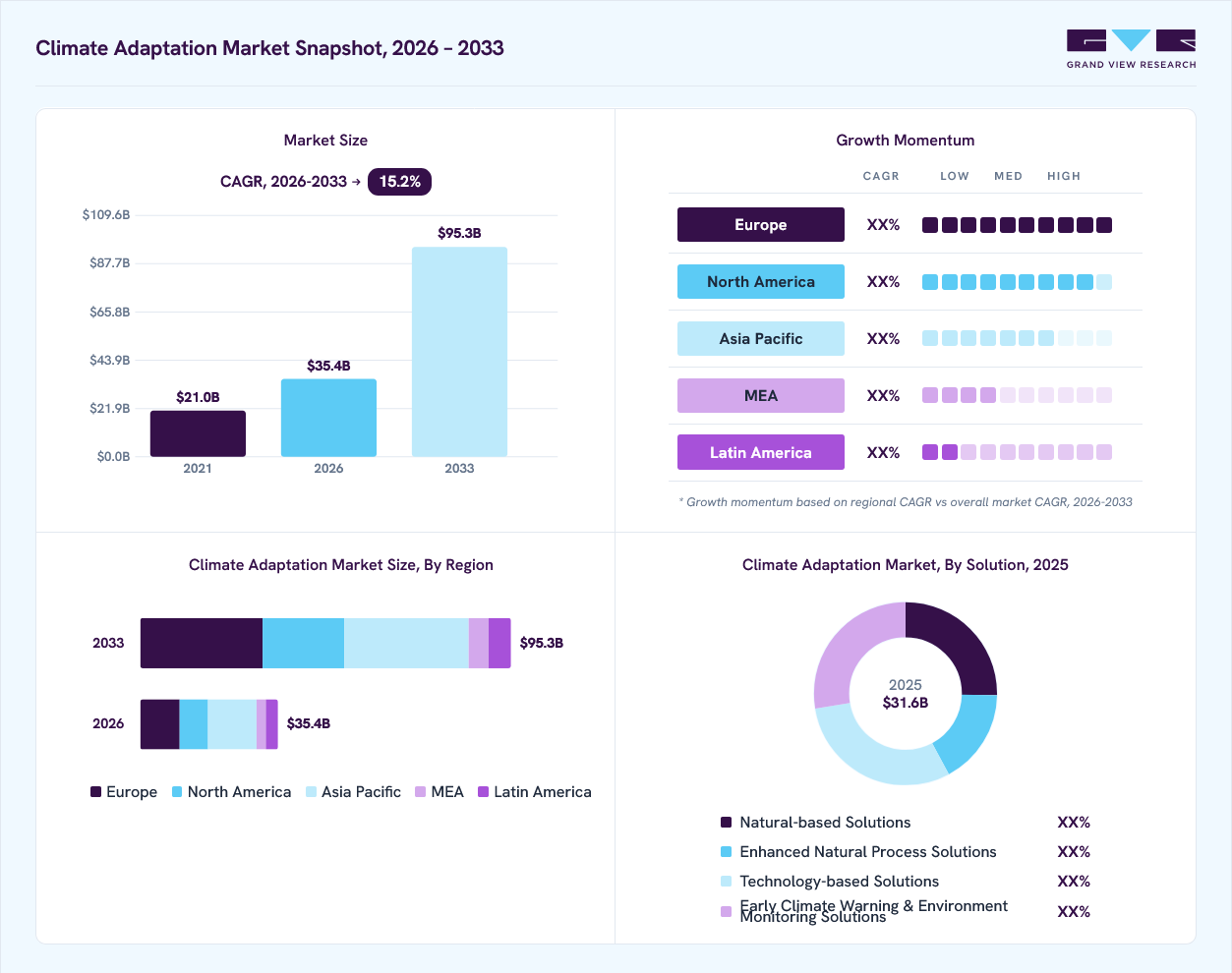
The global climate adaptation market size was valued at USD 31.6 billion in 2025 and is projected to grow from USD 35.4 billion in 2026 to USD 95.3 billion by 2033, at a CAGR of 15.2% from 2026 to 2033. Asia Pacific dominated the market, accounting for the largest share of 35.4% in 2025. The market is driven by the rising adoption of climate resistance strategies as governments and enterprises increasingly prioritize mitigation of climate-related risks.
Key Market Trends & Insights
- By solution: Technology-based solutions segment held the largest market share of 30.2% in 2025.
- By industries: Government segment held the largest market share of 23.7% in 2025.
Regional Highlights
- Largest regional market: Asia Pacific (35.4% revenue share, 2025)
- By country: China held the largest share in 2025
Market Size & Forecast
- Market size in 2025: USD 31.6 Billion
- Estimated market size in 2026: USD 35.4 Billion
- Projected market size by 2033: USD 95.3 Billion
- CAGR (2026-2033): 15.2%
The increasing frequency of extreme weather events and climate-induced disruptions is encouraging significant investments in resilient infrastructure, environmental monitoring technologies, and disaster preparedness systems. In addition, advancements in climate analytics, satellite monitoring, and early warning technologies are supporting more effective climate risk assessment and adaptation planning across industries and regions. Expanding public-private partnerships and growing climate finance initiatives are further strengthening the development and deployment of large-scale climate adaptation solutions globally.The growing integration of satellite-based climate monitoring systems is enhancing environmental risk assessment and climate adaptation planning worldwide. Satellite technologies provide continuous observation of atmospheric conditions, ocean dynamics, and land surface changes across large areas. These systems enable governments and environmental agencies to track climate patterns, extreme weather, and environmental degradation in real time. The increasing availability of high-resolution satellite imagery and climate data is improving the accuracy of environmental forecasting models. As a result, satellite-based monitoring is becoming an essential part of climate risk management and adaptation planning.
Furthermore, the rising demand for resilient water infrastructure is emerging as a major driver for climate adaptation initiatives globally. Increasing water scarcity, driven by changing precipitation patterns and prolonged droughts, is placing significant pressure on existing water supply systems. Governments and utilities are therefore investing in resilient water infrastructure to ensure reliable water availability during climate disruptions. Infrastructure upgrades such as advanced water storage systems, climate-resilient reservoirs, and improved distribution networks are gaining strong momentum. As water security becomes a critical policy priority, the development of adaptive water infrastructure is accelerating across both developed and emerging economies.
Solution Insights
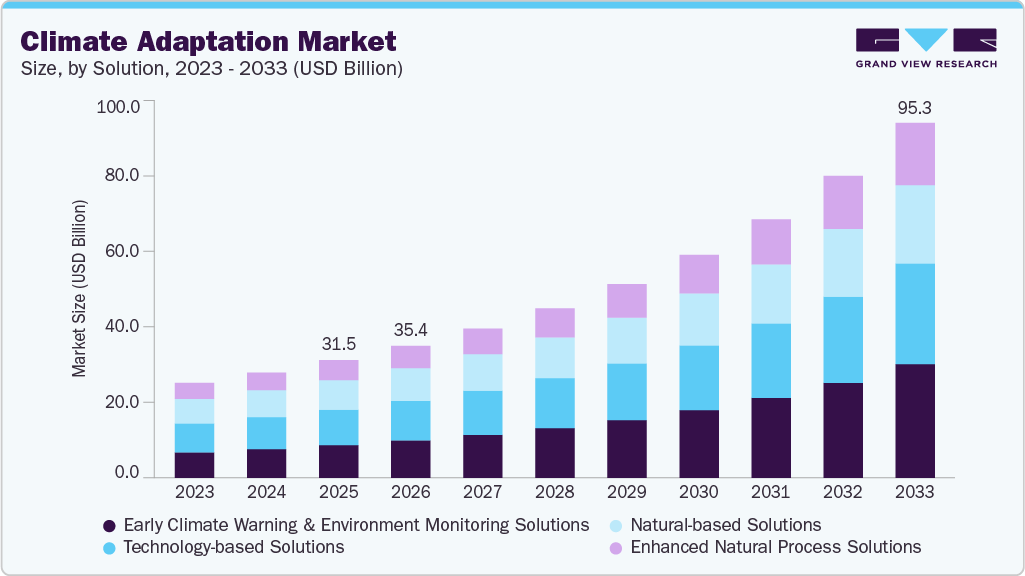
The technology-based solutions segment accounted for the largest market revenue share of 30.2% in 2025. The growth is driven by the increasing demand for advanced digital and engineering technologies to assess, monitor, and manage climate-related risks. Technologies such as artificial intelligence, satellite-based earth observation, and climate data analytics support accurate climate modelling and risk assessment, enabling more informed adaptation planning. Technological advancements in water management, agriculture, and infrastructure design also support resilience against climate variability and environmental stress.
The early climate warning & environment monitoring solutions segment is predicted to foresee significant growth in the forecast period, anticipated due to the increasing frequency and intensity of extreme weather events, which require timely climate information and proactive risk management systems. Early warning systems provide timely alerts for hazards such as floods, cyclones, droughts, and heatwaves, enabling authorities and communities to take preventive actions and reduce disaster impacts. Environmental monitoring networks also support continuous tracking of climate variables enabling more accurate forecasting and disaster response planning.
Industries Insights
The government segment holds the highest market share of the global revenue in 2025, driven by the increasing responsibility of public authorities to address climate risks affecting infrastructure, communities, and natural resources. Governments develop national and regional climate adaptation strategies to manage the impacts of extreme weather events, rising temperatures, and changing precipitation patterns. Public sector institutions allocate funding for climate-resilient infrastructure, disaster risk reduction programs, and environmental monitoring systems to strengthen societal resilience.
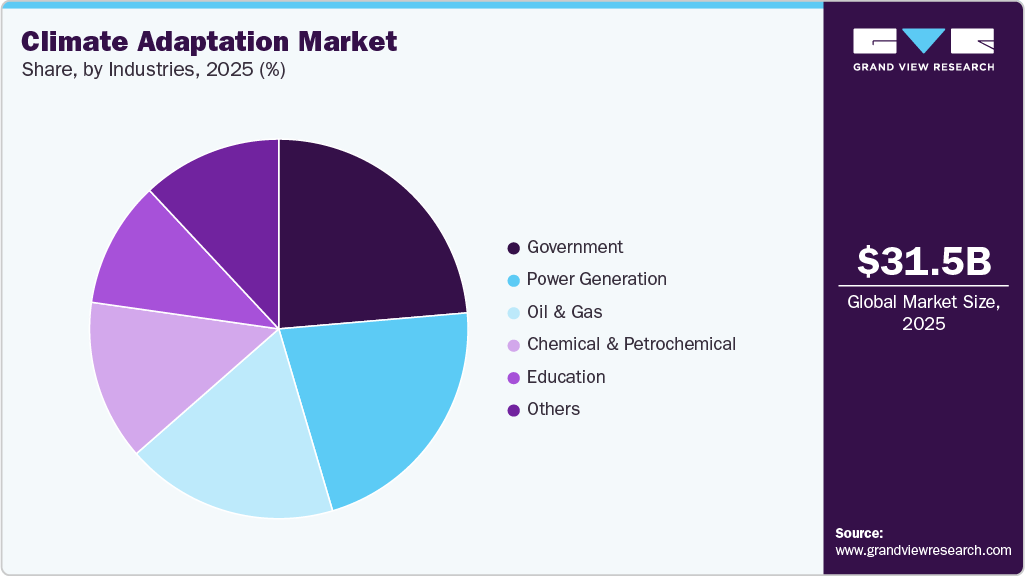
The power generation segment is predicted to foresee significant growth in the forecast period. The growing demand for power generation is driven by the increasing need of electricity generation infrastructure to climate variability and extreme weather events. Rising temperatures, floods, storms, droughts, and wildfires are affecting power plants, transmission systems, and fuel supply chains, creating operational disruptions and infrastructure damage. Power generation facilities depend heavily on water resources for cooling, and reduced water availability or higher water temperatures can limit plant efficiency and electricity output.
Regional Insights
North America had a significant revenue share in 2025, due to the increasing exposure to climate-related disasters that affect infrastructure, ecosystems, and economic activities across the region. Hurricanes along the Atlantic and Gulf coasts, wildfires in western regions, and severe winter storms have increased the focus on climate-resilient infrastructure planning. Governments and local authorities integrate climate risk assessments into urban development, transportation systems, and coastal protection programs. Insurance and risk management sectors also promote climate risk evaluation to reduce financial exposure to disasters.
U.S. Climate Adaptation Market Trends
The climate adaptation market in the U.S. is driven by increasing federal and state-level initiatives focused on climate resilience and disaster preparedness. The country experiences a wide range of climate hazards for which federal programs and climate resilience grants support investments in coastal protection systems, resilient infrastructure, and environmental monitoring networks. Urban planning authorities integrate climate risk considerations into transportation, water systems, and building standards. Research institutions and solution companies also contribute to the development of climate analytics platforms and forecasting tools.
Europe Climate Adaptation Market Trends
In Europe, the market is driven by strong policy frameworks and regional cooperation focused on climate resilience and environmental sustainability. European governments integrate adaptation strategies into urban planning, water management, and ecosystem protection initiatives. The region faces increasing climate risks including heatwaves, river flooding, and coastal erosion that affect cities and critical infrastructure. Regional programs promote climate-resilient infrastructure and sustainable land use planning across member states.
Asia Pacific Climate Adaptation Market Trends
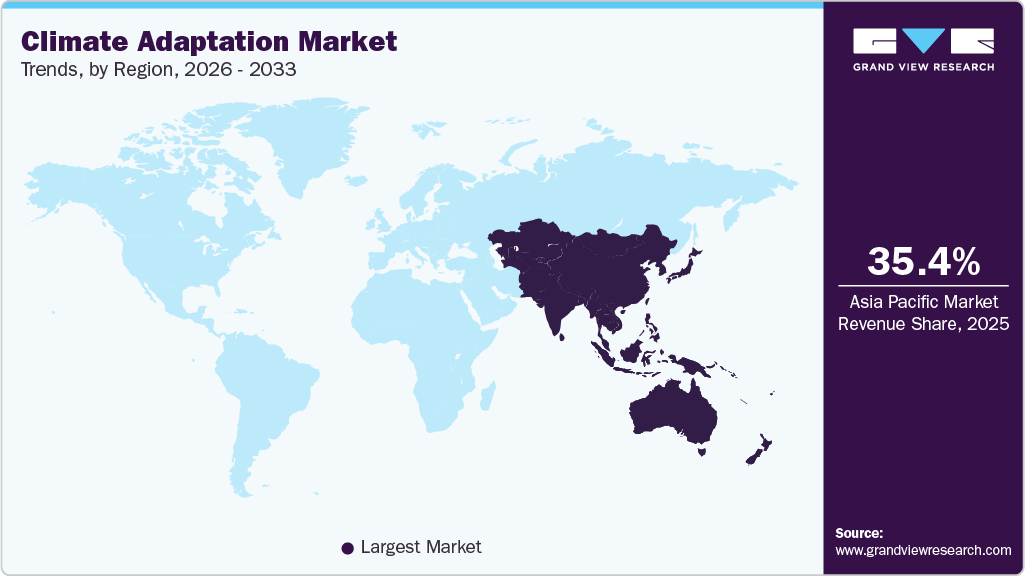
Asia Pacific dominated the market by 35.4% revenue share in 2025. Region’s high exposure to climate hazards including typhoons, floods, droughts, and rising temperatures and population growth increase pressure on infrastructure, water resources, and coastal ecosystems. Governments across the region implement climate adaptation policies to strengthen disaster risk management and infrastructure resilience. Regional development banks and international organizations support climate adaptation projects and capacity building programs.
Key Climate Adaptation Company Insights
Some key companies in the climate adaptation industry are Campbell Scientific, Inc., IBM Corporation, DTN, Zero Carbon Systems.
-
Zero Carbon Systems company is focused on developing Direct Air Capture (DAC) systems designed to remove carbon dioxide (CO₂) directly from the atmosphere. The company engineers large-scale carbon removal technologies aimed at addressing climate change by capturing CO₂ from ambient air and enabling its storage or reuse in industrial industriess. The company’s solutions primarily revolve around carbon capture solution and scalable carbon removal infrastructure. Its DAC systems are designed to operate continuously with high throughput and are capable of running entirely on renewable electricity, enabling cost-efficient and large-scale carbon dioxide removal.
-
IBM uses AI, cloud computing, geospatial analytics, and advanced data platforms to support climate resilience and environmental risk management. In the climate adaptation landscape, IBM provides digital solutions that help governments, enterprises, and infrastructure operators anticipate, assess, and respond to climate-related risks such as extreme weather events, flooding, heatwaves, and supply chain disruptions. The company delivers climate intelligence through AI-driven analytics platforms, geospatial data systems, and environmental monitoring tools that transform large volumes of climate and weather data into actionable insights.
Key Climate Adaptation Companies:
The following key companies have been profiled for this study on the climate adaptation market.
- BARANI DESIGN Technologies s. r. o.
- Campbell Scientific, Inc.
- Carbon Engineering ULC
- Climeworks
- CAPA Strategies, LLC.
- DTN
- Esri
- Zero Carbon Systems
- IBM Corporation
- ClimeCo LLC
Recent Developments
-
In January 2026, DTN launched DTN Weather Hub, a next-generation platform designed to help organizations make faster and more confident operational decisions using real-time weather intelligence. The platform converts complex weather data into decision-ready insights, enabling operational leaders to better understand weather risks and take timely actions to protect people, assets, and business continuity.
-
In February 2025, IBM collaborated with the C40 Cities to develop AI-driven solutions aimed at improving urban climate resilience. The initiative, launched through the IBM Sustainability Accelerator, focuses on building data-driven tools that help cities analyze risks related to extreme heat and urban heat-island effects, enabling better climate adaptation planning and protection of vulnerable populations.
-
In July 2025, Esri partnered with Fugro to advance climate resilience through integrated geospatial intelligence solutions. The collaboration combines Esri’s ArcGIS GIS solution with Fugro’s capabilities in satellite earth observation, high-resolution surveys, in-situ measurements, and predictive modeling to deliver data-driven insights for climate risk management.
-
In September 2025, ClimeCo announced a partnership with Offset AI to deliver verified carbon offsets that help reduce the environmental footprint associated with artificial intelligence usage. The collaboration enables users to measure the carbon impact of AI activities through a browser-based tool and automatically offset those emissions through ClimeCo’s verified climate projects.
Climate Adaptation Market Report Scope
Report Attribute
Details
Market size in 2025
USD 31.6 billion
Estimated market size in 2026
USD 35.4 billion
Projected market size by 2033
USD 95.3 billion
Growth rate
CAGR of 15.2% from 2026 to 2033
Base year for estimation
2025
Actual data
2021 - 2024
Forecast period
2026 - 2033
Quantitative units
Revenue in USD million/billion and CAGR from 2026 to 2033
Report coverage
Revenue forecast, company ranking, competitive landscape, growth factors, and trends
Segments covered
Solution, industries, and regional
Regional scope
North America; Europe; Asia Pacific; Latin America; MEA
Country scope
U.S.; Canada; Mexico; UK; Germany; France; China; Japan; India; South Korea; Australia; Brazil; KSA; UAE; South Africa
Key companies profiled
BARANI DESIGN Technologies s. r. o.; Campbell Scientific, Inc.; Carbon Engineering ULC; Climeworks; CAPA Strategies, LLC.; DTN; Esri Corporation; Zero Carbon Systems; IBM Corporation; ClimeCo LLC
Customization scope
Free report customization (equivalent up to 8 analysts working days) with purchase. Addition or alteration to country, regional & segment scope.
Pricing and purchase options
Avail customized purchase options to meet your exact research needs. Explore purchase options
Global Climate Adaptation Market Report Segmentation
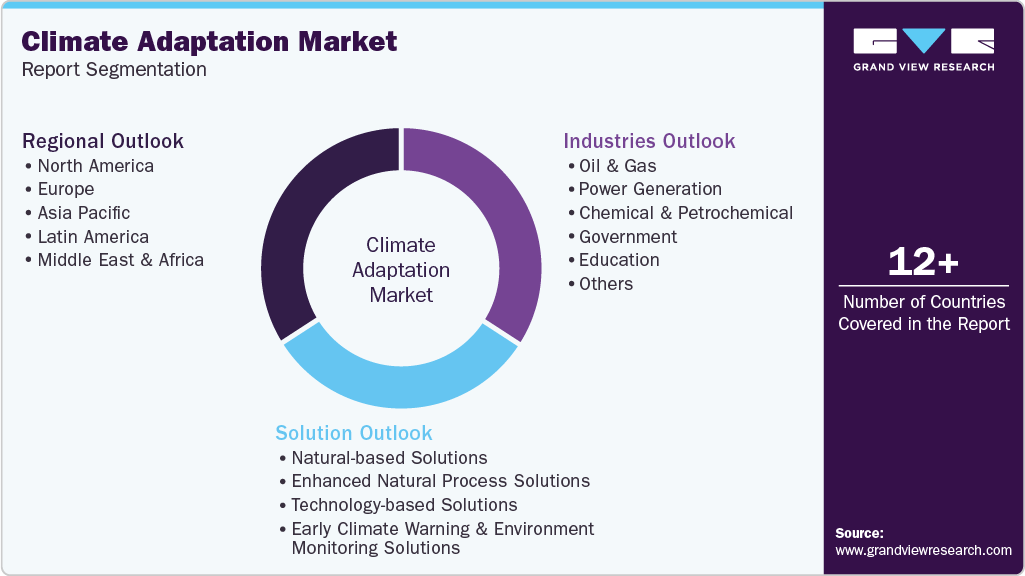
This report forecasts revenue growth at global, regional, and country levels and provides an analysis of the latest industry trends in each of the sub-segments from 2021 to 2033. For this study, Grand View Research has segmented the global climate adaptation market report based on solution, industries, and region.
-
Solution Outlook (Revenue, USD Million, 2021 - 2033)
-
Natural-based Solutions
-
Enhanced Natural Process Solutions
-
Technology-based Solutions
-
Early Climate Warning & Environment Monitoring Solutions
-
-
Industries Outlook (Revenue, USD Million, 2021 - 2033)
-
Oil & Gas
-
Power Generation
-
Chemical & Petrochemical
-
Government
-
Education
-
Others
-
-
Regional Outlook (Revenue, USD Million, 2021 - 2033)
-
North America
-
U.S.
-
Canada
-
Mexico
-
-
Europe
-
UK
-
Germany
-
France
-
-
Asia Pacific
-
China
-
Japan
-
India
-
South Korea
-
Australia
-
-
Latin America
-
Brazil
-
-
Middle East and Africa (MEA)
-
KSA
-
UAE
-
South Africa
-
-
Frequently Asked Questions About This Report
Some key players operating in the climate adaptation market include BARANI DESIGN Technologies s. r. o.; Campbell Scientific, Inc.; Carbon Engineering ULC; Climeworks; CAPA Strategies, LLC.; DTN; Esri; Global Thermostat; IBM Corporation; and ClimeCo LLC.
The increase in extreme weather events, such as floods and droughts, is pushing governments and businesses to invest in climate resilience. Governments are implementing policies and funding projects for infrastructure and early warning systems, while corporations are focusing on adaptive technologies and sustainability initiatives.
The global climate adaptation market size was estimated at USD 31.6 billion in 2025 and is expected to reach USD 35.4 billion in 2026.
The global climate adaptation market is expected to grow at a compound annual growth rate of 15.2% from 2026 to 2033, reaching USD 95.3 billion by 2033.
Technology-based Solutions segment dominated the market in 2025 with 30.2% of revenue share. The growth is driven by the increasing demand for advanced digital and engineering technologies to assess, monitor, and manage climate-related risks.
About the Author(s)
Next Generation Technologies Research Team
Technology · Next Generation TechnologiesThis report was authored by the next generation technologies research team at Grand View Research - comprising two research analysts, one senior research analyst, and one industry expert - with specialized expertise in the next generation technologies segment of the technology industry. All findings are based on proprietary technology databases, executive interviews, and regulatory analysis, subject to internal peer review prior to publication.
Last Updated:
Speak to Analyst

Need a Tailored Report?
Customize this report to your needs — add regions, segments, or data points, with 20% free customization.
Or view our licence options:


ISO 9001:2015 & 27001:2022 Certified
We are GDPR and CCPA compliant! Your transaction & personal information is safe and secure. For more details, please read our privacy policy.












