
- Home
- »
- Next Generation Technologies
- »
-
Cloud Access Security Broker Market Size Report 2026-2033GVR Report cover

Cloud Access Security Broker Market (2026 - 2033)
Size, Share, & Trends Analysis Report By Solution (Data Security, Threat Protection), By Deployment Mode (IaaS, PaaS, SaaS), By Enterprise Size (Large Enterprises, Small and Medium Enterprises), By End-use, By Region, And Segment Forecasts
Market Size, 2025
$6.6BMarket Estimate, 2026
$7.6BMarket Forecast, 2033
$19.9BCAGR, 2026–2033
14.8%Cloud Access Security Broker Market Summary
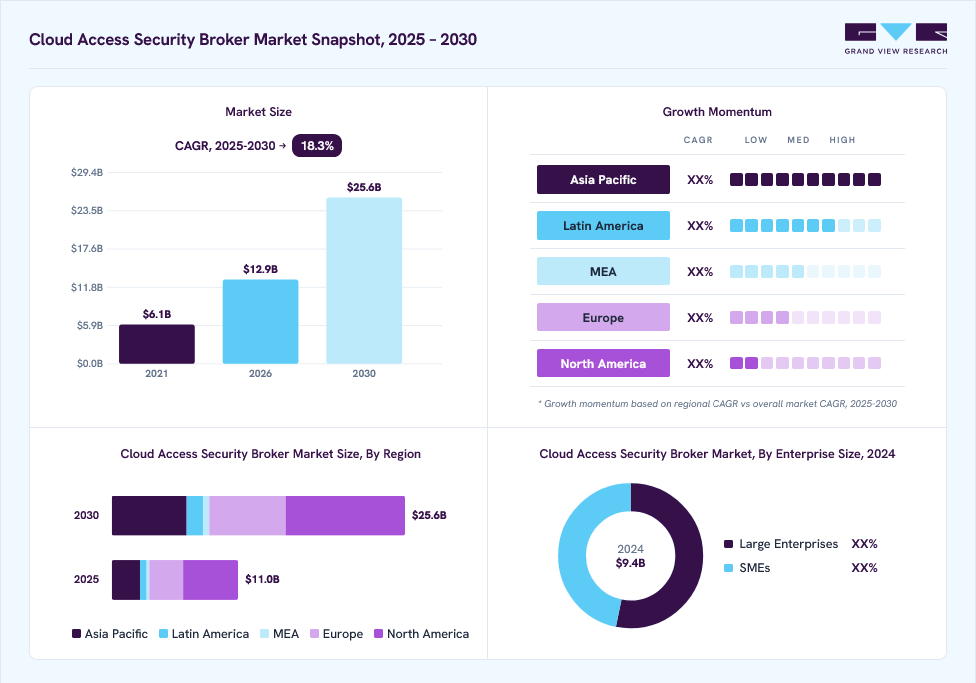
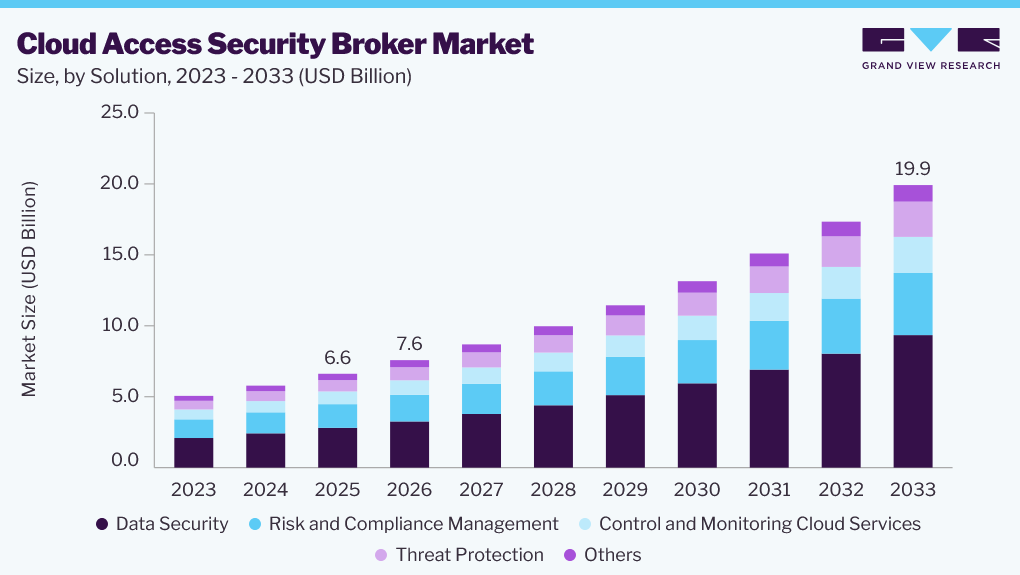
The global cloud access security broker market size was valued at USD 6.6 billion in 2025 and is projected to grow from USD 7.6 billion in 2026 to USD 19.9 billion by 2033, at a CAGR of 14.8% from 2026 to 2033. North America dominated the market, accounting for a revenue share of 43.5% in 2025. This growth is driven by rising frequency of cloud-based cyberattacks and data breaches.
 Source: Grand View Research, IR Documents, Primary Interviews, Paid DatabasesTo learn more about this report,
 Download Free Sample Report
 Key Market Trends & Insights
- By solution: Data security segment dominated the market, with a revenue share of 42.4% in 2025.
- By deployment mode: SaaS held the largest market share of 53.7% in 2025.
- By enterprise size: Large enterprises segment held the largest market share of 52.2% in 2025.
- By end use: BSFI segment held the largest market share of 20.2% in 2025.
Regional Highlights
- Largest regional market: North America (43.5% revenue share, 2025)
- Fastest-growing regional market: Asia Pacific (highest CAGR, 2026-2033)
- By country: The U.S. held the largest market share in 2025.
Market Size & Forecast
- Market size in 2025: USD 6.6 Billion
- Estimated market size in 2026: USD 7.6 Billion
- Projected market size by 2033: USD 19.9 Billion
- CAGR (2026-2033): 14.8%
Three ways to get this report
Buy it, customize it, or ask a question.Ask an Analyst
Analyst response in 1 business day
- AccessReport author, directly
- Reply timeWithin 1 working day
- No sales callDirect answer only
- FormatEmail reply
- CostFree, no cost
Get the Full Report
What the study covers
- FormatsPDF · Excel · Dashboard
- Timeline2026–2033 annual, 2025 base
- Coverage20+ countries, 5 regions
- Companies10+ key players profiled
Customize the Report
20% free customization
- IncludeCountries, segments, points
- TailorTo your product definition
- ExtendDeeper competitor detail
- OrA fully bespoke study
- Turnaround5–10 working days
As organizations shift to cloud-based applications and services, the need for robust security solutions to monitor and protect sensitive data becomes critical. CASBs provide visibility, data security, threat protection, and compliance enforcement across cloud environments, making them essential to modern cybersecurity strategies.The growing prevalence of sophisticated cyberattacks, such as ransomware and insider threats, has further accelerated the demand for cloud access security broker solutions. Enterprises seek advanced security measures, including data loss prevention (DLP), encryption, and user behavior analytics, to safeguard confidential information in cloud applications. Additionally, regulatory frameworks such as GDPR, CCPA, and HIPAA mandate strict data protection policies, prompting organizations to deploy CASBs to ensure compliance.
 To learn more about this report, Download Free Sample Report
 The rapid shift towards cloud-based infrastructure and applications is a primary driver of the cloud access security broker market. Organizations across industries are increasingly leveraging Software-as-a-Service (SaaS), Platform-as-a-Service (PaaS), and Infrastructure-as-a-Service (IaaS) solutions to enhance operational efficiency, scalability, and cost-effectiveness. However, this transition introduces security challenges, such as lack of visibility into cloud activities and potential data breaches. cloud access security broker solutions address these concerns by providing comprehensive monitoring, access control, and risk assessment, ensuring secure cloud adoption without compromising productivity.
The escalating frequency and sophistication of cyber threats, including ransomware, phishing attacks, insider threats, and cloud misconfigurations, are significantly driving the demand for CASB solutions. Cybercriminals increasingly target cloud environments due to their vast data repositories and often insufficient security controls. CASBs provide real-time threat intelligence, user behavior analytics, and anomaly detection to identify and mitigate security risks. Additionally, CASB solutions integrate with Security Information and Event Management (SIEM) systems to enhance incident response and forensic analysis, further strengthening an organization's cybersecurity posture.
The integration of artificial intelligence (AI), machine learning (ML), and zero-trust security models into CASB solutions is further propelling market growth. AI-driven CASB platforms enhance threat detection by analyzing user behavior, identifying anomalies, and predicting potential security breaches before they occur. Zero-Trust frameworks, which operate on the principle of "never trust, always verify," enable organizations to implement strict access controls, micro-segmentation, and continuous authentication for cloud resources. These advancements make CASBs more effective in proactively securing cloud environments against emerging cyber threats.
Market Dynamics
The cloud access security broker market is experiencing significant growth as organizations strengthen their cybersecurity frameworks to protect sensitive data, cryptographic keys, and digital transactions from increasingly sophisticated cyber threats. HSMs provide dedicated, tamper-resistant environments for encryption, decryption, authentication, digital signing, and key management, making them essential for industries such as banking, financial services, government, healthcare, telecommunications, and cloud computing. The growing adoption of digital payments, cloud services, e-signatures, public key infrastructure (PKI), and data protection regulations is accelerating demand for advanced cryptographic security solutions. Furthermore, the emergence of technologies such as IoT, 5G networks, and connected devices is expanding the volume of encrypted data and machine-to-machine communications, creating additional opportunities for HSM deployment.
The growing demand for unified cloud security management is propelling market growth by encouraging organizations to consolidate multiple security technologies into integrated SASE platforms. Enterprises often manage separate solutions for cloud security, secure web gateways, identity management, firewall services, and remote access, creating fragmented security operations and inconsistent policy enforcement. SASE architectures simplify security administration by combining these capabilities within a centralized cloud-native framework, with CASB providing dedicated protection for cloud applications and sensitive enterprise information. Unified security operations improve visibility while reducing operational complexity across increasingly distributed digital environments. The continued convergence of enterprise security technologies strengthens demand for CASB capabilities.
High deployment and operational costs for large-scale cloud security implementations are restraining growth in the CASB market as organizations face substantial financial commitments when deploying comprehensive cloud security architectures across complex enterprise environments. Large enterprises often manage thousands of users, numerous cloud applications, multiple public cloud providers, hybrid infrastructure, and globally distributed operations, requiring extensive CASB deployment, configuration, policy development, and integration activities. The overall investment extends beyond software licensing to include implementation services, infrastructure optimization, employee training, consulting, security assessments, and ongoing administrative management. Organizations with constrained cybersecurity budgets may delay or reduce the scope of CASB adoption while prioritizing other critical technology investments. These financial considerations create a significant barrier to widespread deployment across highly distributed enterprise environments.
The growing demand for automated incident response contributes to market growth as organizations seek to reduce the operational burden placed on cybersecurity teams. Modern security operations centers often manage thousands of alerts generated across complex cloud environments, making rapid prioritization and response increasingly challenging. CASB platforms equipped with automated response capabilities can immediately revoke risky user sessions, quarantine suspicious files, block unauthorized data transfers, modify access permissions, and initiate security workflows without waiting for manual intervention. Automated remediation improves organizational resilience while reducing response times during security incidents. The expanding focus on operational automation creates attractive opportunities across the CASB market.
Analyst Perspective
The cloud access security broker market is undergoing a strategic transition as standalone CASB solutions increasingly become integral components of broader cloud-native security architectures. Competitive differentiation is shifting from basic cloud visibility and policy enforcement toward the ability to deliver unified protection across users, devices, applications, and data in highly distributed environments. Vendors that can effectively integrate CASB capabilities with zero trust frameworks, secure service edge (SSE), and secure access service edge (SASE) platforms are expected to gain a competitive advantage as enterprises seek to consolidate fragmented security tools. Going forward, organizations are likely to prioritize platforms that provide consistent security governance across diverse cloud environments while balancing strong protection with seamless user access and operational simplicity.
Solution Insights
Based on solution, the data security segment led the market with the largest revenue share of 42.4% in 2025. Data security remains the dominant solution segment in the cloud access security broker market due to the increasing volume of sensitive information stored and processed in cloud environments. Enterprises across industries rely on cloud-based applications for critical operations, making data protection a top priority. CASB solutions offer advanced data security features, including DLP, encryption, tokenization, and access controls, ensuring that confidential data remains protected against unauthorized access and leaks. Additionally, regulatory requirements such as GDPR, CCPA, and HIPAA mandate strict data security measures, driving organizations to implement CASB solutions that provide compliance support and audit capabilities. The growing emphasis on zero-trust security models and secure collaboration in cloud-based workflows further reinforces the dominance of data security in the CASB market.
The threat protection segment is expected to grow at a significant rate during the forecast period due to the rising complexity and frequency of cyber threats targeting cloud environments. Cybercriminals increasingly exploit cloud misconfigurations, insider threats, and advanced malware to infiltrate enterprise systems. As a result, organizations are prioritizing proactive threat detection and response mechanisms to safeguard their cloud applications and infrastructure. CASB solutions equipped with AI-driven anomaly detection, behavioral analytics, and real-time threat intelligence help organizations identify suspicious activities and mitigate security risks before they escalate. The increasing adoption of zero-trust architecture and cloud-native security frameworks is further fueling demand for threat protection solutions, positioning them as a rapidly growing segment within the CASB market.
Deployment Mode Insights
Based on deployment mode, the SaaS segment led the market with the largest revenue share of 53.7% in 2025 due to the widespread adoption of cloud-based applications across enterprises. Businesses increasingly rely on SaaS solutions such as Microsoft 365, Google Workspace, Salesforce, and Dropbox to enhance productivity and collaboration. However, these cloud applications introduce security challenges, including data exposure, unauthorized access, and compliance risks. CASB solutions deployed in SaaS mode provide seamless integration, centralized policy enforcement, and real-time visibility into cloud activity, making them the preferred choice for organizations seeking scalable and efficient cloud security. Additionally, the low maintenance requirements and ease of deployment associated with SaaS-based CASBs contribute to their market dominance, as enterprises prioritize security solutions that do not require extensive on-premise infrastructure.
The PaaS segment is expected to grow at a significant rate during the forecast period. PaaS environments introduce unique security risks, such as container vulnerabilities, API security gaps, and misconfigured cloud services, necessitating advanced CASB capabilities tailored for application-layer protection. The growing focus on cloud workload security, microservices architecture, and secure DevOps (DevSecOps) drives demand for CASB solutions optimized for PaaS environments. As organizations accelerate digital transformation initiatives, the need for real-time monitoring, access controls, and compliance enforcement in PaaS deployments is fueling rapid growth in this segment.
End-use Insights
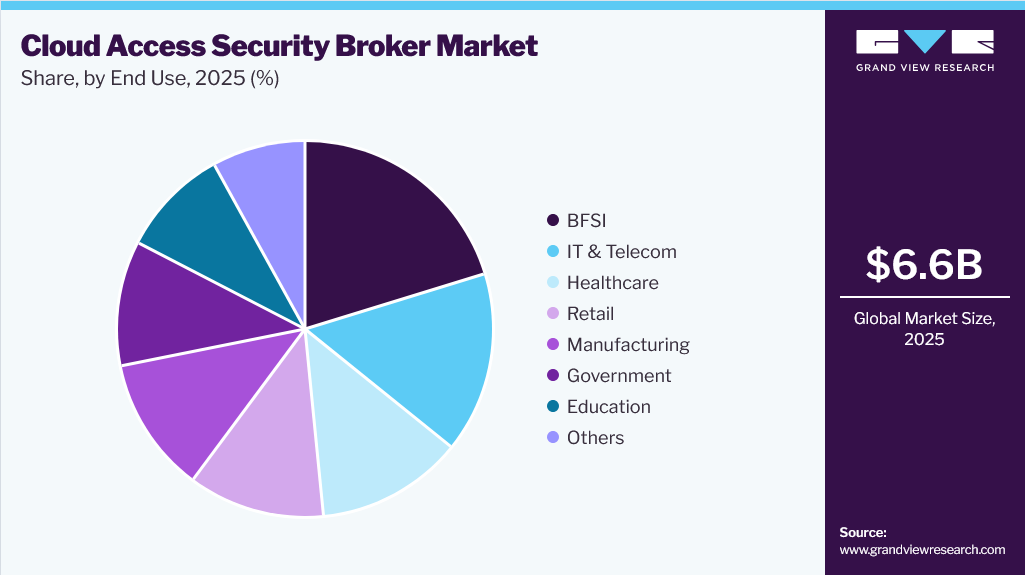
Based on end use, the BSFI segment led the market with the largest revenue share of 20.2% in 2025 due to its heavy reliance on cloud-based platforms for financial transactions, customer data management, and regulatory compliance. Given the highly sensitive nature of financial data, the BFSI industry faces stringent regulatory requirements, such as GDPR, PCI-DSS, SOX, and GLBA, which necessitate implementing advanced cloud security solutions. CASB solutions enable BFSI organizations to enforce DLP, encryption, identity access management (IAM), and threat detection to protect against cyber threats, unauthorized access, and compliance violations. Additionally, the rise of digital banking, fintech services, and remote financial operations has further increased the need for robust CASB solutions to secure cloud-based workflows, making BFSI the leading end-use segment in the market.
 To learn more about this report, Download Free Sample Report
 The manufacturing segment is expected to grow at a significant rate during the forecast period due to the increasing integration of the Industrial Internet of Things (IIoT), smart factories, and cloud-based supply chain management. As manufacturers transition to Industry 4.0 technologies, they rely on cloud platforms for real-time data analytics, predictive maintenance, and remote monitoring of industrial operations. However, this digital transformation introduces cybersecurity risks, such as intellectual property (IP) theft, industrial espionage, and operational disruptions from cyberattacks. CASB solutions help manufacturing enterprises secure cloud-based applications, prevent data breaches, and ensure compliance with industry regulations, such as ISO 27001 and NIST cybersecurity frameworks. Additionally, the growing adoption of multi-cloud strategies and hybrid cloud environments in manufacturing is driving the need for comprehensive cloud security solutions, contributing to the rapid expansion of CASB in this sector.
Enterprise Size Insights
Based on enterprise size, the large enterprises segment led the market with the largest revenue share of 52.2% in 2025 due to their extensive reliance on cloud-based applications and the high volume of sensitive data they manage. These organizations operate across multiple locations, use diverse cloud services, and face complex regulatory compliance requirements such as GDPR, HIPAA, and CCPA, making robust cloud security solutions necessary. CASB solutions enable large enterprises to enforce granular access controls, DLP, encryption, and threat intelligence, ensuring comprehensive security across their cloud ecosystems. Large enterprises often have dedicated IT security teams and higher budgets, allowing them to invest in AI-driven CASB solutions, Zero Trust security frameworks, and multi-cloud security strategies. As cloud adoption expands, large enterprises remain the primary contributors to the CASB market due to their need for advanced security, compliance management, and real-time threat detection.
The small & medium enterprise (SME) segment is expected to grow at the fastest rate during the forecast period due to the increasing shift towards cloud-based business operations, remote work, and digital transformation initiatives. SMEs are becoming prime targets for cyber threats, including phishing, ransomware, and cloud misconfigurations, driving the demand for cost-effective, easy-to-deploy CASB solutions. Additionally, the rise of Software-as-a-Service (SaaS) adoption among SMEs and growing awareness of cloud security risks has accelerated the adoption of CASB solutions tailored to their needs. Cloud security providers increasingly offer scalable, subscription-based CASB solutions that provide automated security controls, compliance management, and threat protection without requiring extensive IT resources. As cybersecurity regulations become more stringent across industries, SMEs are expected to continue adopting CASB solutions at a rapid pace to secure their cloud environments and mitigate security risks.
Regional Insights
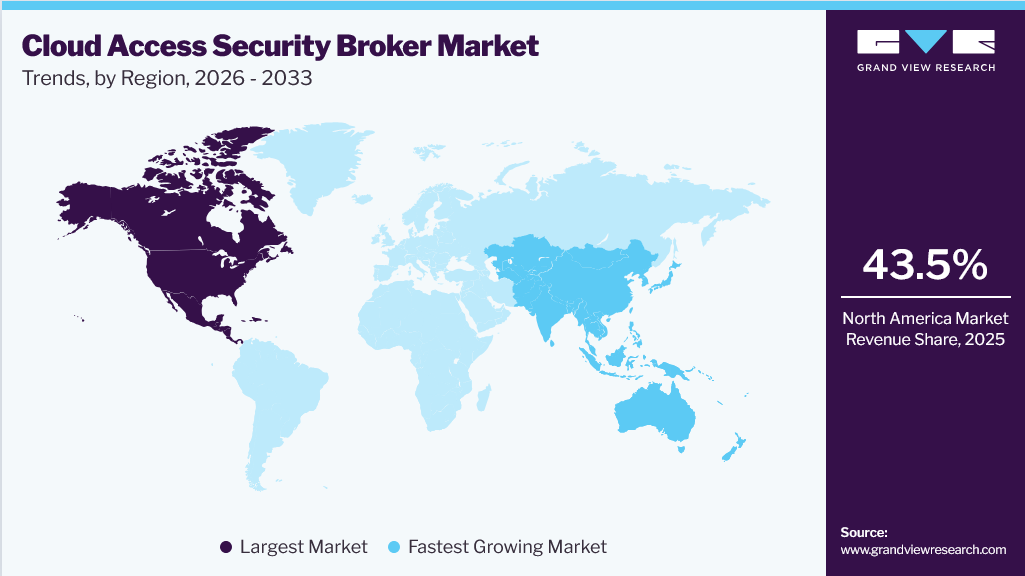
North America dominated the global cloud access security broker market with the largest revenue share of 43.5% in 2025. North America remains the largest driven by the widespread adoption of cloud computing across enterprises and the growing emphasis on zero-trust security frameworks. The presence of leading cybersecurity vendors and cloud service providers, such as Microsoft, Cisco, and Palo Alto Networks, has also contributed to the region's strong market growth.
 To learn more about this report, Download Free Sample Report
 U.S. Cloud Access Security Broker Market Trends
The cloud access security broker market in the U.S. held the largest share in the North America region in 2025. The U.S. dominates the North American cloud access security broker industry, owing to its high cloud adoption rate, strict regulatory environment, and rising cybersecurity threats. Enterprises across industries, including BFSI, healthcare, IT & telecom, and government, increasingly invest in AI-powered CASB solutions to protect sensitive data in cloud environments. Compliance requirements such as HIPAA, CCPA, and SOX have fueled demand for CASB solutions offering audit trails, encryption, and access controls.
Europe Cloud Access Security Broker Market Trends
Europe's cloud access security broker industry is growing significantly, at a CAGR of over 17% from 2025 to 2030. This growth is driven by GDPR compliance requirements, which mandate stringent data protection policies for cloud-based applications. Organizations are increasingly deploying CASB solutions to ensure secure cloud access, data privacy, and regulatory adherence. The region is also witnessing a rise in hybrid cloud deployments and multi-cloud strategies, increasing the demand for CASB solutions with advanced visibility and security analytics.
The UK cloud access security broker market is expected to grow rapidly in the coming years. The U.K. cloud access security broker industry is expanding rapidly due to rising cyber threats, data sovereignty concerns, and increasing cloud adoption across enterprises. Post-Brexit regulatory shifts have led organizations to seek enhanced cloud security measures to comply with GDPR-equivalent laws and other data protection regulations. The financial services sector, in particular, is driving demand for CASB solutions with real-time monitoring, anomaly detection, and IAM to secure sensitive transactions and client data.
Cloud access security broker market in Germany held a substantial market share in 2024. Germany is a key market for cloud access security broker adoption in Europe, propelled by strict data privacy laws, rising industrial digitalization, and growing cloud migration among enterprises. The country's strong emphasis on cyber resilience, regulatory compliance, and data localization requirements has increased the demand for CASB solutions that ensure end-to-end encryption and secure cloud access.
Asia Pacific Cloud Access Security Broker Industry Trends
The Asia Pacific's cloud access security broker industry is anticipated to grow at the fastest CAGR from 2026 to 2033. The Asia Pacific region is witnessing rapid growth in the cloud access security broker industry, driven by digital transformation initiatives, increasing cloud adoption, and growing cybersecurity awareness. Governments across the region are implementing strict data, encouraging enterprises to adopt CASB solutions for regulatory compliance and data security.
The China cloud access security broker market held a substantial share in 2024. China's CASB cloud access security broker industry is expanding significantly due to strict government regulations on data security and cloud computing, particularly with implementing the Cybersecurity Law and PIPL. Enterprises focus on data localization, access control, and cloud visibility to meet compliance requirements.
Cloud access security broker market in Japan held a substantial share in 2024. Japan is witnessing steady growth in the cloud access security broker industry market, driven by the increasing use of cloud services, rising cybersecurity concerns, and stringent regulatory frameworks such as the Protection of Personal Information (APPI) Act. Banking, manufacturing, and healthcare enterprises are deploying CASB solutions to prevent data leaks, mitigate insider threats, and ensure secure third-party cloud collaborations.
India cloud access security broker market is expanding rapidly. The rise of fintech, IT services, e-commerce platforms, and the growing adoption of hybrid cloud environments drive demand for AI-powered CASB solutions that offer real-time security monitoring, access management, and multi-cloud security controls.
Key Cloud Access Security Broker Company Insights
Key players operating in the cloud access security broker market include Broadcom Corporation, Censornet, Forcepoint, iboss, Lookout, Inc., McAfee, LLC, Microsoft, Netskope, Proofpoint, Inc., and Zscaler, Inc. The companies focus on various strategic initiatives, including new product development, partnerships & collaborations, and agreements to gain a competitive advantage over their rivals. The following are some instances of such initiatives.
-
In January 2024, SCC announced a strategic partnership with iboss, a recognized leader in cloud security, to strengthen cybersecurity measures for businesses operating in cloud-first environments. This collaboration aims to introduce an advanced Zero Trust security service designed to protect data, systems, applications, and users from evolving cyber threats. By integrating iboss's cutting-edge security technologies, SCC will offer a comprehensive suite of cloud security solutions, including Secure Web Gateway (SWG), browser isolation, malware defense, Cloud Access Security Broker (CASB), and data loss prevention. This holistic approach ensures real-time, scalable protection, enabling businesses to safeguard their digital assets against emerging cyber risks. The partnership underscores SCC's commitment to delivering robust security solutions, reinforcing its position as a trusted technology partner for enterprises navigating the complexities of modern cloud environments.
-
In October 2023, Lookout, Inc., a provider of data-centric cloud security solutions, announced new enhancements to the Lookout Cloud Security Platform to strengthen organizations' ability to assess, discover, and protect data as it moves across networks, from endpoints to the cloud. These advancements offer a unified security solution that enhances visibility and safeguards access across all applications, ensuring comprehensive data protection in an increasingly complex digital landscape.
Key Cloud Access Security Broker Companies:
The following key companies have been profiled for this study on the cloud access security broker market.
- Broadcom Corporation
- Censornet
- Forcepoint
- iboss
- Lookout, Inc.
- McAfee, LLC
- Microsoft
- Netskope
- Proofpoint, Inc.
- Zscaler, Inc.
Competitive Benchmarking
Category
Operating Strategies
Competitive Edge
Weakness
Established Players (Microsoft; Palo Alto Networks; Netskope; Broadcom; Cisco)
Mature players focus on delivering comprehensive CASB platforms as part of broader cybersecurity portfolios that combine data protection, identity security, threat prevention, and Zero Trust access. Their strategies emphasize deep integration with SaaS applications, secure access technologies, security operations platforms, and unified security frameworks to provide centralized visibility and policy enforcement across enterprise cloud environments.
These companies benefit from extensive cybersecurity product portfolios, established enterprise relationships, and broad integration with widely used cloud applications and identity providers. Their ability to offer unified security management, global threat intelligence, and advanced policy controls enables organizations to secure complex multi-cloud and hybrid IT environments through a single security ecosystem.
Broad product portfolios can increase deployment complexity and require significant configuration to align with diverse enterprise security policies. Higher licensing costs, feature overlap with other security solutions, and dependence on existing security ecosystems may also reduce flexibility for organizations seeking standalone CASB deployments.
Emerging Players (DoControl; Grip Security;Wing Security;Obsidian Security;Adaptive Shield)
Emerging players focus on addressing modern SaaS security challenges by providing SaaS posture management, shadow IT discovery, identity risk monitoring, and automated remediation capabilities. Their strategies prioritize rapid deployment, API-first architectures, AI-driven risk analysis, and continuous monitoring to help organizations secure rapidly expanding cloud application environments without extensive infrastructure changes.
These companies offer specialized capabilities designed for modern cloud-native environments, enabling faster detection of SaaS misconfigurations, unauthorized applications, and identity-based threats. Their lightweight deployment models, automation capabilities, and focus on emerging cloud security risks allow organizations to improve operational efficiency while adapting quickly to evolving cloud adoption patterns.
Emerging vendors often have narrower product portfolios and limited global sales channels compared with larger cybersecurity providers. Enterprise customers may also hesitate to adopt newer platforms due to concerns regarding long-term vendor stability, ecosystem maturity, and integration with existing security operations workflows.
Cloud Access Security Broker Market Report Scope
Report Attribute
Details
Market size in 2025
USD 6.6 billion
Estimated market size in 2026
USD 7.6 billion
Projected market size by 2033
USD 19.9 billion
Growth rate
CAGR of 14.8% from 2026 to 2033
Base year for estimation
2025
Historical data
2021 - 2024
Forecast period
2026 - 2033
Quantitative units
Revenue in USD million/billion and CAGR from 2026 to 2033
Report coverage
Revenue forecast, company market share analysis, competitive landscape, growth factors, and trends
Segments covered
Solution, deployment mode, enterprise size, end-use, region
Regional scope
North America; Europe; Asia Pacific; Latin America; MEA
Country scope
U.S.; Canada; Mexico; UK; Germany; France; China; India; Japan; Australia; South Korea; Brazil; UAE; Saudi Arabia; South Africa
Key companies profiled
Broadcom Corporation; Censornet; Forcepoint; iboss; Lookout, Inc.; McAfee, LLC; Microsoft; Netskope; Proofpoint, Inc.; Zscaler, Inc.
Customization scope
Free report customization (equivalent up to 8 analysts' working days) with purchase. Addition or alteration to country, regional & segment scope.
Pricing and purchase options
Avail customized purchase options to meet your exact research needs. Explore purchase options
Global Cloud Access Security Broker Market Report Segmentation
This report forecasts revenue growth at global, regional, and country levels and provides an analysis of the latest industry trends in each of the sub-segments from 2021 to 2033. For this study, Grand View Research has segmented the cloud access security broker market report based on solution, deployment mode, enterprise size, end use, and region.
-
Solution Outlook (Revenue, USD Billion, 2021 - 2033)
-
Control and Monitoring Cloud Services
-
Risk and Compliance Management
-
Data Security
-
Threat Protection
-
Others
-
-
Deployment Mode Outlook (Revenue, USD Billion, 2021 - 2033)
-
IaaS
-
PaaS
-
SaaS
-
-
Enterprise Size Outlook (Revenue, USD Billion, 2021 - 2033)
-
Large Enterprises
-
Small and Medium Enterprises (SMEs)
-
-
End-use Outlook (Revenue, USD Billion, 2021 - 2033)
-
BFSI
-
Healthcare
-
Retail
-
IT & Telecom
-
Education
-
Manufacturing
-
Government
-
Others
-
-
Regional Outlook (Revenue, USD Billion, 2021 - 2033)
-
North America
-
U.S.
-
Canada
-
Mexico
-
-
Europe
-
Germany
-
UK
-
France
-
-
Asia Pacific
-
China
-
India
-
Japan
-
South Korea
-
Australia
-
-
Latin America
-
Brazil
-
-
Middle East & Africa
-
UAE
-
Saudi Arabia
-
South Africa
-
-
Research Methodology
The Cloud access security broker market figures in this report are based on a proven research process that combines executive interviews with secondary research from proprietary databases, company filings, and recognized regulatory and institutional sources. Market size is built through value-chain sizing - reconciling supply-side and demand-side estimates - and triangulated with bottom-up and top-down approaches. Every estimate passes multiple levels of expert validation before publication, with each cloud access security broker segment quantified using the revenue-capture definitions in the table below.
Segment Definition
Segment - Component
Revenue capture definition
Control and Monitoring Cloud Services
The largest solution category, capturing value through continuous visibility into cloud applications, user activities, data movement, and policy enforcement across multi-cloud environments. Vendors monetize by enabling organizations to detect shadow IT, monitor cloud usage, and maintain centralized governance over expanding SaaS, PaaS, and IaaS deployments.
Risk and Compliance Management
Commercial demand is driven by enterprises seeking automated compliance monitoring, audit readiness, regulatory reporting, and policy management across cloud ecosystems. Providers differentiate through solutions that simplify adherence to data protection regulations while reducing compliance risks and administrative overhead.
Data Security
Market value is derived from capabilities such as data loss prevention (DLP), encryption, tokenization, access governance, and secure data sharing. Organizations invest in these solutions to safeguard sensitive information throughout its lifecycle while maintaining secure collaboration across cloud platforms.
Threat Protection
Revenue opportunities stem from advanced threat detection, malware prevention, user and entity behavior analytics (UEBA), account compromise detection, and AI-driven security intelligence. Growing sophistication of cloud-based cyberattacks continues to accelerate enterprise investment in proactive threat defense capabilities.
Others
This segment includes identity management, cloud security posture management (CSPM), cloud infrastructure entitlement management (CIEM), API security, and workload protection features integrated into CASB platforms. Vendors expand platform value by offering unified cloud security capabilities that reduce complexity and strengthen overall cyber resilience.
Segment - Deployment Mode
Revenue capture definition
IaaS
Demand originates from organizations securing virtual machines, storage resources, containers, and cloud networking environments hosted on public infrastructure platforms. CASB vendors generate value by extending policy enforcement, workload visibility, and access controls across rapidly expanding infrastructure deployments.
PaaS
Spending is focused on protecting cloud-native application development environments, databases, APIs, and DevOps workflows. Enterprises increasingly adopt CASB solutions to secure application lifecycles while maintaining governance over developer access and cloud service consumption.
SaaS
The dominant deployment segment, supported by widespread adoption of enterprise applications such as collaboration tools, CRM, ERP, productivity suites, and file-sharing platforms. Providers benefit from recurring demand for access control, data protection, and user activity monitoring across an expanding SaaS ecosystem.
Segment - Enterprise Size
Revenue capture definition
Large Enterprises
High-value contracts are secured from organizations managing complex hybrid and multi-cloud infrastructures across global operations. Enterprise deployments typically include advanced policy customization, integration with existing security architectures, and centralized governance for thousands of users and cloud applications.
Small and Medium Enterprises (SMEs)
Adoption is fueled by cloud-first business strategies that require enterprise-grade security without significant infrastructure investments. Subscription-based CASB platforms enable SMEs to strengthen cloud protection, meet customer security expectations, and simplify security management with limited IT resources.
Segment - End Use
Revenue capture definition
BFSI
Financial institutions invest heavily in CASB solutions to secure digital banking platforms, payment applications, customer financial records, and cloud-hosted business systems. Strict regulatory obligations and the need to prevent data breaches make cloud access governance a strategic cybersecurity priority.
Government
Public-sector agencies deploy CASB platforms to protect classified information, citizen records, and cloud-based public services. Procurement is driven by national cybersecurity frameworks, digital government initiatives, and requirements for secure cloud adoption across departments.
Healthcare
Healthcare organizations implement CASB solutions to safeguard electronic health records, medical imaging repositories, telehealth applications, and cloud-based clinical systems. Protecting sensitive patient information while maintaining regulatory compliance continues to drive investment in this segment.
IT & Telecom
Technology companies and telecom operators utilize CASB platforms to secure cloud-native applications, distributed workforces, software development environments, and managed cloud services. The rapid expansion of digital infrastructure and SaaS adoption sustains strong demand for cloud security solutions.
Manufacturing
Industrial enterprises adopt CASB technologies to protect cloud-connected production systems, intellectual property, engineering data, and smart manufacturing platforms. Increasing integration between operational technology (OT) and cloud environments is expanding the need for comprehensive cloud security governance.
Retail
Retailers leverage CASB platforms to secure e-commerce applications, customer databases, digital payment systems, and omnichannel operations. Rising online transactions and customer data protection requirements continue to strengthen cloud security investments across the retail sector.
Education
Educational institutions deploy CASB solutions to secure learning management systems, student information platforms, research data, and cloud collaboration tools used by faculty and students. Growth is supported by the ongoing digitalization of education and hybrid learning environments.
Others
This category includes energy, logistics, media, legal services, hospitality, pharmaceuticals, and professional services. Organizations across these sectors implement CASB solutions to gain visibility into cloud usage, strengthen access controls, and protect critical business data as cloud adoption continues to accelerate.
Estimation Model
Layer
Question
Analysis
Cloud Visibility Layer
Where is Cloud Access Security Broker (CASB) protection required?
Identify cloud environments where organizations need centralized visibility and security oversight, including SaaS applications, public cloud platforms, private cloud deployments, and hybrid cloud infrastructures. This layer evaluates the growing use of cloud services by distributed workforces and third-party users, creating demand for solutions that monitor cloud access, discover shadow IT, and maintain consistent security policies across diverse cloud environments.
Policy Enforcement Layer
What security challenges drive CASB implementation?
Assess the need to enforce data protection policies, user access controls, regulatory compliance, and threat prevention across cloud applications. Organizations deploy CASB solutions to address unauthorized cloud usage, sensitive data exposure, insider threats, misconfigured cloud services, and compliance requirements while maintaining secure collaboration and cloud adoption without disrupting business operations.
Security Orchestration Layer
How are CASB solutions integrated into enterprise security architectures?
Analyze the integration of CASB platforms with identity and access management (IAM), secure web gateways (SWG), zero trust architectures, security information and event management (SIEM), endpoint security, and cloud-native security tools. This layer examines how organizations utilize CASB capabilities such as data loss prevention (DLP), user behavior analytics, encryption, tokenization, and adaptive access controls to establish unified cloud security operations across multi-cloud environments.
Subscription & Security Value Layer
How is commercial value generated within the CASB ecosystem?
Evaluate revenue generation through subscription-based security platforms, user- or workload-based licensing, managed security services, implementation and integration projects, compliance consulting, and ongoing support services. Additional value is created by reducing the financial impact of data breaches, simplifying regulatory audits, enabling secure cloud migration, and strengthening enterprise cyber resilience as organizations continue to expand their cloud-first strategies.
Delivered Customizations
This report has been delivered with the following In-depth customizations
Client Request
Customization Delivered
Value Adds
Multi-Cloud Visibility & SaaS Security Governance Trends
Conducted a focused analysis of Cloud Access Security Broker (CASB) adoption across enterprises managing multiple SaaS applications, focusing on cloud visibility, shadow IT discovery, user activity monitoring, and policy enforcement across distributed cloud environments.
Helps stakeholders identify high-priority cloud security requirements, evaluate enterprise cloud governance maturity, and assess commercialization opportunities in SaaS security and risk management solutions.
Data Loss Prevention, Compliance & Insider Risk Management Adoption Trends
Evaluated adoption trends for cloud-based Data Loss Prevention (DLP), user and entity behavior analytics (UEBA), encryption, tokenization, and policy-based access controls supporting regulatory compliance and protection of sensitive enterprise data.
Provides insights into evolving data protection priorities, compliance-driven security investments, and commercially attractive capabilities supporting secure cloud collaboration.
Zero Trust Security Architecture & Cloud Access Control Opportunity Assessment
Assessed demand for CASB integration with Secure Service Edge (SSE), Security Service Edge, Secure Access Service Edge (SASE), identity and access management (IAM), and Zero Trust frameworks, along with challenges related to policy consistency, application compatibility, and hybrid cloud security management.
Supports investment and expansion strategies by identifying emerging cloud security opportunities, evaluating enterprise Zero Trust readiness, and strengthening long-term growth potential in unified cloud access and data protection ecosystems.
Frequently Asked Questions About This Report
The global cloud access security broker market size was valued at USD 6.6 billion in 2025 and is estimated at USD 7.6 billion in 2026.
The global cloud access security broker market is expected to grow at a CAGR of 14.8% from 2026 to 2033, reaching USD 19.9 billion by 2033.
Key factors include growing prevalence of sophisticated cyberattacks, such as ransomware and insider threats, has further accelerated the demand for cloud access security broker solutions.
North America dominated with 43.5% revenue share in 2025.
Asia Pacific is the fastest-growing region over the forecast period.
The data security segment led with a 42.4% revenue share in 2025 and threat protection segment is the fastest-growing segment.
The SaaS segment led the market with the largest revenue share of 53.7% in 2025 due to the widespread adoption of cloud-based applications across enterprises.
The large enterprises segment led the market with the largest revenue share of 52.2% in 2025 due to their extensive reliance on cloud-based applications and the high volume of sensitive data they manage.
Key players operating in the cloud access security broker market include Amazon Web Services (AWS); Microsoft Azure; Google Cloud Platform (GCP); Oracle Cloud Infrastructure (OCI); IBM Cloud; Alibaba Cloud; Tencent Cloud; OVHcloud; SAP SE; T-Systems; Clever Cloud; Cloudian
About the Author(s)
Next Generation Technologies Research Team
Technology · Next Generation TechnologiesThis report was authored by the next generation technologies research team at Grand View Research - comprising two research analysts, one senior research analyst, and one industry expert - with specialized expertise in the next generation technologies segment of the technology industry. All findings are based on proprietary technology databases, executive interviews, and regulatory analysis, subject to internal peer review prior to publication.
Last Updated:
Speak to Analyst

Customize this report to your needs - add regions, segments, or data points, with 20% free customization.
Or view our licence options:


ISO 9001:2015 & 27001:2022 Certified
We are GDPR and CCPA compliant! Your transaction & personal information is safe and secure. For more details, please read our privacy policy.


