
- Home
- »
- Next Generation Technologies
- »
-
Cloud AI Market Size, Share & Trends Report, 2026-2033GVR Report cover

Cloud AI Market (2026 - 2033)
Size, Share & Trends Analysis Report By Technology (Machine Learning, Deep Learning, Natural Language Processing), By Type (Solution, Services), By Verticals (BFSI, Government, Healthcare), By Region, And Segment Forecasts
Market Size, 2025
$121.7BMarket Estimate, 2026
$169.9BMarket Forecast, 2033
$1,728.4BCAGR, 2026–2033
39.3%Cloud AI Market Summary
The global cloud AI market size was valued at USD 121.7 billion in 2025 and is projected to grow from USD 169.9 billion in 2026 to USD 1,728.4 billion by 2033, at a CAGR of 39.3% from 2026 to 2033. North America held the largest revenue share of 32.5% of the global market in 2025. The increasing demand for cloud AI integrates the capabilities of cloud computing with artificial intelligence algorithms to deliver various benefits, including faster processing, enhanced efficiency, and cost savings for businesses.
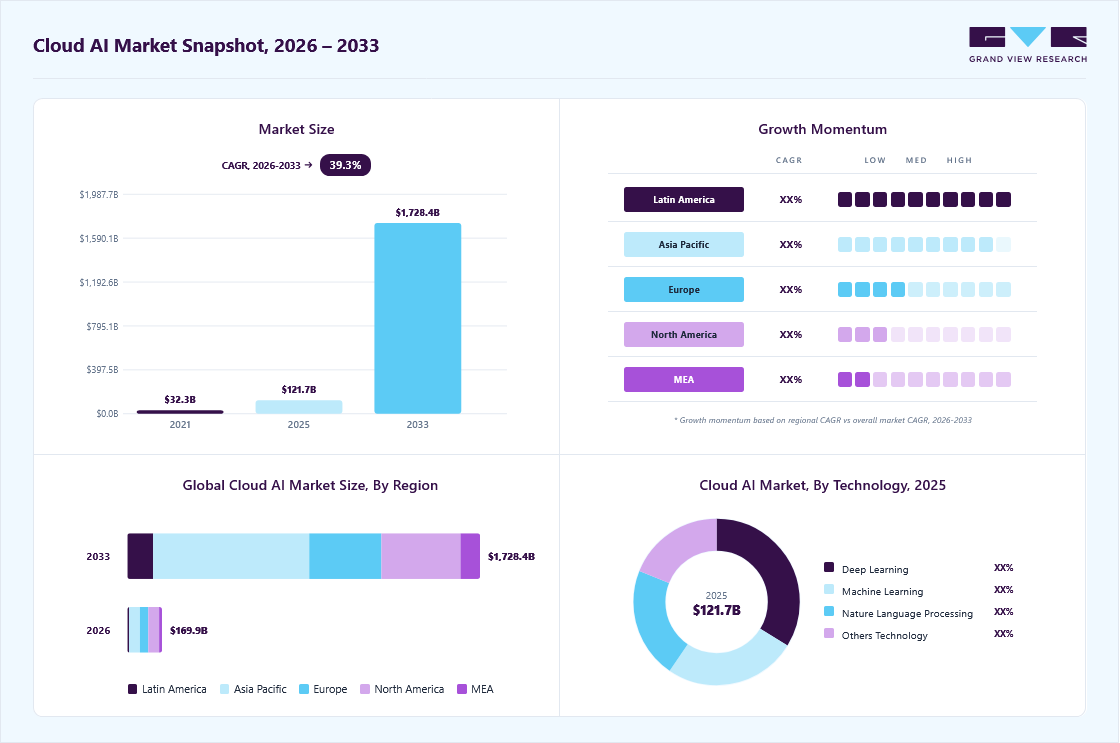 Source: Grand View Research, IR Documents, Primary Interviews, Paid DatabasesTo learn more about this report,
 Download Free Sample Report
 Key Market Trends & Insights
- By technology: Deep learning segment held the largest share of 33.7% in 2025.
- By type: Solution segment held the largest share of 62.5% in 2025.
- By verticals: IT & telecommunication segment held the largest share in 2025.
Regional Highlights
- Largest regional market: North America (32.5% market share, 2025)
- Fastest-growing regional market: Asia Pacific
- By Country: The U.S. held the largest market share in 2025.
Market Size & Forecast
- Market size in 2025: USD 121.7 Billion
- Market size in 2026: USD 169.9 Billion
- Projected market size by 2033: USD 1,728.4 Billion
- CAGR (2026–2033): 39.3%
Three ways to get this report
Buy it, customize it, or ask a question.Ask an Analyst
Analyst response in 1 business day
- AccessReport author, directly
- Reply timeWithin 1 working day
- No sales callDirect answer only
- FormatEmail reply
- CostFree, no cost
Get the Full Report
What the study covers
- FormatsPDF · Excel · Dashboard
- Timeline2026–2033 annual, 2025 base
- Coverage20+ countries, 5 regions
- Companies10+ key players profiled
Customize the Report
20% free customization
- IncludeCountries, segments, points
- TailorTo your product definition
- ExtendDeeper competitor detail
- OrA fully bespoke study
- Turnaround5–10 working days
One of the primary factors driving the expansion of the cloud AI industry is the growing adoption of artificial intelligence and machine learning technologies across multiple industries. As these technologies become more widely used, organizations are exploring ways to harness their potential for gaining a competitive edge. Cloud AI offers a scalable and accessible platform, making it a practical choice for implementing these advanced solutions effectively. Major technology companies, including Microsoft and Google LLC, are driving this growth by offering sophisticated AI platforms that cater to diverse business needs. These platforms provide tools for natural language processing, image recognition, predictive analytics, and other AI functionalities. The market is experiencing rapid growth due to increasing demand from businesses across various industries seeking to optimize their operations and enhance decision-making. Cloud AI integrates artificial intelligence algorithms with the scalability and flexibility of cloud computing, enabling organizations to deploy advanced technologies without requiring significant capital investment. This ease of access is encouraging more businesses to experiment with AI-driven solutions, contributing to widespread adoption. Consequently, the market continues to expand, supported by ongoing advancements in AI capabilities and cloud infrastructure.
 To learn more about this report, Download Free Sample Report
 The proliferation of data across industries is another crucial factor propelling the growth of the market. As businesses generate and collect vast amounts of data, the need for efficient processing, analysis, and actionable insights has become paramount. Cloud AI platforms address these challenges by offering scalable solutions that can handle large datasets while ensuring real-time processing. Furthermore, they enable seamless integration with existing enterprise systems, making them highly adaptable for businesses of all sizes. This growing reliance on data-driven decision-making is fueling the adoption of cloud AI solutions, ensuring sustained cloud AI industry growth.
Market Dynamics
The increasing demand for scalable AI-powered business automation solutions is a primary driver of growth in the cloud AI market, as enterprises prioritize operational efficiency, process optimization, and intelligent decision-making. Across various industries, organizations are adopting cloud-based AI platforms to automate repetitive workflows, enhance customer engagement, streamline supply chain management, and improve workforce productivity without substantial on-premises infrastructure investments. The scalability and flexibility of cloud AI solutions allow businesses to deploy automation capabilities across multiple departments, while supporting real-time analytics and adaptive learning. Additionally, the adoption of generative AI, intelligent virtual assistants, robotic process automation (RPA), and AI-powered enterprise applications is accelerating the need for cloud-native automation ecosystems that address evolving business requirements at scale.
Enterprises are leveraging scalable AI-powered automation solutions to reduce operational costs, improve service delivery accuracy, and enhance competitive positioning within increasingly digital business environments. Cloud AI platforms offer centralized access to advanced machine learning models, data processing capabilities, and AI development frameworks, enabling rapid deployment of automation initiatives across geographically dispersed operations. The focus on digital transformation strategies, combined with increased investment in intelligent enterprise infrastructure, is prompting organizations to migrate automation workloads to cloud environments that provide greater scalability, interoperability, and ongoing AI model optimization. Moreover, rising demand for personalized customer experiences, predictive maintenance, fraud detection, and intelligent workflow orchestration is expected to sustain long-term growth in the cloud AI market.
The substantial costs of deploying AI infrastructure and using cloud computing resources represent a significant barrier to the growth of the cloud AI market, particularly for small and medium-sized enterprises with limited technology budgets. Advanced AI workloads necessitate considerable investments in high-performance GPUs, AI accelerators, large-scale data storage systems, and high-bandwidth networking infrastructure, thereby increasing overall operational expenditures for organizations adopting cloud AI solutions. Moreover, the increasing complexity of generative AI models and large language model (LLM) training processes is driving up cloud costs, including those for computing, storage, and energy. These financial constraints hinder many enterprises from efficiently scaling AI initiatives, especially within cost-sensitive industries and developing markets.
Organizations incur ongoing expenses related to AI model maintenance, data management, cybersecurity, compliance, and continuous cloud infrastructure optimization, which further increase the total cost of ownership for cloud AI deployments. The unpredictable nature of cloud resource utilization and usage-based pricing models presents budget management challenges for enterprises operating large-scale AI applications with variable workloads. Additionally, businesses integrating AI into mission-critical operations often require premium cloud services that offer enhanced processing capabilities, low-latency performance, and advanced security features, substantially increasing deployment costs. Consequently, concerns about long-term return on investment and rising cloud expenditures may slow the adoption of AI among enterprises with limited financial and technical resources.
The widespread adoption of cloud AI solutions for predictive analytics and real-time decision-making is generating significant growth opportunities within the cloud AI market, as organizations increasingly prioritize data-driven strategies and operational intelligence. Enterprises across various sectors utilize cloud-based AI platforms to process large volumes of structured and unstructured data in real time, facilitating the rapid identification of market trends, customer behavior patterns, and operational risks. The scalability and computational power of cloud AI infrastructure enable the deployment of advanced predictive models without the need for substantial investment in on-premises systems, thereby supporting broader enterprise adoption. Moreover, the heightened demand for rapid decision-making in dynamic business environments is driving the adoption of AI-powered analytics solutions that deliver actionable insights faster and with greater accuracy.
Cloud AI providers are experiencing increased benefits from rising enterprise investments in intelligent forecasting, predictive maintenance, fraud detection, supply chain optimization, and personalized customer engagement applications. Real-time, AI-driven analytics solutions enable organizations to enhance operational efficiency, minimize downtime, optimize resource allocation, and strengthen strategic planning across geographically dispersed operations. The integration of AI with edge computing, Internet of Things (IoT) devices, and enterprise data ecosystems further improves the effectiveness of cloud-based predictive analytics platforms by supporting continuous data processing and low-latency decision-making. Additionally, ongoing digital transformation initiatives and the emphasis on business agility are anticipated to generate sustained opportunities for cloud AI vendors that offer scalable, industry-specific predictive intelligence and real-time analytics solutions.
Market Concentration & Characteristics
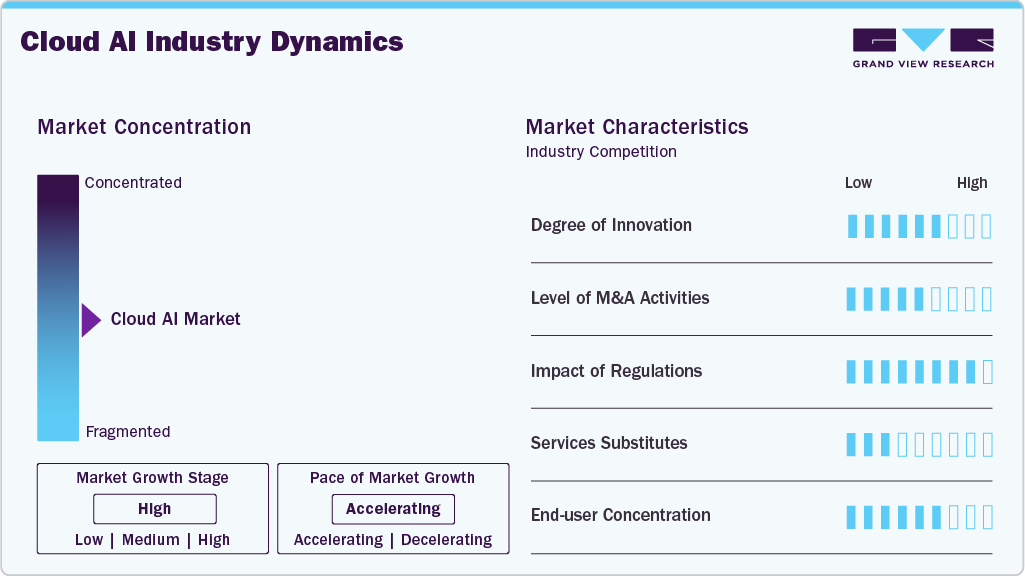
The cloud AI market exhibits moderate to high concentration, with major cloud service providers, hyperscale infrastructure companies, and enterprise AI platform vendors competing across sectors such as banking, financial services, and insurance (BFSI), healthcare, retail, manufacturing, telecommunications, and government. The competitive landscape is defined by multinational technology companies that leverage advanced AI infrastructure, proprietary large language models (LLMs), integrated cloud ecosystems, and robust partner networks to enhance market positioning. Rising enterprise adoption of generative AI, predictive analytics, intelligent automation, and AI-as-a-Service (AIaaS) solutions is intensifying competition and accelerating innovation within cloud AI platforms. Moreover, sustained investments in AI data centers, GPU acceleration technologies, sovereign cloud infrastructure, and hybrid cloud capabilities are further propelling market expansion and technological differentiation.
 To learn more about this report, Download Free Sample Report
 The market is facing increased competitive pressure from open-source AI frameworks, edge AI platforms, and specialized AI software vendors that offer cost-efficient, industry-specific solutions. In response, cloud AI providers are emphasizing advancements in AI model optimization, cybersecurity, scalable infrastructure orchestration, real-time analytics, and responsible AI governance to enhance service differentiation and drive enterprise adoption. Additionally, organizations are demanding cloud AI solutions that offer scalability, improved decision-making accuracy, greater automation efficiency, and faster return on investment, which is fostering ongoing product innovation and strategic partnerships. The influence of regulatory compliance, data privacy standards, and AI governance frameworks is also shaping competitive dynamics as vendors prioritize secure, transparent, and compliant cloud AI environments.
Technology Insights
The deep learning segment led the market and accounted for 33.7% of the global revenue in 2025, driven by the demand for handling unstructured data volumes through scalable neural architectures. Deep Learning-accelerated infrastructure supports intensive model training and low-latency inference essential for complex pattern recognition. Advancements in federated learning enable privacy-preserving computation across distributed datasets. Hybrid deployment models facilitate seamless integration of on-premises and cloud resources for optimized performance.
The natural language processing segment is predicted to foresee significant growth over the forecast period. Natural language processing in the market advances via integration of large language models into user interfaces for language comprehension tasks. Cloud-native platforms deliver computational resources for response analysis and translation at enterprise scale. Expansion of model-as-a-service offerings accelerates deployment of hyper-personalized interaction systems. Multimodal processing capabilities enhance handling of combined text and voice inputs.
Type Insights
The solution segment accounted for the largest market revenue share in 2025. Solutions integrate agentic AI frameworks that autonomously execute multi-step tasks, such as generating personalized project recommendations from natural language inputs. These frameworks combine multimodal processing with real-time data synthesis to deliver actionable outcomes, including inventory-linked guidance and workflow automation.
The services segment is predicted to foresee significant growth over the forecast period. Cloud AI services deploy conversational interfaces that interpret project descriptions via voice, text, or image inputs to produce comprehensive materials lists. Backend automation handles intent resolution and issue mitigation through integrated chat, SMS, and voice channels. Route optimization incorporates external variables like access constraints for precise delivery execution.
Verticals Insights
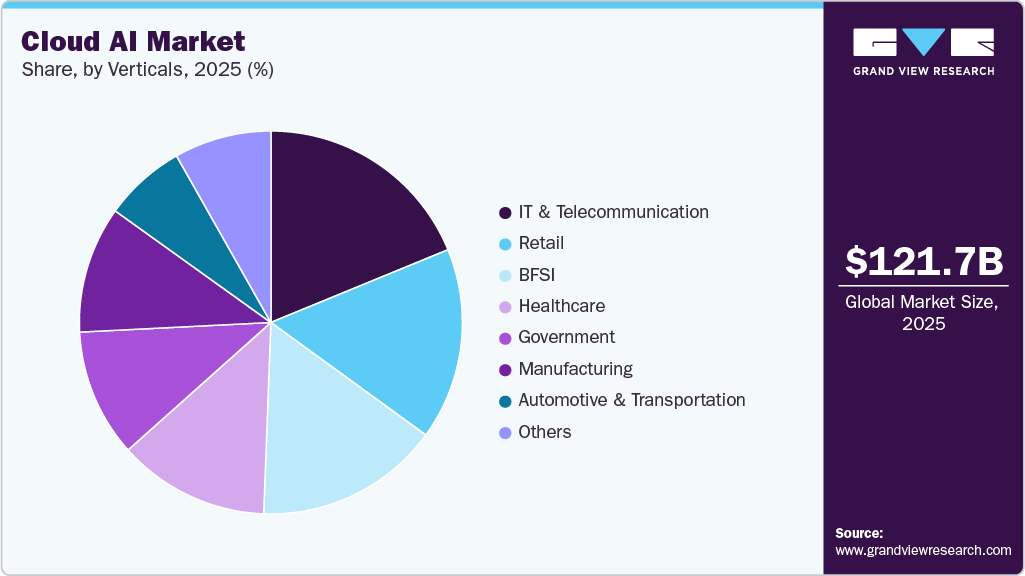
The IT & telecommunication segment holds the largest market share of the global revenue in 2025. This sector extensively uses AI to optimize network management, improve customer natural language processing, and enhance data security. The integration of AI in telecommunications supports innovations such as 5G technology, predictive maintenance, and automated support systems. For instance, in August 2025, Xtelify launched Airtel Cloud, an independent telco-grade platform. The cloud offering provides IaaS, PaaS, advanced connectivity, secure migration, scaling capabilities, cost efficiencies, and vendor lock-in avoidance, managed by certified cloud experts.
 To learn more about this report, Download Free Sample Report
 The government segment is predicted to foresee significant growth over the forecast period. This sector is growing due to the adoption of AI as it seeks to improve efficiency and modernize public services. AI is being used to enhance security, streamline administrative processes, and optimize resource allocation. For instance, in December 2025, India's Ministry of Electronics and Information Technology introduced MeghRaj, the GI Cloud platform as part of the Digital India program. It offers secure, flexible, and expandable cloud services for e-Governance, with features like on-demand scaling, pay-as-you-go billing, easy self-service setup, and quick app deployment.
Regional Insights
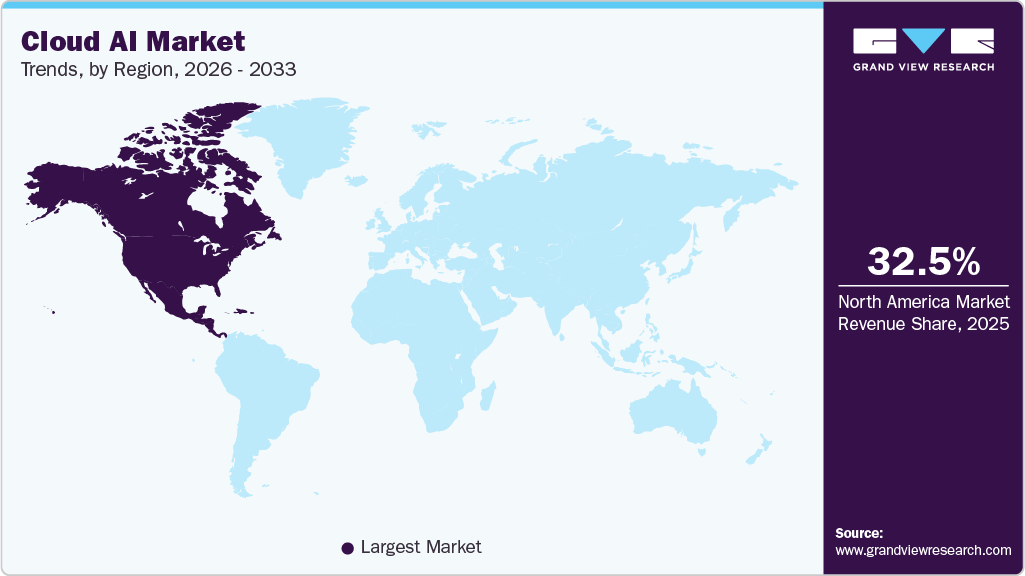
North America cloud AI industry dominated the global market with a 32.5% revenue share in 2025. The cloud AI industry in North America is highly advanced, driven by the presence of major technology companies and early adoption of AI solutions. Businesses across industries are leveraging cloud AI to enhance efficiency and innovation. Significant investments in AI research and development further bolster the region's leadership in this cloud AI industry. Regulatory frameworks and strong digital infrastructure support widespread adoption of cloud-based AI services.
 To learn more about this report, Download Free Sample Report
 U.S. Cloud AI Market Trends
The U.S. cloud AI industry dominated the global market in 2025, with leading companies such as Microsoft and Google LLC driving innovation. The country’s diverse industries, including healthcare, finance, and retail, are rapidly adopting AI to gain a competitive edge. Government initiatives and private sector investments in AI research further accelerate cloud AI industry growth. The strong digital infrastructure and talent pool make the U.S. a global leader in cloud AI adoption. The increasing demand for scalable AI solutions positions the U.S. as a cornerstone of the global cloud AI industry.
Europe Cloud AI Market Trends
The Europe cloud AI industry is expanding as businesses and governments adopt AI to drive digital transformation. Key markets such as Germany, the UK, and France are investing heavily in AI infrastructure and innovation. The European Union’s focus on ethical AI and data privacy influences the development of cloud-based AI solutions. Industries such as manufacturing, automotive, and banking are integrating AI to improve efficiency and competitiveness. This growing adoption reflects Europe’s strategic approach to advancing cloud AI technologies while addressing regulatory concerns.
Asia Pacific Cloud AI Market Trends
The cloud AI industry in Asia-Pacific is growing rapidly, fueled by increasing digitalization and AI adoption across industries. Countries such as China, Japan, and India are leading this growth through significant investments in cloud infrastructure and AI research. Businesses in e-commerce, healthcare, and finance are leveraging cloud AI to optimize operations and enhance customer experiences. Government initiatives promoting AI adoption, along with a large and tech-savvy consumer base, contribute to the Cloud AI industry’s expansion. Asia-Pacific is emerging as a key region for cloud AI innovation and application on a global scale.
Key Cloud AI Company Insights
Some key companies in the cloud AI industry are Apple Inc., Intel Corporation, NVIDIA, and ZTE Corp.
-
Apple Inc. is using AI to improve its devices and services, such as Siri and facial recognition. While the company focuses more on Services, it’s expanding its AI capabilities through services such as iCloud. Apple’s AI-powered features help with things like personalized recommendations and smarter photo management. The company is also enhancing its Solution with AI tools. Apple Inc. is gradually growing its role in cloud AI to improve the user experience.
-
Google LLC is a major player in cloud AI, offering powerful AI tools such as TensorFlow and AutoML. Google Cloud uses AI for machine learning, language processing, and image recognition. The company’s AI services help businesses in industries such as healthcare and finance. Google continues to innovate and expand its AI offerings, making cloud AI more accessible. Google’s advancements in AI are helping businesses make smarter, data-driven decisions.
Key Cloud AI Companies:
The following key companies have been profiled for this study on the cloud AI market.
- Apple Inc.
- Google, Inc.
- IBM Corporation
- Intel Corporation
- Microsoft
- MicroStrategy, Inc.
- NVIDIA Corporation
- Oracle Corporation
- Qlik Technologies, Inc.
- Salesforce.com Inc.
- ZTE Corp.
Competitive Benchmarking
Operating Strategies
Competitive Edge
Weaknesses
Mature Players: Microsoft Corporation; Amazon Web Services, Inc.; Google LLC; IBM Corporation.
- Leading providers are increasing investments in hyperscale AI infrastructure, proprietary LLMs, and GPU-accelerated cloud environments.
- Major companies are expanding partnerships with software vendors, semiconductor companies, and AI developers to strengthen integrated AI offerings.
- Established companies benefit from strong global cloud infrastructure and diversified enterprise customer ecosystems.
- Market leaders possess proprietary AI frameworks, advanced cybersecurity capabilities, and comprehensive cloud AI ecosystems.
- Mature vendors face rising operational costs associated with AI model training and large-scale infrastructure management.
- Large organizational structures may reduce responsiveness to rapidly evolving AI innovation trends and niche enterprise requirements.
Emerging Players: MicroStrategy Incorporated; Qlik Technologies, Inc.; ZTE Corporation.
- Emerging companies are focusing on generative AI platforms, AI inference services, and cloud-native model optimization technologies.
- Growth-stage vendors are emphasizing industry-specific AI applications, flexible pricing models, and developer-focused AI ecosystems.
- Emerging vendors demonstrate strong technological agility through open-source AI architectures and scalable GPU cloud infrastructure.
- Startups are leveraging faster innovation cycles and customized enterprise AI solutions to strengthen market differentiation.
- Emerging companies face limitations related to financial scalability and access to global cloud infrastructure networks.
- Smaller providers face challenges competing against established vendors with substantial R&D investments and broader enterprise ecosystems.
Recent Developments
-
In January 2026, Google launched MedASR and MedGemma 1.5, open-source AI models for healthcare, accessible on Hugging Face and Google Cloud's Vertex AI under the Health AI Developer Foundations initiative. MedGemma 1.5 handles intricate 3D medical scans such as CTs, MRIs, and pathology slides, plus electronic health record processing with DICOM integration.
-
In December 2024, Amazon Web services (AWS), Inc., introduced new AI servers powered by its Trainium2 chips, with Apple joining as a customer to use them. These servers, designed for advanced generative AI workloads, will be used by AI startup Anthropic and offer greater chip connectivity than existing alternatives.
-
In October 2024, Intel collaborated with Inflection AI to launch inflection for enterprise, a ready-to-use AI system running on Intel's Gaudi 3 chips and Tiber AI Cloud. It offers chat-based AI that's customized to a company's own data, rules, and ways of working, helping employees get more done whether on local servers, in the cloud, or a mix of both.
Cloud AI Market Report Scope
Report Attribute
Details
Market size value in 2025
USD 121.7 billion
Estimated Market size in 2026
USD 169.9 billion
Projected Market size by 2033
USD 1,728.4 billion
Growth rate
CAGR of 39.3% from 2026 to 2033
Base year for estimation
2025
Actual data
2021 - 2024
Forecast period
2026 - 2033
Quantitative units
Revenue in USD million/billion and CAGR from 2026 to 2033
Report coverage
Revenue forecast, company ranking, competitive landscape, growth factors, and trends
Segments covered
Technology, type, verticals, region
Regional scope
North America; Europe; Asia Pacific; Latin America; MEA
Country scope
U.S.; Canada; Europe; UK; Germany; France; China; Japan; India; South Korea; Australia; Brazil; KSA; UAE; South Africa; Mexico
Key companies profiled
Apple Inc.; Google Inc.; IBM Corporation; Intel Corporation; Microsoft; MicroStrategy Inc.; NVIDIA Corporation; Oracle Corporation; Qlik Technologies Inc.; Salesforce.com Inc.; ZTE Corp.
Customization scope
Free report customization (equivalent up to 8 analysts working days) with purchase. Addition or alteration to country, regional & segment scope.
Pricing and purchase options
Avail customized purchase options to meet your exact research needs. Explore purchase options
Global Cloud AI Market Report Segmentation
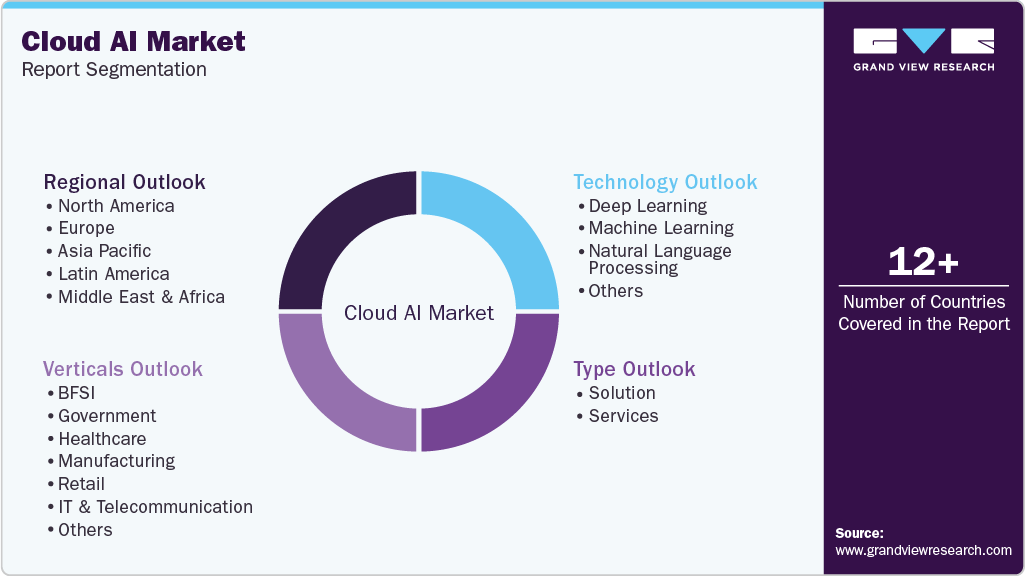
This report forecasts revenue growth at global, regional, and country levels and provides an analysis of the latest industry trends in each of the sub-segments from 2021 to 2033. For this study, Grand View Research has segmented the global cloud AI market report based on technology, type, verticals, and region:
 To learn more about this report, Download Free Sample Report
 -
Technology Outlook (Revenue, USD Million, 2021 - 2033)
-
Deep Learning
-
Machine Learning
-
Natural Language Processing
-
Others
-
-
Type Outlook (Revenue, USD Million, 2021 - 2033)
-
Solution
-
Services
-
-
Verticals Outlook (Revenue, USD Million, 2021 - 2033)
-
BFSI
-
Government
-
Healthcare
-
Manufacturing
-
Retail
-
IT & Telecommunication
-
Automotive & Transportation
-
Others
-
-
Regional Outlook (Revenue, USD Million, 2021 - 2033)
-
North America
-
U.S.
-
Canada
-
Mexico
-
-
Europe
-
UK
-
Germany
-
France
-
-
Asia Pacific
-
China
-
Japan
-
India
-
South Korea
-
Australia
-
-
Latin America
-
Brazil
-
-
Middle East and Africa (MEA)
-
KSA
-
UAE
-
South Africa
-
-
Delivered Customizations
This report has been delivered with the following In-depth customizations
Client Objective
Custom Research Modules Delivered
Strategic Value / Business Impact
Market Entry & Expansion Assessment
- Analysis of AI workload migration trends from on-premises to cloud environments.
- Evaluation of AI adoption trends among small and medium-sized enterprises (SMEs).
- Assessment of regional sovereign AI cloud infrastructure development trends.
- Analysis of enterprise spending trends on AI-as-a-Service (AIaaS) platforms.
- Identified expansion opportunities in cloud-native enterprise AI deployments.
- Supported customer acquisition strategies across emerging enterprise segments.
- Enabled strategic investment planning aligned with regional compliance requirements.
- Improved long-term revenue forecasting and service portfolio planning.
Technology & Innovation Assessment
- Evaluation of AI chip optimization and GPU cloud acceleration deployment trends.
- Analysis of autonomous AI agent and intelligent workflow automation adoption trends.
- Assessment of cloud AI integration trends with edge computing and IoT ecosystems.
- Mapping of open-source AI ecosystem adoption and enterprise customization trends.
- Identified infrastructure scalability opportunities for high-performance AI workloads.
- Supported next-generation enterprise automation and productivity strategies.
- Strengthened real-time analytics and distributed AI deployment capabilities.
- Enabled product differentiation and faster AI innovation cycle development.
Frequently Asked Questions About This Report
Asia Pacific is the fastest-growing region over the forecast period.
Deep learning segment led with 33.7% share in 2025, while natural language processing segment is expected to grow fastest.
The global cloud AI market size was estimated at USD 121.7 billion in 2025 and is expected to reach USD 169.9 billion in 2026.
The global cloud AI market is expected to grow at a compound annual growth rate of 39.3% from 2026 to 2033 to reach USD 1,728.4 billion by 2033.
Some key players operating in the cloud AI market include Apple Inc; Google Inc.; IBM Corporation; Intel Corporation; Microsoft Corporation; MicroStrategy Inc; NVIDIA Corporation; Oracle Inc.; Qlik Technologies Inc.; Salesforce Inc.; and ZTE Corp.
Key factors that are driving the market growth include the increasing demand for cloud AI integrates the capabilities of cloud computing with artificial intelligence algorithms to deliver various benefits, including faster processing, enhanced efficiency, and cost savings for businesses
Solution segment led with 62.5% share in 2025, while services segment is expected to grow fastest.
IT & telecommunication held the largest share in 2025, while government segment is expected to grow fastest at 41.3% CAGR.
North America dominated the cloud AI market with a share of 32.5% in 2025. This is driven by the presence of major technology companies and early adoption of AI solutions as businesses across industries are using cloud AI to enhance efficiency and innovation.
About the Author(s)
Next Generation Technologies Research Team
Technology · Next Generation TechnologiesThis report was authored by the next generation technologies research team at Grand View Research - comprising two research analysts, one senior research analyst, and one industry expert - with specialized expertise in the next generation technologies segment of the technology industry. All findings are based on proprietary technology databases, executive interviews, and regulatory analysis, subject to internal peer review prior to publication.
Last Updated:
Speak to Analyst

Customize this report to your needs - add regions, segments, or data points, with 20% free customization.
Or view our licence options:


ISO 9001:2015 & 27001:2022 Certified
We are GDPR and CCPA compliant! Your transaction & personal information is safe and secure. For more details, please read our privacy policy.


