
- Home
- »
- Next Generation Technologies
- »
-
Cloud Cost Management Market Size, Industry Report, 2033GVR Report cover

Cloud Cost Management Market (2026 - 2033)
Size, Share & Trends Analysis Report By Component (Software, Services), By Deployment (Public Cloud, Private Cloud), By Enterprise Size (Large Enterprises, SMEs), By Application, By End Use, By Region, And Segment Forecasts
Market Size, 2025
$5.3BMarket Estimate, 2026
$6.2BMarket Forecast, 2033
$19.3BCAGR, 2026–2033
17.6%Cloud Cost Management Market Summary
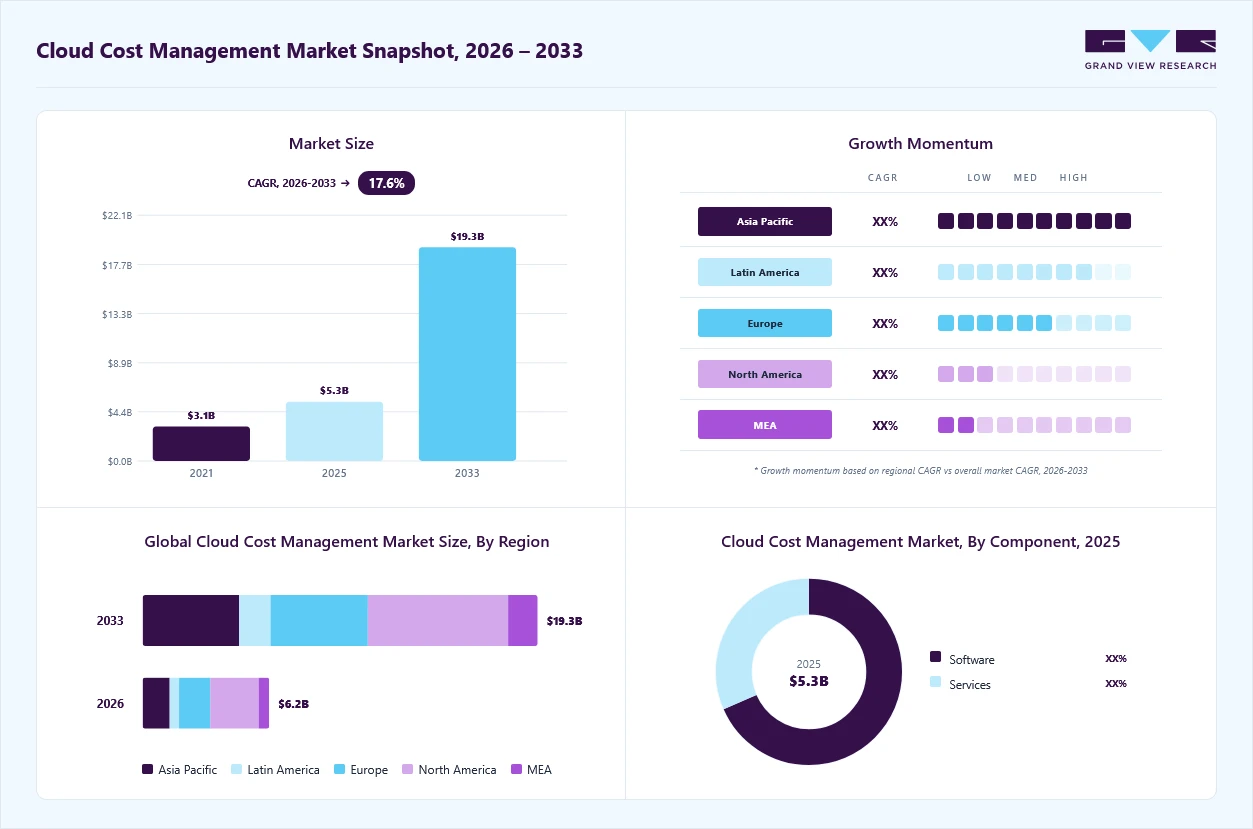
The global cloud cost management market size was valued at USD 5.3 billion in 2025 and is projected to grow from USD 6.2 billion in 2026 to USD 19.3 billion by 2033, at a CAGR of 17.6% from 2026 to 2033. The market in North America dominated with a revenue share of 38.6% in 2025. The industry is expanding rapidly as organizations continue to increase their spending on public, private, and hybrid cloud environments.
 Source: Grand View Research, IR Documents, Primary Interviews, Paid DatabasesTo learn more about this report,
 Download Free Sample Report
 Key Market Trends & Insights
- By component: The software segment held the largest revenue share of 68.4% in 2025.
- By deployment: The public segment held the largest revenue share in 2025.
- By enterprise size: Large enterprises segment held the largest revenue share in 2025.
Regional Highlights
- Largest regional market: North America (38.6% revenue share, 2025)
- Fastest-growing regional market: Asia Pacific (highest CAGR, 2026-2033)
- The cloud cost management industry in the U.S. held the largest revenue share in 2025.
Market Size & Forecast
- Market size in 2025: USD 5.3 Billion
- Estimated market size in 2026: USD 6.2 Billion
- Projected market size by 2033: USD 19.3 Billion
- CAGR (2026-2033): 17.6%
Three ways to get this report
Buy it, customize it, or ask a question.Ask an Analyst
Analyst response in 1 business day
- AccessReport author, directly
- Reply timeWithin 1 working day
- No sales callDirect answer only
- FormatEmail reply
- CostFree, no cost
Get the Full Report
What the study covers
- FormatsPDF · Excel · Dashboard
- Timeline2026–2033 annual, 2025 base
- Coverage20+ countries, 5 regions
- Companies10+ key players profiled
Customize the Report
20% free customization
- IncludeCountries, segments, points
- TailorTo your product definition
- ExtendDeeper competitor detail
- OrA fully bespoke study
- Turnaround5–10 working days
As enterprises migrate critical workloads to the cloud, managing and optimizing cloud expenses has become a strategic priority. Cloud cost management solutions help businesses gain visibility into spending patterns, reduce unnecessary resource usage, and improve financial accountability across departments. One of the primary growth drivers is the sharp increase in multi-cloud and hybrid cloud adoption in 2025. Companies are no longer relying on a single cloud provider; instead, they use multiple platforms to enhance flexibility and resilience. However, this complexity increases the risk of cost overruns and unused resources. Cloud cost management platforms provide centralized dashboards, real-time monitoring, and automated optimization tools that enable organizations to control and streamline spending across diverse cloud environments.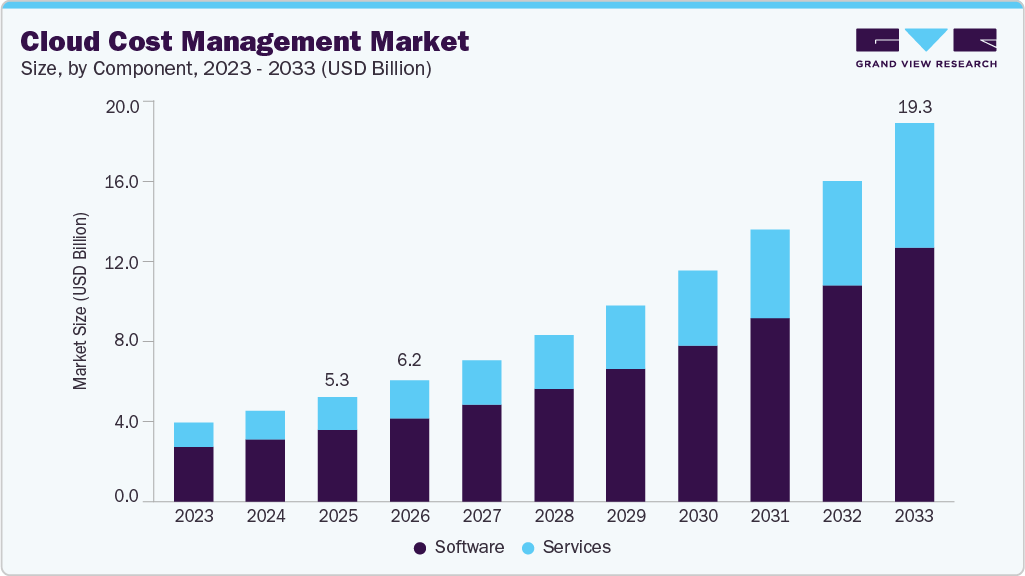 To learn more about this report, Download Free Sample Report
 Another key growth driver is the increasing adoption of FinOps practices across enterprises. In 2025, organizations are placing greater focus on aligning cloud spending with business value. Finance, IT, and operations teams are collaborating more closely to ensure cost transparency and accountability. Cloud cost management tools support budgeting, forecasting, chargeback mechanisms, and policy-based governance, helping enterprises make data-driven financial decisions while improving operational efficiency.
The growing use of AI, data analytics, and containerized workloads is also contributing to market expansion. Advanced workloads often require dynamic scaling, which can result in unpredictable cloud bills if not properly managed. Cost management solutions leverage AI-driven analytics to identify underutilized resources, recommend rightsizing strategies, and automate workload scheduling. This capability is especially critical for large enterprises managing complex infrastructure and rapidly growing digital services.
As companies expand artificial intelligence and data-intensive applications, cloud infrastructure consumption rises quickly, often leading to unexpected expenses. This has made cost visibility and financial accountability critical for enterprises. In November 2025, Apptio (an IBM company) launched next-generation FinOps solutions designed to help organizations manage and optimize cloud investments in AI-driven environments. The solution provides real-time cost visibility, forecasting, and governance capabilities to control cloud spending before infrastructure is deployed. The company highlighted that increasing AI adoption is creating financial complexity, making proactive cloud cost management essential for businesses seeking better ROI and budget control.
Component Insights
The software segment led the industry with the largest revenue share of 68.4% in 2025. This dominance is driven by the increasing adoption of cloud platforms and the growing need for organizations to monitor and optimize their increasing cloud expenses. As enterprises migrate workloads to public and hybrid cloud environments, they rely on cloud cost management software for real-time cost visibility, usage analytics, automated optimization, budgeting, and financial reporting. The expansion of multi-cloud environments and the adoption of FinOps practices have further increased demand for software solutions that help IT and finance teams manage complex billing structures and prevent cost overruns. Government digital transformation initiatives are also contributing to segment growth, as public organizations require better transparency and accountability in technology spending. For instance, in June 2025, according to the UK Government Technology Blog, the government introduced a Cloud Cost Data Solution (CCDS) to improve public sector cloud spending visibility by collecting and standardizing cloud billing and usage data across departments, enabling better monitoring, budgeting, and cost optimization decisions.
The services segment is anticipated to grow at the fastest CAGR during the forecast period, driven by the increasing need for expert support to manage complex multi-cloud environments and continuously optimize cloud spending. Many organizations lack in-house FinOps and cloud financial management expertise, so they rely on managed service providers for cost monitoring, optimization, governance, and automated resource management. As cloud usage expands across departments, enterprises are outsourcing cost control activities such as usage audits, rightsizing recommendations, and billing management to specialized service vendors to reduce operational burden and avoid unexpected cloud bills. As a result, the growing complexity of cloud ecosystems and the rising demand for continuous cost optimization are expected to significantly accelerate the adoption of cloud cost management services across enterprises worldwide.
Deployment Insights
The public cloud segment led the cloud cost management market with the largest revenue share in 2025. primarily driven by the rapid migration of enterprise workloads to public cloud platforms such as infrastructure, storage, and software services. Organizations increasingly prefer public cloud environments due to their scalability, flexibility, and pay-as-you-go pricing model, which allows businesses to scale resources based on demand without heavy upfront investments. However, as cloud usage expanded in 2025, many enterprises faced challenges related to uncontrolled spending and complex billing structures. This increased the adoption of cloud cost management solutions that provide real-time visibility into usage patterns, helping companies track expenses, eliminate unused resources, and optimize cloud budgets efficiently.
The hybrid cloud segment is anticipated to register the fastest CAGR during the forecast period, driven by the growing need for organizations to balance flexibility, security, and cost efficiency across their IT environments. Many enterprises adopted hybrid cloud strategies that combine public cloud platforms with private infrastructure to manage sensitive data while still benefiting from scalable cloud resources. However, managing costs across multiple environments became increasingly complex, creating strong demand for cloud cost management solutions that provide unified visibility and centralized financial control across both public and private systems.
Enterprise Size Insights
The large enterprises segment accounted for the largest share of market revenue in 2025, mainly due to their extensive use of multi-cloud and hybrid cloud environments to support large-scale business operations. Large organizations run complex workloads such as data analytics, enterprise applications, AI platforms, and global digital services, which generate significant cloud spending. As cloud expenses increased, these enterprises adopted cloud cost management solutions to gain better visibility into usage, control budgets, and reduce unnecessary resource consumption. The need to manage thousands of cloud resources across departments made automated cost monitoring and optimization tools essential for maintaining financial efficiency.
The small & medium enterprises (SMEs) segment is expected to grow at the fastest CAGR during the forecast period. The growth of this segment is primarily driven by the rapid adoption of cloud services among smaller businesses seeking scalable and cost-efficient IT solutions. SMEs increasingly moved their applications, storage, and business operations to public cloud platforms to reduce upfront infrastructure costs and improve operational flexibility. However, limited IT budgets and a lack of dedicated cloud management teams made cost control a major challenge. As a result, SMEs began adopting cloud cost management solutions to monitor usage, avoid overspending, and manage cloud resources more efficiently through automated optimization and budgeting tools.
Application Insights
The cost monitoring & visibility segment led the market with the largest revenue share in 2025, mainly because organizations first need clear visibility into their cloud spending before they can optimize or control costs. As enterprises expanded their use of public and hybrid cloud environments, managing complex billing structures and tracking resource usage across multiple teams became challenging. Cost monitoring solutions provide real-time dashboards, usage tracking, and spending alerts that help businesses understand where their cloud budget is being used and identify unnecessary expenses. The growing adoption of multi-cloud strategies, rising cloud bills, and the need for financial transparency across IT and finance teams strongly supported demand for monitoring and visibility tools, making them the most widely adopted function within cloud cost management platforms.
The financial operations (FinOps) segment is anticipated to grow at the fastest CAGR during the forecast period. The growth of this segment is primarily driven by the increasing focus of organizations on aligning cloud spending with business value. Enterprises began adopting FinOps practices to improve collaboration between finance, IT, and operations teams, ensuring better accountability and control over cloud expenses. As cloud environments became more complex, companies required tools that support budgeting, forecasting, cost allocation, and policy-based governance to manage spending efficiently. FinOps solutions help organizations make data-driven decisions, optimize resource usage, and prevent unexpected cloud bills, which is becoming increasingly important as businesses expand AI workloads, digital services, and multi-cloud deployments. The growing need for financial transparency and continuous cost optimization is expected to significantly accelerate the adoption of FinOps capabilities across enterprises.
End Use Insights
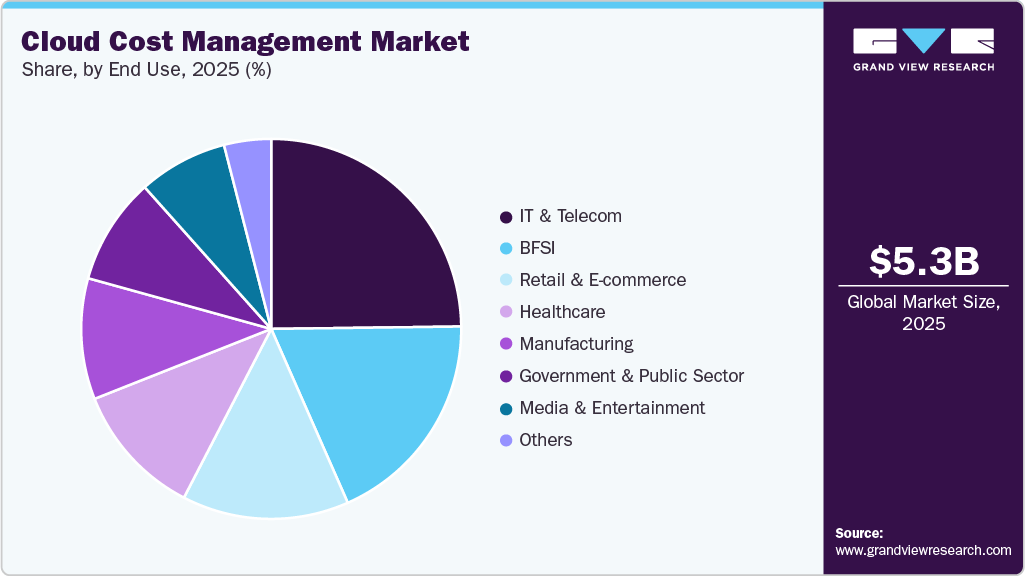
The IT & telecom segment led the market with the largest revenue share in 2025. The growth of this segment is primarily driven by the sector’s heavy reliance on cloud infrastructure to support large-scale digital services, data traffic, and network operations. IT and telecom companies operate complex cloud environments to manage applications, data centers, 5G networks, streaming platforms, and customer service systems, which results in high cloud spending. The rapid growth of data consumption, cloud-native applications, and virtualization has increased the need for strong cost monitoring and optimization tools to prevent overspending. Cloud cost management solutions help telecom and IT firms track resource usage in real time, automate workload optimization, and improve financial control across multiple cloud platforms, making them essential for maintaining operational efficiency and profitability in highly competitive markets.
 To learn more about this report, Download Free Sample Report
 The healthcare segment is anticipated to register the fastest CAGR during the forecast period. The growth of this segment is primarily driven by the rapid adoption of cloud technologies to manage growing volumes of patient data, digital health records, and connected medical systems. Healthcare organizations increasingly rely on cloud platforms to support telemedicine, electronic health records (EHRs), data analytics, and remote patient monitoring, creating a strong need for effective cloud cost management. Rising regulatory requirements and governance frameworks also encouraged hospitals and healthcare providers to closely monitor cloud usage, ensure compliance, and optimize operational spending. Cloud cost management solutions help healthcare institutions gain better visibility into resource consumption, control unnecessary expenses, and maintain secure and efficient IT operations while improving overall patient service delivery.
Regional Insights
North America cloud cost management industry is witnessing rapid expansion of cloud infrastructure investments, especially driven by artificial intelligence workloads, government digital transformation, and enterprise multi-cloud adoption. North American enterprises are shifting toward FinOps practices to manage unpredictable AI and data processing costs, while hybrid and multi-cloud environments are becoming standard deployment models, increasing the need for centralized cost monitoring platforms. Large technology investments, such as expanded secure cloud infrastructure for government workloads, are further accelerating demand for advanced cost governance and optimization solutions across public and private sectors.
 To learn more about this report, Download Free Sample Report
 U.S. Cloud Cost Management Market Trends
The cloud cost management industry in the U.S. is anticipated to witness a significant CAGR from 2026 to 2033. Growth is mainly supported by federal initiatives focused on improving cloud spending transparency and accountability across government agencies. In the U.S., agencies under cloud modernization and FedRAMP-aligned environments are increasingly adopting FinOps frameworks to monitor usage, prevent resource waste, and justify IT budgets. Rising AI workloads, large-scale federal cloud contracts, and stricter budget oversight are pushing agencies and enterprises to deploy automated cost analytics, governance dashboards, and resource optimization platforms, making cloud cost management a critical layer of enterprise cloud strategy.
Asia Pacific Cloud Cost Management Market Trends
The cloud cost management industry in Asia Pacific is expected to grow at the fastest CAGR from 2026 to 2033.Asia Pacific accounted for the largest market share of the cloud cost management industry in 2025. The region is witnessing rapid cloud adoption driven by large-scale digital transformation, AI deployment, and heavy investments in hyperscale data centers across countries such as India, China, Southeast Asia, and Japan. Governments and enterprises are moving workloads to public and hybrid clouds to support e-commerce, fintech, smart manufacturing, and digital public services, which is significantly increasing cloud spending and creating strong demand for cost monitoring and optimization solutions. In 2025, multiple infrastructure investments across Asia accelerated cloud usage. For instance, in March 2025, Thailand approved USD 2.7 billion in data center and cloud investments, while global providers such as AWS, Google, and Microsoft expanded regional infrastructure to meet growing demand. These developments are increasing cloud consumption complexity, making cloud cost management tools essential for enterprises to control spending and improve resource efficiency.
China cloud cost management industry is projected to grow at a notable CAGR from 2026 to 2033. Growth is supported by strong domestic cloud expansion and large investments by technology companies into AI and cloud infrastructure. In February 2025, Alibaba announced plans to invest over USD 52 billion in cloud computing and AI infrastructure over three years, reflecting the rapid scaling of cloud workloads that require advanced financial governance and optimization platforms. In addition, China’s accelerating digital ecosystem and widespread internet modernization, such as high IPv6 adoption reaching about 865 million active users in 2025, are driving higher data traffic and enterprise cloud utilization, further increasing the need for cost visibility and FinOps practices. As Chinese enterprises scale AI, data analytics, and platform services, cloud cost management solutions are becoming critical for managing operational expenses and improving cloud efficiency.
Europe Cloud Cost Management Market Trends
The cloud cost management market in Europe is anticipated to grow at a significant CAGR from 2026 to 2033, mainly driven by rapid cloud adoption, data sovereignty regulations, and increasing enterprise focus on financial control over cloud spending. Organizations in Europe are moving large workloads to cloud platforms while simultaneously facing strict compliance rules such as GDPR and regional data-residency requirements. This has increased demand for tools that monitor usage, allocate costs across departments, and ensure governance compliance. For instance, in 2025, according to Eurostat data, 52.7% of EU enterprises used paid cloud computing services, showing a sharp increase compared with earlier years, which directly increases the need for cost visibility and optimization solutions. In addition, Europe is seeing major investments in sovereign cloud infrastructure as governments and regulated industries prioritize financial transparency and control over cloud environments, further accelerating the adoption of cloud cost management platforms.
The UK cloud cost management market is anticipated to grow at a significant CAGR from 2026 to 2033, supported by strong public-sector cloud modernization and spending accountability initiatives. UK government agencies are actively improving cloud financial governance to reduce unnecessary IT expenditure and optimize taxpayer-funded digital infrastructure. Programs focused on cloud governance and centralized spending monitoring are encouraging organizations to adopt FinOps practices and automated cost optimization tools. Enterprises across finance, healthcare, and public services are increasingly implementing multi-cloud strategies, which raises cost complexity and drives demand for advanced cloud cost monitoring and optimization solutions.
Key Cloud Cost Management Company Insights
Some of the key companies operating in the cloud cost management market, include Apptio, an IBM Company, BMC Software, Inc., CloudZero, Flexera, and Google among others are some of the leading participants in the cloud cost management market.
-
Apptio is a technology business management and cloud financial management software company that helps organizations understand, manage, and optimize their IT and cloud spending. The company provides cloud cost management solutions through its platform, including Cloudability. Its offerings support FinOps practices by providing cost visibility, automation, budgeting, and optimization capabilities across major cloud platforms such as AWS, Microsoft Azure, and Google Cloud. Apptio has a strong presence in the cloud cost management market, serving large enterprises globally.
-
Flexera is a global technology intelligence company that helps organizations optimize and manage their IT and cloud investments. Through its Flexera One platform, the company provides cloud cost optimization, IT asset management (ITAM), SaaS management, and FinOps capabilities that enable enterprises to gain full visibility into technology spending and improve financial control across hybrid and multi-cloud environments. Flexera has a strong presence in the cloud cost management market, serving large enterprises with complex cloud infrastructures by offering a unified SaaS-based platform that integrates cost visibility, optimization, and compliance management to maximize IT value and reduce overall cloud expenditure
Key Cloud Cost Management Companies:
The following key companies have been profiled for this study on the cloud cost management market.
- Amazon Web Services, Inc.
- Apptio, an IBM Company
- BMC Software, Inc.
- CloudZero
- Densify (Wipro)
- Finout
- Flexera
- Microsoft
- NetApp
- nOps
- ServiceNow
- VMware (by Broadcom)
- Yotascale, Inc.
- Zesty
Recent Developments
-
In January 2026, Flexera acquired ProsperOps and Chaos Genius to expand its FinOps solution with AI-powered and automated cost optimization. These acquisitions enhance Flexera’s cloud cost management tools by adding smart automation and better control of cloud spending, helping organizations manage costs for AI and data workloads more efficiently.
-
In April 2025, Flexera introduced new Cloud License Management capabilities as part of its technology platform to help organizations better manage and optimize software licenses running in cloud environments, improving visibility into licensing costs and supporting more efficient cloud spending.
Cloud Cost Management Market Report Scope
Report Attribute
Details
Market size in 2025
USD 5.3 billion
Estimated market size in 2026
USD 6.2 billion
Projected market size by 2033
USD 19.3 billion
Growth rate
CAGR of 17.6% from 2026 to 2033
Actual data
2021 - 2025
Forecast period
2026 - 2033
Quantitative units
Revenue in USD million/billion and CAGR from 2026 to 2033
Report coverage
Revenue forecast, company share, competitive landscape, growth factors, and trends
Segments covered
Component, deployment, enterprise size, application, end use, region
Regional scope
North America; Europe; Asia Pacific; Latin America; MEA
Country scope
U.S.; Canada; Mexico; UK; Germany; France; China; India; Japan; Australia; South Korea; Brazil; UAE; Saudi Arabia; South Africa
Key companies profiled
Amazon Web Services, Inc.; Apptio, an IBM Company; BMC Software, Inc.; CloudZero; Densify (Wipro); Finout; Flexera; Google; Microsoft; NetApp; nOps; ServiceNow; VMware (by Broadcom); Yotascale, Inc.; Zesty
Customization scope
Free report customization (equivalent to 8 analysts working days) with purchase. Addition or alteration to country, regional & segment scope.
Pricing and purchase options
Avail customized purchase options to meet your exact research needs. Explore purchase options
Global Cloud Cost Management Market Report Segmentation
This report forecasts revenue growth at global, regional, and country levels and provides an analysis of the latest industry trends in each of the sub-segments from 2021 to 2033. For this study, Grand View Research has segmented the global cloud cost management market report based on component, deployment, enterprise size, application, end use, and region.
-
Component Outlook (Revenue, USD Billion, 2021 - 2033)
-
Software
-
Services
-
-
Deployment Outlook (Revenue, USD Billion, 2021 - 2033)
-
Public Cloud
-
Private Cloud
-
Hybrid Cloud
-
-
Enterprise Size Outlook (Revenue, USD Billion, 2021 - 2033)
-
Large Enterprises
-
Small & Medium Enterprises (SMEs)
-
-
Application Outlook (Revenue, USD Billion, 2021 - 2033)
-
Cost Monitoring & Visibility
-
Resource Optimization
-
Budgeting & Forecasting
-
Governance & Compliance
-
Financial Operations (FinOps)
-
Others
-
-
End Use Outlook (Revenue, USD Billion, 2021 - 2033)
-
IT & Telecom
-
BFSI
-
Retail & E-commerce
-
Healthcare
-
Manufacturing
-
Government & Public Sector
-
Media & Entertainment
-
Others
-
-
Regional Outlook (Revenue, USD Billion, 2021 - 2033)
-
North America
-
U.S.
-
Canada
-
Mexico
-
-
Europe
-
Germany
-
UK
-
France
-
-
Asia Pacific
-
China
-
India
-
Japan
-
South Korea
-
Australia
-
-
Latin America
-
Brazil
-
-
Middle East & Africa
-
UAE
-
Saudi Arabia
-
South Africa
-
-
Frequently Asked Questions About This Report
The software segment led with a 68.4% revenue share in 2025.
Public held the largest revenue share in 2025.
Large enterprises held the largest share in 2025.
North America dominated with a 38.6% revenue share in 2025.
Some key players operating in the market include Amazon Web Services, Inc.; Apptio, an IBM Company; BMC Software, Inc.; CloudZero; Densify (Wipro); Finout; Flexera; Google; Microsoft; NetApp; nOps; ServiceNow; VMware (by Broadcom); Yotascale, Inc.; Zesty
Factors such as Increasing adoption of multi-cloud and hybrid cloud environments, creating complexity in tracking and optimizing cloud spending, rising need for cost visibility and financial governance (FinOps practices) across enterprises, driving the market growth.
The global cloud cost management size was estimated at USD 5.3 billion in 2025 and is expected to reach USD 6.2 billion in 2026.
The global cloud cost management is expected to grow at a compound annual growth rate of 17.6% from 2026 to 2033 to reach USD 19.3 billion by 2033.
About the Author(s)
Next Generation Technologies Research Team
Technology · Next Generation TechnologiesThis report was authored by the next generation technologies research team at Grand View Research - comprising two research analysts, one senior research analyst, and one industry expert - with specialized expertise in the next generation technologies segment of the technology industry. All findings are based on proprietary technology databases, executive interviews, and regulatory analysis, subject to internal peer review prior to publication.
Last Updated:
Speak to Analyst

Customize this report to your needs - add regions, segments, or data points, with 20% free customization.
Or view our licence options:


ISO 9001:2015 & 27001:2022 Certified
We are GDPR and CCPA compliant! Your transaction & personal information is safe and secure. For more details, please read our privacy policy.


