
- Home
- »
- IT Services & Applications
- »
-
Cloud Point Of Sale Market Size &Share Report, 2026-2033GVR Report cover

Cloud Point Of Sale Market (2026 - 2033)
Size, Share & Trends Analysis Report By Component (Hardware, Software, Services), By Type (Fixed POS, Mobile POS), By Enterprise Size, By End-use (Restaurants, Hospitality, Healthcare, Retail), By Region, And Segment Forecasts
Market Size, 2025
$36.2BMarket Estimate, 2026
$40.1BMarket Forecast, 2033
$77.9BCAGR, 2026–2033
10.0%Cloud Point Of Sale Market Summary
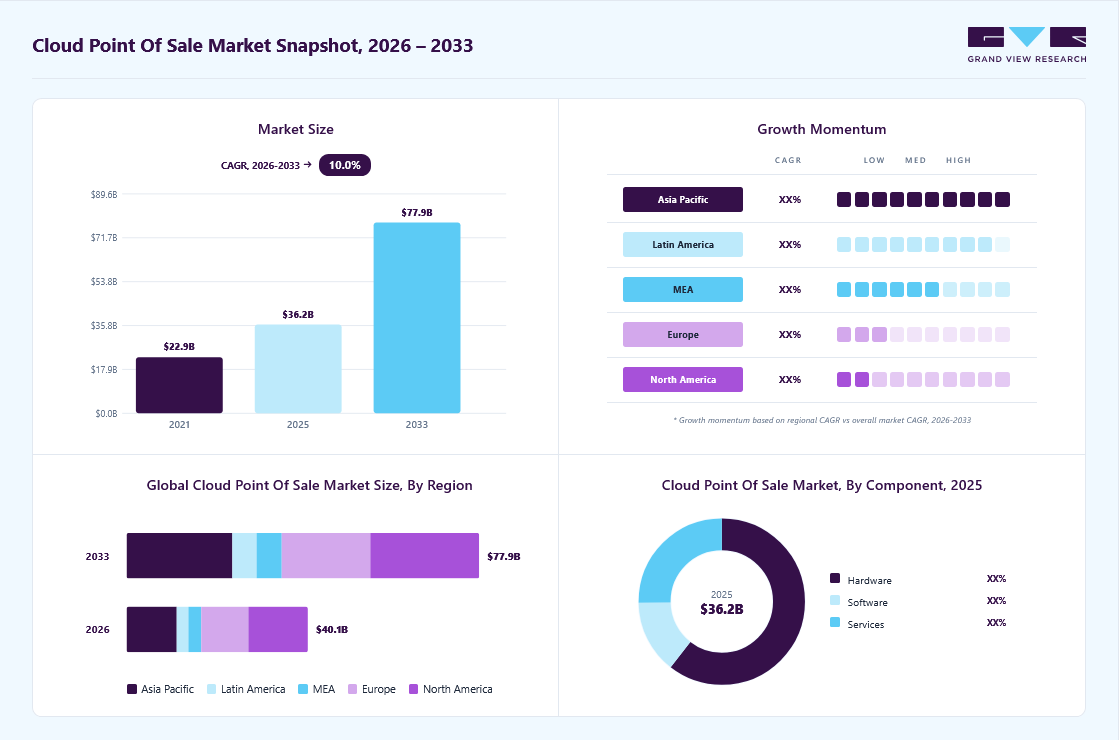
The global cloud point of sale market size was valued at USD 36.2 billion in 2025 and is projected to grow from USD 40.1 billion in 2026 to USD 77.9 billion by 2033, at a CAGR of 10.0% from 2026 to 2033. North America dominated the market, accounting for a revenue share of 33.1% in 2025. This growth is driven by growing omnichannel retail adoption and increasing demand for cloud-based, AI-enabled payment and business management solutions.
 Source: Grand View Research, IR Documents, Primary Interviews, Paid DatabasesTo learn more about this report,
 Download Free Sample Report
Key Market Trends & Insights
- By component: Hardware led the market and accounted for a share of 61.0% in 2025.
- By type: Fixed POS segment dominated the market, with a revenue share of 53.5% in 2025.
- By enterprise size: Large enterprises segment dominated the market, with a revenue share of 56.7% in 2025.
- By end use: Restaurants segment held the largest revenue share in 2025.
Regional Highlights
- Largest regional market: North America (33.1% revenue share, 2025)
- By country: The U.S. held the largest market share in 2025.
Market Size & Forecast
- Market size in 2025: USD 36.2 Billion
- Estimated market size in 2026: USD 40.1 Billion
- Projected market size by 2033: USD 77.9 Billion
- CAGR (2026-2033): 10.0%
Three ways to get this report
Buy it, customize it, or ask a question.Ask an Analyst
Analyst response in 1 business day
- AccessReport author, directly
- Reply timeWithin 1 working day
- No sales callDirect answer only
- FormatEmail reply
- CostFree, no cost
Get the Full Report
What the study covers
- FormatsPDF · Excel · Dashboard
- Timeline2026–2033 annual, 2025 base
- Coverage20+ countries, 5 regions
- Companies10+ key players profiled
Customize the Report
20% free customization
- IncludeCountries, segments, points
- TailorTo your product definition
- ExtendDeeper competitor detail
- OrA fully bespoke study
- Turnaround5–10 working days
Retailers, restaurants, and service providers increasingly require unified platforms that seamlessly integrate in-store, online, and mobile sales channels. The rising demand for cost-efficient, scalable IT infrastructure among small and medium-sized enterprises (SMEs) is a key driver of the cloud point of sale industry, while also influencing the broader POS terminal market and the wireless POS terminal market. Unlike traditional on-premise systems, cloud POS solutions operate on subscription-based models, eliminating the need for significant upfront capital investment in hardware and maintenance. This shift not only accelerates adoption in the Cloud Point of Sale Market but also supports the evolution of the POS terminal market as businesses increasingly transition to flexible, cloud-enabled devices. Moreover, the wireless POS terminal market is gaining momentum, driven by the need for mobility, real-time transaction processing, and seamless connectivity across retail environments.
 To learn more about this report, Download Free Sample Report
The rapid adoption of mobile and contactless payment technologies is also fueling market growth. With increasing consumer preference for digital wallets, QR code payments, NFC-enabled cards, and buy-now-pay-later (BNPL) options, businesses require POS systems that can support diverse and evolving payment ecosystems. Cloud POS platforms are inherently more agile in integrating new payment gateways and complying with regional payment standards, thereby enhancing transaction speed, security, and convenience. For instance, a survey published by U.S.-based fintech payment gateway NMI in April 2026, covering 300 small business owners and 1,000 consumers across the U.S. and the UK, highlights strong momentum for tap-to-mobile payments. The findings show that 95% of SMB owners are open to adopting the technology, including 92% of businesses that currently operate on a cash-only basis. On the consumer side, 83% indicated they would likely use tap-to-mobile payment options if available, while 85% said such offerings would make them more inclined to shop with a business.
Data-driven decision-making and advanced analytics capabilities are further propelling the adoption of cloud POS solutions. These systems capture granular transaction-level data that can be leveraged for demand forecasting, personalized marketing, inventory optimization, and customer lifecycle management. Integration with AI and machine learning tools enables predictive insights, such as identifying purchasing patterns and optimizing pricing strategies. As businesses increasingly prioritize data-centric operations, cloud POS becomes a critical enabler of intelligent retail and service management. For instance, in July 2025, Citrus-Lime introduced a major upgrade to the back office of its Cloud POS platform, rebuilding the system from the ground up to deliver improved speed, performance, and usability. With a fully rewritten codebase, the update provides a more streamlined and efficient experience, enabling retailers to reduce administrative workload and focus more on core business operations.
Market Dynamics
The global cloud point of sale (cloud PoS) market is experiencing strong growth as retailers, restaurants, hospitality providers, healthcare organizations, and service-based businesses increasingly adopt cloud-based platforms to modernize operations and enhance customer experiences. Cloud PoS solutions enable businesses to manage sales transactions, inventory, customer data, employee scheduling, and analytics through centralized, internet-based systems accessible from multiple locations. Modern cloud PoS platforms integrate artificial intelligence (AI), omnichannel commerce, contactless payments, mobile wallets, inventory automation, customer relationship management (CRM), loyalty programs, and real-time business intelligence to improve operational efficiency and decision-making. The rapid expansion of digital payments, e-commerce integration, multi-store retail operations, and subscription-based software deployment models is accelerating demand for cloud PoS solutions that provide scalability, flexibility, lower infrastructure costs, and seamless business management across distributed locations.
The growing adoption of omnichannel retail strategies, digital payment technologies, and cloud-based business management is a significant driver of the global cloud point of sale market. Retailers, restaurants, convenience stores, supermarkets, hospitality providers, and specialty stores are increasingly deploying cloud PoS platforms to unify in-store and online operations while enabling real-time inventory visibility, centralized reporting, and personalized customer engagement. These solutions support contactless payments, mobile ordering, click-and-collect services, loyalty management, AI-powered sales analytics, and seamless integration with accounting, e-commerce, and supply chain systems. Modern cloud PoS platforms leverage cloud infrastructure to provide automatic software updates, remote management, enhanced scalability, and lower total cost of ownership, allowing businesses to quickly adapt to evolving consumer preferences. For instance, in January 2026, Toast introduced new retail-specific capabilities for its Toast IQ AI assistant, enhancing inventory intelligence, pricing optimization, AI invoice scanning, and operational automation to improve cloud-based point-of-sale operations.
Concerns regarding data security, cybersecurity risks, and dependence on stable internet connectivity remain significant restraints for the global cloud point of sale market. Cloud PoS platforms process sensitive customer payment information, business transactions, and operational data, making them attractive targets for cyberattacks, ransomware, and data breaches. Businesses must comply with evolving payment security regulations, data privacy requirements, and industry standards while ensuring secure cloud infrastructure and continuous system availability. Additionally, internet outages, network disruptions, or limited connectivity in remote locations can temporarily affect transaction processing and business operations, particularly for organizations without robust offline capabilities. These challenges may discourage adoption among small businesses with limited IT resources or organizations operating in regions with unreliable network infrastructure.
The rapid expansion of AI-powered analytics, unified commerce platforms, and mobile-first retail technologies presents a significant growth opportunity for the global Cloud Point of Sale market. Businesses are increasingly investing in intelligent Cloud PoS solutions that combine AI-driven demand forecasting, personalized promotions, predictive inventory management, customer behavior analytics, and automated business reporting to improve profitability and customer satisfaction. The continued growth of mobile commerce, self-service kiosks, digital wallets, QR-code payments, and embedded financial services is creating demand for flexible, cloud-native PoS platforms capable of supporting multiple sales channels from a single system. Furthermore, advancements in API-based integrations, edge computing, IoT-enabled retail devices, and subscription-based software delivery are enabling vendors to offer scalable, secure, and future-ready Cloud PoS solutions that support digital transformation across retail, hospitality, healthcare, and service industries.
Analyst Perspective
The cloud PoS market is positioned at the convergence of digital commerce transformation, cloud computing adoption, and the rapid shift toward omnichannel retail and contactless payments. Businesses across retail, restaurants, hospitality, healthcare, entertainment, and service industries are increasingly adopting cloud-based PoS platforms to streamline operations, enhance customer experiences, and enable real-time business management from any location. Unlike traditional on-premise systems, cloud PoS solutions offer centralized management, automatic software updates, seamless scalability, and integration with digital payment platforms, inventory management, customer relationship management (CRM), and e-commerce ecosystems.
Component Insights
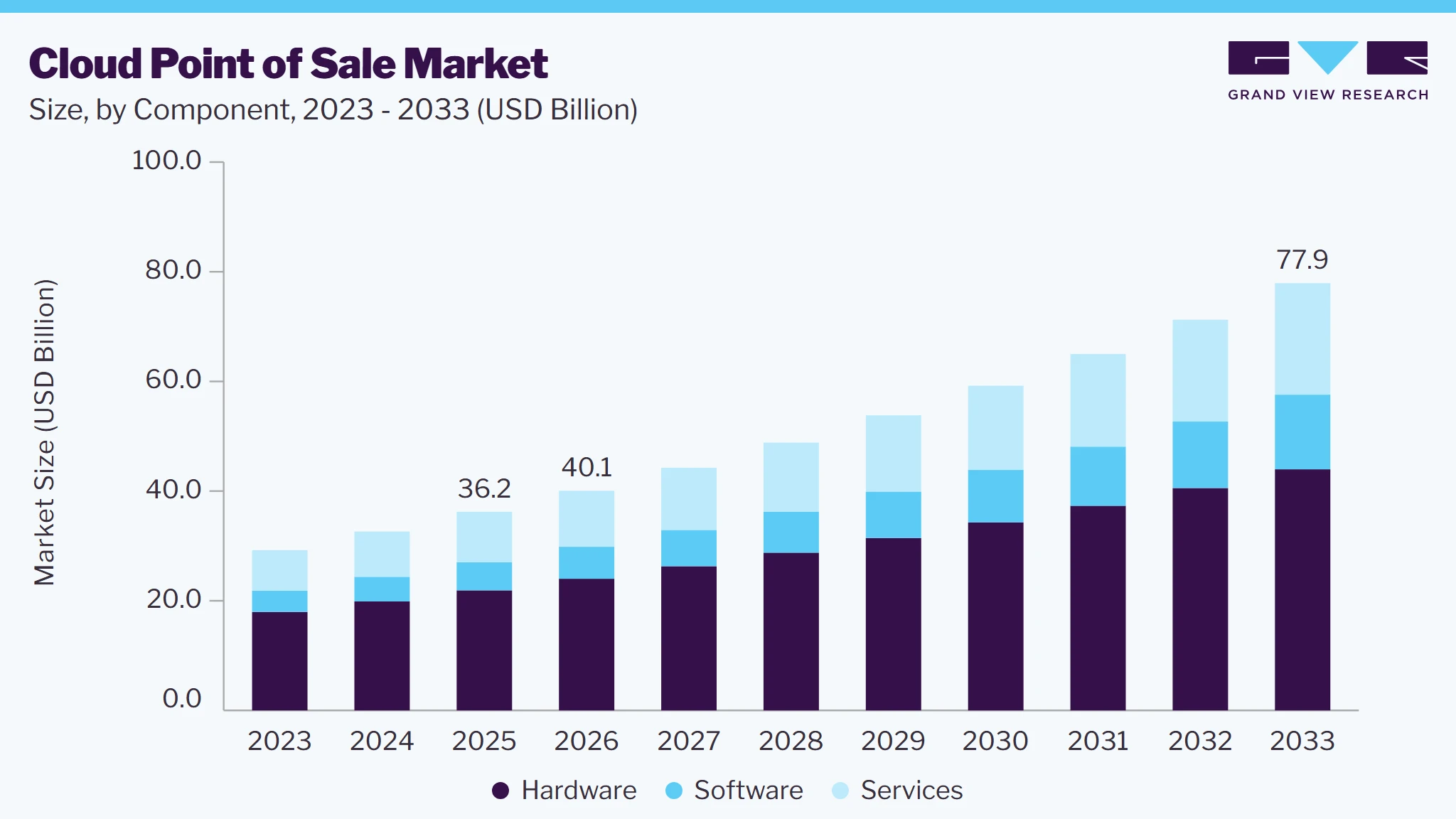
Based on component, the hardware segment led the market with the largest revenue share of 61.0% in 2025, driven by continuous innovation in specialized, high-performance, and purpose-built devices that enhance transaction efficiency and the in-store experience. Modern POS hardware, such as smart terminals, self-service kiosks, handheld ordering devices, and integrated barcode/RFID scanners, is increasingly designed with advanced processors, longer battery life, rugged form factors, and seamless cloud connectivity to support high-volume, real-time operations.
The software segment is anticipated to grow at the fastest CAGR during the forecast period, driven by the rapid evolution of feature-rich, modular, and API-first platforms that enable deep customization and seamless third-party integrations. Vendors are increasingly offering industry-specific software suites with built-in capabilities such as workforce management, loyalty program orchestration, subscription billing, and compliance automation, allowing businesses to tailor POS environments to highly specialized operational workflows.
Type Insights
Based on type, the fixed POS segment led the market with the largest revenue share of 53.5%in 2025, driven by the continued need for high-throughput, stable, and centrally controlled transaction environments in large-format retail, supermarkets, and enterprise hospitality settings. Fixed POS terminals, typically comprising countertop systems with integrated receipt printers, cash drawers, and customer displays, are preferred in scenarios requiring consistent performance, multi-terminal synchronization, and tight control over cashier operations.
The mobile POS segment is expected to grow at a significant CAGR during the forecast period, driven by the increasing need for transaction mobility and decentralized customer engagement across retail and service environments. Businesses are deploying handheld POS devices and tablet-based systems to enable line-busting, table-side ordering, on-the-floor assisted selling, and field-based payments, significantly enhancing customer convenience and reducing wait times.
Enterprise Size Insights
Based on enterprise size, the large enterprises segment led the market with the largest revenue share of 56.7% in 2025, driven by the need for centralized governance, standardization, and global operational consistency across multi-location and multi-country business networks. Enterprises are increasingly adopting cloud POS platforms to enforce uniform pricing strategies, promotional campaigns, taxation rules, and compliance frameworks across many stores, while maintaining real-time visibility into performance metrics at regional and store levels.
The small & medium enterprises segment is expected to grow at a significant CAGR during the forecast period, driven by the increasing availability of plug-and-play, industry-tailored solutions that require minimal technical expertise and enable rapid deployment. Vendors are offering pre-configured POS software bundles for specific verticals, such as cafés, salons, boutiques, and small clinics, enabling SMEs to go live quickly without complex customization.
End-use Insights
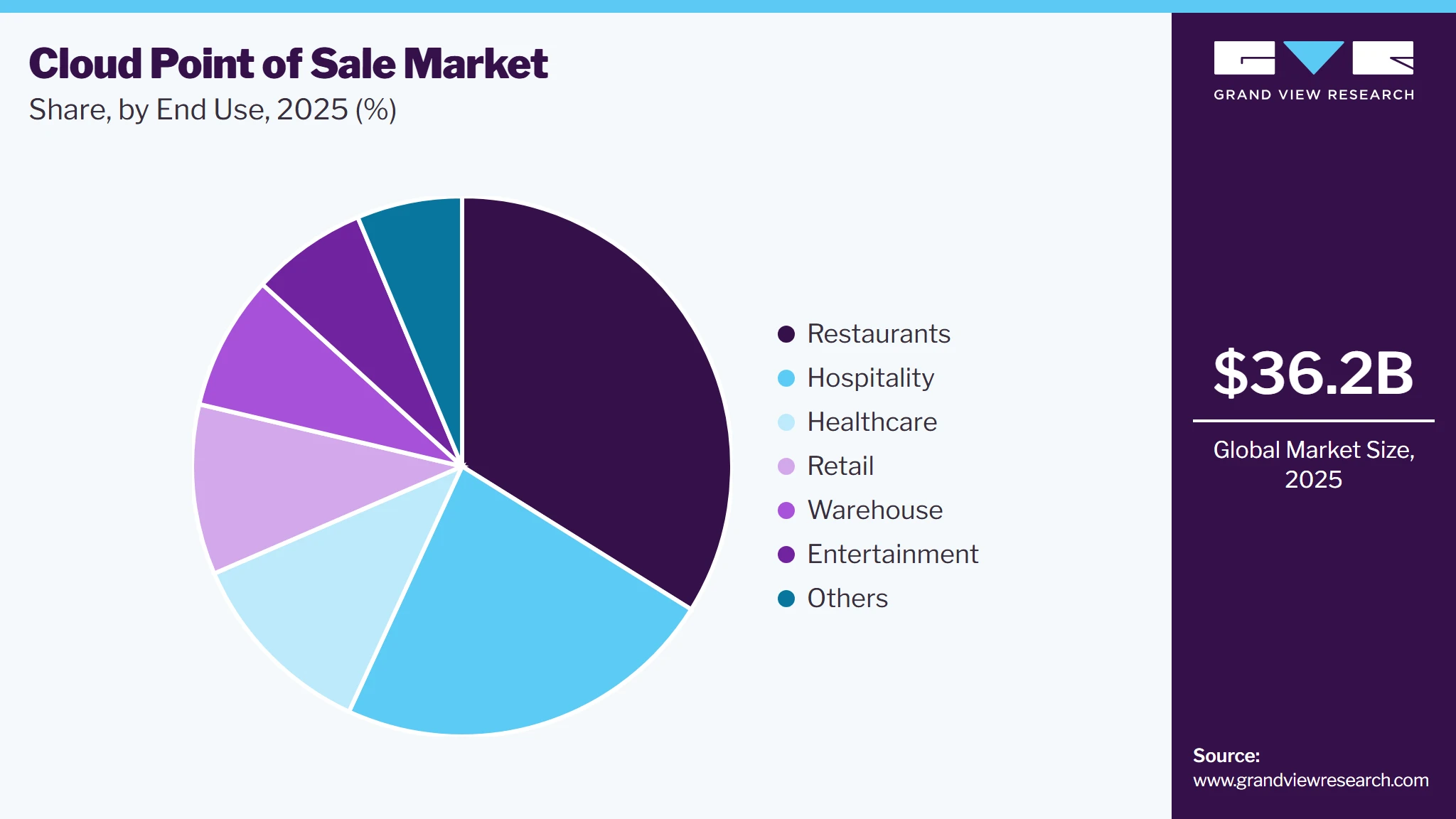
Based on end use, defense & military segment led the market with the largest revenue share of 34.2% in 2025, driven by the increasing need for tightly integrated kitchen-to-front-of-house workflows that enhance order accuracy, speed, and service quality. Modern cloud POS solutions enable real-time synchronization among order entry systems, kitchen display systems (KDS), and inventory tracking systems, reducing manual errors and improving table turnover rates.
 To learn more about this report, Download Free Sample Report
The healthcare segment is expected to grow at a significant CAGR over the forecast period, driven by the increasing need to streamline patient billing, pharmacy transactions, and ancillary service payments within a unified, compliant digital framework. Healthcare providers are adopting cloud POS solutions to manage complex billing structures involving insurance co-payments, package-based treatments, and multi-department service charges with greater accuracy and transparency.
Regional Insights
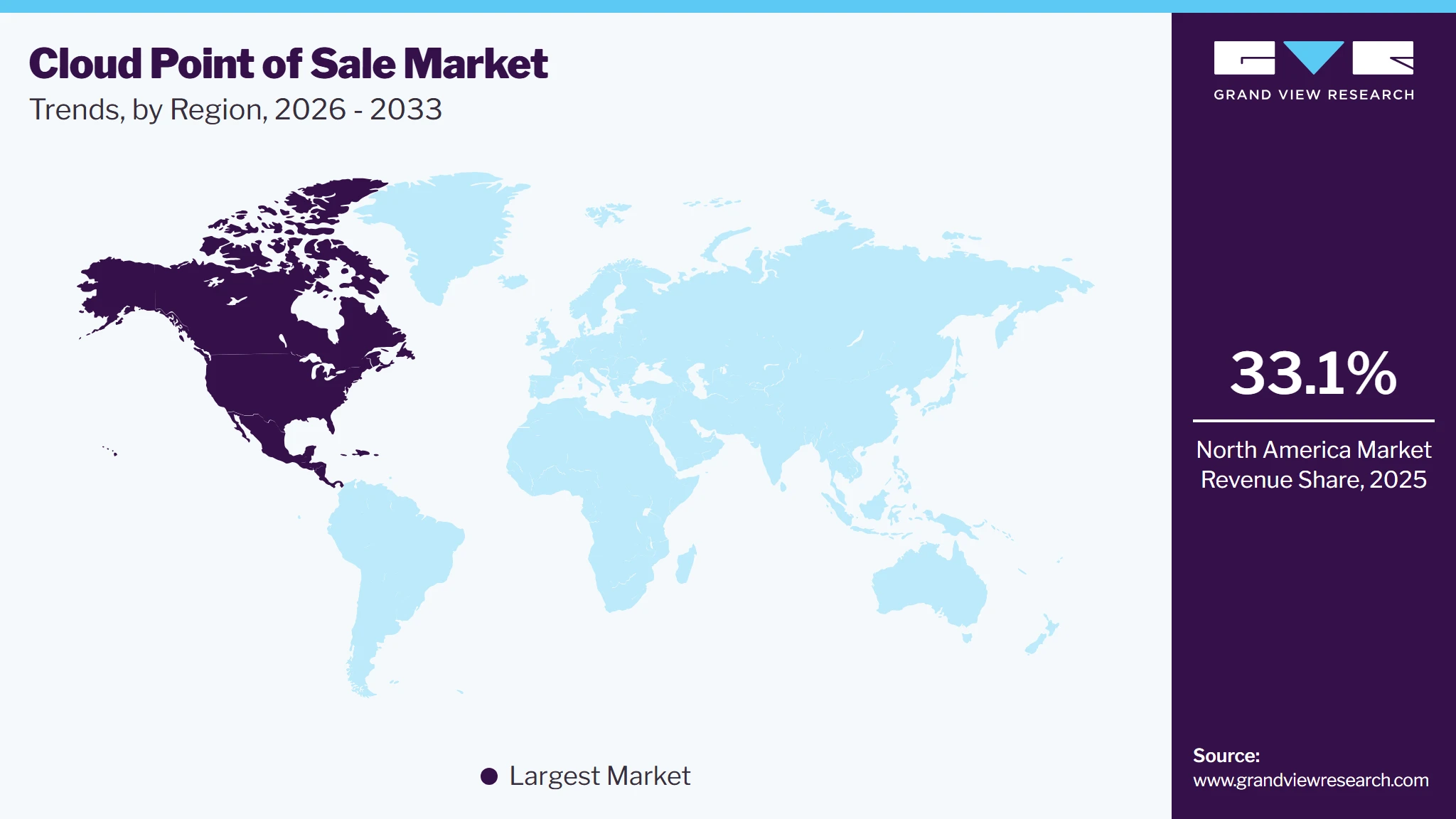
North America dominated the global cloud point of sale market with the largest revenue share of 33.1% in 2025, driven bythe rapid convergence of POS systems with advanced retail media networks and in-store digital engagement platforms. Businesses are increasingly leveraging POS-integrated advertising, digital signage, and personalized promotions triggered at checkout, transforming POS systems into revenue-generating touchpoints.
 To learn more about this report, Download Free Sample Report
U.S. Cloud Point of Sale Market Trends
The cloud point of sale market in the U.S. held the largest share in the North America region in 2025, due tothe strong emphasis on subscription-based and service-oriented business models across the retail and hospitality sectors. Cloud POS systems are being adopted to manage recurring billing, memberships, bundled offerings, and service add-ons with precision.
Europe Cloud Point of Sale Market Trends
The cloud point of sale industry in Europe is anticipated to register considerable growth from 2026 to 2033, driven by stringent fiscal requirements and electronic invoicing mandates across multiple countries. Governments are enforcing real-time transaction reporting, digital receipts, and tamper-proof fiscal systems, compelling businesses to adopt compliant, cloud-enabled POS platforms.
The UK cloud point of sale marketis expected to grow rapidly in the coming years, owing to the rapid expansion of unattended retail formats such as automated stores, smart vending machines, and self-checkout systems. These formats rely heavily on cloud POS infrastructure for remote monitoring, transaction validation, and system updates.
The cloud point of sale market in Germany held a substantial share in 2025, driven by the widespread adoption of secure digital transaction systems aligned with the country’s Kassensicherungsverordnung (KassenSichV) regulations. Businesses are required to deploy certified technical security systems (TSS) for transaction recording, prompting a shift toward cloud POS solutions that can ensure compliance while simplifying certification and audit processes.
Asia Pacific Cloud Point of Sale Market Trends
The Asia Pacific cloud point of sale industry held a significant global share in 2025, driven by the rapid formalization of informal retail and the expansion of organized retail networks in emerging economies. Governments and financial institutions are promoting digital transaction ecosystems, encouraging small merchants to transition from cash-based operations to digital POS-enabled systems.
The Japan cloud point of sale market is expected to grow rapidly in the coming years, driven by the need to address labor shortages and improve operational efficiency through automation in the retail and foodservice sectors. Cloud POS systems are being integrated with robotics, automated ordering systems, and smart inventory controls to reduce reliance on human staff.
The cloud point of sale market in China held a substantial share in 2025, due to the deep integration of POS systems with super-app ecosystems and social commerce platforms. Businesses are leveraging POS systems that can seamlessly connect with platforms such as WeChat and Alipay to enable in-app purchases, loyalty programs, and social-driven transactions.
Key Cloud Point Of Sale Company Insights
Key players operating in the cloud point of sale industry are Block, Inc.; Intuit Inc.; Shopify; Lightspeed; Clover Network, LLC; Toshiba Global Commerce Solutions; NEC Corporation; NCR Voyix Corporation; Oracle Corporation; PAX Technology, and SAMSUNG. The companies are focusing on various strategic initiatives, including new product development, partnerships & collaborations, and agreements to gain a competitive advantage over their rivals. The following are some instances of such initiatives.
-
In April 2026, Block, Inc. and Uber Technologies, Inc. formed a global partnership to enhance restaurant operations and payments. The deal expands Square’s Uber Eats integration internationally, allowing restaurants to manage orders within their POS systems and streamline workflows while introducing Cash App Pay for Uber and Uber Eats users in the U.S.
-
In March 2026, Lightspeed Commerce and Faire partnered to launch a wholesale integration within Lightspeed’s retail POS platform, enabling merchants to discover and order products directly from Faire’s supplier network. Embedded into Lightspeed Retail, the integration enhances POS functionality by streamlining procurement and inventory sourcing, while strengthening omnichannel and back-office capabilities within modern cloud POS systems.
-
In January 2026, Toshiba Global Commerce Solutions announced the launch of a comprehensive suite of retail technology solutions targeting businesses across segments, including AI-driven software, mobile enterprise tools, and advanced point-of-sale (POS) systems. Designed with a modular architecture, these solutions leverage AI, computer vision, and machine learning to enable retailers to customize, scale, and align technology deployments with their specific operational goals.
Key Cloud Point Of Sale Companies
The following key companies have been profiled for this study on the cloud point of sale market.
-
Block, Inc.
-
Cegid Group
-
Clover Network, LLC
-
Ingenico
-
Intuit Inc.
-
Lightspeed
-
NCR Voyix Corporation
-
NEC Corporation
-
Oracle Corporation
-
PAX Global Technology Ltd.
-
SAMSUNG
-
Shopify
-
Toast Inc.
-
Toshiba Global Commerce Solutions
-
Verifone, Inc.
Competitive Benchmarking
Category
Operating Strategies
Competitive Edge
Weakness
Established Players (Oracle Corporation, NCR Voyix Corporation, Block, Inc., Clover Network, LLC, Ingenico, SAMSUNG, Toshiba Global Commerce Solutions)
Expand cloud-native PoS platforms by integrating AI-driven analytics, omnichannel commerce, digital payments, inventory management, CRM, loyalty programs, and embedded financial services.
Strengthen partnerships with payment processors, retailers, hospitality chains, banks, ISVs, and system integrators while investing in cloud infrastructure, cybersecurity, mobile payments, and unified commerce capabilities.
Extensive global customer base, established partner ecosystems, comprehensive hardware and software portfolios, and strong brand recognition enable large-scale enterprise deployments across retail, hospitality, healthcare, and other commercial sectors.
Broad product offerings, global service networks, and continuous innovation provide high customer retention and long-term recurring SaaS revenue.
Large enterprise platforms often involve higher implementation costs, complex deployment processes, and longer sales cycles.
Legacy infrastructure and extensive product portfolios may slow innovation and customization compared with cloud-native competitors.
Emerging Players (Toast Inc., Lightspeed, Shopify)
Focus on cloud-native, SaaS-based PoS platforms with AI-powered business insights, mobile-first capabilities, omnichannel retail integration, self-service ordering, subscription-based pricing, and rapid feature innovation.
Differentiate through industry-specific solutions, seamless e-commerce integration, flexible APIs, and continuous platform enhancements for SMEs and mid-market businesses.
Agile product development, intuitive user experience, flexible subscription models, and strong cloud capabilities enable rapid customer acquisition and high scalability.
Vertical specialization, particularly in restaurants, retail, and hospitality, allows faster response to evolving customer requirements.
Comparatively smaller global service networks, lower penetration among large multinational enterprises, and greater dependence on specific industry verticals may limit expansion into highly complex enterprise environments.
Intense competition from established vendors and payment providers can increase customer acquisition costs.
Cloud Point Of Sale Market Report Scope
Report Attribute
Details
Market size in 2025
USD 36.2 billion
Estimated Market size in 2026
USD 40.1 billion
Projected Market size by 2033
USD 77.9 billion
Growth rate
CAGR of 10.0% from 2026 to 2033
Base year for estimation
2025
Historical data
2021 - 2024
Forecast period
2026 - 2033
Quantitative units
Revenue in USD million/billion and CAGR from 2026 to 2033
Report coverage
Revenue forecast, company market share analysis, competitive landscape, growth factors, and trends
Segments covered
Component, type, enterprise size, end use, and region
Regional scope
North America; Europe; Asia Pacific; Latin America; MEA
Country scope
U.S.; Canada; Mexico; Germany; UK; France; China; Japan; India; South Korea; Australia; Brazil; Saudi Arabia; South Africa; UAE
Key companies profiled
Block, Inc.; Cegid Group; Clover Network, LLC; Ingenico;Intuit Inc.; Lightspeed; NCR Voyix Corporation; NEC Corporation; Oracle Corporation; PAX Global Technology Ltd.; SAMSUNG; Shopify; Toast Inc.; Toshiba Global Commerce Solutions; Verifone, Inc.
Customization scope
Free report customization (equivalent up to 8 analysts' working days) with purchase. Addition or alteration to country, regional & segment scope.
Pricing and purchase options
Avail customized purchase options to meet your exact research needs. Explore purchase options
Global Cloud Point Of Sale Market Report Segmentation
This report forecasts revenue growth at the global, regional, and country levels and provides an analysis of the latest industry trends in each of the sub-segments from 2021 to 2033. For this study, Grand View Research has segmented the global cloud point of sale market report based on component, type, enterprise size, end-use, and region:
-
Component Outlook (Revenue, USD Billion, 2021 - 2033)
-
Hardware
-
Software
-
Services
-
-
Type Outlook (Revenue, USD Billion, 2021 - 2033)
-
Fixed POS
-
Mobile POS
-
-
Enterprise Size Outlook (Revenue, USD Billion, 2021 - 2033)
-
Small & Medium Enterprises
-
Large Enterprise
-
-
End-use Outlook (Revenue, USD Billion, 2021 - 2033)
-
Restaurants
-
Hospitality
-
Healthcare
-
Retail
-
Warehouse
-
Entertainment
-
Others
-
-
Regional Outlook (Revenue, USD Billion, 2021 - 2033)
-
North America
-
U.S.
-
Canada
-
Mexico
-
-
Europe
-
UK
-
Germany
-
France
-
-
Asia Pacific
-
China
-
India
-
Japan
-
South Korea
-
Australia
-
-
Latin America
-
Brazil
-
-
Middle East & Africa
-
UAE
-
Saudi Arabia
-
South Africa
-
-
Research Methodology
The cloud point of sale Market figures in this report are based on a proven research process that combines executive interviews with secondary research from proprietary databases, company filings, and recognized regulatory and institutional sources. Market size is built through value-chain sizing - reconciling supply-side and demand-side estimates - and triangulated with bottom-up and top-down approaches. Every estimate passes multiple levels of expert validation before publication, with each cloud point of sale Market segment quantified using the revenue-capture definitions in the table below.
Segment Definition
Segment - Component
Revenue capture definition
Hardware
Revenue is generated from the sale cloud PoS hardware used to process transactions and support retail and service operations. Revenue includes fixed POS terminals, mobile POS devices, tablets, touchscreen displays, barcode scanners, receipt printers, cash drawers, payment terminals, customer displays, card readers, kiosks, and other peripheral hardware integrated with cloud-based PoS systems.
Software
Revenue is generated from subscription fees, licensing, and recurring SaaS payments for cloud-based point of sale software. Revenue includes transaction processing software, inventory management, customer relationship management (CRM), employee management, reporting and analytics, loyalty management, digital ordering, omnichannel commerce, payment integration, and other cloud-hosted PoS applications.
Services
Revenue is generated from professional and managed services supporting cloud PoS deployment and operation. Revenue includes implementation, installation, system integration, customization, consulting, migration, employee training, technical support, maintenance, managed services, and software upgrades.
Segment - Type
Revenue capture definition
Fixed POS
Revenue is generated from cloud-based point of sale solutions deployed on stationary checkout terminals installed at fixed business locations. Revenue includes software subscriptions, integrated hardware, payment processing capabilities, and associated services supporting permanent checkout counters in retail stores, restaurants, hotels, healthcare facilities, and other commercial establishments.
Mobile POS
Revenue is generated from cloud-based point of sale solutions operating on smartphones, tablets, handheld terminals, and other portable devices. Revenue includes mobile PoS software subscriptions, compatible payment readers, wireless transaction processing, digital payment acceptance, and related implementation and support services that enable transactions from any location.
Segment - Enterprise Size
Revenue capture definition
Small & Medium Enterprises
The SMEs segment, with respect to the number of employees, generally includes organizations employing between 10 and 999 employees.
Large Enterprise
The large enterprises segment, with respect to the number of employees, typically comprises organizations employing more than 1,000 employees for multinational corporations.
Segment - End Use
Revenue capture definition
Restaurants
Revenue is generated from cloud PoS solutions deployed by quick-service restaurants, full-service restaurants, cafés, food trucks, and other foodservice establishments. Revenue includes software subscriptions, hardware, payment processing, online ordering integration, kitchen display systems, and related services.
Hospitality
Revenue is generated from cloud PoS solutions used by hotels, resorts, bars, clubs, casinos, and other hospitality establishments. Revenue includes guest billing, food and beverage management, property management system integration, payment processing, and related implementation and support services.
Healthcare
Revenue is generated from cloud PoS solutions used by hospitals, clinics, pharmacies, diagnostic centers, and other healthcare providers. Revenue includes patient billing, pharmacy transaction management, inventory tracking, payment processing, and associated software and services.
Retail
Revenue is generated from cloud PoS solutions deployed across supermarkets, convenience stores, department stores, specialty retailers, fashion outlets, electronics stores, and e-commerce-enabled retailers. Revenue includes software subscriptions, hardware, inventory management, omnichannel integration, customer loyalty solutions, and related services.
Warehouse
Revenue is generated from cloud PoS solutions supporting warehouse stores, wholesale distributors, cash-and-carry operators, and fulfillment centers. Revenue includes inventory tracking, order management, payment processing, barcode scanning, and associated cloud-based software and services.
Entertainment
Revenue is generated from cloud PoS solutions used by cinemas, amusement parks, stadiums, museums, event venues, gaming centers, and other entertainment facilities. Revenue includes ticketing integration, concession sales, cashless payments, customer management, and related software and services.
Others
Revenue is generated from cloud PoS solutions deployed across beauty salons, spas, fitness centers, educational institutions, transportation services, automotive service providers, government facilities, and other commercial and service organizations utilizing cloud-based point-of-sale platforms.
Estimation Model
Layer
Question
Analysis
Business Transaction Digitalization Layer
Who can benefit from cloud PoS solutions?
Identify organizations that require digital transaction processing, centralized business management, and real-time sales visibility across one or multiple locations. These include retail stores, restaurants, hotels, cafés, supermarkets, pharmacies, healthcare providers, entertainment venues, warehouses, convenience stores, and service-based businesses. Organizations seeking to improve operational efficiency, customer experience, inventory accuracy, omnichannel commerce, and payment flexibility represent the core demand base for cloud PoS solutions.
Cloud Infrastructure & Digital Readiness Layer
Who can deploy cloud PoS solutions?
Evaluate organizations based on cloud adoption maturity, internet connectivity, digital payment acceptance, omnichannel retail strategies, mobile workforce enablement, and IT modernization initiatives. Businesses utilizing SaaS applications, cloud infrastructure, e-commerce platforms, CRM systems, ERP software, digital payment gateways, and mobile business applications possess the operational readiness to successfully deploy cloud PoS platforms across single-site and multi-location operations.
Adoption & Utilization Layer
Who actively uses cloud PoS solutions?
Analyze the deployment of cloud PoS platforms across retail chains, supermarkets, specialty stores, restaurants, cafés, hotels, pharmacies, healthcare facilities, entertainment venues, warehouses, convenience stores, and field service operations. Active users include retailers, restaurant operators, hospitality providers, healthcare organizations, warehouse operators, entertainment businesses, and service enterprises utilizing cloud-based platforms for transaction processing, inventory management, customer engagement, employee management, digital payments, and business analytics.
Monetization Layer
How much revenue is generated?
Assess revenue generated through subscriptions and licensing of cloud PoS software, sales of compatible hardware including POS terminals, tablets, barcode scanners, receipt printers, cash drawers, payment terminals, kiosks, and mobile card readers. Additional revenue streams include implementation, system integration, customization, consulting, cloud hosting, payment processing services, software updates, technical support, maintenance, employee training, managed services, analytics modules, loyalty management, omnichannel commerce capabilities, and long-term SaaS subscription contracts supporting cloud-based point-of-sale operations.
Delivered Customizations
This report has been delivered with the following In-depth customizations
Client Request
Customization Delivered
Value Adds
AI-Driven Retail Analytics & Intelligent PoS Trends
Conducted a structured analysis of cloud PoS technologies focused on AI-powered sales analytics, demand forecasting, customer behavior analysis, personalized promotions, automated inventory management, and intelligent business reporting.
Helps stakeholders understand evolving AI-enabled retail technologies, identify high-growth Cloud PoS innovations, and evaluate commercialization opportunities across retail, hospitality, and service industries.
Omnichannel Commerce & Digital Payment Trends
Conducted a comprehensive analysis of cloud PoS adoption across omnichannel retail, e-commerce integration, contactless payments, mobile wallets, QR code payments, embedded finance, loyalty programs, and unified commerce platforms.
Helps stakeholders identify opportunities in digital commerce transformation, assess omnichannel investment strategies, and evaluate technologies that enhance customer experience and operational efficiency.
SME Digital Transformation & Cloud Adoption Trends
Conducted a comprehensive analysis of cloud PoS deployment among SMEs, focusing on SaaS adoption, subscription-based business models, mobile PoS, remote business management, cloud infrastructure, and scalable retail technology solutions.
Helps stakeholders understand Cloud PoS adoption among small and medium-sized businesses, evaluate cloud migration strategies, and assess growth opportunities driven by digital transformation, operational efficiency, and expanding cloud-based business management solutions.
Frequently Asked Questions About This Report
The global cloud point of sale market is expected to grow at a compound annual growth rate of 10.0% from 2026 to 2033 to reach USD 77.9 billion by 2033.
Key factors include growing adoption of omnichannel retail strategies, digital payment technologies, and cloud-based business management.
The fixed POS segment led with a 53.5% revenue share in 2025, while the mobile POS segment is the fastest-growing segment.
The restaurants segment held the largest share (over 34.0%) in 2025, while the healthcare segment is the fastest-growing segment.
Key players operating in the cloud point of sale market include Block, Inc.; Cegid Group; Clover Network, LLC; Ingenico;Intuit Inc.; Lightspeed; NCR Voyix Corporation; NEC Corporation; Oracle Corporation; PAX Global Technology Ltd.; SAMSUNG; Shopify; Toast Inc.; Toshiba Global Commerce Solutions; Verifone, Inc.
The global cloud point of sale market size was estimated at USD 36.2 billion in 2025 and is expected to reach USD 40.1 billion in 2026.
North America dominated with 33.1% revenue share in 2025.
Asia Pacific is the fastest-growing region over the forecast period.
The hardware segment led with a 61.0% revenue share in 2025, while the software segment is the fastest-growing segment.
About the Author(s)
IT Services & Applications Research Team
Technology · IT Services & ApplicationsThis report was authored by the it services & applications research team at Grand View Research - comprising two research analysts, one senior research analyst, and one industry expert - with specialized expertise in the it services & applications segment of the technology industry. All findings are based on proprietary technology databases, executive interviews, and regulatory analysis, subject to internal peer review prior to publication.
Last Updated:
Speak to Analyst

Customize this report to your needs - add regions, segments, or data points, with 20% free customization.
Or view our licence options:


ISO 9001:2015 & 27001:2022 Certified
We are GDPR and CCPA compliant! Your transaction & personal information is safe and secure. For more details, please read our privacy policy.


