
- Home
- »
- Next Generation Technologies
- »
-
Cloud Robotics Market Size & Share, Industry Report, 2033GVR Report cover

Cloud Robotics Market (2025 - 2033) Size, Share & Trends Analysis Report By Component (Solution, Services), By Service Model, By Robot Type, By Industry Vertical, By Region, And Segment Forecasts
Market Size, 2024
$7.8BMarket Estimate, 2026
$9.5BMarket Forecast, 2033
$55.7BCAGR, 2025–2033
24.8%Cloud Robotics Market Summary
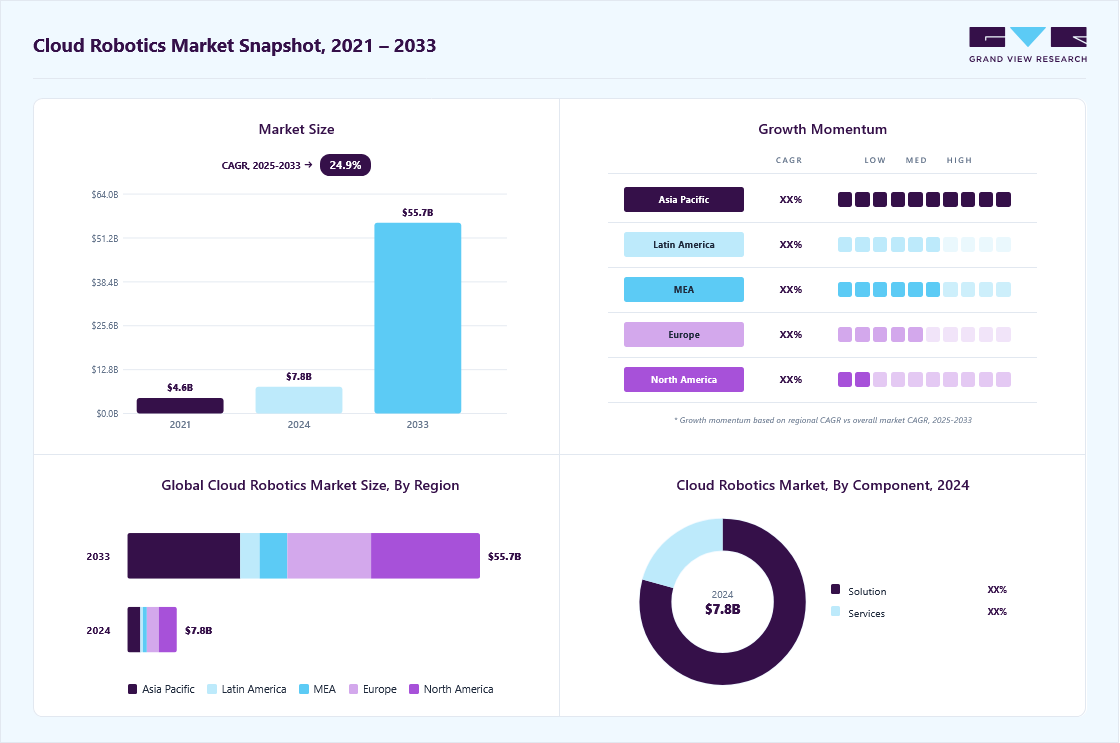
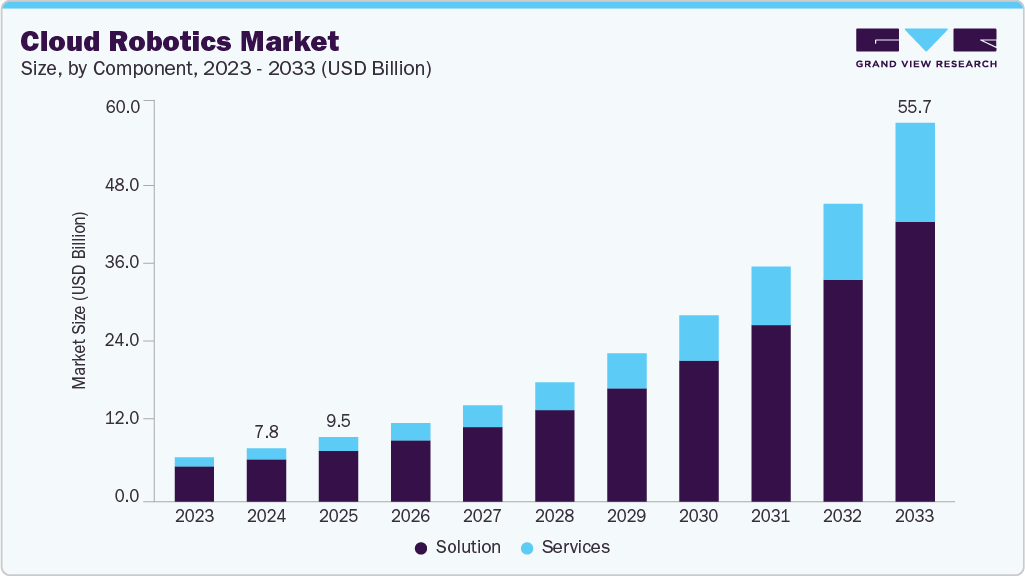
The global cloud robotics market size was estimated at USD 7.83 billion in 2024 and is projected to reach USD 55.68 billion by 2033, growing at a CAGR of 24.8% from 2025 to 2033. The market is witnessing steady growth, driven by the increasing demand for smart warehousing, autonomous delivery, and last-mile logistics solutions.
 Source: Grand View Research, IR Documents, Primary Interviews, Paid DatabasesTo learn more about this report,
 Download Free Sample Report
 Key Market Trends & Insights
- North America emerged as the leading regional market in 2024, capturing a 36.3% revenue share of the global cloud robotics market.
- In the U.S., cybersecurity and data governance plays a crucial role in driving cloud robotics market growth.
- By component, the solution segment held the largest revenue share of over 79.2% in 2024.
- By service model, the SaaS segment held the largest revenue share in 2024.
- By robot type, the industrial robot segment held the largest revenue share in 2024.
Market Size & Forecast
- 2024 Market Size: USD 7.83 Billion
- 2033 Projected Market Size: USD 55.68 Billion
- CAGR (2025-2033): 24.8%
- North America: Largest Market in 2024
- Asia Pacific: Fastest growth market
Three ways to get this report
Buy it, customize it, or ask a question.Ask an Analyst
Analyst response in 1 business day
- AccessReport author, directly
- Reply timeWithin 1 working day
- No sales callDirect answer only
- FormatEmail reply
- CostFree, no cost
Get the Full Report
What the study covers
- FormatsPDF · Excel · Dashboard
- Timeline2025–2033 annual, 2024 base
- Coverage20+ countries, 5 regions
- Companies10+ key players profiled
Customize the Report
20% free customization
- IncludeCountries, segments, points
- TailorTo your product definition
- ExtendDeeper competitor detail
- OrA fully bespoke study
- Turnaround5–10 working days
The accelerating development and deployment of the Industrial Internet of Things (IIoT) and 5G networks, which enhance the connectivity and responsiveness of cloud-connected robots, is driving growth in the cloud robotics market. With the low latency and high bandwidth provided by 5G, robots can communicate with cloud platforms in near real-time, enabling faster decision-making and coordination across distributed systems. This is particularly beneficial for applications such as autonomous vehicles, drone fleets, and collaborative robots (cobots) working alongside humans in warehouses and factories. The seamless integration of cloud robotics within smart infrastructure allows organizations to optimize workflows, reduce operational costs, and quickly scale robotic solutions without extensive on-premise investments.The growing demand for scalable, intelligent robotic systems across various industries, such as manufacturing, logistics, agriculture, and healthcare, is driving the cloud robotics industry’s growth. Traditional robots often encounter limitations in processing power, storage capacity, and real-time decision-making. By utilizing the cloud, robotic systems can offload data-intensive tasks like complex simulations, object recognition, and machine learning model updates, thereby alleviating hardware constraints and enabling smarter, more adaptive behaviors. This capability not only boosts performance but also expands the usefulness of robots in more dynamic and unpredictable environments.
 To learn more about this report, Download Free Sample Report
 The expansion of e-commerce and on-demand services is also contributing to the growth of the cloud robotics market. As companies strive to enhance fulfillment speed and accuracy, cloud-connected robots are increasingly deployed in warehouses and distribution centers. These robots can coordinate tasks through centralized platforms, optimize routing, manage inventory in real time, and respond dynamically to changes in demand. In this context, cloud robotics serves as a key enabler of an agile and responsive logistics infrastructure, which is vital in an era of rapidly shifting consumer expectations.
The global shift toward smart cities and intelligent infrastructure is another factor driving the advancement of cloud robotics. In urban environments, robots are being deployed for tasks such as surveillance, maintenance, and autonomous transportation. These applications often require real-time data integration from traffic systems, weather updates, environmental sensors, and other urban data streams, all of which are best managed through cloud platforms. Cloud robotics enables centralized coordination of multiple robotic units operating in complex environments, making city-wide deployments more feasible and effective. Additionally, government and municipal initiatives focused on digital transformation are providing funding and regulatory support, further enhancing adoption in public sector projects.
Furthermore, the growing integration of artificial intelligence (AI) and machine learning (ML) in robotics is increasing the demand for cloud-based processing. Training and deploying advanced AI models necessitate substantial computational resources, which often exceed the capacity of individual robots. The cloud offers a centralized environment where AI models can be trained on aggregated data from various sources and continuously enhanced. Robots connected to the cloud can then automatically update their algorithms, resulting in collective learning across fleets of machines. This cycle of continuous improvement accelerates innovation and enables the rapid adoption of AI-driven features such as natural language processing, predictive maintenance, and adaptive navigation.
Component Insights
The solution segment dominated the cloud robotics market with a revenue share of 79.2% in 2024. The rising demand for integrated platforms that blend robotic functionalities with advanced cloud-based services is fueling segment growth. These solutions encompass the robots themselves as well as the software, middleware, and cloud infrastructure that manage data processing, analytics, remote control, and automation orchestration. As industries seek comprehensive systems that seamlessly deploy, monitor, and update fleets of robots, end-to-end solutions have become more appealing than fragmented or hardware-only options. Companies strive for enhanced operational efficiency, and bundled cloud robotics solutions provide this by facilitating centralized control and real-time data access, reducing latency, and enabling dynamic reconfiguration of robotic tasks across various locations and environments.
The services segment is projected to grow at a significant CAGR from 2025 to 2033. The emergence of service-based business models such as robotics-as-a-Service (RaaS) is reshaping how organizations approach automation. Instead of investing in full ownership of robotic infrastructure, many companies prefer to subscribe to cloud robotics services on a usage-based or subscription model. This reduces capital expenditures and enables businesses to scale up or down based on operational demands. This increasing preference for service-based models contributes to the expansion of the services segment, making it one of the most dynamic components of the cloud robotics ecosystem.
Service Model Insights
The SaaS segment dominated the cloud robotics industry in 2024. Software-as-a-service (SaaS) platforms enable seamless interoperability among various robotic devices and business applications. The modular architecture of SaaS solutions allows them to function as central hubs, integrating with other cloud services, IoT platforms, and enterprise software such as ERP or warehouse management systems. This interoperability is essential for industries that depend on real-time data synchronization and multi-device coordination across geographically distributed operations. For instance, a logistics provider can oversee a diverse fleet of autonomous robots at multiple warehouses from a single SaaS dashboard, streamlining operations while ensuring consistency and control.
The infrastructure as a service (IaaS) segment is projected to grow at a significant CAGR from 2025 to 2033. The development of robotics in test environments and simulation platforms is driving the demand for IaaS. Developers can utilize cloud infrastructure to execute large-scale simulations of robotic operations, experiment with algorithm adjustments, or test new functionalities on virtual models before deploying them to physical robots. This approach reduces the time and cost associated with trial and error in real-world settings. IaaS providers facilitate this by offering powerful GPU-enabled instances and containerized environments optimized for robotics software stacks, thus accelerating the design and testing process for both startups and large enterprises.
Robot Type Insights
The industrial robot segment dominated the cloud robotics market in 2024. The rise of robotics development in test environments and simulation platforms is driving the demand for IaaS. Developers can utilize cloud infrastructure to execute large-scale simulations of robotic operations, experiment with algorithm adjustments, or test new functionalities across virtual models prior to deploying them to physical robots. This decreases the time and cost associated with trial and error in real-world settings. IaaS providers facilitate this by offering robust GPU-enabled instances and containerized environments optimized for robotics software stacks, accelerating the design and testing process for both startups and large enterprises.
The service robot segment is projected to be the fastest-growing segment from 2025 to 2033. The growth of smart homes and connected ecosystems is propelling the demand for domestic service robots integrated with cloud platforms. Robotic vacuum cleaners, lawnmowers, and home assistants are increasingly connected to cloud environments, allowing them to receive software updates, sync schedules across devices, and interact with larger smart home infrastructures. For consumers, this translates to greater convenience, ongoing enhancements to functionality, and the ability to manage their robots remotely through mobile apps or voice interfaces. For manufacturers and developers, cloud robotics facilitates detailed usage data collection, which supports product enhancements, predictive maintenance, and customer support automation.
Industry Vertical Insights
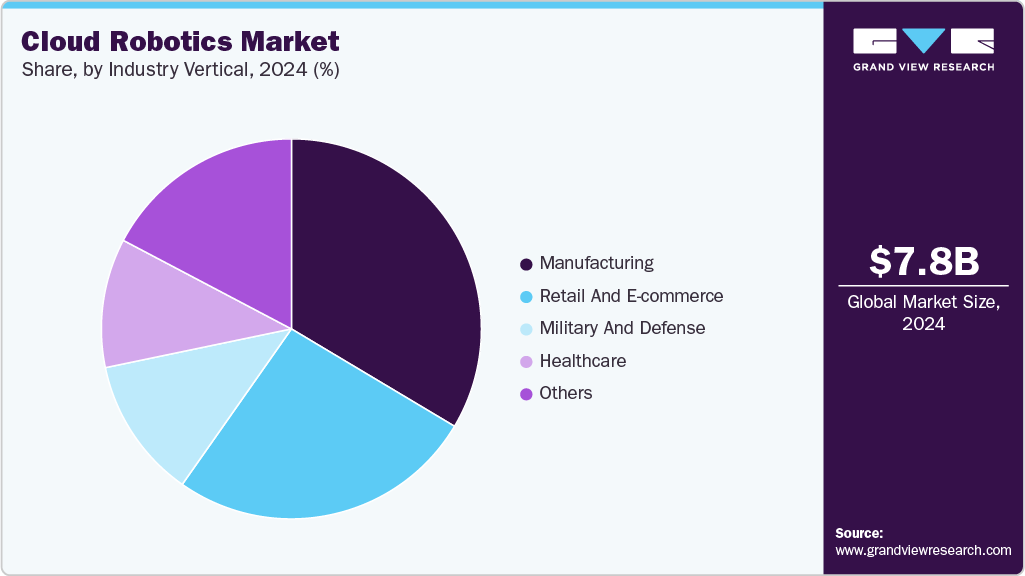
The manufacturing segment dominated the cloud robotics market in 2024. The convergence of robotics with cloud-based digital twins and simulation platforms enhances productivity in the manufacturing sector. Manufacturers can utilize cloud-hosted digital twins to model and test robotic behavior virtually before deployment. These simulations are continuously fed with real-world data from robots on the factory floor, ensuring that the virtual and physical systems remain in sync. This real-time feedback loop enables ongoing process improvement, faster innovation cycles, and risk-free experimentation. The capability to simulate and remotely manage robotic systems through the cloud is becoming a strategic advantage for manufacturers aiming to stay competitive in highly dynamic markets.
 To learn more about this report, Download Free Sample Report
 The retail and e-commerce segment is projected to be the fastest-growing segment from 2025 to 2033. The increasing adoption of automated delivery robots and drones in the last-mile logistics is further advancing the role of cloud robotics in retail and e-commerce. These autonomous delivery solutions are typically managed through cloud platforms that provide real-time navigation updates, traffic data, delivery instructions, and customer communication interfaces. This cloud-based coordination enables precise delivery execution, minimizes route inefficiencies, and supports secure handoffs-all of which are crucial for customer trust and brand reputation in the highly competitive e-commerce sector. As sustainability becomes a greater concern, cloud-enabled delivery robots can also help reduce carbon emissions by optimizing delivery routes and consolidating orders.
Regional Insights
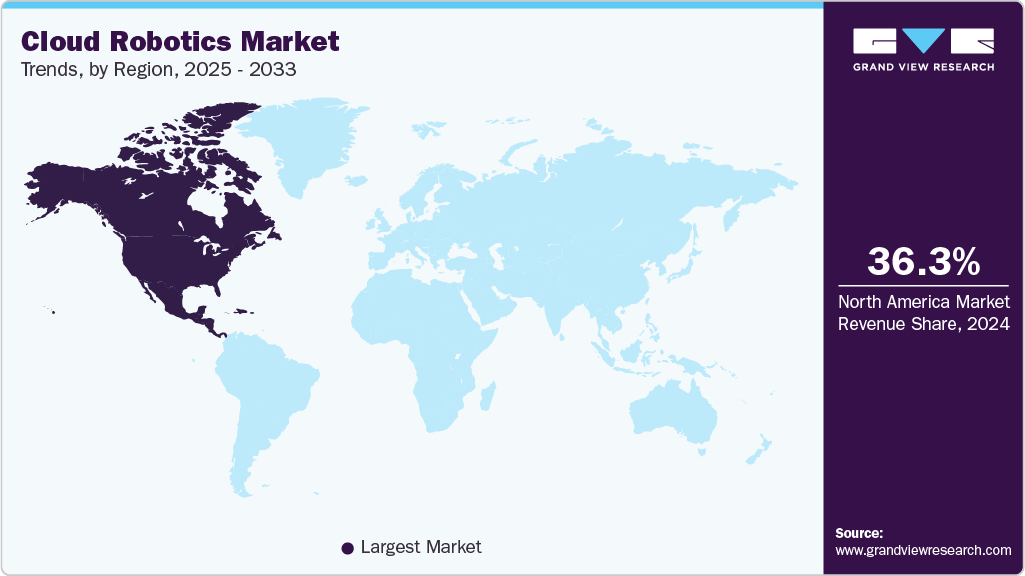
North America dominated the cloud robotics market with a market share of over 36.3% in 2024. The proliferation of Internet of Things (IoT) devices and the rising emphasis on Industry 4.0 initiatives are also significantly driving the market growth. Businesses are increasingly adopting IoT-enabled robots that collect and transmit data to cloud platforms for analysis and predictive maintenance. This integration allows organizations to optimize resource usage, enhance productivity, and minimize unplanned outages. Moreover, government initiatives and funding aimed at promoting smart manufacturing and automation technologies in sectors like defense and aerospace further boost the adoption of cloud robotics solutions in the region.
 To learn more about this report, Download Free Sample Report
 U.S. Cloud Robotics Market Trends
The U.S. cloud robotics industry is projected to grow during the forecast period. The U.S. government and private sector have shown a strong commitment to innovation in automation and robotics. Substantial investments in R&D, along with supportive regulations and funding programs from agencies such as the National Science Foundation (NSF) and the Department of Defense (DoD), have accelerated the development and deployment of cloud robotics technologies. These initiatives aim to maintain U.S. competitiveness in high-tech manufacturing and national defense, further stimulating demand for robotics solutions that leverage cloud connectivity for smarter, faster, and more adaptive performance.
Europe Cloud Robotics Market Trends
The cloud robotics industry in Europe is expected to grow during the forecast period. Europe’s commitment to data privacy and cybersecurity plays a key role in shaping cloud robotics adoption. Regulatory frameworks like the General Data Protection Regulation (GDPR) have prompted cloud robotics providers to implement rigorous data protection measures, thereby increasing trust among businesses and consumers. This emphasis on secure and ethical data usage supports broader acceptance of cloud robotics, especially in sensitive environments like healthcare and public infrastructure. As a result, the convergence of strong regulatory oversight, technological capability, and digital policy support continues to drive the expansion of cloud robotics across the European region.
The cloud robotics market in the UK is expected to grow during the forecast period. The increasing demand for smart warehousing, autonomous delivery, and last-mile logistics solutions driven by the rapid expansion of e-commerce in the UK is fueling the adoption of cloud robotics. Companies are deploying cloud-connected robots to manage inventory, optimize delivery routes, and streamline supply chain operations, all of which contribute to faster service and reduced costs. As labor shortages continue to challenge sectors like transport and healthcare, cloud robotics provides a practical, scalable alternative that enhances service delivery while maintaining compliance with safety and regulatory standards. These trends collectively position the UK as a leading market for cloud robotics in Europe.
Asia Pacific Cloud Robotics Market Trends
The Asia Pacific cloud robotics industry is expected to be the fastest-growing segment, with a CAGR of 26.5% over the forecast period. The proliferation of IoT devices, advanced wireless communication technologies such as 5G, and the availability of high-performance cloud platforms are reinforcing the adoption of cloud robotics across the region. These technologies enable seamless data exchange between robots and the cloud, allowing for faster decision-making, continuous learning, and enhanced robot coordination. As urbanization and smart city projects expand in the Asia Pacific, cloud robotics is also finding applications in public services, surveillance, infrastructure maintenance, and elder care, highlighting its growing relevance across both commercial and societal domains.
The Japan cloud robotics market is projected to grow during the forecast period. The rising consumer demand for smarter, connected products and services also influences the market in Japan. Beyond industrial use, cloud robotics is expanding into personal assistance, entertainment, and home automation. Robots integrated with cloud platforms can deliver personalized experiences by learning user preferences, updating functionalities remotely, and interacting through natural language processing powered by cloud AI. As Japanese consumers increasingly embrace smart devices and expect seamless digital integration, cloud robotics offers unique opportunities to meet these evolving needs. This consumer-driven momentum complements industrial adoption, creating a comprehensive growth landscape for cloud robotics across multiple facets of Japanese society.
Key Cloud Robotics Companies & Market Share Insights
Some of the key companies operating in the market are Rockwell Automation Inc. and ABB.
-
Rockwell Automation Inc. is an industrial automation and digital transformation company. Rockwell has significantly advanced its capabilities in cloud robotics, integrating cloud computing technologies to enhance the intelligence and efficiency of industrial robots. A notable development is the collaboration with NVIDIA to incorporate the NVIDIA Isaac robotics platform into Rockwell's OTTO autonomous mobile robots (AMRs). This integration aims to improve performance and efficiency in manufacturing logistics by leveraging AI-driven capabilities.
-
ABB specializes in electrification and automation. ABB's Robotics division is renowned for its comprehensive portfolio, including industrial robots, collaborative robots (cobots), and advanced automation solutions tailored for various industries such as automotive, electronics, logistics, and healthcare. ABB's innovation in cloud robotics is its RobotStudio Cloud platform. This web-based software enables users to program, simulate, and collaborate on robotic applications remotely, eliminating the need for physical presence at the robot's location.
Ortelio Ltd and CloudMinds Technologies Co., Ltd. are some of the emerging participants in the cloud robotics market.
-
Ortelio Ltd is a UK-based research company specializing in cloud robotics and intelligent software development. Ortelio has developed the Noos platform, a cloud-based service that provides centralized intelligence to connected robots. This platform supports various functionalities, including computer vision, deep learning, and simultaneous localization and mapping (SLAM), allowing robots to perform complex tasks by offloading computationally intensive processes to the cloud.
-
CloudMinds Technologies Co., Ltd. is a Chinese-American company specializing in cloud-based intelligent robotics. CloudMinds' offerings are its Human Augmented Robotics Intelligence with Extreme Reality (HARIX) platform. HARIX serves as a scalable "cloud brain" capable of operating millions of robots simultaneously. It utilizes secure Virtual Backbone Networks (VBNs) over 4G/5G to connect robots to the cloud, enabling real-time AI processing for tasks such as natural language processing, computer vision, and vision-guided manipulation.
Key Cloud Robotics Companies:
The following are the leading companies in the cloud robotics market. These companies collectively hold the largest market share and dictate industry trends.
- Amazon Web Services, Inc.
- Microsoft Corporation
- IBM Corporation
- Google LLC
- Rockwell Automation Inc.
- Huawei Technologies Co., Ltd.
- ABB
- Rapyuta Robotics
- Vention
- CloudMinds Technologies Co., Ltd.
- Formant
Recent Developments
-
In March 2025, inait partnered with Microsoft to fast-track the development and commercialization of its cutting-edge AI technology, leveraging its distinctive digital brain AI platform. This collaboration will utilize the Microsoft Azure cloud platform and its extensive global network to speed up the rollout of inait’s AI solutions. In the field of robotics, the emphasis will be on creating smarter, more adaptable robots for industrial manufacturing that operate effectively in complex and dynamic settings.
-
In September 2024, Vention collaborated with ABB to confirm the compatibility between the Vention Manufacturing Automation Platform and ABB’s GoFa cobot family. Through this collaboration within the Vention ecosystem, ABB will be able to reach a wider range of DIY automation customers. Vention will strengthen its product lineup by incorporating ABB’s robotics solutions. This mutually advantageous partnership aims to expand market presence and drive innovation for both companies.
-
In May 2024, Vention launched a suite of AI-powered features to its Manufacturing Automation Platform, enhancing its position as the only all-in-one cloud-based solution for designing, automating, and operating automated equipment and robotic cells. The updates include an instant deployment feature that enables robotics developers to effortlessly transfer programs and machine configurations from a digital twin to a physical machine directly via a web browser.
-
In April 2024, Hypertherm Associates partnered with Rapyuta Robotics to become the first company in the U.S. to deploy the innovative Pick Assist Autonomous Mobile Robots (AMRs). These advanced AMRs enable Hypertherm Associates to automate warehouse tasks while sustainably supporting its workforce. Rapyuta Robotics' Pick Assist AMRs integrate cutting-edge technologies, including optimal course planning, multi-robot coordination powered by AI, a picker guidance system, and centralized fleet management.
Cloud Robotics Market Report Scope
Report Attribute
Details
Market size value in 2025
USD 9.46 billion
Revenue forecast in 2033
USD 55.68 billion
Growth rate
CAGR of 24.8% from 2025 to 2033
Actual data
2021 - 2024
Forecast period
2025 - 2033
Quantitative units
Revenue in USD billion and CAGR from 2025 to 2033
Report coverage
Revenue forecast, company share, competitive landscape, growth factors, and trends
Segments covered
Component, service model, robot type, industry vertical, and region
Regional scope
North America; Europe; Asia Pacific; Latin America; MEA
Country scope
U.S.; Canada; Mexico; UK; Germany; France; China; India; Japan; Australia; South Korea; Brazil; UAE; Saudi Arabia; South Africa
Key companies profiled
Amazon Web Services, Inc.; Microsoft Corporation; IBM Corporation; Google LLC; Rockwell Automation Inc.; Huawei Technologies Co., Ltd.; ABB; Rapyuta Robotics; Vention; CloudMinds Technologies Co., Ltd.; Formant
Customization scope
Free report customization (equivalent to 8 analysts working days) with purchase. Addition or alteration to country, regional & segment scope.
Pricing and purchase options
Avail customized purchase options to meet your exact research needs. Explore purchase options
Global Cloud Robotics Market Report Segmentation
This report forecasts revenue growth at global, regional, and country levels and provides an analysis of the latest industry trends in each of the sub-segments from 2021 to 2033. For this study, Grand View Research has segmented the cloud robotics market report based on component, service model, robot type, industry vertical, and region:
-
Component Outlook (Revenue, USD Billion, 2021 - 2033)
-
Solution
-
Services
-
-
Service Model Outlook (Revenue, USD Billion, 2021 - 2033)
-
SaaS
-
IaaS
-
PaaS
-
-
Robot Type Outlook (Revenue, USD Billion, 2021 - 2033)
-
Industrial Robot
-
Service Robot
-
-
Industry Vertical Outlook (Revenue, USD Billion, 2021 - 2033)
-
Manufacturing
-
Military and Defense
-
Retail and E-commerce
-
Healthcare
-
Others
-
-
Regional Outlook (Revenue, USD Billion, 2021 - 2033)
-
North America
-
U.S.
-
Canada
-
Mexico
-
-
Europe
-
Germany
-
UK
-
France
-
-
Asia Pacific
-
China
-
India
-
Japan
-
South Korea
-
Australia
-
-
Latin America
-
Brazil
-
-
Middle East & Africa
-
UAE
-
Saudi Arabia
-
South Africa
-
-
Frequently Asked Questions About This Report
The global cloud robotics market size was estimated at USD 7.83 billion in 2024 and is expected to reach USD 9.46 billion in 2025.
The global cloud robotics market is expected to grow at a compound annual growth rate of 23.7% from 2025 to 2033 to reach USD 55.68 billion by 2033.
The industrial robot segment dominated the cloud robotics market with a market share of over 67.0% in 2024. The rise of robotics development in test environments and simulation platforms is driving the segment growth.
Some key players operating in the market include Amazon Web Services, Inc., Microsoft Corporation, IBM Corporation, Google LLC, Rockwell Automation Inc., Huawei Technologies Co., Ltd., ABB, Rapyuta Robotics, Vention, CloudMinds Technologies Co., Ltd., Formant
Factors such the increasing demand for smart warehousing, autonomous delivery, and last-mile logistics solutions and the accelerating development and deployment of the Industrial Internet of Things (IIoT) and 5G networks are anticipated to accelerate the market growth.
About the Author(s)
Next Generation Technologies Research Team
Technology · Next Generation TechnologiesThis report was authored by the next generation technologies research team at Grand View Research - comprising two research analysts, one senior research analyst, and one industry expert - with specialized expertise in the next generation technologies segment of the technology industry. All findings are based on proprietary technology databases, executive interviews, and regulatory analysis, subject to internal peer review prior to publication.
Last Updated:
Speak to Analyst

Customize this report to your needs - add regions, segments, or data points, with 20% free customization.
Or view our licence options:


ISO 9001:2015 & 27001:2022 Certified
We are GDPR and CCPA compliant! Your transaction & personal information is safe and secure. For more details, please read our privacy policy.


