
- Home
- »
- Next Generation Technologies
- »
-
Cloud Testing Market Size, Share, Growth Report 2026-2033GVR Report cover

Cloud Testing Market (2026 - 2033)
Size, Share & Trends Analysis Report By Component (Solution, Services), By Type (Security Testing, API Testing, Automation Testing), By Enterprise Size (SMEs, Large Enterprises), By Deployment, By End Use, By Region, And Segment Forecasts
Market Size, 2025
$12.8BMarket Estimate, 2026
$14.1BMarket Forecast, 2033
$29.6BCAGR, 2026–2033
11.2%Cloud Testing Market Summary
The global cloud testing market size was valued at USD 12.8 billion in 2025 and is projected to grow from USD 14.1 billion in 2026 to USD 29.6 billion by 2033, at a CAGR of 11.2% from 2026 to 2033. The market in North America dominated with a revenue share of 38.6% in 2025. Expansion of DevOps and continuous integration/continuous deployment practices is driving market growth.
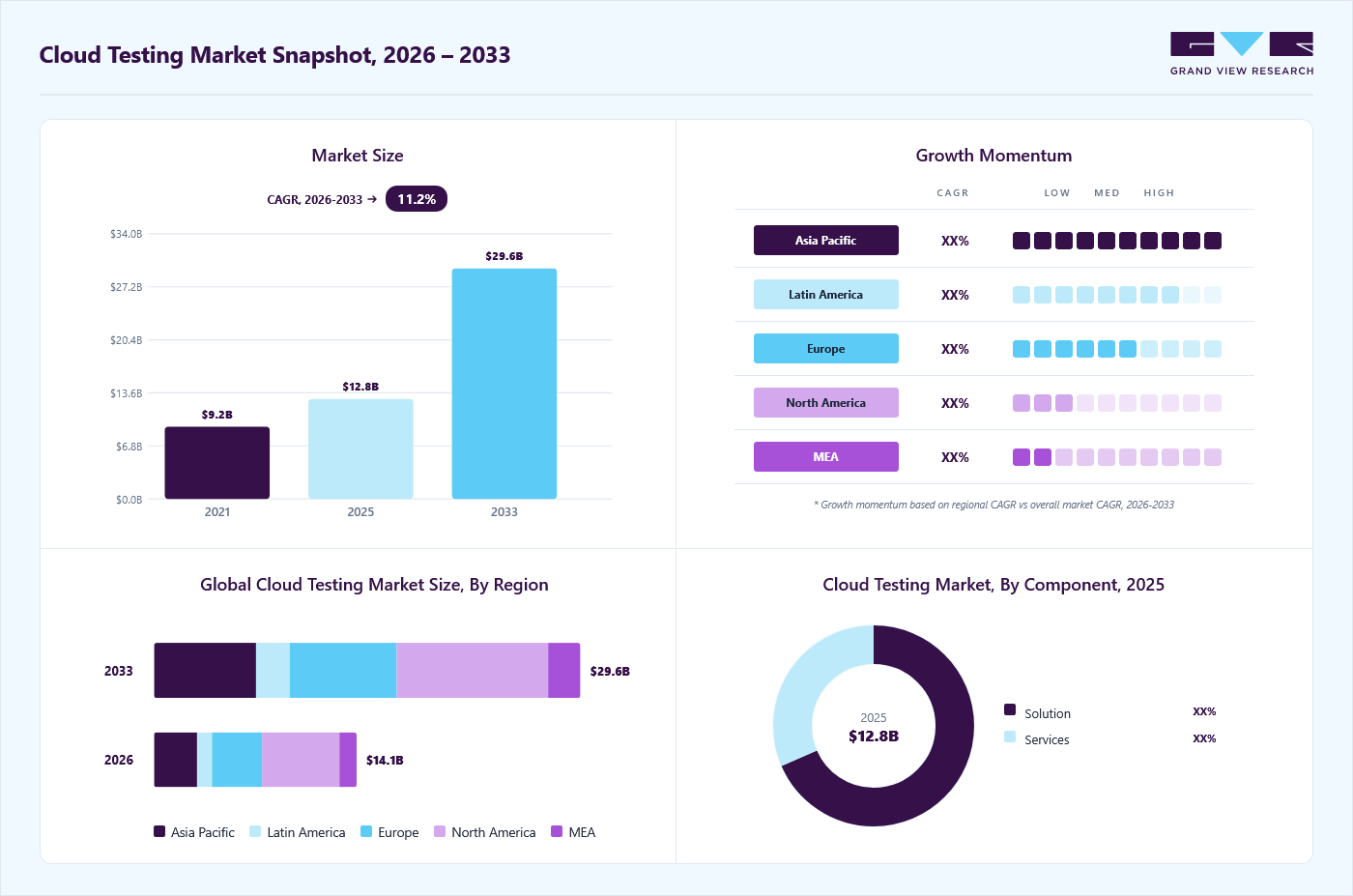 Source: Grand View Research, IR Documents, Primary Interviews, Paid DatabasesTo learn more about this report,
 Download Free Sample Report
 Key Market Trends & Insights
- By component: Solution segment held the largest market share of 68.4% in 2025.
- By type: Automation testing segment held the largest market share in 2025.
- By enterprise size: Large enterprises segment held the largest market share in 2025.
- By deployment: Public cloud segment held the largest market share in 2025.
- By end use: IT & telecom segment held the largest market share in 2025.
Regional Highlights
- Largest regional market: North America (38.6% revenue share, 2025)
- Fastest-growing regional market: Asia Pacific (highest CAGR, 2026-2033)
- By country: The U.S. held the largest market share in 2025
Market Size & Forecast
- Market size in 2025: USD 12.8 Billion
- Estimated market size in 2026: USD 14.1 Billion
- Projected market size by 2033: USD 29.6 Billion
- CAGR (2026-2033): 11.2%
Three ways to get this report
Buy it, customize it, or ask a question.Ask an Analyst
Analyst response in 1 business day
- AccessReport author, directly
- Reply timeWithin 1 working day
- No sales callDirect answer only
- FormatEmail reply
- CostFree, no cost
Get the Full Report
What the study covers
- FormatsPDF · Excel · Dashboard
- Timeline2026–2033 annual, 2025 base
- Coverage20+ countries, 5 regions
- Companies10+ key players profiled
Customize the Report
20% free customization
- IncludeCountries, segments, points
- TailorTo your product definition
- ExtendDeeper competitor detail
- OrA fully bespoke study
- Turnaround5–10 working days
The growing adoption of DevOps and continuous integration/continuous delivery (CI/CD) practices is a key driver for the cloud testing market. Modern development methodologies emphasize rapid and frequent releases, requiring continuous testing throughout the development lifecycle. Cloud testing platforms integrate seamlessly with CI/CD pipelines, enabling automated testing at every stage. This ensures that issues are identified and resolved quickly, reducing time-to-market. Automation improves efficiency by reducing manual intervention and human error. It also allows teams to run multiple tests simultaneously, accelerating the development process. Continuous testing supports agile development practices and enhances product quality. Faster release cycles are critical for maintaining competitiveness in digital markets. As DevOps adoption increases, the demand for cloud testing solutions continues to rise.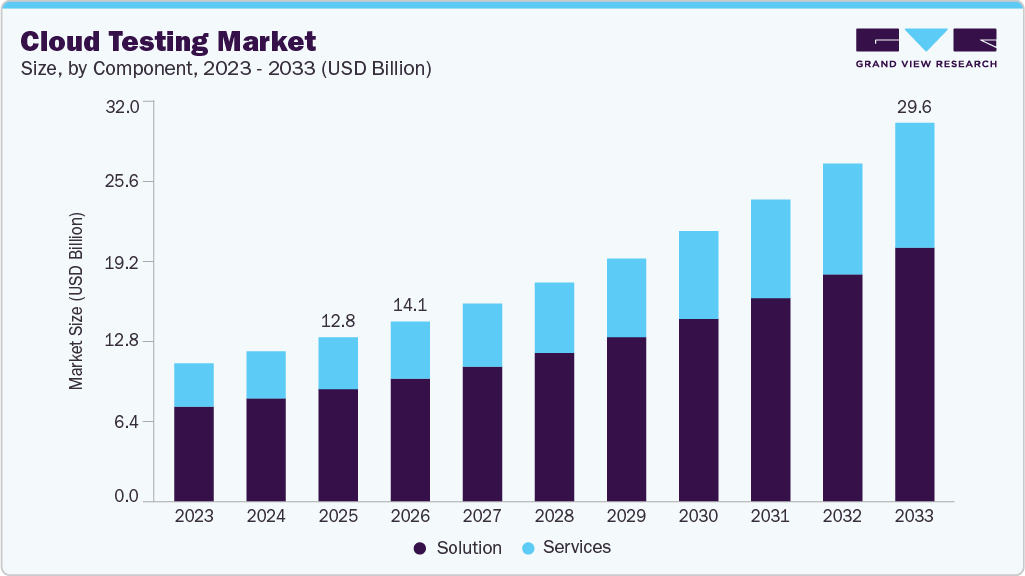 To learn more about this report, Download Free Sample Report
 The increasing demand for performance and load testing is also contributing to the growth of the cloud testing industry. Applications must handle high volumes of users and transactions without performance degradation. Cloud testing platforms enable the simulation of large-scale user loads across different regions. This helps organizations evaluate application performance under real-world conditions. Identifying performance issues before deployment reduces the risk of system failures. It also improves user experience and customer satisfaction. Scalable testing environments allow for comprehensive performance evaluation. Organizations can test various scenarios and optimize system behavior accordingly. As user expectations for performance increase, the demand for cloud testing solutions grows.
Another significant driver is the rising importance of security and compliance in application development. Cybersecurity threats are becoming more sophisticated, requiring robust testing to identify vulnerabilities. Cloud testing platforms offer security testing capabilities that help detect and mitigate risks. They enable testing of applications in different environments to ensure compliance with regulatory standards. Automated security testing improves efficiency and reduces the likelihood of breaches. Organizations can continuously monitor and validate security measures. This enhances trust and reliability in digital systems. Compliance requirements further drive the need for comprehensive testing solutions. As security concerns increase, the adoption of cloud testing is expanding.
The growing need for cross-platform and cross-browser testing is also driving the market growth. Modern applications are expected to deliver seamless, consistent, and high-performance functionality across diverse devices, operating systems, browsers, and user environments. Ensuring compatibility across these platforms is challenging with traditional testing methods. Cloud testing platforms provide access to a wide range of environments for comprehensive testing. This allows organizations to validate application behavior across different configurations. Improved compatibility enhances user experience and reduces support issues. It also ensures that applications reach a broader audience. Testing across diverse environments is essential for global deployment. As digital ecosystems become more diverse, the demand for cloud testing increases.
Furthermore, continuous advancements in cloud technologies and testing tools are driving the growth of the cloud testing market. Innovations such as artificial intelligence, machine learning, and automation are enhancing testing capabilities. AI-driven testing tools can identify patterns, predict issues, and optimize test cases. Automation reduces manual effort and improves accuracy. Cloud platforms are becoming more robust, offering advanced features and integrations. These advancements improve the efficiency and effectiveness of testing processes. Organizations can achieve higher quality outcomes with less effort. Continuous innovation keeps cloud testing relevant in a rapidly evolving digital landscape. As technology evolves, the demand for advanced cloud testing solutions continues to increase.
Component Insights
The solution segment dominated the cloud testing market with a share of 68.4% in 2025, driven by the increasing demand for comprehensive, end-to-end testing platforms that can handle the full lifecycle of application validation. Organizations are no longer looking for isolated testing tools; they prefer integrated solutions that combine functional, performance, security, and compatibility testing in a single environment. This reduces the complexity of managing multiple tools and improves overall efficiency. Cloud-based testing solutions offer centralized dashboards, reporting, and automated testing capabilities that streamline testing workflows. Teams can manage test cases, run tests, and analyze results within a single unified system. This integration enhances visibility and control over the testing process. It also improves collaboration among development, testing, and operations teams. As applications become more complex, the need for holistic testing solutions becomes critical.
The services segment is projected to grow at the fastest CAGR from 2026 to 2033, driven by the growing need for specialized expertise to manage complex testing environments and develop testing strategies. Many organizations lack in-house capabilities to design, implement, and optimize cloud-based testing frameworks effectively. Cloud testing services providers offer deep technical knowledge and experience that help organizations adopt best practices and avoid costly mistakes. These services include consulting, implementation, integration, and ongoing support, all essential to successful testing operations. As applications become more complex, the demand for expert guidance increases significantly. Service providers help tailor testing strategies based on specific business requirements and system architectures. As reliance on specialized expertise grows, the demand for cloud testing services continues to expand.
Type Insights
The automation testing segment dominated the cloud testing industry in 2025. The rising demand for cross-platform and cross-browser testing is driving this segment. Applications must function seamlessly across various devices, operating systems, and browsers. Automation testing enables the execution of test cases across multiple platforms simultaneously. Cloud environments offer a wide range of configurations for comprehensive testing. This ensures compatibility and consistent performance across different user environments. Automated tools can quickly identify issues related to specific platforms or browsers. This improves user experience and reduces support costs. Organizations can reach a broader audience with reliable applications. As digital ecosystems diversify, the need for automated testing solutions grows.
Performance testing is projected to be the fastest-growing segment from 2026 to 2033. The rapid growth of digital platforms such as e-commerce, streaming services, and online banking is contributing to segment growth. These platforms experience fluctuating traffic patterns, especially during peak events like sales, promotions, or major announcements. Performance testing enables organizations to prepare for such spikes by evaluating system behavior under stress conditions. Cloud testing environments provide the scalability needed to effectively simulate these high-demand scenarios. This helps prevent system crashes and ensures smooth user experiences during critical periods. As digital platforms continue to expand, the importance of performance testing increases significantly.
Enterprise Size Insights
The large enterprises segment dominated the cloud testing industry in 2025. The rising complexity of applications and integration requirements is contributing to the growth of this segment. Large enterprises rely on interconnected systems, including legacy applications, cloud platforms, and third-party services. Testing these complex environments requires advanced tools and strategies. Cloud testing provides the flexibility to test across multiple environments and configurations. It ensures that all components function seamlessly together. Comprehensive testing reduces the risk of system failures. Enterprises can maintain high levels of performance and reliability. As system complexity increases, reliance on cloud testing solutions grows.
The small & medium enterprises segment is projected to grow at a higher CAGR from 2026 to 2033. The growing need for faster time-to-market is a key driver for SMEs. Smaller businesses often operate in highly competitive environments where speed is crucial for success. Delays in product releases can result in lost opportunities and reduced market share. Cloud testing enables rapid execution of test cases, significantly reducing testing cycles. Automated testing tools further enhance speed and efficiency. SMEs can quickly identify and fix issues, enabling faster application deployment. This agility allows them to respond effectively to customer demands and market trends. Faster releases improve competitiveness and business growth. As time-to-market becomes a critical factor, the adoption of cloud testing solutions continues to rise.
Deployment Insights
The public cloud segment dominated the cloud testing market in 2025. The increasing adoption of cloud-native applications is a key driver for this segment. Modern applications are being designed specifically for cloud environments, leveraging microservices, containers, and distributed architectures. Testing these applications requires environments that closely mirror their deployment platforms. Public cloud provides the ideal infrastructure for such testing scenarios. It allows organizations to validate application behavior under real-world cloud conditions. This ensures better performance, scalability, and reliability. Testing in cloud-native environments reduces the risk of deployment issues. It also improves overall application quality. As cloud-native development becomes more prevalent, the demand for public cloud testing solutions increases.
The hybrid cloud segment is projected to grow at the fastest CAGR from 2026 to 2033. The growing need for collaboration across distributed teams and environments is contributing to market growth. Organizations often have teams working on different platforms and locations. Hybrid cloud testing platforms provide centralized access to testing tools and data across environments. This enables seamless collaboration among teams regardless of location. Real-time updates and shared dashboards improve communication and coordination. Teams can work simultaneously on different testing aspects. Hybrid environments support flexible workflows and global operations. Improved collaboration enhances productivity and efficiency. As distributed work models become more common, the demand for hybrid cloud testing solutions increases.
End Use Insights
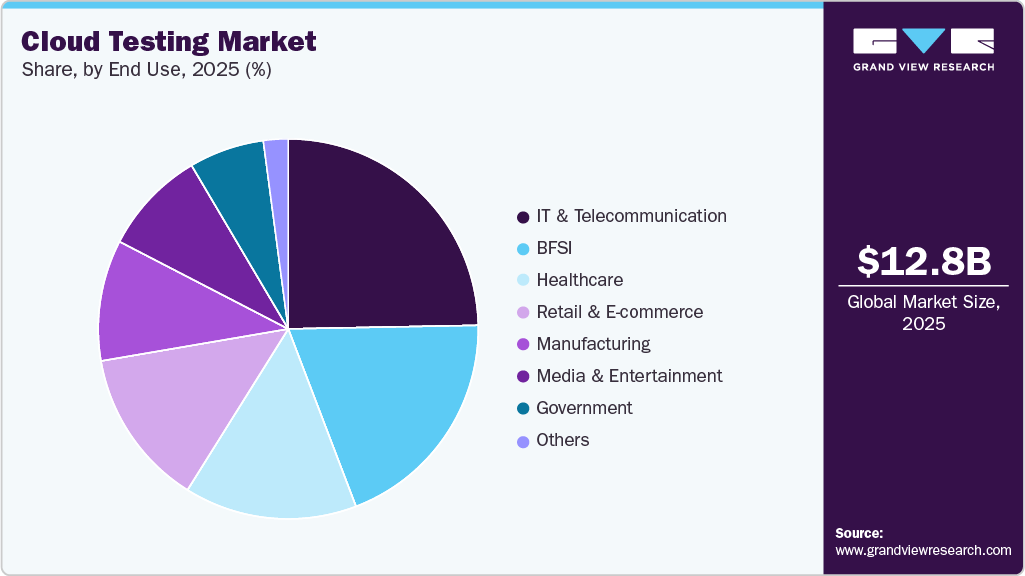
The BFSI segment held a significant market share in 2025. The rapid adoption of digital banking and online financial services is driving the BFSI segment growth. Customers increasingly rely on mobile apps and online platforms for transactions, investments, and insurance services. These digital channels must deliver seamless performance and user experience at all times. Cloud testing enables validation of application performance across multiple devices, platforms, and network conditions. It ensures that digital services function reliably even under high user demand. Testing in cloud environments allows simulation of real-world scenarios across different geographies. This helps financial institutions optimize their digital offerings. Improved user experience enhances customer satisfaction and retention. As digital banking continues to expand, the demand for cloud testing grows.
 To learn more about this report, Download Free Sample Report
 The retail and e-commerce segment is projected to grow significantly from 2026 to 2033. The rapid expansion of omnichannel retail strategies is contributing to the growth of the cloud testing market in this segment. Retailers are integrating online platforms with physical stores, mobile apps, and other digital touchpoints to provide a unified customer experience. Managing and testing such interconnected systems requires advanced testing solutions. Cloud testing enables validation of interactions across multiple channels and platforms. It ensures that data flows seamlessly between systems, providing a consistent customer experience. Testing omnichannel environments helps identify integration issues and improve system reliability. Retailers can deliver cohesive experiences across all touchpoints. This enhances brand perception and customer engagement. As omnichannel strategies become more prevalent, the demand for cloud testing increases.
Regional Insights
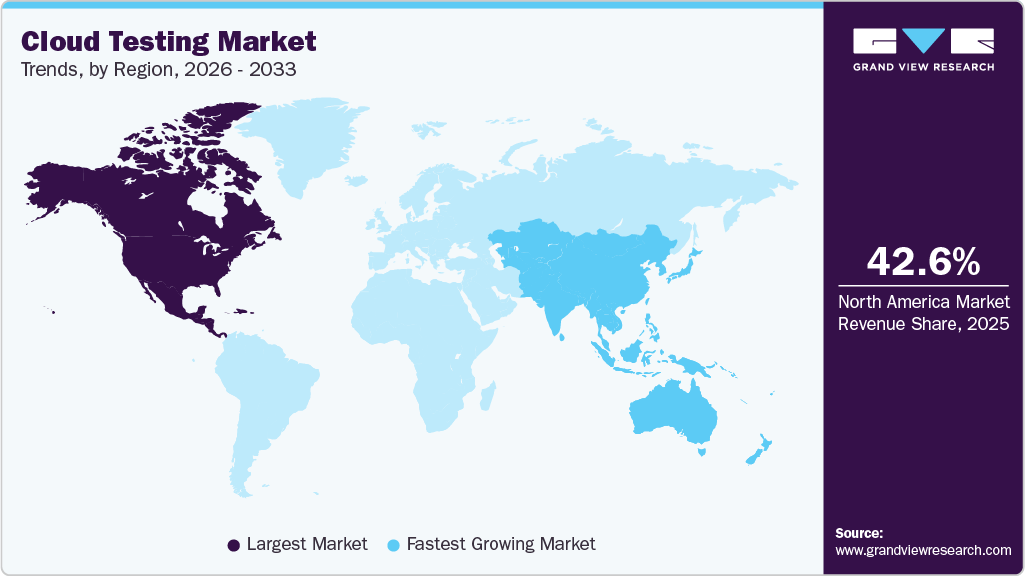
North America dominated the cloud testing market with a share of 38.6% in 2025, driven by the region’s early and extensive adoption of cloud computing technologies across industries. Organizations in the U.S., Canada, and Mexico have been at the forefront of migrating their applications and infrastructure to cloud environments, creating strong demand for testing solutions that align with modern cloud architectures. Cloud testing enables businesses to validate application performance, scalability, and reliability in dynamic cloud environments, which is particularly important as enterprises increasingly adopt multi-cloud and hybrid cloud strategies.
 To learn more about this report, Download Free Sample Report
 U.S. Cloud Testing Market Trends
The U.S. cloud testing industry is projected to grow during the forecast period. The growing emphasis on user experience and performance optimization is driving the market growth. Businesses aim to deliver fast, seamless, and reliable digital experiences to users. Performance issues can lead to customer dissatisfaction and revenue loss. Cloud testing enables the simulation of real-world user conditions to evaluate application performance. This helps identify bottlenecks and optimize system behavior. Testing across multiple devices and network conditions ensures a consistent user experience. Improved performance enhances customer satisfaction and retention. Companies prioritize user-centric design and functionality. As user expectations continue to rise, the demand for cloud testing increases.
The Canada cloud testing market is witnessing growing adoption of cloud-native testing solutions due to increasing investments in digital transformation initiatives and enterprise cloud modernization projects. Similarly, the Mexico cloud testing market is expanding steadily with the rising presence of IT outsourcing, cloud service providers, and growing enterprise demand for scalable application testing solutions. The ability to simulate real-world scenarios in scalable cloud environments enhances testing efficiency and enables companies to ensure seamless application performance across distributed systems. In addition, the maturity of cloud ecosystems across North America continues to accelerate adoption, as businesses expand their cloud footprints and increase reliance on advanced cloud testing platforms, further driving growth in the Canada cloud testing market and the regional market.
Asia Pacific Cloud Testing Market Trends
The Asia Pacific cloud testing industry is projected to grow at the fastest CAGR during the forecast period. The increasing penetration of mobile devices and internet connectivity is driving market growth across the region, including Japan. Asia Pacific has a vast and rapidly expanding user base that relies heavily on mobile applications for activities such as shopping, banking, entertainment, and communication, creating strong demand for applications that perform consistently across different devices, operating systems, and network conditions. Cloud testing platforms provide organizations with access to diverse testing environments for comprehensive application validation without requiring significant investment in physical infrastructure. This enables businesses to test applications across multiple configurations, improve compatibility, and enhance overall user experience.
The cloud testing market in Japan is witnessing increased adoption due to rising enterprise investments in digital transformation, cloud-native application development, and advanced software quality assurance practices. Improved application performance helps organizations achieve higher customer satisfaction and retention. At the same time, the continued growth of mobile usage and cloud adoption across the Asia Pacific further accelerates the demand for cloud testing solutions throughout the forecast period.
The China cloud testing market is projected to grow during the forecast period. The strong growth of e-commerce and digital services is a key driver for the China market. Online retail platforms, digital payment systems, and service applications handle significant transaction volumes daily. Ensuring reliable performance and security for these platforms is critical. Cloud testing enables organizations to simulate high transaction loads and validate system behavior under stress. It helps prevent system failures during peak periods such as major sales events. Testing also ensures secure and seamless payment processing. Businesses can optimize their platforms based on testing insights. Reliable digital services enhance customer trust and satisfaction. As e-commerce continues to expand, the need for cloud testing grows.
Europe Cloud Testing Market Trends
The Europe cloud testing industry is expected to grow during the forecast period. The growing adoption of DevOps and agile development practices is driving the market growth. Organizations are focusing on accelerating software development cycles while maintaining high quality. Continuous integration and continuous delivery require continuous testing throughout the development lifecycle. Cloud testing platforms integrate seamlessly with CI/CD pipelines, enabling automated, scalable testing. This improves efficiency and reduces time-to-market for applications. Automation minimizes manual intervention and enhances accuracy. Faster release cycles allow companies to respond quickly to market demands. Agile methodologies depend heavily on efficient testing solutions. As DevOps adoption increases, the demand for cloud testing rises.
The UK cloud testing market is expected to grow significantly during the forecast period. The rising complexity of modern applications and IT architectures is contributing to the market growth. Applications are increasingly built using microservices, APIs, and distributed systems. Testing these systems requires advanced tools capable of handling complex interactions and dependencies. Cloud testing provides scalable environments for effectively validating such applications. It allows organizations to test individual components and their integration within the system. Comprehensive testing reduces the risk of failures and improves reliability. Businesses can ensure consistent performance across different environments. Managing complexity becomes more efficient with cloud-based solutions. As application architectures become more sophisticated, reliance on cloud testing grows.
Key Cloud Testing Company Insights
Some of the key companies operating in the market include Infosys Limited and VIAVI Solutions Inc.
-
Infosys Limited is a global technology services and consulting company. Infosys provides comprehensive services designed to ensure the performance, security, and reliability of applications deployed in cloud environments. Its cloud testing capabilities cover functional testing, performance testing, security validation, and automation across public, private, and hybrid cloud infrastructures. Infosys helps organizations validate that applications perform consistently under varying workloads, scale efficiently, and remain secure against evolving cyber threats. By leveraging advanced testing frameworks and automation tools, the company enables faster release cycles and improved software quality, which are critical in dynamic cloud-based ecosystems.
-
VIAVI Solutions Inc. is a U.S.-based technology company specializing in network test, monitoring, and assurance solutions for telecommunications, cloud, and enterprise environments. VIAVI Solutions provides advanced testing and validation solutions designed to ensure the performance and resilience of cloud-native applications and infrastructure. Its offerings focus on network performance testing, application assurance, and service validation across hybrid and multi-cloud environments. These solutions simulate real-world traffic conditions, user behavior, and network loads, allowing organizations to evaluate how applications perform under different scenarios. This capability is critical for identifying bottlenecks, ensuring scalability, and maintaining consistent user experiences in cloud-based services.
Key Cloud Testing Companies:
The following key companies have been profiled for this study on the cloud testing market.
- ASTONSYS
- Cybage Software Pvt. Ltd.
- DataArt
- DeviQA Solutions
- ImpactQA
- Infosys Limited
- IT Svit
- Pentera
- QAwerk
- Sun Technologies
- TestFort
- TestingXperts
- ThinkSys Inc.
- UiPath
- VIAVI Solutions Inc.
Recent Developments
-
In March 2025, UiPath launched UiPath Test Cloud, an innovative software testing solution that leverages advanced AI to significantly enhance tester productivity throughout the entire testing lifecycle, driving greater efficiency and cost optimization. With Test Cloud, agentic testing becomes a practical reality for quality assurance teams, providing AI-powered agents such as UiPath Autopilot and customizable testing agents built with Agent Builder to serve as collaborative partners at every stage of testing.
-
In March 2024, Pentera launched the general availability of Pentera Cloud, extending its automated security validation platform beyond its existing Pentera Core and Surface offerings. Pentera Cloud represents the first cloud testing solution built to deliver on-demand security assessments and resilience analysis for enterprise cloud environments, specifically targeting cloud-native threats. Integrated with Pentera’s wider platform, it helps security teams reduce vulnerabilities and enhance protection across the full IT attack surface.
Cloud Testing Market Report Scope
Report Attribute
Details
Market size in 2025
USD 12.8 billion
Estimated market size in 2026
USD 14.1 billion
Projected market size by 2033
USD 29.6 billion
Growth rate
CAGR of 11.2% from 2026 to 2033
Actual data
2021 - 2025
Forecast period
2026 - 2033
Quantitative units
Revenue in USD million/billion and CAGR from 2026 to 2033
Report coverage
Revenue forecast, company share, competitive landscape, growth factors, and trends
Segments covered
Component, type, enterprise size, deployment, end use, region
Regional scope
North America; Europe; Asia Pacific; Latin America; MEA
Country scope
U.S.; Canada; Mexico; UK; Germany; France; China; India; Japan; Australia; South Korea; Brazil; UAE; Saudi Arabia; South Africa
Key companies profiled
ASTONSYS; Cybage Software Pvt. Ltd.; DataArt; DeviQA Solutions; ImpactQA; Infosys Limited; IT Svit; Pentera; QAwerk; Sun Technologies; TestFort; TestingXperts; ThinkSys Inc.; UiPath; VIAVI Solutions Inc.
Customization scope
Free report customization (equivalent to 8 analysts working days) with purchase. Addition or alteration to country, regional & segment scope.
Pricing and purchase options
Avail customized purchase options to meet your exact research needs. Explore purchase options
Global Cloud Testing Market Report Segmentation
This report forecasts revenue growth at the global, regional, and country levels and provides an analysis of the latest industry trends in each of the sub-segments from 2021 to 2033. For this study, Grand View Research has segmented the cloud testing market report based on component, type, enterprise size, deployment, end use, and region:
-
Component Outlook (Revenue, USD Million, 2021 - 2033)
-
Solution
-
Services
-
-
Type Outlook (Revenue, USD Million, 2021 - 2033)
-
Performance Testing
-
Security Testing
-
API Testing
-
Compatibility Testing
-
Automation Testing
-
Others
-
-
Enterprise Size Outlook (Revenue, USD Million, 2021 - 2033)
-
Small & Medium Enterprises (SMEs)
-
Large Enterprises
-
-
Deployment Outlook (Revenue, USD Million, 2021 - 2033)
-
Public Cloud
-
Private Cloud
-
Hybrid Cloud
-
-
End Use Outlook (Revenue, USD Million, 2021 - 2033)
-
IT & Telecommunication
-
BFSI
-
Healthcare
-
Retail & E-commerce
-
Media & Entertainment
-
Manufacturing
-
Government
-
Others
-
-
Regional Outlook (Revenue, USD Million, 2021 - 2033)
-
North America
-
U.S.
-
Canada
-
Mexico
-
-
Europe
-
Germany
-
UK
-
France
-
-
Asia Pacific
-
China
-
India
-
Japan
-
South Korea
-
Australia
-
-
Latin America
-
Brazil
-
-
Middle East & Africa
-
UAE
-
Saudi Arabia
-
South Africa
-
-
Frequently Asked Questions About This Report
North America dominated with a 38.6% revenue share in 2025.
Asia Pacific is the fastest-growing region over the forecast period.
The automation testing segment held the largest revenue share in 2025, while performance testing is the fastest-growing type.
Large enterprises segment accounted for the largest revenue share in 2025, while small & medium enterprises is the fastest-growing segment.
Public cloud segment led the market with largest revenue share in 2025, while hybrid cloud is the fastest-growing deployment.
The solution segment dominated the cloud testing market with a market share of 68.4% in 2025, driven by the increasing demand for comprehensive, end-to-end testing platforms that can handle the full lifecycle of application validation.
Key players include ASTONSYS; Cybage Software Pvt. Ltd.; DataArt; DeviQA Solutions; ImpactQA; Infosys Limited; IT Svit; Pentera; QAwerk; Sun Technologies; TestFort; TestingXperts; ThinkSys Inc.; UiPath; VIAVI Solutions Inc.
Factors such as growing shift toward cloud-native and microservices architectures are the key factors driving the market growth.
The global cloud testing market size was valued at USD 12.8 billion in 2025 and is estimated at USD 14.1 billion for 2026.
The global cloud testing market is expected to grow at a CAGR of 11.2% from 2026 to 2033, reaching USD 29.6 billion by 2033.
About the Author(s)
Next Generation Technologies Research Team
Technology · Next Generation TechnologiesThis report was authored by the next generation technologies research team at Grand View Research - comprising two research analysts, one senior research analyst, and one industry expert - with specialized expertise in the next generation technologies segment of the technology industry. All findings are based on proprietary technology databases, executive interviews, and regulatory analysis, subject to internal peer review prior to publication.
Last Updated:
Speak to Analyst

Customize this report to your needs - add regions, segments, or data points, with 20% free customization.
Or view our licence options:


ISO 9001:2015 & 27001:2022 Certified
We are GDPR and CCPA compliant! Your transaction & personal information is safe and secure. For more details, please read our privacy policy.


