
- Home
- »
- Advanced Interior Materials
- »
-
Coil Winding Machine Market Size And Share Report, 2033GVR Report cover

Coil Winding Machine Market (2026 - 2033)
Size, Share & Trends Analysis Report By Machine Type (Single, Multiple), By End Use (Electrical Equipment, Automotive), By Automation (Fully Automated Systems, Semi-Automated Systems, Manual), By Region, And Segment Forecasts
Market Size, 2025
$4.2BMarket Estimate, 2026
$4.4BMarket Forecast, 2033
$6.3BCAGR, 2026–2033
5.3%Coil Winding Machine Market Summary
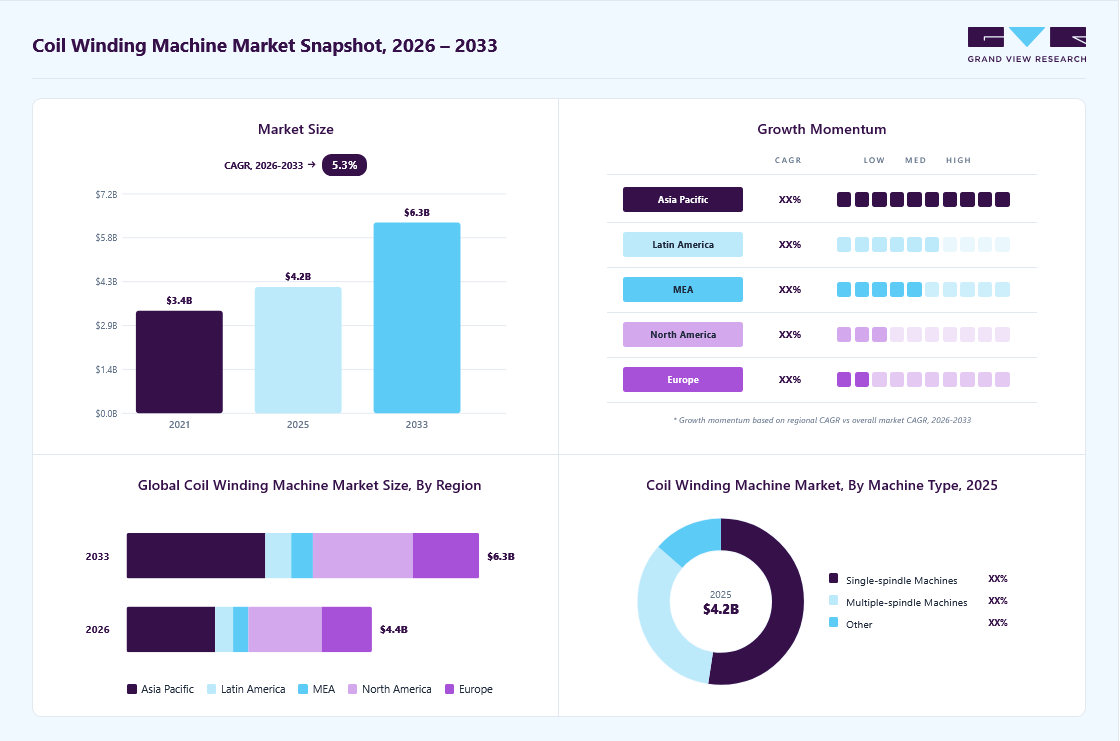
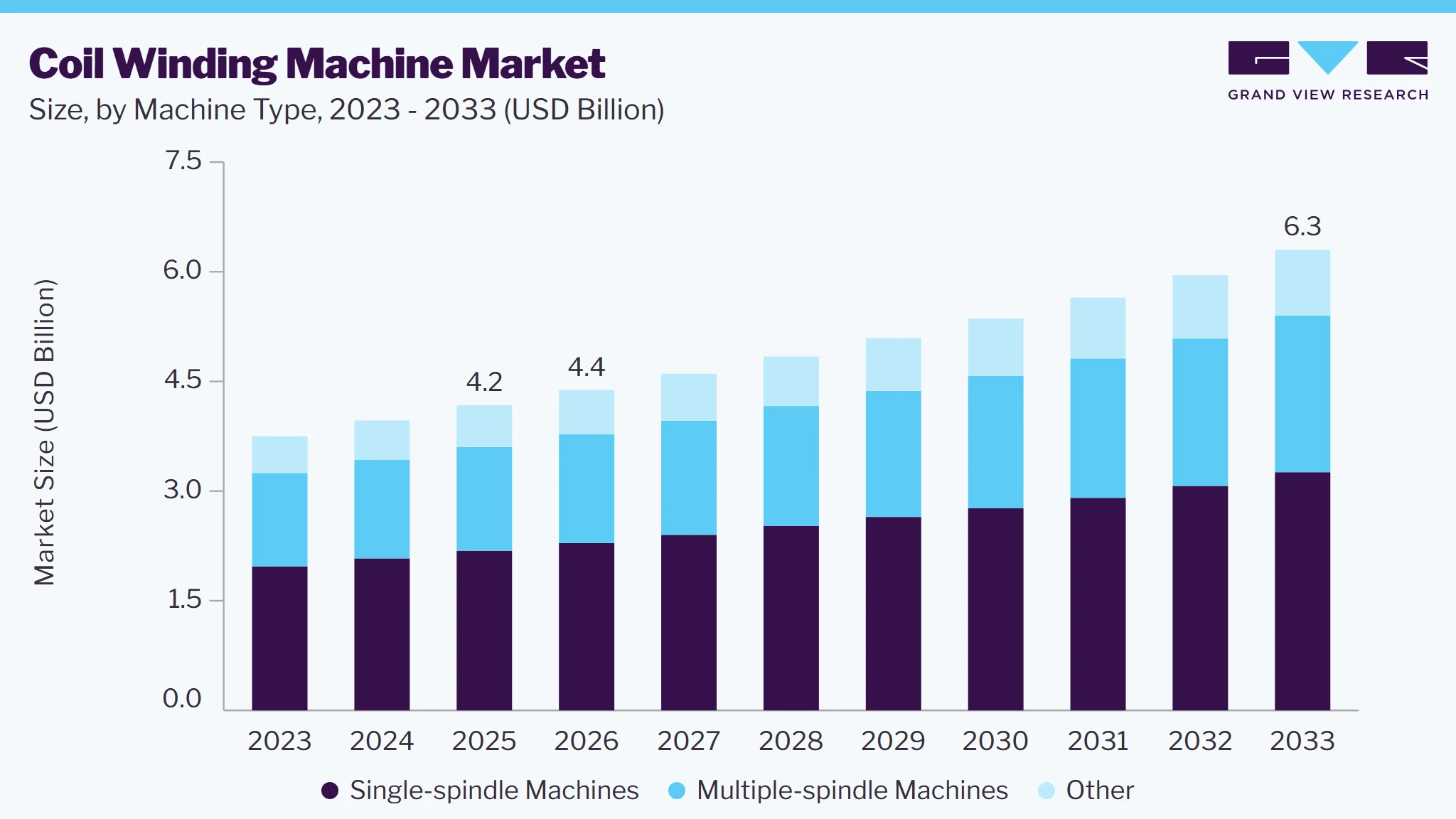
The global coil winding machine market size was valued at USD 4.2 billion in 2025 and is projected to grow from USD 4.4 billion in 2026 to USD 6.3 billion by 2033, at a CAGR of 5.3% from 2026 to 2033. Asia Pacific dominated the market, accounting for the largest revenue share of 35.6% in 2025. The market is driven by the growing demand for electric motors, transformers, and electromagnetic components across automotive, electronics, and power industries.
 Source: Grand View Research, IR Documents, Primary Interviews, Paid DatabasesTo learn more about this report,
 Download Free Sample Report
Key Market Trends & Insights
- By machine type: The single-spindle machines segment led the market with the largest revenue share of 52.3% in 2025.
- By automation: The fully automated systems segment led the market with the largest revenue share of 52.2% in 2025.
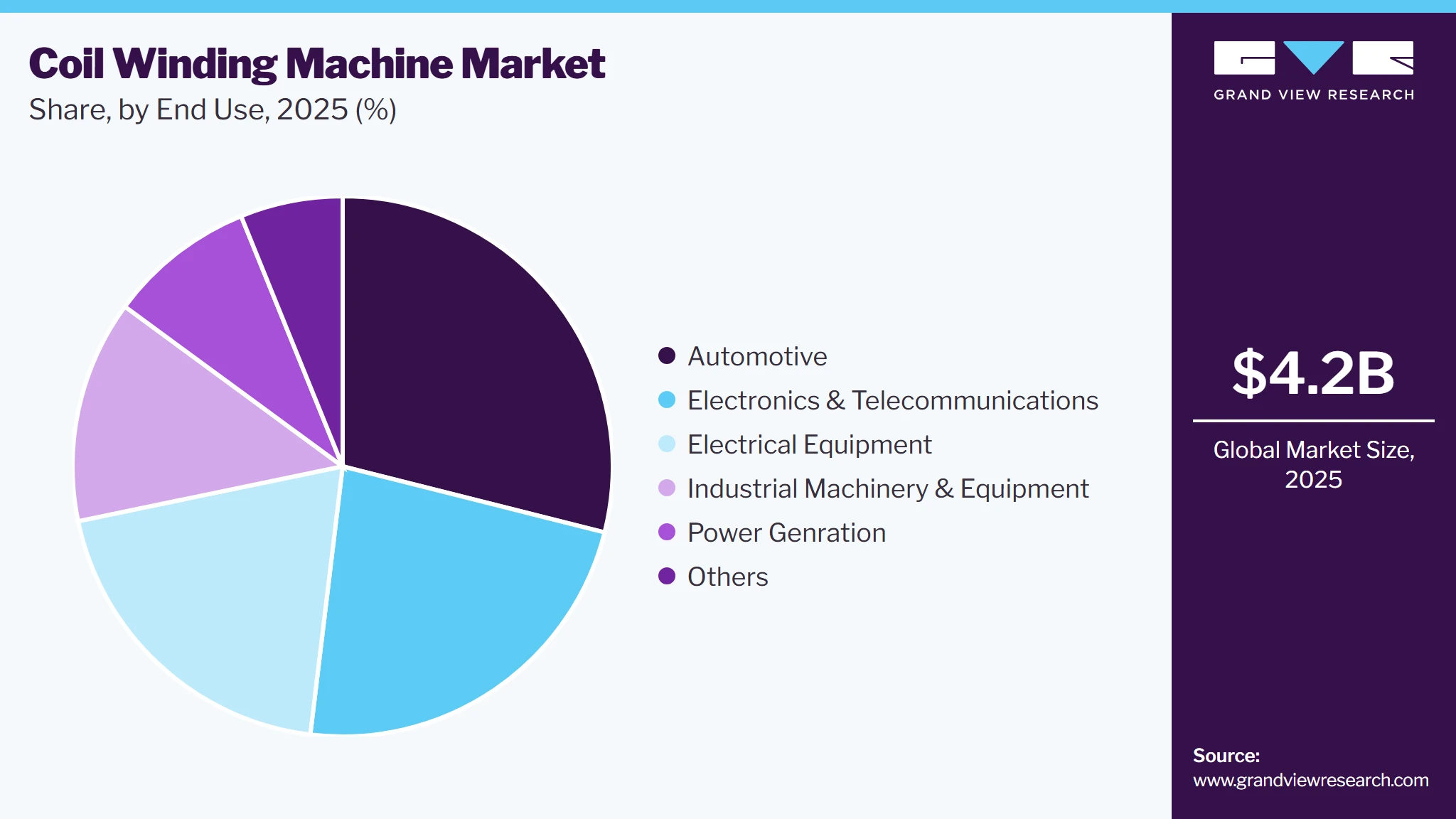
- By end use: The automotive segment led the market with the largest revenue share of 28.9% in 2025.
Regional Highlights
- Largest regional market: Asia Pacific (35.6% revenue share, 2025)
- By country: China held the largest market share in 2025
Market Size & Forecast
- Market size in 2025: USD 4.2 Billion
- Estimated market size in 2026: USD 4.4 Billion
- Projected market size by 2033: USD 6.3 Billion
- CAGR (2026-2033): 5.3%
Three ways to get this report
Buy it, customize it, or ask a question.Ask an Analyst
Analyst response in 1 business day
- AccessReport author, directly
- Reply timeWithin 1 working day
- No sales callDirect answer only
- FormatEmail reply
- CostFree, no cost
Get the Full Report
What the study covers
- FormatsPDF · Excel · Dashboard
- Timeline2026–2033 annual, 2025 base
- Coverage20+ countries, 5 regions
- Companies10+ key players profiled
Customize the Report
20% free customization
- IncludeCountries, segments, points
- TailorTo your product definition
- ExtendDeeper competitor detail
- OrA fully bespoke study
- Turnaround5–10 working days
The increasing adoption of electric vehicles is creating demand for advanced motor winding equipment used in traction motors and other electrical components. Investments in power transmission infrastructure, renewable energy projects, and industrial equipment are also supporting the need for coil winding machines used in transformers, generators, and electric motors. The increasing adoption of automation in manufacturing is another key factor supporting market growth.
 To learn more about this report, Download Free Sample Report
Manufacturers are investing in automated and multi-spindle coil winding machines to improve production speed, maintain winding accuracy, and reduce material wastage. The growing complexity of electronic components and the need for consistent product quality are further encouraging the adoption of advanced machines with precise tension control, programmable settings, and flexible production capabilities. These developments are helping manufacturers improve productivity while meeting the changing requirements of electrical and electronic component production.
Market Dynamics
The market is influenced by rising demand for electric motors, transformers, automotive electrical components, and electronic devices. Increasing automation in manufacturing and the need for accurate, consistent coil production are encouraging equipment upgrades. However, high initial investment, machine customization requirements, and differences in production volumes across end-use industries can affect purchasing decisions. Opportunities are emerging from electric vehicle manufacturing, renewable energy infrastructure, and the development of advanced winding systems.
The growing use of electric motors across automotive, industrial machinery, household appliances, and power equipment is supporting demand for coil winding machines. These machines are essential for winding conductive wire into stators, rotors, transformers, inductors, and other electromagnetic components. The expansion of electric vehicle production is further increasing the need for specialized winding equipment capable of handling complex motor designs and maintaining consistent winding quality. Manufacturers are adopting advanced coil winding machines to improve production accuracy, reduce wire wastage, and maintain consistent output across large production volumes. This growing need for reliable electrical components is creating opportunities for equipment suppliers offering precision and high-capacity winding solutions.
Advanced coil winding machines, particularly fully automated systems, require substantial upfront investment in equipment, tooling, control systems, and production-line integration. Additional expenses related to installation, operator training, and process adjustments can make adoption difficult for small and medium-sized manufacturers. These costs may encourage some buyers to continue using manual or semi-automated equipment, delaying the replacement of existing machinery.
The expansion of electric vehicle manufacturing presents an opportunity for coil winding machine suppliers, as traction motors require precise and repeatable winding processes. Manufacturers are developing specialized equipment for different motor architectures, including hairpin winding systems used in certain electric vehicle motors. Demand is also emerging for flexible, automated machines that can accommodate changing motor designs and higher production volumes. Suppliers that offer adaptable winding technology, digital process monitoring, and integration with automated assembly lines can benefit from investments in electric mobility and next-generation motor manufacturing.
Market Concentration & Characteristics
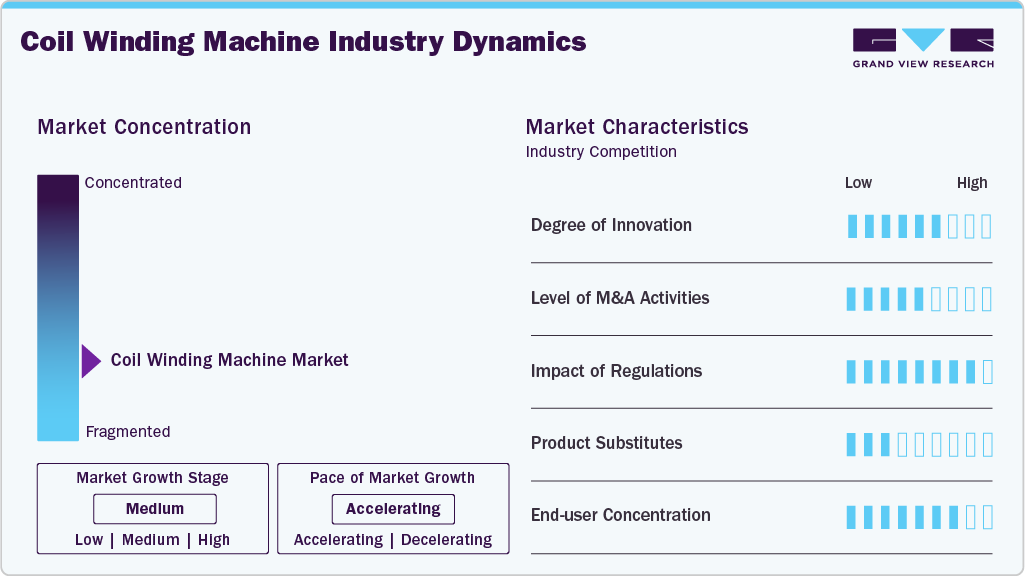
The coil winding machine industry is fragmented, with several established manufacturers and specialized regional players competing across different machine types and end-use industries. Leading companies such as Nittoku Engineering, Marsilli, Odawara Automation, and Elmotec Statomat focus on advanced winding technologies and automated production systems, while smaller manufacturers cater to customized applications and cost-sensitive customers. Differences in machine design, automation capabilities, production capacity, and application expertise allow multiple players to operate in the market without a single company dominating all segments.
The coil winding machine industry is experiencing steady technological advancement, driven by demand for higher winding precision, faster production, and improved manufacturing consistency. Manufacturers are developing automated systems with programmable controls, digital monitoring, and precise wire tension management to support complex coil designs. Integration with robotics and smart manufacturing technologies is also helping improve productivity and reduce material wastage.
 To learn more about this report, Download Free Sample Report
Regulatory requirements influence the market through workplace safety standards, electrical equipment requirements, and energy-efficiency expectations. Machine manufacturers must comply with applicable machinery safety and electrical standards in their target markets, including relevant CE requirements in Europe and OSHA workplace safety requirements in the U.S. These regulations encourage the use of suitable guarding, emergency-stop systems, and safer operating procedures, although specific requirements vary by application and location.
The coil winding machine industry serves a diverse customer base across electrical equipment, automotive, electronics and telecommunications, power generation, and industrial machinery. Demand is influenced by production requirements in these industries, with motor, transformer, and electronic component manufacturers representing important customer groups. While large manufacturers may invest in high-capacity automated systems, small and medium-sized producers often prefer semi-automated or specialized machines, creating opportunities across different customer sizes and production needs.
Analyst Perspective
The market is positioned for growth, supported by rising demand for electric motors, transformers, automotive electrical components, and electronic devices. Fully automated systems currently benefit from manufacturers' focus on production efficiency and winding precision, while semi-automated machines offer growth potential among cost-conscious manufacturers. Asia Pacific remains a key market due to its strong manufacturing base, with India emerging as a potential growth market. Going forward, manufacturers offering flexible machine configurations, advanced automation, and application-specific winding solutions are likely to strengthen their competitive position.
Machine Type Insights
The single-spindle machines segment dominated the market, driven by its flexibility, precise winding control, and suitability for producing different coil designs. These machines are widely used by manufacturers of transformers, electric motors, inductors, and electronic components, where winding accuracy and product customization are important. Their relatively simple operation and suitability for small- to medium-volume production also support adoption across diverse end-use industries.
The multiple-spindle machines segment is expected to grow at a CAGR of 5.3% over the forecast period, supported by increasing demand for high-volume coil production and manufacturing automation. These machines can wind multiple coils simultaneously, helping manufacturers improve throughput, reduce production time, and maintain consistent output. Growing investments in electric vehicle motors, electrical equipment, and electronic component manufacturing are expected to increase demand for multiple-spindle systems, particularly among manufacturers seeking greater production efficiency.
Automation Insights
The fully automated systems segment dominated the market, driven by the need for high production efficiency, consistent winding quality, and reduced manual intervention. These systems automate key operations, including wire feeding, tension control, winding, and process monitoring, making them suitable for large-scale manufacturing of electric motors, transformers, and electronic components. Their ability to minimize human error, reduce material wastage, and maintain repeatable production quality supports adoption among manufacturers with high-volume requirements.
The semi-automated systems segment is expected to grow at a CAGR of 5.3%, supported by demand from manufacturers seeking a balance between productivity and equipment investment. These machines automate essential winding operations while allowing manual involvement in activities such as material loading, unloading, and setup. This flexibility makes them suitable for small and medium-sized manufacturers handling varied product designs or moderate production volumes. Growing demand for affordable automation and gradual modernization of existing manufacturing facilities is expected to support segment growth.
End Use Insights
The automotive segment dominated the market, driven by the extensive use of wound electrical components in vehicle systems. Coil winding machines are essential for manufacturing electric motor windings, ignition coils, solenoids, and other electromagnetic components used in conventional and electric vehicles. The growing adoption of vehicle electrification and increasing demand for efficient electric motors are encouraging automotive component manufacturers to invest in precise and automated winding equipment to improve production quality and consistency.
 To learn more about this report, Download Free Sample Report
The electrical equipment segment is expected to grow at the fastest rate at a CAGR of 6.0% over the forecast period, supported by rising investments in power infrastructure, grid modernization, and renewable energy installations. Transformers, generators, inductors, and other electrical equipment require wound coils for reliable performance. Increasing demand for electricity and the expansion of transmission and distribution networks are encouraging manufacturers to increase production capacity and adopt advanced coil winding machines. These developments are expected to create additional opportunities for equipment suppliers serving the electrical equipment industry.
Regional Insights
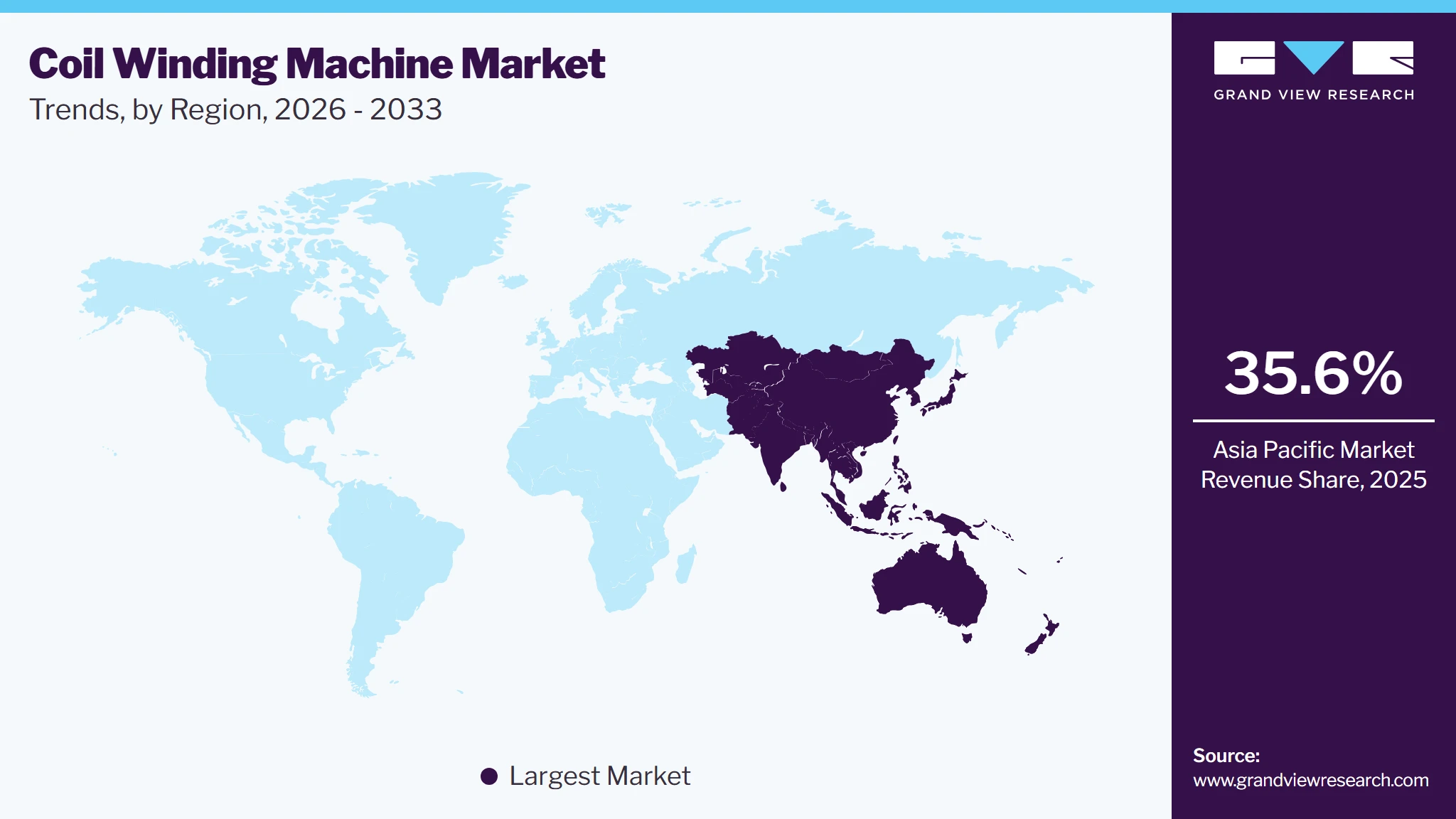
Asia Pacific dominated the market, accounting for the largest revenue share of 35.6% in 2025. Asia Pacific dominated the market and is expected to remain the fastest-growing region, supported by its strong electrical equipment, automotive, and electronics manufacturing base. China, Japan, South Korea, and India are key contributors, with established production capabilities in electric motors, transformers, and electronic components. Expanding electric vehicle manufacturing and investments in industrial automation are further increasing demand for advanced coil winding equipment across the region.
 To learn more about this report, Download Free Sample Report
China Coil Winding Machine Market Trends
The coil winding machine market in China held a leading position in Asia Pacific, supported by its extensive manufacturing base across automotive, electronics, electrical equipment, and industrial machinery. The country's growing production of electric vehicles, expansion of power infrastructure, and strong domestic supply chains are creating demand for coil winding machines used in electric motors, transformers, inductors, and other electromagnetic components. In addition, investments in factory automation and advanced manufacturing are encouraging producers to adopt precision winding equipment to improve productivity, maintain product quality, and support large-scale production.
India coil winding machine marketis expected to grow at the fastest CAGR in the Asia Pacific market, driven by expanding automotive production, electrification, and domestic manufacturing initiatives. According to India's Ministry of Heavy Industries, passenger vehicle production increased from 4.9 million units in FY 2023-24 to 5.1 million units in FY 2024-25, while two-wheeler production reached 23.88 million units in FY 2024-25. In addition, electric vehicles accounted for 2.6% of passenger vehicle registrations and 6.1% of two-wheeler registrations in FY 2024-25. This expanding manufacturing base and gradual shift toward electric mobility are expected to increase demand for coil winding machines used in motors, automotive electrical components, and industrial equipment.
North America Coil Winding Machine Market Trends
The coil winding machine market in North America is witnessing increasing demand for coil winding machines, driven by investments in domestic manufacturing, power infrastructure, and electric vehicle supply chains. The U.S. accounts for a major share of regional demand, supported by transformer production, industrial motor manufacturing, and the expansion of battery and electric vehicle facilities. Efforts to strengthen domestic supply chains are also encouraging manufacturers to upgrade production capabilities and improve operational efficiency.
The U.S. coil winding machine marketdominated North America in 2025, supported by growing demand for electric vehicles, electrical equipment, and power infrastructure upgrades. According to the U.S. Department of Energy, the country's distribution transformer stock is projected to grow by 160%-260% by 2050, reflecting rising electricity demand, electrification, and grid expansion. Furthermore, U.S. government data indicate that sales of electric and plug-in hybrid vehicles increased from approximately 526,000 units in 2021 to 1.6 million in 2024. These developments are expected to increase demand for coil winding machines used in electric motors, transformers, generators, and other electrical components, creating growth opportunities for equipment manufacturers.
Europe Coil Winding Machine Market Trends
The coil winding machine market in Europe is experiencing significant growth, supported by its established automotive engineering industry and increasing focus on electric mobility. Germany, Italy, and France contribute to demand through their automotive component, industrial machinery, and electrical equipment manufacturing sectors. The shift toward electric powertrains and investments in energy-efficient manufacturing are encouraging producers to adopt precision winding systems and automated production technologies.
Germany coil winding machine market dominated Europe, supported by its strong automotive manufacturing base and transition toward electric mobility. According to the German Association of the Automotive Industry (VDA), Germany produced approximately 4.15 million passenger cars in 2025, up 2% from 2024. Electric passenger car production reached a record 1.67 million units, increasing 23% year over year, with electric vehicles accounting for 40% of domestic passenger car production. These developments support demand for coil winding machines used in electric motors, automotive electrical components, and related manufacturing processes.
The coil winding machine market in Italyis expected to grow at a faster rate in Europe, supported by its automotive component manufacturing and industrial engineering sectors. According to Italy’s National Association of the Automotive Industry (ANFIA), the country produced approximately 474,000 motor vehicles in 2025, including around 238,000 passenger cars. Although total vehicle production declined 19.8% compared with 2024, Italy’s established automotive supply chain and ongoing shift toward vehicle electrification offer opportunities for coil winding machine manufacturers. Demand is linked to future production recovery and investment in electric motors, automotive electrical components, and industrial equipment.
Middle East & Africa Coil Winding Machine Market Trends
The coil winding machine market in MEA is supported by investments in electricity infrastructure, renewable energy projects, and industrial development. Countries such as Saudi Arabia and the UAE are expanding energy and manufacturing capabilities, creating potential demand for electrical equipment and associated winding machinery. In Africa, grid development and efforts to improve electricity access are supporting the need for transformers and other electrical components, providing opportunities for coil winding machine suppliers.
South Africa coil winding machine marketdominated MEA in 2025, supported by its established industrial base, automotive manufacturing sector, and demand for electrical equipment. The country's mining, manufacturing, and power industries require electric motors, transformers, and generators, creating demand for coil winding machines used in component production. In addition, ongoing efforts to strengthen electricity infrastructure, expand renewable energy capacity, and modernize industrial facilities are creating opportunities for winding equipment suppliers. South Africa's automotive component manufacturing capabilities also support demand for machines used to produce motor windings and other electrical components.
Latin America Coil Winding Machine Market Trends
The coil winding machine market in Latin America is gradually expanding its demand for coil winding machines as automotive production, electrical equipment manufacturing, and power infrastructure development create new requirements for wound components. Brazil and Argentina are important markets, supported by automotive assembly operations and industrial manufacturing activity. Grid expansion and investments in renewable energy projects are also creating opportunities for manufacturers supplying winding equipment for transformers, motors, and generators.
Brazil coil winding machine marketgrowth is supported by its automotive manufacturing industry, electrical equipment production, and expanding renewable energy sector. Demand for electric motors, transformers, and generators across industrial and power applications is creating opportunities for coil winding machine manufacturers. In addition, Brazil's established automotive supply chain and growing interest in vehicle electrification are supporting demand for precision winding equipment used in motor and electrical component manufacturing. Investments in electricity infrastructure and wind energy projects are further expected to support the need for reliable electrical components and associated winding machinery.
Key Coil Winding Machine Company Insights
Some of the key players operating in the market include Nittoku Engineering, Odawara Automation, and Marsilli.
-
NITTOKU Co., Ltd. is a Japan-based manufacturer established in 1972, specializing in the development, manufacturing, and sale of automatic winding machines, related machinery, and components. The company serves industries requiring precision winding technology and automated production solutions, including automotive, electronics, and electrical equipment manufacturing. Headquartered in Saitama, Japan, NITTOKU focuses on developing winding technologies that help manufacturers improve production efficiency, accuracy, and consistency. As of April 2026, the company had 580 employees on a standalone basis and 1,254 employees on a consolidated basis.
-
Odawara Automation, Inc. specializes in coil winding machinery and automated manufacturing solutions for electric motor production. The company became part of Japan-based Odawara Engineering in 1986 and offers a range of technologies for motor manufacturing, including needle winding, flyer winding, hairpin winding, and wire insertion systems. Its solutions serve industries such as automotive, aerospace, medical equipment, consumer products, and industrial machinery, helping manufacturers streamline production processes and achieve consistent quality.
Key Coil Winding Machine Companies
The following key companies have been profiled for this study on the coil winding machine market.
-
Nittoku Engineering
-
Odawara Automation
-
Marsilli
-
TANAC
-
Bestec Co., Ltd.
-
Jovil Universal
-
Synthesis Winding Technologies
-
Broomfield
-
Gorman Machine Corp.
-
BR TECHNOLOGIES GmbH & Co.KG
-
Metar SA
-
Micro Tool & Machine Ltd.
-
Armature Coil Equipment
-
Elmotec Statomat
-
Guangri Electronic Machinery Co., Ltd.
Competitive Benchmarking
Category
Operating Strategies
Competitive Edge
Weakness
Established Players (e.g., NITTOKU Engineering; Odawara Automation; Marsilli; TANAC; Elmotec Statomat)
- Invest in advanced winding technologies and automated production systems.
- Develop customized solutions for electric motors, automotive components, and electrical equipment.
- Expand machine capabilities to meet complex, high-volume manufacturing requirements.
- Established industry experience and technical expertise in winding machinery.
- Strong capabilities in precision winding and production automation.
- Diverse equipment portfolios for different winding applications.
- High initial costs for advanced winding and automation systems.
- Complex installation and integration requirements for customized equipment.
- Demand sensitivity to capital expenditure cycles in manufacturing industries.
Emerging & Regional Players (e.g., Synthesis Winding Technologies; Bestec Co., Ltd.; Guangri Electronic Machinery Co., Ltd.; BR TECHNOLOGIES GmbH & Co. KG; Metar SA)
- Focus on specialized winding applications and customized machinery.
- Target regional manufacturers and growing electric motor production demand.
- Offer flexible equipment solutions for different production volumes and customer budgets.
- Flexibility in addressing specific customer requirements.
- Potential cost advantages in selected machine categories.
- Opportunities to serve niche applications and regional markets.
- Comparatively limited global market reach and brand recognition.
- Potential constraints in research investment and international distribution.
- Challenges competing for large-scale, technically complex automation projects.
Recent Developments
-
In June 2026, Nittoku Europe signed a memorandum of understanding with ENODA to jointly develop advanced copper coil winding equipment for future ENODA PRIME Exchanger manufacturing facilities. The collaboration aims to support the transition from prototype development to large-scale manufacturing, highlighting demand for specialized winding equipment in next-generation electrical energy technologies.
-
In June 2026, Xiamen SIPU Mechanical highlighted its high-voltage coil winding equipment designed for new energy applications, including electric vehicles, photovoltaic inverters, energy storage systems, wind power converters, and EV charging infrastructure. The equipment features servo-controlled wire tension with a stated accuracy of ±3% and supports integration with automated processes such as terminal insertion, welding, and inspection.
Coil Winding Machine Market Report Scope
Report Attribute
Details
Market size in 2025
USD 4.2 billion
Estimated market size in 2026
USD 4.4 billion
Projected market size by 2033
USD 6.3 billion
Growth rate
CAGR of 5.3% from 2026 to 2033
Historical data
2021 - 2025
Forecast period
2026 - 2033
Quantitative units
Revenue in USD billion and CAGR from 2026 to 2033
Report coverage
Revenue forecast, company ranking, competitive landscape, growth factors, and trends
Segments covered
Machine type, automation, end use, region
Regional scope
North America; Europe; Asia Pacific; Latin America; MEA
Country scope
U.S.; Canada; Mexico; UK; Germany; France; Spain; Italy; China; Japan; India; Australia; South Korea; Brazil; Argentina; Saudi Arabia; UAE; South Africa
Key companies profiled
Nittoku Engineering; Odawara Automation; Marsilli; TANAC; Bestec Co., Ltd.; Jovil Universal; Synthesis Winding Technologies; Broomfield; Gorman Machine Corp.; BR TECHNOLOGIES GmbH & Co. KG; Metar SA; Micro Tool & Machine Ltd.; Armature Coil Equipment; Elmotec Statomat; Guangri Electronic Machinery Co., Ltd.
Customization scope
Free report customization (equivalent up to 8 analysts working days) with purchase. Addition or alteration to country, regional & segment scope.
Pricing and purchase options
Avail customized purchase options to meet your exact research needs. Explore purchase options
Global Coil Winding Machine Market Report Segmentation
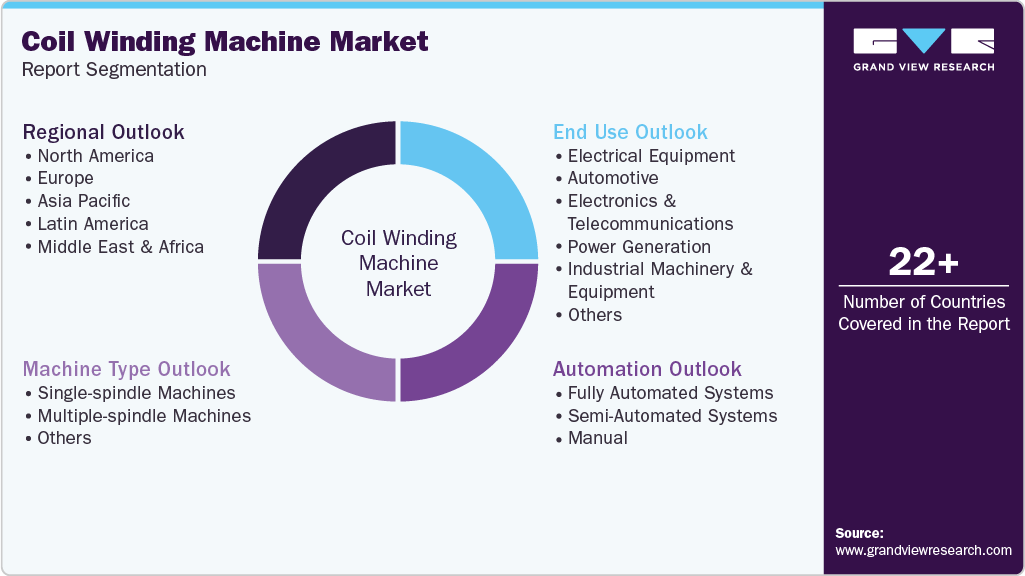
This report forecasts revenue growth at global, regional, and country levels and provides an analysis of the latest industry trends in each of the sub-segments from 2021 to 2033. For this study, Grand View Research has segmented the global coil winding machine market report based on machine type, automation, end use, and region:
 To learn more about this report, Download Free Sample Report
-
Machine Type Outlook (Revenue, USD Billion, 2021 - 2033)
-
Single-spindle Machines
-
Multiple-spindle Machines
-
Others
-
-
Automation Outlook (Revenue, USD Billion, 2021 - 2033)
-
Fully Automated Systems
-
Semi-Automated Systems
-
Manual
-
-
End Use Outlook (Revenue, USD Billion, 2021 - 2033)
-
Electrical Equipment
-
Automotive
-
Electronics & Telecommunications
-
Power Generation
-
Industrial Machinery & Equipment
-
Others
-
-
Regional Outlook (Revenue, USD Billion, 2021 - 2033)
-
North America
-
U.S.
-
Canada
-
Mexico
-
-
Europe
-
Germany
-
France
-
Italy
-
Spain
-
UK
-
-
Asia Pacific
-
China
-
India
-
Japan
-
South Korea
-
Australia
-
-
Latin America
-
Brazil
-
Argentina
-
-
Middle East & Africa
-
Saudi Arabia
-
UAE
-
South Africa
-
-
Research Methodology
The coil winding machine market figures in this report are based on a proven research process that combines executive interviews with secondary research from proprietary databases, company filings, and recognized regulatory and institutional sources. Market size is built through value-chain sizing-reconciling supply-side and demand-side estimates-and triangulated with bottom-up and top-down approaches. Every estimate passes multiple levels of expert validation before publication, with each coil winding machine segment quantified using the revenue-capture definitions in the table below.
Segment Definition
Machine Type
Revenue Capture Definition
Single-spindle Machines
Revenue generated from the sale of single-spindle coil winding machines designed to wind wire onto one spindle at a time for precision and specialized coil production.
Multiple-spindle Machines
Revenue generated from the sale of multiple-spindle coil winding machines that wind wire onto several spindles simultaneously to support high-volume production.
Others
Revenue generated from the sale of specialized coil winding machines designed for specific winding configurations, materials, or manufacturing applications.
Automation
Revenue Capture Definition
Fully Automated Systems
Revenue generated from the sale of fully automated coil winding systems that perform winding operations with minimal manual intervention, including automated feeding, tension control, and winding processes.
Semi-Automated Systems
Revenue generated from the sale of semi-automated coil winding systems that combine automated winding operations with manual activities such as material loading, unloading, and machine setup.
Manual
Revenue generated from the sale of manual coil winding machines that require operators to control or perform most winding operations.
End Use
Revenue Capture Definition
Electrical Equipment
Revenue generated from the sale of coil winding machines used to manufacture coils and windings for transformers, inductors, switchgear, and other electrical equipment.
Automotive
Revenue generated from the sale of coil winding machines used to manufacture electric motor windings, ignition coils, solenoids, and other electromagnetic components for conventional and electric vehicles.
Electronics & Telecommunications
Revenue generated from the sale of coil winding machines used to manufacture inductors, miniature coils, and other wound components for electronic devices and telecommunications equipment.
Power Generation
Revenue generated from the sale of coil winding machines used to manufacture or rewind generator windings, alternator coils, and other components for power generation equipment.
Industrial Machinery & Equipment
Revenue generated from the sale of coil winding machines used to manufacture motor windings and electromagnetic components for pumps, compressors, industrial drives, and other machinery.
Others
Revenue generated from the sale of coil winding machines used in other applications, including medical devices, aerospace equipment, textile machinery, and specialized industrial products.
Estimation Model
Layer Name
Key Question
Description
Production Volume Analysis
How many coil winding machines are sold annually?
Assess annual production and sales volumes of coil winding machines across major manufacturers, machine types, automation levels, and end-use industries.
Average Selling Price Analysis
What is the average price of coil winding machines?
Evaluate machine pricing based on spindle configuration, automation level, technical capabilities, production capacity, and application requirements.
Market Demand Analysis
What is the total demand for coil winding machines?
Estimate demand across single-spindle machines, multiple-spindle machines, fully automated systems, semi-automated systems, manual machines, and end-use industries.
Revenue Estimation
What is the total market revenue?
Calculate total market revenue by multiplying the estimated sales volume by the corresponding average selling price across market segments and regions.
Delivered Customizations
This report has been delivered with the following In-depth customizations
CLIENT REQUEST
CUSTOMIZATION DELIVERED
VALUE ADDS
Regional Segmentation
Delivered a comprehensive regional and country-level analysis covering North America, Europe, Asia Pacific, Latin America, and the Middle East & Africa. The report included key country markets, highlighting Germany and China as leading markets, India and Italy as growth markets, and the industrial, automotive, and electrical equipment trends shaping regional demand.
Provided a clear understanding of regional market opportunities, country-level growth drivers, and differences in manufacturing capabilities. This helps identify high-potential geographies for market entry and business expansion.
Competitive Benchmarking
Delivered a competitive assessment of key coil winding machine manufacturers, including NITTOKU Engineering, Odawara Automation, Marsilli, TANAC, Elmotec Statomat, and other established and regional players. The analysis covered product portfolios, machine types, automation capabilities, end-use applications, and selected recent company developments.
Helped assess competitive positioning, identify areas of technological differentiation, and understand how manufacturers compete through precision winding, automation, customization, and production efficiency.
Opportunity Assessment
Delivered an opportunity assessment based on machine type, automation level, end-use industries, and regional demand. The report evaluated growth opportunities associated with electric vehicle manufacturing, electric motors, transformers, renewable energy infrastructure, and increasing adoption of automated winding systems.
Identified potential growth areas for manufacturers, including multi-spindle machines, semi-automated systems, and winding equipment for electrical equipment production. The assessment supports strategic decisions related to product development, target industries, and market expansion.
Frequently Asked Questions About This Report
Single-spindle machines dominated the market, accounting for 52.3% of total revenue in 2025, driven by their precision, flexibility, and suitability for diverse coil manufacturing applications.
The global coil winding machine market size was estimated at USD 4.2 billion in 2025 and is expected to be USD 4.4 billion in 2026.
The global coil winding machine market, in terms of revenue, is expected to grow at a compound annual growth rate of 5.3% from 2026 to 2033 to reach USD 6.3 billion by 2033.
Asia Pacific was the largest regional market, accounting for 35.6% of global revenue in 2025, supported by its strong automotive, electronics, and electrical equipment manufacturing base.
China held the largest country-level market share in 2025, supported by its extensive manufacturing capacity across automotive, electronics, electric motors, and electrical equipment.
Fully automated systems held the largest share, accounting for 52.2% of market revenue in 2025, supported by demand for higher production efficiency, consistent winding quality, and reduced manual intervention.
The automotive segment led the market with a 28.9% revenue share in 2025, driven by demand for electric motor windings, ignition coils, solenoids, and other automotive electrical components.
Some of the key players operating in the global coil winding machine market include Nittoku Engineering; Odawara Automation; Marsilli; TANAC; Bestec Co., Ltd.; Jovil Universal; Synthesis Winding Technologies; Broomfield; Gorman Machine Corp.; BR TECHNOLOGIES GmbH & Co. KG; Metar SA; Micro Tool & Machine Ltd.; Armature Coil Equipment; Elmotec Statomat; Guangri Electronic Machinery Co., Ltd.
The market is primarily driven by increasing demand for electric motors, transformers, and automotive electrical components, along with rising electric vehicle production, power infrastructure investments, and the adoption of automated manufacturing technologies.
About the Author(s)
Advanced Interior Materials Research Team
Advanced Materials · Advanced Interior MaterialsThis report was authored by the advanced interior materials research team at Grand View Research - comprising two research analysts, one senior research analyst, and one industry expert - with specialized expertise in the advanced interior materials segment of the advanced materials industry. All findings are based on proprietary advanced materials databases, executive interviews, and regulatory analysis, subject to internal peer review prior to publication.
Last Updated:
Speak to Analyst

Customize this report to your needs - add regions, segments, or data points, with 20% free customization.
Or view our licence options:


ISO 9001:2015 & 27001:2022 Certified
We are GDPR and CCPA compliant! Your transaction & personal information is safe and secure. For more details, please read our privacy policy.


