
- Home
- »
- Next Generation Technologies
- »
-
Cold Chain Equipment Market Size, Share Report 2026-2033GVR Report cover

Cold Chain Equipment Market (2026 - 2033)
Size, Share & Trends Analysis Report By Equipment Type (Storage Equipment, Transportation Equipment), By Application (Fruits & Vegetables, Fruit & pulp, concentrates, Dairy Products), By Region, And Segment Forecasts
Market Size, 2025
$24.1BMarket Estimate, 2026
$29.3BMarket Forecast, 2033
$97.4BCAGR, 2026–2033
18.7%Cold Chain Equipment Market Summary
The global cold chain equipment market size was valued at USD 24.1 billion in 2025 and is projected to grow from USD 29.3 billion in 2026 to USD 97.4 billion by 2033, at a CAGR of 18.7% from 2026 to 2033. The market in North America dominated with a revenue share of 42.9% in 2025. It consists of a wide range of devices, including freezers, refrigerators, cold rooms, temperature sensors, data loggers, and monitoring systems.
 Source: Grand View Research, IR Documents, Primary Interviews, Paid DatabasesTo learn more about this report,
 Download Free Sample Report
 Key Market Trends & Insights
- By equipment type: Storage equipment segment held the largest market share of 73.8% in 2025.
- By application: Fish, meat, & seafood segment held the largest market share of 18.7% in 2025.
Regional Highlights
- Largest regional market: North America (42.9% revenue share, 2025)
- Fastest-growing regional market: Asia Pacific (highest CAGR, 2026-2033)
- By country: The U.S. held the largest market share in 2025
Market Size & Forecast
- Market size in 2025: USD 24.1 Billion
- Estimated market size in 2026: USD 29.3 Billion
- Projected market size by 2033: USD 97.4 Billion
- CAGR (2026-2033): 18.7%
Three ways to get this report
Buy it, customize it, or ask a question.Ask an Analyst
Analyst response in 1 business day
- AccessReport author, directly
- Reply timeWithin 1 working day
- No sales callDirect answer only
- FormatEmail reply
- CostFree, no cost
Get the Full Report
What the study covers
- FormatsPDF · Excel · Dashboard
- Timeline2026–2033 annual, 2025 base
- Coverage20+ countries, 5 regions
- Companies10+ key players profiled
Customize the Report
20% free customization
- IncludeCountries, segments, points
- TailorTo your product definition
- ExtendDeeper competitor detail
- OrA fully bespoke study
- Turnaround5–10 working days
These devices are designed to maintain a constant temperature within a predetermined range and to offer real-time information regarding temperature variations, which is essential for making sure that items continue to be secure and efficient. Effective cold chain equipment is required to preserve the quality and safety of these perishable goods due to the rising demand for fresh produce, seafood, meat, and dairy products. Similar to the food and beverage industry, the pharmaceutical and healthcare industry relies significantly on cold chain equipment to store and ship temperature-sensitive medical supplies including vaccines and medications. To learn more about this report, Download Free Sample Report
 Companies are using IoT and cloud computing to monitor and manage temperature and humidity levels in real time, allowing them to swiftly address any issues. Data loggers and sensors are used in the pharmaceutical industry, among others, to track the temperature and humidity of goods as they are transported. Effective cold chain equipment is required due to the rising demand for perishable foods. For instance, businesses in the seafood sector must make sure that fish and other seafood items are transported safely and in good condition. Companies are making investments in cutting-edge refrigeration and monitoring gear, including temperature sensors, data loggers, and monitoring systems, to meet this demand.
Also, there is a huge need for cold chain equipment due to the expansion of the pharmaceutical and healthcare sectors. For instance, the COVID-19 pandemic has increased the need for efficient vaccine distribution and storage, and businesses are investing in cutting-edge cold chain technology to guarantee the vaccines' continued safety and efficacy. To address the demand for ultra-low temperature storage of the COVID-19 vaccine from Pfizer-BioNTech, businesses are investing in cutting-edge freezers and refrigeration equipment. The market for cold chain equipment is expanding as a result of the aforementioned issues, and businesses are spending money on cutting-edge machinery to fulfill the rising need for temperature-controlled storage and transportation.
The emergence of portable and modular cold chain systems addresses the growing demand for flexible, cost-effective, and scalable temperature-controlled solutions across industries. These systems support last-mile delivery, seasonal storage needs, and operations in underserved regions, with innovations such as IoT-enabled monitoring and solar-powered units enhancing their efficiency. This trend is reshaping the market by improving accessibility, reducing operational costs, and enabling businesses to adapt to dynamic logistics requirements.
The rising demand for perishable goods is driving the global cold chain equipment industry, driven by the expansion of e-commerce, urbanization, and changing consumer preferences for fresh and frozen products. Global food trade and stringent food safety standards further necessitate advanced cold chain solutions to ensure product quality and minimize waste. This growth is prompting investments in innovative refrigeration technologies and efficient storage and transportation systems.
Market Dynamics
The cold chain equipment market is shaped by expanding global consumption of temperature-sensitive food and pharmaceutical products, rising regulatory oversight on product safety, and increasing integration of automation and monitoring technologies across supply chains. Growth dynamics are influenced by urbanization, organized retail penetration, vaccine distribution programs, and cross-border trade in perishables, while technology forces such as IoT-enabled temperature monitoring, energy-efficient refrigeration, and solar-powered systems are redefining equipment design and deployment. Collectively, these factors position the market toward steady infrastructure-led expansion, with higher emphasis on reliability, compliance, and lifecycle cost optimization.
The primary driver of the cold chain equipment market is the growing reliance on temperature-controlled supply chains for food, beverages, and pharmaceutical products. Increased consumption of fresh produce, dairy, meat, and frozen foods, coupled with the globalization of food trade, has heightened the need for reliable cold storage and transportation infrastructure. In addition, the pharmaceutical sector continues to expand its cold chain requirements as the distribution of vaccines, biologics, and specialty drugs that require strict temperature adherence grows. Regulatory agencies across major economies have also tightened standards related to food safety and drug integrity, making cold chain infrastructure a compliance necessity rather than an operational option.
Cold chain equipment solutions directly address this driver by enabling consistent temperature maintenance across storage and transit stages. Advanced refrigeration systems, insulated storage units, and real-time temperature monitoring technologies reduce spoilage, extend shelf life, and ensure regulatory compliance. The adoption of modular cold rooms, energy-efficient freezers, and integrated monitoring systems supports scalability for both large logistics providers and smaller producers. As supply chains become increasingly time-sensitive and quality-driven, investments in cold chain equipment continue to accelerate, reinforcing sustained market growth.
The high upfront capital investment required for cold chain equipment remains a significant restraint to market adoption, particularly in cost-sensitive and developing regions. Cold storage facilities, refrigerated transport units, and advanced monitoring systems entail substantial expenditures for equipment procurement, installation, and infrastructure upgrades. In addition, operating costs for energy consumption, skilled labor, and routine maintenance further increase the total cost of ownership. These cost pressures can deter small and mid-sized producers, distributors, and logistics operators from adopting comprehensive cold chain solutions.
Downstream, this restraint disproportionately impacts emerging economies and rural supply chains where access to reliable power infrastructure and financing mechanisms is limited. Off-grid regions and fragmented agricultural markets face slower adoption due to affordability constraints, limiting cold chain penetration at the farm-gate and first-mile levels. As a result, spoilage rates remain high, and market expansion is uneven across geographies. The cost barrier slows overall market growth by restricting equipment upgrades and delaying large-scale infrastructure deployment in high-potential regions.
One of the opportunities in the cold chain equipment market lies in the growing adoption of solar-powered and energy-efficient refrigeration solutions. Increasing energy costs, sustainability mandates, and unreliable grid connectivity in rural areas are driving demand for off-grid cold chain equipment. Technological advancements in solar panels, battery storage, and high-efficiency compressors have improved the commercial viability of solar chillers and cold boxes. Government-backed rural electrification programs and agricultural cold chain subsidies further enable adoption across developing markets.
This opportunity presents strong growth potential for vendors offering solar chillers, milk coolers, and modular off-grid storage solutions tailored for agriculture and healthcare applications. Equipment manufacturers focused on energy optimization, low-maintenance designs, and localized deployment models are well-positioned to capture demand. Segments serving dairy collection centers, vaccine storage points, and horticulture hubs stand to benefit the most, supporting long-term market expansion beyond traditional urban cold storage facilities.
Analyst Perspective
The cold chain equipment market is transitioning from capacity-driven expansion toward efficiency- and compliance-focused growth. Demand is increasingly shaped by food safety regulations, pharmaceutical cold chain requirements, and sustainability considerations. Technological advancements in energy-efficient refrigeration, remote monitoring, and solar-powered systems are reshaping equipment design and deployment strategies. Capital investment is expected to prioritize modular, scalable, and off-grid solutions, particularly in emerging economies. Competitive dynamics are shifting toward solution-oriented offerings that integrate equipment, software, and lifecycle services.
Equipment Type Insights
In terms of equipment type, the market is bifurcated into storage equipment and transportation equipment. The storage equipment segment dominated the overall market, gaining a market share of 73.8% in 2025. The storage equipment is created to maintain a particular temperature range that is suitable for the product being stored. For some goods, such as vaccines, this temperature range can vary from below freezing to just above freezing, and above freezing for other products, such as fruits and vegetables. Throughout the cold chain process, it is essential to keep the products' quality, safety, and efficacy, which calls for appropriate storage equipment and temperature control. The products could spoil, lose their efficacy, or even become dangerous to use or consume without the right storage equipment.
The transportation equipment segment is anticipated to grow at a significant growth rate from 2026 to 2033. Depending on the method of transportation and the particular requirements of the product being carried out, different types of transportation equipment are used in the cold chain system. Refrigerated trucks, vans, and containers, as well as air cargo containers, and ships with refrigeration units, are a few instances of transportation tools used in the cold chain system. To guarantee that the product maintains the required temperature throughout the entire journey, from loading to unloading, the transportation equipment must keep a specified temperature range. This is accomplished by utilizing specialized heating or cooling systems that can keep a constant temperature independent of the outside environment. In order to prevent product damage during transit, temperature control and transportation equipment are both essential. To protect against damage from factors such as vibrations, shocks, and humidity fluctuations, the equipment must be built to provide adequate insulation, airflow, and humidity control.
Application Insights
In terms of application, the market is segmented into fish, meat, & seafood, fruits & vegetables, dairy products, processed food, fruit & pulp concentrates, bakery & confectionaries, pharmaceuticals, and others. The fish, meat, & seafood segment dominated the market in 2025, with a market share of over 18.7%. The refrigerated storage of fish, meat, and seafood is crucial as harmful bacteria can grow on the meat when the animal is slaughtered. Food, meat, and seafood are among the high-risk products in terms of food poisoning. Hence, refrigerated storage solutions are vital to maintaining their quality and shelf life. Bacteria can multiply rapidly in meat when stored between 5°C and 63°C. The optimal temperature to store fish, meat, and seafood products is between 0°C and 5°C.
 To learn more about this report, Download Free Sample Report
 The processed food segment is anticipated to witness the fastest growth from 2026 to 2033. Processed foods are food items that have undergone various chemical or mechanical processes from their raw agricultural state, such as heating, cooking, canning, and dehydrating. They include ready-to-eat meals, frozen pizzas, and foods with added ingredients such as spices, oils, and sweeteners, among others. According to the U.S. Department of Agriculture and Foreign Agricultural Service (FAS), the total U.S. processed food export was valued at USD 34.24 billion in 2021. Cold chain solutions help maintain the quality of processed foods and increase their shelf life.
Regional Insights
North America dominated the global cold chain equipment market with the largest revenue share of 42.9% in 2025. The cold chain equipment industry in North America is a mature and established industry that serves a wide range of sectors, including food, pharmaceuticals, and chemicals. There are several prominent companies that provide cold chain equipment solutions in the region. One example is Lineage Logistics, which is the world's largest temperature-controlled warehousing and logistics company. Lineage Logistics operates over 300 facilities across North America and provides a wide range of services, including blast freezing, cross-docking, and import/export services. Another example is Carrier, which is a global leader in heating, air conditioning, and refrigeration solutions. Carrier offers a range of cold chain equipment solutions, including refrigerated transport vehicles, storage solutions, and refrigeration systems. In addition, Americold is a leading provider of temperature-controlled warehousing and logistics services, with a focus on sustainability and energy efficiency.
 To learn more about this report, Download Free Sample Report
 U.S. Cold Chain Equipment Market Trends
The cold chain equipment market in the U.S. held the largest share in the North America region in 2025. The U.S. cold chain equipment industry is growing due to rising e-commerce sales of perishable goods, the expanding pharmaceutical industry, and increasing consumer demand for fresh and organic products. Strict regulations on food safety and pharmaceutical distribution, coupled with advancements in IoT-enabled and energy-efficient solutions, are further driving adoption. In addition, investments in infrastructure and efforts to reduce food waste are strengthening the market's growth trajectory.
Asia Pacific Cold Chain Equipment Market Trends
Asia Pacific market is anticipated to witness the fastest growth from 2026 to 2033. The cold chain equipment industry in the Asia Pacific region is rapidly expanding due to the increasing demand for fresh and frozen food, pharmaceuticals, and other perishable products. The region is home to some of the world's largest population centers, and there is a growing awareness of the importance of maintaining product quality and safety during transport and storage. Many companies in the Asia Pacific region provide cold chain equipment solutions. One example is Haier, a Chinese company that offers a range of refrigerators and freezers, including medical refrigerators and vaccine freezers. Another example is Daikin Industries, a Japanese company that provides air conditioning and refrigeration equipment, including refrigerated transport trucks and trailers. In addition, Nichirei Logistics, a Japanese company, specializes in temperature-controlled warehousing and transportation solutions for food and pharmaceutical products.
Key Cold Chain Equipment Company Insights
Some of the key players operating in the market include Thermo King (Trane Technologies plc), Carrier, and Schmitz Cargobull, among others.
- Thermo King is a brand of Trane Technologies plc. Trane Technologies plc reports business in three segments, namely, Americas, EMEA, and Asia Pacific. Thermo King provides temperature-controlled solutions for transporting perishable goods such as medicines and food. Thermo King offers a wide range of refrigeration units for trailers, trucks, railcars, and other cold storage applications. Their product line includes both diesel-powered and electric refrigeration units, with an increasing focus on energy-efficient, eco-friendly technologies.
Rivacold srl and Intertecnica (IK Interklimat S.p.A.) are some of the emerging market participants in the target market.
- CAREL INDUSTRIES S.p.A. provides components and solutions, both software and hardware, which can help in achieving energy-efficient control, and regulation instruments for HVAC and refrigeration markets. As such, the company offers control and humidification solutions for refrigeration, humidification, heating, air conditioning, and IoT application segments. The group operates through 49 companies with 15 production sites in Germany, China, Croatia, Italy, the U.S., Poland, and Brazil.
Key Cold Chain Equipment Companies:
The following key companies have been profiled for this study on the cold chain equipment market.
- Thermo King (Trane Technologies plc)
- Carrier
- Zanotti S.p.A.
- Viessmann Group
- Schmitz Cargobull
- Fermod
- Intertecnica (IK Interklimat S.p.A.)
- ebm-papst
- CAREL INDUSTRIES S.p.A.
- BITZER Group
- Kelvion Holding GmbH
- ARNEG S.p.A.
- Rivacold srl
- Kason Industries, Inc.
- Component Hardware Group, Inc.
Competitive Benchmarking
Category
Operating Strategies
Competitive Edge
Weakness
Established Players (Fastenal Company, MSC Industrial Direct Co., Inc., Airgas Inc., IMC Group)
- Established players are focused on broad industrial distribution, standardized product portfolios, and long-term enterprise contracts
- These players emphasize strong distribution networks, scale efficiencies, and established customer relationships
- Limited customization and slower adoption of niche cold chain innovations
Emerging Players (Apex Industrial Technologies LLC, AutoCrib, Inc., CribMaster)
- Emerging players are emphasis on automation, inventory intelligence, and application-specific solutions.
- These players have technology-led differentiation and flexible deployment models
- Smaller geographic reach and limited capital scale.
Recent Development
-
In October 2024, Carrier Transicold launched its next-generation Supra A and Citimax D series refrigeration units at REFCOLD 2024 in Kolkata, India, showcasing cutting-edge technology and efficiency for the cold chain industry. The Supra A series offers enhanced efficiency, compactness, and reliability in high ambient temperatures, while the Citimax D series features improved performance, faster pull-down speeds, lighter design, and an intelligent controller, supporting the growing demands of the cold chain sector.
-
In August 2024, Trane Technologies plc, through its Thermo King brand, completed the acquisition of Klinge Corporation, enhancing its sustainable transport temperature control offerings. Klinge Corporation, a company specializing in ISO refrigerated containers, complements Thermo King's portfolio of innovative solutions for transporting temperature-sensitive goods, aligning with the company's growth strategy and commitment to global efficiency in delivering critical goods.
Cold Chain Equipment Market Report Scope
Report Attribute
Details
Market size in 2025
USD 24.1 billion
Estimated market size in 2026
USD 29.3 billion
Projected market size by 2040
USD 97.4 billion
Growth rate
CAGR of 18.7% from 2026 to 2040
Base year for estimation
2025
Historical data
2021 - 2024
Forecast period
2026 - 2040
Quantitative units
Revenue in USD billion and CAGR from 2026 to 2040
Report coverage
Revenue forecast, company market share, competitive landscape, growth factors, and trends
Segments covered
Equipment type, application, region
Regional scope
North America; Europe; Asia Pacific; Latin America; MEA
Country scope
U.S.; Canada; Mexico; Germany; U.K.; France; China; Japan; India; South Korea; Australia; Brazil; Saudi Arabia; UAE; and South Africa
Key companies profiled
Thermo King (Trane Technologies plc); Carrier; Zanotti S.p.A.; Viessmann Group; Schmitz Cargobull; Fermod; Intertecnica (IK Interklimat S.p.A.); ebm-papst; CAREL INDUSTRIES S.p.A.; BITZER Group
Customization scope
Free report customization (equivalent up to 8 analysts' working days) with purchase. Addition or alteration to country, regional & segment scope.
Pricing and purchase options
Avail customized purchase options to meet your exact research needs.Explore purchase options
Global Cold Chain Equipment Market Report Segmentation
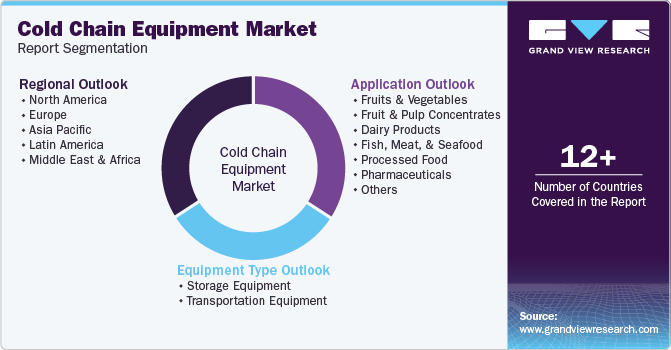
This report forecasts revenue growths at global, regional, and country levels and provides an analysis of the industry trends in each of the sub-segments from 2021 to 2033. For the purpose of this study, Grand View Research has segmented the global cold chain equipment market based on equipment type, application, and region.
 To learn more about this report, Download Free Sample Report
 -
Equipment Type Outlook (Revenue, USD Million, 2021 - 2033)
-
Storage Equipment
-
On-grid
-
Walk-in coolers
-
Walk-in freezers
-
Ice-lined refrigerators
-
Deep freezers
-
-
Off-grid
-
Solar Chillers
-
Milk Coolers
-
Solar powered cold boxes
-
Others
-
-
Others
-
-
Transportation Equipment
-
-
Application Outlook (Revenue, USD Million, 2021 - 2033)
-
Fruits & Vegetables
-
Fruit & pulp concentrates
-
Dairy Products
-
Fish, Meat, & Seafood
-
Processed Food
-
Pharmaceuticals
-
Bakery & Confectionaries
-
Others
-
-
Regional Outlook (Revenue, USD Million, 2021 - 2033)
-
North America
-
U.S.
-
Canada
-
Mexico
-
-
Europe
-
Germany
-
UK
-
France
-
Spain
-
Italy
-
Poland
-
Sweden
-
Finland
-
Norway
-
Croatia
-
Greece
-
Turkey
-
-
Asia Pacific
-
India
-
China
-
Japan
-
Australia
-
South Korea
-
-
Latin America
-
Brazil
-
-
Middle East & Africa
-
UAE
-
Kingdom of Saudi Arabia (KSA)
-
South Africa
-
-
Research Methodology
The cold chain equipment market figures in this report are based on a proven research process that combines executive interviews with secondary research from proprietary databases, company filings, and recognized regulatory and institutional sources. Market size is built through value-chain sizing - reconciling supply-side and demand-side estimates - and triangulated with bottom-up and top-down approaches. Every estimate passes multiple levels of expert validation before publication, with each cold chain equipment segment quantified using the revenue-capture definitions in the table below.
Segment Definition
Segment - Equipment type
Revenue capture definition
Storage Equipment
- The segment includes storage equipment such as On-grid: walk-in coolers, walk-in freezers, ice-lined refrigerators, and deep freezers; Off-grid: solar chillers, milk coolers, and solar-powered cold boxes; and others.
- On-grid: On-grid refers to the electrically powered cold storage equipment connected to grid infrastructure, including system sales, upgrades, and energy-optimized retrofits.
- Walk-in coolers: walk-in coolers are the large-capacity refrigerated rooms which are designed for short- to medium-term storage of chilled products, including customization and installation services.
- Walk-in freezers: walk-in freezers involve revenue from frozen storage rooms capable of maintaining sub-zero temperatures, including structural insulation, refrigeration units, and control systems.
- Ice-lined refrigerators: Ice-lined refrigerators using ice-lined technology to maintain temperature stability during power outages, commonly used in healthcare and vaccines.
- Deep freezers: These are standalone or integrated deep-freezing units used for long-term frozen storage in food and pharmaceutical applications.
- Off-grid: It refers to revenue from cold chain equipment designed to operate without grid electricity, including solar- and hybrid-powered systems.
- Solar chillers: Solar-powered refrigeration systems used primarily in agriculture and dairy applications.
- Milk coolers: It emphasizes bulk milk cooling units installed at collection centers to preserve raw milk quality before processing.
- Solar-powered cold boxes: This segment involves portable solar-powered storage units used for vaccines, seafood, and agricultural produce.
- Others: This segment includes other specialized or hybrid storage systems that are not widely classified.
Transportation Equipment
Transportation equipment types include refrigerated vehicles, containers, and mobile cooling units used for temperature-controlled transportation.
Segment - Application
Revenue capture definition
Fruits & Vegetables
This segment reduces post-harvest losses and extends the shelf life during storage and transport.
Fruit & pulp concentrates
This segment supports the controlled storage of processed fruit bases requiring stable temperatures.
Dairy Products
This segment includes refrigeration systems for milk, cheese, butter, and yogurt across collection, processing, and distribution stages.
Fish, Meat, & Seafood
This segment covers freezing and chilling equipment, ensuring hygiene and shelf-life preservation of protein products.
Process Food
This segment includes cold storage supporting frozen and ready-to-eat food categories.
Pharmaceuticals
This segment encompasses temperature-controlled equipment for vaccines, biologics, and specialty drugs.
Bakery & Confectionaries
This segment includes chilled and frozen storage for dough, fillings, and finished bakery products.
Others
This segment includes chemicals and specialty products needing temperature control.
Estimation Model
Layer Name
Key Question
Description
Demand-Side Assessment
Where is cold chain equipment demand generated?
This layer evaluates demand across food, agriculture, and pharmaceutical value chains, considering production volumes, consumption patterns, and export flows. It identifies temperature-sensitive product categories driving equipment adoption. Regional consumption and regulatory requirements are key inputs.
Infrastructure Mapping
What infrastructure supports cold chain operations?
This layer maps existing cold storage capacity, transportation networks, and power availability. It assesses gaps in on-grid and off-grid infrastructure affecting equipment deployment. The analysis highlights urban-rural disparities.
Technology & Equipment Penetration
Which technologies are adopted?
This layer examines penetration of refrigeration technologies, energy sources, and monitoring systems. It evaluates adoption of solar-powered, automated, and energy-efficient solutions. Replacement cycles and upgraded trends are also considered.
Revenue Realization
How is market value captured?
This layer converts equipment shipments, installations, and service revenues into market value. Pricing, lifecycle services, and aftermarket revenues are incorporated. Segment-wise revenue contribution is finalized at this stage.
Delivered Customizations
This report has been delivered with the following In-depth customizations
Client Request
Customization Delivered
Value Adds
Regional Cold Chain Equipment Market Opportunity Assessment
Conducted country- and region-level market sizing supported by demand-side indicators and infrastructure mapping
Evaluated regional demand drivers, adoption patterns, and cold chain-specific regulatory frameworks
Identified high-growth regions based on perishables trade intensity, healthcare expansion, and cold storage capacity gaps
Highlighted region-specific growth opportunities and underpenetrated markets
Supported regional expansion planning and go-to-market prioritization
Enabled informed capital allocation and location-based investment decisions
Cross-Segmentation Analysis for the Cold Chain Equipment Market
Developed criss-cross analysis across equipment type and application segments
Assessed demand intensity and adoption maturity across key end-use industries
Benchmarked segment attractiveness based on scalability, regulatory pull, and infrastructure readiness
Identified high-potential and fast-adopting market segments
Supported targeted product positioning and segment-specific marketing strategies
Improved customer prioritization and resource allocation across segments
Competitive Benchmarking and Strategic Positioning
Benchmarked key market participants across product portfolios, pricing models, partnerships, and innovation focus
Conducted comparative assessment of competitive capabilities, geographic reach, and strategic approaches
Identified competitive strengths, capability gaps, and differentiation opportunities
Identified competitive white spaces and unmet market needs
Supported strategic positioning and differentiation initiatives
Enabled data-driven competitive strategy and long-term roadmap development
Frequently Asked Questions About This Report
The global cold chain equipment market size was valued at USD 24.1 billion in 2025 and is estimated at USD 29.3 billion for 2026.
The global cold chain equipment market is expected to grow at a CAGR of 18.7% from 2026 to 2033, reaching USD 97.4 billion by 2033.
Key factors that are driving the market growth include growing demand for frozen food across the globe, increasing demand for processed food in developing economies, coupled with the focus on reducing wastage of food in African countries.
The storage equipment segment led with a 73.8% revenue share in 2025.
The fish, meat, & seafood segment led with a 18.7% revenue share in 2025, while processed food is the fastest-growing segment.
North America dominated with a 42.9% revenue share in 2025.
Some key players operating in the cold chain equipment market include Thermo King (Trane Technologies plc); Carrier; Zanotti S.p.A.; Viessmann Group; Schmitz Cargobull; Fermod; Intertecnica (IK Interklimat S.p.A.); ebm-papst; CAREL INDUSTRIES S.p.A.; BITZER Group.
About the Author(s)
Next Generation Technologies Research Team
Technology · Next Generation TechnologiesThis report was authored by the next generation technologies research team at Grand View Research - comprising two research analysts, one senior research analyst, and one industry expert - with specialized expertise in the next generation technologies segment of the technology industry. All findings are based on proprietary technology databases, executive interviews, and regulatory analysis, subject to internal peer review prior to publication.
Last Updated:
Speak to Analyst

Customize this report to your needs - add regions, segments, or data points, with 20% free customization.
Or view our licence options:


ISO 9001:2015 & 27001:2022 Certified
We are GDPR and CCPA compliant! Your transaction & personal information is safe and secure. For more details, please read our privacy policy.


