
- Home
- »
- Advanced Interior Materials
- »
-
Cold-formed Steel Market Size And Share Report, 2026-2033GVR Report cover

Cold-formed Steel Market (2026 - 2033)
Size, Share & Trends Analysis Report By Application (Automotive, Building & Construction, Industrial Equipment), By Region (North America, Europe, Asia Pacific), And Segment Forecasts
Market Size, 2025
$17.1BMarket Estimate, 2026
$17.8BMarket Forecast, 2033
$28.1BCAGR, 2026–2033
6.7%Cold-formed Steel Market Summary
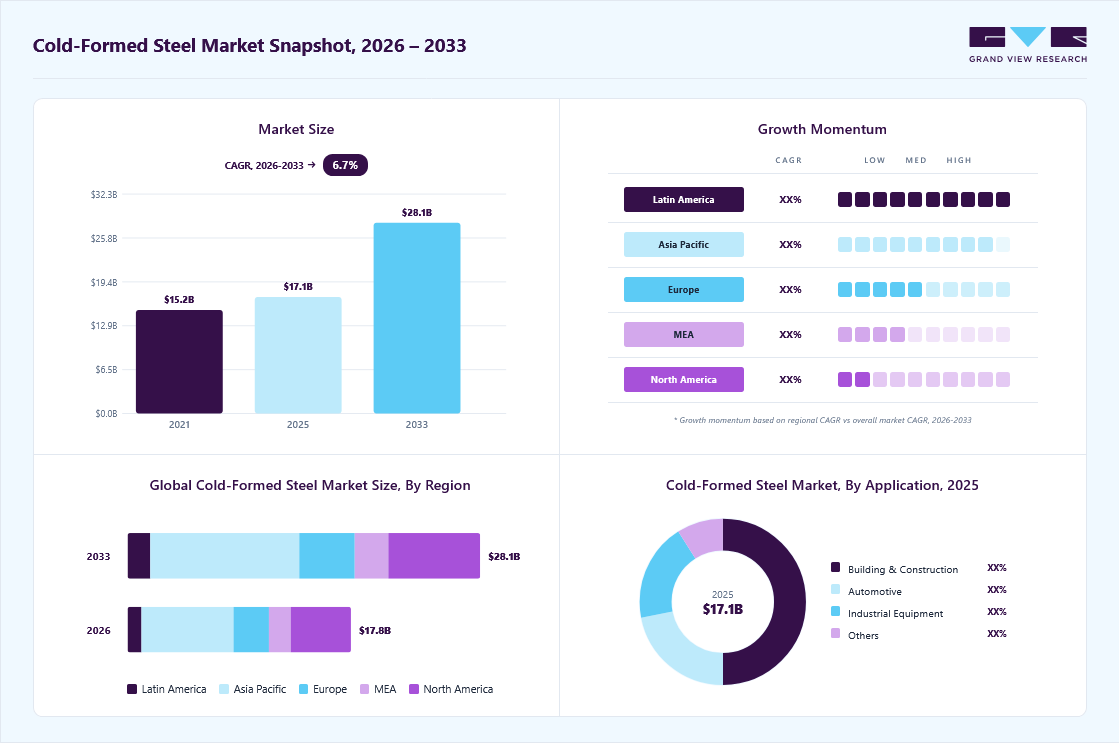
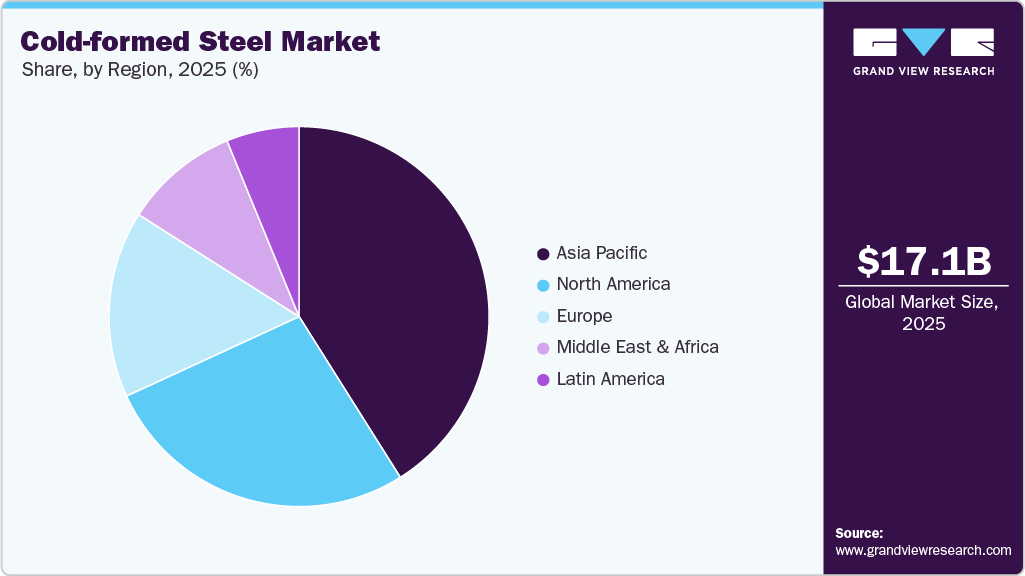
The global cold-formed steel market size was valued at USD 17.1 billion in 2025 and is projected to grow from USD 17.8 billion in 2026 to USD 28.1 billion by 2033, at a CAGR of 6.7% from 2026 to 2033. The market in Asia Pacific dominated with a revenue share of 41.1% in 2025. The market is experiencing robust growth, driven by the increasing adoption of lightweight, high-strength construction materials across residential, commercial, and industrial infrastructure projects.
 Source: Grand View Research, IR Documents, Primary Interviews, Paid DatabasesTo learn more about this report,
 Download Free Sample Report
 Key Market Trends & Insights
- By application: Building and construction segment held the largest market share of 49.9% in 2025.
Regional Highlights
- Largest regional market: Asia Pacific (41.1% revenue share, 2025)
- By country: China held the largest market share in 2025
Market Size & Forecast
- Market size in 2025: USD 17.1 Billion
- Estimated market size in 2026: USD 17.8 Billion
- Projected market size by 2033: USD 28.1 Billion
- CAGR (2026-2033): 6.7%
Three ways to get this report
Buy it, customize it, or ask a question.Ask an Analyst
Analyst response in 1 business day
- AccessReport author, directly
- Reply timeWithin 1 working day
- No sales callDirect answer only
- FormatEmail reply
- CostFree, no cost
Get the Full Report
What the study covers
- FormatsPDF · Excel · Dashboard
- Timeline2026–2033 annual, 2025 base
- Coverage20+ countries, 5 regions
- Companies10+ key players profiled
Customize the Report
20% free customization
- IncludeCountries, segments, points
- TailorTo your product definition
- ExtendDeeper competitor detail
- OrA fully bespoke study
- Turnaround5–10 working days
Rapid urbanization, rising investments in prefabricated and modular construction, and the growing emphasis on cost-efficient and time-saving building solutions are accelerating demand for cold-formed steel framing systems.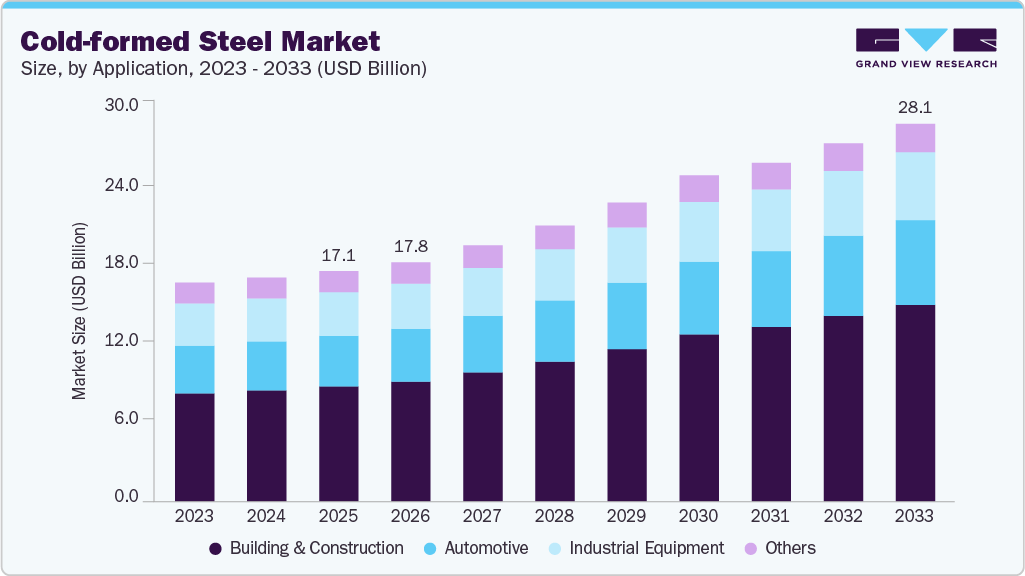 To learn more about this report, Download Free Sample Report
 Cold-formed steel (CFS) is increasingly gaining traction due to its strong sustainability profile within the construction ecosystem. Steel is 100% recyclable without degradation in mechanical properties, making cold-formed sections aligned with circular economy principles. The material’s high strength-to-weight ratio reduces overall structural dead load, thereby lowering foundation requirements and embodied carbon per square meter of construction. Compared to conventional concrete-intensive systems, CFS framing generates less on-site waste and supports off-site prefabrication, thereby enhancing material utilization efficiency and reducing construction-related emissions. In addition, the integration of Environmental Product Declarations (EPDs) and green building certifications, such as LEED and BREEAM, is accelerating the adoption of cold-formed steel in sustainable building projects globally.
Technological advancements in roll-forming, computer-aided engineering (CAE), and Building Information Modelling (BIM) are transforming the cold-formed steel industry. Automated roll-forming lines with precision control systems enable high-volume, dimensionally accurate production with minimal tolerance deviation. The increasing use of advanced finite element modelling (FEM) tools allows engineers to optimize section profiles for enhanced load-bearing performance while minimizing material consumption. Moreover, the adoption of digital fabrication, robotics in panelization, and modular construction techniques is improving installation speed and structural consistency. Coating technologies such as advanced galvanization and zinc-aluminum-magnesium (ZAM) coatings are also enhancing corrosion resistance, expanding CFS applications into coastal, industrial, and high-humidity environments.
Drivers, Opportunities & Restraints
The cold-formed steel industry is primarily driven by strong demand from the construction, infrastructure, and manufacturing sectors, which value its high strength-to-weight ratio, durability, and cost efficiency. Increasing urbanization and infrastructure development worldwide are driving the adoption of lighter, faster-to-install framing systems in residential, commercial, and industrial projects, while precision metal forming is supporting emerging sectors such as modular building and electric vehicles. For example, a November 20, 2025, industry report highlighted that growth in modular manufacturing and EV production is sparking a surge in cold-rolled steel demand, underscoring broader industrial demand beyond traditional construction applications.
Significant opportunities in the cold-formed steel industry stem from sustainability trends and technological integration. The growing focus on eco-friendly materials positions cold-formed steel as a recyclable, resource-efficient choice for green buildings and infrastructure projects. Digitalization of design and manufacturing, including Building Information Modeling (BIM), automation, and prefabrication, enables more efficient production, tighter tolerances, and faster assembly, increasing competitiveness in advanced construction and industrial supply chains. Emerging markets with unmet demand for affordable housing and resilient infrastructure also present expansion avenues.
Despite strong demand, the market faces notable restraints, particularly cost pressures and material competition. Production of cold-formed steel requires significant capital investment in rolling and forming equipment and energy-intensive operations, which can deter smaller manufacturers and inflate costs compared with traditional materials. Volatility in steel raw material prices and competition from alternative materials such as aluminum and composites in automotive and construction segments further constrain adoption and profitability.
Application Insights
The building and construction segment led the market with the largest revenue share of 49.9% in 2025 and is anticipated to grow at the fastest CAGR during the forecast period, driven by its extensive use in structural framing, roofing, wall studs, and non-load-bearing partitions across residential, commercial, and industrial projects. Cold-formed steel systems deliver high strength-to-weight performance, excellent dimensional accuracy, and rapid on-site assembly, making them especially attractive for high-rise buildings, modular construction, and prefabricated housing. These advantages reduce labor costs, shorten construction cycles, and improve overall project quality factors that are increasingly critical as developers seek faster time-to-market and compliance with stringent building codes. In regions with seismic risk, such as Japan and parts of the U.S., cold-formed steel’s ductility and predictable performance under lateral loads further bolster its adoption, reinforcing its dominant position and robust growth trajectory within the construction value chain.
In the automotive sector, cold-formed steel is gaining traction as manufacturers pursue lightweighting without compromising safety or structural integrity. Advanced high-strength cold-formed steel sections are utilized in body-in-white components, chassis parts, crash management systems, and reinforcements to improve fuel efficiency and reduce emissions in internal combustion engine vehicles, as well as to extend range in electric vehicles (EVs). The precise roll-forming process enables the production of complex geometries with consistent mechanical properties, supporting the high-volume production and tight tolerances required on modern assembly lines. While automotive represents a smaller share than construction, increasing regulatory pressure for stringent safety standards and efficiency targets alongside the shift toward electrification presents a growing opportunity for cold-formed steel in lightweight, safety-critical automotive structures.
Regional Insights
Asia Pacific dominated the global cold-formed steel market with the largest revenue share of 41.1% in 2025 and is projected to grow at the fastest CAGR during the forecast period, driven by rapid urbanization, large population centers, and significant infrastructure spending in China, India, Japan, and Southeast Asia. The construction sector’s shift toward prefabrication and modular building systems fuels demand, while industrial applications in manufacturing and automotive further enhance growth. Government initiatives promoting sustainable materials and high-efficiency building standards accelerate adoption, making the region a key engine for long-term market expansion.
China Cold-formed Steel Market Trends
The cold-formed steel industry in China accounted for the largest market revenue share in Asia Pacific in 2025. China has seen steady demand for cold-formed steel driven by rapid urbanization, the rise of prefabricated and modular construction, and growing adoption of light-gauge steel framing in residential and industrial projects. Large-scale affordable housing programs and factory and warehouse builds are increasing demand for quick, repeatable construction systems that cold-formed steel enables, because it speeds construction, reduces on-site labor needs, and improves quality control.
North America Cold-formed Steel Market Trends
The cold-formed steel market in North America is driven by robust construction activity, particularly in non-residential buildings, warehouses, and infrastructure modernization. Adoption is supported by stringent building codes emphasizing structural safety, hurricane and seismic resistance, and energy efficiency. The growth of prefabricated housing and light-gauge steel framing in both the commercial and residential sectors-especially in Canada and the U.S. continues to expand market share. Technological integration in manufacturing and high demand from industrial facility construction underpin stable growth in the region.
The cold-formed steel market in the U.S. accounted for the largest market revenue share in North America in 2025, propelled by strong investments in commercial construction, logistics, real estate, and infrastructure upgrades. The material’s advantages in construction speed, dimensional accuracy, and corrosion resistance appeal to developers focused on cost control and sustainability. Government incentives for resilient, energy-efficient building practices further support adoption, while automation and digital fabrication in steel forming are enhancing competitive positioning against traditional materials.
 To learn more about this report, Download Free Sample Report
 Europe Cold-formed Steel Market Trends
The cold-formed steel market in Europe benefits from high demand in residential renovation, modular construction, and green building projects. Countries such as Germany, the UK, and France lead adoption due to strict environmental regulations and emphasis on sustainable construction materials. Cold-formed steel’s recyclability and compatibility with modern design standards make it a preferred choice for energy-efficient buildings. The region also sees growth in industrial and commercial sectors where lightweight, durable structural systems reduce overall project costs.
Latin America Cold-formed Steel Market Trends
The cold-formed steel market in Latin America is growing due to expanding infrastructure projects, affordable housing initiatives, and increased foreign investment in commercial construction. Brazil and Mexico are key contributors, leveraging cold-formed steel for cost-effective and rapid construction solutions. However, market progress is moderated by economic volatility and competition from traditional building materials. Continued urbanization and government focus on resilient infrastructure offer upside potential for broader adoption.
Middle East & Africa Cold-formed Steel Market Trends
The cold-formed steel market in Middle East & Africa is witnessing incremental growth in cold-formed steel use, powered by large-scale infrastructure, industrial, and commercial developments in the Gulf Cooperation Council (GCC) countries. Urban expansion and mega-project construction stimulate demand for durable, light, and easily assembled structural systems. In Africa, emerging economies are beginning to explore cold-formed steel for affordable housing and educational facilities. Market expansion is supported by investments in building modernization and a gradual shift toward prefabricated construction methods.
Key Cold-formed Steel Company Insights
Some of the key players operating in the market include Nucor Corporation, Tata Steel Limited, and others
-
Nucor Corporation is a U.S.-based steel manufacturer founded in 1940 and headquartered in Charlotte, North Carolina. The company is one of the largest steel producers in the U.S. and a leading supplier of cold-formed steel framing, joists, deck, and structural systems for commercial, residential, and industrial construction. Through its decentralized operating model and extensive electric arc furnace (EAF) network, Nucor focuses on cost efficiency, product innovation, and sustainable steelmaking with lower carbon intensity. The company serves infrastructure, automotive, and non-residential construction markets across the U.S., Canada, and Mexico.
-
Tata Steel Limited is an India-based multinational steel producer founded in 1907 and part of the Tata Group. The company manufactures a comprehensive portfolio of flat and long steel products, including cold-formed steel sections used in building systems, roofing, cladding, and light structural applications. Tata Steel has a strong presence in India, Europe, and Southeast Asia, supporting residential, commercial, and infrastructure projects. The company places strategic emphasis on advanced high-strength steels, downstream value-added products, and decarbonization initiatives aligned with global sustainability targets.
-
BlueScope Steel Limited is an Australia-based steel producer established in 2002 following its demerger from BHP Steel. BlueScope specializes in coated and painted steel products, including cold-formed steel solutions widely used in building and construction, particularly in pre-engineered buildings and modular structures. The company operates across Australia, Asia, and North America, supplying steel to residential, commercial, and industrial end users. BlueScope focuses on product differentiation through advanced coating technologies, operational efficiency, and investments in lower-emission steel production processes.
Key Cold-formed Steel Companies:
The following key companies have been profiled for this study on the cold-formed steel market.
- ArcelorMittal
- BlueScope Steel Limited
- ClarkDietrich Building Systems
- Hadley Group
- MarinoWARE
- Metsec Plc
- Nucor Corporation
- SSAB AB
- Tata Steel Limited
- Voestalpine AG
Recent Developments
-
On 6 December 2023, Nucor Corporation announced an investment of approximately USD 280 million to construct a new utility structures production facility in Brigham City, Utah. The plant is intended to supply steel structures for transmission and distribution infrastructure projects across the western U.S., supporting grid modernization and renewable energy integration. The investment strengthens Nucor’s downstream capabilities in cold-formed and structural steel products, aligned with infrastructure demand growth.
-
On 29 November 2023, Tata Steel Limited announced that it will invest approximately GBP 1.25 billion to transition its Port Talbot operations in the UK to a low-carbon electric arc furnace (EAF) based steelmaking route. The project, supported by UK government funding, aims to significantly reduce carbon emissions while sustaining long-term steel production for construction and automotive applications, including cold-formed steel feedstock.
-
On 12 October 2023, ArcelorMittal announced that it commenced construction of a new electric arc furnace at its Calvert facility in Alabama, U.S., with an investment of approximately USD 1.2 billion. The project is designed to expand advanced steel production capacity for the automotive and construction markets while lowering the company’s carbon intensity by increasing the use of recycled scrap and implementing energy-efficient processes.
Cold-formed Steel Market Report Scope
Report Attribute
Details
Market definition
The market size represents the annual sales value of cold-formed steel products in a particular year.
Market size in 2025
USD 17.1 billion
Estimated market size in 2026
USD 17.8 billion
Projected market size by 2033
USD 28.1 billion
Growth Rate
CAGR of 6.7% from 2026 to 2033
Base year for estimation
2025
Historical data
2021 - 2024
Forecast period
2026 - 2033
Quantitative Units
Revenue in USD million/billion, volume in kilotons and CAGR from 2026 to 2033
Report coverage
Revenue and Volume forecast, competitive landscape, growth factors, and trends
Segments covered
Application, region
Regional scope
North America; Europe; Asia Pacific; Latin America; Middle East & Africa
Country scope
U.S.; Canada; Mexico; Germany; UK; Italy; France; Spain; China; Japan; South Korea; India; Australia; Brazil; Argentina; Saudi Arabia; UAE; South Africa
Key companies profiled
ArcelorMittal; BlueScope Steel Limited; ClarkDietrich Building Systems; Hadley Group; MarinoWARE; Metsec Plc; Nucor Corporation; SSAB AB; Tata Steel Limited; Voestalpine AG
Customization scope
Free report customization (equivalent up to 8 analysts working days) with purchase. Addition or alteration to country, regional & segment scope.
Pricing and purchase options
Avail customized purchase options to meet your exact research needs. Explore purchase options
Global Cold-formed Steel Market Report Segmentation
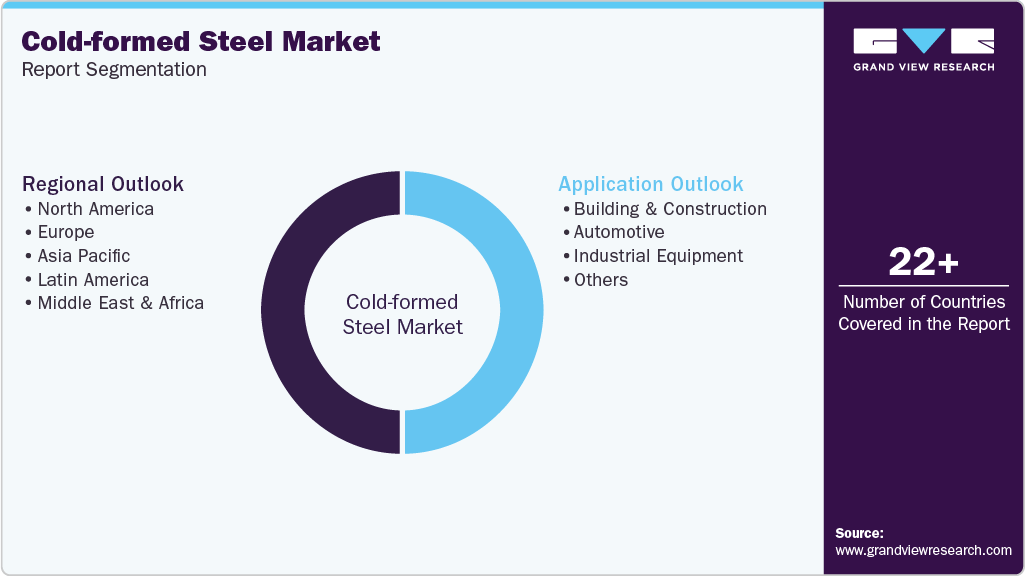
This report forecasts country revenue growth and analyzes the latest trends in each sub-segment from 2021 to 2033. For this study, Grand View Research has segmented the global cold-formed steel market report based on the application, and region.
 To learn more about this report, Download Free Sample Report
 -
Application Outlook (Volume, Kilotons; Revenue, USD Million, 2021 - 2033)
-
Building & Construction
-
Automotive
-
Industrial Equipment
-
Others
-
-
Regional Outlook (Volume, Kilotons; Revenue, USD Million, 2021 - 2033)
-
North America
-
U.S.
-
Canada
-
Mexico
-
-
Europe
-
Germany
-
UK
-
Italy
-
France
-
Spain
-
-
Asia Pacific
-
China
-
Japan
-
South Korea
-
India
-
Australia
-
-
Latin America
-
Brazil
-
Argentina
-
-
Middle East & Africa
-
Saudi Arabia
-
UAE
-
South Africa
-
-
Frequently Asked Questions About This Report
Asia Pacific dominated with a 41.1% revenue share in 2025.
By application, the building & construction segment has the largest market share, accounting for over 49.0% in 2025. This dominance is driven by extensive use of cold-formed steel in structural framing, roofing, wall studs, and prefabricated building systems across residential and non-residential projects.
Some key players in the cold-formed steel market include ArcelorMittal, BlueScope Steel Limited, ClarkDietrich Building Systems, Hadley Group, MarinoWARE, Metsec Plc, Nucor Corporation, SSAB AB, Tata Steel Limited, Voestalpine AG, and others.
The key driver of the cold-formed steel market is the rising demand for lightweight, high-strength, and cost-efficient structural materials in residential, commercial, and industrial construction. Increasing adoption of prefabricated and modular building systems, supported by rapid urbanization and infrastructure development, is further accelerating market growth.
The global cold-formed steel market size was estimated at USD 17.13 billion in 2025 and is expected to reach USD 17.78 billion in 2026.
The global cold-formed steel market is expected to grow at a compound annual growth rate of 6.7% from 2026 to 2033 to reach USD 28.06 billion by 2033.
About the Author(s)
Advanced Interior Materials Research Team
Advanced Materials · Advanced Interior MaterialsThis report was authored by the advanced interior materials research team at Grand View Research - comprising two research analysts, one senior research analyst, and one industry expert - with specialized expertise in the advanced interior materials segment of the advanced materials industry. All findings are based on proprietary advanced materials databases, executive interviews, and regulatory analysis, subject to internal peer review prior to publication.
Last Updated:
Speak to Analyst

Customize this report to your needs - add regions, segments, or data points, with 20% free customization.
Or view our licence options:


ISO 9001:2015 & 27001:2022 Certified
We are GDPR and CCPA compliant! Your transaction & personal information is safe and secure. For more details, please read our privacy policy.


