
- Home
- »
- Food Additives & Nutricosmetics
- »
-
Collagen Peptides Market Size, Share & Growth Report 2030GVR Report cover

Collagen Peptides Market (2024 - 2030) Size, Share & Trends Analysis Report By Source (Bovine, Porcine, Poultry, Marine), By End-use (Food & Beverages, Healthcare, Cosmetics), By Region, And Segment Forecasts
Market Size, 2023
$2.3BMarket Estimate, 2026
$2.5BMarket Forecast, 2030
$4.9BCAGR, 2024–2030
11.6%Collagen Peptides Market Summary
The global collagen peptides market size was estimated at USD 2.32 billion in 2023 and is projected to reach USD 4.90 billion by 2030, growing at a CAGR of 11.6% from 2024 to 2030. Lifestyle changes and higher dependence on nutraceuticals and drugs for health maintenance have resulted in a notable hike in consumer healthcare spending worldwide.
 Source: Grand View Research, IR Documents, Primary Interviews, Paid DatabasesTo learn more about this report,
 Download Free Sample Report
 Key Market Trends & Insights
- North America dominated the market with a revenue share of 30.8% in 2023.
- Collagen peptides market in China benefits from the country's significant role in the global beef market.
- By source, bovine segment dominated the market with a revenue share of 47.6% in 2023.
- By end use, healthcare segment dominated the market with a revenue share of 50.2% in 2023.
Market Size & Forecast
- 2023 Market Size: USD 2.32 Billion
- 2030 Projected Market Size: USD 4.90 Billion
- CAGR (2024-2030): 11.6%
- North America: Largest market in 2023
Three ways to get this report
Buy it, customize it, or ask a question.Ask an Analyst
Analyst response in 1 business day
- AccessReport author, directly
- Reply timeWithin 1 working day
- No sales callDirect answer only
- FormatEmail reply
- CostFree, no cost
Get the Full Report
What the study covers
- FormatsPDF · Excel · Dashboard
- Timeline2024–2030 annual, 2023 base
- Coverage20+ countries, 5 regions
- Companies10+ key players profiled
Customize the Report
20% free customization
- IncludeCountries, segments, points
- TailorTo your product definition
- ExtendDeeper competitor detail
- OrA fully bespoke study
- Turnaround5–10 working days
Furthermore, the consumption of peptide-based supplements may help in muscle development and improve muscle joint interaction. This, in turn, is anticipated to be one of the driving factors for the increased product consumption in the healthcare sector.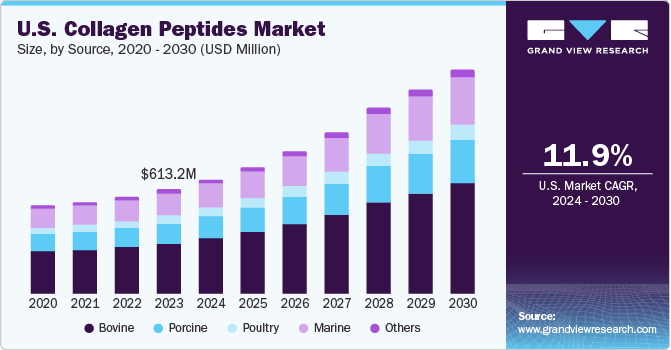 To learn more about this report, Download Free Sample Report
 Collagen peptides or hydrolyzed collagen is broken down into smaller protein chains, that are made up of amino acids. It is sourced from connective tissue, skin, and bones of animals. The processes involved in the production are extraction of collagen to gelatin, demineralization, enzymatic hydrolysis to obtain the product, ion exchange, filtration, evaporation, sterilization, and drying.
Suppliers and distributors, including meat producers and processors, of raw materials derived from animals, are required to be aware of the prevalence of existing diseases that may pose a threat to human health. This is expected to restrain the demand for collagen peptides sourced from bovine, porcine, and poultry.
Market Dynamics
The collagen peptides market is driven by increasing consumer focus on functional nutrition, healthy aging, and protein supplementation across food, beverage, nutraceutical, and personal care industries. Collagen peptides are widely incorporated into dietary supplements, functional beverages, sports nutrition products, and beauty-from-within formulations due to their association with joint health, skin elasticity, muscle recovery, and bone support. Organizations such as the International Food Information Council (IFIC) have highlighted growing consumer preference for high-protein and health-supportive ingredients, supporting stronger adoption of collagen-based formulations in mainstream nutrition products.
Leading ingredient manufacturers and nutrition companies have expanded collagen peptide product launches targeting wellness-focused consumers and active lifestyles. Increasing product innovation in ready-to-drink beverages, gummies, powders, and fortified foods has strengthened commercial demand across both developed and emerging markets. The rising popularity of preventive healthcare and clean-label nutritional products continues to support long-term growth opportunities for collagen peptide manufacturers across multiple end-use industries.
A major restraint for the collagen peptides market is the high dependence on animal-derived raw materials such as bovine, porcine, and marine sources, which creates supply chain and sourcing challenges. Fluctuations in livestock availability, disease outbreaks, and changes in animal processing regulations can directly impact raw material procurement and production stability. In addition, traceability and quality assurance requirements for animal-derived ingredients increase operational complexity for manufacturers operating in regulated food and nutraceutical markets.
Regulatory scrutiny regarding ingredient labeling, health claims, and source transparency also remains a challenge for market participants. Food safety authorities across various regions require strict compliance related to sourcing, allergen management, and product claims associated with collagen supplementation. At the same time, increasing consumer preference for plant-based and vegan alternatives is creating competitive pressure on traditional collagen peptide products, particularly in regions with rising demand for sustainable and animal-free nutrition solutions.
Market Concentration & Characteristics
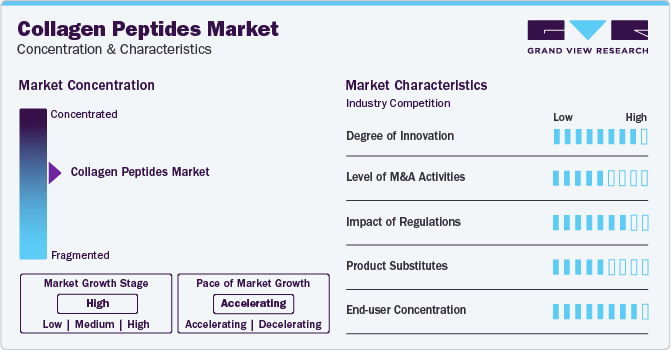
The market is highly concentrated in nature with top players accounting for more than 75% of the market share. Companies such as GELITA AG, and Rousselot are highly integrated and involved in the manufacturing of peptides-based end-use products such as skincare, haircare, and wellness products, biomedical materials, and dental surgery devices. The well-established distribution networks comprise of direct distribution for proximity sales and local sales coupled with external agencies devoted to international distribution.
 To learn more about this report, Download Free Sample Report
 Partnerships, collaboration, and innovative product launches are key strategies adopted by manufacturers to gain a higher share of the market. In January 2022, Rousselot partnered with a California based research institute called, Terasaki Institute for Biomedical Innovation (TIBI). This strategic initiative helped in the development of therapies and final products.
Source Insights
Bovine source dominated the market with a revenue share of 47.6% in 2023. This is attributed to the higher availability of cattle, increasing beef production and comparatively lower prices. Bovine sources are rich in type I and type III, which is known to strengthen bones, muscles, ligaments, gums, and improve skin health. In addition, it is used to reduce the effect of osteoporosis and osteoarthritis symptoms. The growing demand for bovine based product in the bio-medical applications to cure different medical conditions such as arthritis, improved skin health and osteoporosis.
The demand for marine based products in the economy is expected to be driven by using the product in cosmetics for skin rejuvenation and anti-aging creams. In addition, the rising demand for gelatin in the UK for use in confectionery products such as chewing gums and candies is expected to drive market growth over the forecast period. The rise in the consumption of the product for use in bone reconstruction and other orthopedic surgeries and dental surgeries is expected to drive market growth.
End-use Insights
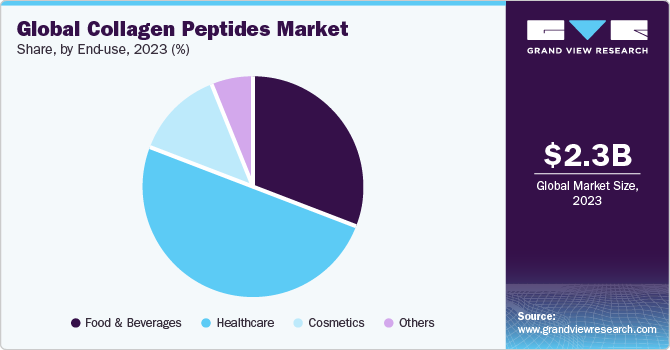
Healthcare dominated the market with a revenue share of 50.2% in 2023. The presence of major meat processing companies (raw material suppliers) globally coupled with high expenditure on healthcare sector development by the governing agencies propel the product demand. The demand for medical-grade peptides in orthopedic surgeries is likely to emerge as the major growth driver over the forecast period.
 To learn more about this report, Download Free Sample Report
 The demand is also expected to be driven by its use in cosmetic formulations, especially as an ingredient in the production of hair care products. Its utilization for skin smoothing and rejuvenation is likely to boost the market growth over the forecast period. In addition, rising awareness regarding its use as an ingredient in beauty-enhancing products is projected to propel the market. Furthermore, the growing advancements in the production of peptide-based cosmetic formulations are expected to benefit the market growth over the forecast period.
Regional Insights
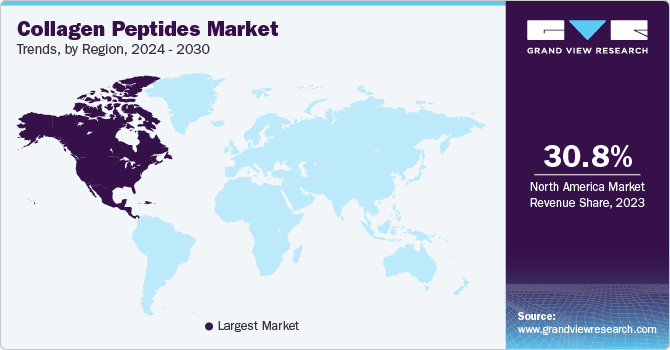
North America dominated the market with a revenue share of 30.8% in 2023. The demand for collagen peptides in the region is expected to be driven by advancements in bone reconstruction and grafting techniques, translating into market growth over the forecast period. The region is also expected to witness sustained growth in the near future on account of the specialty gums introduction by confectionery product manufacturers including Wrigley and Cadbury Adams.
 To learn more about this report, Download Free Sample Report
 U.S. Collagen Peptides Market Trends
The market in the U.S. is expected to be propelled by the presence of a strong bovine meat processing and healthcare sector. Surging demand for the treatment of diseases such as arthritis as well as to improve bone strength is expected to positively impact the market growth. Additionally, a rising preference for functional beverages, primarily due to changing lifestyles, is expected to propel the demand in the country.
Europe Collagen Peptides Market Trends
Collagen peptides market in Europe is characterized by the presence of stringent regulations established by the European Commission. The use of premium quality products for the production of bone and tissue reconstruction patches is likely to drive market growth. In addition, the rising demand for purified collagen peptides for use in the production of casings for meat is expected to boost the market growth over the forecast period. The market is likely to benefit from the presence of major sugar confectionery manufacturers such as Britannia Superfine and Astir. The use of collagen for drug delivery systems and in cardiovascular surgeries is also likely to positively impact market demand in the coming years.
Germany collagen peptides market benefits from the country's well-established meat processing and slaughter industries, resulting in an abundance of raw materials. It is characterized by the presence of a significant meat-eating population leading to high demand for products such as beef, pork, and chicken. In addition, the development of advanced peptide grades through intensive research & development is expected to drive the market growth over the forecast period.
Asia Pacific Collagen Peptides Market Trends
Collagen peptides market in the Asia Pacific region is expected to be driven by the rapid development of economies such as India and China. The presence of a well-established meat processing industry in the aforementioned economies is likely to lead to an increase in the production levels for captive consumption. In addition, growth in the demand for peptide-based films & formulations for use in surgical formulations is expected to drive the demand over the forecast period.
Japan collagen peptides market is expected to be driven by the growing inclusion of protein ingredients in dietary supplements, along with increasing demand for sports nutrition, especially in developed economies like Japan and Southeast Asian countries, over the forecast period. Furthermore, Japan is involved in notable exports of food and pharmaceutical products to developed nations such as the U.S. and other European countries, leading to the utilization of collagen peptides in the country.
Collagen peptides market in China benefits from the country's significant role in the global beef market, characterized by high production and consumption volumes. The availability of low-cost collagen-based products across the country is likely to help increase the demand in the country. The fishery industry in China is also highly developed in terms of the volume of production consumed locally. The presence of a well-established fishery industry results in an abundance of raw materials translating into high production levels.
Latin America Collagen Peptides Market Trends
Latin America collagen peptides market is characterized by the presence of major manufacturers such as Rousselot, which account for a high share in the production of bovine-sourced products. The consumption volume of is low since a majority of the collagen peptides produced here are exported to economies in Europe and North America. In addition, the market is likely to witness growth owing to the product’s superior taste and imparting properties in processed food and ready-to-eat meals. The region is characterized by the availability of low-cost collagen peptides, primarily beef based, on account of high production levels achieved by meat processing companies here. Ascending demand for bovine collagen peptides in countries such as Argentina, Peru, and Chile are expected to boost the market growth over the forecast period.
Collagen peptides market in Brazil is expected to register growth due to rising product utilization in autogenous graft and other bone reconstruction procedures. The rising utilization of collagen films in cosmetic surgery coupled with the ascending consumption of fortified sports drinks is expected to propel the demand in Brazil. The growing health awareness among consumers coupled with the various benefits offered by the product including high protein content, weight loss, and quicker injury recovery, is expected to drive the market in the country in the near future.
MEA Collagen Peptides Market Trends
MEA collagen peptides market is expected to witness increased demand for dietary supplements driven by rapid urbanization and rising disposable incomes in Middle Eastern countries and South Africa. Furthermore, the growing importance of the Middle East region as a commercial hub on account of its close vicinity to oil & gas fields is expected to trigger the number of working professionals, which is expected to fuel the demand for nutraceuticals over the forecast period. The above-mentioned trends are expected to influence collagen peptide manufacturers to establish their production units in the region.
Collagen peptides market in Saudi Arabia is primarily furnished by the demand for products sourced from bovine, poultry, and marine sources. Religious sentiments associated with the consumption of pigskin products in Arabic countries, including Saudi Arabia, the UAE, and Qatar, are expected to limit the demand for porcine-sourced product. Additionally, the demand for collagen peptides in the healthcare industry is expected to register growth due to an increase in the use of nutraceuticals for weight management, cardiovascular diseases, joint and bone health, and cognitive health in the country.
Key Collagen Peptides Company Insights
The major market leaders in the global collagen peptides market are Gelita AG, Rousselot, and Nitta Gelatin, NA Inc., among others. Juncà Gelatines SL, Weishardt International and Collagen Matrix, Inc. are the other key market players. Compared to other industry participants, the top three companies have a higher penetration of their products in various end-use markets such as food & beverage, health & nutrition, and pharmaceuticals among others due to their exceptional distribution network and goodwill worldwide. An extensive range of product portfolio for end-use markets has also fueled the sales of the above-mentioned companies.
Rousselot and Gelita AG are prominent producers and suppliers in the world and thus, have the maximum share in the marketplace. The company has partnered with local players to provide services on time with the best quality possible. It has its reach to global customers which helps them deliver advanced and innovative ingredient solutions which contribute to the health of the public.
Rousselot and GELITA AG are some of the leading market participants in the collagen peptides market.
-
Rousselot: Rousselot manufactures and supplies collagen peptides to the food, pharmaceutical, and healthcare industries. Its product portfolio includes Gelatin, Synergy Systems, ProTake, SiMoGel, StabiCaps, X-Pure, and Peptan Collagen Peptides
-
GELITA AG: GELITA AG manufactures and supplies gelatin, collagen, peptides & fats, and minerals & proteins. It caters its products to various end-use industries including food & beverage, pharmaceutical, health & nutrition, and pet food. The company operates through its manufacturing facilities and sales offices in Europe, North America, South America, Asia Pacific, and Africa
Juncà Gelatines SL, Collagen Matrix, Inc., and Advanced BioMatrix, Inc., are some of the emerging market participants in the collagen peptides market.
-
Juncà Gelatines SL is a family-owned company that mainly manufactures collagen and gelatin. Its product portfolio includes food gelatine, pharmaceutical gelatine, hydrolyzed food gelatine PROTESOL F, and hydrolyzed dietary collagen PROTESOL D
-
Advanced BioMatrix, Inc. specializes in life sciences, and it develops and manufactures a wide range of biochemical solutions for three-dimensional (3D) applications in tissue culture, cell assay, and cell proliferation. The company’s product portfolio comprises of collagen type I, type II, type III, collagen coated beads, collagen standards, to name a few
Key Collagen Peptides Companies:
The following are the leading companies in the collagen peptides market. These companies collectively hold the largest market share and dictate industry trends.
- Rousselot
- GELITA AG
- Resendable Group
- Weishardt Holding SA
- Juncà Gelatines SL
- Xiamen Yiyu Biological Technology Co., Ltd.
- Symatese
- Collagen Matrix, Inc.
- Collagen Solutions Plc
- ConnOils LLC
- Advanced BioMatrix, Inc.
- Nitta Gelatin, NA Inc.
Competitive Benchmarking
Operating Strategies
Competitive Edge
Weakness
Mature Players: Rousselot, GELITA AG, Weishardt Holding SA, Nitta Gelatin, NA Inc., Symatese
- Mature players focus on expanding collagen peptide portfolios for nutrition, beauty, pharmaceutical, and biomedical applications.
- Companies invested in advanced hydrolysis technologies, clinical validation, and high-purity collagen production capabilities.
- Strategic partnerships with nutraceutical brands, food manufacturers, and healthcare companies were strengthened to improve global market penetration.
- Mature players benefited from strong global distribution networks and established relationships with food, supplement, and healthcare manufacturers.
- Extensive R&D capabilities supported development of clinically supported and application-specific collagen peptide formulations.
- Large-scale manufacturing infrastructure enabled consistent product quality and supply reliability across global markets.
- High dependence on animal-derived raw materials exposed companies to supply chain and sourcing risks.
- Compliance with food safety, traceability, and sustainability regulations increased operational costs.
- Large organizational structures reduced flexibility in responding to niche and rapidly changing consumer trends.
Emerging Players: Juncà Gelatines SL, Xiamen Yiyu Biological Technology Co., Ltd., Collagen Matrix, Inc., Collagen Solutions Plc, ConnOils LLC, Advanced BioMatrix, Inc., Resendable Group
- Emerging players concentrated on niche collagen applications including regenerative medicine, tissue engineering, marine collagen, and specialty nutraceutical formulations.
- Companies emphasized customized ingredient solutions and regional distribution partnerships to strengthen market presence.
- Selective investments were made in bioactive collagen technologies and clean-label product development.
- Emerging players benefited from greater operational flexibility and faster product customization capabilities.
- Strong specialization in niche biomedical and functional nutrition applications supported market differentiation.
- Competitive pricing and targeted product offerings improved penetration in regional and specialty segments.
- Limited global brand recognition and narrower distribution reach compared to established manufacturers.
- Lower production capacity restricted participation in large-volume commercial supply agreements.
- Reduced R&D budgets limited large-scale clinical validation and advanced formulation development.
Recent Developments
-
In March 2023, Darling Ingredients Inc. completed the acquisition of Gelnex, a key producer of collagen and gelatin products. The six acquired facilities in the U.S. and South America account for approximately 46,000 tons of collagen and gelatin products per annum
-
In March 2023, Tessenderlo Group inaugurated a fish-based collagen peptide plant in China. The primary operations comprise of production and sale of fish peptides under the brand name “SOLUGEL”
Collagen Peptides Market Report Scope
Report Attribute
Details
Market size value in 2024
USD 2.53 billion
Revenue forecast in 2030
USD 4.90 billion
Growth rate
CAGR of 11.6% from 2024 to 2030
Historical data
2018 - 2023
Forecast period
2024 - 2030
Quantitative units
Volume in Kilotons, Revenue in USD million/billion and CAGR from 2024 to 2030
Report coverage
Volume in kilotons, revenue forecast, company ranking, competitive landscape, growth factors, and trends
Segments covered
Source, end-use, region
Regional scope
North America; Europe; Asia Pacific; Latin America; Middle East & Africa
Country scope
U.S.; Canada; Germany; UK; France; Italy; Spain; Russia; Portugal; Netherlands; Switzerland; Poland; China; Japan; India; Indonesia; Vietnam; Thailand; Philippines; Brazil; Mexico; Ecuador; Peru; Bolivia; Chile; Argentina; South Africa; Saudi Arabia; Turkey; UAE; Qatar; Israel
Key companies profiled
Rousselot; GELITA AG; Resendable Group; Weishardt Holding SA; Juncà Gelatines SL; Xiamen Yiyu Biological Technology Co., Ltd.; Symatese; Collagen Matrix, Inc.; Collagen Solutions Plc; ConnOils LLC; Advanced BioMatrix, Inc.; Nitta Gelatin, NA Inc.
Customization scope
Free report customization (equivalent up to 8 analysts working days) with purchase. Addition or alteration to country, regional & segment scope.
Pricing and purchase options
Avail customized purchase options to meet your exact research needs. Explore purchase options.
Global Collagen Peptides Market Report Segmentation
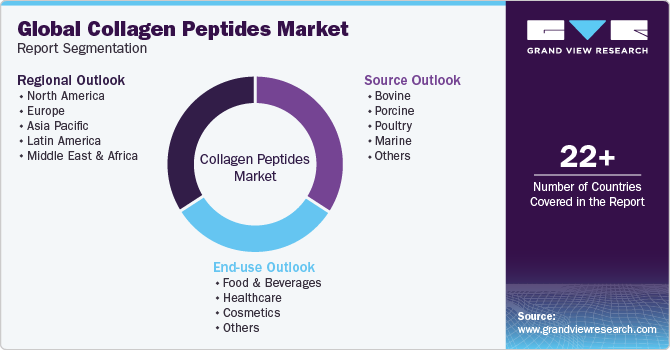
This report forecasts revenue growth at global, regional, and country levels and provides an analysis of the latest industry trends in each of the sub-segments from 2018 to 2030. For this study, Grand View Research has segmented the global collagen peptides market report based on source, end-use, and region:
 To learn more about this report, Download Free Sample Report
 -
Source Outlook (Volume, Kilotons; Revenue, USD Million, 2018 - 2030)
-
Bovine
-
Porcine
-
Poultry
-
Marine
-
Others
-
-
End-use Outlook (Volume, Kilotons; Revenue, USD Million, 2018 - 2030)
-
Food & Beverages
-
Functional Food
-
Functional Beverages
-
Dietary Supplements
-
Confectionary
-
Desserts
-
Meat Processing
-
-
Healthcare
-
Bone & Joint Health Supplements
-
Wound Dressing
-
Tissue Regeneration
-
Medical Implants
-
Cardiology
-
Drug Delivery
-
-
Cosmetics
-
Beauty Supplements (Nutricosmetics)
-
Topical Cosmetic Products
-
-
Others
-
-
Regional Outlook (Volume, Kilotons, Revenue; USD Million, 2018 - 2030)
-
North America
-
U.S.
-
Canada
-
-
Europe
-
Germany
-
UK
-
France
-
Italy
-
Spain
-
Russia
-
Portugal
-
Netherlands
-
Switzerland
-
Poland
-
-
Asia Pacific
-
China
-
Japan
-
India
-
Indonesia
-
Vietnam
-
Thailand
-
Philippines
-
-
Latin America
-
Brazil
-
Mexico
-
Argentina
-
Ecuador
-
Peru
-
Bolivia
-
Chile
-
-
Middle East and Africa
-
South Africa
-
Saudi Arabia
-
Turkey
-
UAE
-
Qatar
- Israel
-
-
Delivered Customizations
This report has been delivered with the following In-depth customizations
Client Request
Customization Delivered
Value Adds
Regional Segmentation
An expanded regional assessment of the collagen peptides market was conducted across North America, Europe, Asia Pacific, Latin America, and Middle East & Africa, with additional country-level evaluation of consumption trends, raw material availability, manufacturing presence, and regulatory landscape. The analysis further examined demand patterns for bovine, porcine, poultry, and marine collagen peptides across food & beverages, healthcare, and cosmetics applications.
Assisted in identifying high-demand regional clusters, sourcing advantages, and emerging consumption markets for collagen-based products. Supported localization strategies, distribution planning, and regional expansion initiatives across nutraceutical and personal care industries.
Competitive Benchmarking
Key collagen peptide manufacturers were benchmarked based on source specialization, peptide extraction capabilities, geographic footprint, product diversification, sustainability initiatives, partnerships, healthcare application expertise, and penetration across food, nutraceutical, and cosmetic industries. The assessment also reviewed strategic developments related to marine collagen and bioactive peptide innovation.
Supported evaluation of competitive positioning, innovation leadership, and strategic differentiation opportunities within the collagen peptides value chain. Assisted in partnership assessment and long-term market positioning strategies.
Opportunity Assessment
Emerging growth opportunities within the collagen peptides market were evaluated across functional nutrition, healthy aging products, sports nutrition, nutricosmetics, wound care, and regenerative healthcare applications. The study additionally assessed rising consumer demand for marine collagen, clean-label formulations, and bioactive peptide-based wellness products.
Enabled prioritization of high-growth application areas and innovation opportunities, supporting long-term portfolio expansion, premium product development, and strategic investment planning.
Frequently Asked Questions About This Report
The global collgen peptides market size was estimated at USD 2.32 billion in 2023 and is expected to reach USD 2.53 billion in 2024.
The global collgen peptides market is expected to grow at a compound annual growth rate of 11.6% from 2024 to 2030 to reach USD 4.90 billion by 2030.
North America dominated the collgen peptides market with a share of 30.8% in 2023. The demand for collagen peptides in the region is expected to be driven by advancements in bone reconstruction and grafting techniques, translating into market growth over the forecast period.
Some key players operating in the collgen peptides market include Rousselot, GELITA AG, Resendable Group, Weishardt Holding SA, Juncà Gelatines SL, Xiamen Yiyu Biological Technology Co., Ltd., Symatese, Collagen Matrix, Inc., Collagen Solutions Plc, ConnOils LLC, Advanced BioMatrix, Inc., Nitta Gelatin, NA Inc. ]
Key factors that are driving the market growth include growing demand for bovine based product in the bio-medical applications to cure different medical conditions such as arthritis, improved skin health and osteoporosis, coupled with expenditure on healthcare sector development by the governing agencies propel the product demand.
About the Author(s)
Food Additives & Nutricosmetics Research Team
Specialty & Chemicals · Food Additives & NutricosmeticsThis report was authored by the food additives & nutricosmetics research team at Grand View Research - comprising two research analysts, one senior research analyst, and one industry expert - with specialized expertise in the food additives & nutricosmetics segment of the specialty & chemicals industry. All findings are based on proprietary specialty & chemicals databases, executive interviews, and regulatory analysis, subject to internal peer review prior to publication.
Last Updated:
Speak to Analyst

Customize this report to your needs - add regions, segments, or data points, with 20% free customization.
Or view our licence options:


ISO 9001:2015 & 27001:2022 Certified
We are GDPR and CCPA compliant! Your transaction & personal information is safe and secure. For more details, please read our privacy policy.


