
- Home
- »
- Homecare & Decor
- »
-
Comic Book Market Size And Share, Industry Report, 2033GVR Report cover

Comic Book Market (2026 - 2033) Size, Share & Trends Analysis Report By Type (Digital, Non-Digital), By Format (Hard Copy, E-Book, Audiobooks), By Genre (Science-Fiction, Manga, Superhero, Non-fiction), By Region, And Segment Forecasts
Market Size, 2025
$19.0BMarket Estimate, 2026
$20.5BMarket Forecast, 2033
$37.1BCAGR, 2026–2033
8.9%Comic Book Market Summary
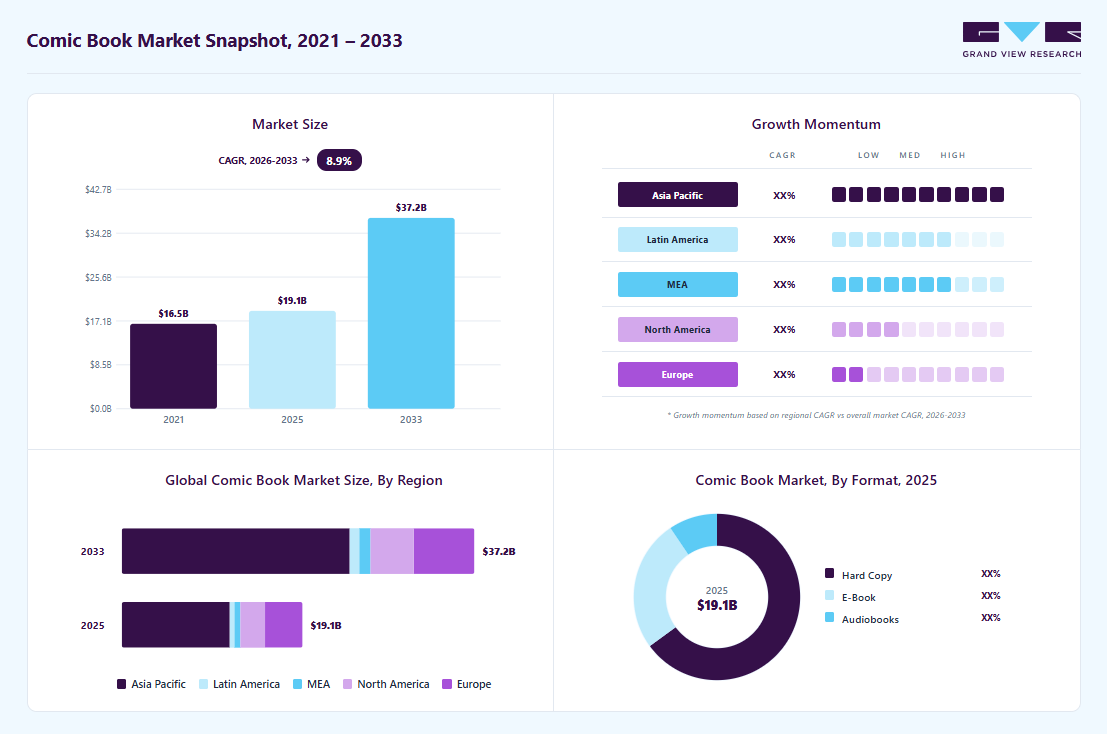
The global comic books market size was valued at USD 19.0 billion in 2025 and is projected to grow from USD 20.5 billion in 2026 to USD 37.2 billion by 2033, at a CAGR of 8.9% from 2026 to 2033. Asia Pacific dominated the global comic book market with the largest revenue share of 59.6% in 2025.
 Source: Grand View Research, IR Documents, Primary Interviews, Paid DatabasesTo learn more about this report,
 Download Free Sample Report
 Key Market Trends & Insights
- By type: The non-digitalled market held the largest revenue share of 65.0% in 2025.
- By format: Hard copy segment led with the largest revenue share of 65.0% in 2025.
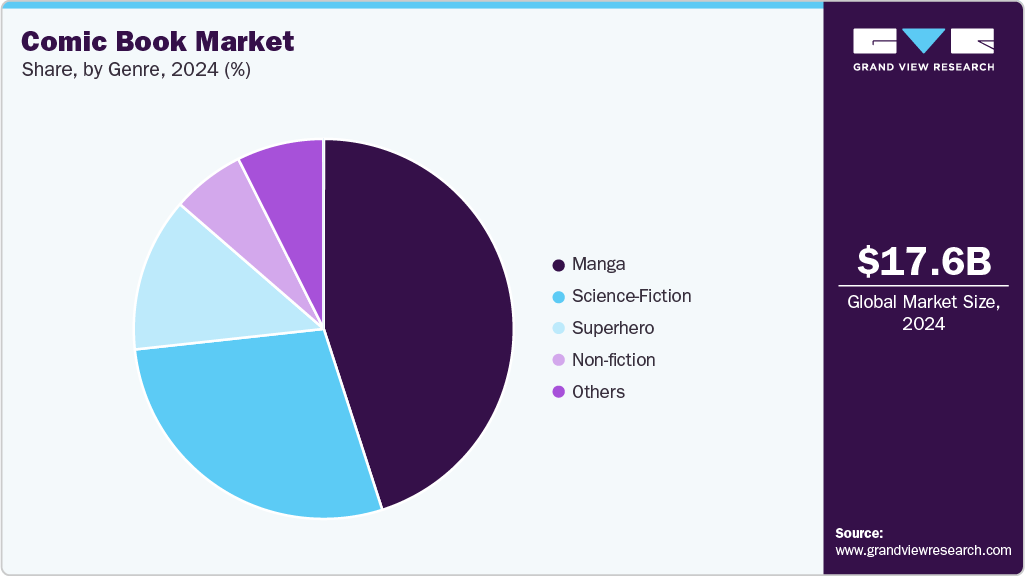
- By genre: Manga segment dominated the market with the largest revenue share of 45.5% in 2025.
Regional Highlights
- Largest regional market: Asia Pacific (59.6% revenue share, 2025)
- The comic books industry in China held the largest revenue share in 2025.
Market Size & Forecast
- Market size in 2025: USD 19.0 Billion
- Estimated market size in 2026: USD 20.5 Billion
- Projected market size by 2033: USD 37.2 Billion
- CAGR (2026-2033): 8.9%
Three ways to get this report
Buy it, customize it, or ask a question.Ask an Analyst
Analyst response in 1 business day
- AccessReport author, directly
- Reply timeWithin 1 working day
- No sales callDirect answer only
- FormatEmail reply
- CostFree, no cost
Get the Full Report
What the study covers
- FormatsPDF · Excel · Dashboard
- Timeline2026–2033 annual, 2025 base
- Coverage20+ countries, 5 regions
- Companies10+ key players profiled
Customize the Report
20% free customization
- IncludeCountries, segments, points
- TailorTo your product definition
- ExtendDeeper competitor detail
- OrA fully bespoke study
- Turnaround5–10 working days
The increasing prevalence of graphic novels in literary spaces and the growing recognition of comics as a sophisticated storytelling medium have attracted adult readers, further fueling demand. The integration of comic book intellectual properties into film, television, gaming, and merchandise has significantly expanded market reach. Blockbuster franchises from Marvel, DC, and independent publishers have cultivated a loyal global consumer base, with adaptations driving renewed interest in source materials.
 To learn more about this report, Download Free Sample Report
 Comic books have persisted through decades of change in the medium of entertainment. Kids around the world have grown up reading comics like Tintin, Asterix, Spiderman, and Teen Titans, regardless of the digital wave crashing against the relatively scarce literature readership. However, considering the massive fan base of giants like Marvel Comics and DC Comics, it is safe to say that most people have grown up reading comics at one point or another. These factors have driven the market growth over the last few years.
The influence of superhero franchises expanded further with adaptations across television, films, and other media. Blockbuster hits like "The Dark Knight" (2008) and the Marvel Cinematic Universe’s interconnected films, starting with "Iron Man" (2008), brought iconic characters to a global audience, turning them into cultural phenomena. These adaptations, alongside fan-driven events like Comic-Con, have not only boosted comic book sales but also created thriving communities that celebrate superhero stories, cementing their central role in the entertainment industry.
In the first half of 2024, sales of superhero comics showed remarkable growth, particularly in comic bookstores, where sales surged nearly 12% from January through August. Marvel’s Ultimate and X-Men titles and DC’s new compact comics featuring affordable reprints of iconic storylines drove much of this momentum. Skybound’s GI Joe, IDW’s relaunch of Teenage Mutant Ninja Turtles, and licensed comics from publishers like Mad Cave and Dynamite added to the surge. The success of Deadpool/Wolverine at the box office also played a crucial role in boosting interest, reversing negative superhero film narratives, and drawing more readers to these stories.
The integration of web comics and manga into mainstream publishing is redefining the comic book industry. The accessibility of digital-first platforms allows readers to discover new stories before they transition into print, driving interest in physical comic book sales. Titles blending manga-style storytelling with Western influences are also on the rise, creating fresh opportunities for publishers. As manga continues to dominate graphic novel sales, its success is not only reshaping the industry but also broadening the appeal of comic books worldwide, ensuring long-term growth and innovation.
Manga sales in 2001 totaled just £736 (~ USD 995.9), highlighting the dramatic growth of the category. But its popularity has continued to surge, and in 2025, manga became the largest graphic novel subcategory, representing 56.9% of all sales and generating £17.7 (~ USD 24) million even before the year concluded. In 2023, nearly 49% of the 44.7 million graphic novels sold in the U.S. were manga, highlighting its immense popularity. NielsenIQ BookData released a list of the top 60 bestselling graphic novels of 2025 so far, and all of the top 10 are manga. The surge is largely fueled by anime streaming platforms like Crunchyroll and Hulu, which introduce audiences to popular series. Once considered a niche genre, manga now appeals to a broad demographic, drawing in young and adult readers alike. This growing demand has encouraged more publishers to expand their manga offerings, further strengthening the global comic book industry.
Market Dynamics
The comic book market is being strongly propelled by the growing dominance of pop culture-driven intellectual property across entertainment ecosystems. Major franchises spanning superheroes, anime, gaming, and cinematic universes continue to generate sustained consumer engagement, significantly reinforcing demand for both new releases and legacy comic titles.
The integration of comic IPs into films, streaming content, and video games has substantially broadened audience reach, converting casual viewers into active readers and collectors. Additionally, the increasing prevalence of limited-edition releases, variant covers, and licensed collaborations enhances perceived scarcity and emotional value, fostering strong engagement within fandom communities. This convergence of storytelling and multimedia continues to reinforce the long-term demand and cultural relevance of comic books.
The comic book market faces growing constraints due to structural saturation, particularly within modern and mass-market releases. High production volumes, frequent variant editions, and continuous relaunch cycles have diluted scarcity value, weakening long-term price appreciation potential for many contemporary issues.
This oversupply has contributed to a fragmented value hierarchy, where only select “key issues” or legacy editions maintain strong appreciation, while a large portion of modern releases experience stagnant or declining collectible value. Additionally, intensified competition across publishers and formats has created pricing volatility and reduced investor confidence in lower-tier assets, limiting speculative upside and long-term market stability.
Consumer Insights
The comic books and graphic novels appeal to both children and adults, offering a unique storytelling experience that blends visuals with narrative. Many readers prefer them over traditional novels as the combination of text and imagery enhances engagement and emotional connection. Graphic novels also serve as a form of escapism, allowing readers to immerse themselves in imaginative worlds beyond reality.
 To learn more about this report, Download Free Sample Report
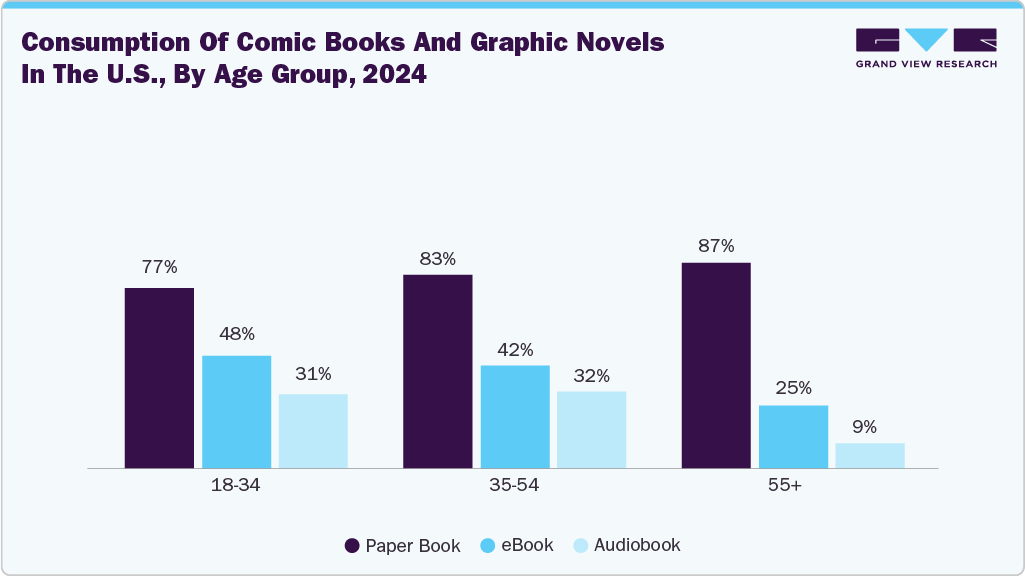
 Millennials and Gen Z, having grown up with iconic animated classics, are particularly drawn to comics and graphic novels. According to Kristen McLean of NPD BookScan, who shared key demographic insights at the New York Comic Con Insider Sessions powered by ICv2, 57% of all comic and graphic novel purchases come from 13-29-year-olds. In addition, in 2025, mobile app and device usage patterns indicate that 39% of comic book fans in India fall within the 25 to 34 age group.
Type Insights
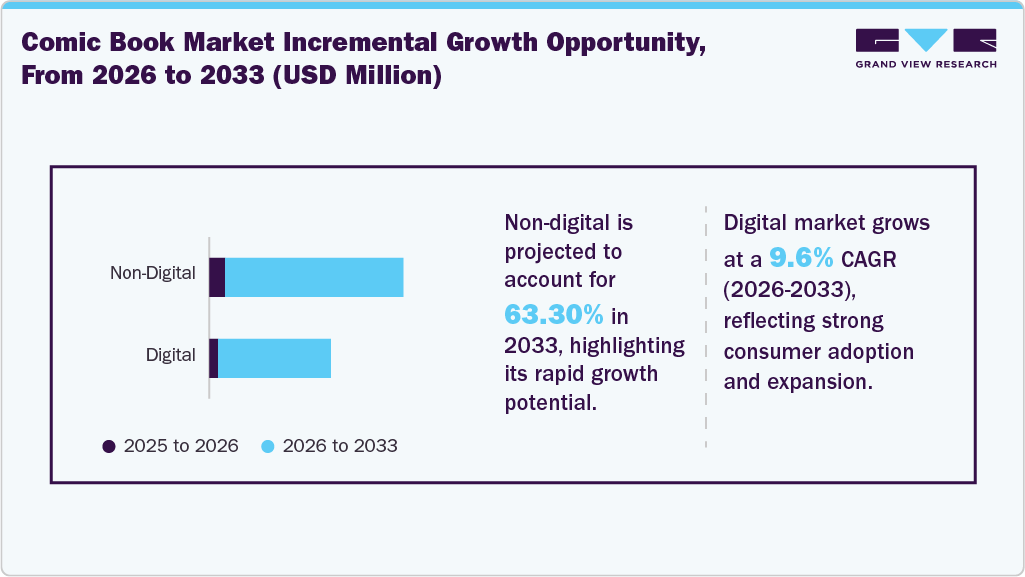
The non-digital segment led the market with the largest revenue share of 65.0% in 2025. The demand for non-digital (print) comic books remains strong, driven by factors such as nostalgia, collectability, and the unique experience of physical comics. Despite the rise of digital formats, print comics continue to appeal to a dedicated and passionate fan base. A key driver is the nostalgia factor, as many readers associate print comics with their childhood or a long-standing hobby. Collectors also highly value physical comics, particularly rare issues, special editions, and vintage collections, making print comics an investment in both culture and memorabilia. During a survey carried out by the Comic Book Resources website, more than 75% of respondents stated they preferred reading comic books in print.
 To learn more about this report, Download Free Sample Report
 The digital segment is anticipated to witness at the fastest CAGR of 9.6% from 2026 to 2033. The demand for digital comic books has grown significantly in recent years, driven by the rise of smartphones, tablets, and digital platforms. One of the primary factors fueling this demand is convenience. Digital comics allow readers to access vast libraries instantly, without the need for physical storage space. This on-demand access is especially appealing to readers who may not have easy access to comic bookstores or who prefer the portability of digital devices.
Format Insights
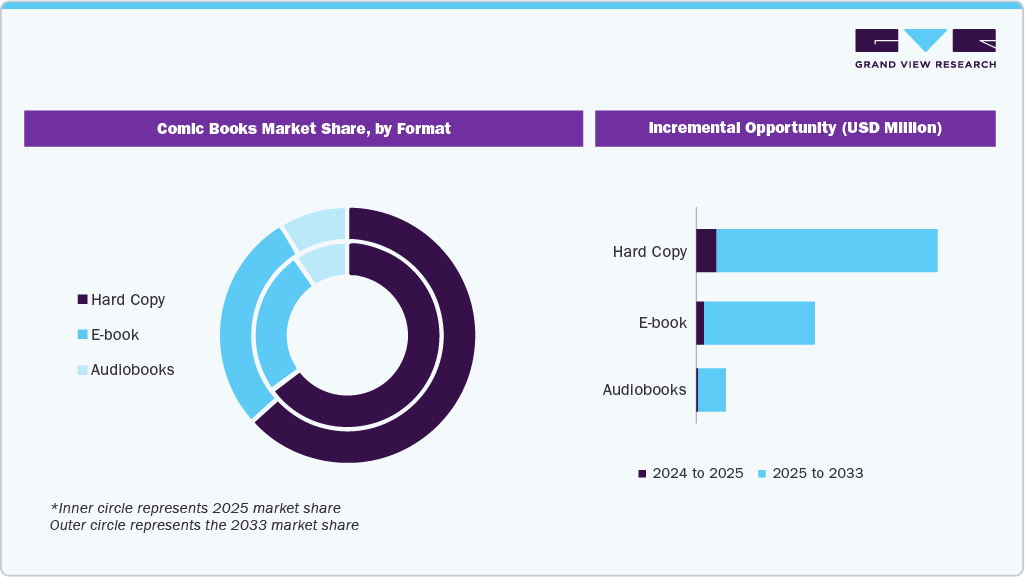
The hard copy segment led the market with the largest revenue share of 65.0% in 2025. Hard-copy comic books can provide a much-needed break in a world where people are constantly connected digitally. It gives a chance to get away from screens. It serves as a break from the interruptions of incoming texts, emails, and other notifications. People find balance in their day-to-day life by reading printed books. According to the 2024 annual report of the Association of American Publishers, hardcover revenues were up 17.1%, coming in at USD 297.4 million; paperbacks were up 6.7%, with USD 302.0 million in revenue; and special bindings were up 3.6%, with USD 21.5 million in revenue.
 To learn more about this report, Download Free Sample Report
 The e-books segment is projected to witness the fastest CAGR of 10.2% from 2026 to 2033. Consumers prefer reading e-books or downloadable books because they negate the need to carry the book anywhere. With devices like Kindle and tablet PCs, it is possible to carry the book anywhere. Since these devices can hold files of various sizes, they allow readers to access multiple books at once. This feature is particularly helpful for college students and research fellows, as they can carry their ‘books’ with them for easy reference wherever they go. Thus, the ease of access and availability of e-books further drive their demand globally.
Genre Insights
The manga segment led the market with the largest revenue share of 45.5% in 2025. The growing popularity of manga in the comic book industry has been one of the most notable trends in the past few decades, especially in Western countries. Traditionally, comics in the U.S. have been dominated by superhero genres, with American publishers like Marvel and DC leading the way. However, manga, a form of Japanese comic book or graphic novel, has carved out a massive and rapidly expanding niche. This surge in popularity can be attributed to several factors, including the increasing accessibility of digital manga platforms and the global rise of anime.
 To learn more about this report, Download Free Sample Report
 The superhero genre segment is anticipated to witness at the fastest CAGR of 8.7% from 2026 to 2033. In the past, superhero comics were largely written for children, who were the main readers. However, in recent years, adults, too, are now reading superhero comics far too frequently. The Marvel Cinematic Universe (MCU) and DC Extended Universe (DCEU) have become cultural phenomena, propelling characters like Spider-Man, Batman, and Wonder Woman into the global spotlight. Sales of superhero comics are anticipated to increase throughout the forecast period due to an increase in the reading of superhero comics among Americans of all ages. For instance, Marvel comics secured thirty-two spots in the Top 50, reflecting an increase from the twenty-seven titles it achieved in July 2025.
Regional Insights
The comic book market in North America is undergoing a significant transformation, driven by technological advancements, evolving consumer preferences, and diversifying content. A notable trend is the shift towards digital comics and webcomics. Platforms like ComiXology, Webtoon, and Tapas have made comics more accessible, especially to younger, tech-savvy readers who prefer digital content. This transition allows independent creators to reach global audiences without the constraints of traditional publishing, fostering a broader range of stories and perspectives.
U.S. Comic Book Market Trends
The comic book market in the U.S. held a significant share in North America in 2025. The presence of a large number of independent publishers and publishing companies in the U.S. is anticipated to boost the comic book industry growth. In addition, the growing number of avid readers in North America is likely to benefit market growth. Amazon is the largest book retailer in North America, followed by Barnes & Noble. The penetration of e-books is also anticipated to increase in the region. A large number of physical retail bookstores have been facing challenges as readers switch to online shopping or opt for subscription-based e-books. Comic books in audiobooks have gained in popularity in the last three years, and it looks like the pandemic-induced lockdown has only increased people’s appetite for audiobooks. It helped them get a personalized audio experience anytime, anywhere. According to the Audio Publishers Association (APA), 38% of American adults listened to an audiobook in 2024. The number is up from the 35% reported in 2023. Thus, the increasing popularity of audiobooks in the region further drives the growth of the comic book industry.
Asia Pacific Comic Book Market Trends
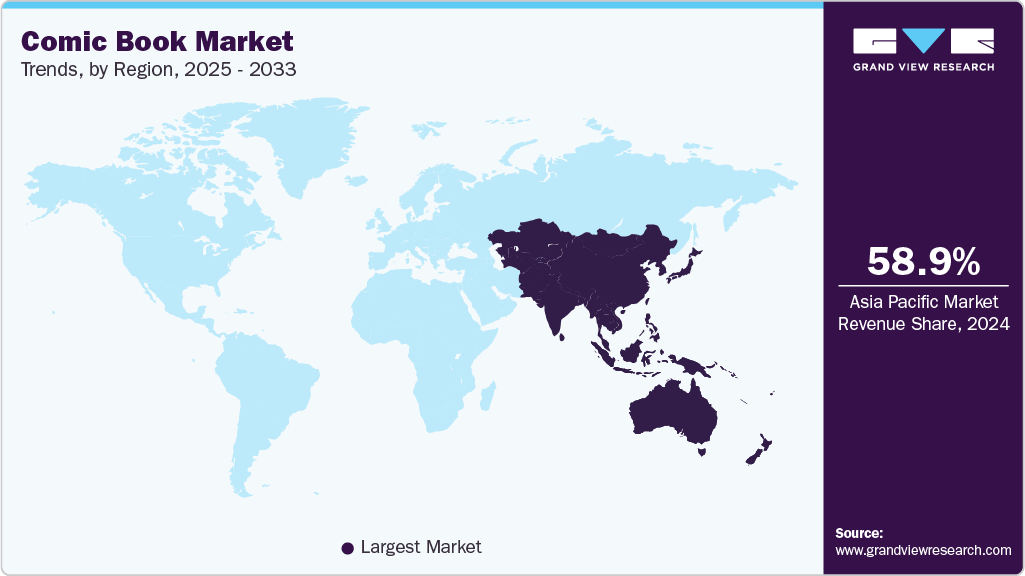
Asia Pacific dominated the global comic book market with the largest revenue share of 59.6% in 2025, fueled by a blend of cultural shifts, digital innovation, and the increasing global influence of anime. This region, which encompasses countries like Japan, South Korea, China, and India, is seeing a steady rise in both the production and consumption of comic books, expanding far beyond traditional print into digital platforms. The increasing popularity of Japanese manga and Korean manhwa, both of which have seen massive global recognition, plays a pivotal role in this expansion. Anime, as the primary medium for manga adaptations, has become an important cultural export of Japan, and the ongoing rise in anime streaming platforms like Crunchyroll, Funimation, and Netflix has boosted both manga sales and the comic book industry as a whole.
 To learn more about this report, Download Free Sample Report
 The comic book market in China accounted for the largest market revenue share in Asia Pacific in 2025. In China, there are well-established library systems, led by the National Library of China (NLC), which is the largest library in Asia, housing the largest collection of Chinese books in the world. There are about 3,000 public libraries in China at the provincial, city, and county levels all over the country. Each university and college has its own library to provide all formats of print and electronic resources. Such library systems boost the demand for comic books across the country. Moreover, online recommendations have become an important mechanism that more and more publishers consider. WeChat is one of China’s most efficient ways to sell books. Apart from popular online bookstores like Taobao, JD, and Dangdang, WeChat has become an indispensable promotional and sales channel for publishers.
The India comic book market is driving the sales of print books at a significant rate, despite the intrusion of mobile phones and digital reading. Significant improvement in India’s literacy rates over the last decade, owing to government investments in education, has also improved reading habits in the country. Many Indian cities, including Delhi, Kolkata, Bengaluru, Hyderabad, Chennai, Mumbai, and Pune, are home to street-side markets, which include several book stalls. This further drives the sales of hard copies in the country. The market has expanded rapidly as a result of various initiatives and government programs to promote comics to kids to increase their interest in reading and enhance their learning skills. For instance, in August 2025, the Ministry of Information and Broadcasting’s Publication Division introduced a Chhota Bheem comic at the 29th Delhi Book Fair. The initiative aimed to encourage children to read by using well-known animated characters and appealing narratives, helping reduce digital distractions while supporting literacy and creative thinking.
Europe Comic Book Market Trends
The comic book market in Europe has seen significant growth in recent years, driven by changing consumer behaviors, technological advancements, and the growing popularity of comics in e-books and audiobooks. Manga is the most popular genre in European countries. The European International Booksellers Federation’s (EIBF) Study on Consumer Behavior reported that, overall, 92% of UK respondents reported having read a book in 2024, compared to 94% in Italy, 91% in Ireland, 88% in France, and 87% in Germany. According to the EUDICOM (a program made to support publishers of comics in Europe) survey, major European countries, i.e., France, Germany, Italy, and Spain, produce 3,000-4,000 new comic book titles per year. France also has the largest number of publishers, followed by Germany and Italy, with 100 to 400 publishers. In Spain, according to data from Miguel Jiménez (Federation of Spanish Publisher Associations), 3,243 print comic books were published in 2019, along with 289 digital titles.
The UK comic book market held a significant share in Europe in 2025. With increasing digitalization, the Internet of Things (IoT), and technological advancement, the popularity of E-books and the purchase of hard copies of comic books through online channels is growing significantly across the region. Moreover, with the growing popularity of audiobooks, various publishers are publishing audiobooks to cater to the increasing demand. For instance, W.F. Howes Ltd. is a UK-based audiobook publisher and distributor, offering a wide range of comic fiction and non-fiction titles. The company provides high-quality audiobook productions across a range of genres, including best-selling fiction, comics, educational content, biographies, self-help books, and more.
The comic book market in Germany has a long-standing tradition of high book consumption, and initiatives like the Long Night of the Books (Lange Nacht der Bücher) and World Book Day have helped increase public interest in reading. Similarly, readers in Spain are increasingly preferring contemporary fiction, comics, thrillers, and rom-coms. Initiatives like the Semana de la Lectura (Reading Week) and public libraries offering free access to e-books have also contributed to a steady increase in reading rates. Audiobooks are gaining popularity, especially in digital formats, with platforms like Audible and Storytel expanding their reach. Thus, such initiatives in different European countries contributing to the increasing public interest in reading further propel the demand for comic books in the region and aid the market growth.
Latin America Comic Book Market Trends
The comic book market in Latin America is expected to grow at a significant CAGR of 8.8% from 2026 to 2033. Some of the largest comic book industry in the region are Argentina, Brazil, and Colombia. The demand for comic books in these countries is anticipated to increase. To meet this demand, the number of bookstores in the region is likely to grow as well. According to the National Yearbook of Bookstores, Brazil has 2.972 bookstores spread across the five corners of the country.
According to a recent study by the World Cities Culture Forum, Buenos Aires (the capital of Argentina) has more bookshops per inhabitant than any other city in the world. With a population of around 2.8 million, Buenos Aires has at least 734 bookstores - roughly 25 bookshops for every 100,000 inhabitants. The increasing popularity of comic books in Brazil is anticipated to be supported by several fairs and events, including the São Paulo Comic Con Experience (CCXP), the largest comic book festival in South America. Moreover, another significant driver of growth in the book market is the rise of digital technology and the increasing popularity of e-books. The proliferation of smartphones and tablets has made digital books more accessible across the region.
Middle East & Africa Comic Book Market Trends
The comic book market in the Middle East and Africa region, particularly in countries like South Africa, the UAE, and Saudi Arabia, is experiencing significant growth as the demand for diverse and engaging storytelling continues to rise. Historically, the comic book industry in this region was relatively niche, with limited access to global comics and little local content. However, in recent years, there has been a surge in both the production of homegrown comics and the consumption of international comics, driven by a combination of cultural shifts, increasing internet access, and expanding entertainment options.
The South Africa comic book market has seen a renaissance, with local creators and publishers gaining prominence in both the African continent and globally. South African comics, such as "Kwezi" and "The Nightline", which often feature African themes and local cultures, are helping to broaden the scope of the market and appeal to a diverse audience. The emergence of African superheroes and stories that reflect the region’s unique history and issues resonates with local readers and attracts international attention.
Key Comic Book Company Insights
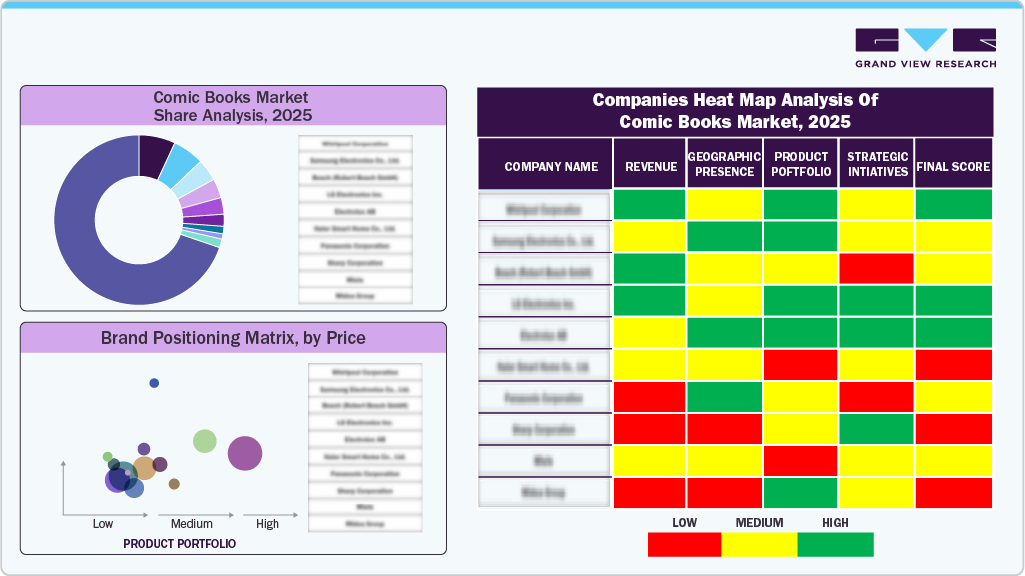
Leading players in the comic book industry include Disney, DC Comics, Shueisha Inc., and PANINI S.P.A. The global comic book industry is highly competitive, with major publishers such as Marvel Comics and DC Comics, independent creators, specialty comic shops, bookstores, and digital D2C platforms expanding across physical retail, pop-culture stores, conventions, and online marketplaces.
Companies are increasingly focusing on premium artwork, collector editions, diverse storytelling, and franchise-driven content to appeal to evolving reader preferences across superheroes, manga, fantasy, and graphic novels. Innovation is also being fueled by digital comics, webtoons, subscription services, and limited-edition merchandise bundles, alongside technology-enabled distribution models such as e-commerce platforms like Amazon, digital reading apps, and personalized collector boxes.
 To learn more about this report, Download Free Sample Report
 Key Comic Book Companies:
The following key companies have been profiled for this study on the comic book market.
- Disney.
- DC Comics
- Shueisha Inc.
- PANINI S.P.A.
- Shogakukan Inc.
- Dark Horse Comics
- Image Comics
- IDW Publishing
- HAKUSENSHA
- TOKYOPOP
Recent Developments
-
In January 2026, Image Comics announced that acclaimed writer William Harms teamed with artist JP Mavinga and colorist Lee Loughridge to launch the dystopian thriller series White Sky, with the first issue debuting in February and featuring a variant cover by Eliza Ivanova to drive market interest and broader distribution.
-
In January 2026, Image Comics announced the April release of Ghost Machine: The Official Guidebook, a five-issue miniseries profiling over 120 characters and teasing future storylines across its four shared universes, Geiger, Rook: Exodus, Hyde Street, and The Unbelievables, to deepen fan engagement and support franchise growth.
-
In January 2026, Image Comics revealed a suite of eye-popping variant covers for the upcoming high-fantasy satire D’orc series, featuring contributions from top creators like Brett Bean, Jorge Corona, Jason Howard, Ryan Ottley, Ryan Stegman, Riley Rossmo, and Mirka Andolfo to support its February launch and drive collector interest.
-
In January 2026, Bisleri International and the National Book Trust launched the comic book Chhota Bheem and Vidya’s - Big Green Mission at the New Delhi World Book Fair to promote waste management awareness among children, translating it into 48 languages and emphasizing waste segregation, recycling, and sustainable habits through engaging storytelling.
-
In January 2026, Image Comics announced the return of the fan-favorite series Kill 6 Billion Demons with its fifth volume, Breaker of Infinities, adapted from the original webcomic. The trade paperback was scheduled for spring release, continuing the epic multiversal saga of Allison Ruth amid escalating cosmic conflict.
Comic Book Market Report Scope
Report Attribute
Details
Market size in 2025
USD 19.0 billion
Estimated market size in 2026
USD 19.05 billion
Projected market size by 2033
USD 37.15 billion
Growth rate
CAGR of 8.9% from 2026 to 2033
Base year for estimation
2025
Historical data
2021 - 2024
Forecast period
2026 - 2033
Quantitative units
Revenue in USD million/billion, and CAGR from 2026 to 2033
Report coverage
Revenue forecast, company ranking, competitive landscape, growth factors, and trends
Segments covered
Type, format, genre, region
Region Covered
North America; Europe; Asia Pacific; Central & South America; Middle East & Africa
Country Covered
U.S.; Canada; Mexico; UK; Germany; France; Spain; Italy; China; Japan; India; South Korea; Australia & New Zealand; Brazil; South Africa
Key companies profiled
Disney; DC Comics; Shueisha Inc.; PANINI S.P.A.; Shogakukan Inc.; Dark Horse Comics; Image Comics; IDW Publishing; HAKUSENSHA; TOKYOPOP
Customization scope
Free report customization (equivalent up to 8 analysts’ working days) with purchase. Addition or alteration to country, regional & segment scope.
Pricing and purchase options
Avail customized purchase options to meet your exact research needs. Explore purchase options
Global Comic Book Market Report Segmentation
This report forecasts revenue growth at regional levels and provides an analysis of the latest trends and opportunities in each sub-segment from 2021 to 2033. For this study, Grand View Research has segmented the global comic book market report based on the type, format, genre, and region.
 To learn more about this report, Download Free Sample Report
 -
Type Outlook (Revenue, USD Billion, 2021 - 2033)
-
Digital
-
Non-Digital
-
-
Format Outlook (Revenue, USD Billion, 2021 - 2033)
-
Hard Copy
-
E-Book
-
Audiobooks
-
-
Genre Outlook (Revenue, USD Billion, 2021 - 2033)
-
Science-Fiction
-
Manga
-
Superhero
-
Non-fiction
-
Others (Fantasy, Horror, Slice of Life, Romance)
-
-
Regional Outlook (Revenue, USD Billion, 2021 - 2033)
-
North America
-
U.S.
-
Canada
-
Mexico
-
-
Europe
-
UK
-
Germany
-
France
-
Spain
-
Italy
-
-
Asia Pacific
-
China
-
Japan
-
India
-
South Korea
-
Australia & New Zealand
-
-
Latin America
-
Brazil
-
-
Middle East and Africa (MEA)
-
South Africa
-
-
Delivered Customizations
This report has been delivered with the following In-depth customizations
Client Request
Customization Delivered
Value Adds
Environment & Social Sustainability
Assessment of comic book paper and ink supply chain environmental footprint, including feedstock sourcing, printing emissions, and recyclability
Evaluation of digital vs. print format trade-offs and long-term sustainability pathways
Supports sustainability positioning for publishers, investors, and internal stakeholders. Enables benchmarking against evolving regulatory and consumer expectations.
Business Opportunity Mapping
Mapping of high-potential end-use segments, including graphic novels, manga, webcomics, licensed merchandise, and film/TV adaptations
Analysis of demand trends across geographies, collector vs. casual reader segments, and digital platform growth
Assessment of whitespace opportunities, competitive intensity, and market attractiveness across key sub-categories
Enables publishers and investors to prioritize the most attractive growth segments, reveal unmet reader needs, and develop targeted expansion strategies.
Feasibility of New Manufacturing Plant
Evaluation of market demand, print economics, digital platform viability, and raw material (paper, ink) availability
Analysis of technology pathways, including print-on-demand, digital-first, and hybrid distribution models
Assessment of competitive landscape, key investment risks, capital expenditure / operating expenditure drivers, and location attractiveness for print facilities
Validates investment attractiveness and project viability, informs capacity sizing and site selection, and highlights key risk mitigation levers for critical return drivers.
Frequently Asked Questions About This Report
Some of the key players operating in the comic book market include Disney; DC Comics; Shueisha Inc.; PANINI S.P.A.; Shogakukan Inc.; Dark Horse Comic; Image Comics; IDW Publishing; HAKUSENSHA; TOKYOPOP.
Growth of the global comic book market is majorly driven on account of The increasing prevalence of graphic novels in literary spaces and the growing recognition of comics as a sophisticated storytelling medium has attracted adult readers.
Asia Pacific dominated with a 9.60% revenue share in 2025.
The non-digitalled the market with the largest revenue share of 64.96% in 2025.
Hard copyled the market with the largest revenue share of 64.96% in 2025.
Mangaled the market with the largest revenue share of 45.48% in 2025.
The global comic book market was estimated at USD 19.0 billion in 2025 and is expected to reach USD 20.6 billion in 2026.
The global comic book market is expected to grow at a compound annual growth rate of 8.9% from 2026 to 2033 to reach USD 37.2 billion by 2033.
Asia Pacific dominated the comic book market with a share of 59.60% in 2025. The regional growth is driven by the expanding readership, fueled by younger demographics and a growing adult audience, which has strengthened market demand across diverse genres and formats.
About the Author(s)
Homecare & Decor Research Team
Consumer Goods · Homecare & DecorThis report was authored by the homecare & decor research team at Grand View Research - comprising two research analysts, one senior research analyst, and one industry expert - with specialized expertise in the homecare & decor segment of the consumer goods industry. All findings are based on proprietary consumer goods databases, executive interviews, and regulatory analysis, subject to internal peer review prior to publication.
Last Updated:
Speak to Analyst

Customize this report to your needs - add regions, segments, or data points, with 20% free customization.
Or view our licence options:


ISO 9001:2015 & 27001:2022 Certified
We are GDPR and CCPA compliant! Your transaction & personal information is safe and secure. For more details, please read our privacy policy.


