
- Home
- »
- Next Generation Technologies
- »
-
Composite AI Market Size And Trends, Industry Report, 2033GVR Report cover
![Composite AI Market Size, Share & Trends Report]()
Composite AI Market (2025 - 2033) Size, Share & Trends Analysis Report By AI Techniques (Machine Learning, Data Mining), By Application (Product Design & Development, Customer Service), By End-use, By Region, And Segment Forecasts
Market Size, 2024
$1,264.2MMarket Estimate, 2026
$1,630.4MMarket Forecast, 2033
$12,989.0MCAGR, 2025–2033
29.6%Composite AI Market Summary
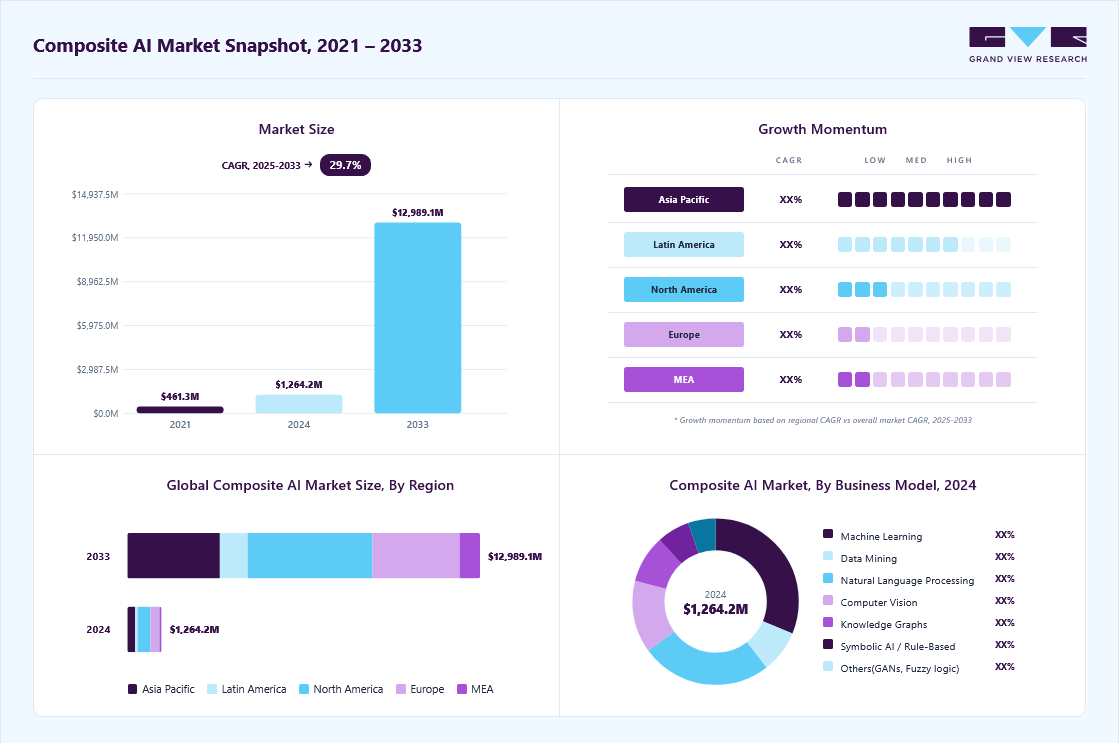
The global composite AI market size was estimated at USD 1,264.2 million in 2024 and is projected to reach USD 12,989.0 million by 2033, growing at a CAGR of 29.6% from 2025 to 2033. The integration of symbolic reasoning with machine learning is propelling the composite AI industry by enhancing model transparency and contextual accuracy.
Key Market Trends & Insights
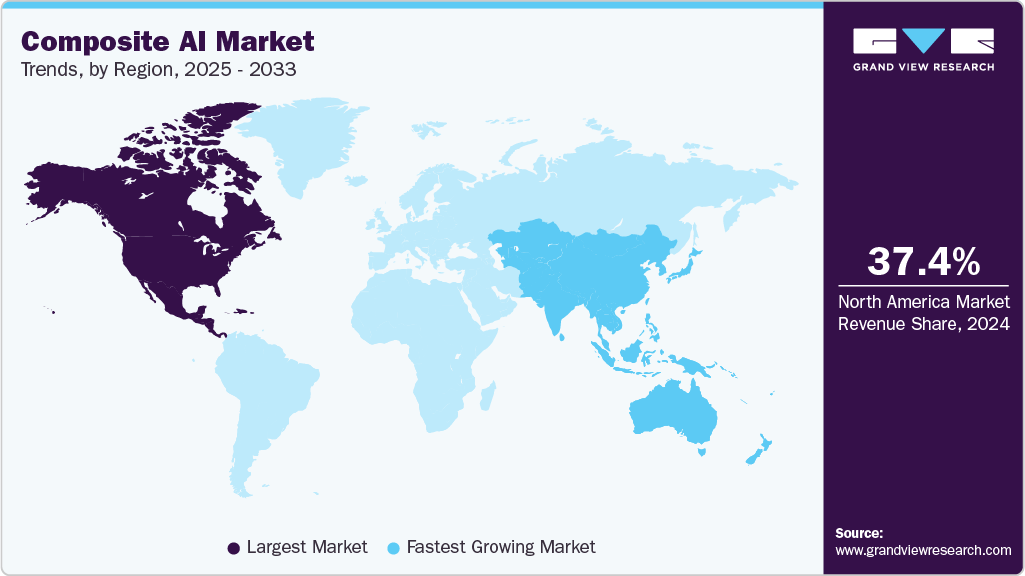
- North America dominated the composite AI market with the largest revenue share of 37.4% in 2024.
- The composite AI market in the U.S. accounted for the largest market revenue share in North America in 2024.
- By AI techniques, the machine learning led the market with the largest revenue share of 31.2% in 2024.
- By application, the customer service segment led the market with the largest revenue share of 21.3% in 2024.
- By end use, the healthcare & life sciences segment is expected to grow at the fastest CAGR of 32.5% from 2025 to 2033.
Market Size & Forecast
- 2024 Market Size: USD 1,264.2 Million
- 2033 Projected Market Size: USD 12,989.0 Million
- CAGR (2025-2033): 29.6%
- North America: Largest market in 2024
- Asia Pacific: Fastest growing market
This combination allows systems to not only learn from data but also apply structured logic, making them more reliable in regulated environments. Enterprises are adopting these hybrid models to meet the growing demand for explainable and compliant AI solutions.
The composite AI industry is witnessing increased development of industry-specific solutions. Enterprises are combining techniques such as LLMs, computer vision, simulation, and symbolic reasoning. These models are designed to incorporate industry knowledge and align with specific operational requirements. There is a growing use of cloud-based platforms to scale composite AI deployments. Strategic collaborations are helping integrate advanced AI into sector-specific workflows. Adoption is expanding rapidly across manufacturing, finance, retail, telecom, and automotive industries. For instance, in October 2024, Tata Consultancy Services (TCS), an Indian IT company, expanded its partnership with NVIDIA Corporation by setting up a dedicated NVIDIA Business Unit within its AI. Cloud division to speed up AI adoption across various industries. Through this collaboration, the companies launched composite AI solutions for key industries using NVIDIA AI Enterprise, Omniverse, and agentic AI.
Data environments are becoming more varied and complex. Traditional AI models struggle to perform across such diverse conditions. They are often limited in adapting to multiple data formats and real-time inputs. Organizations now require flexible frameworks to manage and process different data types efficiently. Customizable AI enables better alignment with operational goals and regulatory requirements. It also improves integration across structured, unstructured, and semi-structured datasets. This need is driving broader adoption and development of composite AI solutions. Companies across sectors are actively implementing such frameworks to enhance performance and scalability. For instance, in August 2024, NVIDIA Corporation introduced NIM Agent Blueprints, a set of customizable AI workflows designed for enterprise applications such as customer service, drug discovery, and PDF data extraction. The company aims to accelerate the development of scalable, data-driven AI systems using tools such as NeMo, NIM microservices, and Tokkio.
Organizations increasingly face scrutiny over the decision-making process of AI systems. Regulatory pressures and ethical concerns are raising the need for greater model transparency. Explainable AI (XAI) has emerged as a key requirement to ensure trust and accountability in automated decisions. Traditional black-box models often fail to provide clear reasoning behind their outputs. Composite AI addresses this by integrating interpretable symbolic methods with machine learning. This combination helps in delivering more understandable and auditable results. As enterprises adopt AI in sensitive areas such as finance, healthcare, and public services, the demand for explainability becomes critical. Composite AI frameworks allow human-in-the-loop models that align better with compliance standards. The market is responding with platforms that embed XAI features into hybrid systems. This change is accelerating the adoption of composite AI across regulated and high-risk environments.
Market Dynamics
Enterprise adoption of multimodal and generative AI technologies is a significant growth driver for the composite AI market. Organizations in banking, healthcare, manufacturing, retail, and telecommunications are integrating AI technologies, such as machine learning, natural language processing, computer vision, and knowledge graphs, to develop intelligent, context-aware business systems. This integration improves decision-making accuracy, automates complex workflows, and enhances customer engagement through unified AI-driven platforms. Additionally, increased investments in AI copilots, autonomous agents, and enterprise automation solutions are accelerating the deployment of composite AI architectures across global industries.
The rapid expansion of cloud-based AI infrastructure and advanced data orchestration platforms facilitates the large-scale implementation of composite AI solutions. Enterprises are prioritizing AI systems that integrate predictive, generative, and reasoning capabilities to improve operational agility and business intelligence. Technology providers are investing in scalable foundation models and industry-specific AI ecosystems to enhance competitive positioning and address evolving enterprise needs. As a result, demand for integrated and adaptive AI frameworks is projected to drive sustained growth in the global composite AI market.
The increasing complexity of integrating multiple AI technologies and managing enterprise-wide AI governance frameworks is a significant restraint on the composite AI market. Composite AI systems often combine diverse technologies such as deep learning, symbolic AI, predictive analytics, and generative AI. This combination heightens deployment complexity and creates interoperability challenges for enterprises. Many organizations encounter difficulties when integrating these AI models into legacy IT infrastructure, resulting in higher implementation costs and longer deployment timelines. Furthermore, the shortage of skilled AI professionals capable of managing sophisticated composite AI ecosystems continues to limit large-scale adoption across various industries.
In addition, increasing concerns about data privacy, model transparency, cybersecurity risks, and regulatory compliance present further operational challenges for enterprises deploying composite AI solutions. Governments and regulatory authorities globally are implementing stricter AI governance and responsible AI frameworks, requiring organizations to invest substantially in risk management, auditability, and explainability capabilities. The absence of standardized frameworks for AI interoperability and ethical AI deployment further contributes to uncertainty among enterprises adopting advanced AI systems. As a result, these technological and regulatory complexities may slow the pace of adoption, particularly among small and medium-sized enterprises with limited digital transformation budgets.
Rising demand for industry-specific artificial intelligence (AI) applications and autonomous decision intelligence platforms is generating significant growth opportunities within the composite AI market. Organizations are seeking tailored AI solutions that integrate predictive analytics, generative AI, reasoning engines, and real-time data processing to meet sector-specific operational needs. Sectors including healthcare, financial services, manufacturing, retail, and logistics are adopting composite AI platforms to optimize workflows, enhance forecasting accuracy, and facilitate automated decision-making. This increasing preference for customized AI ecosystems is prompting technology providers to develop vertical-specific composite AI solutions with improved scalability and specialized domain expertise.
Furthermore, advancements in agentic AI, edge AI, and real-time orchestration technologies are facilitating the development of next-generation autonomous enterprise systems. Organizations are investing in AI-driven digital assistants, intelligent process automation platforms, and adaptive enterprise knowledge systems to enhance productivity and operational resilience. The integration of composite AI with Internet of Things (IoT), cloud computing, and enterprise analytics platforms is broadening its application across smart manufacturing, connected healthcare, and intelligent supply chain management. Consequently, the increasing adoption of industry-specific autonomous AI ecosystems is projected to create substantial long-term revenue opportunities for market vendors.
Market Concentration & Characteristics
The composite AI market exhibits moderate-to-high concentration, primarily driven by the widespread adoption of multimodal AI models, generative AI frameworks, and hybrid AI architectures in enterprise settings. Market expansion is driven by increasing demand for integrated AI systems that combine machine learning, natural language processing, computer vision, knowledge graphs, and predictive analytics to enable more contextual and autonomous decision-making. Leading cloud providers, enterprise software firms, and advanced AI platform vendors are consolidating their positions through strategic partnerships, acquisitions, and investments in large-scale AI infrastructure and foundational models. Concurrently, ongoing advancements in agentic AI, edge AI, and domain-specific composite AI solutions are facilitating the entry of emerging startups and specialized technology providers, thereby intensifying global competitive dynamics.
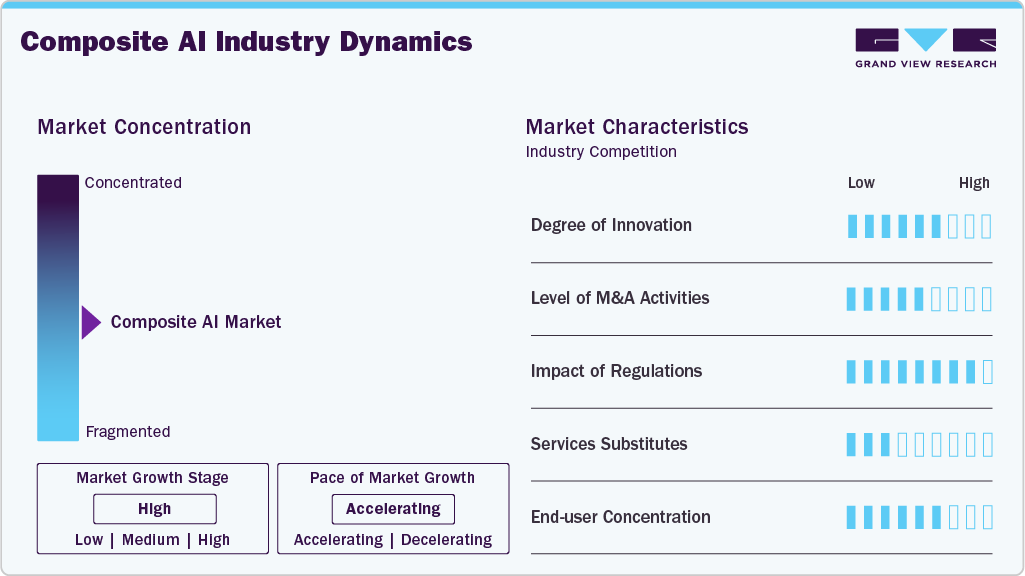
The market is experiencing growth driven by the increasing deployment of enterprise AI platforms, intelligent virtual assistants, and automated decision-making systems across multiple industries. The adoption of hybrid AI models that integrate machine learning, deep learning, symbolic AI, and generative AI capabilities enables organizations to improve operational efficiency, customer experience, and strategic business intelligence. Additionally, ongoing advancements in cloud-based AI infrastructure, AI orchestration frameworks, and scalable data management technologies are accelerating the commercialization and enterprise-wide implementation of composite AI solutions. Moreover, heightened focus on AI governance, model interoperability, and responsible AI practices is prompting enterprises to invest in secure, explainable, and industry-specific composite AI applications, thereby generating sustained long-term opportunities in the global composite AI market.
AI Techniques Insights
The machine learning segment led the market with the largest revenue share of 31.2% in 2024. The machine learning segment has established dominance in the composite AI industry owing to its versatility and proven ability to process vast volumes of structured and unstructured data. Its integration within composite AI architectures enhances predictive capabilities by enabling systems to learn from evolving patterns and continuously improve performance. As organizations pursue more adaptive and intelligent decision-making systems, machine learning serves as the foundational layer that supports the fusion of other AI techniques such as natural language processing, knowledge graphs, and symbolic reasoning.
The knowledge graphs segment is anticipated to grow at the fastest CAGR during the forecast period, due to their ability to represent structured relationships between entities in a machine-readable format. They provide a semantic backbone that helps AI systems understand context, disambiguate meanings, and support logical inference. This structured understanding complements other AI techniques such as machine learning, natural language processing, and computer vision, allowing for more accurate and explainable decision-making. In domains such as healthcare, finance, and telecommunications, Knowledge Graphs are used to unify fragmented datasets, identify hidden connections, and provide traceable outputs.
Application Insights
The customer service segment accounted for the largest market revenue share in 2024, due to the widespread deployment of intelligent assistants and automated support systems. Enterprises are integrating technologies such as natural language processing, machine learning, and knowledge graphs to improve response accuracy and contextual relevance. These solutions allow for seamless resolution of queries across chat, email, and voice channels. Composite AI helps reduce customer wait times while improving agent productivity through real-time recommendations. The focus on improving customer experience and reducing operational costs is a key driver behind this trend. Sectors such as banking, telecom, and e-commerce are scaling AI-driven service platforms to handle growing volumes efficiently.
The product design and development segment is anticipated to grow at the fastest CAGR during the forecast period, due to the increasing need for agile and innovation-driven processes. Companies are using AI to simulate designs, forecast performance, and iterate faster using real-world data. Integration of simulation models, computer vision, and symbolic reasoning is improving accuracy and reducing prototyping cycles. These technologies help identify flaws early and align product features with consumer demands. Composite AI is also enabling co-creative design tools that assist engineers in generating alternatives based on specified parameters. Sectors such as automotive, consumer electronics, and industrial machinery are applying these tools to streamline R&D.
End-use Insights
The BFSI segment accounted for the largest market revenue share in 2024, owing to its early adoption of advanced analytics, risk modeling, and fraud detection solutions. Financial institutions are leveraging composite AI frameworks that combine symbolic reasoning, machine learning, and natural language processing to enhance decision-making. These systems help in automating loan approvals, detecting anomalies in transactions, and ensuring compliance with evolving regulatory frameworks. Composite AI also supports real-time customer personalization in digital banking services. The need for secure, explainable AI in high-stakes environments further accelerates adoption in this sector. Major banks and insurance firms are deploying hybrid AI models to achieve operational efficiency and gain competitive advantages.
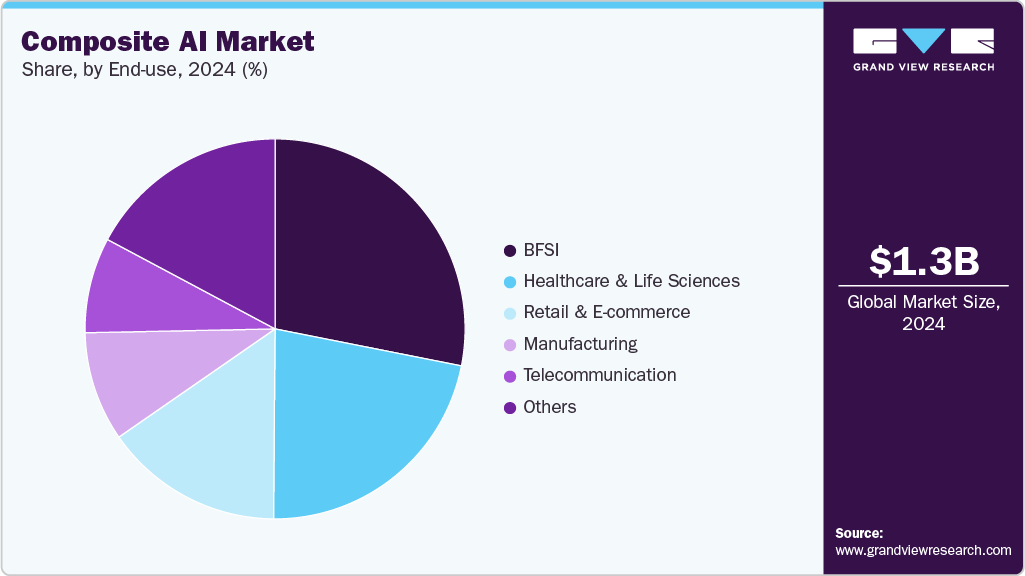
The healthcare & life sciences segment is anticipated to grow at the fastest CAGR during the forecast period, due to increasing demand for precision diagnostics and personalized treatment planning. Composite AI enables the integration of unstructured medical records, imaging data, and genomic information for improved clinical decision support. Hospitals and research institutions are applying hybrid AI models to accelerate drug discovery, optimize patient pathways, and predict disease progression. The ability to explain AI outputs is crucial in medical settings, making composite frameworks more suitable than black-box models. Regulatory shifts toward AI transparency further reinforce this transition.
Regional Insights
North America dominated the composite AI market with the largest revenue share of 37.4% in 2024, due to mature digital ecosystems and high enterprise AI adoption. Companies are utilizing composite AI to integrate multiple models for better decision-making. The region benefits from strong institutional support for AI innovation and funding. Demand for context-aware and explainable AI is pushing further development. Cloud infrastructure enables flexible deployment of AI components. Continuous investment across sectors reinforces the region’s leadership in this space.
U.S. Composite AI Market Trends
The composite AI market in the U.S. is driven by advanced AI research and a strong tech ecosystem. Enterprises are rapidly adopting composite AI for automation, personalization, and predictive insights. High investment from both private and public sectors accelerates innovation. Use cases span finance, healthcare, manufacturing, and defense. Regulatory discussions are also shaping responsible composite AI deployment.
Europe Composite AI Market Trends
The composite AI market in Europe growth is rising due to growing emphasis on explainability and data privacy. Companies are integrating symbolic and statistical AI to meet strict regulatory standards. Demand is growing in sectors such as automotive, energy, and public services. EU-funded AI initiatives support collaborative research and deployment. Regional players are focusing on ethical AI frameworks and interoperability.
Asia Pacific Composite AI Market Trends
The composite AI market in Asia Pacific is anticipated to grow at the fastest CAGR during the forecast period. Rapid digital transformation across industries is accelerating AI adoption. Governments are investing heavily in national AI strategies and infrastructure. Enterprises are deploying composite AI to enhance efficiency and decision-making. Countries such as China, India, and Japan are driving regional momentum. Expanding tech ecosystems and data availability further support growth.
Key Composite AI Company Insights
Some of the key companies in the composite AI industry include Fujitsu, Google LLC, IBM Corporation, Microsoft, and others. Organizations are focusing on increasing customer base to gain a competitive edge in the industry. Therefore, key players are taking several strategic initiatives, such as mergers and acquisitions, and partnerships with other major companies.
-
IBM Corporation integrates symbolic reasoning, machine learning, and natural language processing to deliver enterprise-grade composite AI solutions. Its Watson platform applies hybrid AI across industries such as healthcare, finance, and customer support. IBM Research focuses on neurosymbolic AI to enhance transparency and decision quality. The company designs adaptable AI systems aligned with specific operational contexts. These developments support scalable and explainable AI adoption in complex business environments.
-
Microsoft combines large language models with knowledge graphs, simulation, and rule-based systems to support composite AI deployments. Through Azure AI, it enables advanced workflows that span data analysis, automation, and decision support. Microsoft collaborates with enterprises to build customized, domain-specific AI solutions. Its platforms help integrate structured and unstructured data into cohesive AI systems. These efforts address real-time business needs while maintaining flexibility and traceability.
Key Composite AI Companies:
The following are the leading companies in the composite AI market. These companies collectively hold the largest market share and dictate industry trends.
- Accenture
- BlackSwan Technologies
- C3.ai, Inc.
- Fujitsu
- Google LLC
- IBM Corporation
- Microsoft
- NVIDIA Corporation
- SAP SE
- TATA Consultancy Services Limited (TCS)
Competitive Benchmarking
Operating Strategies
Competitive Edge
Weaknesses
Mature Players: Accenture; Google LLC; IBM Corporation; Microsoft; SAP SE
- Mature players are increasingly investing in multimodal AI platforms to accelerate enterprise-wide intelligent automation capabilities.
- Major technology providers are expanding AI governance and explainable AI frameworks to support secure and compliant enterprise adoption.
- Integrated cloud, analytics, and automation portfolios support seamless deployment across multinational organizations.
- Strong global partnerships and industry-specific AI expertise accelerate enterprise digital transformation initiatives.
- High implementation and customization expenses can limit adoption among SMEs and mid-sized enterprises.
- Large organizations may experience slower innovation cycles due to legacy system dependencies and operational complexity.
Emerging Players: BlackSwan Technologies; C3.ai, Inc.; Fujitsu; NVIDIA Corporation
- Emerging players are rapidly developing industry-specific composite AI solutions to address evolving enterprise automation demands.
- These companies are prioritizing cloud-native and API-driven AI platforms to improve deployment flexibility and scalability.
- Their competitive edge is driven by agile innovation models and faster adoption of next-generation AI technologies.
- Advanced focus on generative AI, orchestration platforms, and adaptive analytics enhance product differentiation.
- Dependence on external cloud ecosystems and AI model providers may create operational vulnerabilities.
- Increasing competition from established technology companies can intensify pricing pressure and market consolidation risks.
Recent Developments
-
In July 2025, Accenture and Google Cloud collaborated with Air France-KLM to launch a generative AI factory that supports agentic AI capabilities, streamlining AI use case development across operations. The initiative accelerates digital transformation by enabling rapid design, testing, and deployment of gen AI solutions with measurable business impact.
-
In January 2025, Accenture, an IT company in Ireland, launched the AI Refinery for Industry, featuring 12 industry-specific agentic AI solutions to streamline business processes using multi-agent networks. Built on NVIDIA AI software, these solutions aim to reduce deployment time and accelerate value creation across sectors such as clinical trials, industrial maintenance, and marketing.
-
In January 2025, NVIDIA Corporation launched AI foundation models as NIM microservices for RTX AI PCs, enabling users to build digital humans, creative workflows, and agentic AI locally. These models, supported by GeForce RTX 50 Series GPUs, power applications such as Project R2X, AI Blueprints, and various developer tools to accelerate AI deployment and performance on PCs.
Composite AI Market Report Scope
Report Attribute
Details
Market size value in 2025
USD 1,630.4 million
Revenue forecast in 2033
USD 12,989.0 million
Growth rate
CAGR of 29.6% from 2025 to 2033
Base year for estimation
2024
Historical data
2021 - 2023
Forecast period
2025 - 2033
Quantitative units
Revenue in USD million/billion, and CAGR from 2025 to 2033
Report coverage
Revenue forecast, company ranking, competitive sector, growth factors, and trends
Segment scope
AI techniques, application, end-use, region
Region scope
North America; Europe; Asia Pacific; Latin America; Middle East & Africa
Country scope
U.S.; Canada; Mexico; Germany; UK; France; China; Japan; India; Australia; South Korea; Brazil; KSA; UAE; South Africa
Key companies profiled
Accenture; BlackSwan Technologies; C3.ai, Inc.; Fujitsu; Google LLC; IBM Corporation; Microsoft; NVIDIA Corporation; SAP SE; TATA Consultancy Services Limited (TCS)
Customization scope
Free report customization (equivalent up to 8 analysts’ working days) with purchase. Addition or alteration to country, regional & segment scope
Pricing and purchase options
Avail customized purchase options to meet your exact research needs. Explore purchase options
Global Composite AI Market Report Segmentation
This report forecasts revenue growth at the global, regional, and country levels and provides an analysis of the latest industry trends and opportunities in each of the sub-segments from 2021 to 2033. For this study, Grand View Research has segmented the global composite AI market report based on the AI techniques, application, end-use, and region.

-
AI Techniques Outlook (Revenue, USD Million, 2021 - 2033)
-
Machine Learning
-
Data Mining
-
Natural Language Processing
-
Computer Vision
-
Knowledge Graphs
-
Symbolic AI / Rule-based
-
Others
-
-
Application Outlook (Revenue, USD Million, 2021 - 2033)
-
Product Design and Development
-
Customer Service
-
Predictive Maintenance
-
Fraud Detection
-
Risk Management
-
Others
-
-
End-use Outlook (Revenue, USD Million, 2021 - 2033)
-
BFSI
-
Healthcare & Life Sciences
-
Retail & E-commerce
-
Manufacturing
-
Telecommunications
-
Others
-
-
Regional Outlook (Revenue, USD Million, 2021 - 2033)
-
North America
-
U.S.
-
Canada
-
Mexico
-
-
Europe
-
UK
-
Germany
-
France
-
-
Asia Pacific
-
China
-
Japan
-
India
-
Australia
-
South Korea
-
-
Latin America
-
Brazil
-
-
Middle East & Africa (MEA)
-
KSA
-
UAE
-
South Africa
-
-
Delivered Customizations
This report has been delivered with the following In-depth customizations
Client Objective
Custom Research Modules Delivered
Strategic Value / Business Impact
Composite AI Market Expansion & Enterprise AI Transformation Strategy
- Enterprise adoption analysis of composite AI solutions across healthcare, BFSI, retail, manufacturing, telecommunications, and government sectors.
- Benchmark assessment of multimodal AI platforms, generative AI frameworks, predictive analytics systems, knowledge graphs, and intelligent automation technologies.
- Regional opportunity mapping for cloud-native composite AI deployment, AI orchestration platforms, and enterprise intelligent automation investments.
- Evaluation of AI governance frameworks, responsible AI regulations, model interoperability standards, and enterprise data management requirements.
- Identified high-growth opportunities in generative AI, multimodal intelligence, and enterprise decision automation solutions.
- Supported strategic expansion into AI orchestration, autonomous enterprise systems, and intelligent business process automation markets.
- Improved enterprise AI investment planning, scalability assessment, and operational optimization strategies.
- Strengthened competitive positioning in next-generation composite AI ecosystems and adaptive enterprise intelligence platforms.
Composite AI Technology Benchmarking & Competitive Intelligence
- Causal reasoning engine analysis and intelligent decision automation technology assessment.
- Product benchmarking and feature comparison of causal inference platforms, explainable AI tools, and AI-driven scenario simulation systems.
- Pricing analysis, enterprise AI adoption trends, and cloud-native causal AI deployment assessment.
- Competitor strategy evaluation, strategic AI partnerships, and innovation analysis in explainable and trustworthy AI technologies.
- Enabled differentiation through advanced multimodal AI capabilities and enterprise intelligent automation solutions.
- Supported pricing optimization and AI-driven enterprise transformation strategy development.
- Identified emerging opportunities in AI orchestration platforms, agentic AI technologies, and industry-specific composite AI applications.
- Enhanced long-term commercialization planning and innovation strategies within the global Composite AI market.
Frequently Asked Questions About This Report
The global composite AI market size was estimated at USD 1,264.2 million in 2024 and is expected to reach USD 1,630.4 million in 2025.
The global composite AI market is expected to grow at a compound annual growth rate of 29.6% from 2025 to 2033 to reach USD 12,989.1 million by 2033.
North America dominated the composite AI market with a share of 37.4% in 2024. This is attributable to early adoption of AI technologies, strong R&D investments, and the presence of major technology firms in the region.
Some key players operating in the Composite AI market include Accenture, BlackSwan Technologies, C3.ai, Inc., Fujitsu, Google LLC, IBM Corporation, Microsoft, NVIDIA Corporation, SAP SE, and TATA Consultancy Services Limited (TCS)
Key factors driving the market growth include rising demand for advanced decision-making systems, growing adoption of AI across industries, and the need for more accurate and context-aware AI models.
About the Author(s)
Next Generation Technologies Research Team
Technology · Next Generation TechnologiesThis report was authored by the next generation technologies research team at Grand View Research - comprising two research analysts, one senior research analyst, and one industry expert - with specialized expertise in the next generation technologies segment of the technology industry. All findings are based on proprietary technology databases, executive interviews, and regulatory analysis, subject to internal peer review prior to publication.
Last Updated:
Speak to Analyst

Need a Tailored Report?
Customize this report to your needs — add regions, segments, or data points, with 20% free customization.
Or view our licence options:


ISO 9001:2015 & 27001:2022 Certified
We are GDPR and CCPA compliant! Your transaction & personal information is safe and secure. For more details, please read our privacy policy.












