
- Home
- »
- Animal Feed and Feed Additives
- »
-
Compound Feed Market Size & Share Report, 2026-2033GVR Report cover
![Compound Feed Market (2026 - 2033)Report]()
Compound Feed Market (2026 - 2033)
Size, Share & Trends Analysis Report By Form (Mash, Crumbled), By Ingredient (Feed Cereals, Oilseed Meals and Cakes), By Livestock (Poultry, Swine), By Region, And Segment Forecasts
Market Size, 2025
$567.0BMarket Estimate, 2026
$592.5BMarket Forecast, 2033
$806.3BCAGR, 2026–2033
4.5%Compound Feed Market Summary
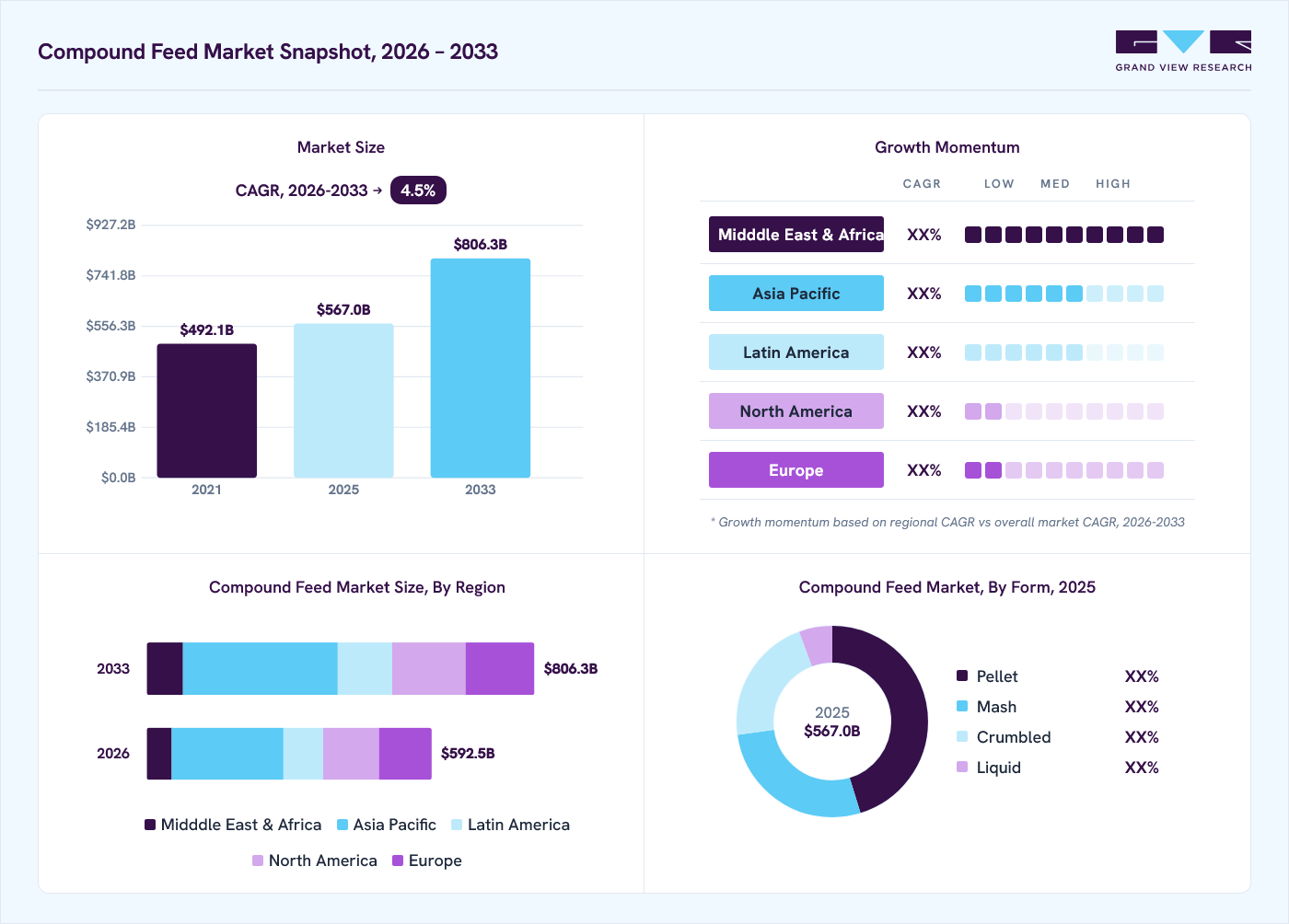
The global compound feed market size was valued at USD 567.0 billion in 2025 and is projected to grow from USD 592.5 billion in 2026 to USD 806.3 billion by 2033, at a CAGR of 4.5% from 2026 to 2033. Asia Pacific dominated the market, accounting for the largest revenue share of 39.1% in 2025. Market growth is supported by the continued expansion of commercial livestock and poultry production, which is increasing demand for nutritionally balanced and consistently manufactured feed.
Key Market Trends & Insights
- By form: The pellet segment held the dominating revenue share of 45.2% in 2025.
- By ingredient: The feed cereals accounted for the largest revenue share of 44.5% in 2025.
- By livestock: The poultry segment represented the largest revenue share in 2025, capturing a 39.7% revenue share.
Regional Highlights
- Largest Region: Asia Pacific (39.1% revenue share, 2025)
- Fastest-growing Region: Middle East & Africa (highest CAGR, 2026-2033)
- By country: China held the largest market share in 2025
Market Size & Forecast
- Market size in 2025: USD 567.0 Billion
- Estimated market size in 2026: USD 592.5 Billion
- Projected market size by 2033: USD 806.3 Billion
- CAGR (2026-2033): 4.5%
Poultry remains a major source of feed demand, while aquaculture and other intensive production systems are also strengthening feed requirements. Industry data show that poultry feed has remained comparatively resilient even amid animal-health and economic pressures. The market also presents opportunities through improvements in feed efficiency and formulation innovation.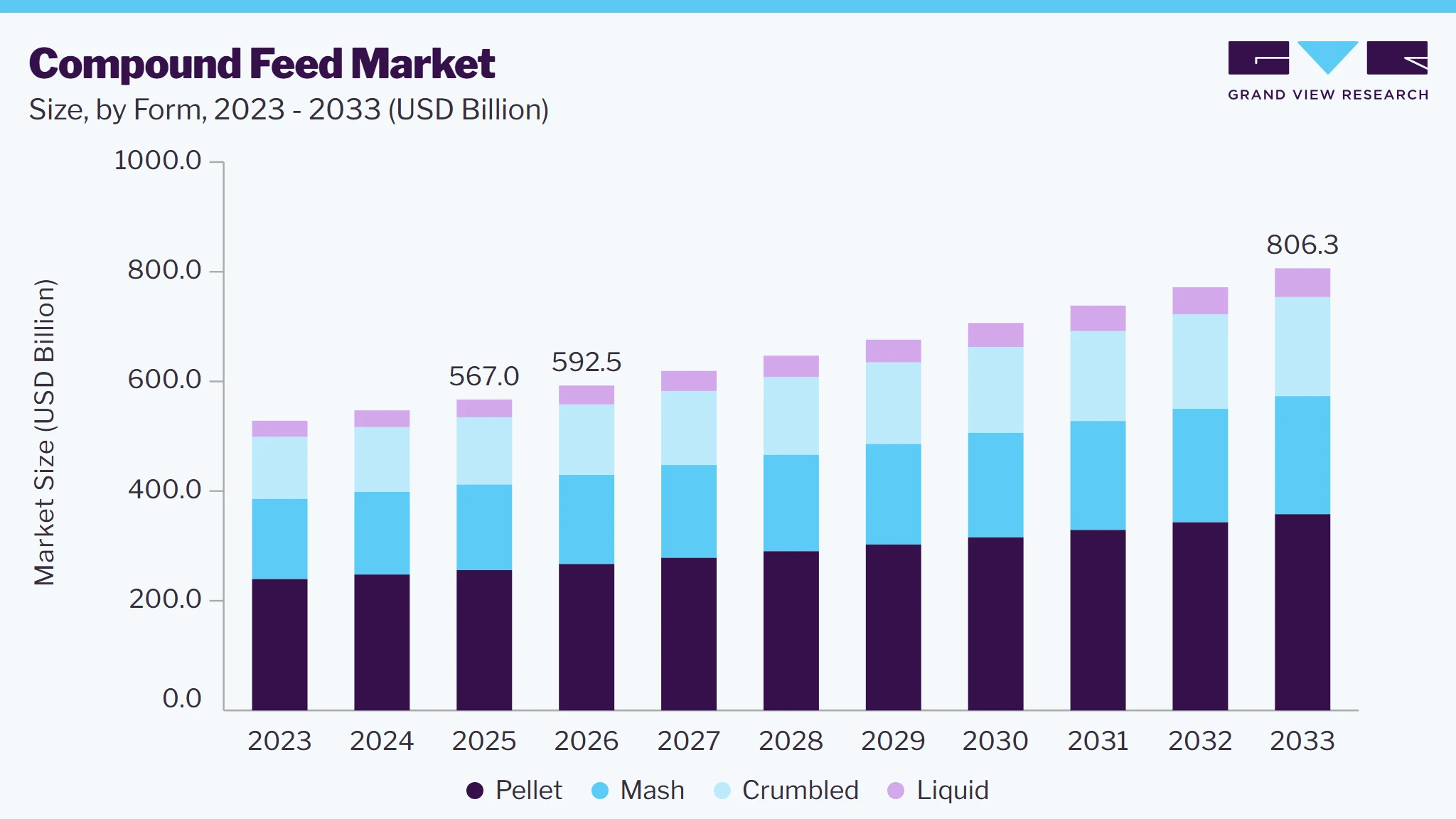
Manufacturers are increasingly focusing on optimized nutrient delivery, improved feed utilization, and the incorporation of alternative raw materials. The growing emphasis on feed circularity and better utilization of secondary resources creates additional scope for differentiated formulations and more resource-efficient feed production.
Market Dynamics
The market is shaped by the interplay among livestock production trends, feed formulation economics, raw material availability, animal health conditions, production efficiency, and evolving sustainability requirements. Demand is supported by the expansion of organized farming and the need for nutritionally consistent feed, while market performance varies considerably across livestock categories and geographies. Mature markets tend to show relatively stable production, whereas regions with expanding poultry, swine, and aquaculture industries offer greater potential for volume growth. At the same time, manufacturers face pressure from fluctuations in feed input costs, disease outbreaks, regulatory requirements, and changing expectations regarding environmental performance. Recent European industry data illustrate this balance, with overall compound-feed production remaining broadly stable while poultry feed continues to show comparatively stronger momentum.
The increasing scale of commercial poultry, swine, dairy, beef, and aquaculture operations is strengthening demand for manufactured compound feed. Larger farms require predictable nutrition, standardized feed quality, and efficient feeding programs, increasing their reliance on professionally formulated products rather than individually mixed feed materials. This trend is particularly important in developing livestock markets where organized production is expanding.
Compound-feed manufacturers remain exposed to fluctuations in the prices and availability of cereals, oilseed meals, amino acids, vitamins, minerals, and other formulation inputs. Changes in agricultural output, weather conditions, trade flows, energy costs, and geopolitical conditions can affect procurement costs and margins. Reliance on imported protein ingredients can further increase supply chain exposure in certain markets.
There is increasing scope for species- and life-stage-specific, performance-oriented compound feeds designed around particular production objectives. Examples include feeds tailored for early-stage poultry, high-yield dairy animals, finishing livestock, breeding stock, and intensive aquaculture. Such products allow manufacturers to move beyond volume-based competition and capture value through formulation expertise and technical differentiation.
Market Concentration & Characteristics
The global compound feed industry is fragmented, with strong participation from large multinational producers alongside numerous regional and local feed manufacturers. The industry operates in more than 130 countries, while IFIF members collectively represent more than 80% of global compound animal feed production, reflecting the breadth of the organized feed industry rather than concentration among a few companies.
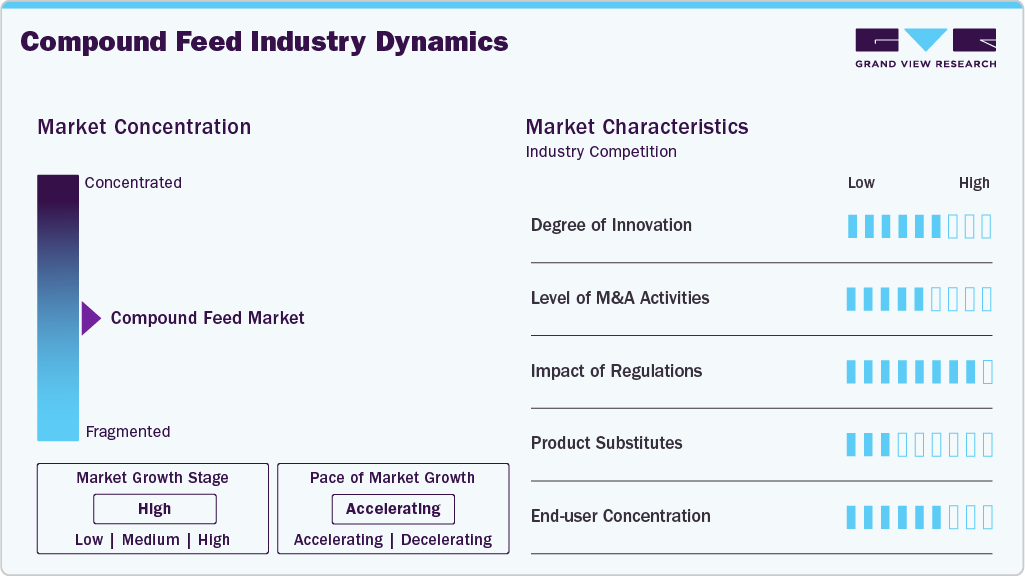
The market is capital-intensive, production-scale-driven, and highly localized around livestock clusters and raw material availability. Large producers benefit from integrated manufacturing, procurement networks, formulation capabilities, and broad distribution, while regional manufacturers compete through local sourcing, species-specific formulations, and proximity to customers. Asia Pacific and North America have been gaining importance, while mature European markets remain comparatively stable.
Analyst Perspective
The market offers stable, structurally supported growth, with demand anchored by expanding animal-protein production and the increasing adoption of commercially formulated feed. Growth is expected to remain strongest in developing markets, while established markets will focus on feed efficiency, formulation optimization, production automation, and sustainability. Manufacturers with strong procurement networks, scalable production assets, and species-specific nutrition capabilities are well-positioned to capture incremental demand.
Form Insights
Pellet held the largest revenue share of 45.2% in 2025, because pelletization improves feed consistency and handling efficiency, ensuring that ingredients remain integrated during storage, transportation, and feeding. This reduces ingredient segregation and wastage while providing animals with a more uniform nutrient intake, making pellets particularly suitable for large-scale commercial feed operations.
Liquid is the fastest-growing form segment, with a CAGR of 6.2% from 2026 to 2033, driven by the increasing adoption of controlled, precise feeding programs. Liquid feeding systems can facilitate accurate ration delivery, phase feeding, and incorporation of functional additives, enabling producers to align nutritional supply more closely with animal requirements and production objectives.
Livestock Insights
Poultry held the largest revenue share of 39.7% in 2025 because commercial poultry production is highly dependent on formulated feed, which is a major operating input for intensive broiler and layer systems. The need for consistent energy, protein, amino acids, vitamins, and minerals supports sustained demand for compound feed as producers prioritize predictable bird performance and production efficiency. FAO identifies feed as the most important input cost in intensive poultry production.
Aquaculture is projected to grow at a CAGR of 6.5% from 2026 to 2033, driven by the increasing sophistication of feeding practices and species-specific nutritional requirements. Commercial producers require precisely formulated feeds that balance protein, energy, digestibility, and functional nutrients, creating greater demand for specialized manufactured feed as aquaculture shifts toward more intensive production systems.
Ingredient Insights
Feed cereals accounted for 44.5% of the global market revenue in 2025, because they provide the primary energy base for compound-feed formulations, with maize, wheat, barley, and other grains widely incorporated into livestock diets. Their established nutritional role, broad availability, and compatibility with poultry, swine, and ruminant formulations support consistently high utilization across commercial feed manufacturing. FAO identifies maize as a major feed grain and a standard energy source in livestock diets.
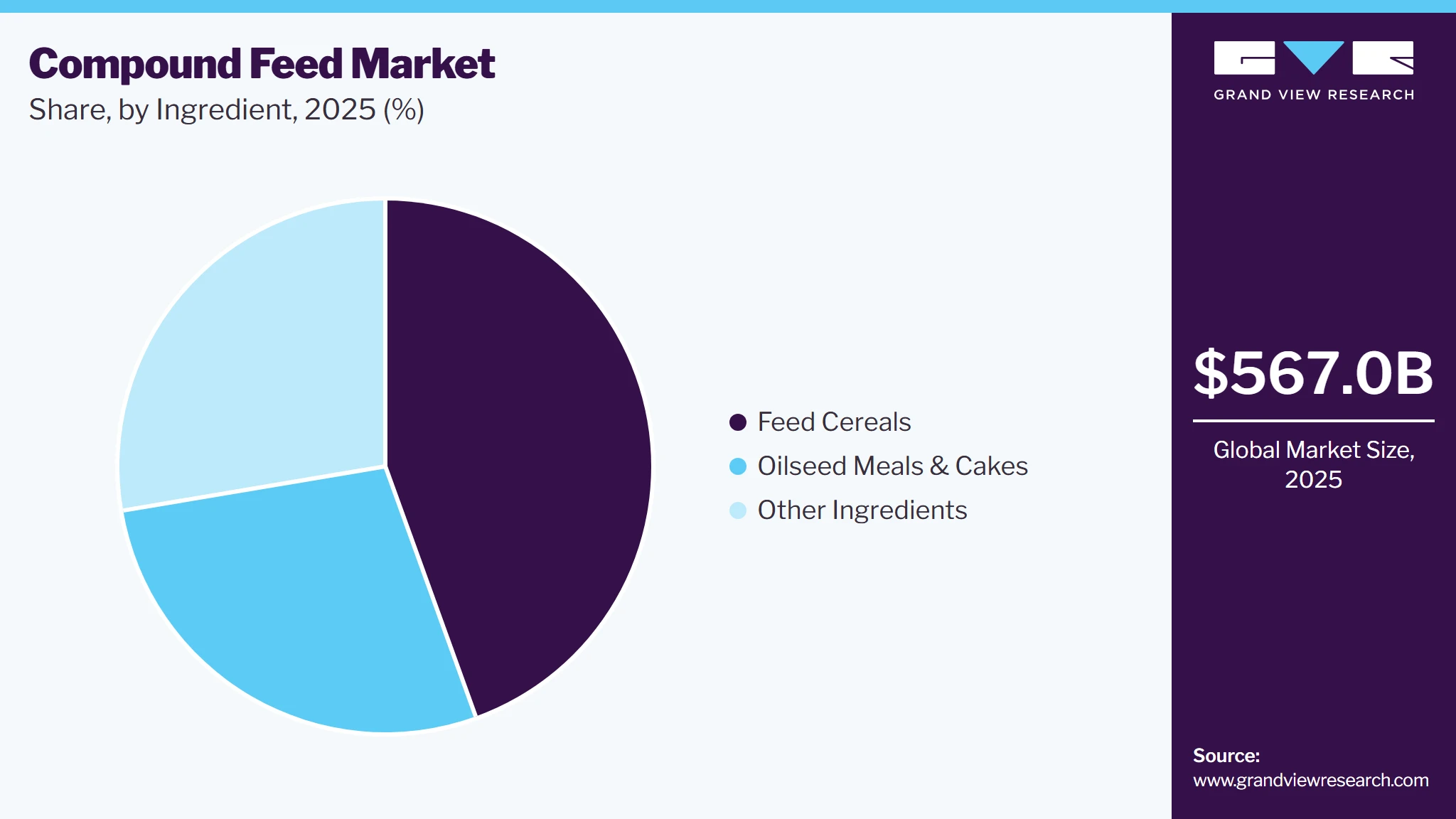
Oilseed meals and cakes is the fastest-growing grade segment, with a CAGR of 4.5% from 2026 to 2033, as compound-feed manufacturers increase the use of concentrated plant-based protein sources to meet the nutritional requirements of intensive poultry, swine, dairy, and aquaculture production. Soybean meal, sunflower meal, rapeseed meal, and other oilseed-derived products provide formulation flexibility and complement cereal-based energy sources, supporting their expanding role in balanced feed formulations.
Regional Insights
Asia Pacific held the largest revenue share of 39.1% in 2025, due to the large concentration of commercial poultry, swine, and aquaculture production across the region. The scale of livestock farming established feed-milling infrastructure, and high reliance on formulated diets creates a substantial recurring requirement for compound feed.

China Compound Feed Market Trends
The compound feed market in China is underpinned by its large-scale livestock and aquaculture industries, supported by extensive commercial feed-manufacturing capacity. The scale of animal production and continued modernization of farming operations sustain demand for standardized, nutritionally balanced feed and encourage manufacturers to optimize formulation and production efficiency.
Middle East & Africa Compound Feed Market Trends
The compound feed market in MEA is the fastest-growing region with a revenue CAGR of 5.4% during the forecast period, as commercial poultry, dairy, aquaculture, and livestock production become increasingly organized. Rising investment in modern farming systems and feed-manufacturing capacity is creating greater reliance on formulated diets, while improvements in feed efficiency and production management are supporting broader adoption of compound feed.
North America Compound Feed Market Trends
The compound feed market in North America benefits from a highly developed commercial livestock industry and an established feed-manufacturing ecosystem. Large-scale poultry, swine, dairy, and beef operations rely on professionally formulated feed programs, while integrated supply chains and advanced feed-mill capabilities support consistent production and distribution across major livestock-producing areas.
The compound feed market in the U.S. is supported by highly industrialized poultry, swine, dairy, and beef production systems, where feed formulation is closely linked to production economics and animal performance. The presence of sophisticated feed manufacturing, extensive grain availability, and established nutrition programs reinforces the use of compound feed across commercial operations.
Europe Compound Feed Market Trends
The compound feed market in Europe is mature, characterized by well-established feed manufacturing infrastructure, stringent quality requirements, and advanced livestock production systems. Compound feed remains an important component of the regional animal-production supply chain, although overall production is relatively stable, with environmental, animal-health, and regulatory considerations influencing livestock output. FEFAC estimates EU27 industrial compound-feed production at approximately 152 million tonnes for 2026.
Latin America Compound Feed Market Trends
The compound feed market in Latin America is supported by its strong livestock and poultry production base and extensive agricultural raw-material resources. The availability of cereals and oilseed-derived feed ingredients provides a favorable foundation for compound-feed manufacturing, while expanding commercial farming and animal-protein production continue to broaden demand across the region.
Key Compound Feed Company Insights
The market comprises established chemical manufacturers and regional producers competing across textile, pulp & paper, chemical processing, and water treatment applications. Competitive positioning is influenced by production capacity, product quality, pricing, access to raw materials, distribution reach, and supply reliability. Companies with integrated manufacturing operations, broad geographic coverage, and established relationships with high-volume industrial customers are better positioned to address demand across major consuming markets.
-
Charoen Pokphand Foods (CP Foods) is a chemical manufacturer specializing in compound feed. Through its compound feed production operations, the company manufactures Gujin-brand compound feed for domestic and international customers, with applications spanning textile processing, pulp & paper, and other industrial uses. Its large-scale production capabilities have established an export presence, and its involvement in developing compound feed industry standards strengthens its position in the global market.
-
Cargill is an inorganic chemicals manufacturer, with compound feed as one of its key products. The company supplies compound feed for textile, paper, chemical, pharmaceutical, and other industrial applications, while its broader product portfolio includes zinc-based chemicals and sulfoxylate products. Its manufacturing expertise across different production routes and focus on reducing and bleaching agents provide a strong position in serving industrial customers across India and international markets.
Key Global Compound Feed Companies
The following key companies have been profiled for this study on the compound feed market.
-
Charoen Pokphand Foods (CP Foods)
-
Cargill
-
New Hope Group
-
ADM (Archer Daniels Midland)
-
Nutreco
-
De Heus Animal Nutrition
-
ForFarmers
-
Guangdong HAID Group
-
Land O’Lakes
-
FEED ONE CO., LTD.
Competitive Benchmarking
Operating Strategies
Competitive Edge
Weaknesses
Mature Players: Charoen Pokphand Foods (CP Foods), Cargill, New Hope Group, ADM (Archer Daniels Midland), Nutreco, De Heus Animal Nutrition, ForFarmers, Land O’Lakes
- Focused on large-scale feed manufacturing, geographic diversification, vertical integration, broad livestock coverage, long-term customer relationships, and optimization of raw-material procurement. Companies increasingly combine feed production with nutrition services, technical support, breeding, livestock production, and integrated agricultural operations.
- Strong manufacturing scale established feed-mill networks, extensive distribution infrastructure, formulation expertise, brand recognition, and access to raw materials. Broad exposure across poultry, swine, ruminants and aquaculture reduces dependence on a single livestock segment.
- Large operating structures and mature-market exposure can limit growth flexibility. Dependence on cereals and oilseed meals creates exposure to raw-material price volatility, while extensive international operations increase supply-chain, regulatory, and currency risks.
Guangdong HAID Group, FEED ONE CO., LTD.
- Focused on capacity expansion, specialization in high-demand livestock segments, regional manufacturing expansion, product diversification, and strengthening feed distribution networks. Greater emphasis is placed on aquaculture and livestock feed opportunities where demand is expanding rapidly.
- Strong regional market knowledge, specialized feed capabilities, faster response to local customer requirements, and opportunities to scale from expanding domestic feed demand. HAID, for example, has particularly strong positioning across aquaculture and livestock feed.
- More concentrated geographic exposure, smaller international distribution networks, and comparatively lower global diversification can increase exposure to regional market cycles and raw-material supply conditions. International brand recognition and scale remain below the largest global players.
Recent Developments
-
In February 2026, Cargill expanded its presence in the Indian compound feed market by opening a new dairy feed plant in Wazirabad, Punjab, with an investment of ₹300 crore. The facility has an annual production capacity of 400,000 metric tons and is Cargill’s largest dairy feed plant in South Asia. The plant will produce feed for young animals and milking cows under the Provimi and Purina brands, strengthening Cargill’s local manufacturing capabilities and supporting the growing demand for quality dairy nutrition in India.
-
In March 2026, De Heus Animal Nutrition completed the acquisition of CJ Feed & Care from CJ Cheil Jedang, strengthening its position in the Asian compound feed market. The acquisition comprises 17 feed mills and livestock operations across Vietnam, Indonesia, Cambodia, South Korea, and the Philippines. The transaction expands De Heus’ presence in existing Asian markets while providing direct access to South Korea and the Philippines, supporting its strategy to expand its animal nutrition portfolio and strengthen its regional feed production network
Compound Feed Market Report Scope
Report Attribute
Details
Market size in 2025
USD 567.0 billion
Estimated market size in 2026
USD 592.5 billion
Projected market size by 2033
USD 806.3 billion
Growth rate
CAGR of 4.5% from 2026 to 2033
Historical data
2021 - 2025
Forecast period
2026 - 2033
Quantitative units
Volume in kilotons, revenue in USD billion, and CAGR from 2026 to 2033
Report coverage
Volume & revenue forecast, volume forecast, company ranking, competitive landscape, growth factors, and trends
Segments covered
Form, ingredient, livestock, region
Country scope
U.S.; Canada; Mexico; Germany; UK; France; Italy; Spain; China; India; Japan; South Korea; Brazil; Argentina; Saudi Arabia; South Africa
Key companies profiled
Charoen Pokphand Foods (CP Foods); Cargill; New Hope Group; ADM (Archer Daniels Midland); Nutreco; De Heus Animal Nutrition; ForFarmers; Guangdong HAID Group Ltd; Land O’Lakes; FEED ONE CO., LTD.
Customization scope
Free report customization (equivalent up to 8 analysts’ working days) with purchase. Addition or alteration to country, regional & segment scope.
Pricing and purchase options
Avail customized purchase options to meet your exact research needs. Explore purchase options
Global Compound Feed Market Report Segmentation
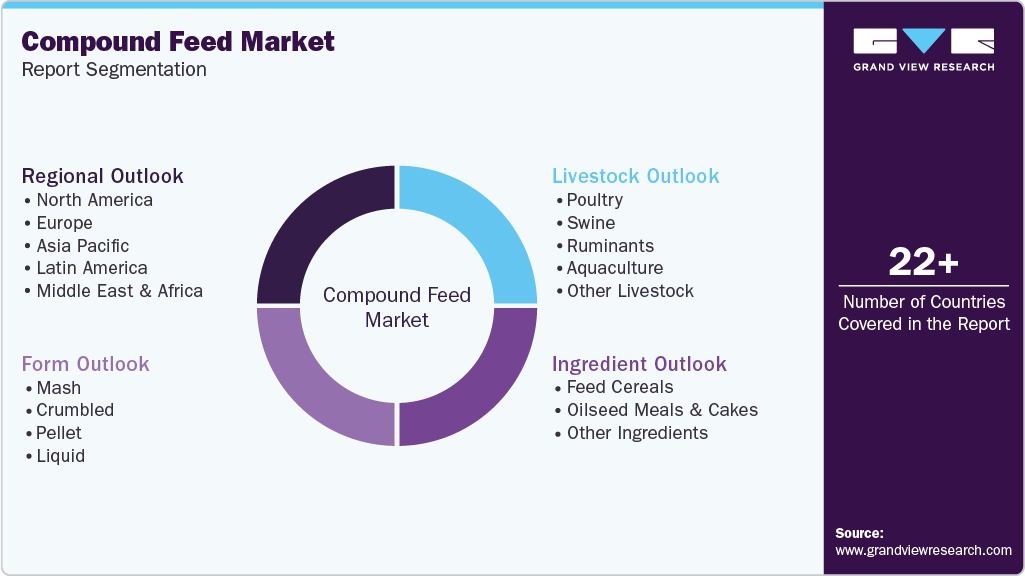
This report forecasts volume & revenue growth at regional and country levels and provides an analysis of the latest industry trends in each of the sub-segments from 2021 to 2033. For this study, Grand View Research has segmented the global compound feed market report based on form, ingredient, livestock, and region:
-
Form Outlook (Volume, Kilotons; Revenue, USD Billion, 2021 - 2033)
-
Mash
-
Crumbled
-
Pellet
-
Liquid
-
-
Ingredient Outlook (Volume, Kilotons; Revenue, USD Billion, 2021 - 2033)
-
Feed Cereals
-
Oilseed meals and cakes
-
Other Ingredients
-
-
Livestock Outlook (Volume, Kilotons; Revenue, USD Billion, 2021 - 2033)
-
Poultry
-
Swine
-
Ruminants
-
Aquaculture
-
Other Livestock
-
-
Region Outlook (Volume, Kilotons; Revenue, USD Billion, 2021 - 2033)
-
North America
-
U.S.
-
Canada
-
Mexico
-
-
Europe
-
Germany
-
UK
-
France
-
Italy
-
Spain
-
-
Asia Pacific
-
China
-
India
-
Japan
-
South Korea
-
-
Latin America
-
Brazil
-
Argentina
-
-
Middle East & Africa
-
Saudi Arabia
-
South Africa
-
-
Research Methodology
The compound feed market figures in this report are based on a proven research process that combines executive interviews with secondary research from proprietary databases, company filings, and recognized regulatory and institutional sources. Market size is built through value-chain sizing-reconciling supply-side and demand-side estimates-and triangulated with bottom-up and top-down approaches. Every estimate passes multiple levels of expert validation before publication, with each compound feed segment quantified using the revenue-capture definitions in the table below.
Segment Definition
Segment - Form
Revenue capture definition
Mash
Revenue generated from the sale of compound feed supplied in loose, non-pelletized form, where ingredients are mechanically blended to the required nutritional specification.
Crumbled
Revenue generated from the sale of compound feed processed into small, uniform particles by crumbling pellets, primarily for applications requiring easier feed intake and handling.
Pellet
Revenue generated from the sale of compound feed manufactured by compressing formulated feed ingredients into uniform pellets, including feed supplied for commercial livestock, poultry, swine, ruminant and aquaculture applications.
Liquid
Revenue generated from the sale of compound feed supplied in liquid or fluid form, including formulated liquid feeds and feed products incorporating liquid nutritional components for livestock applications.
Segment - Ingredient
Revenue capture definition
Feed Cereals
Revenue attributable to compound feed formulations in which cereal-based ingredients, such as corn, wheat, barley and other feed grains, constitute the primary energy source.
Oilseed meals and cakes
Revenue attributable to compound feed formulations containing protein-rich oilseed meals and cakes, including soybean meal, rapeseed meal, sunflower meal and other oilseed-derived protein sources.
Other Ingredients
Revenue attributable to compound feed formulations based on ingredients other than feed cereals and oilseed meals and cakes, including minerals, vitamins, amino acids, feed additives, animal-derived ingredients and other nutritional components.
Segment - Livestock
Revenue capture definition
Poultry
Revenue generated from the sale of compound feed formulated for poultry, including broilers, layers, breeders and other commercial poultry production.
Swine
Revenue generated from the sale of compound feed formulated for pigs across different production stages, including piglets, growers, finishers and breeding animals.
Ruminants
Revenue generated from the sale of compound feed formulated for cattle, dairy cattle, beef cattle, sheep, goats and other ruminant livestock.
Aquaculture
Revenue generated from the sale of formulated compound feed intended for farmed aquatic species, including fish, shrimp and other commercially cultivated aquatic animals.
Other Livestock
Revenue generated from the sale of compound feed formulated for livestock and animal categories not classified under poultry, swine, ruminants or aquaculture, including horses, rabbits and other specialty animals.
Estimation Model
Layer Name
Key Question
Description
Global Production Baseline
What is the global volume of compound feed produced?
Establishes the 2025 global compound-feed production baseline in metric tons using feed-industry associations, government statistics and other primary industry sources.
Country Production Assessment
How much compound feed is produced in each country?
Develops country-level production estimates by collecting livestock-feed production data and reconciling national statistics with industry sources.
Livestock Allocation
How is feed production distributed across livestock categories?
Allocates total compound-feed volume across poultry, swine, ruminants, aquaculture and other livestock based on species-level feed production and consumption patterns.
Form Allocation
What proportion of feed is sold in each physical form?
Splits compound-feed volume across mash, crumbled, pellet and liquid formats based on production practices, livestock requirements and regional feed-mill structures.
Delivered Customizations
This report has been delivered with the following In-depth customizations
Client Request
Customization Delivered
Value Adds
Cross-Segmentation Analysis
The analysis assessed the relationship between mash, crumbled, pellet, and liquid feed forms across poultry, swine, ruminants, aquaculture, and other animals and evaluated the contribution of feed cereals, oilseed meals and cakes, and other ingredients across livestock categories.
Provides visibility into high-value feed combinations and demand pockets, supporting formulation planning, capacity allocation, product development, and segment prioritization.
Competitive Benchmarking
Leading compound feed manufacturers were benchmarked based on production capacity, livestock-focused product portfolio, feed-form capabilities, ingredient sourcing, manufacturing footprint, distribution network, vertical integration, sustainability initiatives, and recent strategic developments.
Help identify competitive strengths, operational advantages, product portfolio gaps, and strategic positioning opportunities. Supports competitive differentiation, partnership assessment, capacity planning, and market-entry decisions.
Opportunity Assessment
Growth opportunities were assessed across poultry, swine, ruminants, aquaculture, and other animals, with additional evaluation of demand for pellet, mash, crumbled, and liquid feed and the role of feed cereals, oilseed meals and cakes, and other ingredients.
Supports identification of priority growth segments, emerging demand areas, and investment opportunities, enabling informed decisions on capacity expansion, product mix, formulation capabilities, and market development.
Frequently Asked Questions About This Report
Asia Pacific held the largest revenue share of 39.1% in 2025, due to the large concentration of commercial poultry, swine, and aquaculture production across the region. The scale of livestock farming established feed-milling infrastructure, and high reliance on formulated diets create a substantial recurring requirement for compound feed.
Market growth is supported by the continued expansion of commercial livestock and poultry production, which is increasing demand for nutritionally balanced and consistently manufactured feed. Poultry remains a major source of feed demand, while aquaculture and other intensive production systems are also strengthening feed requirements. Industry data show that poultry feed has remained comparatively resilient even amid animal-health and economic pressures.
Key players include Charoen Pokphand Foods (CP Foods); Cargill; New Hope Group; ADM (Archer Daniels Midland); Nutreco; De Heus Animal Nutrition; ForFarmers; Guangdong HAID Group Ltd; Land O’Lakes; FEED ONE CO., LTD.
The compound feed market size was USD 567.0 billion in 2025 and is expected to reach 592.5 billion by 2026.
The compound feed market is anticipated to grow at a CAGR of 4.5% from 2026 to 2033 and projected to reach 806.3 billion by 2033.
Based on form, pellet dominated with a share of 45.2% in 2025.
Based on ingredients, feed cereals dominated with a share of 44.5% in 2025.
In terms of livestock, poultry led the segment with a revenue share of 39.7% in 2025.
Aquaculture is fastest growing segment with revenue CAGR of 6.5% during forecast period.
About the Author(s)
Animal Feed and Feed Additives Research Team
Specialty & Chemicals · Animal Feed and Feed AdditivesThis report was authored by the animal feed and feed additives research team at Grand View Research - comprising two research analysts, one senior research analyst, and one industry expert - with specialized expertise in the animal feed and feed additives segment of the specialty & chemicals industry. All findings are based on proprietary specialty & chemicals databases, executive interviews, and regulatory analysis, subject to internal peer review prior to publication.
Last Updated:
Speak to Analyst


Customize this report to your needs — add regions, segments, or data points, with 20% free customization.
Or view our licence options:


ISO 9001:2015 & 27001:2022 Certified
We are GDPR and CCPA compliant! Your transaction & personal information is safe and secure. For more details, please read our privacy policy.


