
- Home
- »
- Advanced Interior Materials
- »
-
Connected Thermostat Market Size, Share Report 2026-2033GVR Report cover
![Connected Thermostat Market (2026 - 2033)Report]()
Connected Thermostat Market (2026 - 2033)
Size, Share & Trends Analysis Report By Connectivity Technology (Wi-Fi Enabled, Bluetooth Thermostats), By Distribution Channel, By Application, By End Use (Commercial, Residential, Industrial), By Region, And Segment Forecasts
Market Size, 2025
$2.7BMarket Estimate, 2026
$3.0BMarket Forecast, 2033
$8.2BCAGR, 2026–2033
15.3%Connected Thermostat Market Summary
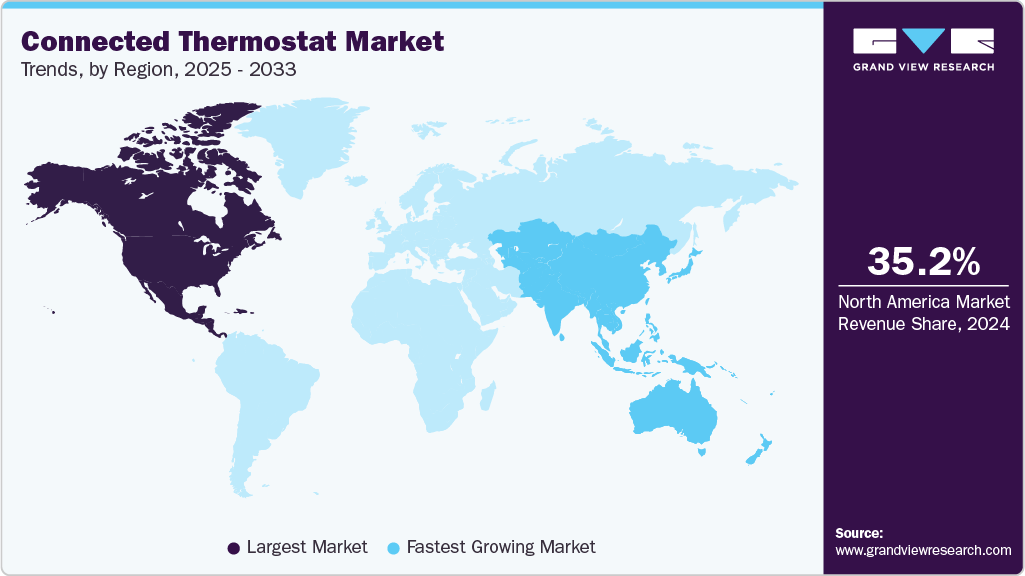
The global connected thermostat market size was valued at USD 2.7 billion in 2025 and is projected to grow from USD 3.0 billion in 2026 to USD 8.2 billion by 2033, at a CAGR of 15.3% from 2026 to 2033. North America dominated the market, accounting for a revenue share of 35.2% in 2025. The market is witnessing significant growth due to increasing adoption of smart home technologies, demand for energy efficiency, and rising awareness about environmental sustainability.

Key Market Trends & Insights
- By connectivity technology: Bluetooth thermostats segment dominated the market, with a revenue share of 55.2% in 2025.
- By distribution channel: Retail stores segment held the largest market share of 44.5% in 2025.
- By application: New construction segment held the largest revenue share of 53.2% in 2025.
- By end use: Commercial segment held the largest market share of 52.2% in 2025.
Regional Highlights
- Largest regional market: North America (35.2% revenue share, 2025)
- Fastest growing regional market: Asia Pacific (highest CAGR, 2026-2033)
- By country: The U.S. held the largest market share in 2025.
Market Size & Forecast
- Market size in 2025: USD 2.7 Billion
- Estimated market size in 2026: USD 3.0 Billion
- Projected market size by 2033: USD 8.2 Billion
- CAGR (2026-2033): 15.3%
Connected thermostats offer real-time remote control, learning capabilities, and automation that enhance user convenience and reduce energy consumption. The adoption of connected thermostats is gaining traction across residential, commercial, and industrial sectors as users seek data-driven climate control solutions. In addition, utility companies are deploying connected thermostats as part of demand response programs to optimize grid usage, which is further stimulating market growth.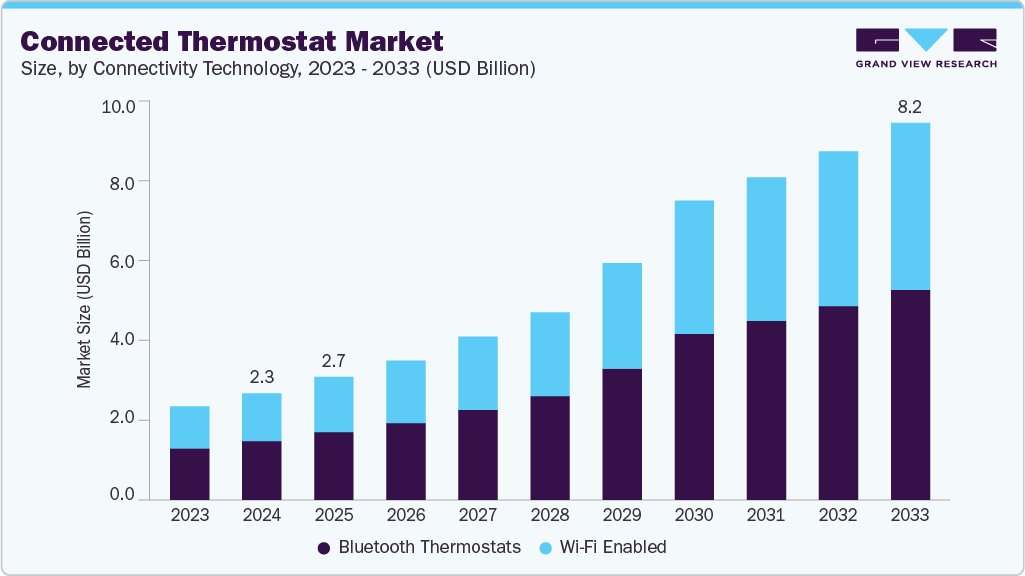
Market Dynamics
The connected thermostat market is witnessing steady growth, driven by increasing adoption of smart home technologies, rising awareness of energy conservation, and growing investments in intelligent building infrastructure. Consumers and businesses are increasingly replacing conventional thermostats with connected solutions that enable remote monitoring, automated temperature control, and integration with HVAC systems. Advances in IoT, artificial intelligence, cloud-based analytics, and wireless connectivity are enhancing thermostat functionality through features such as occupancy sensing, predictive scheduling, and energy usage insights.
The increasing focus on reducing energy consumption and carbon emissions is a major driver for the connected thermostat market. Heating and cooling systems account for a significant share of electricity consumption in residential and commercial buildings, prompting property owners to adopt intelligent temperature control solutions that optimize HVAC operations. Connected thermostats automatically adjust temperature settings based on occupancy patterns, weather conditions, and user preferences, helping reduce unnecessary energy usage while maintaining indoor comfort.
Governments, utilities, and energy providers are also encouraging the adoption of smart energy management technologies through efficiency programs, rebates, and building performance standards. As smart homes, green buildings, and digitally managed commercial facilities become more common, connected thermostats are increasingly viewed as a cost-effective solution for lowering utility expenses, improving energy efficiency, and supporting sustainability goals.
Despite their long-term energy-saving benefits, connected thermostats often require a higher upfront investment than conventional thermostats, particularly when integrated with advanced HVAC systems or broader building automation platforms. Compatibility issues with older HVAC equipment, installation complexity, and the need for professional configuration can further increase deployment costs. These factors may discourage adoption among price-sensitive residential customers and owners of aging buildings, especially in developing markets where awareness of smart energy technologies is still evolving.
The modernization of existing residential and commercial buildings presents a significant growth opportunity for the connected thermostat market. Millions of buildings worldwide continue to operate with conventional thermostats and outdated HVAC control systems, creating substantial potential for retrofit installations. Building owners are increasingly investing in smart upgrades to improve energy performance, enhance occupant comfort, and comply with evolving energy efficiency regulations.
Unlike complete HVAC replacements, installing a connected thermostat is a relatively simple and cost-effective upgrade that delivers measurable energy savings and remote control capabilities. As digital building management, IoT-enabled infrastructure, and sustainability initiatives continue to expand, retrofit projects are expected to become a key source of market growth over the forecast period.
Market Concentration & Characteristics
The global connected thermostat market is moderately consolidated, characterized by the presence of several leading multinational corporations such as Honeywell International Inc., Emerson Electric Co., and ecobee, alongside a growing number of specialized startups and regional players. These companies compete primarily on technological innovation, connectivity technology design, interoperability, and ecosystem compatibility.
Large players hold notable market shares due to their established brand presence, wide distribution networks, and integration with broader smart home or building automation platforms. However, emerging startups are actively disrupting the space with agile development cycles, unique software capabilities, and competitive pricing models. These challengers often focus on niche applications or enhanced user experiences, contributing to a dynamic competitive landscape.
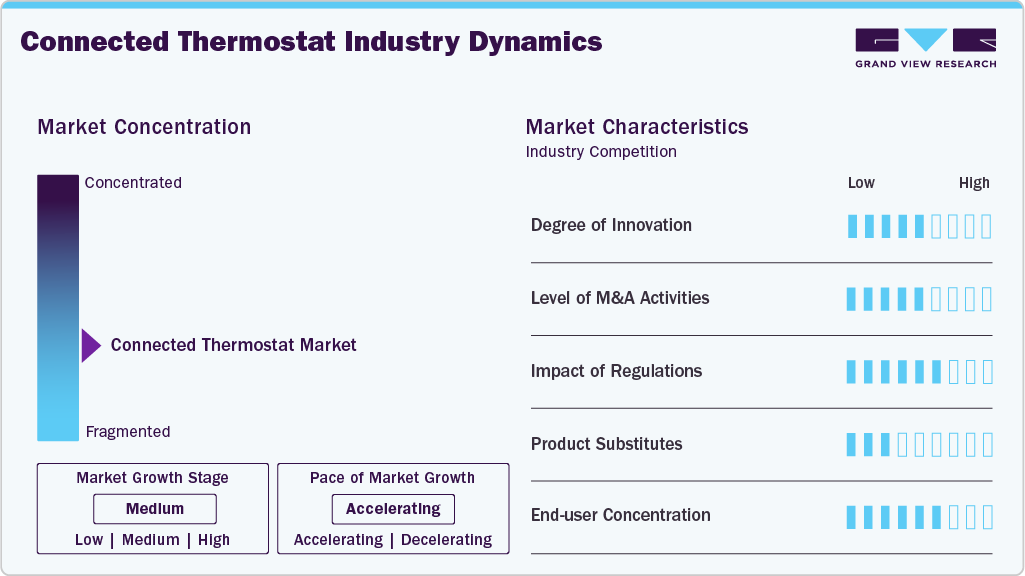
Research and development investments are centered around features such as self-learning algorithms, geofencing, voice assistant integration, and predictive maintenance capabilities. Cloud connectivity, over-the-air software updates, and mobile app control are becoming baseline features as consumer demands convenience and control.
Strategic collaborations are also shaping the industry, with thermostat manufacturers increasingly partnering with HVAC system OEMs, utility providers for demand-response programs, and IoT platform providers to deliver integrated climate control ecosystems. White-labeling is emerging as a preferred model among retailers and utility companies aiming to offer branded smart energy connectivity technology.
Analyst Perspective
The connected thermostat market is expected to experience steady growth over the forecast period, supported by increasing adoption of smart home technologies, greater emphasis on energy efficiency, and ongoing investments in connected building infrastructure. Demand is likely to be influenced by the growing integration of IoT, cloud-based platforms, and AI-enabled HVAC controls that enhance user convenience and optimize energy consumption. Commercial applications are anticipated to remain a key source of demand and is expected to increase as organizations focus on improving operational efficiency and reducing energy costs. In addition, retrofit projects, smart city initiatives, and evolving building energy regulations are expected to create new opportunities for manufacturers to expand their product offerings and strengthen their presence across regional markets.
Connectivity Technology Insights
Based on connectivity technology, Bluetooth thermostats segment led the market with the largest revenue share of 55.2% in 2025, due to their ease of installation, lower cost, and compatibility with a wide range of HVAC systems. These devices are particularly popular in smaller homes and retrofit projects with limited Wi-Fi coverage. Their ability to operate without an internet connection makes them suitable for basic automation needs while offering app-based control.
Wi-Fi enabled thermostats support remote access, integration with voice assistants, and advanced scheduling features, making them appealing to tech-savvy users. Growing consumer demand for real-time control and interoperability with broader smart home platforms is supporting the expansion of this segment.
Distribution Channel Insights
Based on distribution channel, retail stores segment led the market with the largest revenue share of 44.5% in 2025 of the revenue share due to wide connectivity technology availability, in-store promotions, and brand visibility. Consumers benefit from hands-on demonstrations, staff assistance, and bundled offers with other smart home connectivity technologies. Retail chains and electronics outlets continue to be primary sales channels for connected thermostats, especially in mature markets with established smart home ecosystems.
E-commerce platforms offer consumers a broad selection, competitive pricing, and doorstep delivery, making them an increasingly preferred channel for connected thermostat purchases. The growth of digital retail is further supported by rising smartphone usage, online payment adoption, and promotional campaigns by manufacturers targeting tech-savvy users.
Application Insights
Based on application, new construction segment led the market with the largest revenue share of 53.2% in 2025, driven by the incorporation of smart HVAC systems in modern residential and commercial developments. Builders and contractors are increasingly integrating connected thermostats to meet energy codes and enhance building appeal. Government incentives and rising interest in energy-efficient designs further contribute to this trend.
Aging building stock in developed regions and the growing need for energy upgrades are driving demand for connected thermostats in renovation projects. These devices offer a cost-effective way to modernize HVAC systems without major structural changes, appealing to both homeowners and commercial facility managers.
End Use Insights
Based on end use, commercial segment led the market with the largest revenue share of 52.2% in 2025, driven by growing adoption in office buildings, retail outlets, hospitality, and healthcare facilities. Businesses are leveraging connected thermostats to optimize energy usage, reduce operating costs, and meet sustainability goals. Integration with building management systems and centralized HVAC networks further supports large-scale implementation. Rising focus on occupant comfort and remote facility management is also contributing to continued market dominance.
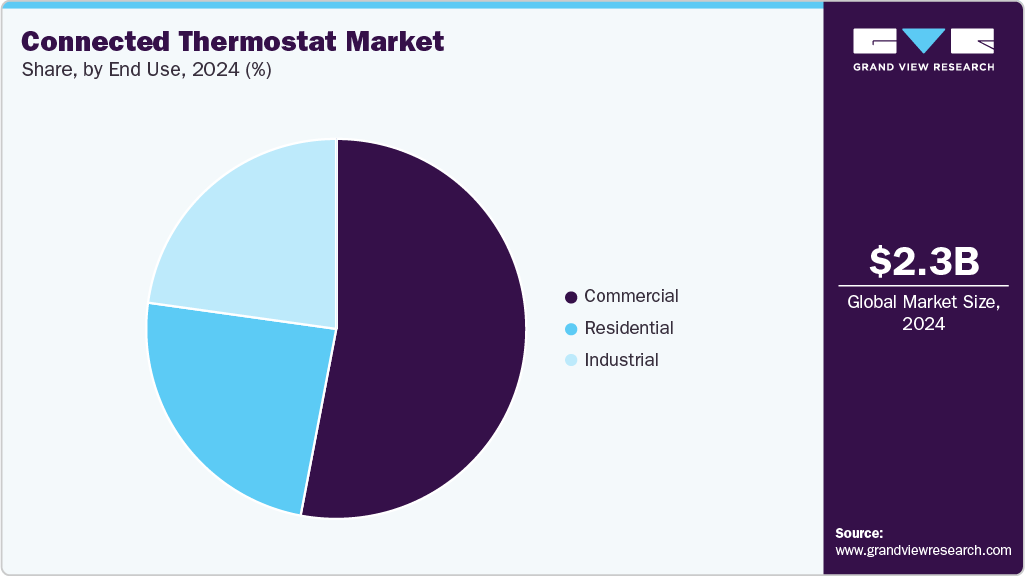
Manufacturing plants, warehouses, and data centers are increasingly adopting connected thermostats to manage thermal environments and reduce energy consumption. These systems help operators monitor, control, and automate HVAC operations across large, complex facilities. The push toward operational efficiency, energy benchmarking, and compliance with environmental regulations is driving growth in this segment.
Regional Insights
North America dominated the connected thermostat market with the largest revenue share of 35.2% in 2025. The region’s market is supported by high penetration of smart home technologies and well-established HVAC infrastructure. Consumers across the United States and Canada have shown strong interest in energy-saving solutions, driven by environmental awareness, rising electricity costs, and comfort expectations.
U.S. Connected Thermostat Market Trends
The connected thermostat market in the U.S. held the largest share in the North America region in 2025. The U.S. remains one of the most mature and technologically advanced markets for connected thermostats, driven by widespread smart home adoption and strong consumer preference for automation.
Europe Connected Thermostat Market Trends
Europe holds a significant share of the global connected thermostat market, underpinned by strict energy performance regulations and a strong policy focus on decarbonization. Countries across Western and Northern Europe have implemented building energy codes that promote smart heating and cooling controls. Consumers are increasingly investing in smart thermostats for broader home automation upgrades and energy-efficient retrofits, especially in colder regions. Integration with hydronic heating systems and district heating networks is common, adding complexity and opportunity for tailored solutions.
The connected thermostat market in Italy is expected to grow at a CAGR of 15.2% over the forecast period. Growth in the Italian connected thermostat market is largely influenced by increasing interest in energy-efficient retrofits and smart building solutions. Rising electricity prices, combined with incentives under Italy’s Ecobonus program, are encouraging households to upgrade to intelligent climate control systems.
France connected thermostat market is expected to grow at a CAGR of 15.0% over the forecast period. France is witnessing a steady rise in connected thermostat adoption, supported by the country’s emphasis on smart energy management and its long-term carbon neutrality goals.
Asia Pacific Connected Thermostat Market Trends
Asia Pacific is emerging as the fastest-growing regional market, fueled by rapid urbanization, infrastructure expansion, and increasing digitization. Countries such as China, India, Japan, South Korea, and Australia are seeing growing demand for connected thermostats across both residential and commercial buildings. The region’s large population base, improving disposable incomes, and the proliferation of smart devices are creating favorable conditions for market expansion.
The connected thermostat market in China is expected to grow at a CAGR of 16.6% over the forecast period. China’s connected thermostat market is expanding rapidly due to accelerating urbanization, the proliferation of smart buildings, and the increasing demand for intelligent energy solutions.
India connected thermostat market is projected to grow at a CAGR of 16.3% over the forecast period. Although still at a nascent stage, India’s connected thermostat market is gaining traction amid increasing awareness of energy efficiency and the emergence of smart residential and commercial infrastructure. The country’s expanding IT workforce and widespread smartphone usage are fostering interest in smart home technologies.
Middle East & Africa Connected Thermostat Market Trends
The Middle East and Africa market is gaining momentum, driven by rising demand for energy-efficient cooling systems and ongoing investment in smart infrastructure. Hot climate conditions and heavy reliance on air conditioning systems make connected thermostats a practical solution for temperature management and cost savings. Countries such as Saudi Arabia and the United Arab Emirates are leading adoption, supported by national development plans focused on sustainability and digital transformation.
The connected thermostat market in Saudi Arabia is expected to grow at a CAGR of 15.8% over the forecast period. The country’s hot climate, coupled with extensive use of air conditioning, makes it a high-potential market for connected thermostat adoption. The government’s Vision 2030 framework, which emphasizes energy diversification and efficiency, is fostering growth in smart building technologies, including advanced climate control systems.
Latin America Connected Thermostat Market Trends
Latin America is experiencing steady growth in the connected thermostat market, supported by rising consumer awareness, expanding urban populations, and the gradual modernization of residential and commercial properties. Key countries such as Brazil, Mexico, and Argentina are witnessing increasing adoption of smart home devices, including thermostats, particularly in urban areas. As electricity tariffs continue to rise, homeowners and businesses are actively seeking ways to reduce energy bills through intelligent climate control. While economic instability and low connectivity technology penetration in rural regions pose limitations, the expanding presence of e-commerce platforms and global smart home brands is making connected thermostats more accessible.
Argentina connected thermostat market is projected to grow at a CAGR of 15.2% over the forecast period. The country is gradually emerging as a viable market for connected thermostats, driven by a growing focus on energy management in urban households and commercial establishments.
Key Connected Thermostat Company Insights
Some of the key players operating in the market include Honeywell International Inc. and Carrier
-
Honeywell International Inc. is a global technology company with decades of experience in home automation and climate control. The company’s connectivity technology are widely used in both residential and commercial settings, offering features like geofencing, multi-room sensors, and energy-saving automation.
-
Carrier is a prominent company involved in the larger HVAC industry and a leading provider of heating, cooling, and smart control systems. The company’s connected thermostats are recognized for energy efficiency, advanced diagnostics, and seamless compatibility with home HVAC systems. The company has a strong global presence with operations and sales presence in several nations.
Key Connected Thermostat Companies
The following key companies have been profiled for this study on the connected thermostat market.
-
Honeywell International Inc.
-
Trane
-
Carrier
-
ecobee
-
Copeland LP
-
LUX Connectivity Technologys Pro Solutions (EME Delaware Inc)
-
Robert Bosch GmbH
-
Hive (Centrica Hive Limited)
-
Netatmo
-
tado GmbH
Competitive Benchmarking
Category
Operating Strategies
Competitive Edge
Weakness
Established Players (e.g., Honeywell International Inc., Carrier, Trane, Robert Bosch GmbH, Siemens AG, Johnson Controls International plc)
- Invest in AI-, IoT, and cloud-enabled thermostat technologies to enhance HVAC automation and energy management.
- Expand smart building ecosystems through partnerships with HVAC OEMs, software providers, and home automation platforms.
- Strengthen global distribution channels while offering integrated HVAC and building management solutions.
- Strong global brand recognition and well-established customer relationships across residential and commercial markets.
- Comprehensive product portfolios with seamless integration into HVAC and building automation systems.
- Significant R&D capabilities and financial resources that support continuous innovation and technology upgrades.
- Premium-priced products may limit adoption in price-sensitive markets.
- Longer product development and commercialization cycles compared to smaller competitors.
- Large organizational structures can slow response to rapidly changing consumer preferences.
Emerging & Regional Players (e.g., ecobee, tado GmbH, Netatmo, Hive (Centrica Hive Limited), Venstar, LLC.)
- Focus on intuitive, app-based smart thermostats with advanced energy-saving and remote control features.
- Expand market reach through online sales, utility partnerships, and smart home ecosystem collaborations.
- Target regional markets with affordable, easy-to-install connected thermostat solutions.
- Competitive pricing and customer-centric product design.
- Strong compatibility with popular voice assistants and smart home platforms.
- Limited global presence and smaller distribution networks than established competitors.
- Lower investment capacity for large-scale R&D and international marketing.
- Higher dependence on third-party smart home ecosystems and regional market demand.
Recent Developments
-
In October 2024, Ecobee launched the ecobee Smart Thermostat Lite, a new pro-exclusive model designed for professional installers. It is easy to install, durable, and hardwired, eliminating the need for charging or secondary power sources. Compatible with most HVAC systems-including multi-stage heating and cooling, radiant heating, and dual-fuel systems-it supports accessories like humidifiers and ventilators.
-
In February 2024, Carrier introduced a new Smart Thermostat aimed at residential new construction builders and homeowners, offering improved connectivity at an affordable price. This 24V thermostat features a modern design, supports accessories, integrates with smart home systems, and offers warranty options of up to 5 years when connected.
Connected Thermostat Market Report Scope
Report Attribute
Details
Market size in 2025
USD 2.7 billion
Estimated market size in 2026
USD 3.0 billion
Projected market size by 2033
USD 8.2 billion
Growth rate
CAGR of 15.3% from 2026 to 2033
Base year for estimation
2025
Historical data
2021 - 2024
Forecast period
2026 - 2033
Quantitative units
Revenue in USD billion and CAGR from 2026 to 2033
Report coverage
Revenue forecast, company ranking, competitive landscape, growth factors, and trends
Segments covered
Connectivity technology, distribution channel, application, end use, and region.
Regional scope
North America; Europe; Asia Pacific; Latin America; Middle East & Africa
Country scope
U.S.; Canada; Mexico; UK; Germany; France; Spain; Italy; China; Japan; India; Australia; South Korea; Brazil; Argentina; Saudi Arabia; UAE; South Africa
Key companies profiled
Honeywell International Inc.; Trane; Carrier; ecobee; Copeland LP; LUX Connectivity Solutions Pro (EME Delaware Inc.); Robert Bosch GmbH; Hive (Centrica Hive Limited); Netatmo; tado GmbH; Siemens AG; Johnson Controls International plc; Schneider Electric SE; Midea Group Co., Ltd.; Venstar, LLC.
Customization scope
Free report customization (equivalent up to 8 analysts' working days) with purchase. Addition or alteration to country, regional & segment scope.
Pricing and purchase options
Avail customized purchase options to meet your exact research needs. Explore purchase options
Global Connected Thermostat Market Report Segmentation
This report forecasts revenue growth at global, regional, and country levels and provides an analysis of the latest industry trends in each of the sub-segments from 2021 to 2033. For this study, Grand View Research, Inc has segmented the global connected thermostat market report based on connectivity technology, distribution channel, application, end use, and region:
-
Connectivity Technology Outlook (Revenue, USD Million, 2021 - 2033)
-
Wi-Fi Enabled
-
Bluetooth Thermostats
-
-
Distribution Channel Outlook (Revenue, USD Million, 2021 - 2033)
-
Online
-
Retail Stores
-
Wholesale Stores
-
Others
-
-
Application Outlook (Revenue, USD Million, 2021 - 2033)
-
New Construction
-
Retrofit & Renovation
-
-
End Use Outlook (Revenue, USD Million, 2021 - 2033)
-
Commercial
-
Residential
-
Industrial
-
-
Regional Outlook (Revenue, USD Million, 2021 - 2033)
-
North America
-
U.S.
-
Canada
-
Mexico
-
-
Europe
-
Germany
-
France
-
Italy
-
Spain
-
UK
-
-
Asia Pacific
-
China
-
India
-
Japan
-
South Korea
-
Australia
-
-
Latin America
-
Brazil
-
Argentina
-
-
Middle East and Africa
-
Saudi Arabia
-
UAE
-
South Africa
-
-
Research Methodology
The connected thermostat market figures in this report are based on a proven research process that combines executive interviews with secondary research from proprietary databases, company filings, and recognized regulatory and institutional sources. Market size is built through value-chain sizing - reconciling supply-side and demand-side estimates - and triangulated with bottom-up and top-down approaches. Every estimate passes multiple levels of expert validation before publication, with each connected thermostat segment quantified using the revenue-capture definitions in the table below.
Segment Definition
Connectivity Technology
Revenue Capture Definition
Wi-Fi Enabled
Revenue captured from the sale of internet-connected thermostats equipped with Wi-Fi connectivity for remote monitoring and control through mobile applications, cloud-based data access, programmable scheduling, voice assistant integration, real-time energy monitoring, and smart HVAC automation across residential, commercial, and industrial buildings.
Bluetooth Thermostats
Revenue captured from the sale of thermostats featuring Bluetooth connectivity for short-range wireless communication, local smartphone or tablet control, programmable temperature settings, and standalone HVAC management without requiring continuous internet connectivity.
Distribution Channel
Revenue Capture Definition
Online
Revenue captured from the sale of connected thermostats through manufacturer websites, e-commerce platforms, online marketplaces, and digital retail channels, serving residential consumers, businesses, and professional installers.
Retail Stores
Revenue captured from the sale of connected thermostats through home improvement stores, consumer electronics retailers, HVAC specialty outlets, and organized retail chains offering in-store product selection and customer support.
Wholesale Stores
Revenue captured from the sale of connected thermostats supplied in bulk through HVAC distributors, wholesalers, contractors, builders, facility management companies, and commercial procurement networks for large-scale installation projects.
Others
Revenue captured from the sale of connected thermostats through direct manufacturer sales, authorized dealers, system integrators, utility programs, and other alternative distribution channels serving institutional and enterprise customers.
Application
Revenue Capture Definition
New Construction
Revenue captured from the sale of connected thermostats installed in newly constructed residential, commercial, and industrial buildings as part of integrated HVAC systems, smart building infrastructure, and energy-efficient construction projects.
Retrofit & Renovation
Revenue captured from the sale of connected thermostats used to replace conventional thermostats or upgrade existing HVAC control systems during building renovation, remodeling, energy efficiency improvement, and smart building modernization projects.
End Use
Revenue Capture Definition
Commercial
Revenue captured from the sale of connected thermostats deployed across office buildings, hotels, hospitals, educational institutions, shopping malls, retail outlets, restaurants, and other commercial facilities to improve HVAC efficiency, reduce operating costs, and enhance occupant comfort.
Residential
Revenue captured from the sale of connected thermostats installed in single-family homes, apartments, condominiums, villas, and residential communities for remote temperature control, energy optimization, smart home integration, and automated HVAC management.
Industrial
Revenue captured from the sale of connected thermostats used in manufacturing facilities, warehouses, production plants, laboratories, cold storage facilities, data centers, and other industrial environments requiring precise temperature control, operational efficiency, and reliable HVAC performance.
Estimation Model
Layer Name
Key Question
Description
Installed HVAC & Building Base
What is the installed base and annual deployment of HVAC systems that require thermostat controls across residential, commercial, and industrial buildings?
Estimate the addressable market by evaluating new building construction, existing HVAC installations, and replacement demand for thermostat-enabled temperature control systems.
Connected Thermostat Adoption
What percentage of HVAC installations utilize connected thermostats, and how is adoption split by Wi-Fi and Bluetooth technologies?
Assess penetration of connected thermostats based on smart home adoption, building automation deployment, retrofit activities, energy efficiency initiatives, and technology preferences.
Sales Volume Assessment
How many connected thermostat units are sold annually across connectivity technologies, applications, distribution channels, and end-use sectors?
Estimate annual unit shipments by considering new construction demand, replacement cycles, distribution channel sales, and adoption across residential, commercial, and industrial customers.
Revenue Estimation
What is the total revenue generated from connected thermostat sales across all market segments?
Estimate total market revenue by consolidating revenue generated across connectivity technologies, applications, distribution channels, and end-use industries at regional and global levels.
Delivered Customizations
This report has been delivered with the following In-depth customizations
Client Request
Customization Delivered
Value Adds
Regional Segmentation
Delivered an in-depth regional assessment covering North America, Europe, Asia Pacific, Latin America, and the Middle East & Africa, including market size, growth trends, adoption of connected thermostats, demand drivers, regulatory landscape, and country-level opportunities across major economies.
Enabled identification of high-growth regional markets, technology adoption trends, investment hotspots, and region-specific demand patterns to support expansion and market entry strategies.
Competitive Benchmarking
Delivered a comprehensive competitive analysis of leading connected thermostat manufacturers, covering product portfolios, connectivity technologies, innovation capabilities, strategic developments, distribution networks, market positioning, and competitive landscape assessment.
Helped benchmark competitors, identify product differentiation strategies, evaluate technological capabilities, and understand competitive strengths for strategic decision-making and partnership opportunities.
Opportunity Assessment
Delivered a detailed evaluation of emerging market opportunities, including smart home adoption, retrofit and renovation projects, energy efficiency initiatives, building automation integration, IoT-enabled HVAC systems, and expansion opportunities across residential, commercial, and industrial sectors.
Provided actionable insights into future growth avenues, untapped customer segments, evolving technology trends, and investment opportunities, enabling clients to prioritize high-potential markets and optimize long-term business strategies.
Frequently Asked Questions About This Report
Commercial segment held the largest market share of 52.2% in 2025, driven by growing adoption in office buildings, retail outlets, hospitality, and healthcare facilities.
Asia Pacific is the fastest-growing region over the forecast period.
Some of the key players operating in the connected thermostat market include Honeywell International Inc.; Trane; Carrier; ecobee; Copeland LP; LUX Connectivity Solutions Pro (EME Delaware Inc.); Robert Bosch GmbH; Hive (Centrica Hive Limited); Netatmo; tado GmbH; Siemens AG; Johnson Controls International plc; Schneider Electric SE; Midea Group Co., Ltd.; Venstar, LLC.
The global connected thermostat market size was valued at USD 2.7 billion in 2025 and is estimated at USD 3.0 billion in 2026
The retail stores segment led the market with the largest revenue share of 44.5% in 2025. Consumers continue to prefer retail outlets for product demonstrations, immediate availability, professional guidance, and access to a wide range of connected thermostat brands.
The global connected thermostat market is expected to grow at a CAGR of 15.3% from 2026 to 2033, reaching USD 8.2 billion by 2033.
Key factors driving the connected thermostat market include rising demand for energy-efficient HVAC solutions and growing smart home adoption. Technological advancements like remote access, AI-based scheduling, and voice assistant integration are further accelerating adoption.
Bluetooth thermostats segment led the market with the largest revenue share of 55.2% in 2025
North America dominated with a 35.2% revenue share in 2025.
About the Author(s)
Advanced Interior Materials Research Team
Advanced Materials · Advanced Interior MaterialsThis report was authored by the advanced interior materials research team at Grand View Research - comprising two research analysts, one senior research analyst, and one industry expert - with specialized expertise in the advanced interior materials segment of the advanced materials industry. All findings are based on proprietary advanced materials databases, executive interviews, and regulatory analysis, subject to internal peer review prior to publication.
Last Updated:
Speak to Analyst


Customize this report to your needs — add regions, segments, or data points, with 20% free customization.
Or view our licence options:


ISO 9001:2015 & 27001:2022 Certified
We are GDPR and CCPA compliant! Your transaction & personal information is safe and secure. For more details, please read our privacy policy.


