
- Home
- »
- Next Generation Technologies
- »
-
Connected Worker Market Size & Share Report, 2026-2033GVR Report cover
![Connected Worker Market (2026 - 2033)Report]()
Connected Worker Market (2026 - 2033)
Size, Share & Trends Analysis Report By Component (Hardware, Software, Services), By Deployment, By Enterprise Size, By Application, By End-use, By Region, And Segment Forecasts
Market Size, 2025
$9.4BMarket Estimate, 2026
$10.7BMarket Forecast, 2033
$52.3BCAGR, 2026–2033
25.5%Connected Worker Market Summary
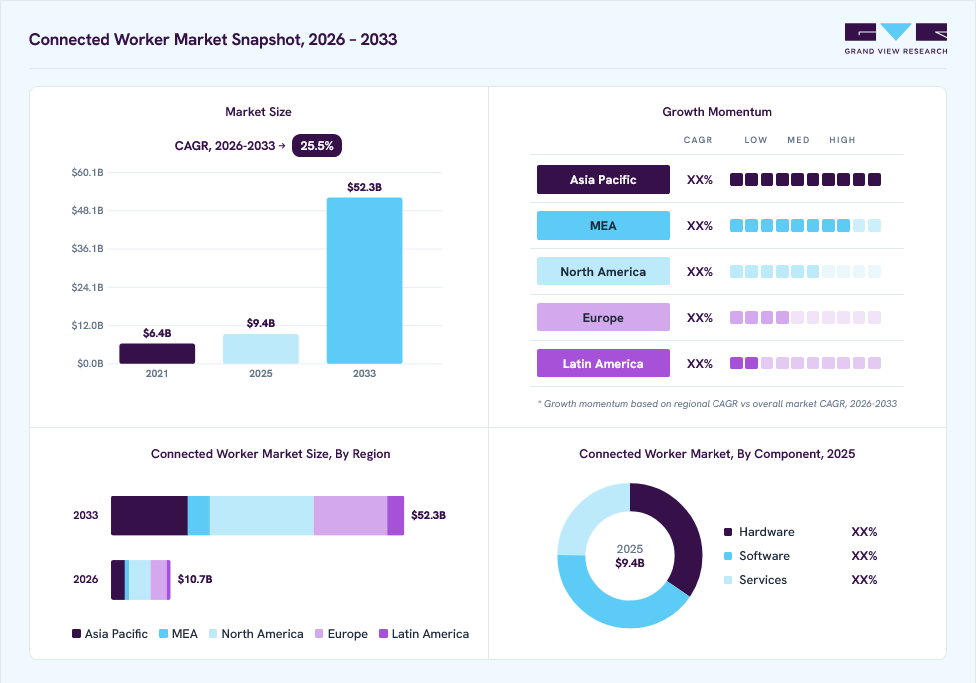
The global connected worker market size was valued at USD 9.4 billion in 2025 and is projected to grow from USD 10.7 billion in 2026 to USD 52.3 billion by 2033, at a CAGR of 25.5% from 2026 to 2033. North America dominated the market, accounting for the largest revenue share of 35.8% in 2025. The market growth is driven by rising industrial digitalization, growing emphasis on workforce safety and productivity, and increasing adoption of internet of things (IoT), wearables, AI, and real-time workforce collaboration solutions.
Key Market Trends & Insights
- By component: Software segment held the largest revenue share of 40.6% in 2025
- By deployment: Cloud held the largest revenue share of 67.1% in 2025
- By enterprise size: Large enterprises held the largest revenue share of 65.9% in 2025
- By application: Workforce safety & monitoring held the largest revenue share of 26.6% in 2025
- By end use: Manufacturing held the largest revenue share in 2025
Regional Highlights
- Largest regional market: North America (35.8% revenue share, 2025)
- Fastest-growing regional market: Asia Pacific (highest CAGR, 2026-2033)
- By country: The U.S. held the largest market share in 2025
Market Size & Forecast
- Market size in 2025: USD 9.4 Billion
- Estimated market size in 2026: USD 10.7 Billion
- Projected market size by 2033: USD 52.3 Billion
- CAGR (2026-2033): 25.5%
Increasing focus on occupational health and safety, workplace risk reduction, and regulatory compliance is driving organizations to deploy connected-worker solutions. Wearable devices, location tracking, real-time alerts, environmental sensors, and worker-monitoring platforms enable organizations to identify hazards, monitor worker conditions, and respond rapidly to incidents. This is particularly important in high-risk environments such as manufacturing, construction, mining, oil & gas, and utilities, where connected technologies can reduce workplace incidents while improving safety oversight.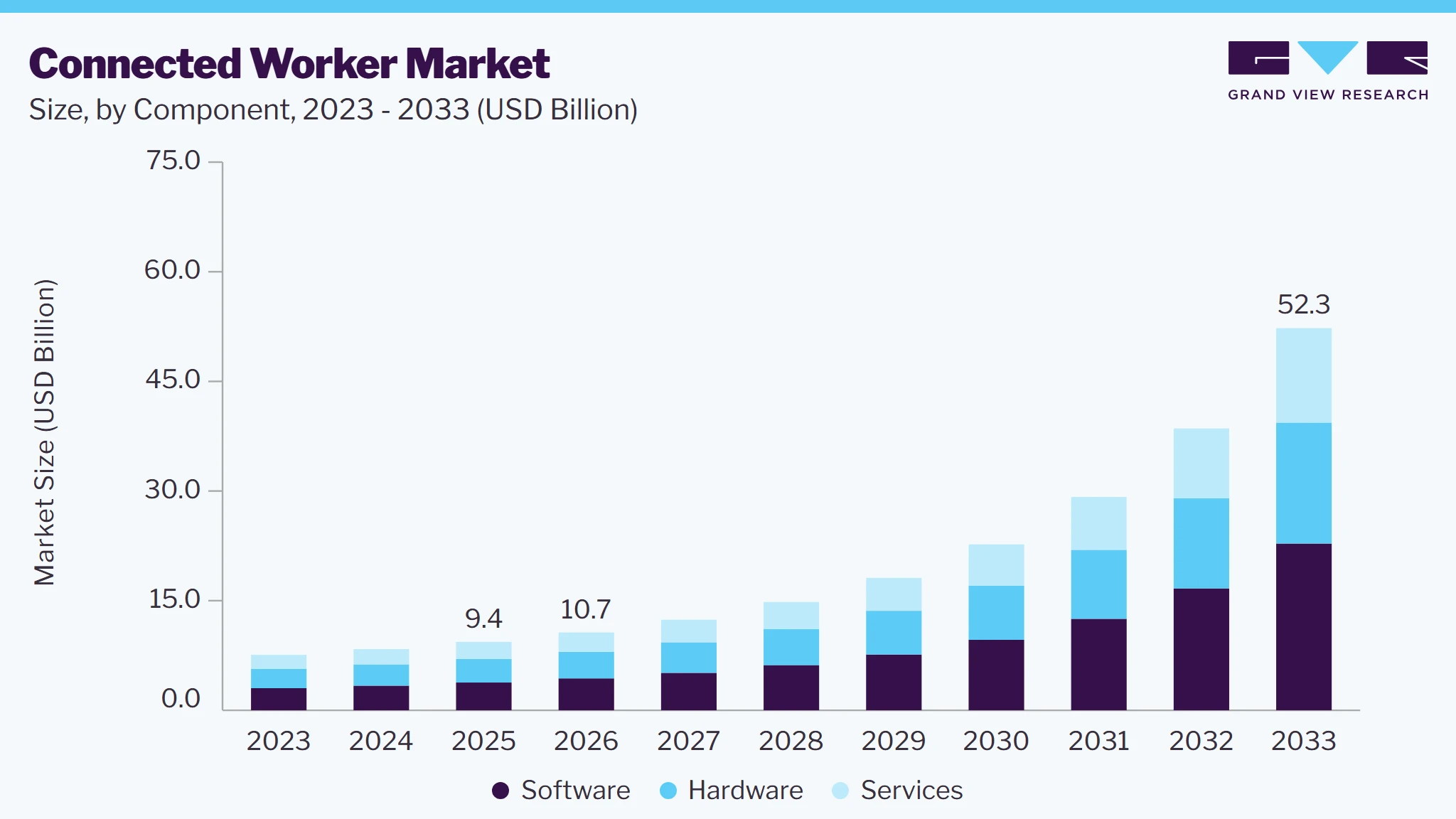
The expansion of Industry 4.0 initiatives is accelerating the integration of frontline workers with connected industrial environments. Organizations are combining IoT sensors, industrial devices, mobile applications, cloud platforms, AI, analytics, and digital workflows to provide workers with real-time operational information. Connected-worker platforms help bridge the gap between physical operations and enterprise systems, enabling employees to access machine data, work instructions, maintenance information, and operational insights directly at the point of work.
Labor shortages, rising operational costs, and pressure to improve operational efficiency are encouraging enterprises to digitize frontline workflows. Connected-worker solutions can automate task allocation, digitize checklists and workflows, track task completion, and provide real-time visibility into workforce activities. These capabilities help reduce administrative work, minimize downtime, improve workforce utilization, and accelerate decision-making, supporting stronger productivity across labor-intensive industries.
Market Dynamics
The connected worker market is driven by the increasing need to improve frontline workforce safety, productivity, collaboration, and operational decision-making across industries with distributed or deskless employees. The proliferation of industrial IoT, wearable devices, mobile computing, cloud platforms, AI, augmented reality (AR), digital workflows, and real-time analytics is enabling organizations to connect frontline workers with people, processes, machines, and enterprise systems. Connected-worker technologies are increasingly moving beyond basic communication toward real-time guidance, task orchestration, predictive safety, remote assistance, digital training, and AI-enabled decision support.
The rapid adoption of artificial intelligence (AI), industrial AI, real-time analytics, and intelligent automation is driving the connected worker market as organizations seek to augment frontline employees with contextual information and decision support at the point of work. AI-enabled connected-worker platforms can analyze workforce and operational data to provide intelligent task recommendations, identify safety risks, optimize workflows, automate reporting, and support workers in resolving operational issues. In January 2026, Honeywell launched Performance+ for Guided Work, a connected workforce solution combining voice-driven guided work with advanced analytics to provide real-time insights, streamline workflows, and improve visibility across warehousing, retail, and logistics operations.
Fragmented technology environments and difficulties integrating heterogeneous operational systems can restrain the connected worker market growth. Enterprises often operate combinations of legacy machinery, industrial control systems, ERP, MES, EAM/CMMS, HR, workforce-management platforms, mobile devices, wearables, and communication tools that use different data structures, protocols, and security frameworks. Connecting these systems into a unified worker experience can require substantial investments in APIs, middleware, data contextualization, device management, cybersecurity, and IT/OT integration. The challenge is particularly significant in industrial environments where operational continuity, low latency, and cybersecurity are critical.
The growing shortage of skilled workers and the need to transfer expertise across distributed operations create significant opportunities for AI-powered guided work, remote assistance, digital training, and frontline knowledge management. Connected-worker platforms can provide step-by-step digital work instructions, remote expert support, contextual knowledge, video collaboration, and AI-generated assistance, enabling less-experienced employees to perform complex tasks with greater accuracy. The opportunity extends across manufacturing, construction, energy & utilities, oil & gas, mining, transportation, and healthcare, where experienced personnel may be geographically dispersed or where tasks involve safety-critical procedures.
Analyst Perspective
The convergence of connected-worker platforms, AI, industrial IoT, wearable technologies, digital twins, and real-time operational intelligence is expected to increasingly shape the connected worker market. Organizations are moving from standalone workforce communication and monitoring tools to integrated systems that continuously connect frontline employees with operational data, equipment, workflows, enterprise applications, and remote experts. AI is expected to increasingly transform connected-worker solutions from passive information-delivery tools into proactive workforce intelligence platforms that can recommend actions, identify potential safety or operational issues, and support autonomous or semi-autonomous workflows. At the same time, deployment is likely to extend beyond centralized cloud platforms toward edge and on-premises intelligence where low latency, connectivity resilience, cybersecurity, and data sovereignty are critical.
Component Insights
The software segment dominated the connected worker market, accounting for the largest revenue share of 40.6% in 2025, driven by the increasing need for centralized platforms that orchestrate frontline workflows, standardize work processes, and provide role-specific digital experiences across geographically dispersed teams. Enterprises are increasingly adopting software that enables dynamic task assignment, digital checklists, workflow automation, skills management, knowledge capture, shift coordination, and real-time operational visibility, helping supervisors manage changing workloads without relying on paper-based processes or fragmented applications.
The services segment is anticipated to grow at a significant CAGR during the forecast period, driven by the growing need for specialized expertise to configure, integrate, customize, and continuously manage connected-worker environments. Organizations often require implementation support to align connected-worker solutions with existing operational processes, devices, enterprise applications, and workforce structures. Demand is further supported by the need for training, technical support, system upgrades, managed services, and ongoing optimization, particularly where organizations lack sufficient internal expertise to manage complex frontline technology ecosystems.
Deployment Insights
The cloud segment dominated the connected worker industry, accounting for the largest revenue share of 67.1%in 2025 due to the growing need for rapid multi-site scalability and centralized administration of connected-worker applications. Cloud-based platforms allow organizations to deploy software consistently across facilities, update applications remotely, and manage users, workflows, and connected devices through a centralized environment. This model is particularly attractive to organizations expanding geographically or managing distributed frontline teams, as it reduces dependence on site-specific IT infrastructure and simplifies the rollout of new connected-worker capabilities.
The on-premises segment is anticipated to grow at a significant CAGR during the forecast period, supported by organizations' requirements for greater control over sensitive workforce and operational data, system configuration, and infrastructure availability. Industries operating in critical or highly regulated environments may prefer locally hosted connected-worker platforms to maintain tighter control over access, data residency, cybersecurity policies, and integration with existing internal systems.
Enterprise Size Insights
The large enterprises segment dominated the market and accounted for the revenue share of 65.9% in 2025 due to the complexity of managing large, geographically distributed frontline workforces and the need to establish consistent operating procedures across multiple facilities, business units, and regions. Large organizations increasingly require enterprise-grade capabilities such as multi-site administration, centralized governance, role-based access, workforce analytics, multilingual support, and integration with existing corporate systems.
The small & medium enterprises (SMEs) segment is expected to grow at a significant CAGR during the forecast period, driven by the increasing availability of more affordable, modular, and easy-to-deploy connected-worker solutions that reduce the technology and resource barriers traditionally associated with enterprise workforce digitization. Subscription-based software, mobile-first applications, low-code configuration, and cloud delivery enable smaller organizations to introduce specific frontline capabilities without major infrastructure investments or dedicated IT teams
Application Insights
The workforce safety & monitoring segment dominated the connected worker market, accounting for a revenue share of 26.6% in 2025, driven by the increasing requirement for real-time visibility into worker location, environmental exposure, hazardous conditions, and emergency situations, particularly in high-risk operating environments. Connected-worker applications can support lone-worker protection, geofencing, incident alerts, fatigue monitoring, and safety-event documentation, enabling organizations to strengthen preventive safety programs rather than relying solely on post-incident reporting.
The workforce training & remote assistance segment is expected to grow at a significant CAGR during the forecast period, driven by the need to overcome skills shortages, workforce turnover, and the geographic concentration of experienced personnel. Digital learning modules, interactive work instructions, remote expert assistance, video support, and contextual knowledge repositories enable organizations to transfer operational expertise directly to frontline employees.
End Use Insights
The manufacturing segment dominated the connected worker industry, accounting for a revenue share of 25.4% in 2025, supported by the increasing complexity of production environments and the need to coordinate frontline employees across production, quality, maintenance, material handling, and machine operations. Connected-worker technologies enable manufacturers to digitize standard operating procedures, provide contextual instructions at workstations, capture production-floor information, and facilitate collaboration between operators and technical personnel.
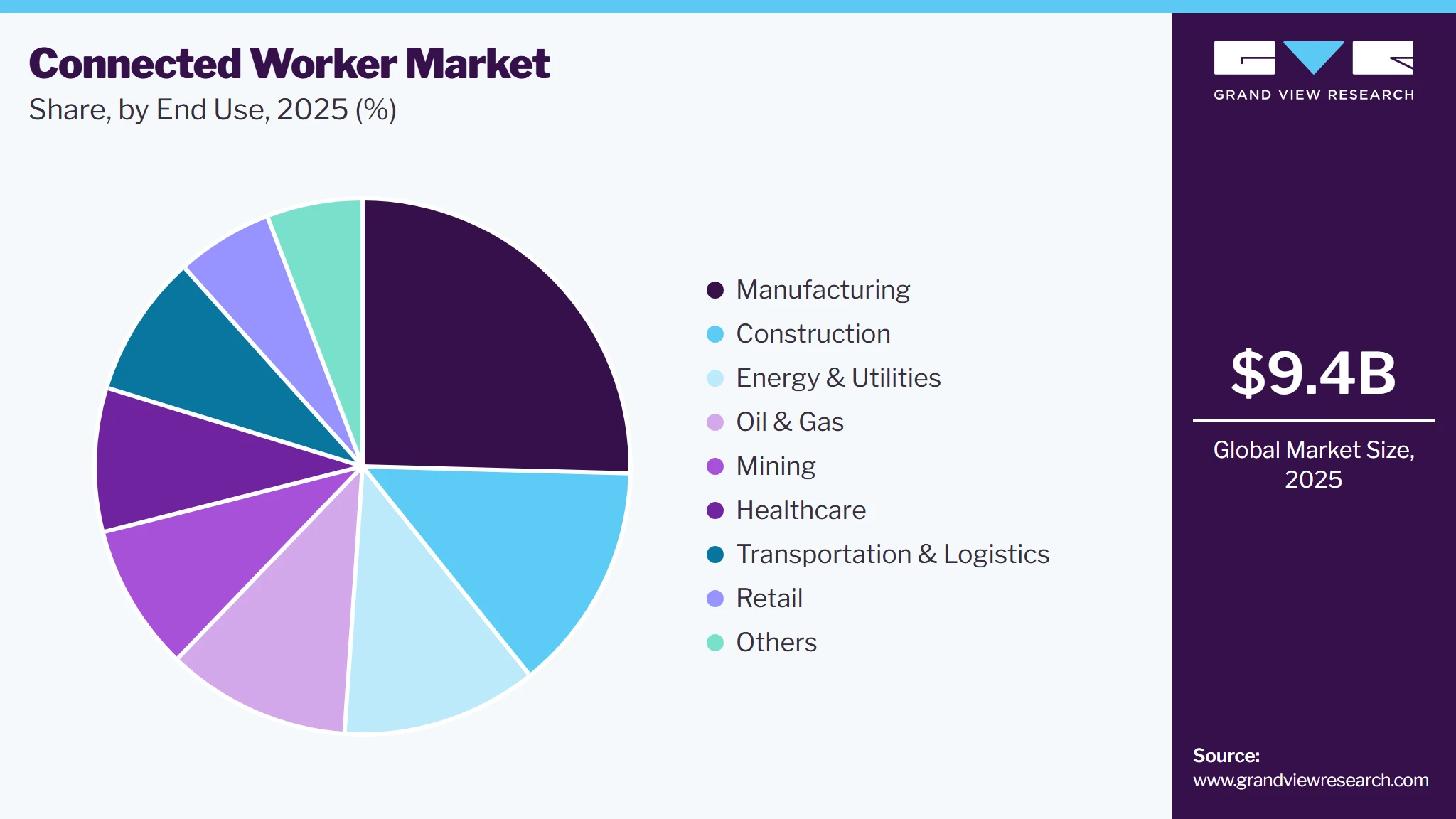
The healthcare segment is expected to grow at a significant CAGR over the forecast period, driven by the growing requirement to improve coordination among clinical and non-clinical frontline personnel while maintaining accurate information exchange, timely task execution, and continuity of care. Connected-worker solutions can support staff coordination, mobile access to operational information, digital task workflows, asset and personnel location awareness, and communication across hospitals and care facilities.
Regional Insights
North America dominated the global connected worker market, with the largest revenue share of 35.8% in 2025, driven by the region’s high concentration of digitally mature industrial enterprises and the increasing integration of connected worker technologies into existing IoT, cloud, mobile, wearable, and enterprise software environments. Organizations are increasingly seeking unified frontline platforms that can connect employees with operational systems and distributed assets while improving execution consistency across multiple facilities.

U.S. Connected Worker Market Trends
The U.S. connected worker industry is expected to grow at a significant CAGR of 25.0% from 2026 to 2033, driven by persistent demand for frontline workforce replacement and skills availability, particularly in manufacturing and other operational occupations. The U.S. Bureau of Labor Statistics projects nearly 1 million openings in production occupations annually, on average, from 2024 to 2034, primarily reflecting replacement needs as workers leave these occupations.
Europe Connected Worker Market Trends
The Europe connected worker industry is anticipated to register considerable growth from 2026 to 2033, driven by the region’s emphasis on human-centric industrial digitalization, workforce resilience, and sustainable productivity improvements. European organizations are increasingly balancing automation with technologies that augment rather than simply replace frontline personnel, creating demand for digital guidance, workforce collaboration, training, and operational decision-support capabilities.
The UK connected worker market is expected to grow rapidly in the coming years, owing to the increasing requirement to improve frontline workforce coordination across service-intensive and distributed operating environments, including logistics, healthcare, utilities, construction, and manufacturing. Organizations are increasingly digitizing manual frontline processes and equipping mobile employees with real-time access to procedures, schedules, operational information, and communication tools.
The connected worker market in Germany held a substantial revenue share in 2025, due to the country's transition toward connected, data-driven manufacturing and the need to address industrial workforce shortages. Germany's manufacturing employment declined by 177,000 during 2025, while the country's Manufacturing-X initiative is promoting secure data exchange, standardized interfaces, and connected industrial value chains. These conditions strengthen demand for technologies that enable employees to interact with increasingly digital production environments, access contextual operational information, and collaborate across production and supply-chain functions.
Asia Pacific Connected Worker Market Trends
The Asia Pacific connected worker industry held a significant global share in 2025, due to the region’s rapid expansion of smart factories, industrial automation, electronics manufacturing, logistics infrastructure, and digitally enabled production networks. Manufacturers across the region are increasingly combining connected machinery, robotics, sensors, AI, and digital production systems, creating a requirement for technologies that maintain effective human interaction with increasingly automated environments.
The Japan connected worker market is expected to grow rapidly in the coming years, driven by demographic aging and structural labor shortages, which are increasing the need to augment worker capabilities and preserve operational expertise. Japan's government has highlighted population decline and aging as reasons for strengthening employment opportunities for older workers, while manufacturing employment and workforce availability remain important policy concerns.
The connected worker market in China held a substantial revenue share in 2025, due to the country's aggressive transition toward smart manufacturing and digitally integrated production. Chinese factories are increasingly deploying automated production lines, industrial software, robotics, and connected equipment, creating demand for technologies that allow workers to interact effectively with highly automated operations. Recent developments in China's smart-factory ecosystem demonstrate the increasing use of digital technologies throughout production environments, including highly automated production lines and digitally enabled manufacturing processes.
Key Connected Worker Company Insights
Key players operating in the connected worker industry are Honeywell International Inc., Zebra Technologies, Siemens, Microsoft, Schneider Electric, PTC Inc., and IBM Corporation. The companies are focusing on various strategic initiatives, including new product development, partnerships & collaborations, and agreements to gain a competitive advantage over their rivals.
Key Connected Worker Companies
The following key companies have been profiled for this study of the connected worker market.
-
Augmentir Inc.
-
Hexagon
-
Honeywell International Inc.
-
IBM Corporation
-
Innovapptive Inc.
-
Microsoft
-
Poka Inc.
-
ProGlove
-
PTC Inc.
-
RealWear Inc.
-
Schneider Electric
-
Siemens
-
TeamViewer
-
Tulip Interfaces Inc.
-
Zebra Technologies
Competitive Benchmarking
Category
Operating Strategies
Competitive Edge
Weakness
Established Players (Honeywell International Inc.; Zebra Technologies; Siemens; Microsoft; Schneider Electric; PTC Inc.; IBM Corporation)
- Invest in AI-enabled frontline workforce platforms, connected-worker software, wearable technologies, guided work, workforce safety, remote assistance, digital work instructions, frontline collaboration, industrial IoT, and real-time workforce intelligence.
- Expand connected-worker portfolios through strategic partnerships, acquisitions, cloud integration, and industrial technology ecosystems.
- Strong global brands, extensive enterprise customer bases, and established relationships with industrial, manufacturing, logistics, energy, healthcare, and other frontline-intensive organizations.
- Broad technology portfolios spanning AI, cloud, industrial automation, IoT, enterprise software, wearable devices, augmented reality, analytics, and collaboration tools.
- Higher software, hardware, implementation, integration, and customization costs can constrain adoption among smaller organizations.
- Complex enterprise architectures can result in longer procurement and deployment cycles.
- Large technology portfolios can also require significant technical expertise, workforce training, and organizational change management.
Emerging Players (Hexagon; TeamViewer; RealWear Inc.; ProGlove; Innovapptive Inc.)
- Focus on specialized connected-worker applications, AR/assisted reality, wearable computing, remote assistance, digital work instructions, frontline task management, mobile workforce enablement, workforce productivity, and connected asset workflows. Expand capabilities through partnerships with cloud, industrial software, device, AI, and enterprise technology providers.
- Emphasize rapid deployment, modular architectures, intuitive user interfaces, hands-free workflows, and specialized use cases such as remote expert support, guided maintenance, frontline training, asset operations, warehouse workflows, and field service.
- Greater flexibility and faster deployment compared with complex enterprise-wide technology suites. Strong capabilities in specialized areas such as AR-based remote assistance, wearable computing, guided workflows, frontline task execution, asset-centric operations, and industrial workforce enablement.
- Modular solutions can be attractive to organizations seeking targeted connected-worker applications without replacing existing enterprise infrastructure. Specialized vendors can also provide deeper domain expertise and customized implementation support.
- Smaller customer footprints and comparatively lower brand recognition than major enterprise and industrial technology providers. Limited ownership of core ERP, industrial automation, cloud, or enterprise infrastructure can increase reliance on technology partners and third-party platforms.
- Integration with specialized plant-floor systems, legacy equipment, and enterprise applications may require additional implementation work.
Recent Developments
-
In June 2026, Zebra Technologies showcased its intelligent automation ecosystem, highlighting technologies designed to connect frontline workers with manufacturing workflows and improve operational efficiency. The portfolio integrates machine vision, industrial scanning, automation, and AI-enabled capabilities to help manufacturers enhance process visibility, streamline repetitive activities, and support employees with more actionable information at the point of work. The company positioned these solutions as part of its broader connected-frontline strategy, combining worker-facing technologies with intelligent automation to create more responsive and data-driven manufacturing environments.
-
In January 2026, Honeywell International Inc. launched Performance+ for Guided Work, a connected workforce solution designed to improve productivity and operational visibility across warehousing, retail, and logistics environments. The solution combines voice-enabled guided workflows with advanced analytics to provide real-time workforce insights, digitize manual processes, streamline task allocation, and monitor employee performance. It also enables frontline workers to report operational incidents through hands-free interfaces while allowing supervisors to respond promptly and track corrective actions.
Connected Worker Market Report Scope
Report Attribute
Details
Market size in 2025
USD 9.4 billion
Estimated market size in 2026
USD 10.7 billion
Projected market size by 2033
USD 52.3 billion
Growth Rate
CAGR of 25.5% from 2026 to 2033
Actual data
2021 - 2025
Forecast period
2025 - 2033
Quantitative units
Revenue in USD billion and CAGR from 2026 to 2033
Report coverage
Revenue forecast, company share, competitive landscape, growth factors, and trends
Segments covered
Component, deployment, enterprise size, application, end use, and region
Regional scope
North America; Europe; Asia Pacific; Latin America; MEA
Country scope
U.S.; Canada; Mexico; UK; Germany; France; China; India; Japan; Australia; South Korea; Brazil; UAE; Kingdom of Saudi Arabia; South Africa
Key companies profiled
Augmentir Inc.; Hexagon; Honeywell International Inc.; IBM Corporation; Innovapptive Inc.; Microsoft; Poka Inc.; ProGlove; PTC Inc.; RealWear Inc.; Schneider Electric; Siemens; TeamViewer; Tulip Interfaces Inc.; Zebra Technologies
Customization scope
Free report customization (equivalent to 8 analysts working days) with purchase. Addition or alteration to country, regional & segment scope.
Pricing and purchase options
Avail customized purchase options to meet your exact research needs. Explore purchase options
Global Connected Worker Market Report Segmentation
This report forecasts revenue growth at the global, regional & country levels and provides an analysis of the latest industry trends in each of the sub-segments from 2021 to 2033. For this study, Grand View Research has segmented the global connected worker market report based on component, deployment, enterprise size, application, end use, and region:
-
Component Outlook (Revenue, USD Billion, 2021 - 2033)
-
Hardware
-
Software
-
Services
-
-
Deployment Outlook (Revenue, USD Billion, 2021 - 2033)
-
Cloud
-
On-premises
-
-
Enterprise Size Outlook (Revenue, USD Billion, 2021 - 2033)
-
Large Enterprises
-
Small & Medium Enterprises (SMEs)
-
-
Application Outlook (Revenue, USD Billion, 2021 - 2033)
-
Workforce Safety & Monitoring
-
Workforce Productivity & Task Management
-
Workforce Communication & Collaboration
-
Workforce Training & Remote Assistance
-
Others
-
-
End Use Outlook (Revenue, USD Billion, 2021 - 2033)
-
Manufacturing
-
Construction
-
Energy & Utilities
-
Oil & Gas
-
Mining
-
Transportation & Logistics
-
Healthcare
-
Retail
-
Others
-
-
Regional Outlook (Revenue, USD Billion, 2021 - 2033)
-
North America
-
U.S.
-
Canada
-
Mexico
-
Europe
-
UK
-
Germany
-
France
-
Asia Pacific
-
China
-
India
-
Japan
-
South Korea
-
Australia
-
Latin America
-
Brazil
-
Middle East & Africa
-
UAE
-
Saudi Arabia
-
South Africa
-
Research Methodology
The connected worker market figures in this report are based on a proven research process that combines executive interviews with secondary research from proprietary databases, company filings, and recognized regulatory and institutional sources. Market size is built through value-chain sizing-reconciling supply-side and demand-side estimates-and triangulated with bottom-up and top-down approaches. Every estimate passes multiple levels of expert validation before publication, with each connected worker segment quantified using the revenue-capture definitions in the table below.
Segment Definition
Component
Revenue capture definition
Hardware
Market value is captured through physical connected-worker devices and equipment used to connect, monitor, assist, or enable frontline workers. This includes wearable devices, smart glasses, rugged mobile devices, industrial handhelds, scanners, sensors, location-tracking devices, worker safety devices, and other connected worker hardware. Revenue includes hardware sales and equipment-related charges attributable to connected-worker applications.
Software
Market value is captured through software platforms and applications that enable organizations to connect, manage, monitor, guide, communicate with, train, and analyze frontline workers. This includes connected-worker platforms, workforce management applications, digital work instructions, guided-work software, task-management applications, collaboration tools, safety-monitoring software, remote-assistance applications, workforce analytics, and AI-enabled frontline applications. Revenue includes software licenses, subscriptions, SaaS fees, and usage-based charges attributable to connected-worker capabilities.
Services
Market value is captured through professional and ongoing services supporting the deployment and operation of connected-worker solutions. This includes consulting, implementation, integration, customization, deployment, training, technical support, maintenance, managed services, and system upgrades directly associated with connected-worker technologies.
Deployment
Revenue capture definition
Cloud
Market value is captured through connected-worker software and platforms hosted on cloud infrastructure and accessed remotely through internet or enterprise networks. This includes SaaS subscriptions, cloud-hosted applications, cloud-based workforce management, remote assistance, analytics, collaboration, and connected-worker platforms where the primary software processing and storage infrastructure is managed by the provider or cloud service environment.
On-premises
Market value is captured through connected-worker software and platforms installed, hosted, and managed within the customer's own IT infrastructure or controlled enterprise environment. This includes perpetual or subscription software licenses, locally deployed workforce applications, on-site databases, and connected-worker systems where data processing and storage are primarily maintained on the customer's premises.
Enterprise Size
Revenue capture definition
Large Enterprises
The large enterprises segment, with respect to the number of employees, typically comprises organizations employing more than 1,000 employees for multinational corporations.
Small & Medium Enterprises (SMEs)
The SMEs segment, with respect to the number of employees, generally includes organizations employing between 10 and 999 employees.
Application
Revenue capture definition
Workforce Safety & Monitoring
Market value is captured through connected-worker solutions designed to protect, monitor, and improve the safety and well-being of frontline employees. This includes worker location tracking, lone-worker monitoring, emergency alerts, geofencing, environmental exposure monitoring, hazard detection, safety compliance, incident reporting, and real-time worker-condition monitoring.
Workforce Productivity & Task Management
Market value is captured through solutions that improve frontline task execution, workforce utilization, and operational productivity. This includes digital task assignment, scheduling, workflow management, digital checklists, work-order execution, task tracking, productivity monitoring, workflow automation, and real-time performance visibility.
Workforce Communication & Collaboration
Market value is captured through technologies enabling real-time communication and collaboration among frontline workers, supervisors, managers, remote experts, and other organizational personnel. This includes mobile communication, team collaboration, messaging, video communication, shift handovers, information sharing, and frontline communication platforms.
Workforce Training & Remote Assistance
Market value is captured through solutions that provide digital workforce training, skills development, work guidance, and remote expert assistance. This includes digital work instructions, AR-assisted training, virtual training, remote troubleshooting, video-based expert support, knowledge management, skills transfer, and contextual guidance delivered at the point of work.
Others
Market value is captured through connected-worker applications not classified within the defined safety, productivity and task management, communication and collaboration, or training and remote assistance categories. This includes specialized workforce applications, employee experience capabilities, workforce recognition, wellness-related workplace applications, and other niche connected-worker use cases.
End Use
Revenue capture definition
Manufacturing
Market value generated from connected-worker solutions deployed by manufacturers and industrial production facilities to support production employees, maintenance personnel, quality teams, warehouse workers, and plant supervisors. Applications include guided work, safety monitoring, task execution, digital instructions, machine-related assistance, workforce communication, and frontline training.
Construction
Market value generated from connected-worker solutions used across construction sites and building projects to connect field workers, contractors, supervisors, engineers, and project managers. This includes worker safety monitoring, location tracking, digital work instructions, task coordination, remote assistance, and field communication.
Energy & Utilities
Market value generated from connected-worker solutions deployed by electricity, water, waste management, renewable energy, and other utility operators, supporting field technicians, maintenance teams, plant personnel, and other frontline workers.
Oil & Gas
Market value generated from connected-worker solutions used across upstream, midstream, and downstream oil and gas operations, including exploration, extraction, processing, refining, transportation, and storage. Applications include worker safety, remote assistance, digital procedures, field communication, and operational task management.
Mining
Market value generated from connected-worker technologies deployed across mining, mineral extraction, processing, and related operations to improve worker safety, location awareness, task execution, communications, training, and remote expert support in physically demanding and hazardous environments.
Transportation & Logistics
Market value generated from connected-worker solutions used by transportation operators, warehouses, distribution centers, freight companies, ports, and logistics providers to support drivers, warehouse workers, field personnel, maintenance teams, and other frontline employees.
Healthcare
Market value generated from connected-worker solutions deployed by hospitals, clinics, laboratories, long-term care facilities, and other healthcare organizations to support clinical and non-clinical frontline personnel through communication, task coordination, staff safety, training, workflow management, and mobile access to operational information.
Retail
Market value generated from connected-worker solutions deployed across retail stores, supermarkets, department stores, specialty retailers, and retail distribution operations to support store associates, inventory personnel, managers, and other frontline employees through task management, communication, training, workforce coordination, and operational guidance.
Others
Market value generated from connected-worker solutions deployed across end-use industries, including hospitality, education, government, telecommunications, agriculture, aerospace & defense, and other frontline-intensive sectors.
Estimation Model
Layer No.
Layer
Question
Analysis
01
Frontline Workforce & Operational Environment Layer
Where are connected-worker solutions required?
Identify frontline work environments where employees require continuous access to operational information, communication, digital guidance, safety support, task coordination, training, or remote assistance. This layer evaluates manufacturing plants, construction sites, energy facilities, oil & gas operations, mines, warehouses, transportation networks, healthcare facilities, retail locations, and other distributed or frontline-intensive environments where connected-worker technologies are required to improve workforce safety, productivity, collaboration, and operational execution.
02
Connected Worker Technology & Infrastructure Layer
What enables connected-worker implementation?
Assess the technologies and infrastructure supporting connected-worker solutions, including wearables, smart glasses, rugged mobile devices, industrial handhelds, sensors, location technologies, IoT, AI/ML, edge computing, cloud platforms, augmented reality, voice technologies, digital work instructions, connectivity networks, workforce-management systems, and enterprise application integrations. Effective implementation depends on the ability to connect workers with operational systems, equipment, enterprise data, and other personnel while maintaining reliable connectivity, cybersecurity, interoperability, usability, and real-time information availability.
03
Connected Worker Application & Deployment Layer
How are connected-worker capabilities delivered to frontline employees?
Analyze the delivery models and applications through which connected-worker capabilities are operationalized, including cloud and on-premises deployments supporting workforce safety and monitoring, productivity and task management, communication and collaboration, and training and remote assistance. Providers deliver capabilities through software platforms, mobile applications, wearable devices, digital work instructions, guided workflows, alerts, location tracking, remote expert support, workforce analytics, AI assistants, APIs, and enterprise-system integrations, supported by implementation and managed services.
04
Connected Worker Solutions & Enterprise Economics Layer
How is value generated within the connected-worker ecosystem?
Evaluate revenue generated through connected-worker hardware sales, software licenses, SaaS subscriptions, usage-based models, implementation and systems integration, consulting, customization, managed services, maintenance, training, and technical support. Additional enterprise value is generated through improved worker safety, reduced incident rates, higher workforce productivity, faster task execution, lower downtime, improved workforce utilization, accelerated employee training, reduced travel and specialist-support costs, improved knowledge transfer, and greater operational consistency across distributed frontline environments.
Delivered Customization
This report has been delivered with the following In-depth customizations
Client Request
Customization Delivered
Value Adds
Connected Worker Technology Integration & Frontline Intelligence Trends
Analyzed connected-worker technologies including wearables, smart glasses, IoT, AI/ML, AR, cloud, edge computing, digital work instructions, and enterprise integration.
Evaluated real-time connectivity and AI-enabled workforce intelligence across frontline operations.
Helps identify connected-worker technology and integration opportunities.
Provides insights into workforce connectivity, interoperability, skills transfer, and real-time operational intelligence.
Connected Worker, AI-Powered Workforce Intelligence & Frontline Transformation Trends
Evaluated adoption of workforce safety, productivity, task management, communication, collaboration, training, and remote assistance solutions.
Assessed AI, IoT, AR, digital workflows, and workforce analytics adoption.
Highlights emerging connected-worker technologies and frontline digitalization opportunities.
Enables understanding of the convergence of AI, IoT, wearables, AR, and digital work instructions.
Connected Worker Application & Enterprise Opportunity Assessment
Assessed key applications across manufacturing, construction, energy & utilities, oil & gas, mining, transportation & logistics, healthcare, and retail.
Evaluated cloud vs. on-premises, large enterprises vs. SMEs, and hardware/software/services adoption.
Supports identification of high-growth applications, industries, and deployment models.
Helps prioritize opportunities for technology vendors, integrators, and managed-service providers.
About the Author(s)
Next Generation Technologies Research Team
Technology · Next Generation TechnologiesThis report was authored by the next generation technologies research team at Grand View Research - comprising two research analysts, one senior research analyst, and one industry expert - with specialized expertise in the next generation technologies segment of the technology industry. All findings are based on proprietary technology databases, executive interviews, and regulatory analysis, subject to internal peer review prior to publication.
Last Updated:
Speak to Analyst


Customize this report to your needs — add regions, segments, or data points, with 20% free customization.
Or view our licence options:


ISO 9001:2015 & 27001:2022 Certified
We are GDPR and CCPA compliant! Your transaction & personal information is safe and secure. For more details, please read our privacy policy.


