
- Home
- »
- Automotive & Transportation
- »
-
Construction Robots Market Size & Share Report, 2026-2033GVR Report cover

Construction Robots Market (2026 - 2033)
Size, Share & Trends Analysis Report By Function (Demolition, Bricklaying, Material Handling), By Type (Traditional Robot, Robotic Arm, Exoskeleton), By End-use (Industrial, Residential, Commercial), By Region, And Segment Forecasts
Market Size, 2025
$1.6BMarket Estimate, 2026
$1.8BMarket Forecast, 2033
$6.1BCAGR, 2026–2033
19.0%Construction Robots Market Summary
The global construction robots market size was valued at USD 1.6 billion in 2025 and is projected to grow from USD 1.8 billion in 2026 to USD 6.1 billion by 2033, at a CAGR of 19.0% from 2026 to 2033. North America dominated the global market with the largest revenue share of 31.6% in 2025. Various factors, such as reduced labour costs, increased safety due to robotic automation, and rapid urbanization and industrialization, are contributing to growth.
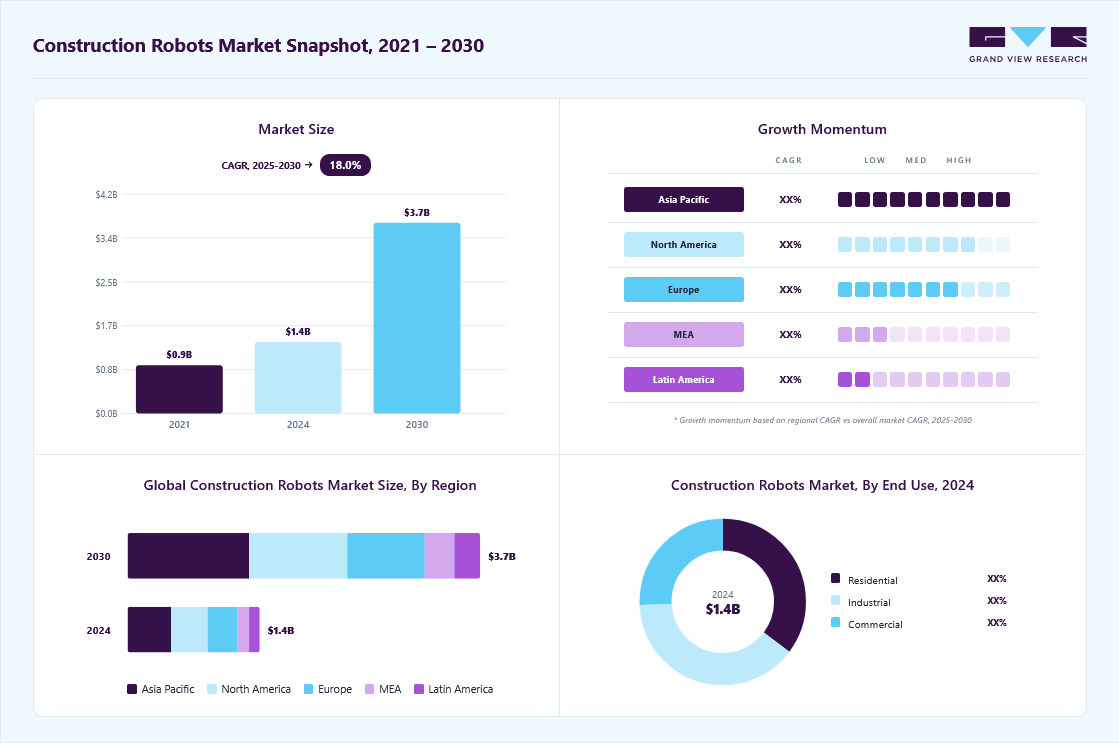 Source: Grand View Research, IR Documents, Primary Interviews, Paid DatabasesTo learn more about this report,
 Download Free Sample Report
 Key Market Trends & Insights
- By function: Material handling segment dominated the market, with a revenue share of 33.2% in 2025.
- By type: Robotic arm segment held the largest market share of 69.3% in 2025.
- By end use: Industrial segment held the largest revenue share in 2025.
Regional Highlights
- Largest regional market: North America (31.6% revenue share, 2025)
- Fastest-growing regional market: Asia Pacific (highest CAGR, 2026-2033)
- By country: The U.S. held the largest market share in 2025.
Market Size & Forecast
- Market size in 2025: USD 1.6 Billion
- Estimated market size in 2026: USD 1.8 Billion
- Projected market size by 2033: USD 6.1 Billion
- CAGR (2026-2033): 19.0%
Three ways to get this report
Buy it, customize it, or ask a question.Ask an Analyst
Analyst response in 1 business day
- AccessReport author, directly
- Reply timeWithin 1 working day
- No sales callDirect answer only
- FormatEmail reply
- CostFree, no cost
Get the Full Report
What the study covers
- FormatsPDF · Excel · Dashboard
- Timeline2026–2033 annual, 2025 base
- Coverage20+ countries, 5 regions
- Companies10+ key players profiled
Customize the Report
20% free customization
- IncludeCountries, segments, points
- TailorTo your product definition
- ExtendDeeper competitor detail
- OrA fully bespoke study
- Turnaround5–10 working days
Global demand for construction robots is expected to increase as more construction firms undertake automation initiatives and increase funding toward modernizing their construction activities. The increasing need for advanced infrastructure, coupled with the ever-increasing population, is expected to drive demand for automated construction solutions. According to a report by Autodesk Inc., around 13,000 buildings need to be constructed daily by 2050 to accommodate the increasing population. The reason for the shift toward construction robots is smart agility, convenience, and cost-effectiveness. The growing emphasis of construction firms on reducing resource wastage and overall costs is expected to drive the construction robot industry. In addition, emphasis on reducing the turnaround time of construction projects is motivating market players to launch new and innovative products with increased efficiency and speed.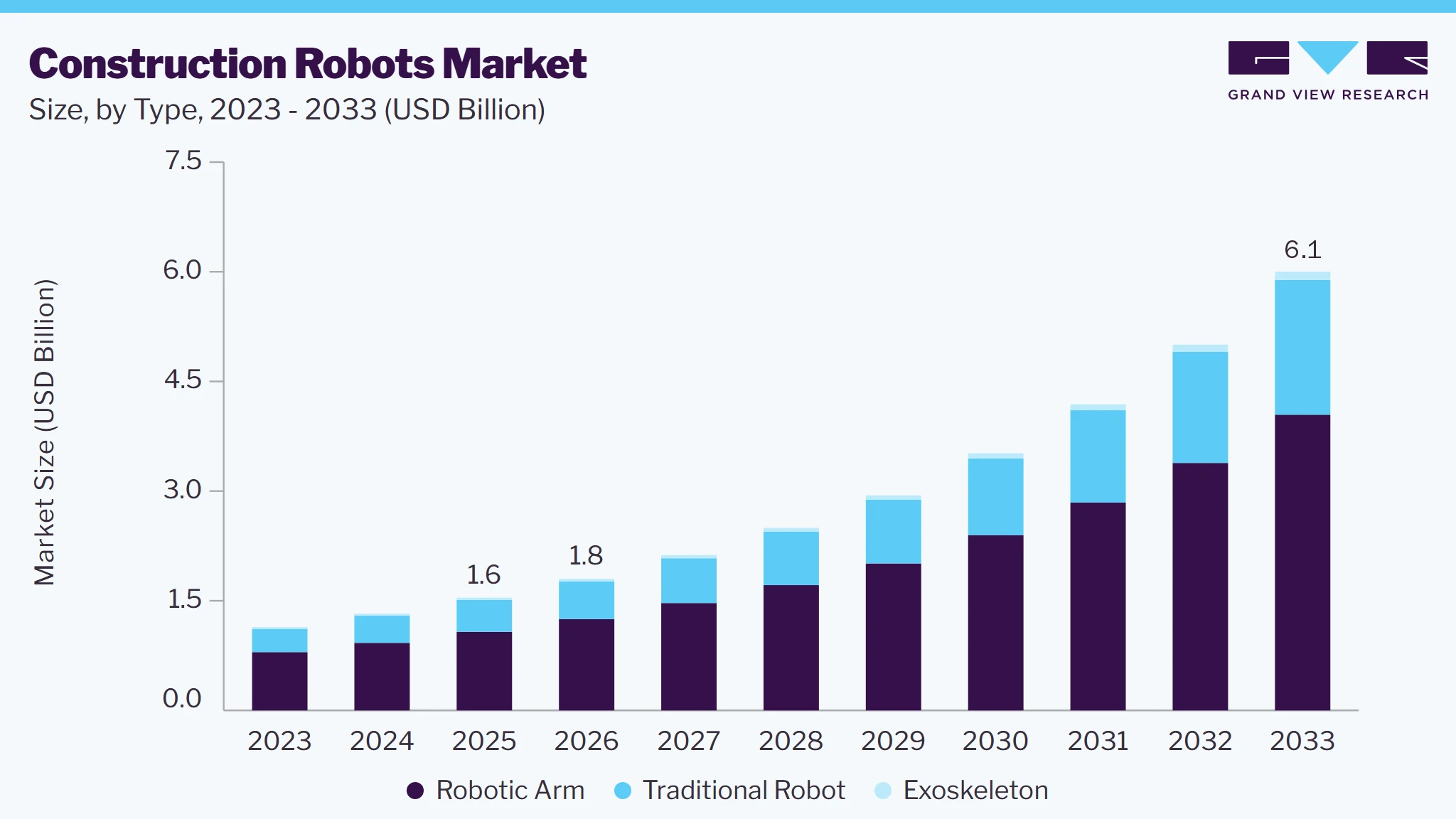 To learn more about this report, Download Free Sample Report
 For instance, in April 2022, PrintStones, a manufacturer of mobile 3D printing construction robots, announced the launch of Baubot, a mobile robot for 3D printing and on-site construction. Printstones also released a specialized software development kit (SDK) for use with the Baubot to make construction sites efficient and safer for laborers. Customers can customize their robots with new applications and tools as they see fit, resulting in a truly adaptable product suitable for any manufacturing site.
Labor shortages in the construction industry, driven by an aging workforce and declining interest in trade professions, are pushing companies to adopt robotic solutions to maintain productivity. Construction robots can perform repetitive and hazardous tasks, reducing reliance on manual labor while improving operational efficiency. In addition, these robots enhance workplace safety by minimizing human exposure to dangerous environments, leading to fewer accidents and compliance with stricter safety regulations. This dual benefit of addressing workforce gaps and prioritizing safety is significantly fueling the growth of the global construction robot industry.
Technological advancements in AI and robotics are transforming the global construction robot industry by enabling machines to perform complex tasks with greater precision and autonomy. AI-driven systems allow robots to adapt to real-time conditions, enhancing efficiency in activities such as material handling, precision assembly, and on-site problem-solving. These innovations reduce errors, speed up project timelines, and optimize resource utilization, addressing key challenges in the construction industry. As a result, these advancements are accelerating the adoption of robotics and reshaping traditional construction processes.
Market Dynamics
Rapid advancements in robotics, artificial intelligence, machine vision, sensor technologies, digital twins, autonomous navigation, and connectivity solutions are significantly improving the precision, productivity, safety, and operational efficiency of construction robots across residential, commercial, industrial, and infrastructure projects. The integration of real-time monitoring, remote operation capabilities, predictive maintenance, and data-driven project management platforms enables better resource utilization, reduced material wastage, enhanced quality control, and accelerated project execution timelines. However, high upfront capital investments, integration complexities with conventional construction practices, limited interoperability between digital construction ecosystems, regulatory uncertainties, and a shortage of skilled personnel capable of operating and maintaining robotic systems continue to constrain large-scale adoption, particularly among small and mid-sized contractors. Meanwhile, increasing labor shortages, rising construction costs, growing emphasis on worker safety, expanding adoption of prefabrication and modular construction techniques, and the accelerating digitalization of the construction sector under Industry 4.0 initiatives are creating significant opportunities for manufacturers to develop autonomous, cost-effective, and scalable robotic solutions tailored for tasks such as bricklaying, concrete printing, demolition, material handling, inspection, and site surveying.
The increasing shortage of skilled construction workers and the growing adoption of automation technologies are significantly driving demand for construction robots across residential, commercial, industrial, and infrastructure projects. Modern construction robots equipped with artificial intelligence, machine vision, autonomous navigation, and precision control systems enable faster project execution, improved construction accuracy, enhanced worker safety, and reduced reliance on manual labor. These next-generation robotic solutions are increasingly being deployed for applications such as bricklaying, concrete printing, material handling, demolition, welding, inspection, and site surveying, making them critical components of digitally enabled construction sites.
The market is also witnessing growing integration of digital construction technologies, including Building Information Modeling (BIM), digital twins, cloud-based project management platforms, and Industrial IoT solutions. AI-enabled monitoring systems facilitate real-time progress tracking, predictive maintenance, equipment utilization analysis, and remote operation capabilities, helping contractors minimize project delays, optimize resource allocation, and improve overall productivity. Additionally, the increasing adoption of prefabrication and modular construction methods, coupled with stringent workplace safety regulations and rising labor costs, is accelerating investments in autonomous, intelligent, and scalable construction robotic systems designed to support next-generation construction practices.
The deployment of construction robots requires substantial capital investment in robotic equipment, software platforms, sensors, autonomous navigation systems, artificial intelligence capabilities, and supporting digital construction infrastructure. The high upfront costs associated with equipment procurement, customization, installation, training, and maintenance often limit adoption, particularly among small and medium-sized contractors operating in highly competitive and cost-sensitive markets. In addition, companies may need to invest in complementary technologies such as Building Information Modeling (BIM), digital twins, cloud-based project management systems, and communication networks, further increasing the total cost of ownership.
The market also faces challenges related to the integration of robotic systems into conventional construction workflows and project environments. Construction robots must operate seamlessly alongside existing machinery, human workers, and digital construction platforms while adapting to dynamic and unstructured jobsite conditions. Ensuring interoperability between robotic systems, BIM models, site management software, sensors, and autonomous control technologies often requires specialized engineering expertise, extended implementation periods, and additional integration expenditures. Furthermore, resistance to technological change, limited availability of skilled operators, and potential disruptions to established construction processes can hinder large-scale deployment and delay return on investment.
The increasing adoption of prefabrication, modular construction, and industrialized building methods is creating significant opportunities for construction robot manufacturers worldwide. Rising pressure to reduce project timelines, improve construction quality, minimize material wastage, and address labor shortages is encouraging contractors and developers to invest in robotic and automated construction solutions. Construction robots play a critical role in performing repetitive and precision-intensive tasks such as bricklaying, welding, concrete printing, material handling, and component assembly, enabling faster project delivery, higher productivity, and improved cost efficiency. As governments and private developers continue to promote modern construction practices, demand for intelligent robotic systems is expected to accelerate across residential, commercial, and infrastructure projects.
The market is also benefiting from the growing digitalization of the construction industry through the integration of technologies such as Building Information Modeling (BIM), digital twins, artificial intelligence, cloud-based project management platforms, and Industrial IoT solutions. These technologies facilitate real-time project monitoring, autonomous equipment operation, predictive maintenance, and data-driven decision-making, enhancing overall project performance and resource utilization. Additionally, increasing investments in smart cities, sustainable infrastructure development, and advanced manufacturing-inspired construction processes are generating substantial opportunities for manufacturers to develop autonomous, scalable, and energy-efficient construction robot solutions tailored to next-generation construction environments.
Analyst Perspective
The construction robots market is growing rapidly due to increasing labor shortages, rising automation adoption, and greater emphasis on worker safety and productivity. Construction firms are deploying robotic solutions to improve efficiency, precision, and project timelines across residential, commercial, and infrastructure projects. Advancements in robotics, artificial intelligence, machine vision, and autonomous technologies are expanding applications in demolition, bricklaying, material handling, inspection, and concrete printing. The market is further supported by the adoption of BIM, digital twins, and Industrial IoT technologies, which enhance project monitoring and operational efficiency. While high implementation costs and integration challenges remain, ongoing investments in smart infrastructure, modular construction, and digital transformation are expected to drive continued market growth.
Function Insights
Based on function, the material handling segment led the market with the largest revenue share of 33.2% in 2025. The growth of the segment is driven by the need to improve efficiency and safety in transporting heavy and repetitive loads on construction sites. Robotic material handlers reduce labor costs, minimize the risk of workplace injuries, and enhance overall productivity by automating tasks like lifting, moving, and positioning materials. In addition, advancements in AI and sensor technologies enable these robots to navigate complex environments with precision, further boosting their adoption. This focus on streamlining operations and addressing labor shortages is propelling the demand for material-handling construction robots.
The demolition segment is expected to grow at a significant CAGR during the forecast period. The segment is driven by the increasing demand for efficient and safe demolition processes in urban redevelopment and infrastructure projects. Robotic demolition machines offer precise performance, even in confined or hazardous environments, significantly reducing risks to human workers. In addition, these robots can handle heavy workloads, minimize waste, and comply with stringent environmental and safety regulations. This combination of safety, efficiency, and environmental sustainability is fueling the adoption of demolition robots globally.
End-use Insights
Based on end use, the industrial segment led the market with the largest revenue share of 39.6% in 2025. The growth of the segment is driven by the increasing demand for automation in large-scale industrial projects, such as manufacturing facilities, power plants, and warehouses. Construction robots enhance efficiency and precision in activities like site preparation, structural assembly, and maintenance, helping industries meet tight project deadlines and quality standards. In addition, the adoption of robots in industrial construction reduces reliance on manual labor and ensures greater safety in hazardous environments.
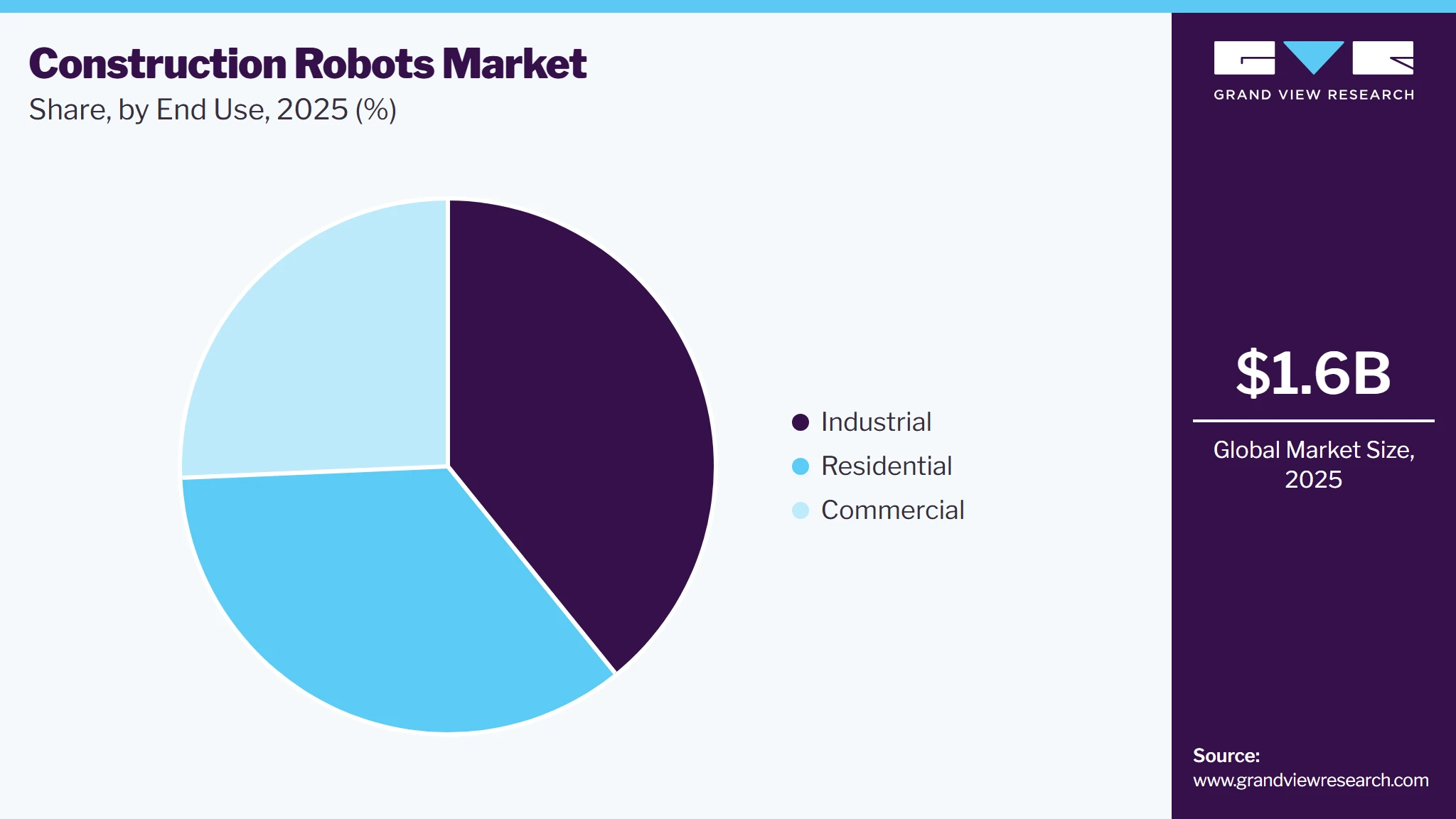 To learn more about this report, Download Free Sample Report
 The residential segment is expected to grow at a significant CAGR from 2025 to 2033. The growth of the segment is driven by the rising demand for efficient, cost-effective, and high-quality housing solutions. Construction robots are increasingly used for tasks such as bricklaying, painting, and 3D printing of housing components, significantly reducing project timelines and labor costs. In addition, the growing focus on sustainability and precision in residential construction aligns with the capabilities of robotic systems. This adoption is further supported by advancements in automation technology, making robotic solutions more accessible for residential construction projects.
Type Insights
Based on type, the robotic arm segment led the market with the largest revenue share of 69.3% in 2025. Construction industry trends such as refined construction, rapid construction, and standardized design have aided in the adoption of innovative technologies. Market players operating in the robotic arm segment have to constantly develop and design new and innovative products to cope with the increasing demand. For instance, in April 2021, PrintStones, an autonomous 3D printing and construction robot provider, announced the launch of a new variant of Baubot. The new robot is an autonomous construction assistant with a robotic arm mounted on top that carries out functions such as security, drywall, 3D printing, painting, welding, and bricklaying.
The traditional robot segment is expected to witness at the fastest CAGR during the forecast period. Increasing awareness of benefits brought about by the adoption of robotic automation in the construction industry has fueled demand for innovative construction robots and products. The traditional robot segment has witnessed significant new innovative products launched by market players to address the evolving needs of the construction industry. For instance, in October 2022, Built Robotics, a provider of construction automation products, announced the launch of its Ecosystems platform in the European market. Exosystems can transform excavators into autonomous robots.
Regional Insights
North America dominated the global construction robots market with the largest revenue share of 31.6% in 2025. The growth of the construction robots industry in North America is driven by the region's advanced adoption of automation technologies and a strong focus on addressing labor shortages in the construction industry. Increased investment in large-scale infrastructure projects, combined with the need to enhance productivity and safety, has spurred demand for robotic solutions. In addition, supportive government initiatives and funding for smart construction technologies further accelerate market growth, making North America a leading hub for construction robotics innovation.
 To learn more about this report, Download Free Sample Report
 U.S. Construction Robots Market Trends
US is the fastest growing country in the construction robots market. The construction robots market in the U.S. is expected to grow at a significant CAGR from 2025 to 2033. The U.S. market is growing due to a surge in urbanization and large-scale infrastructure modernization projects, such as smart cities and green building initiatives. The industry's push to address labor shortages with advanced robotics is further fueled by a strong emphasis on cost efficiency and project timelines. In addition, U.S.-based construction firms' investment in cutting-edge technologies, including AI-powered robots for precision and automation, positions the country as a leader in driving innovation in construction robotics.
Asia Pacific Construction Robots Market Trends
Asia Pacific construction robots market dominated the global market with the largest revenue share of 33.0% in 2024 and is anticipated to grow at the fastest CAGR during the forecast period. The increasing adoption of robotic automation and tools in this region is the major factor driving the growth. The region is likely to witness significant growth owing to the increasing government spending on the construction industry and increasing competition among the market players.
In addition, Asia Pacific has a high population, resulting in the increasing demand for residential and industrial infrastructure, which makes Asia Pacific a promising region. For instance, instance in February 2022, Schindler announced the deployment of its Schindler R.I.S.E robot in the Asia Pacific region. Schindler R.I.S.E is an autonomous, self-climbing robot that is used for installation activities in elevator shafts.
The construction robots market in Japan growth is driven by the country's aging population and labor shortage, which is increasing the demand for automated solutions to maintain productivity in construction. Japan's strong focus on technological innovation and smart city development further fuels the adoption of robotics in construction to ensure high efficiency and precision in projects.
The China construction robots market held a substantial market share in Asia Pacific in 2024, driven by rapid urbanization and large-scale infrastructure projects, which created a significant demand for efficient construction technologies. China's government has been actively promoting the adoption of robotics and automation in construction, aiming to enhance productivity and reduce labor costs.
Europe Construction Robots Market Trends
The construction robots market in Europe is expected to grow at a significant CAGR from 2025 to 2033. The growth of the construction robots industry in Europe is driven by the region's stringent sustainability regulations and increasing adoption of green building practices. Governments and private sectors are investing in automation to meet energy efficiency targets and reduce carbon footprints in construction. In addition, the region's emphasis on modular construction and precision engineering further supports the adoption of advanced robotic technologies.
The UK construction robots market growth is driven by the government's push for modernization in the construction sector through initiatives like the Construction 2025 strategy, which aims to enhance productivity and sustainability. In addition, the UK's focus on high-tech infrastructure projects and sustainable urban development is creating new opportunities for robotic solutions.
The construction robots market in Germany growth is driven by the country’s strong emphasis on innovation and technological leadership in the engineering and construction sectors. Germany’s high standards for quality and precision in construction projects are fostering demand for robotic solutions that enhance efficiency and reduce human error. Furthermore, the country’s push towards sustainable and energy-efficient buildings, supported by government incentives, is encouraging the use of robotics for tasks like material handling and energy-efficient construction. The shortage of skilled labor in the construction sector is also prompting greater reliance on automation to meet project demands.
Key Construction Robots Company Insights
Some of the key companies in the construction robots industry include Construction Robotics, ABB, Advanced Construction Robotics, Inc., Brokk Global, and others. Organizations are focusing on integrating advanced technologies into their offerings to maintain competitive advantages. Therefore, key players are taking several strategic initiatives, such as new product launches, mergers and acquisitions, and partnerships, among others.
-
ABB is a global company in industrial automation and robotics, providing advanced robotic solutions for the construction industry. The company's cutting-edge technology enhances construction efficiency, safety, and precision through automation, contributing significantly to the growth of construction robots in sectors like infrastructure and smart buildings.
-
Advanced Construction Robotics, Inc. specializes in developing innovative robotic systems for the construction industry. Its flagship product, the "Tybot," automates rebar-tying tasks, significantly improving efficiency, safety, and cost-effectiveness on construction sites. The company plays a key role in advancing automation within the global construction robots industry.
Key Construction Robots Companies
The following key companies have been profiled for this study on the construction robots market.
-
Construction Robotics
-
ABB
-
Advanced Construction Robotics, Inc.
-
Brokk Global
-
Ekso Bionics
-
Autonomous Solutions, Inc.
-
MX3D
-
Husqvarna Group
-
FBR Ltd
-
Conjet
Competitive Benchmarking
Operating Strategies
Competitive Edge
Weaknesses
Established Players (ABB, Brokk Global, Husqvarna Group, Ekso Bionics)
- Focus on developing advanced robotic platforms for demolition, material handling, industrial automation, and worker augmentation applications.
- Continuous investment in artificial intelligence, autonomous navigation, machine vision, sensor technologies, exoskeleton systems, and digital construction solutions.
- Expansion of partnerships with contractors, technology providers, and industrial customers to accelerate robotic adoption across construction activities.
- Strong global presence, extensive engineering expertise, established distribution networks, and recognized brand reputation.
- Broad product portfolios, proven technology capabilities, and robust after-sales service and maintenance infrastructure.
- Significant R&D capabilities supporting product innovation, safety enhancements, and scalability across multiple construction applications.
- High research, development, and commercialization costs associated with advanced robotic systems.
- Longer sales cycles due to conservative purchasing behavior within the construction industry and lengthy project approval processes.
- Challenges in adapting robotic solutions to highly variable and unstructured construction site conditions.
Emerging Players (Advanced Construction Robotics, Inc., Autonomous Solutions, Inc., MX3D, FBR Ltd, Conjet)
- Focus on specialized construction robotic solutions, including automated bricklaying, concrete processing, robotic welding, autonomous site operations, and precision demolition technologies.
- Emphasis on modular system architectures, pilot deployments, contractor collaborations, and application-specific innovations to address labor shortages and productivity challenges.
- Greater agility in developing niche technologies and responding to evolving construction automation requirements.
- Faster product development cycles, flexible customization capabilities, and strong innovation pipelines targeting emerging construction applications.
- Limited global footprint, smaller manufacturing capacities, and constrained financial resources relative to established industry participants.
- Dependence on pilot projects and early adopters for commercial validation and market penetration.
Recent Developments
-
In March 2024, ABB Robotics partnered with U.K.-based start-up AUAR to advance robotic micro-factories for building affordable, sustainable timber homes. The collaboration aims to address skills shortages, enhance sustainability, and improve quality by automating construction, with robots playing a critical role in reducing waste and increasing efficiency.
-
In March 2023, Advanced Construction Robotics, Inc. unveiled IronBOT, the world's first rebar lifting, carrying, and placing robot, designed to enhance construction crew efficiency. Paired with TyBOT for rebar tying, this technology can reduce rebar installation time by 50%.
Construction Robots Market Report Scope
Report Attribute
Details
Market size in 2025
USD 1.6 billion
Estimated market size in 2026
USD 1.8 billion
Projected market size by 2033
USD 6.1 billion
Growth rate
CAGR of 19.0% from 2026 to 2033
Base year for estimation
2025
Historical data
2021 - 2024
Forecast period
2026 - 2033
Quantitative units
Revenue in USD million/billion and CAGR from 2026 to 2033
Report coverage
Revenue forecast, company ranking, competitive landscape, growth factors, and trends
Segments covered
Function, type, end-use, region
Regional scope
North America; Europe; Asia Pacific; Latin America; MEA
Country scope
U.S.; Canada; Mexico; U.K.; Germany; France; Italy China; Japan; India; Australia; South Korea; Australia; Brazil; Kingdom of Kingdom of Saudi Arabia (KSA); UAE; South Africa
Key companies profiled
ABB; Advanced Construction Robotics, Inc.; Brokk Global; Ekso Bionics; Autonomous Solutions, Inc.; MX3D; Husqvarna Group; FBR Ltd; Conjet
Customization scope
Free report customization (equivalent up to 8 analysts' working days) with purchase. Addition or alteration to country, regional & segment scope.
Pricing and purchase options
Avail customized purchase options to meet your exact research needs. Explore purchase options
Global Construction Robots Market Report Segmentation
This report forecasts revenue and volume growth at global, regional, and country levels and provides an analysis of the latest industry trends in each of the sub-segments from 2021 to 2033. For this study, Grand View Research has segmented the global construction robots market report based on function, type, end-use, and region.
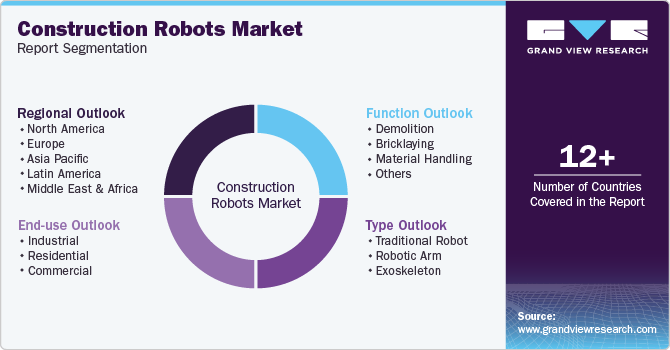 To learn more about this report, Download Free Sample Report
 -
Function Outlook (Volume, Units; Revenue, USD Million, 2021 - 2033)
-
Demolition
-
Bricklaying
-
Material Handling
-
Others
-
-
Type Outlook (Volume, Units; Revenue, USD Million, 2021 - 2033)
-
Traditional Robot
-
Robotic Arm
-
Exoskeleton
-
-
End-use Outlook (Volume, Units; Revenue, USD Million, 2021 - 2033)
-
Industrial
-
Residential
-
Commercial
-
-
Regional Outlook (Volume, Units; Revenue, USD Million, 2021 - 2033)
-
North America
-
U.S.
-
Canada
-
-
Europe
-
Germany
-
UK
-
France
-
Italy
-
-
Asia Pacific
-
China
-
Japan
-
India
-
South Korea
-
Australia
-
-
Latin America
-
Brazil
-
Mexico
-
-
Middle East and Africa
-
KSA
-
UAE
-
South Africa
-
-
Research Methodology
The construction robots market figures in this report are based on a proven research process that combines executive interviews with secondary research from proprietary databases, company filings, and recognized regulatory and institutional sources. Market size is built through value-chain sizing-reconciling supply-side and demand-side estimates-and triangulated with bottom-up and top-down approaches. Every estimate passes multiple levels of expert validation before publication, with each construction robots segment quantified using the revenue-capture definitions in the table below.
Segment Definition
Segment- Function
Revenue Capture Definition
Demolition
This segment captures revenue generated from construction robots designed to perform demolition activities, including concrete breaking, wall dismantling, surface preparation, and hazardous material removal. These robots are widely utilized in renovation projects, industrial plant decommissioning, mining operations, and infrastructure rehabilitation activities where enhanced worker safety, precision, and productivity are required.
Bricklaying
This segment includes revenue derived from construction robots engineered for automated bricklaying, masonry, and block placement applications. These systems are increasingly adopted in residential, commercial, and large-scale construction projects to accelerate building timelines, improve construction accuracy, reduce material wastage, and address shortages of skilled masonry labor.
Material Handling
This segment captures revenue generated from construction robots used for transporting, lifting, positioning, and distributing construction materials across jobsites. Applications include movement of bricks, concrete elements, steel components, tools, and prefabricated modules. These robots enhance site productivity, minimize manual handling, improve safety, and support efficient execution of complex construction projects.
Others
This segment includes revenue generated from construction robots deployed for applications such as concrete 3D printing, welding, inspection, surveying, painting, finishing, rebar tying, site monitoring, and other specialized or emerging construction activities aimed at improving operational efficiency and project quality.
Segment- Type
Revenue Capture Definition
Traditional Robot
This segment captures revenue generated from conventional construction robots designed to perform predefined and repetitive tasks using fixed programming and controlled operating environments. These systems are commonly utilized for demolition, material transportation, inspection, and manufacturing-inspired construction activities where high precision, repeatability, and productivity are essential.
Robotic Arm
This segment includes revenue derived from robotic arms equipped with articulated joints, advanced sensors, machine vision, and precision control systems. These robots are widely deployed for bricklaying, welding, concrete dispensing, material manipulation, assembly, and finishing applications, enabling improved construction accuracy, reduced labor dependency, and enhanced operational flexibility.
Exoskeleton
This segment captures revenue generated from wearable robotic exoskeletons designed to augment worker strength, endurance, and mobility during physically demanding construction activities. These systems are increasingly adopted to reduce worker fatigue, minimize musculoskeletal injuries, enhance safety, and improve productivity in lifting, drilling, overhead work, and repetitive manual operations.
Segment- End use
Revenue Capture Definition
Industrial
This segment captures revenue generated from construction robots deployed in industrial facilities, including manufacturing plants, energy projects, warehouses, processing facilities, and heavy industrial infrastructure developments. These robots support activities such as demolition, material handling, assembly, inspection, and modular construction, helping contractors improve efficiency, safety, and project execution timelines.
Residential
This segment includes revenue derived from construction robots utilized in residential building projects, including single-family homes, multifamily housing developments, and prefabricated housing applications. These systems are increasingly adopted for bricklaying, concrete printing, material transportation, and finishing tasks to accelerate construction schedules, reduce labor costs, and improve build quality.
Commercial
This segment captures revenue generated from construction robots used in commercial construction projects such as office buildings, retail complexes, hotels, hospitals, educational institutions, and mixed-use developments. These robotic solutions facilitate efficient execution of masonry, demolition, inspection, and material handling activities while enhancing worker safety, construction precision, and overall project productivity.
Estimation Model
Layer Name
Key Question
Description
Construction Activity & Project Pipeline Layer
Where are construction robots used and what drives demand?
Establish the total potential demand base by identifying construction robot deployment across residential, commercial, industrial, and infrastructure projects. This includes applications such as demolition, bricklaying, material handling, concrete works, inspection, and modular construction activities where automation can improve productivity, safety, and project efficiency.
Addressable Construction Automation Market Layer
Which construction projects can realistically adopt construction robots solutions?
Refine the total construction activity base into the realistically serviceable market by considering factors such as project size, labor availability, contractor automation readiness, capital investment capacity, digital construction maturity, compatibility with Building Information Modeling (BIM), regulatory requirements, and regional adoption of industrialized and automated construction methods.
Construction Robots Procurement Layer
Who is actively purchasing, expanding, or deploying construction robots systems?
Estimate annual demand generation by analyzing new building construction, infrastructure development programs, renovation and demolition activities, modular and prefabricated construction investments, smart city initiatives, labor shortage mitigation strategies, replacement of conventional equipment, and increasing adoption of robotic technologies by contractors, developers, and construction firms.
Revenue Layer
How is revenue generated from construction robots sales?
Revenue is generated through the sale of construction robots across various functions (demolition, bricklaying, material handling, and other applications), robot types (traditional robots, robotic arms, and exoskeletons), and end-use sectors. Market revenue is calculated by considering unit shipments, system capabilities, autonomy levels, software and AI integration, installation and commissioning services, maintenance contracts, regional pricing variations, and value chain margins across robot manufacturers, technology providers, system integrators, and construction solution providers.
Delivered Customizations
This report has been delivered with the following In-depth customizations
Client Request
Customization Delivered
Value Adds
Construction Robots Market Assessment
Structured evaluation of market dynamics, including key drivers, restraints, opportunities, and industry trends across the construction robots value chain.
Assessment of technology evolution across artificial intelligence, machine vision, autonomous navigation, Building Information Modeling (BIM), digital twins, Industrial IoT, and robotic control systems.
Clear visibility into market growth drivers, adoption challenges, and emerging opportunities.
Strategic input for market entry, expansion planning, and investment decision-making.
End-Use and Application Insights
Analysis of demand distribution across industrial, residential, and commercial construction sectors.
Evaluation of evolving industry requirements related to labor shortages, worker safety, project schedule optimization, prefabrication, modular construction, and digital construction initiatives.
Assessment of key robotic applications, including demolition, bricklaying, material handling, and other specialized construction activities.
Identification of high-growth application areas and end-use segments.
Support for targeted product development, commercialization strategies, and customer prioritization.
Technology and Competitive Landscape Review
Benchmarking of key construction robot technologies, including traditional robots, robotic arms, and exoskeleton systems.
Analysis of major players' innovation strategies, automation capabilities, product differentiation, AI integration, autonomous functionalities, and regional market presence.
Assessment of emerging trends in robotic construction, additive manufacturing, smart jobsites, and human-robot collaboration.
Competitive intelligence for technology positioning and portfolio optimization.
Guidance for R&D prioritization, partnership assessment, and long-term growth planning.
Frequently Asked Questions About This Report
Material handling dominated the function segment with a market share of 33.2% in 2025.
Robotic arm dominated the type segment with a market share of 69.3% in 2025.
Industrial dominated the end use segment with a market share of 39.6% in 2025.
Material handling segment is expected to grow at a compound annual growth rate of 19.5% from 2026 to 2033
The global construction robots market size was estimated at USD 1.6 billion in 2025 and is expected to reach USD 1.8 billion in 2026.
The global construction robots market is expected to grow at a compound annual growth rate of 19.0% from 2026 to 2033 to reach USD 6.1 billion by 2033.
Key factors driving the market growth include increasing awareness regarding the benefits of robots in construction activities, the ever-increasing population, and the increasing number of initiatives undertaken by governments in the construction industry
North America dominated the construction robots market with a market share of 31.6% in 2025. Increasing population, rapid urbanization and industrialization, and increasing adoption of robotic automation are some of the factors contributing to regional market growth.
Some key players operating in the construction robots market include Construction Robots, ABB, Advanced Construction Robots, BROKK GLOBAL, Esko Bionics, Autonomous Solutions Inc., MX3D, Husqvarna AB, FBR Ltd., and Conjet
About the Author(s)
Automotive & Transportation Research Team
Technology · Automotive & TransportationThis report was authored by the automotive & transportation research team at Grand View Research - comprising two research analysts, one senior research analyst, and one industry expert - with specialized expertise in the automotive & transportation segment of the technology industry. All findings are based on proprietary technology databases, executive interviews, and regulatory analysis, subject to internal peer review prior to publication.
Last Updated:
Speak to Analyst

Customize this report to your needs - add regions, segments, or data points, with 20% free customization.
Or view our licence options:


ISO 9001:2015 & 27001:2022 Certified
We are GDPR and CCPA compliant! Your transaction & personal information is safe and secure. For more details, please read our privacy policy.


