
- Home
- »
- Advanced Interior Materials
- »
-
Container Glass Market Size And Share Report, 2026-2033GVR Report cover

Container Glass Market (2026 - 2033)
Size, Share & Trends Analysis Report, By Product (Bottles, Jars), By End Use (Pharmaceutical Industry, Cosmetics & Personal Care Industry), By Region, And Segment Forecasts
Market Size, 2025
$70.0BMarket Estimate, 2026
$73.2BMarket Forecast, 2033
$109.9BCAGR, 2026–2033
6.0%Container Glass Market Summary
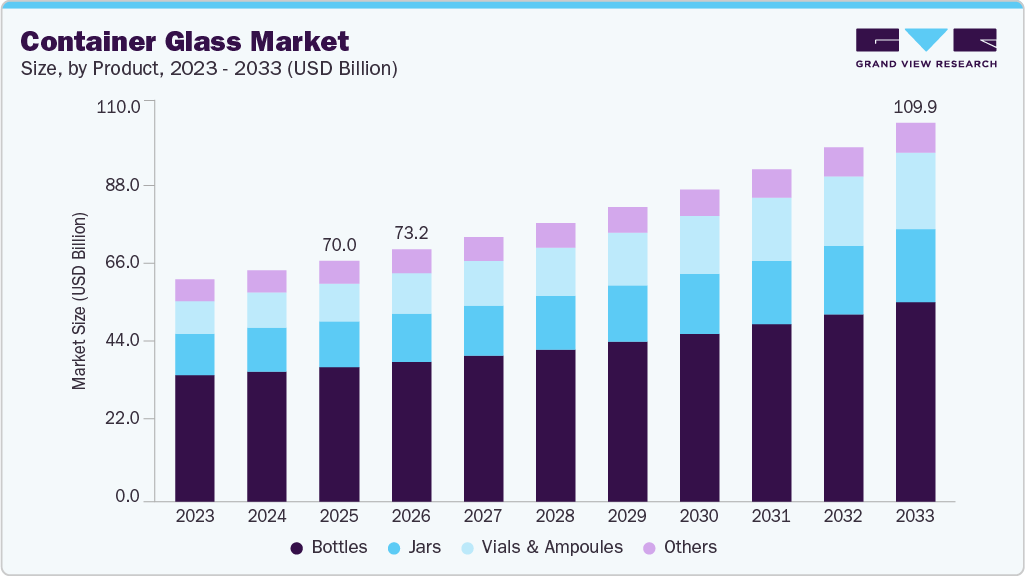
The global container glass market size was valued at USD 70.0 billion in 2025 and is projected to grow from USD 73.2 billion in 2026 to USD 109.9 billion by 2033, at a CAGR of 6.0% from 2026 to 2033. The market in Asia Pacific dominated with a revenue share of 33.5% in 2025. The growth of the market is primarily driven by the increasing global shift toward sustainable and environmentally friendly packaging solutions.
 Source: Grand View Research, IR Documents, Primary Interviews, Paid DatabasesTo learn more about this report,
 Download Free Sample Report
 Key Market Trends & Insights
- By product: Bottles segment held the largest market share of 55.0% in 2025.
- By end use: Food & beverage industry segment held the largest market share of 56.0% in 2025.
Regional Highlights
- Largest regional market: Asia Pacific (33.5% revenue share, 2025)
- By country: Japan held the largest market share in 2025
Market Size & Forecast
- Market size in 2025: USD 70.0 Billion
- Estimated market size in 2026: USD 73.2 Billion
- Projected market size by 2033: USD 109.9 Billion
- CAGR (2026-2033): 6.0%
Three ways to get this report
Buy it, customize it, or ask a question.Ask an Analyst
Analyst response in 1 business day
- AccessReport author, directly
- Reply timeWithin 1 working day
- No sales callDirect answer only
- FormatEmail reply
- CostFree, no cost
Get the Full Report
What the study covers
- FormatsPDF · Excel · Dashboard
- Timeline2026–2033 annual, 2025 base
- Coverage20+ countries, 5 regions
- Companies10+ key players profiled
Customize the Report
20% free customization
- IncludeCountries, segments, points
- TailorTo your product definition
- ExtendDeeper competitor detail
- OrA fully bespoke study
- Turnaround5–10 working days
Glass is 100% recyclable, non-toxic, and can be reused without loss of quality, making it highly attractive in a regulatory environment that is increasingly restricting single-use plastics. Governments across regions are implementing strict waste reduction policies, while consumers are becoming more environmentally conscious, accelerating the transition from plastic to glass packaging. This sustainability advantage has positioned container glass as a preferred material across multiple industries.Glass bottles and jars are widely used for alcoholic beverages, soft drinks, dairy products, and processed foods due to their ability to preserve flavor, extend shelf life, and maintain product purity. Rising consumption of packaged foods and beverages, especially in emerging economies, continues to create substantial demand for glass containers, with notable growth observed across the Japan container glass market and the Germany glass container market. The premium perception of glass packaging in beverages such as wine, spirits, and craft drinks further strengthens its market growth.
 To learn more about this report, Download Free Sample Report
 The expansion of the pharmaceutical and healthcare sectors is also contributing significantly to market growth. Glass is chemically inert and provides superior barrier properties, making it ideal for storing medicines, vaccines, and injectable drugs. The increasing production of biologics, vaccines, and specialty drugs has led to a surge in demand for vials, ampoules, and other medical glass containers, thereby supporting the laboratory glass container market. This trend has been particularly noticeable after the global emphasis on healthcare infrastructure and drug safety, which requires reliable and contamination-free packaging solutions.
Rising disposable incomes, urbanization, and changing consumer lifestyles, particularly in developing regions such as the Asia Pacific and India, are further fueling market expansion. As consumers shift toward branded and packaged products, the demand for high-quality and visually appealing packaging increases, driving segments such as the home glass food container market and advancements in the container glass coating market. Glass packaging aligns well with this trend due to its premium appearance and ability to enhance brand value. In addition, policy support against plastic usage in countries like India is directly boosting container glass consumption, with parallel demand momentum also visible in the U.S. container glass market.
Drivers, Opportunities & Restraints
The container glass market is primarily driven by the rising demand for sustainable and recyclable packaging solutions across industries. Glass offers a high recycling rate, chemical stability, and the ability to preserve product integrity, making it highly preferred in food, beverage, and pharmaceutical applications. Increasing consumption of packaged food and premium beverages, along with regulatory pressure to reduce plastic usage, continues to accelerate the adoption of glass containers.
Significant opportunities exist in emerging economies and in the premiumization trend across consumer goods. Rapid urbanization, increasing disposable incomes, and changing lifestyles in regions such as the Asia Pacific and Latin America are driving demand for packaged and branded products, which often rely on glass packaging for quality perception. There is also strong growth potential in lightweight and innovative glass manufacturing technologies that reduce production costs and transportation expenses.
Despite these positive trends, the market faces certain restraints that may hinder its growth. High energy consumption and production costs associated with glass manufacturing remain key challenges, especially in regions with volatile energy prices. Glass is also heavier and more fragile compared to alternative materials such as plastic and metal, which can increase logistics costs and risk of breakage during transportation.
Product Insights
Bottles held the largest market revenue share of over 55.0% in 2025. Bottles are primarily driven by the strong and sustained demand from the food and beverage industry, particularly alcoholic beverages, soft drinks, and packaged foods, where glass bottles are preferred for their ability to preserve taste, quality, and carbonation. In addition, the premiumization trend across beverages, cosmetics, and specialty foods is boosting the adoption of glass bottles due to their superior aesthetics and brand value enhancement.
The vials and ampoules segment is primarily driven by the rapid expansion of the pharmaceutical and biotechnology industries, particularly due to increasing demand for injectable drugs, vaccines, and biologics. Glass remains the material of choice for these applications because of its superior chemical inertness, high resistance to contamination, and ability to maintain drug stability, especially for sensitive formulations. The growth of global immunization programs, rising prevalence of chronic diseases, and increasing investment in healthcare infrastructure are significantly boosting demand for sterile packaging formats such as vials and ampoules.
End Use Insights
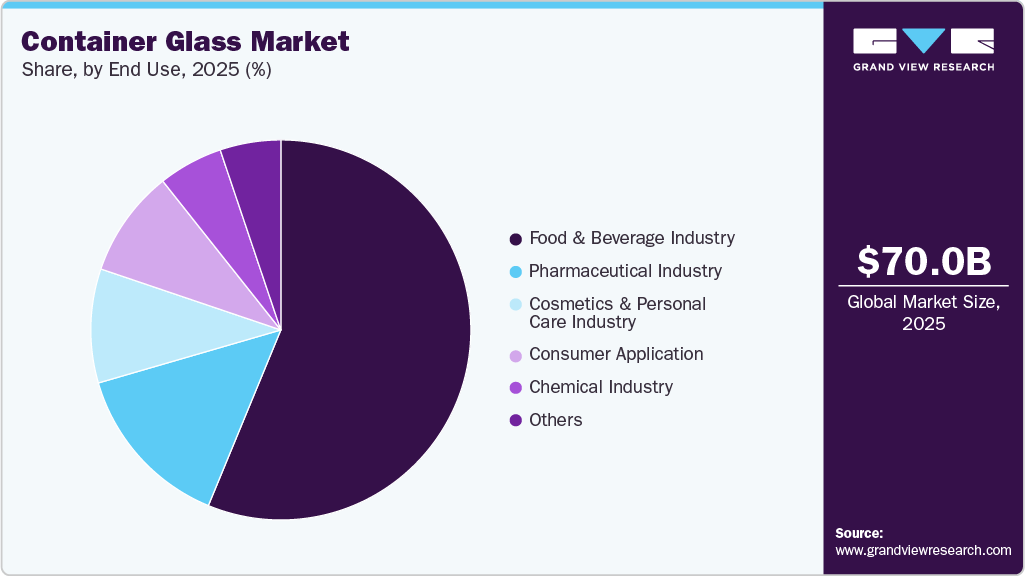
Food & beverage industry held the revenue share of over 56.0% in 2025. The food and beverage segment is supported by the rising global consumption of packaged foods, alcoholic beverages, carbonated drinks, and premium non-alcoholic products. Glass packaging is widely preferred in this segment due to its non-reactive nature, which helps preserve flavor, aroma, and product integrity without any risk of contamination.
 To learn more about this report, Download Free Sample Report
 The pharmaceutical industry is anticipated to register the fastest CAGR, fueled by the increasing demand for safe, sterile, and chemically stable packaging solutions for drugs, vaccines, and biologics. Glass is highly preferred due to its excellent barrier properties, non-reactive nature, and ability to maintain the integrity and efficacy of sensitive formulations over extended periods. The rising prevalence of chronic diseases, growing global vaccination programs, and expanding biologics and injectable drug pipelines are significantly boosting demand for glass containers such as vials, ampoules, and bottles.
Regional Insights
Asia Pacific Container Glass Market Trends
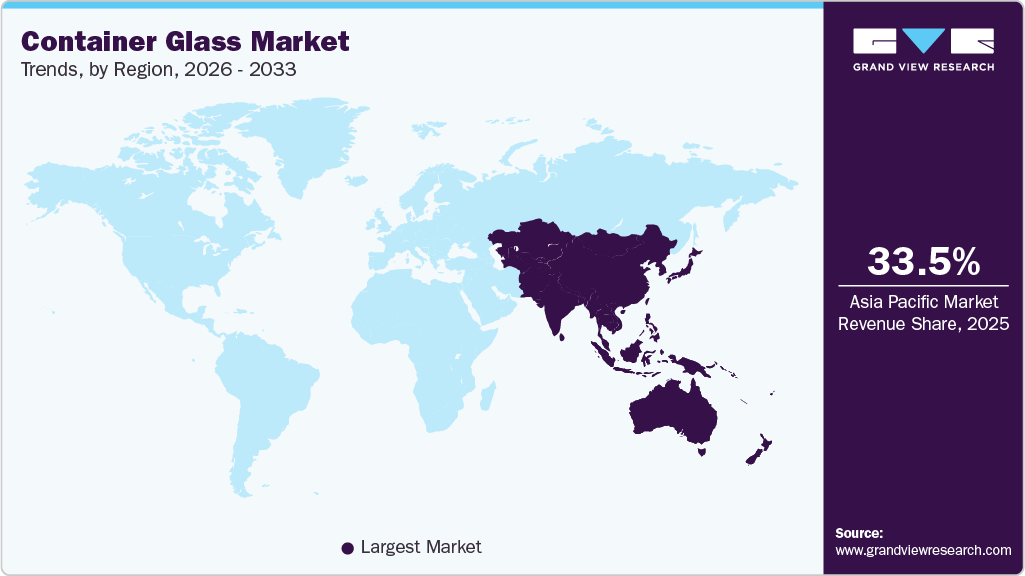
Asia Pacific accounted for the largest market revenue share of 33.5% in 2025. The Asia Pacific container glass market is primarily driven by rapid urbanization, rising disposable incomes, and shifting consumer preferences toward premium and sustainable packaging solutions. As consumers increasingly associate glass with purity, safety, and high product quality, demand has surged across beverages, food, and cosmetics sectors. The strong expansion of the food and beverage industry, particularly alcoholic beverages, dairy products, and premium packaged goods, has significantly boosted the adoption of glass containers due to their ability to preserve taste and prevent contamination.
 To learn more about this report, Download Free Sample Report
 China Container Glass Market Trends
China’s container glass market is mature yet steadily evolving, supported by strong demand from the food and beverage, pharmaceuticals, and cosmetics industries. Growth is driven by increasing consumption of packaged products, rising preference for sustainable and recyclable packaging, and premiumization trends in sectors such as alcoholic beverages and personal care. The market is highly competitive, with a mix of large domestic manufacturers and regional players, while ongoing consolidation and technological upgrades are improving efficiency and product quality. Overall, China remains a key contributor to global container glass demand, supported by its large consumer base and expanding manufacturing ecosystem.
Japan Container Glass Market Trends
The Japan container glass market continues to demonstrate a dominant position within the Asia Pacific region, supported by its advanced manufacturing ecosystem and strong emphasis on high-quality, sustainable packaging solutions. Demand is primarily driven by premium beverages, pharmaceuticals, and processed food segments, where glass remains a preferred material due to its inert and recyclable properties. Additionally, the expansion of the container glass coating market in Japan is enhancing product durability and efficiency across supply chains, further strengthening its competitive advantage. The country’s focus on circular economy practices and high recycling rates continues to reinforce the long-term market.
North America Container Glass Market Trends
The North America market is driven by strong demand from the food and beverage industry, particularly alcoholic beverages such as beer, wine, and premium spirits. The region has a well-established culture of craft beverages and premium packaging, where glass is preferred for its ability to preserve flavor, maintain product integrity, and enhance brand appeal. Beverage producers alone account for a significant share of container glass consumption, supported by rising demand for premium, artisanal, and ready-to-drink products.
Consumers in the U.S. are increasingly favoring glass due to its recyclability, non-toxic nature, and ability to maintain product purity, which is boosting its adoption across multiple industries. Regulatory pressure to reduce plastic waste and corporate sustainability commitments are further supporting this shift. In addition, the expansion of the pharmaceutical sector is significantly contributing to demand for glass containers such as vials and ampoules, owing to their chemical inertness and safety. Technological advancements, including lightweight glass and improved manufacturing processes, are enhancing cost efficiency and logistics, thereby strengthening overall market growth in the country.
U.S. Container Glass Market Trends
The U.S. container glass market is experiencing steady growth, driven by robust demand from the beverage and food packaging sectors, particularly in premium alcoholic drinks and ready-to-eat products. The increasing adoption of glass in the Home Glass Food Container Market reflects shifting consumer preferences toward safe, reusable, and environmentally friendly packaging solutions. Moreover, growth in pharmaceutical and research activities is supporting the Laboratory Glass Container Market, further diversifying demand across end-use industries. Sustainability initiatives, including higher recycled content usage and energy-efficient production processes, continue to shape the market landscape in the U.S.
Europe Container Glass Market Trends
The European market is primarily driven by strong regulatory support for sustainable and circular packaging solutions. The European Union has implemented stringent policies such as the Packaging and Packaging Waste Regulation, which is accelerating the shift toward recyclable materials like glass. With recycling rates exceeding 80% across the region, glass is widely preferred due to its ability to be recycled indefinitely without loss of quality. This well-established recycling infrastructure, combined with growing environmental awareness among consumers and businesses, is significantly boosting demand for container glass across industries.
Latin America Container Glass Market Trends
The Latin America market is primarily driven by the rapid expansion of the food and beverage industry, particularly alcoholic beverages such as beer, wine, and spirits. Glass remains the preferred packaging material due to its superior ability to preserve taste, quality, and product integrity, which is critical for beverage manufacturers. Rising consumption of packaged drinks, supported by urbanization and changing lifestyles, is significantly boosting demand for glass containers across the region.
Key Container Glass Company Insights
Some of the key players operating in the market include Amcor plc., Ardagh Group, and others
-
Amcor plc is a global company in packaging solutions, headquartered in Switzerland and operating across more than 30 countries. The company has a long history dating back to the late 19th century. It has evolved into a major player in flexible and rigid packaging for industries such as food, beverages, pharmaceuticals, healthcare, and personal care. Amcor focuses heavily on innovation, sustainability, and global scale, enabling it to serve multinational brands with advanced packaging technologies and solutions tailored to changing consumer and regulatory demands.
-
Ardagh Group is a Luxembourg-based global metal packaging solutions company, recognized as one of the leading manufacturers in the container glass industry. Founded in 1932, the company has expanded significantly through acquisitions and now operates dozens of production facilities across Europe, the Americas, and Africa. Ardagh focuses on delivering high-quality, sustainable packaging to major global brands, supported by strong capabilities in design, manufacturing, and innovation. The company emphasizes circular economy principles, with glass being a core material due to its infinite recyclability and premium appeal.
Key Container Glass Companies:
The following key companies have been profiled for this study on the container glass market.
- Amcor plc
- Ardagh Group
- Borosil
- Corning Incorporated
- Gerresheimer AG
- O-I Glass, Inc.
- Piramal Glass Private Limited
- Schott AG
- Stevanato Group
- Vitro
Recent Development
-
In April 2026, Amcor announced the launch of its next-generation Apex jars featuring Elevate technology from Evansville, Ind., designed to help pasta sauce brands reduce costs and improve performance over traditional glass jars. These clear, lightweight PET jars with metal lug closures offer greater stability for hot-fill processes up to 205°F, resisting deformation from temperature fluctuations, while being compatible with existing production lines to minimize downtime and breakage.
Container Glass Market Report Scope
Report Attribute
Details
Market size in 2025
USD 70.0 billion
Estimated market size in 2026
USD 73.2 billion
Projected market size by 2033
USD 109.9 billion
Growth rate
CAGR of 6.0% from 2026 to 2033
Base year for estimation
2025
Historical data
2021 - 2024
Forecast period
2026 - 2033
Quantitative units
Revenue in USD million/billion, and CAGR from 2026 to 2033
Report coverage
Revenue & volume forecast, competitive landscape, growth factors, and trends
Segments covered
Product, end use, region
Regional scope
North America; Europe; Asia Pacific; Latin America; Middle East & Africa
Country scope
U.S.; Canada; Mexico; Germany; UK; France; China; India; Japan; Brazil
Key companies profiled
Ardagh Group; Gerresheimer AG; Borosil; Schott AG; Stevanato Group; Piramal Glass Private Limited; Corning Incorporated; O-I Glass, Inc.; Vitro; Amcor plc
Customization scope
Free report customization (equivalent up to 8 analysts working days) with purchase. Addition or alteration to country, regional & segment scope.
Pricing and purchase options
Avail customized purchase options to meet your exact research needs. Explore purchase options
Global Container Glass Market Report Segmentation
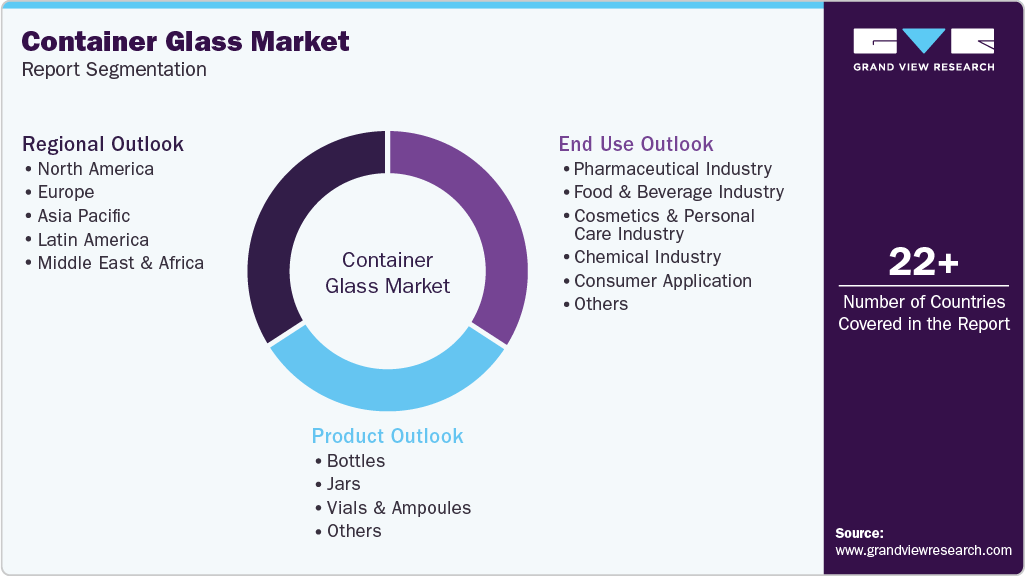
This report forecasts revenue and volume growth at global, regional, and country levels and provides an analysis of the latest industry trends in each of the sub-segments from 2021 to 2033. For this study, Grand View Research has segmented the global container glass market report on the basis of end use, product, and region.
 To learn more about this report, Download Free Sample Report
 -
Product Outlook (Revenue, USD Million, 2021 - 2033)
-
Bottles
-
Jars
-
Vials & Ampoules
-
Others
-
-
End Use Outlook (Revenue, USD Million, 2021 - 2033)
-
Pharmaceutical Industry
-
Food & Beverage Industry
-
Cosmetics & Personal Care Industry
-
Chemical Industry
-
Consumer Application
-
Others
-
-
Regional Outlook (Revenue, USD Million, 2021 - 2033)
-
North America
-
U.S.
-
Canada
-
Mexico
-
-
Europe
-
Germany
-
UK
-
France
-
-
Asia Pacific
-
China
-
India
-
Japan
-
-
Latin America
-
Brazil
-
-
Middle East & Africa
-
Frequently Asked Questions About This Report
The bottles segment led with a 55.0% revenue share in 2025, while the vials and ampoules segment is the fastest-growing.
The food & beverage industry segment led with a 56.0% revenue share in 2025, while the pharmaceutical industry segment is the fastest-growing.
The global container glass market size was valued at USD 70.0 billion in 2025 and is estimated at USD 73.2 billion for 2026.
The global container glass market is expected to grow at a CAGR of 6.0% from 2026 to 2033, reaching USD 109.9 billion by 2033.
Asia Pacific dominated with a 33.5% revenue share in 2025.
Key players include Ardagh Group; Gerresheimer AG; Borosil; Schott AG; Stevanato Group; Piramal Glass Private Limited; Corning Incorporated; O-I Glass, Inc.; Vitro; Amcor plc
The key factor driving the growth of the global container glass market is the rising demand for sustainable and recyclable packaging solutions across food, beverage, and pharmaceutical industries.
About the Author(s)
Advanced Interior Materials Research Team
Advanced Materials · Advanced Interior MaterialsThis report was authored by the advanced interior materials research team at Grand View Research - comprising two research analysts, one senior research analyst, and one industry expert - with specialized expertise in the advanced interior materials segment of the advanced materials industry. All findings are based on proprietary advanced materials databases, executive interviews, and regulatory analysis, subject to internal peer review prior to publication.
Last Updated:
Speak to Analyst

Customize this report to your needs - add regions, segments, or data points, with 20% free customization.
Or view our licence options:


ISO 9001:2015 & 27001:2022 Certified
We are GDPR and CCPA compliant! Your transaction & personal information is safe and secure. For more details, please read our privacy policy.


