
- Home
- »
- Communications Infrastructure
- »
-
Crowdsourced Testing Market Size Report, 2026-2033GVR Report cover

Crowdsourced Testing Market (2026 - 2033)
Size, Share & Trends Analysis Report by Component (Platform, Services), By Testing Type (Usability Testing, Functional Testing), By Application, By Organization Size, By Industry (BFSI, Retail), By Region, And Segment Forecasts
Market Size, 2025
$3.5BMarket Estimate, 2026
$3.9BMarket Forecast, 2033
$9.4BCAGR, 2026–2033
13.3%Crowdsourced Testing Market Summary
The global crowdsourced testing market size was valued at USD 3.5 billion in 2025 and is projected to grow from USD 3.9 billion in 2026 to USD 9.4 billion by 2033, growing at a CAGR of 13.3% from 2026 to 2033. North America dominated the crowdsourced testing market with the largest revenue share of 31.3% in 2025. The global crowdsourced testing market is growing as organizations increase adoption of agile and DevOps development practices.
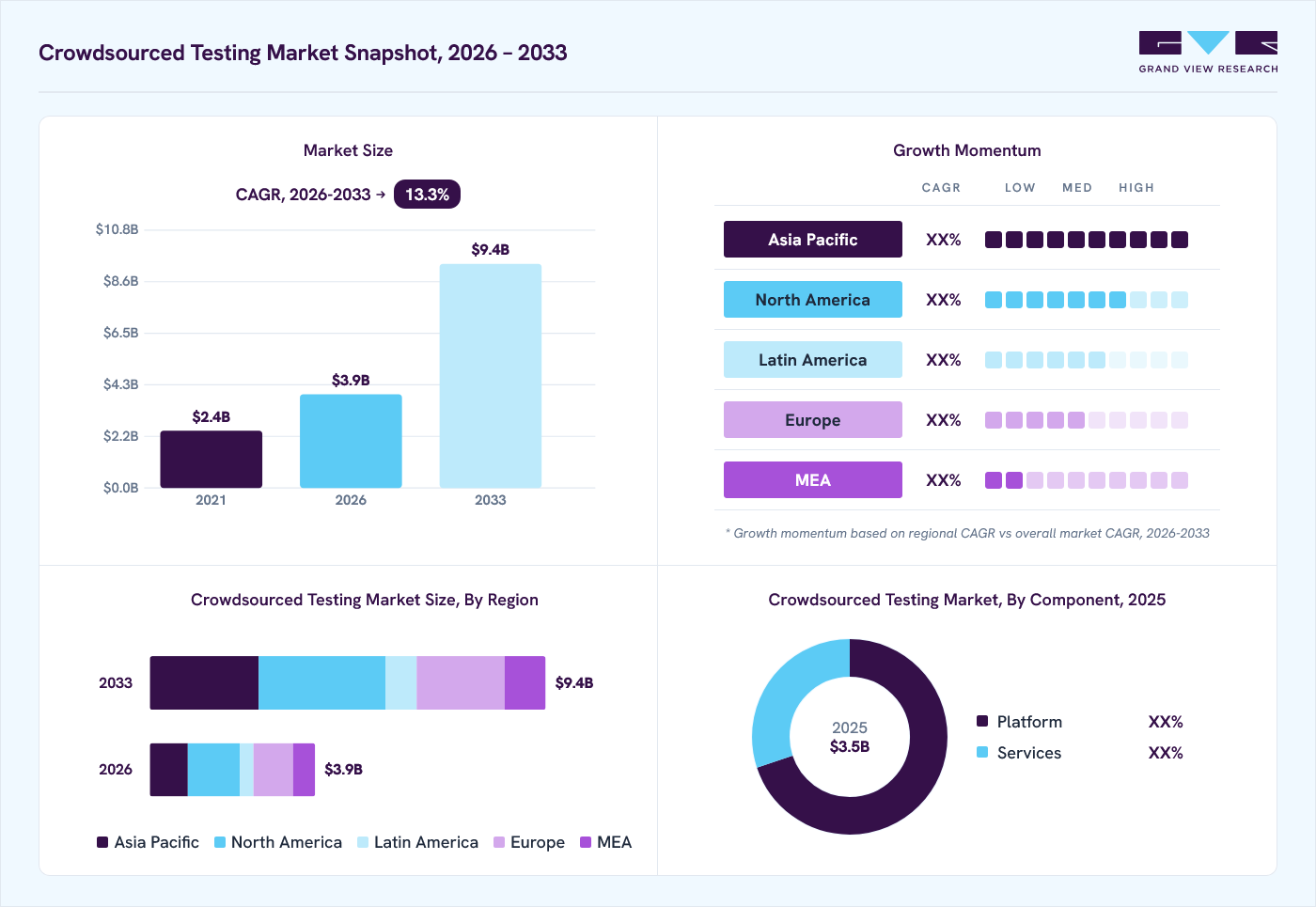 Source: Grand View Research, IR Documents, Primary Interviews, Paid DatabasesTo learn more about this report,
 Download Free Sample Report
 Key Market Trends & Insights
- By component: Platform segment dominated the market, with a revenue share of 69.9% in 2025.
- By application: Mobile applications segment held the largest market share of 42.5% in 2025.
- By organization size: Large Size Enterprises segment held the largest market share of 62.0% in 2025.
- By industry: BFSI segment held the largest market share of 22.6% in 2025.
Regional Highlights
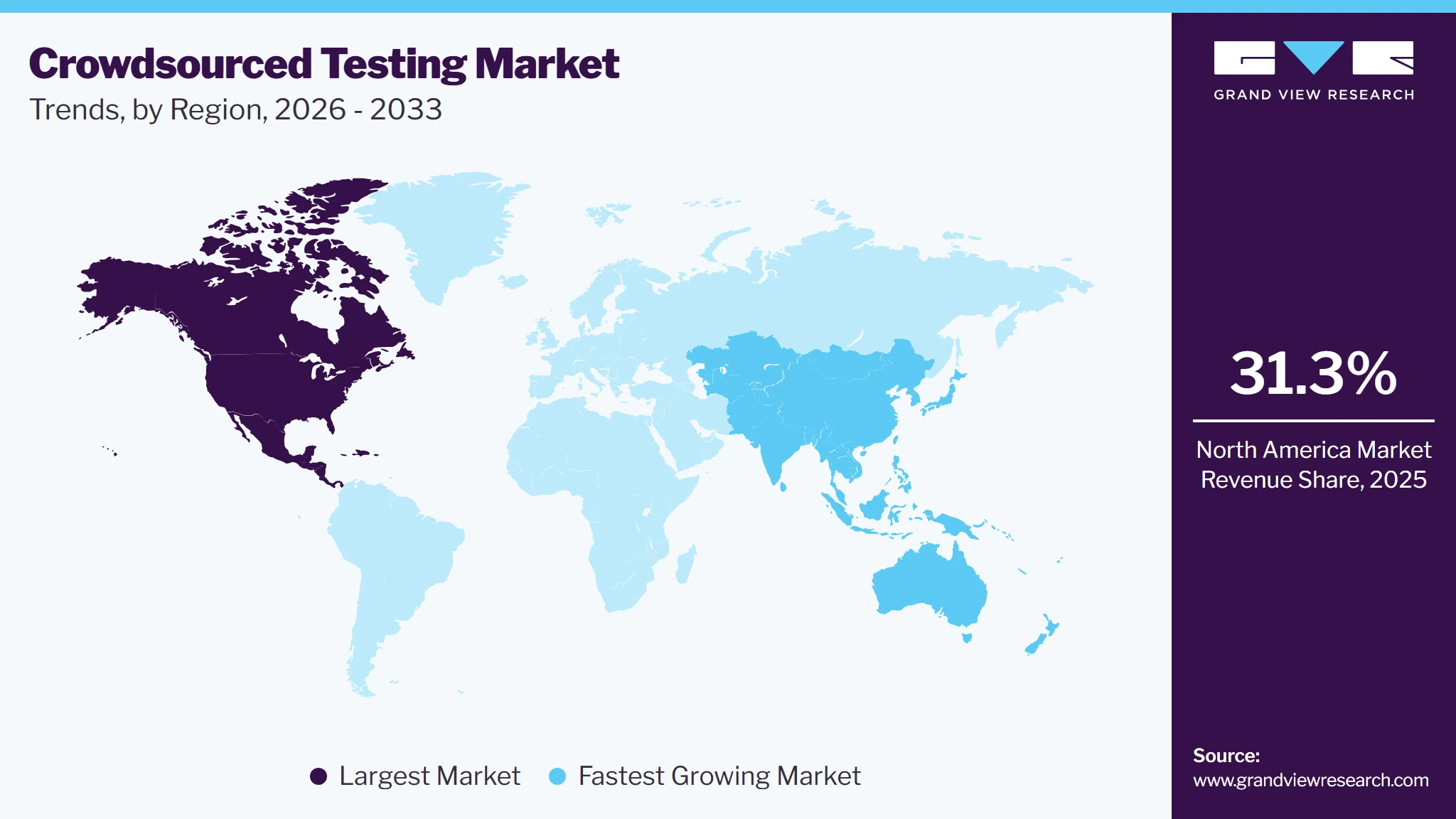
- Largest regional market: North America (31.3% revenue share, 2025)
- Fastest-growing regional market: Asia Pacific (highest CAGR, 2026-2033)
- By country: The U.S. held the largest market share in 2025.
Market Size & Forecast
- Market size in 2025: USD 3.5 billion
- Estimated market size in 2026: USD 3.9 billion
- Projected market size by 2033: USD 9.4 billion
- CAGR (2026-2033): 13.3%
Three ways to get this report
Buy it, customize it, or ask a question.Ask an Analyst
A direct answer, usually in 1 working day
- AccessReport author, directly
- Reply timeWithin 1 working day
- No sales callDirect answer only
- FormatEmail reply
- CostFree, no cost
Get the Full Report
What the study covers
- FormatsPDF · Excel · Dashboard
- Timeline2026–2033 annual, 2025 base
- Coverage20+ countries, 5 regions
- Companies10+ key players profiled
Customize the Report
20% free customization
- IncludeCountries, segments, points
- TailorTo your product definition
- ExtendDeeper competitor detail
- OrA fully bespoke study
- Turnaround5–10 working days
The increasing need for cost-effective and flexible Quality Assurance (QA) practices drives the growth of the crowdsourced testing market. This shift is driving demand for faster and continuous testing cycles to support frequent software releases. Crowdsourced testing is a software testing type that uses testers available throughout the day and in different locations. It has a better possibility of finding a bug as there are many testers, and the tests are conducted under various conditions, such as connectivity, user locations, and devices. Crowdsourced testing offers benefits such as lower test costs and is a customer-centric testing method as the testing is done by actual users worldwide.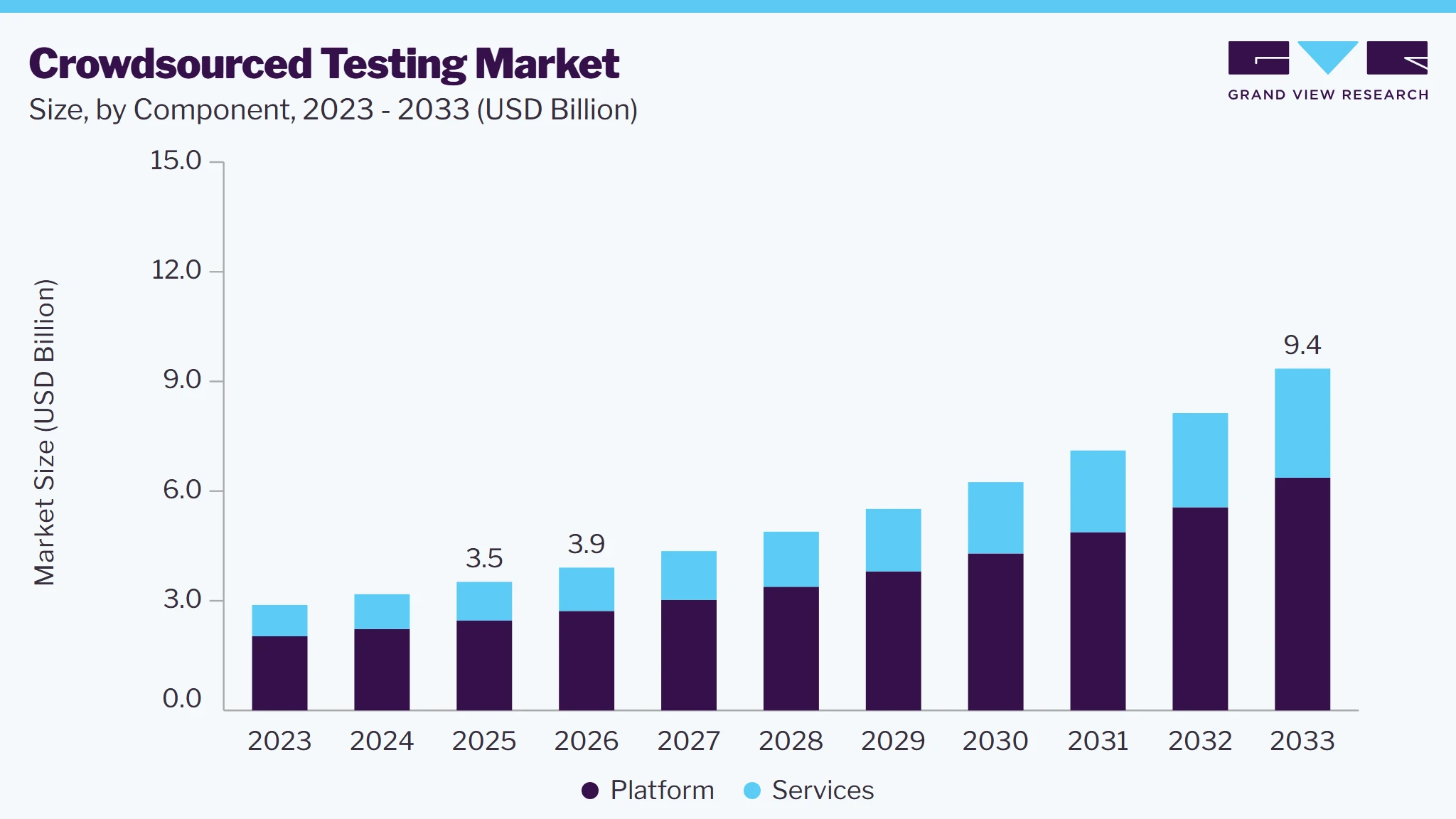 To learn more about this report, Download Free Sample Report
 Crowdsourced testing platforms have been adopted rapidly in North America, a region with many crowdsourced testing companies and developed technological infrastructure. The region has high internet and smartphone penetration, driving North America's crowdsourced testing market growth. The market is fragmented, with many market players present in the market. The market players and new entrants are adopting strategies such as product launches and expansion to gain a competitive edge.
Market Dynamics
The global crowdsourced testing market dynamics are influenced by the increasing shift toward flexible and scalable testing approaches. Demand is rising for faster validation of digital applications across multiple environments. Organizations are adopting distributed testing models to improve efficiency and coverage. Cost considerations are encouraging movement away from fully internal testing structures. Security and quality control factors continue to shape adoption patterns.
The rising focus on user experience quality is increasing demand for testing approaches that reflect real-world usage conditions across diverse digital environments. Organizations are prioritizing how applications perform in terms of speed, usability, responsiveness, and stability across multiple devices, operating systems, and network conditions. This is becoming important as users expect seamless performance across web and mobile platforms. It also influences how companies design, test, and optimize digital products before release.
This shift is driving greater use of distributed testing models that can capture feedback from a wide and varied user base in real time. It helps identify usability issues, functional gaps, and performance inconsistencies that may not appear in controlled internal testing setups. Crowdsourced testers provide diverse perspectives, which improves the accuracy of testing outcomes. This approach ultimately strengthens application reliability and enhances end-user satisfaction across different markets.
Data security and privacy concerns remain a major restraint in the crowdsourced testing market, as organizations are often required to share application access, datasets, or system interfaces with external testers. This exposure increases the risk of unauthorized access, data leakage, and potential misuse of sensitive information. The risk becomes more critical in sectors such as banking, healthcare, and enterprise software, where user data confidentiality is highly regulated and closely monitored.
To manage these risks, enterprises are adopting strict access controls, anonymization techniques, and limited-scope testing environments. However, these measures increase operational complexity and can reduce the flexibility and speed benefits associated with crowdsourced testing. Compliance with data protection regulations further adds layers of approval and monitoring, making organizations more cautious in fully adopting distributed testing models.
The growing adoption of digital transformation initiatives across industries is increasing the need for faster and more scalable testing solutions. Organizations are shifting toward digital platforms, which require continuous validation to ensure performance, functionality, security, and user experience across multiple environments. This includes web applications, mobile apps, and cloud-based systems that are updated frequently and require rapid quality checks before deployment. As digital ecosystems expand, testing requirements are becoming more complex and time sensitive.
This shift is creating strong opportunities for crowdsourced testing as enterprises seek flexible testing models that can manage dynamic workloads and reduce release cycle delays. It is also supporting wider use of distributed tester networks to improve test coverage across different devices, geographies, and user conditions. Crowdsourced testing enables real-world validation that helps identify issues early in the development cycle. This makes it an important approach for organizations aiming to improve software quality while maintaining speed and efficiency.
Market Concentration & Characteristics
The crowdsourced testing market is moderately fragmented, positioned between a highly concentrated and a fully dispersed structure. It comprises a wide range of participants, including specialized testing service providers, digital quality assurance platforms, and large networks of independent testers operating across global geographies. These participants differ in scale, service scope, and technical expertise, spanning niche offerings as well as comprehensive QA platforms serving multiple industry verticals. The ecosystem is further supported by growing participation from freelance testers, which enhances accessibility and scalability of testing services.
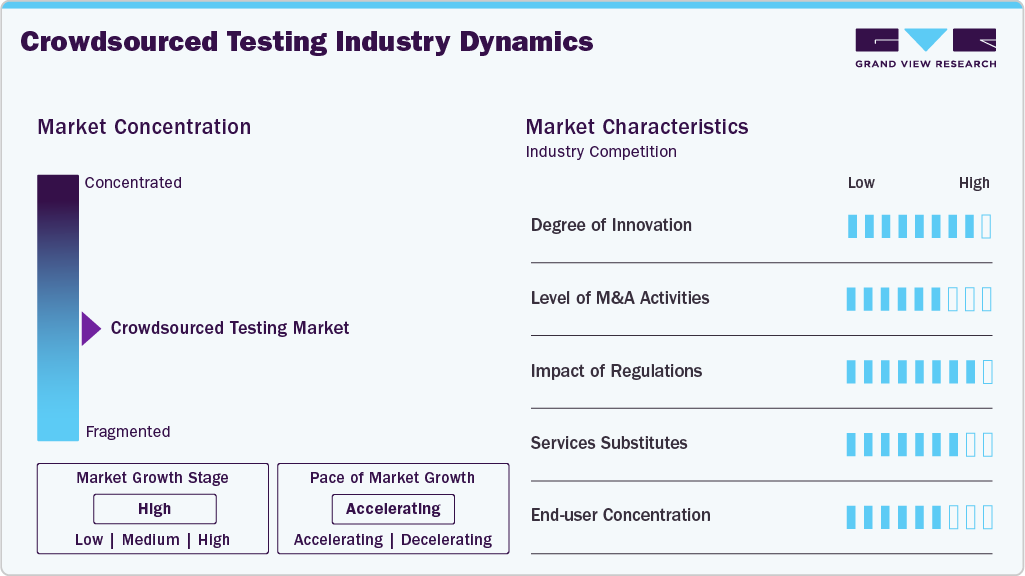 To learn more about this report, Download Free Sample Report
 No single participant holds a dominant market position due to the open, platform-based nature of service delivery. While a limited number of established platforms manage extensive tester communities and enterprise engagements, the continued presence of regional providers and freelance testers maintains a broadly distributed competitive landscape. Market positioning is primarily influenced by factors such as testing speed, coverage breadth, platform efficiency, and tester availability, which collectively prevent high market concentration. Increasing adoption of digital products across industries is further encouraging new entrants, reinforcing competitive intensity and sustaining the fragmented structure.
Analyst Perspective
The crowdsourced testing market is expanding steadily due to increasing demand for scalable and continuous quality assurance solutions. Growth is supported by rising complexity of digital applications and frequent software release cycles across industries. The market remains moderately fragmented with a mix of established platforms and smaller service providers. Competition is driven by service quality, testing speed, and global tester availability. The market shows strong potential with continued adoption across enterprise and mid-sized organizations.
COVID-19 Impact on the Crowdsourced Testing Market
The COVID-19 pandemic had a positive impact on the crowdsourced testing market. Companies adopted the Work-From-Home (WFH) model due to government regulations for social distancing and travel restrictions. Many companies struggled to transition from in-office to a remote working model. Companies suffered from a lack of remote infrastructure to move their in-house Quality Assurance (QA) teams to remote working scenarios. Many organizations’ QA teams could not operate efficiently due to a lack of proper remote infrastructure, aiding the market growth.
The COVID-19 pandemic accelerated digitization, with more people adopting mobile applications for various use cases, including digital payment and online shopping. It also positively impacted mobile application development as businesses shifted to online channels to meet customer expectations. Healthcare, entertainment, and video calling applications saw increased adoption due to the COVID-19 pandemic. Crowdsourced testing offers benefits such as a faster test life cycle process, reduced costs, and availability of remote testers, contributing to the market’s growth due to the COVID-19 pandemic.
Component Insights
Based on component, the platform segment led the market with the largest revenue share of 69.9% in 2025. It is expected to grow at a CAGR of 11.8% throughout the forecast period. Crowdsourcing companies provide organizations access to vetted crowd testers where they can manage test activities, create quality tests, and execute them through the crowdsourced testing platform. The wide availability of crowdsourced testing platforms with feature-based pricing options is driving the growth of the platforms segment. Moreover, some platforms offer integration of the company’s tech stacks with their platform, improving productivity. For instance, Global App Testing (Spa Worldwide Limited)’s platform can integrate with Atlassian’s Jira or GitHub, Inc.’s GitHub, among others.
The services segment is anticipated to grow at the fastest CAGR of 13.0% throughout the forecast period. Services include test management, test plan creation, support, and consulting services. This is a managed crowdsourced testing approach, as the customer doesn’t interact directly with crowd testers, and a dedicated resource provides insights. Services save the organization test management time and improve the development life cycle, driving segment growth.
Testing Type Insights
Based on type, the usability testing segment led the market with the largest revenue share of 25.0% in 2025. In terms of testing type, the market is classified into exploratory, Graphical User Interface (GUI), usability, functional, performance, and other testing types. The usability testing segment dominated the overall market, gaining a market share of 25.1% in 2024. It is expected to grow at a CAGR of 11.6% throughout the forecast period. It determines issues or bugs in an application, and real-life users do the testing. Crowdsourced testing involves testing an application by crowd testers located at remote locations. Testing done by many crowd testers helps determine the bugs in an application quickly and helps companies determine if the application needs revision. Moreover, many crowdsourced companies offer usability testing functionalities. Hence, the benefits and availability of usability testing are driving the segment's growth.
The performance testing segment is expected to grow at the fastest CAGR of 14.1% during the forecast period. It helps determine how efficiently an application can handle the growing number of transactions, users, and data volumes. It helps companies avoid unexpected failures and ensure applications can handle growing demand. The need to ensure efficient and responsive applications even when there are many users is driving the segment growth. Cigniti and StarDust (Computer Task Group, Inc.) are market players offering performance testing solutions.
Application Insights
Based on application, the mobile applications segment led the market with the largest revenue share of 42.5% in 2025. In terms of application, the market is classified into mobile applications, web applications, and native desktop applications. The mobile applications segment has dominated the market, gaining a market share of 41.9% in 2025 and witnessing the fastest CAGR of 13.4% during the forecast period. Growing internet and smartphone penetration worldwide, especially across developing nations, is driving the growth of this segment. Consumers are increasingly using mobile applications for various tasks, such as digital payment, online shopping, and digital media consumption, among others. Moreover, mobile applications are platform specific and are more complex than web applications in terms of functionality and features. Hence, crowdsourcing platforms are being used to improve the overall functionality of mobile applications across platforms and devices.
The web applications segment is anticipated to witness a CAGR of 11.7% throughout the forecast period. Web applications are comparatively less complex than mobile applications as they are not platform specific. However, the need to ensure the smooth functioning of web applications and improve customer experience is driving the growth of this segment. Market players such as Testbirds B.V. and Ubertesters Inc. offer website testing solutions.
Organization Size Insights
Based on organization size, the large size enterprises segment led the market with the largest revenue share of 62.0% in 2025. In terms of organization size, the market is classified into Small and Medium Sized Enterprises (SMEs) and large size enterprises. The large size enterprises segment held the maximum share in the market, with a share of 62.4% in 2024 and is expected to witness a CAGR of 11.4% throughout the forecast period. Large size enterprises might find it difficult to test every application and feature across countries and devices with in-house Quality Assurance (QA) teams. Moreover, the in-house Quality Assurance (QA) teams may miss out on application bugs that crowd testers would identify as they would not have any bias. The need to identify and fix maximum bugs in an application and improve application scalability are driving large enterprises' adoption of crowdsourced testing.
The Small and Medium Sized Enterprises (SMEs) segment is anticipated to grow at the fastest CAGR of 13.4% throughout the forecast period. Small and Medium Sized Enterprises (SMEs) are increasingly adopting or looking to adopt digital technologies to improve business processes and operations affected by the COVID-19 pandemic. According to the World Economic Forum’s 2021 survey, there was a rise in interest in using digital technologies among Small and Medium Sized Enterprises (SMEs) in 2021 compared to 2019. This will likely lead to growth in application development by Small and Medium Sized Enterprises (SMEs). The need for cost-effective software test methods is driving the growth of this segment.
Industry Insights
Based on industry, the BFSI segment led the market with the largest revenue share of 22.6% in 2025. The BFSI segment has dominated the overall crowdsourced market, gaining a market share of 22.6% in 2024 and witnessing a CAGR of 12.4% during the forecast period. The growing digitization of banking platforms and applications to improve customer experience is driving the growth of the BFSI segment. Mobile banking is witnessing growth in adoption as customers increasingly use mobile applications for applications such as instant payment and investments.
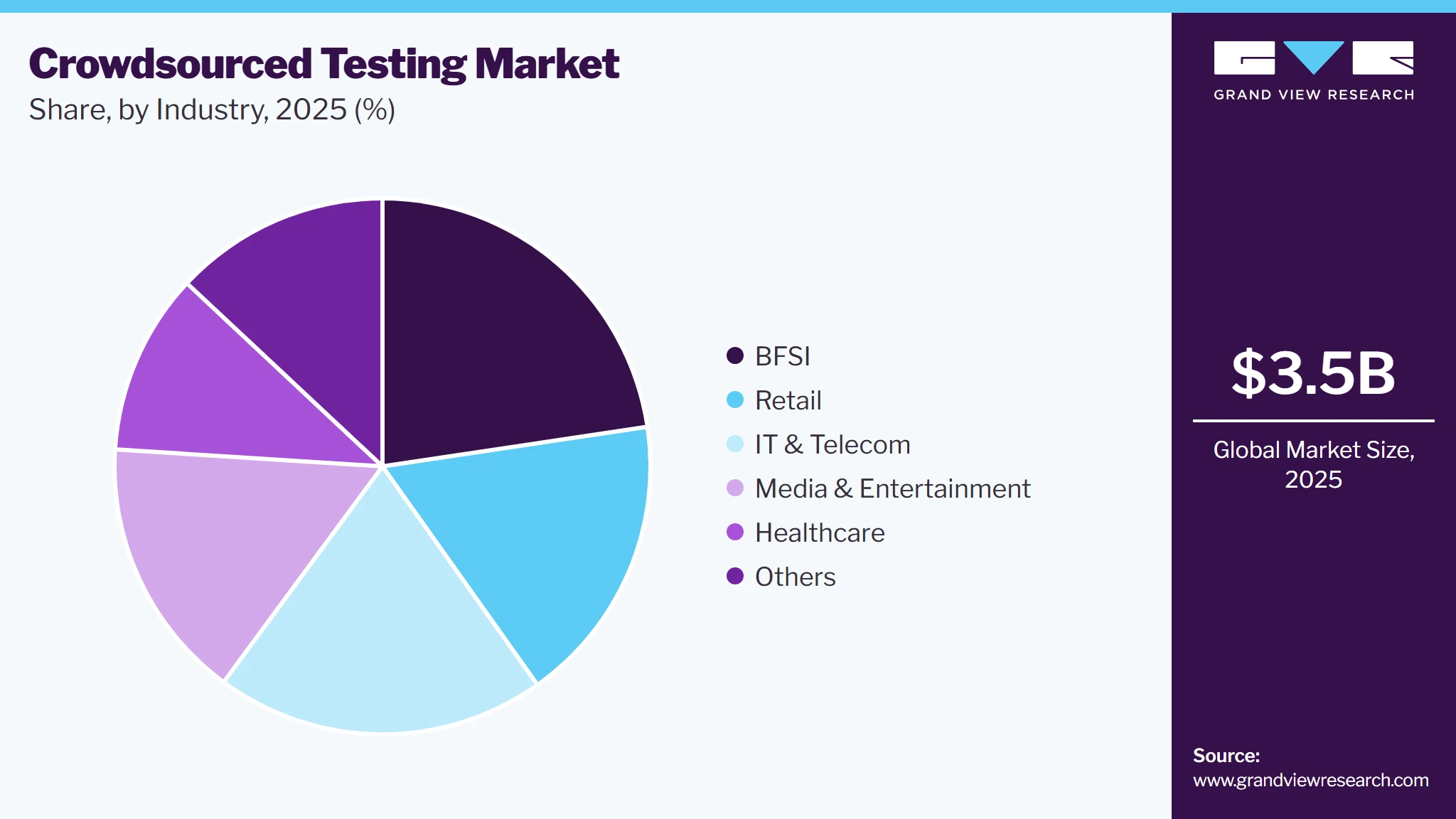 To learn more about this report, Download Free Sample Report
 The retail segment is anticipated to witness the fastest CAGR of 14.1% throughout the forecast period. The growth in e-commerce sales worldwide, accelerated by the COVID-19 pandemic, is driving the growth of this segment. E-commerce websites and applications must load quickly and provide an easy navigation path in addition to efficient checkout and payment processes. Many crowdsourcing companies, such as Testlio, Bugcrowd, and Applause App Quality, Inc., serve the retail sector.
Regional Insights
North America dominated the Crowdsourced testing market with the largest revenue share of 31.3% in 2025. It is expected to grow at a CAGR of 12.3% throughout the forecast period. North America has prominent market players such as U.S.-based Testlio, Test IO (EPAM Systems, Inc.), and Ubertesters Inc. Moreover, developed technological infrastructure is aiding the growth of the region. High mobile app development, computer software Research & Development (R&D), and a favorable cloud ecosystem is aiding the growth of application development in the region. This is aiding the adoption of crowdsourcing test platforms in the region.
 To learn more about this report, Download Free Sample Report
 U.S. Crowdsourced Testing Market
The Crowdsourced testing market in the U.S. held the largest share in the North America region in 2025. The U.S. market is the most mature and largest in the world, driven by the presence of numerous tech giants and a strong startup ecosystem. The country's emphasis on innovation and early adoption of new technologies, coupled with the increasing complexity of software applications, is fueling the demand for crowdsourced testing services. This demand is further driven by the need for faster time-to-market, cost-effectiveness, and access to a diverse pool of testers with specialized skills.
The crowdsourced testing industry in Canada is expected to grow at a significant CAGR from 2026 to 2033. The Canadian market is poised for significant growth due to the increasing adoption of digital technologies across various industries. The country's strong focus on research and development, coupled with a robust IT infrastructure, is creating a favorable environment for the growth of crowdsourced testing. In addition, the presence of a highly skilled workforce and a strong emphasis on quality assurance are further driving the demand for crowdsourced testing services.
Asia Pacific Crowdsourced Testing Market
Asia Pacific crowdsourced testing market is expected to grow at the fastest CAGR of 13.6%. Asia Pacific has a developing technology infrastructure and rising internet & smartphone penetration. This, along with the region’s huge population, is aiding the growth in mobile application usage for various applications, including online shopping and mobile banking services. Hence, the demand for efficient applications across devices and platforms for various sectors is likely to grow to meet the customer demand in the region. Crowdsourced testing can improve the overall test lifecycle and the overall customer experience.
The India crowdsourced testing market is expected to grow at a significant CAGR from 2026 to 2033. India's large pool of skilled IT professionals, coupled with a cost-effective labor market, makes it an attractive destination for global companies seeking crowdsourced testing services. The country's growing startup ecosystem and increasing digital adoption are further driving the demand for quality assurance and testing services. Furthermore, the government's initiatives to promote the IT industry and the increasing availability of high-speed internet are creating a conducive environment for the growth of crowdsourced testing.
The crowdsourced testing market in Japan is expected to grow at a significant CAGR from 2026 to 2033. Japan's focus on quality and reliability, coupled with a strong emphasis on innovation, is driving the adoption of crowdsourced testing services. The country's mature IT industry and the increasing complexity of software applications are creating a demand for efficient and cost-effective testing solutions. In addition, the growing awareness of the benefits of crowdsourced testing, such as faster time-to-market and improved software quality, is further driving the demand for these services.
The China crowdsourced testing market is expected to grow at a significant CAGR from 2026 to 2033. China's rapid digital transformation and the increasing number of internet users are driving the demand for high-quality software applications. The country's large pool of skilled IT professionals and the government's support for the development of the IT industry are creating a favorable environment for the growth of crowdsourced testing. Furthermore, the increasing adoption of mobile devices and the growing popularity of e-commerce are creating new opportunities for crowdsourced testing providers.
Europe Crowdsourced Testing Market
The crowdsourced testing market in Europe is expected to grow at a significant CAGR from 2026 to 2033. Europe's diverse market, with a strong focus on data privacy and security, is driving the demand for robust testing solutions. The increasing adoption of cloud-based technologies and the growing number of startups are creating opportunities for crowdsourced testing providers. In addition, the increasing awareness of the benefits of crowdsourced testing, such as cost-effectiveness and improved software quality, is driving the demand for these services.
The crowdsourced testing industry in Germany is expected to grow at a significant CAGR from 2026 to 2033. Germany's strong emphasis on quality and engineering excellence is driving the adoption of crowdsourced testing services. The country's large automotive and manufacturing industries, which rely heavily on software-driven systems, are creating a significant demand for testing services. In addition, the increasing complexity of software applications and the need for faster time-to-market are driving the demand for efficient and cost-effective testing solutions.
Key Crowdsourced Testing Company Insights
The Crowdsourced Testing market is highly competitive, with a multitude of players vying for market share. Some prominent players in the market include Cigniti, Testlio, Digivante Limited, Global App Testing (Spa Worldwide Limited), Test IO (EPAM Systems, Inc.), Applause App Quality, Inc., Ubertesters Inc., Crowdsprint, Testbirds B.V., Userfeel Ltd, THE Β FAMILY AB., StarDust (Computer Task Group, Inc.), Bugcrowd, Rainforest QA, Inc., msg systems ag, and Mob4Hire, among others. Key players in this space include established software testing companies, specialized crowdsourced testing platforms, and emerging startups. These companies compete on various factors, including pricing, quality of service, global reach, and the diversity and expertise of their tester communities.
Established software testing companies often leverage their existing client relationships and brand reputation to offer crowdsourced testing as an additional service. Specialized crowdsourced testing platforms, on the other hand, focus solely on providing crowdsourced testing services and often offer advanced features and tools to facilitate efficient testing processes. Emerging startups bring innovation and agility to the market, often focusing on niche segments or offering unique testing methodologies.
Some of the key companies operating in the Crowdsourced Testing market include Testbirds B.V., Cigniti, and Testlio, among others.
-
Testbirds B.V. has carved a niche for itself in the crowdsourced testing market by offering a comprehensive platform that combines the power of human testers with advanced AI-powered tools. This unique approach enables efficient and effective testing of complex software applications. The company's strong focus on quality assurance, combined with its global network of skilled testers, allows it to deliver high-quality testing services to clients across various industries.
-
Cigniti is a leading provider of independent software testing and quality engineering services. The company's competitive advantage lies in its deep domain expertise, strong industry partnerships, and a robust global delivery model. Cigniti's comprehensive suite of testing services, including functional testing, performance testing, security testing, and mobile testing, enables it to address the diverse testing needs of its clients.
-
Testlio is a cloud-based software testing platform that empowers organizations to deliver high-quality software faster. The company's proprietary platform leverages a global network of expert testers to provide on-demand testing services. Testlio's competitive advantage lies in its ability to rapidly scale testing efforts, its focus on automation, and its commitment to delivering exceptional customer service.
Bugcrowd and Rainforest QA, Inc. are some of the emerging companies in the target market.
-
Bugcrowd leverages a global network of security researchers to identify and report vulnerabilities in software applications and infrastructure. This crowdsourced approach enables organizations to quickly discover and address security risks before they can be exploited by malicious actors. Bugcrowd's platform provides a streamlined process for managing vulnerability reports, prioritizing issues, and rewarding researchers.
-
Rainforest QA, Inc. offers a cloud-based testing platform that combines human testers with automated testing tools to provide comprehensive testing coverage. The platform's AI-powered features enable efficient test case generation, execution, and analysis. By leveraging a global network of skilled testers, Rainforest QA can quickly scale testing efforts to meet the needs of organizations of all sizes.
Key Crowdsourced Testing Companies:
The following key companies have been profiled for this study on the crowdsourced testing market.
-
Cigniti
-
Testlio
-
Digivante Limited
-
Global App Testing (Spa Worldwide Limited)
-
Test IO (EPAM Systems, Inc.)
-
Applause App Quality, Inc.
-
Ubertesters Inc.
-
Crowdsprint
-
Testbirds B.V.
-
Userfeel Ltd
-
THE Β FAMILY AB
-
StarDust (Computer Task Group, Inc.)
-
Bugcrowd, Rainforest QA, Inc.
-
msg systems ag
-
Mob4Hire
Competitive Benchmarking
Operating Strategies
Competitive Edge
Weaknesses
Mature Players: Applause App Quality, Inc.; EPAM Systems, Inc. (Test IO); Testlio; Cigniti; Digivante Limited;
- Matured players focus on enterprise clients, long-term contracts, and integrated QA solutions. They emphasize automation, AI-based testing, global tester networks, and compliance-driven services.
- Matured players have strong global tester networks, established enterprise relationships, and advanced platform capabilities. Their advantage comes from integrated QA solutions, automation-driven testing, and compliance expertise across regulated industries.
- Matured players often face higher operational costs and slower adaptability due to complex enterprise-focused structures. Heavy reliance on long-term contracts can reduce flexibility in pricing and service customization.
Emerging Players: Ubertesters Inc.; Crowdsprint; Userfeel Ltd; THE Β FAMILY AB; Mob4Hire
- Emerging players focus on cost-effective, flexible, and niche testing services. They rely on agile platforms, freelancer networks, and quick scalability to attract SMEs and mid-sized clients.
- Emerging players compete through cost efficiency, faster onboarding, and flexible service delivery models. Their strength lies in niche testing focus, agile platforms, and ability to quickly adapt to specific client requirements.
- Emerging players face limited global reach and weaker brand recognition. They also struggle with scalability, inconsistent tester quality, and lower ability to serve large enterprise clients.
Recent Developments
-
In June 2024, YouTube integrated a new feature where viewers can add short notes to videos to provide additional context. These notes could explain if a clip is a parody, outdated, or real news. This is currently an experiment limited to mobile users in the US watching English language videos. YouTube will assess the accuracy of the notes before making them widely available.
-
In March 2023, OpenAI has introduced Evals, a software framework designed to crowdsource the testing of its AI models. By making Evals open-source, OpenAI aims to encourage users to report shortcomings in its models, such as GPT-4, and contribute to their improvement. This approach allows for a more comprehensive evaluation of the models' capabilities and limitations, leading to more robust and reliable AI systems. Evals enables users to create and run benchmarks, compare model performance across different datasets, and even implement custom evaluation logic. By fostering collaboration and community involvement, OpenAI hopes to accelerate the development of AI models and address potential issues more effectively.
Crowdsourced Testing Market Report Scope
Report Attribute
Details
Market size in 2025
USD 3.5 billion
Estimated market size in 2026
USD 3.9 billion
Projected market size by 2033
USD 9.4 billion
Growth rate
CAGR of 13.3% from 2026 to 2033
Base year for estimation
2025
Historical data
2021 - 2024
Forecast period
2026 - 2033
Quantitative units
Revenue in USD million/billion and CAGR from 2026 to 2033
Report coverage
Revenue forecast, company ranking, competitive landscape, growth factors, and trends
Segments covered
Component, testing type, application, organization size, industry, region
Regional scope
North America; Europe; Asia Pacific; Latin America; MEA
Country scope
U.S., Canada, Mexico, U.K., Germany, France, China, Japan, India, South Korea, Australia, Brazil, KSA, UAE, South Africa
Key companies profiled
Cigniti, Testlio, Digivante Limited, Global App Testing (Spa Worldwide Limited), Test IO (EPAM Systems, Inc.), Applause App Quality, Inc., Ubertesters Inc., Crowdsprint, Testbirds B.V., Userfeel Ltd, THE Β FAMILY AB., StarDust (Computer Task Group, Inc.), Bugcrowd, Rainforest QA, Inc., msg systems ag, and Mob4Hire
Customization scope
Free report customization (equivalent up to 8 analysts' working days) with purchase. Addition or alteration to country, regional & segment scope.
Pricing and purchase options
Avail customized purchase options to meet your exact research needs. Explore purchase options
Global Crowdsourced Testing Market Report Segmentation
This report forecasts revenue growths at global, regional, as well as at country levels and offers qualitative and quantitative analysis of the market trends for each of the segment and sub-segments from 2021 to 2033. For the purpose of this study, Grand View Research has segmented the global crowdsourced testing market based on component, testing type, application, organization size, industry, and region.
-
Component Outlook (Revenue, USD Million, 2021 - 2033)
-
Platform
-
Services
-
-
Testing Type Outlook (Revenue, USD Million, 2021 - 2033)
-
Exploratory Testing
-
Graphical User Interface (GUI) Testing
-
Usability Testing
-
Functional Testing
-
Performance Testing
-
Others
-
-
Application Outlook (Revenue, USD Million, 2021 - 2033)
-
Mobile Applications
-
Web Applications
-
Native Desktop Applications
-
-
Organization Size Outlook (Revenue, USD Million, 2021 - 2033)
-
Small And Medium Sized Enterprises (SMEs)
-
Large Size Enterprises
-
-
Industry Outlook (Revenue, USD Million, 2021 - 2033)
-
BFSI
-
Retail
-
IT & Telecom
-
Media & Entertainment
-
Healthcare
-
Others
-
-
Regional Outlook (Revenue, USD Million, 2021 - 2033)
-
North America
-
U.S.
-
Canada
-
Mexico
-
-
Europe
-
UK
-
Germany
-
France
-
-
Asia Pacific
-
India
-
China
-
Japan
-
South Korea
-
Australia
-
-
Latin America
-
Brazil
-
-
Middle East & Africa
-
Kingdom of Saudi Arabia (KSA)
-
U.A.E.
-
South Africa
-
-
Research Methodology
The crowdsourced testing market figures in this report are based on a proven research process that combines executive interviews with secondary research from proprietary databases, company filings, and recognized regulatory and institutional sources. Market size is built through value-chain sizing - reconciling supply-side and demand-side estimates - and triangulated with bottom-up and top-down approaches. Every estimate passes multiple levels of expert validation before publication, with each crowdsourced testing segment quantified using the revenue-capture definitions in the table below.
Segment Definition
Segment - Component
Revenue capture definition
Platform
Platform revenue capture is the generation of income by monetizing interactions between different user groups through commissions, subscriptions, transaction fees, or premium offerings enabled by a digital ecosystem.
Services
Services revenue capture is the generation of income through direct delivery of services to customers using project-based fees, usage-based pricing, or contract-based agreements.
Testing Type
Revenue Capture Definition
Exploratory Testing
Revenue capture is generated through project-based or hourly billing for exploratory sessions conducted by distributed testers to identify unexpected defects in applications.
Graphical User Interface (GUI) Testing
Revenue capture is generated through task-based or project-based pricing for validating interface design, layout consistency, and user interaction flows across devices and platforms.
Usability Testing
Revenue capture is generated through engagement-based or project fees for collecting and analyzing end-user feedback on application ease of use and user experience.
Functional Testing
Revenue capture is generated through requirement-based or milestone-linked pricing for verifying application functions against defined specifications.
Performance Testing
Revenue capture is generated through test-cycle or usage-based pricing for evaluating application responsiveness, scalability, and stability under varying workloads.
Others
Revenue capture is generated through customized pricing models for specialized testing services such as security, compatibility, and localization testing.
Application Type
Revenue Capture Definition
Mobile Applications
Revenue capture is generated through testing engagements focused on mobile apps, where providers earn via project-based, task-based, or subscription models for validating performance, usability, and functionality across devices and operating systems.
Web Applications
Revenue capture is generated through testing services for web-based platforms, with income derived from functional, usability, and compatibility testing delivered through project contracts or usage-based pricing.
Native Desktop Applications
Revenue capture is generated through structured testing assignments for desktop software, where providers monetize verification of functionality, performance, and compatibility through project-based or milestone-linked pricing models.
Organization Size
Revenue Capture Definition
Small and Medium Sized Enterprises (SMEs)
Revenue capture is generated through cost-sensitive testing engagements where SMEs adopt flexible, pay-per-use, or subscription-based models for accessing crowdsourced testing services to validate applications without maintaining large in-house QA teams.
Large Size Enterprises
Revenue capture is generated through long-term contracts, enterprise subscriptions, and large-scale testing projects, where providers deliver structured and continuous testing services across complex application ecosystems and global user bases.
Industry
Revenue Capture Definition
BFSI
Revenue capture is generated through structured testing contracts focused on secure application validation, with pricing based on project scope, compliance requirements, and continuous testing needs for digital banking and financial platforms.
Retail
Revenue capture is generated through engagement-based and project-based pricing for testing e-commerce platforms, payment systems, and customer experience applications across web and mobile channels.
IT & Telecom
Revenue capture is generated through large-scale testing engagements covering software platforms, network applications, and digital services, with recurring revenue from continuous testing programs.
Media & Entertainment
Revenue capture is generated through testing services for streaming platforms, content delivery applications, and user interface validation, typically structured as project-based or subscription models.
Healthcare
Revenue capture is generated through regulated testing services for healthcare applications, where pricing reflects compliance requirements, data sensitivity, and validation of critical digital systems.
Others
Revenue capture is generated through diversified testing engagements across multiple industries, using flexible pricing models based on application complexity and testing scope.
Estimation Model
Layer Name
Key Question
Description
Total Digital Application Base Layer
What applications generate testing demand?
Identify the total number of mobile applications, web applications, and desktop applications deployed across industries. This layer establishes the overall digital ecosystem requiring quality assurance and testing services throughout the application lifecycle.
Serviceable Application Layer
Which applications require active testing services?
Filter applications based on development stage, update frequency, user scale, and complexity. Applications undergoing frequent releases, agile development cycles, or continuous deployment form the primary demand base for testing services.
Testing Demand Layer
What types of testing are required?
Estimate demand across exploratory, functional, usability, GUI, performance, and other specialized testing types. Testing frequency, defect rates, and release cycles determine overall testing workload and service requirements.
Revenue Capture Layer
How is revenue generated across the testing ecosystem?
Calculate revenue generated through testing engagements delivered via platforms, service providers, and distributed tester networks, including project-based, subscription-based, and usage-based pricing models across enterprise clients.
Delivered Customizations
This report has been delivered with the following In-depth customizations
Client Request
Customization Delivered
Value Adds
Market Entry & Expansion Assessment
Regional crowdsourced testing demand sizing and growth outlook
Market readiness and adoption maturity assessment across regions
Regulatory and data security landscape evaluation
Competitive intensity and entry barrier analysis
Identified high-potential markets for expansion
Supported entry timing and prioritization decisions
Highlighted regulatory and compliance risks • Enabled informed investment and resource planning
Partner & Distribution Study
Platform ecosystem and testing network analysis
Enterprise client engagement and partnership mapping
Service provider and freelancer tester network evaluation
Pricing models and service delivery channel assessment
Optimized partner selection and collaboration strategy
Identified gaps in tester network coverage
Improved channel efficiency and service reach
Supported scalable go-to-market execution
Product Positioning & Competitive Intelligence
Crowdsourced testing platform benchmarking
\Service capability and feature comparison across players
Pricing structure and value proposition analysis • Client preference and adoption behavior assessment
Strengthened differentiation strategy
Supported pricing and positioning decisions
Identified unmet client requirements
Enhanced competitive advantage in target markets
Frequently Asked Questions About This Report
Asia Pacific is the fastest-growing region over the forecast period.
The platform segment led with a 69.9% revenue share in 2025, while services is the fastest-growing segment.
The usability testing segment led with a 25.0% revenue share in 2025, while performance testing is the fastest-growing segment.
The mobile applications segment accounted for the largest revenue share of 42.5% in 2025 and is also expected to be the fastest-growing segment during the forecast period.
North America dominated the crowdsourced testing market with a share of 31.3% in 2025. This is attributable to developed technology infrastructure and the presence of crowdsourced testing companies.
Some key players operating in the crowdsourced testing market include Cigniti, Testlio, Digivante Limited, Global App Testing (Spa Worldwide Limited), Test IO (EPAM Systems, Inc.), Applause App Quality, Inc., Ubertesters Inc., Crowdsprint, Testbirds B.V., Userfeel Ltd, THE Β FAMILY AB., StarDust (Computer Task Group, Inc.), Bugcrowd, Rainforest QA, Inc., msg systems ag, and Mob4Hire.
Key factors driving the crowdsourced testing market growth include increasing digital transformation and the need for flexible Quality Assurance (QA) practices.
The global crowdsourced testing market size was valued at USD 3.5 billion in 2025 and is estimated at USD 3.9 billion for 2026.
The global crowdsourced testing market is expected to grow at a CAGR of 13.3% from 2026 to 2033, reaching USD 9.4 billion by 2033.
About the Author(s)
Communications Infrastructure Research Team
Technology · Communications InfrastructureThis report was authored by the communications infrastructure research team at Grand View Research - comprising two research analysts, one senior research analyst, and one industry expert - with specialized expertise in the communications infrastructure segment of the technology industry. All findings are based on proprietary technology databases, executive interviews, and regulatory analysis, subject to internal peer review prior to publication.
Last Updated:
Speak to Analyst

Customize this report to your needs - add regions, segments, or data points, with 20% free customization.
Or view our licence options:


ISO 9001:2015 & 27001:2022 Certified
We are GDPR and CCPA compliant! Your transaction & personal information is safe and secure. For more details, please read our privacy policy.


