
- Home
- »
- Green Building Materials
- »
-
Cryogenic Insulation Market Size, Share, Industry Report, 2019-2025GVR Report cover
![Cryogenic Insulation Market Size, Share & Trends Report]()
Cryogenic Insulation Market (2019 - 2025) Size, Share & Trends Analysis Report By Product (PUR and PIR, Cellular Glass, Fiberglass), By Application (LPG/LNG Transport & Storage, Metallurgical), By Region, And Segment Forecasts
Industry Insights
The global cryogenic insulation market size was estimated at USD 1.9 billion in 2018, expanding at a CAGR of 6.5% over the forecast period. Rising demand for LPG/LNG from various sectors such as power generation and automotive is anticipated to boost the demand for transportation and storage, which further propels the growth of the market for cryogenic insulation.
Rising demand for energy and power across the globe on account of the rising industrialization and urbanization is projected to promote the demand for cryogenic insulation. In addition, the growth of aerospace and space exploration industries is further anticipated to propel the demand for cryogenic insulation over the forecast period.
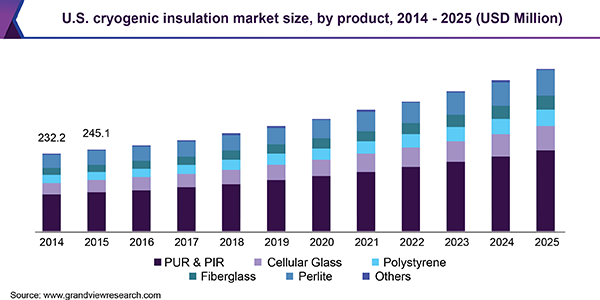
Rising gas exploration activities in the U.S. on account of growing demand from various sectors including electric power, industrial, and residential is expected to propel the demand for cryogenic insulation. In addition, demand for clean and eco-friendly energy resources is anticipated to result in growing demand for LPG/LNG, thereby stimulating the industry growth.

However, fluctuating raw material prices, concerns regarding safety, and issues related to the product durability are the factors estimated to hamper overall market growth. Rising use of enhanced technology to advance performance characteristics is a technological trend estimated to boost industrial demand over the forecast period.
The insulation comprises high priced raw materials that are available for exorbitant prices, which increases the overall cost for the product. In addition, increasing use of materials such as aerogel and perlite in the product leading to superior performance is expected to emerge as the defining trend for the market over the forecast period.
The rising investments in R&D is likely to result in new product development and enhancement of the product quality. In addition, major players are pooling their resources and technologies in order to develop highly efficient products at lower costs. This is projected to stimulate the growth of the market for cryogenic insulation over the forecast period.
Market Dynamics
The crosslinking agent market was driven by the increasing adoption of high-performance coating systems across automotive, industrial, packaging, and decorative applications. Crosslinking agents play a critical role in improving coating durability, chemical resistance, adhesion strength, and thermal stability, making them essential for advanced coating formulations. Growing infrastructure development, automotive production, and industrial manufacturing activities continued to strengthen demand for durable and long-lasting coating technologies across global markets.
Tightening environmental regulations encouraged coating manufacturers to shift toward low-VOC, waterborne, and sustainable coating formulations, increasing the use of advanced crosslinking chemistries. Specialty chemical producers expanded investments in environmentally compliant amino, isocyanate, and carbodiimide-based systems to support evolving regulatory standards and performance requirements. The growing preference for eco-friendly coatings across construction, packaging, and transportation sectors further accelerated demand for innovative crosslinking solutions.
The market faced constraints due to price fluctuations in petrochemical-based raw materials used the produce crosslinking agents. Variations in feedstock costs, energy prices, and supply chain disruptions continued to impact manufacturing expenses and pricing stability for coating formulators and specialty chemical producers. A high reliance on crude oil-derived intermediates further increased exposure to global commodity market volatility.
Stringent environmental and chemical safety regulations created operational challenges for manufacturers, particularly for solvent-based and hazardous crosslinking chemistries. Compliance requirements related to emissions, worker safety, and chemical handling increased production and reformulation costs across several regions. These regulatory pressures also accelerated the need for continuous product innovation and investment in sustainable alternatives, affecting profitability for manufacturers operating in highly regulated markets.
Product Insights
The cryogenic insulation market has been categorized on the basis of product types such as PUR and PIR, cellular glass, polystyrene, fiberglass, perlite, and others. PUR and PIR segment accounted for the largest market share and is estimated to witness a CAGR of 6.8% from 2019 to 2025. The growing demand for liquefaction and regasification is projected to benefit the segment growth.
PUR and PIR cryogenic insulation is widely used in storing gases at extremely low temperatures. In addition, growing transportation of these liquefied gases is projected to boost the demand for insulating pipes, storage tanks, and valves. The growing number of LNG terminals, LNG transporting ships, and storage tanks is anticipated to stimulate the demand for PUR and PIR cryogenic insulation.
The insulating products are produced in the form of bulk-fill, foam, blankets, and multi-layer. The lightweight, flexibility, and strength of these products make them useful in a number of industries that incorporate LNG transportation infrastructure or use high temperature insulation. The high efficiency of the products in providing insulation is likely to result in rising demand over the forecast period.
The perlite segment is projected to witness a CAGR of 6.2% from 2019 to 2025 on account of the rising cryogenic insulation demands from various application industries. The product is used to cater the insulation needs across various industries including refineries, power generation, and storage and transportation of LNG.
Application Insights
On the basis of application, the market for cryogenic insulation is segmented into LPG/LNG transport and storage, energy and power, metallurgical, and others. The LPG/LNG transport and storage segment accounted for USD 929.8 million in 2018 owing to the rising demand for LNG from various industries.
The demand for LNG across various sectors including automotive, power generation, and domestic and commercial fuel is projected to result in rising gas exploration and production activities across the economies. This is anticipated to boost the demand for storage and transportation of LNG, which further benefits the growth of the market for cryogenic insulation over the forecast period.
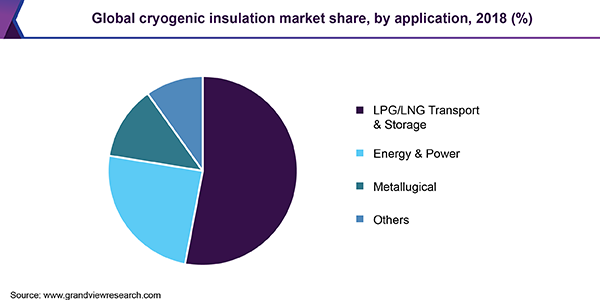
The energy and power application segment is anticipated to exhibit a CAGR of 6.4% from 2019 to 2025. The rising demand for energy and power in developing economies owing to the expansion of the industrial and residential sector is likely to propel the segment growth, which is further projected to result in rising product demand.
The others segment include healthcare, food and beverage, and space applications. The other application segment is estimated to witness a CAGR of 5.2% from 2019 to 2025. Rising disposable incomes and improved standard of living across the globe is likely to benefit the growth of aforementioned application segment, further benefiting the market growth.
Regional Insights
The North America market was valued at USD 432.8 million in 2018 and is estimated to be the fastest growing regional market from 2019 to 2025 on account of the increasing gas exploration and production activities. In addition, high penetration of cryogenic insulation in the LNG industry in the region is expected to drive the regional market growth over the forecast period.
Moreover, high level of environmental awareness in the region is a major factor driving the demand for LNG. In addition, surging demand for LNG from various application industries across the globe is likely to propel the demand for transportation and storage, which is estimated to benefit the market growth over the forecast period.
Factors such as the growth in the manufacturing sector, high energy consumption, and growing environmental concerns are acting as drivers for the market in North America. However, the market for cryogenic insulation in this region is relatively saturated and hence also presents a high level of barriers for the new entrants.
Asia Pacific represents a good opportunity for the cryogenic insulation products manufacturers due to the fast developing economies in the region including China, India, and South Korea. These countries are the major consumers of cryogenic insulation and are responsible for the industrial growth in this region. The rapid industrialization and urbanization are further anticipated to boost the market growth over the forecast period.
Cryogenic Insulation Market Share Insights
Cryogenic insulation products are increasingly gaining recognition mainly for increasing efficiency and reducing the operating cost. The key players are adopting strategies such as new product innovation, mergers and acquisition, joint ventures, and partnerships in order to gain competitive advantage.
Prominent players of the industry include Armacell International Holding GmbH; BASF SE; Lydall Inc.; Cabot Corporation; Johns Manville Inc.; Evonik Industries; Huntsman Corporation; and Rochling Group.
Competitive Benchmarking
Operating Strategies
Competitive Edge
Weakness
Mature Players: BASF SE; Covestro AG; Allnex Group; Evonik Industries; Huntsman Corporation; Dow; DSM Coating Resins; INEOS
- Focus was placed on expanding high-performance crosslinking solutions for automotive, industrial, decorative, and packaging coatings applications.
- Significant investments were made in low-VOC, waterborne, and environmentally compliant coating technologies to align with evolving sustainability regulations.
- Companies strengthened their global manufacturing footprint and downstream coating partnerships to improve supply reliability and customer integration.
- Mature players benefited from strong global distribution networks and diversified specialty chemical portfolios.
- Advanced R&D capabilities supported continuous innovation in high-performance and sustainable crosslinking technologies.
- Long-standing relationships with coating formulators and industrial manufacturers strengthened market penetration across multiple end-use sectors.
- High exposure to raw material and petrochemical price volatility affected production cost structures.
- Compliance with environmental and hazardous chemical regulations increased operational and reformulation expenses.
- Large organizational structures reduced flexibility in responding to niche regional demand shifts.
Emerging Players: Aditya Birla Group; Wanhua Chemicals Group Co. Ltd.
- Expansion efforts were focused on increasing production capacity and strengthening presence in Asia-Pacific coating and industrial markets.
- Companies emphasized cost-competitive crosslinking solutions targeting mid-tier industrial and decorative coating applications.
- Strategic investments were directed toward technology upgrades, export expansion, and broader specialty chemical integration.
- Emerging players benefited from competitive manufacturing costs and strong positioning within rapidly growing regional markets.
- Faster operational decision-making has supported quicker adaptation to changing customer and application requirements.
- Expanding domestic distribution networks strengthened penetration in industrializing economies.
- Limited global brand recognition compared to established multinational competitors restricted premium market penetration.
- Lower R&D scale constrained the development of highly specialized and advanced coating chemistries.
- Greater dependence on regional demand trends increased exposure to localized economic fluctuations.
Report Scope
Attribute
Details
Base year for estimation
2018
Actual estimates/Historical data
2014 - 2017
Forecast period
2019 - 2025
Market representation
Revenue in USD Million and CAGR from 2019 to 2025
Regional scope
North America, Europe, Asia Pacific, Central & South America, Middle East & Africa
Country scope
U.S., Canada, Mexico, Germany, The Netherlands, Russia, Turkey, Spain, France, China, South Korea, India, Australia, Brazil, Argentina, Qatar, Iran
Report coverage
Revenue forecast, competitive landscape, growth factors and trends
15% free customization scope (equivalent to 5 analysts working days)
If you need specific information, which is not currently within the scope of the report, we will provide it to you as a part of customization
Segments Covered in the ReportThis report forecasts revenue growth at global, regional, and country levels and provides an analysis of the latest industry trends in each of the sub-segments from 2014 to 2025. For the purpose of this study, Grand View Research has segmented the global cryogenic insulation market report on the basis of product, application, and region:
-
Product Outlook (Revenue, USD Million, 2014 - 2025)
-
PUR and PIR
-
Cellular Glass
-
Polystyrene
-
Fiberglass
-
Perlite
-
Others
-
-
Application Outlook (Revenue, USD Million, 2014 - 2025)
-
LPG/LNG Transport & Storage
-
Energy and Power
-
Metallurgical
-
Others
-
-
Regional Outlook (Revenue, USD Million, 2014 - 2025)
-
North America
-
U.S.
-
Canada
-
Mexico
-
-
Europe
-
Germany
-
The Netherlands
-
Russia
-
Turkey
-
Spain
-
France
-
-
Asia Pacific
-
China
-
India
-
South Korea
-
Australia
-
-
Middle East & Africa
-
Iran
-
Qatar
-
-
Central & South America
-
Argentina
-
Brazil
-
-
Delivered Customizations
This report has been delivered with the following In-depth customizations
Client Request
Customization Delivered
Value Adds
Regional Segmentation
A detailed regional assessment of the crosslinking agent market was conducted across North America, Europe, Asia Pacific, Latin America, and the Middle East & Africa, with expanded country-level analysis for major coating manufacturing hubs. The study evaluated consumption trends for amino, amine, amide, carbodiimide, isocyanate, and aziridine-based crosslinking agents across decorative, automotive, industrial, and packaging coatings applications.
Enabled identification of high-demand regional clusters, manufacturing concentration areas, and emerging consumption markets. Supported regional expansion planning, production localization strategies, and identification of application-specific growth opportunities.
Competitive Benchmarking
Key crosslinking agent manufacturers were benchmarked based on product portfolio strength, coating technology expertise, innovation capabilities, global manufacturing presence, sustainability initiatives, pricing strategies, and penetration across decorative, automotive, industrial, and packaging coatings industries. The assessment also reviewed strategic partnerships and expansion activities across specialty chemical markets.
Supported competitive positioning analysis and identification of differentiation opportunities within specialty coatings chemistry. Enabled evaluation of technology leadership, strategic partnerships, and expansion potential across regional and application-specific markets.
Opportunity Assessment
A detailed opportunity analysis was conducted, focusing on low-VOC coating systems, sustainable packaging coatings, high-performance automotive coatings, and advanced industrial coating technologies that require specialized crosslinking solutions. The study also assessed the growth potential of environmentally compliant, waterborne coating formulations.
Enabled identification of emerging application areas and future innovation opportunities across sustainable and high-performance coatings markets. Supported long-term product strategy development and investment prioritization in advanced coating technologies.
About the Author(s)
Green Building Materials Research Team
Advanced Materials · Green Building MaterialsThis report was authored by the green building materials research team at Grand View Research - comprising two research analysts, one senior research analyst, and one industry expert - with specialized expertise in the green building materials segment of the advanced materials industry. All findings are based on proprietary advanced materials databases, executive interviews, and regulatory analysis, subject to internal peer review prior to publication.
Last Updated:
Speak to Analyst


Need a Tailored Report?
Customize this report to your needs — add regions, segments, or data points, with 20% free customization.
Or view our licence options:


ISO 9001:2015 & 27001:2022 Certified
We are GDPR and CCPA compliant! Your transaction & personal information is safe and secure. For more details, please read our privacy policy.












