
- Home
- »
- IT Services & Applications
- »
-
Customer Intelligence Platform Market Size Report, 2033GVR Report cover

Customer Intelligence Platform Market (2026 - 2033)
Size, Share & Trends Analysis Report By Component (Platform, Services), By Data Channel (Web, Social Media), By Application, By Deployment, By Enterprise Size, By End-use, By Region, And Segment Forecasts
Market Size, 2025
$3.2BMarket Estimate, 2026
$3.9BMarket Forecast, 2033
$18.4BCAGR, 2026–2033
24.6%Customer Intelligence Platform Market Summary
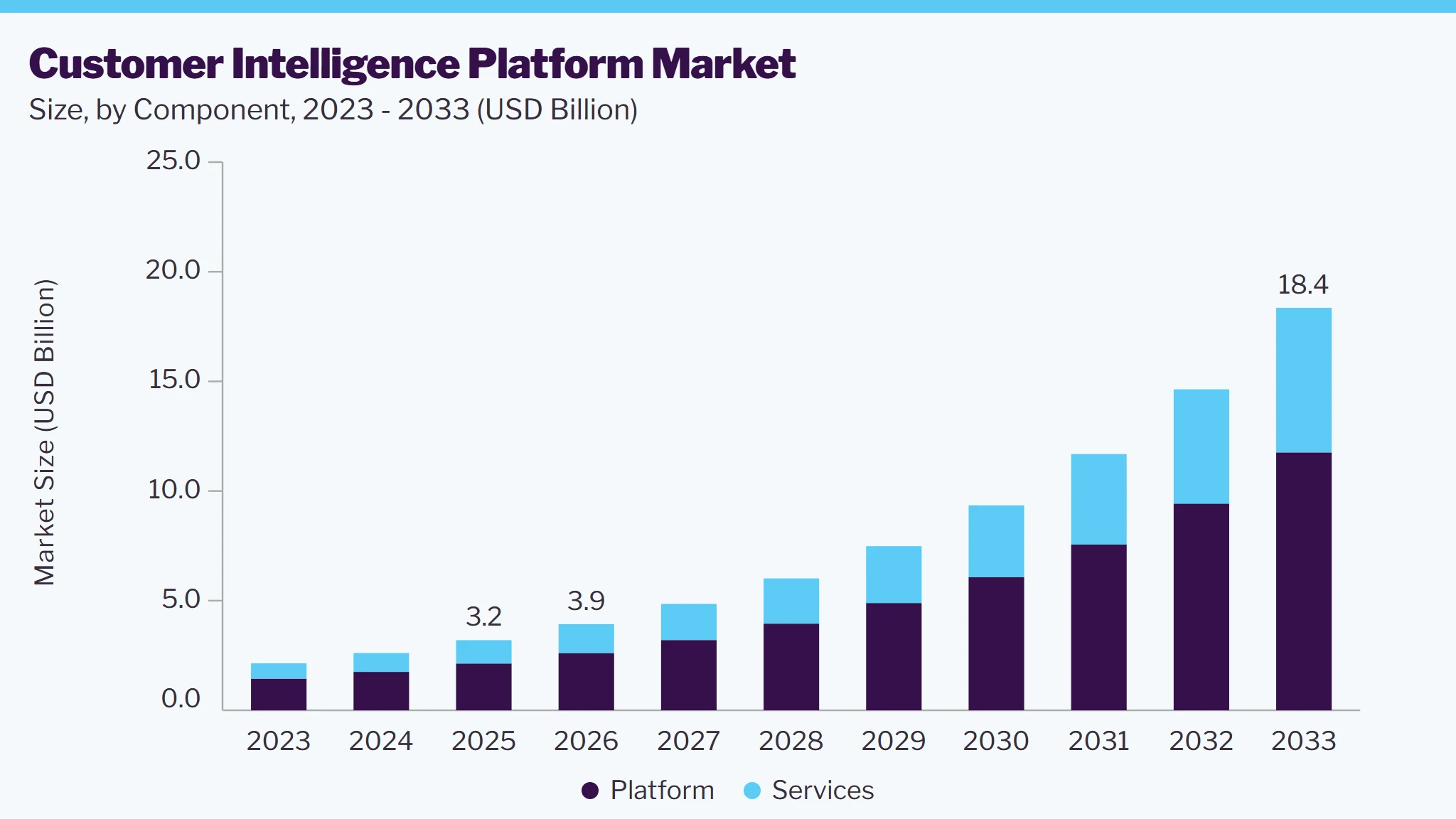
The global customer intelligence platform market size was valued at USD 3.2 billion in 2025 and is projected to grow from USD 3.9 billion in 2026 to USD 18.4 billion by 2033, at a CAGR of 24.6% from 2026 to 2033. North America dominated the market, accounting for a revenue share of 36.8% in 2025. This growth is driven by the increasing adoption of omnichannel customer engagement strategies.
 Source: Grand View Research, IR Documents, Primary Interviews, Paid DatabasesTo learn more about this report,
 Download Free Sample Report
Key Market Trends & Insights
- By component: Platform segment dominated the market, with a revenue share of 66.7% in 2025.
- By data channel: Web led the market and accounted for a share of 23.4% in 2025.
- By application: Customer experience management segment dominated the market, with a revenue share of 22.1% in 2025.
- By deployment: Cloud segment dominated the market, with a revenue share of 55.3% in 2025.
- By enterprise size: Large enterprises segment dominated the market, with a revenue share of 58.4% in 2025.
Regional Highlights
- Largest regional market: North America (36.8% revenue share, 2025)
- Fastest-growing regional market: Asia Pacific (highest CAGR, 2026-2033)
- By country: The U.S. held the largest market share in 2025.
Market Size & Forecast
- Market size in 2025: USD 3.2 Billion
- Estimated market size in 2026: USD 3.9 Billion
- Projected market size by 2033: USD 18.4 Billion
- CAGR (2026-2033): 24.6%
Three ways to get this report
Buy it, customize it, or ask a question.Ask an Analyst
Analyst response in 1 business day
- AccessReport author, directly
- Reply timeWithin 1 working day
- No sales callDirect answer only
- FormatEmail reply
- CostFree, no cost
Get the Full Report
What the study covers
- FormatsPDF · Excel · Dashboard
- Timeline2026–2033 annual, 2025 base
- Coverage20+ countries, 5 regions
- Companies10+ key players profiled
Customize the Report
20% free customization
- IncludeCountries, segments, points
- TailorTo your product definition
- ExtendDeeper competitor detail
- OrA fully bespoke study
- Turnaround5–10 working days
CIPs aggregate and analyze data from various customer touchpoints, enabling companies to gain deeper insights into customer behavior, preferences, and trends. This holistic view helps businesses enhance customer engagement, personalize marketing efforts, and ultimately drive growth and loyalty.Companies are increasingly recognizing that understanding and improving customer experience is crucial for differentiation in a highly competitive market. This need has been amplified by the digital transformation wave, where businesses are leveraging technology to meet the evolving expectations of digital-savvy customers. Additionally, advancements in artificial intelligence (AI) and machine learning (ML) have significantly enhanced the capabilities of customer intelligence platforms, allowing for more sophisticated data analysis and actionable insights.
 To learn more about this report, Download Free Sample Report
Further, the rising adoption of omnichannel strategies. Customers today interact with brands across multiple channels, including social media, mobile apps, websites, and physical stores. Customer intelligence platforms enable businesses to consolidate data from these diverse sources, providing a unified view of the customer journey. This comprehensive perspective is essential for delivering consistent and personalized experiences across all touchpoints.
As AI and ML technologies continue to evolve, customer intelligence platforms can offer more accurate predictions of customer behavior and trends, allowing businesses to proactively address customer needs and preferences. Furthermore, the increasing adoption of Internet of Things (IoT) devices presents a new frontier for customer intelligence, as these devices generate vast amounts of data that can be leveraged to gain deeper insights into customer habits and preferences.
Businesses in regions including Asia-Pacific and Latin America continue to digitalize, there is a growing demand for sophisticated customer intelligence solutions. These markets offer substantial growth potential for customer intelligence platform providers, particularly as local businesses seek to compete on a global scale by enhancing their customer engagement strategies.
Market Dynamics
The customer intelligence platform market is experiencing significant growth as organizations increasingly seek to unify customer data from multiple touchpoints to gain a comprehensive understanding of consumer behavior, preferences, and engagement patterns. Businesses across retail, financial services, telecommunications, healthcare, and media are deploying these platforms to consolidate data from websites, mobile applications, CRM systems, social media, and transaction records into actionable customer profiles. The growing emphasis on personalized marketing, customer retention, and omnichannel engagement is driving demand for platforms that deliver real-time insights and predictive customer analytics. Additionally, advancements in artificial intelligence, machine learning, and data processing technologies are enabling organizations to generate more accurate customer segmentation, behavioral forecasting, and next-best-action recommendations.
The increasing investment in smart city development is driving the customer intelligence platform market. Governments and urban planners are investing heavily in intelligent transportation systems, digital public infrastructure, connected utilities, and sustainable urban development projects. Smart buildings are becoming a foundational element within these broader smart city ecosystems. Customer intelligence platform solutions help integrate buildings with urban infrastructure networks through real-time data exchange, digital management systems, and automated operational coordination. This enables more efficient management of utilities, mobility, public safety, and environmental monitoring across urban spaces. As cities continue modernizing infrastructure through digital transformation, the role of Customer intelligence platform platforms within connected urban ecosystems continues to expand.
Data privacy and regulatory compliance challenges are constraining growth in the customer intelligence platform market by limiting the scope of customer information organizations can collect, process, and use for analytical purposes. Customer intelligence platforms depend on extensive behavioral, transactional, demographic, and interaction data to generate meaningful business insights, yet increasingly stringent privacy requirements reduce unrestricted access to this information. Organizations must implement complex consent management processes, data minimization practices, and lawful processing mechanisms before customer information can be incorporated into analytical models. These additional governance requirements increase implementation complexity while slowing customer intelligence initiatives across multiple industries. As regulatory obligations continue expanding across global markets, organizations face greater operational constraints when deploying customer intelligence platforms.
The increasing demand for sentiment and voice-of-customer analytics is driving market growth in the customer intelligence platform market as organizations place greater emphasis on understanding customer emotions, expectations, and perceptions throughout the entire customer journey. Modern consumer’s express opinions across surveys, reviews, social interactions, chat conversations, emails, contact centers, and digital communities, creating valuable qualitative information that extends beyond traditional transactional data. Customer intelligence platforms aggregate these diverse feedback sources and convert them into structured insights that reveal customer satisfaction levels, recurring concerns, and emerging preferences. Organizations use these insights to improve products, refine services, and strengthen customer engagement strategies with greater precision. The growing importance of customer-centric business models continues to accelerate the adoption of advanced customer intelligence platforms.
Analyst Perspective
The customer intelligence platform market is increasingly defined by an organization's ability to convert fragmented customer interactions into meaningful business outcomes rather than simply aggregating data. As customer acquisition costs continue to rise and brand loyalty becomes more difficult to maintain, enterprises are prioritizing platforms that improve customer lifetime value through deeper behavioral understanding and timely engagement. Competitive advantage is shifting toward vendors that can balance advanced analytical capabilities with responsible data governance, enabling businesses to deliver highly personalized experiences while complying with evolving privacy regulations. Over the long term, customer intelligence platforms are expected to become a strategic foundation for marketing, sales, and customer service, enabling organizations to make faster, evidence-based decisions across the entire customer lifecycle.
Component Insights
Based on component, the platform segment led the market with the largest revenue share of 66.7% in 2025. The increasing need for personalized customer experiences is a primary driver of the customer intelligence platform market. As businesses recognize the value of customer-centric strategies, the demand for sophisticated platforms that can analyze vast amounts of data to provide actionable insights grows. Customer intelligence platforms enable companies to aggregate data from various sources, analyze customer behavior, and predict future trends. This capability is crucial in tailoring marketing efforts, improving customer service, and fostering customer loyalty. As a result, businesses across various sectors, including retail, finance, and healthcare, are investing heavily in customer intelligence platforms to gain a competitive edge by understanding and anticipating customer needs more effectively.
The service segment is expected to grow at a significant rate during the forecast period. The growing complexity of data management and the need for expert insights are key factors driving the growth of the customer intelligence services market. As businesses accumulate vast amounts of customer data from various touchpoints, managing and extracting valuable insights from this data becomes increasingly challenging. Customer intelligence services, which include consulting, implementation, and managed services, provide the necessary expertise and support to help organizations effectively utilize their customer intelligence services. These services ensure that businesses can maximize the potential of their customer intelligence data, leading to more informed decision-making and strategic planning.
Data Channel Insights
Based on data channel, the web segment led the market with the largest revenue share of 23.4% in 2025. The growth of the web segment in the market is driven by the increasing digitization of consumer interactions and the proliferation of online platforms. With the widespread use of the internet, businesses are capturing vast amounts of data from websites, social media, e-commerce platforms, and online forums. This data provides valuable insights into customer behavior, preferences, and trends, enabling companies to tailor their marketing strategies and improve customer engagement.
The call center segment is expected to grow at a significant rate during the forecast period. The call center segment of the market is experiencing growth driven by the increasing importance of customer service in differentiating brands. Call centers remain a crucial touchpoint for customer interactions, handling a wide range of inquiries, complaints, and support requests. The data generated from these interactions is invaluable for understanding customer pain points, preferences, and satisfaction levels.
Application Insights
Based on application, the customer experience management segment led the market with the largest revenue share of 22.1% in 2025. The increasing importance of customer-centric strategies in businesses across various sectors is driving the demand for customer experience management applications. Companies are recognizing that delivering exceptional customer experiences is a crucial differentiator in a competitive market. This shift is driven by several key factors, including the rising expectations of consumers for personalized and seamless interactions with brands. Customers today demand a high level of service and engagement, expecting businesses to understand their preferences and respond to their needs promptly. As a result, organizations are investing heavily in CEM solutions to analyze customer feedback, monitor interactions, and tailor services to enhance satisfaction and loyalty.
The personalized recommendation segment is expected to grow at a significant rate during the forecast period. The market for personalized recommendations is booming as businesses increasingly recognize the value of offering tailored suggestions to enhance customer engagement and drive sales. Personalized recommendation systems leverage data analytics and AI to analyze customer behavior, preferences, and purchase history, enabling companies to deliver highly relevant and individualized product or service recommendations. This personalized approach not only improves the customer experience by making interactions more meaningful but also significantly boosts conversion rates and revenue for businesses.
Deployment Insights
Based on deployment, the cloud segment led the market with the largest revenue share of 55.3% in 2025. The growth of the cloud segment in the Customer Intelligence Platform (CIP) market is primarily driven by the increasing adoption of cloud computing across industries. Businesses are increasingly recognizing the benefits of cloud-based solutions, such as scalability, cost-effectiveness, and ease of deployment. Cloud-based CIP platforms enable organizations to access and analyze vast amounts of customer data in real time, allowing for more accurate and timely insights. This real-time data processing capability is crucial for businesses looking to enhance customer experiences, personalize marketing efforts, and optimize operational efficiencies.
The on-premise segment is expected to grow at a significant rate during the forecast period. The on-premise segment is driven by the need for greater control and security over customer data. Many organizations, particularly those in highly regulated industries such as finance, healthcare, and government, prefer on-premise solutions due to concerns about data privacy and compliance. On-premise CIPs allow these organizations to maintain direct oversight of their data, ensuring that it is stored and managed in accordance with internal policies and regulatory requirements. This level of control is crucial for businesses that handle sensitive customer information and need to adhere to strict data protection standards.
Enterprise size Insights
Based on enterprise size, the large enterprises segment led the market with the largest revenue share of 58.4% in 2025. In large enterprises, the adoption of customer intelligence platforms is driven by the need for advanced data analytics and comprehensive customer insights to maintain a competitive edge in a rapidly evolving market. Large organizations typically have vast amounts of customer data collected from various touchpoints, including online interactions, in-store visits, and customer service engagements. CIP solutions help these enterprises to consolidate and analyze this data to gain a 360-degree view of their customers. This holistic understanding enables large enterprises to personalize marketing efforts, optimize product offerings, and improve customer service, ultimately driving higher customer satisfaction and loyalty.
The SMEs segment is expected to grow at a significant rate over the forecast period. The Customer Intelligence Platform (CIP) market growth within SMEs is primarily driven by the increasing need for data-driven decision-making and enhanced customer engagement. SMEs are recognizing the value of leveraging customer data to gain insights into customer behavior, preferences, and purchasing patterns. With the rise of digital transformation, even small businesses are now able to access and utilize advanced analytics tools that were once reserved for larger enterprises.
End-use Insights
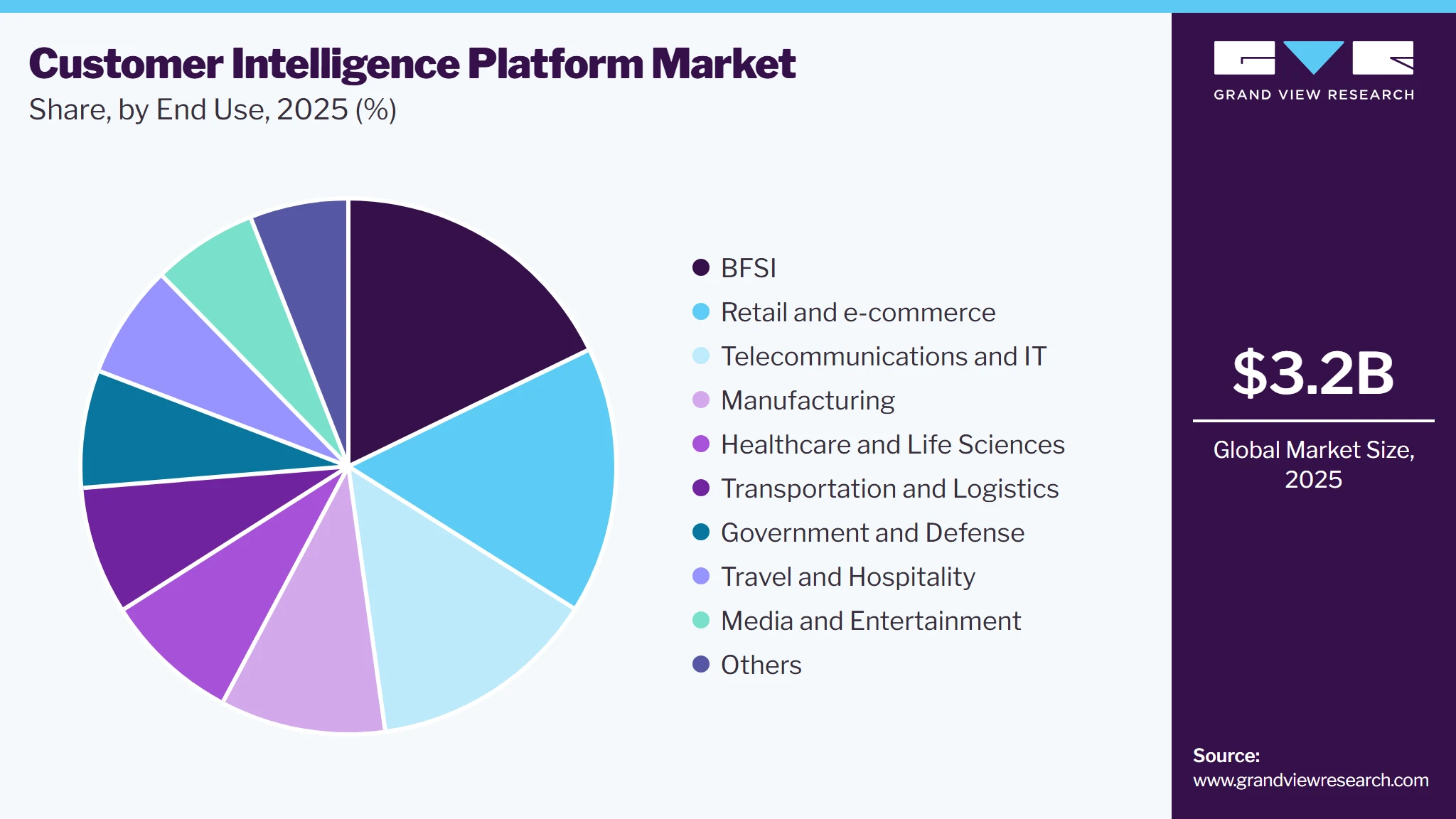
Based on end use, BFSI segment led the market with the largest revenue share of 17.8% in 2025. The banking and financial institutes are leveraging customer experience platforms to gather and analyze customer data, enabling them to offer tailored products and services that meet the specific needs and preferences of their clients. This personalized approach not only enhances customer satisfaction and loyalty but also boosts cross-selling and up-selling opportunities. Additionally, the regulatory environment in the BFSI sector is becoming increasingly stringent, necessitating robust data management and analysis capabilities. CIP solutions help financial institutions comply with regulations by providing comprehensive insights into customer behavior, transactions, and potential risks, thereby enhancing their ability to detect and prevent fraud.
 To learn more about this report, Download Free Sample Report
The media and entertainment segment are expected to grow at a significant rate during the forecast period. In the media and entertainment industry, the adoption of customer intelligence platforms is being driven by the need for enhanced audience engagement and personalized content delivery. The proliferation of digital content and the increasing competition among media providers necessitate a deeper understanding of audience preferences and consumption patterns. CIP solutions enable media companies to collect and analyze data from various sources, such as social media, streaming platforms, and online surveys, to gain comprehensive insights into audience behavior.
Regional Insights
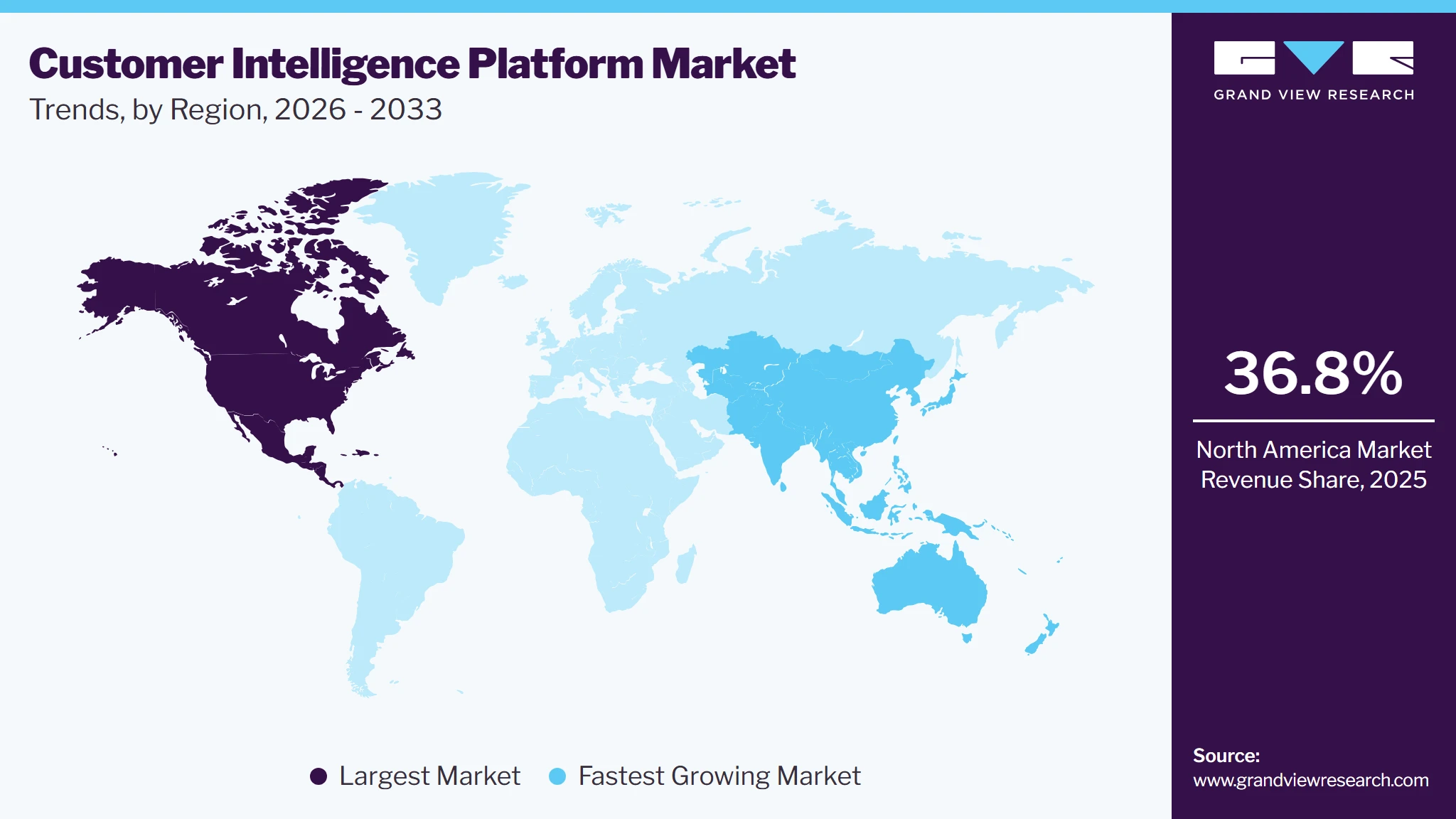
North America dominated the global customer intelligence platform market with the largest revenue share of 36.8% in 2025. The Customer Intelligence Platform (CIP) market in North America is witnessing significant growth driven by the rapid adoption of advanced technologies and data analytics. Businesses in the region are increasingly recognizing the value of customer data in enhancing customer experiences and driving business strategies. Additionally, the high internet penetration and the proliferation of connected devices generate vast amounts of customer data, further propelling the demand for CIP solutions in the region.
 To learn more about this report, Download Free Sample Report
U.S. Customer Intelligence Platform Market Trends
The customer intelligence platform market in the U.S. held the largest share in the North America region in 2025. The presence of major tech giants and a well-established digital infrastructure in the U.S. supports the widespread implementation of CIP solutions. Furthermore, the competitive business environment encourages companies to leverage customer intelligence to gain a competitive edge, optimize marketing efforts, and improve customer retention.
Asia Pacific Customer Intelligence Platform Market Trends
The customer intelligence platform industry in the Asia Pacific is anticipated to grow at the fastest CAGR from 2026 to 2033. In the Asia Pacific region, the Customer Intelligence Platform (CIP) market is experiencing rapid growth due to the increasing digital transformation across various industries. Countries such as China, India, and Japan are at the forefront of adopting advanced analytics and artificial intelligence technologies to harness customer data for strategic decision-making. The burgeoning e-commerce sector in the region generates a massive amount of customer data, which necessitates the use of CIP solutions to analyze and utilize this data effectively.
Europe Customer Intelligence Platform Market Trends
The market in Europe is expected to grow at a CAGR of 27.9% from 2024 to 2030. In Europe, the market is being driven by a combination of regulatory frameworks and technological advancements. The General Data Protection Regulation (GDPR) has heightened the focus on data privacy and protection, prompting businesses to adopt CIP solutions that ensure compliance while still enabling them to gather and analyze customer data efficiently. This regulatory environment is encouraging companies to invest in secure and transparent data management practices, which is, in turn, boosting the adoption of CIP technologies.
Key Customer Intelligence Platform Company Insights
Some of the key players operating in the market include Acxiom LLC; Adobe; Google LLC; Informatica; IBM Corporation; iManage; Microsoft Corporation; Oracle Corporation; Proxima; SAP SE; SAS Institute Inc.; Salesforce.com, inc.; and Teradata among others. The companies are focusing on various strategic initiatives, including new product development, partnerships & collaborations, and agreements to gain a competitive advantage over their rivals. The following are some instances of such initiatives.
-
In May 2024, Acxiom LLC, a global customer intelligence company, announced a strategic partnership with ActionIQ, a customer data platform provider. This collaboration leverages the strengths of both companies to revolutionize the way brands and marketers collect, analyze, and utilize customer data. By combining their expertise, Acxiom and ActionIQ aim to enhance data-driven marketing strategies and deliver seamless, personalized customer experiences.
-
In May 2024, iManage, an AI-powered knowledge work platform provider and vLex, a legal intelligence platform company announced a strategic partnership to integrate their platforms. This collaboration aimed at enhancing access to comprehensive legal insights, streamlining legal research and workflow for users. This move signifies a major advancement in customer intelligence, empowering legal professionals with more efficient and effective tools for knowledge management and decision-making.
-
In December 2023, Proxima, a predictive data intelligence platform introduced an innovative AI-driven business health check tool that provides in-depth insights into profitable unit economics, capital efficiency, profitability, and overall performance. By eliminating the need for a dedicated data team, it empowers brands to thoroughly analyze their data, optimize efficiency, reduce customer acquisition costs, and maximize customer lifetime value.
Key Customer Intelligence Platform Companies
The following are the leading companies in the customer intelligence platform market.
-
Acxiom LLC
-
Adobe
-
Google LLC
-
IBM Corporation
-
iManage
-
Informatica
-
Microsoft Corporation
-
Oracle Corporation
-
Proxima
-
Salesforce.com, inc.
-
SAP SE
-
SAS Institute Inc.
-
Teradata
Competitive Benchmarking
Category
Operating Strategies
Competitive Edge
Weakness
Established Players (Salesforce; Adobe; SAP; Oracle; SAS Institute)
- Mature players focus on delivering unified customer intelligence platforms that consolidate customer data from CRM systems, marketing channels, commerce platforms, and customer service applications into a single analytical environment. Their strategies emphasize AI-powered customer profiling, predictive analytics, real-time segmentation, and integration with enterprise applications to help organizations improve customer engagement, retention, and revenue.
- These companies benefit from extensive enterprise customer bases, mature AI and analytics capabilities, and comprehensive business application ecosystems that simplify enterprise-wide customer data utilization. Their ability to combine customer intelligence with sales, marketing, commerce, and service platforms enables organizations to generate actionable insights across the entire customer lifecycle.
- Large enterprise platforms often involve complex implementation processes, extensive data preparation, and significant organizational change before delivering full business value. Managing customer data across multiple enterprise systems can also increase operational complexity and require continuous governance to maintain data consistency.
Emerging Players (Treasure Data; Amperity; BlueConic; mParticle; ActionIQ)
- Emerging players focus on composable customer intelligence architectures, real-time data activation, privacy-centric identity resolution, and AI-driven customer insights that support modern digital marketing strategies. Their strategies prioritize rapid deployment, flexible API integrations, first-party data optimization, and advanced audience intelligence to help businesses personalize customer experiences across multiple digital channels.
- These companies provide agile platforms that enable organizations to unify fragmented customer data more quickly while supporting faster marketing activation and personalization initiatives. Their strong focus on real-time analytics, identity resolution, and privacy-first data management allows businesses to respond more effectively to changing customer behaviors and evolving data regulations.
- Emerging providers generally have smaller enterprise customer networks and fewer end-to-end business application integrations than larger software vendors. Limited global brand recognition, evolving partner ecosystems, and competition from established enterprise platform providers can slow adoption among large multinational organizations.
Customer Intelligence Platform Market Report Scope
Report Attribute
Details
Market size in 2025
USD 3.2 billion
Estimated market size in 2026
USD 3.9 billion
Projected market size by 2033
USD 18.4 billion
Growth rate
CAGR of 24.6% from 2026 to 2033
Base year for estimation
2025
Historical data
2021 - 2024
Forecast period
2026 - 2033
Quantitative units
Revenue in USD million/billion and CAGR from 2026 to 2033
Report coverage
Revenue forecast, company market share analysis, competitive landscape, growth factors, and trends
Segments covered
Component, data channel, application, deployment, enterprise size, end use, region
Regional scope
North America; Europe; Asia Pacific; Latin America; MEA
Country scope
U.S.; Canada; Mexico; Germany; UK; France; China; Japan; India; South Korea; Australia; Brazil; Saudi Arabia; South Africa; UAE
Key companies profiled
Acxiom LLC; Adobe; Google LLC; Informatica; IBM Corporation; iManage; Microsoft Corporation; Oracle Corporation; Proxima; SAP SE; SAS Institute Inc.; Salesforce.com, inc.; Teradata
Customization scope
Free report customization (equivalent up to 8 analysts' working days) with purchase. Addition or alteration to country, regional & segment scope.
Pricing and purchase options
Avail customized purchase options to meet your exact research needs. Explore purchase options
Global Customer Intelligence Platform Market Report Segmentation
This report forecasts revenue growth at the global, regional, and country levels and provides an analysis of the latest industry trends from 2021 to 2033 in each of the sub-segments. For this study, Grand View Research has segmented the global customer intelligence platform market report based on component, data channel, application, deployment, enterprise size, end-use, and region:
-
Customer Intelligence Platform Component Outlook (Revenue, USD Billion, 2021 - 2033)
-
Platform
-
Services
-
-
Customer Intelligence Platform Data Channel Outlook (Revenue, USD Billion, 2021 - 2033)
-
Web
-
Social Media
-
Smartphone
-
Email
-
Store
-
Call Centre
-
Others
-
-
Customer Intelligence Platform Application Outlook (Revenue, USD Billion, 2021 - 2033)
-
Customer Data Collection and Management
-
Customer Segmentation and Targeting
-
Customer Experience Management
-
Customer Behaviour Analytics
-
Omnichannel Marketing
-
Personalized Recommendation
-
Others
-
-
Customer Intelligence Platform Deployment Outlook (Revenue, USD Billion, 2021 - 2033)
-
On-premise
-
Cloud
-
-
Customer Intelligence Platform Enterprise Size Outlook (Revenue, USD Billion, 2021 - 2033)
-
SMEs
-
Large Enterprises
-
-
Customer Intelligence Platform End Use Outlook (Revenue, USD Billion, 2021 - 2033)
-
Banking, Financial Services, and Insurance (BFSI)
-
Retail and e-commerce
-
Telecommunications and IT
-
Manufacturing
-
Transportation and Logistics
-
Government and Defense
-
Healthcare and Life Sciences
-
Media and Entertainment
-
Travel and Hospitality
-
Others
-
-
Customer Intelligence Platform Regional Outlook (Revenue, USD Billion, 2021 - 2033)
-
North America
-
U.S.
-
Canada
-
Mexico
-
-
Europe
-
UK
-
Germany
-
France
-
-
Asia Pacific
-
China
-
India
-
Japan
-
Australia
-
South Korea
-
-
Latin America
-
Brazil
-
-
Middle East & Africa (MEA)
-
UAE
-
Saudi Arabia
-
South Africa
-
-
Research Methodology
The customer intelligence platform market figures in this report are based on a proven research process that combines executive interviews with secondary research from proprietary databases, company filings, and recognized regulatory and institutional sources. Market size is built through value-chain sizing - reconciling supply-side and demand-side estimates - and triangulated with bottom-up and top-down approaches. Every estimate passes multiple levels of expert validation before publication, with each customer intelligence platform segment quantified using the revenue-capture definitions in the table below.
Segment Definition
Segment - Component
Revenue capture definition
Platform
The largest solution segment, capturing market value through platforms that digitize property management, leasing, tenant engagement, facility operations, asset performance, and real estate transactions. Vendors increasingly monetize through subscription-based licensing, integrated analytics, AI-driven automation, and modular software offerings tailored to different real estate stakeholders.
Services
Commercial opportunities arise from implementation, system integration, data migration, consulting, technical support, managed services, and digital transformation projects. Service providers assist property owners and managers in maximizing software utilization while streamlining operational workflows across real estate portfolios.
Segment - Data Channel
Revenue capture definition
Web
Revenue is captured through customer intelligence capabilities that collect and analyze website visits, search behavior, product interactions, browsing paths, and conversion activity. Spending is directed toward web analytics, behavioral tracking, journey analysis, and personalization tools that help organizations turn digital interactions into actionable customer insights.
Social Media
Value is captured through platforms that monitor social engagement, customer sentiment, comments, interactions, influencer activity, and audience behavior across social networks. Demand is driven by the need to combine social signals with customer profiles and marketing data for segmentation, engagement, campaign optimization, and sentiment-based decision-making.
Smartphone
Smartphone-based intelligence generates value from mobile application activity, device interactions, location signals where permitted, purchase behavior, push-notification engagement, and mobile browsing patterns. Investment centers on mobile customer analytics and personalization capabilities that allow organizations to understand and respond to customers through highly frequent mobile interactions.
Email
Email captures customer intelligence through campaign responses, open and engagement behavior, click activity, purchase responses, and communication preferences. Revenue is associated with analytics and automation capabilities that use these signals for customer segmentation, campaign optimization, retention analysis, and personalized communication.
Store
Store-based customer intelligence derives value from point-of-sale transactions, loyalty activity, purchase frequency, product preferences, footfall patterns, and interactions with sales personnel. Spending is focused on connecting physical-store behavior with digital customer records to improve merchandising, promotions, customer retention, and personalized offers.
Call Centre
Call-center intelligence captures value by analyzing customer inquiries, call histories, service requests, complaints, agent interactions, and, where permitted, voice or text records. Organizations invest in analytics and intelligence tools to identify recurring issues, customer sentiment, service quality patterns, and opportunities for retention or cross-selling.
Others
Other channels include messaging applications, connected devices, kiosks, chatbots, self-service portals, and emerging customer touchpoints. Revenue is generated through intelligence platforms that consolidate these less-traditional interaction signals with broader customer profiles and behavioral datasets.
Segment - Application
Revenue capture definition
Customer Data Collection and Management
Revenue is derived from tools that classify customers according to demographics, behavior, purchase history, preferences, value, propensity, and engagement patterns. Organizations invest in these capabilities to identify distinct customer groups and deliver more precisely targeted campaigns, offers, and retention initiatives.
Customer Segmentation and Targeting
Customer experience management captures value through platforms that monitor interactions across touchpoints, identify friction points, measure satisfaction, and coordinate improvements to customer experiences. Spending is influenced by organizations seeking to connect customer feedback and behavioral data with operational actions across service, sales, and marketing functions.
Customer Experience Management
This segment monetizes analytical capabilities that identify purchasing patterns, engagement trends, churn signals, product affinities, customer journeys, and behavioral changes. Demand stems from the need to translate large volumes of customer activity into predictions and actionable insights for retention, conversion, and revenue optimization.
Customer Behavior Analytics
Omnichannel marketing captures revenue by coordinating customer intelligence across web, mobile, email, social media, stores, call centers, and other communication channels. Value is created through unified campaign orchestration, cross-channel attribution, audience management, and consistent customer engagement.
Omnichannel Marketing
Revenue is captured through recommendation engines that use customer profiles, browsing behavior, transaction history, preferences, and contextual signals to determine relevant products, services, or content. Commercial demand is particularly linked to increasing conversion, cross-selling, upselling, content engagement, and customer retention through individualized experiences.
Personalized Recommendation
Other components include customer feedback analytics, sentiment analysis, loyalty intelligence, predictive analytics, customer journey orchestration, identity resolution, and real-time decisioning. These capabilities contribute to platform value by extending customer intelligence beyond core data management and segmentation functions.
Others
Revenue is derived from tools that classify customers according to demographics, behavior, purchase history, preferences, value, propensity, and engagement patterns. Organizations invest in these capabilities to identify distinct customer groups and deliver more precisely targeted campaigns, offers, and retention initiatives.
Segment - Deployment
Revenue capture definition
On-Premise
On-premise deployment generates revenue through software licenses, dedicated infrastructure, implementation, customization, maintenance, and technical support installed within the customer’s own environment. Demand is concentrated among organizations requiring direct control over customer data, internal systems, security policies, or legacy infrastructure integration.
Cloud
Cloud deployment captures value through subscription-based platforms, hosted analytics, scalable data processing, managed infrastructure, and continuously updated customer intelligence capabilities. Its commercial model is closely associated with rapid implementation, flexible capacity, integration with cloud applications, and access to advanced analytics without extensive dedicated infrastructure.
Segment - Enterprise Size
Revenue capture definition
SMEs
SMEs generate platform demand through comparatively focused deployments that address customer segmentation, marketing automation, personalization, retention, and customer analytics, without extensive internal data infrastructure. Revenue capture typically favors subscription and modular offerings that allow smaller organizations to scale functionality as their customer bases and digital operations expand.
Large Enterprises
Large enterprises incur significant spending on customer intelligence due to large customer datasets, numerous interaction channels, multiple brands or business units, and complex technology environments. Investment commonly encompasses enterprise-wide data integration, advanced analytics, omnichannel orchestration, AI-driven personalization, governance, and integration with CRM and marketing ecosystems.
Segment - End Use
Revenue capture definition
BFSI
BFSI organizations use customer intelligence to analyze financial behavior, transaction patterns, product usage, service interactions, churn indicators, and customer value. Revenue is captured through platforms that support personalized financial product recommendations, customer retention, targeted marketing, service optimization, and relationship management.
Retail and e-commerce
Retail and e-commerce generate strong demand for customer intelligence, including transaction histories, browsing behavior, cart activity, loyalty program data, product affinities, and promotional responses. Spending is directed toward recommendation engines, segmentation, personalization, customer journey analytics, and omnichannel engagement to improve purchasing and retention outcomes.
Telecommunications and IT
Telecommunications and IT companies use customer intelligence to analyze subscriber usage, service interactions, plan preferences, churn patterns, digital engagement, and support activity. Platform value is captured through churn prediction, personalized plan recommendations, targeted promotions, customer-service optimization, and cross-selling of communication or technology services.
Manufacturing
Manufacturing organizations apply customer intelligence to understand distributor relationships, direct buyers, aftermarket customers, product usage, service interactions, and purchasing cycles. Revenue is driven by analytics that improve account targeting, aftermarket sales, product recommendations, customer retention, and demand planning by leveraging customer behavior.
Transportation and Logistics
Transportation and logistics companies use customer intelligence across booking, shipment, delivery, service, loyalty, and communication interactions. Spending centers on understanding customer preferences, optimizing communications, identifying service issues, improving retention, and tailoring logistics or transportation offerings to customer requirements.
Government and Defense
Government and defense organizations use customer or constituent intelligence for citizen service interactions, communication management, feedback analysis, service utilization, and engagement monitoring, subject to applicable privacy and security requirements. Revenue is captured through secure intelligence, analytics, data integration, and engagement platforms designed for complex public-sector environments.
Healthcare and Life Sciences
Healthcare and life sciences organizations apply customer intelligence to patient or member engagement, appointment behavior, service interactions, communication preferences, and engagement with healthcare products. Spending is directed toward personalization, engagement analytics, retention, experience management, and compliant integration of customer or patient information.
Media and Entertainment
Media and entertainment companies derive value from analyzing viewing, listening, reading, subscription, advertising, content-search, and engagement behavior. Customer intelligence platforms are used for content recommendations, audience segmentation, subscription retention, targeted advertising, and individualized experiences across digital channels.
Travel and Hospitality
Travel and hospitality organizations use customer intelligence across bookings, stays, searches, loyalty programs, reviews, service interactions, and travel preferences. Revenue is captured through personalization, targeted offers, loyalty optimization, cross-selling, customer-experience management, and demand-oriented engagement.
Others
Healthcare organizations use customer intelligence for patient engagement, appointment interactions, service preferences, communication behavior, satisfaction analysis, and retention-related activities. Platform spending focuses on improving patient experiences, personalizing communications, coordinating engagement, and extracting actionable insights from interactions across healthcare touchpoints.
Estimation Model
Layer
Question
Analysis
Customer Data Consolidation Layer
What customer information is brought together for intelligence generation?
Identify the diverse sources of customer data that organizations consolidate, including CRM records, website interactions, mobile applications, social media engagement, transaction histories, customer support logs, loyalty programs, marketing campaigns, and connected devices. This layer evaluates how fragmented customer information is unified to create comprehensive customer profiles that support a complete understanding of customer behavior and preferences.
Insight Generation Layer
How is raw customer data transformed into actionable business intelligence?
Assess the analytical capabilities used to convert customer data into meaningful insights, including customer segmentation, behavioral analytics, propensity modeling, churn prediction, lifetime value analysis, sentiment analysis, and next-best-action recommendations. The effectiveness of a customer intelligence platform depends on its ability to continuously process data, identify patterns, and deliver timely insights that support strategic and operational decision-making.
Customer Engagement Orchestration Layer
How are intelligence-driven insights activated across customer touchpoints?
Analyze how organizations operationalize customer intelligence by integrating platforms with marketing automation, sales applications, customer service systems, e-commerce platforms, advertising technologies, and personalization engines. Businesses utilize these insights to deliver targeted campaigns, personalized product recommendations, optimized customer journeys, proactive customer support, and consistent omnichannel experiences that strengthen customer relationships.
Business Growth & Monetization Layer
How is commercial value generated from customer intelligence platforms?
Evaluate revenue generated through cloud subscriptions, enterprise software licensing, implementation services, AI-powered analytics modules, consulting, managed platform services, and premium data integration capabilities. Beyond platform sales, organizations realize value through improved customer acquisition, higher retention rates, increased cross-selling and upselling opportunities, optimized marketing spend, stronger customer loyalty, and enhanced revenue growth driven by data-informed customer engagement strategies.
Delivered Customizations
This report has been delivered with the following In-depth customizations
Client Request
Customization Delivered
Value Adds
Unified Customer Data & 360-Degree Customer View Trends
Conducted a focused analysis of customer intelligence platform adoption across retail, BFSI, telecommunications, travel, and e-commerce, covering customer data unification, identity resolution, behavioral profiling, and cross-channel interaction tracking.
Helps stakeholders identify high-value customer intelligence use cases, evaluate enterprise data unification trends, and assess commercialization opportunities in customer-centric decision-making platforms.
Customer Journey Analytics & Personalization Adoption Trends
Evaluated adoption trends for journey mapping, customer lifetime value analysis, churn prediction, next-best-action recommendations, and hyper-personalized engagement across digital and physical customer touchpoints.
Provides insights into evolving customer engagement strategies, retention improvement opportunities, and commercially attractive capabilities that enhance marketing effectiveness and customer loyalty.
Voice of Customer (VoC) Intelligence & Experience Management Opportunity Assessment
Assessed demand for platforms integrating customer feedback, surveys, contact center interactions, social listening, and sentiment analysis with AI-driven customer intelligence, along with challenges related to data privacy, fragmented customer information, and omnichannel analytics integration.
Supports investment and expansion strategies by identifying emerging customer experience opportunities, evaluating organizational readiness, and strengthening long-term growth potential in experience-led business transformation.
Frequently Asked Questions About This Report
The global customer intelligence platform market size was valued at USD 3.2 billion in 2025 and is estimated at USD 3.9 billion in 2026.
The global customer intelligence platform market is expected to grow at a CAGR of 24.6% from 2026 to 2033, reaching USD 18.4 billion by 2033.
Key factors include, increasing adoption of predictive analytics for marketing optimization, increasing demand for sentiment and voice-of-customer analytics, and increasing investment in smart city development.
North America dominated with 36.8% revenue share in 2025.
Asia Pacific is the fastest-growing region over the forecast period.
The platform segment led with a 66.7% revenue share in 2025, while services segment is the fastest-growing segment.
The web segment led with an 23.4% revenue share in 2025, while call centre segment is the fastest-growing segment.
Large enterprises segment led the market with the largest revenue share of 58.4% in 2025, while small & medium enterprises segment is the fastest-growing segment.
Key players operating in the customer intelligence platform market include Acxiom LLC; Adobe; Google LLC; Informatica; IBM Corporation; iManage; Microsoft Corporation; Oracle Corporation; Proxima; SAP SE; SAS Institute Inc.; Salesforce.com, inc.; Teradata
About the Author(s)
IT Services & Applications Research Team
Technology · IT Services & ApplicationsThis report was authored by the it services & applications research team at Grand View Research - comprising two research analysts, one senior research analyst, and one industry expert - with specialized expertise in the it services & applications segment of the technology industry. All findings are based on proprietary technology databases, executive interviews, and regulatory analysis, subject to internal peer review prior to publication.
Last Updated:
Speak to Analyst

Customize this report to your needs - add regions, segments, or data points, with 20% free customization.
Or view our licence options:


ISO 9001:2015 & 27001:2022 Certified
We are GDPR and CCPA compliant! Your transaction & personal information is safe and secure. For more details, please read our privacy policy.


