
- Home
- »
- Plastics, Polymers & Resins
- »
-
Cut Flower Packaging Market Size, Industry Report, 2033GVR Report cover
![Cut Flower Packaging Market Size, Share & Trends Report]()
Cut Flower Packaging Market (2025 - 2033) Size, Share & Trends Analysis Report By Material (Paper & Paperboard, Plastic, Metal, Jute), By Product (Sleeves, Wrapping Sheets, Boxes & Carton, Poles, Bags, Metal Stands), By Region, And Segment Forecasts
Market Size, 2024
$9.6BMarket Estimate, 2026
$10.2BMarket Forecast, 2033
$17.8BCAGR, 2025–2033
7.2%Cut Flower Packaging Market Summary
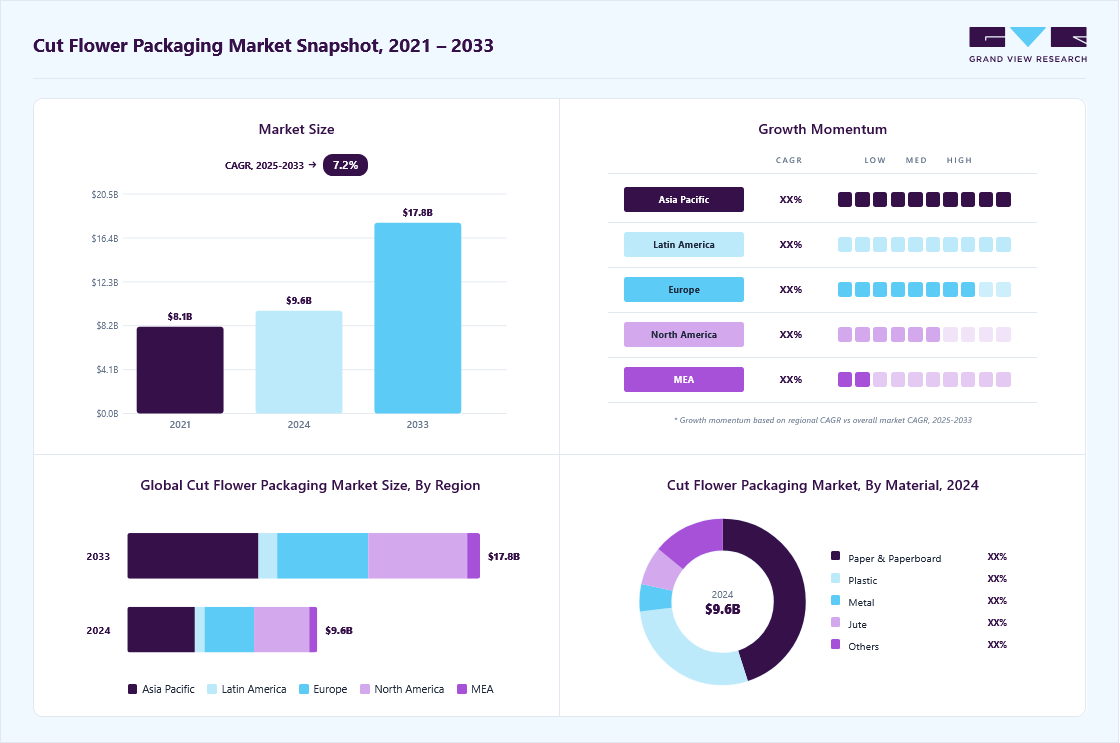
The global cut flower packaging market size was estimated at USD 9.59 billion in 2024 and is projected to reach USD 17.81 billion by 2033, growing at a CAGR of 7.2% from 2025 to 2033. The global cut flower packaging industry is driven by the growing demand for fresh flowers across retail and e-commerce channels, supported by expanding floriculture trade worldwide.
Key Market Trends & Insights
- Asia Pacific dominated the cut flower packaging industry with the largest revenue share of over 35.0% in 2024.
- The cut flower packaging industry in the U.S. is expected to grow at a substantial CAGR of 6.8% from 2025 to 2033.
- By material, the jute segment is expected to grow at a considerable CAGR of 7.7% from 2025 to 2033 in terms of revenue.
- By product, the boxes & carton segment is expected to grow at a considerable CAGR of 7.8% from 2025 to 2033 in terms of revenue.
Market Size & Forecast
- 2024 Market Size: USD 9.59 Billion
- 2033 Projected Market Size: USD 17.81 Billion
- CAGR (2025-2033): 7.2%
- Asia Pacific: Largest market in 2024
Three ways to get this report
Buy it, customize it, or ask a question.Ask an Analyst
A direct answer, usually in 1 working day
- AccessReport author, directly
- Reply timeWithin 1 working day
- No sales callDirect answer only
- FormatEmail reply
- CostFree, no cost
Get the Full Report
What the study covers
- FormatsPDF · Excel · Dashboard
- Timeline2025–2033 annual, 2024 base
- Coverage20+ countries, 5 regions
- Companies10+ key players profiled
Customize the Report
20% free customization
- IncludeCountries, segments, points
- TailorTo your product definition
- ExtendDeeper competitor detail
- OrA fully bespoke study
- Turnaround5–10 working days
In addition, rising consumer preference for sustainable and visually appealing packaging solutions enhances market growth. Flowers are central to celebrations such as weddings, anniversaries, birthdays, and corporate events, fueling steady demand for protective and aesthetic packaging solutions. The expansion of the event management and wedding industries, particularly in regions such as the Asia Pacific and North America, has amplified this need. For instance, according to the Government of India, India's wedding industry stands as the world's second-largest, hosting around 10.0 million weddings annually and commanding an estimated market size of USD 130.0 billion per year, positioning it as the fourth-largest industry in the country. This outlook drives bulk demand for cut flowers and decorative floral packaging. Similarly, florists and retailers in Western countries rely heavily on customized packaging, such as sleeves, wraps, and boxes, to enhance visual appeal and maintain freshness during transportation and display.The rapid expansion of online flower delivery services has significantly influenced the market. E-commerce players such as 1-800-Flowers, Interflora, and Bloom & Wild are investing in innovative, durable, and temperature-resistant packaging to ensure safe delivery of delicate flowers to consumers’ doorsteps. Packaging solutions now incorporate moisture-retaining materials, ventilation features, and corrugated protective inserts to prevent damage and dehydration during shipping. The convenience of ordering flowers online, combined with last-mile delivery optimization, has increased the global circulation of packaged flowers, driving demand for lightweight, recyclable, and cost-effective packaging formats suitable for courier transport.

Sustainability has become a defining trend in the cut flower packaging industry. Growing environmental awareness and regulations restricting single-use plastics have pushed manufacturers toward biodegradable, compostable, and recyclable materials. Brands are increasingly adopting paper-based wraps, plant-based films, and water-soluble coatings to replace conventional plastic packaging. For instance, European packaging suppliers have introduced compostable cellophane made from wood pulp and starch-based bioplastics to meet the EU’s circular economy goals. These eco-conscious initiatives not only help brands comply with environmental policies but also enhance their market appeal among eco-aware consumers, particularly in premium floral retail segments.
Innovations in packaging technology are further driving the growth of the cut flower packaging industry. Advanced materials that offer better breathability, humidity control, and ethylene absorption are increasingly being used to extend the shelf life of flowers during storage and transportation. Modified atmosphere packaging (MAP), anti-fog films, and moisture control sachets help maintain optimal conditions for flower freshness. For example, Dutch exporters, the largest players in the global flower trade, utilize temperature-controlled corrugated boxes with integrated hydration systems to preserve blooms during long-haul shipments. Such technological progress enables suppliers to reduce waste, enhance product quality, and cater to international markets, reinforcing the industry’s global expansion.
Market Dynamics
The global cut flower packaging industry is growing steadily due to the increasing demand for fresh flowers across retail, gifting, decoration, hospitality, and event management industries. Consumers are spending more on floral arrangements for occasions such as weddings, festivals, corporate events, birthdays, and seasonal celebrations, which is driving the need for attractive and protective flower packaging solutions. Packaging plays an important role in maintaining the freshness, appearance, and shelf life of cut flowers during transportation and storage. As international flower trade continues to expand, exporters and retailers are increasingly investing in advanced packaging materials such as sleeves, corrugated boxes, wraps, moisture-retaining packaging, and temperature-resistant solutions to reduce product damage and improve presentation quality.
Another important factor supporting market growth is the rapid expansion of online flower delivery platforms and organized floral retail chains. E-commerce businesses require durable and visually appealing packaging that can protect flowers during long-distance delivery while enhancing customer experience and brand value. In addition, growing consumer preference for sustainable and aesthetically designed packaging is encouraging manufacturers to develop recyclable paper packaging, biodegradable wraps, compostable films, and eco-friendly decorative materials. Advancements in packaging technology, cold-chain logistics, and moisture-control systems are also helping improve transportation efficiency and product freshness, further supporting the growth of the cut flower packaging industry globally.
One of the major restraints affecting the cut flower packaging industry is the high cost associated with maintaining flower quality during storage and transportation. Cut flowers are highly perishable products that require specialized packaging materials, temperature-controlled logistics, and moisture management systems to prevent wilting and physical damage. These additional handling and packaging requirements can significantly increase operational costs for growers, exporters, and retailers. Small and medium-sized flower businesses often face difficulties managing these expenses, especially in highly competitive and price-sensitive markets.
A major challenge in the cut flower packaging industry is developing packaging solutions that provide effective flower protection while also meeting growing sustainability expectations and aesthetic demands. Packaging must maintain freshness, control moisture, prevent mechanical damage, and preserve the visual attractiveness of flowers throughout transportation and retail display. At the same time, consumers and retailers are increasingly demanding environmentally friendly packaging materials that reduce plastic waste and support sustainable sourcing practices.
Market Concentration & Characteristics
The cut flower packaging industry operates within a highly time-sensitive value chain due to the perishable nature of flowers. Packaging solutions must ensure preservation of freshness, color, and fragrance from harvest to final sale. This drives demand for materials and designs that provide temperature regulation, moisture retention, and protection against mechanical damage.
The market is characterized by strong seasonality and event-based demand spikes. Major occasions such as Valentine’s Day, Mother’s Day, Christmas, and wedding seasons significantly influence production and packaging volumes. During these peak periods, packaging suppliers experience surge in orders for custom-printed wraps, decorative sleeves, and branded boxes. For instance, florists in North America and Europe witness up to a 40% rise in packaging demand around Valentine’s Day alone. This cyclical nature requires manufacturers to maintain flexible production capacities, efficient inventory management, and quick response systems to meet fluctuating demand.
Material Insights
The paper & paperboard segment recorded the largest market revenue share of over 45.0% in 2024.Paper and paperboard are among the most widely used materials in cut flower packaging due to their eco-friendliness, biodegradability, and ease of customization. They are commonly used in wrapping papers, corrugated boxes, and decorative sleeves that provide aesthetic appeal and sufficient protection during transportation. Kraft paper and coated paperboard are preferred for their strength and printability, allowing florists and retailers to add branding, color, and patterns. Government regulations promoting paper-based alternatives, such as the EU Single-Use Plastics Directive, have further boosted adoption.
Jute segment is expected to grow at the fastest CAGR of 7.7% during the forecast period. Jute, a natural fiber derived from plants, is increasingly used in cut flower packaging as part of the industry’s shift toward sustainable materials. It is commonly utilized in jute wraps, baskets, and bouquet holders, providing a rustic and natural look. Jute packaging enhances breathability, preventing flowers from rotting while maintaining an organic appeal suitable for eco-conscious customers. Its biodegradability and compostability make it a favored alternative in regions emphasizing environmental responsibility, such as Europe and North America.
Product Insights
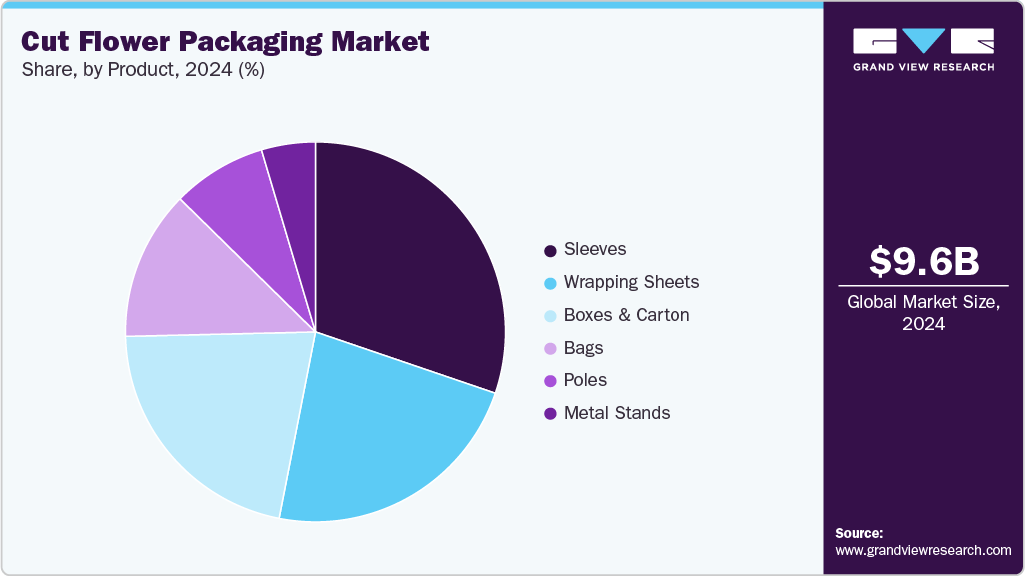
The sleeves segment recorded the largest market share of over 30.0% in 2024.Sleeves are one of the most commonly used packaging formats for cut flowers, typically made from materials such as BOPP (biaxially oriented polypropylene), polyethylene, or biodegradable films. These conical or cylindrical wraps protect flowers during handling and transit while enhancing shelf presentation in retail environments. Sleeves are available in transparent, tinted, or printed designs, enabling branding and aesthetic customization. They are widely used by supermarkets, floral retailers, and e-commerce platforms for bouquet packaging.
The boxes & carton segment is projected to grow at the fastest CAGR of 7.7% during the forecast period. Boxes and cartons are rigid or semi-rigid packaging formats used for long-distance flower transportation and e-commerce delivery. The adoption of boxes and cartons is driven by the expansion of global flower exports and the rapid growth of online floral delivery services. The increasing use of corrugated packaging with integrated moisture control and insulation technologies supports long-haul preservation.
Regional Insights
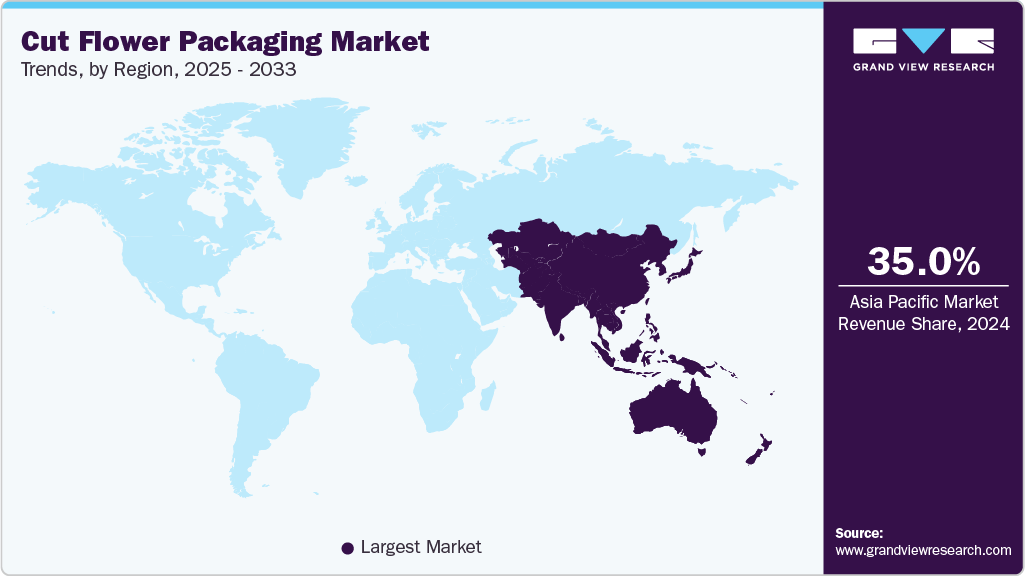
Asia Pacific cut flower packaging industry dominated the market and accounted for the largest revenue share of over 35.0% in 2024 and is witnessing strong growth as it is expected to grow at the fastest CAGR of 7.7% during the forecast period. This positive outlook is due to its robust cut flower production base and rapidly expanding retail and export networks. Countries such as China, India, Japan, and Malaysia are major producers of flowers such as chrysanthemums, orchids, and lilies, driving continuous demand for protective and decorative packaging materials. The region’s growing middle-class population and rising disposable income have boosted domestic consumption of flowers for gifting, weddings, and festivals, necessitating high-quality sleeves, wraps, and cartons.
China cut flower packaging industry’s growing focus on eco-friendly and innovative packaging is further accelerating market expansion. The government’s “Green Packaging Standard” and circular economy initiatives have led manufacturers to invest in biodegradable films and recyclable paper-based packaging for the floral industry. In addition, the rise of e-commerce-driven floral delivery platforms such as FlowerPlus and Roseonly has amplified the demand for aesthetically designed and protective packaging formats. These developments, coupled with China’s cost-efficient production capabilities, position the country as both a manufacturing powerhouse and a trendsetter in the global cut flower packaging landscape.
North America Cut Flower Packaging Market Trends
North America cut flower packaging industry’sgrowth is attributed to the high consumption of ornamental flowers and widespread adoption of premium floral packaging solutions. The U.S. and Canada represent major markets for imported flowers from Latin America, especially Colombia and Ecuador, which require protective corrugated boxes, sleeves, and temperature-controlled packaging during transit. The region’s well-developed retail infrastructure, led by supermarket chains such as Walmart, Costco, and Kroger, fuels demand for standardized, attractive, and sustainable flower packaging formats. Moreover, gifting culture during holidays such as Valentine’s Day, Mother’s Day, and Thanksgiving drives seasonal spikes in packaging demand.
U.S. Cut Flower Packaging Market Trends
The U.S. cut flower packaging industrystands as the largest consumer of cut flowers in North America, making it a critical driver of the regional packaging market. The strong e-commerce ecosystem and increasing preference for doorstep flower deliveries have pushed packaging companies to develop solutions that ensure freshness, minimize mechanical damage, and enhance presentation. Retail giants such as Whole Foods and Trader Joe’s also promote flowers as impulse-buy items, boosting the use of visually appealing sleeves and wraps.
Europe Cut Flower Packaging Market Trends
Europe cut flower packaging industryplays a central role in the global market, driven by its large-scale import, distribution, and consumption of flowers. Netherlands, Germany, and UK act as key hubs for flower trading and logistics, importing massive volumes from Africa and Latin America. These countries require specialized transport packaging solutions such as ventilated boxes, moisture-retaining wraps, and recyclable sleeves to preserve freshness throughout the supply chain. Europe’s strong floral gifting tradition and presence of advanced retail networks, including florists and supermarket chains, contribute to steady demand for premium and decorative packaging formats.
Key Cut Flower Packaging Company Insights
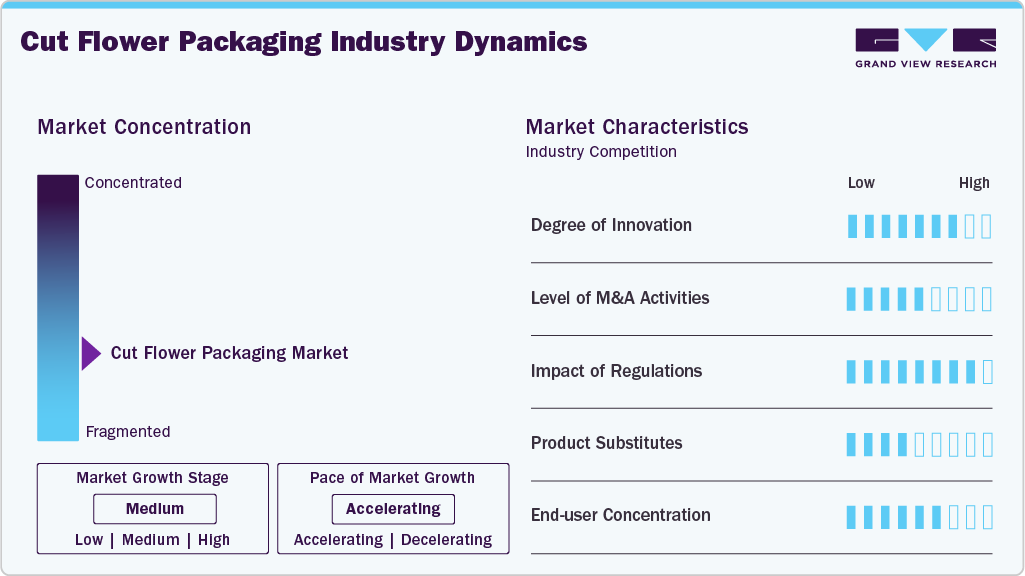
The competitive environment of the global cut flower packaging industry is highly fragmented, characterized by the presence of both multinational packaging corporations and specialized regional suppliers catering to local floriculture hubs. Key players compete based on product innovation, material sustainability, cost efficiency, and design aesthetics to enhance shelf appeal and extend flower freshness during transport.
Strategic collaborations between packaging manufacturers and large flower exporters, especially in regions such as the Netherlands, Colombia, Kenya, and Ethiopia, are intensifying competition through customized and value-added solutions such as anti-fog films, moisture retention liners, and temperature-resistant materials. Furthermore, digital supply chain integration and automation in packaging processes are becoming major differentiators, driving consolidation and M&A activities among leading firms seeking global market reach and operational scalability.
-
In November 2025, Koen Pack Americas launched its Ecologic line, a sustainable floral packaging range made from grass paper and post-consumer recycled plastics, aiming to reduce environmental impact while maintaining quality and visual appeal. This initiative reinforces Koen Pack’s commitment to sustainability, innovation, and reliable supply across the floral industry.
-
In October 2025, DS Smith partnered with Queen Flowers to create a recyclable fibre-based bouquet box made from corrugated cardboard. Designed for easy assembly and material efficiency, it maintains flower freshness, reduces transport weight, and is fully recyclable, supporting both branding and sustainability goals.
Key Cut Flower Packaging Companies:
The following are the leading companies in the cut flower packaging market. These companies collectively hold the largest market share and dictate industry trends.
- Smurfit Westrock
- Stora Enso
- DS Smith
- Mondi
- UFlex Limited
- PakFactory
- Tycoon Packaging
- A·ROO Company
- Smart Packaging Solutions
- Nature-Pack
- Packman Packaging
- Flamingo Holland Inc.
- GleePackaging
Competitive Benchmarking
Operating Strategies
Competitive Edge
Weakness
Mature Players: Smurfit Kappa; DS Smith; Mondi; International Paper; Berry Global Inc.
- Significant investments are being made in lightweight packaging designs, cold-chain compatible materials, and eco-friendly packaging technologies.
- These players prioritize global supply chain expansion, automation, and partnerships with flower exporters and retail chains.
- Broad product portfolios and long-term relationships with floral supply chain participants support strong market positioning.
- Financial strength enables continuous investments in sustainable packaging innovation and logistics optimization.
- Large operational structures can result in higher fixed costs and slower adaptation to rapidly changing sustainability trends and niche floral packaging demands.
- Dependence on raw material availability and fluctuations in paper and plastic prices can impact profitability.
Emerging Players: FloraLife; UFlex Limited; Coveris; Atlas Packaging; Napco National
- Emerging players focus on customized floral packaging, moisture-retention technologies, decorative packaging formats, and sustainable packaging innovations.
- Many companies are investing in biodegradable films, recyclable sleeves, and lightweight packaging systems to meet changing retailer and consumer expectations.
- Emerging players are generally more flexible in responding to changing market trends, sustainability requirements, and customer-specific packaging needs.
- Specialized expertise in floral preservation and customized packaging solutions supports product differentiation.
- Smaller manufacturing scale and limited international distribution capabilities may reduce competitiveness against larger multinational packaging suppliers.
- Rising costs associated with sustainable materials, cold-chain logistics, and product customization can pressure profit margins and operational scalability.
Cut Flower Packaging Market Report Scope
Report Attribute
Details
Market size value in 2025
USD 10.23 billion
Revenue forecast in 2033
USD 17.81 billion
Growth Rate
CAGR of 7.2% from 2025 to 2033
Historical data
2021 - 2023
Forecast period
2025 - 2033
Quantitative units
Revenue in USD million/billion and CAGR from 2025 to 2033
Report coverage
Revenue forecast, competitive landscape, growth factors, and trends
Segments covered
Material, product, region
States scope
North America; Europe; Asia Pacific; Latin America; Middle East & Africa
Country Scope
U.S.; Canada; Mexico; Germany; UK; France; Italy; Spain; China; India; Japan; Australia; South Korea; Brazil; Argentina; South Africa; Saudi Arabia, UAE
Key companies profiled
Smurfit Westrock; Stora Enso; DS Smith; Mondi; UFlex Limited; PakFactory; Tycoon Packaging; A·ROO Company; Smart Packaging Solutions; Nature-Pack; Packman Packaging; Flamingo Holland Inc.; GleePackaging
Customization scope
Free report customization (equivalent up to 8 analyst’s working days) with purchase. Addition or alteration to country, regional, and segment scope.
Pricing and purchase options
Avail customized purchase options to meet your exact research needs. Explore purchase options
Global Cut Flower Packaging Market Report Segmentation
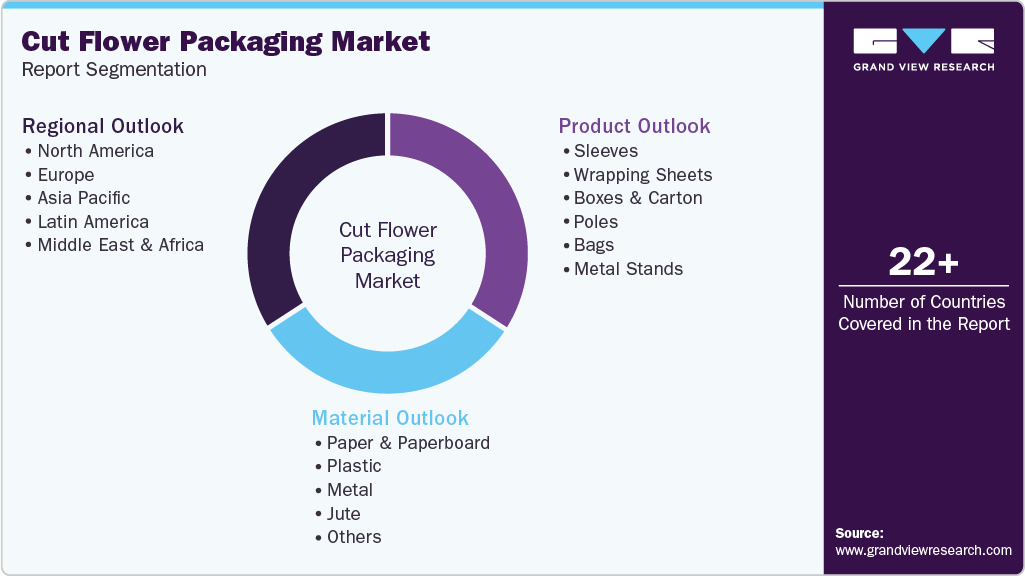
This report forecasts revenue growth at a global level and provides an analysis of the latest industry trends in each of the sub-segments from 2021 to 2033. For this study, Grand View Research has segmented the global cut flower packaging market report based on material, product, and region:
-
Material Outlook (Revenue, USD Million, 2021 - 2033)
-
Paper & Paperboard
-
Plastic
-
Metal
-
Jute
-
Others
-
-
Product Outlook (Revenue, USD Million, 2021 - 2033)
-
Sleeves
-
Wrapping Sheets
-
Boxes & Carton
-
Poles
-
Bags
-
Metal Stands
-
-
Regional Outlook (Revenue, USD Million, 2021 - 2033)
-
North America
-
U.S.
-
Canada
-
Mexico
-
-
Europe
-
Germany
-
France
-
UK
-
Italy
-
Spain
-
-
Asia Pacific
-
China
-
India
-
Japan
-
Australia
-
South Korea
-
-
Latin America
-
Brazil
-
Argentina
-
-
Middle East & Africa
-
South Africa
-
Saudi Arabia
-
UAE
-
-
Delivered Customizations
This report has been delivered with the following In-depth customizations
Client Request
Customization Delivered
Value Adds
Regional Segmentation
Detailed analysis of the global cut flower packaging market across North America, Europe, Asia Pacific, Latin America, and Middle East & Africa, including country-level flower production trends, export-import analysis, retail floral demand, cold-chain infrastructure, sustainability regulations, and regional growth outlook.
Identify high-growth floral markets and emerging flower export hubs. Support region-specific expansion strategies, packaging optimization, and sourcing decisions. Enable understanding of regional sustainability trends, logistics infrastructure, and competitive intensity across floral supply chains.
Cross-Segmentation
Detailed market segmentation analysis by material type, packaging type, flower type, application, distribution channel, and end-use industry, including volume and value analysis across major countries and regions. The study also covers decorative packaging, protective transit packaging, moisture-control solutions, and sustainable floral packaging trends.
Enable identification of high-growth packaging formats and emerging application areas. Support targeted product development, sustainability investments, and market entry strategies. Help understand changing customer preferences and evolving packaging requirements across retail, gifting, and floral export industries.
Trade Assessment
Analysis of global trade flows, import-export trends, paper and flexible packaging material supply dynamics, tariff structures, sustainability regulations, and regional supply chain dependencies impacting the cut flower packaging market. The study further evaluates sourcing trends, logistics challenges, and transportation requirements associated with international flower trade.
Support supply chain risk assessment and sourcing strategy development. Identify major flower-exporting and importing countries, trade bottlenecks, and raw material sourcing opportunities. Enable informed decisions related to procurement diversification, packaging optimization, and international market expansion.
About the Author(s)
Plastics, Polymers & Resins Research Team
Bulk Chemicals · Plastics, Polymers & ResinsThis report was authored by the plastics, polymers & resins research team at Grand View Research - comprising two research analysts, one senior research analyst, and one industry expert - with specialized expertise in the plastics, polymers & resins segment of the bulk chemicals industry. All findings are based on proprietary bulk chemicals databases, executive interviews, and regulatory analysis, subject to internal peer review prior to publication.
Last Updated:
Speak to Analyst


Customize this report to your needs - add regions, segments, or data points, with 20% free customization.
Or view our licence options:


ISO 9001:2015 & 27001:2022 Certified
We are GDPR and CCPA compliant! Your transaction & personal information is safe and secure. For more details, please read our privacy policy.


