
- Home
- »
- Advanced Interior Materials
- »
-
Dairy Testing Market Size & Share Report, 2026-20233GVR Report cover

Dairy Testing Market (2026 - 2033)
Size, Share & Trends Analysis Report By Testing Type (Microbiological Testing, Allergen Testing, Adulteration & Authenticity Testing, GMO Testing, Residue & Contamination Testing), By Technology, By Application, By Region, And Segment Forecasts
Market Size, 2025
$5.0BMarket Estimate, 2026
$5.4BMarket Forecast, 2033
$9.1BCAGR, 2026–2033
7.8%Dairy Testing Market Summary
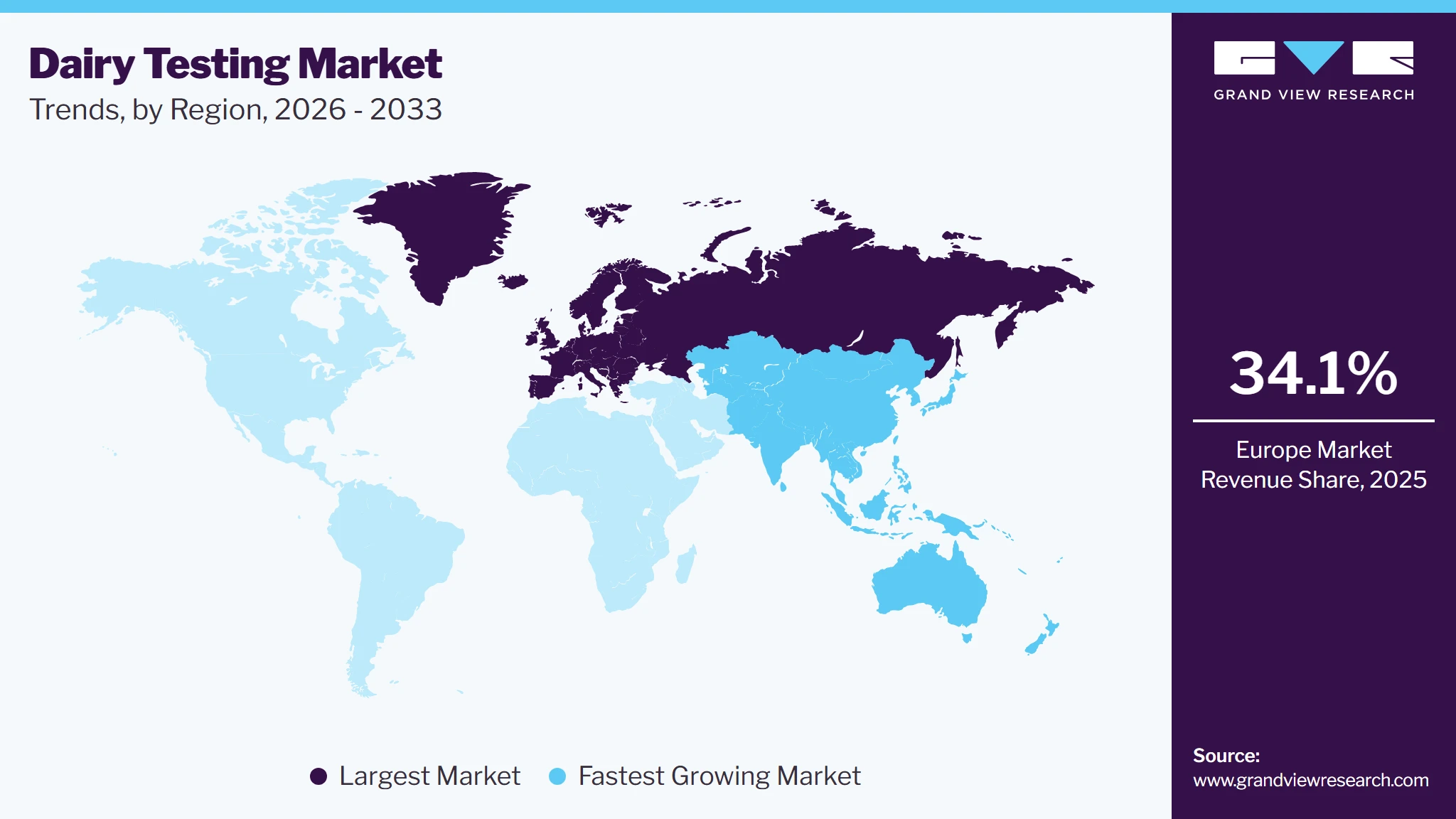
The global dairy testing market size was valued at USD 5.0 billion in 2025 and is projected to grow from USD 5.4 billion in 2026 to reach USD 9.1 billion by 2033, at a CAGR of 7.8% from 2026 to 2033. Europe dominated the market, accounting for the largest revenue share of 34.1% in 2025. The market is expected to grow as dairy processors, regulators, and retailers place greater emphasis on food safety, product quality, and compliance with increasingly stringent standards.
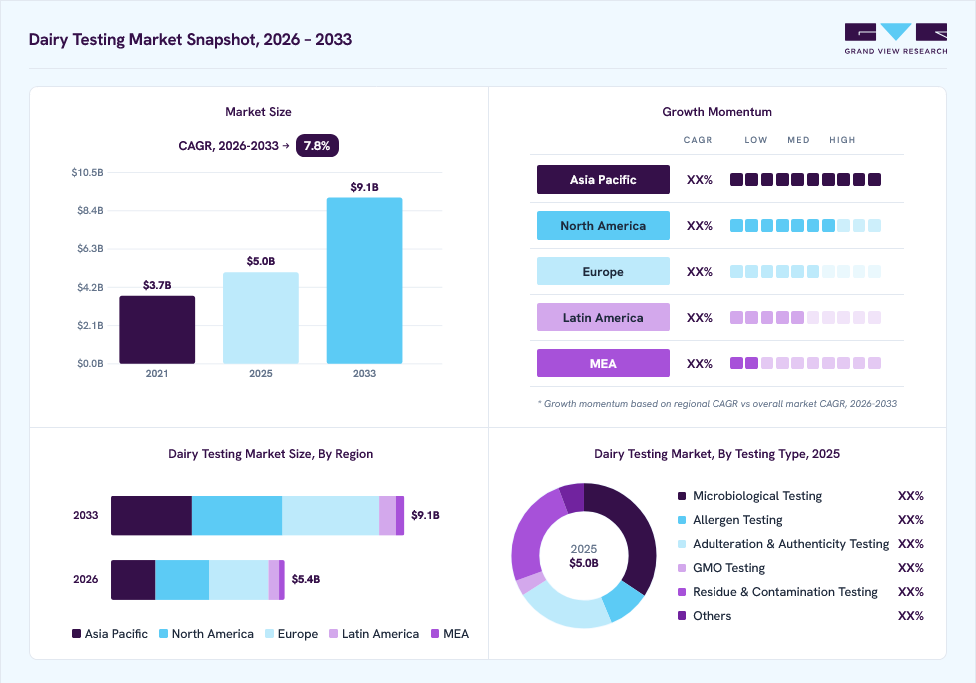 Source: Grand View Research, IR Documents, Primary Interviews, Paid DatabasesTo learn more about this report,
 Download Free Sample Report
Key Market Trends & Insights
- By testing type: The microbiological testing segment led the market with the largest revenue share of 34.2% in 2025.
- By technology: The traditional segment led the market with the largest revenue share of 58.9% in 2025.
- By applications: The milk & milk powder segment led the market with the largest revenue share of 30.9% in 2025.
Regional Highlights
- Largest regional market: Europe (34.1% revenue share, 2025)
- Fastest-growing regional market: Asia Pacific (highest CAGR, 2026-2033)
- By Country: The Germany held the largest market share in 2025.
Market Size & Forecast
- Market size in 2025: USD 5.0 Billion
- Estimated market size in 2026: USD 5.4 Billion
- Projected market size by 2033: USD 9.1 Billion
- CAGR (2026-2033): 7.8%
Prism AI by Grand View Research Free to tryAsk a question about the dairy testing market✓Every figure cited from GVR research Prefer the report? Download free sample →
Testing for pathogens, antibiotics, residues, aflatoxins, adulterants, nutritional composition, and contaminants is becoming increasingly important across the milk and dairy product sectors. Rising consumption of packaged and processed dairy products is increasing the need for routine testing. Growth in international dairy trade is also encouraging manufacturers to meet different regulatory and quality requirements across markets. In addition, rapid testing methods, automated analytical instruments, and molecular techniques are improving testing speed and accuracy, supporting wider adoption. Growing concerns about dairy adulteration and contamination are expected to further encourage investments in laboratory and on-site testing capabilities.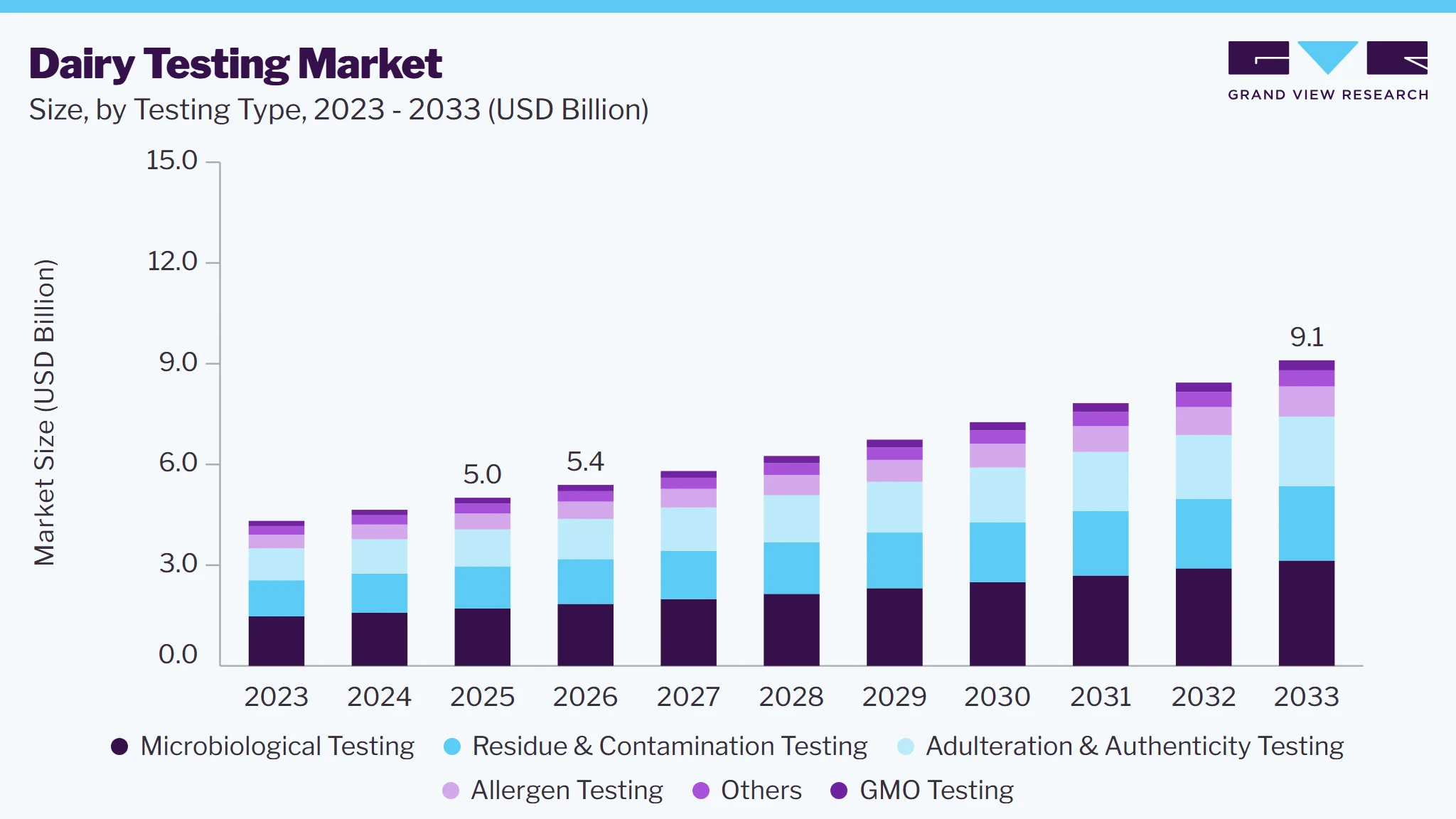 To learn more about this report, Download Free Sample Report
Market Dynamics
The dairy testing market is influenced by increasing food safety requirements, rising dairy consumption, stricter regulatory standards, and growing concerns regarding contamination and adulteration. Demand for testing is increasing across milk, cheese, yogurt, butter, and other dairy products to verify microbiological, chemical, nutritional, and quality parameters. Technological developments in rapid testing, molecular diagnostics, and automated analytical systems are improving testing efficiency. However, high testing costs, complex procedures, and limited laboratory infrastructure in developing markets can constrain adoption.
Increasing food safety requirements are driving demand for dairy testing as producers and processors need to verify that products meet established safety and quality standards. Testing helps identify pathogens, antibiotic residues, pesticides, aflatoxins, heavy metals, and other contaminants that can affect consumer health. Regulatory authorities are strengthening monitoring requirements across dairy supply chains, increasing the frequency of testing. Growing concerns about foodborne illnesses and contamination are also encouraging dairy companies to implement more comprehensive testing programs.
High testing costs can restrain the growth of the dairy testing market, particularly for small and medium-sized dairy producers and processors. Advanced analytical techniques often require expensive instruments, specialized laboratories, trained personnel, and regular equipment maintenance. Testing costs can increase further when multiple parameters, such as pathogens, residues, contaminants, nutritional composition, and adulterants, need to be analyzed. Limited financial resources and laboratory infrastructure in developing regions can therefore reduce the adoption of advanced dairy testing technologies.
The increasing adoption of rapid testing technologies presents an opportunity for the dairy testing market by reducing analysis time and enabling faster quality control decisions. Molecular diagnostics, biosensors, immunoassays, spectroscopy, and portable testing systems can provide quicker detection of pathogens, contaminants, and adulterants compared with conventional laboratory methods. Their use can support testing at dairy farms, collection centers, processing facilities, and distribution points, creating opportunities for wider testing coverage and more frequent quality monitoring across the dairy supply chain.
Market Concentration & Characteristics
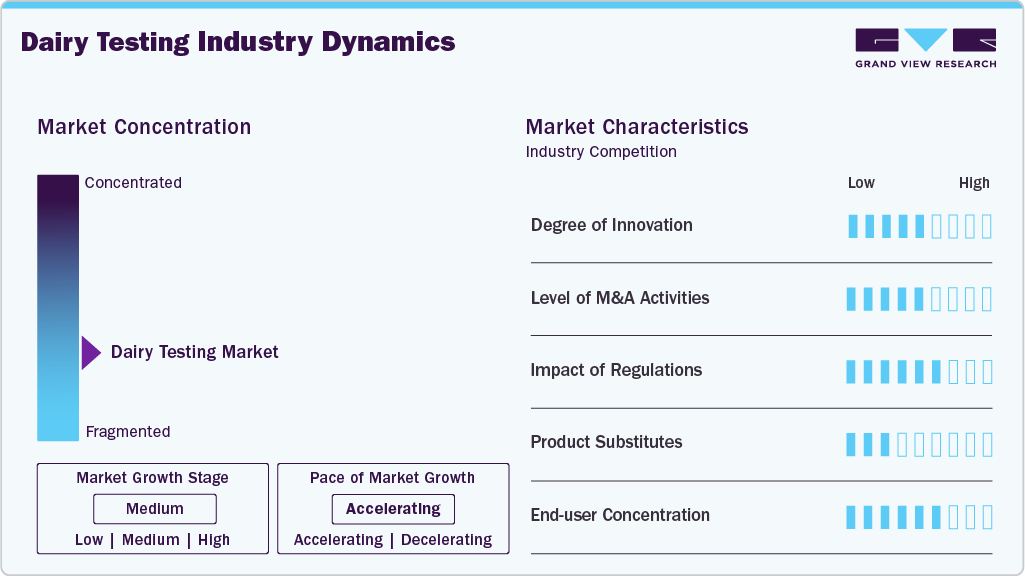
The dairy testing market is fragmented, with numerous global, regional, and local testing laboratories, analytical service providers, and equipment manufacturers competing across different applications. Market participants offer testing for pathogens, contaminants, residues, adulteration, nutritional composition, and quality parameters. The market structure varies by region due to differences in regulatory requirements, dairy production, and laboratory infrastructure. Smaller specialized laboratories coexist with larger companies that provide broader testing capabilities and integrated analytical services.
Laboratories and equipment manufacturers are adopting rapid molecular methods, biosensors, spectroscopy, chromatography, and automated analytical systems. Portable and on-site testing technologies are also gaining adoption, enabling quicker identification of pathogens, residues, adulterants, and quality parameters. Digital data management is further improving testing workflows and traceability.
 To learn more about this report, Download Free Sample Report
Regulations are shaping the dairy testing market by establishing requirements for food safety, contaminant limits, labeling, microbiological quality, and residue control. Regulatory agencies require dairy producers and processors to conduct testing to verify compliance with permitted limits for pathogens, antibiotics, pesticides, toxins, and adulterants. Changes in food safety standards and stricter monitoring requirements are increasing the frequency and scope of testing, supporting demand for laboratory analysis, rapid testing methods, and compliance services.
Analyst Perspective
The dairy testing market is influenced by regulatory requirements for detecting microbial contamination, antibiotic residues, adulteration, pathogens, and nutritional composition. Testing is conducted across milk collection, processing, and finished-product stages to verify compliance with food safety and quality standards. Changes in dairy production volumes, processed dairy consumption, and cross-border trade affect testing requirements. Laboratories are also adopting automated analytical systems and rapid testing methods to reduce testing time.
Testing Type Insights
The microbiological testing segment led the market with the largest revenue share of 34.2% in 2025, as dairy producers increase monitoring for pathogens and spoilage microorganisms that can affect product safety and shelf life. Testing for organisms such as Salmonella, Listeria, E. coli, and Staphylococcus is increasingly incorporated into quality control programs. Stricter food safety requirements, higher consumption of processed dairy products, and greater emphasis on contamination prevention are supporting demand for microbiological testing across milk, cheese, yogurt, and other dairy products.
The allergen testing segment is expected to grow at 8.3% CAGR during the forecast period as dairy manufacturers strengthen controls over allergen presence, cross-contact, and product labeling. Testing trace levels of allergenic ingredients and supports compliance with food safety and labeling requirements. The expansion of processed and multi-ingredient dairy products increases the need for allergen monitoring during production. Greater consumer awareness of food allergies and increasing demand for accurate ingredient information are also supporting adoption of allergen testing across dairy processing facilities.
Technology Insights
The traditional segment dominated the market in 2025. Techniques such as culture-based microbiological testing, titration, gravimetric analysis, and conventional chemical testing remain widely used because of standardized procedures and regulatory acceptance. Demand is supported by the need to assess milk composition, microbial contamination, residues, and other quality parameters across dairy processing and distribution operations.
The rapid testing segment is expected to grow at 8.3% CAGR during the forecast period as dairy processors seek faster results for contamination and quality assessment. Technologies such as polymerase chain reaction (PCR), immunoassays, biosensors, and spectroscopy can reduce testing time compared with conventional methods. Rapid testing enables quicker identification of pathogens, allergens, residues, and adulterants, supporting faster production and quality-control decisions. Increasing regulatory monitoring, higher production volumes, and the need to minimize product release delays are further supporting adoption.
Application Insights
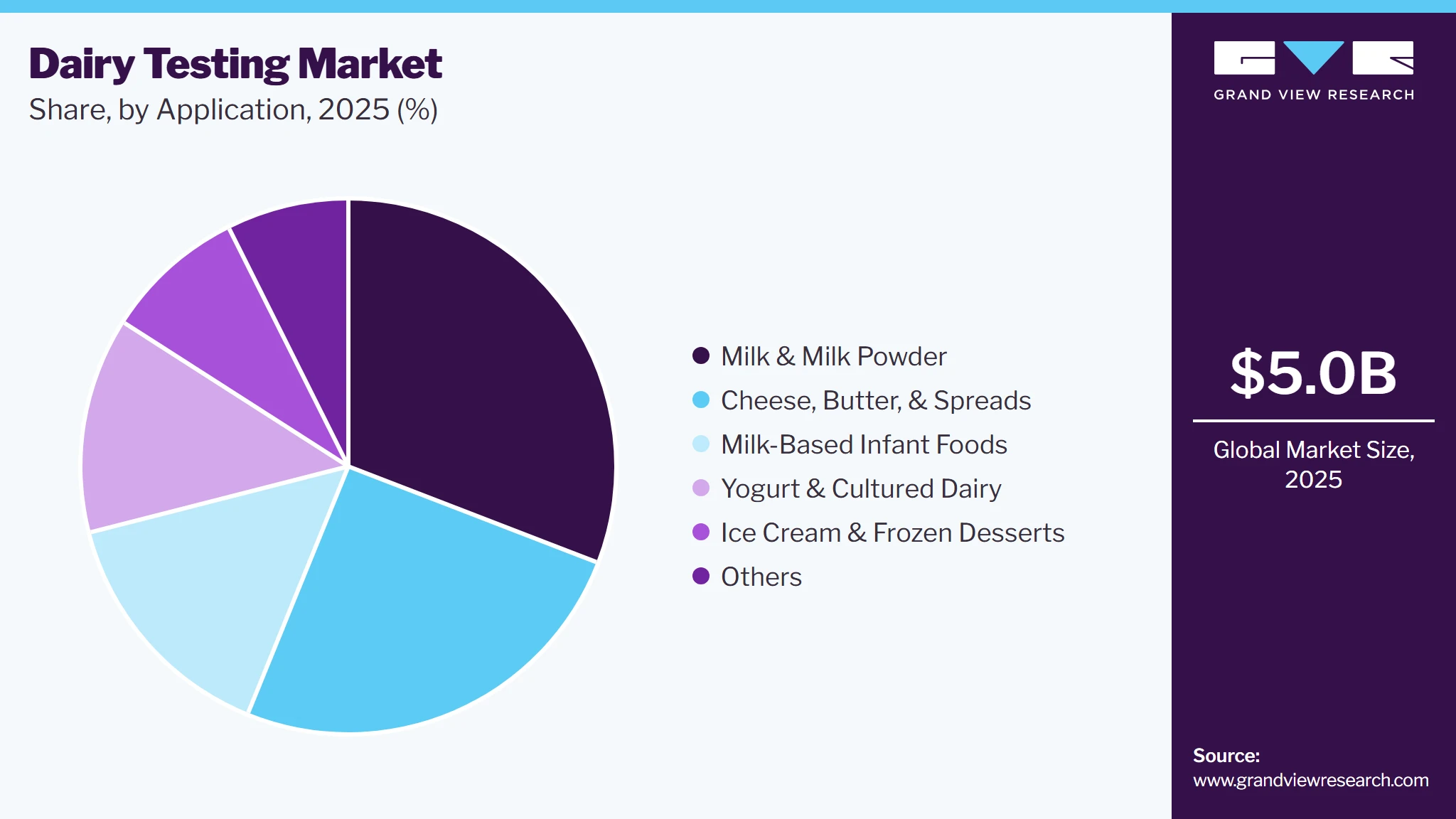
The milk & milk powder segment held the largest revenue share of 30.9% in 2025, due to increasing production, consumption, and international trade of dairy products. Testing is required to verify microbiological safety, nutritional composition, moisture content, contaminants, antibiotic residues, and adulteration. Milk powder manufacturers also require consistent quality during processing and storage. Stricter food safety regulations, greater emphasis on product traceability, and rising demand for shelf-stable dairy products are supporting the adoption of testing across milk processing operations.
 To learn more about this report, Download Free Sample Report
The milk-based infant foods segment is expected to grow at a CAGR of 9.0% from 2026 to 2033, as manufacturers face stringent requirements for product safety, nutritional composition, and contaminant control. Testing is conducted to detect pathogens, allergens, heavy metals, pesticide residues, mycotoxins, and other contaminants that may pose risks to infants. Increasing production of infant nutrition products and greater regulatory scrutiny are supporting testing demand. Manufacturers are also strengthening quality-control procedures to ensure consistency, accurate labeling, and compliance with applicable infant food standards.
Regional Insights
North America is expected to grow significantly in the dairy testing market due to stringent food safety regulations, established dairy processing industries, and increasing monitoring of contaminants and pathogens. The region has extensive laboratory infrastructure and widespread adoption of advanced analytical technologies for microbiological, chemical, allergen, and nutritional testing. Growing consumption of processed dairy products is increasing testing requirements across the supply chain.
U.S. Dairy Testing Market Trends
The U.S. is growing in the dairy testing market due to strong regulatory oversight and a large dairy processing industry. Federal requirements for food safety and quality encourage testing for pathogens, antibiotic residues, contaminants, allergens, and adulteration. Dairy processors increasingly use molecular diagnostics, spectroscopy, and automated analytical systems to support quality control. Rising production of milk, cheese, yogurt, and other processed products is expanding testing requirements. Greater emphasis on traceability and preventive food safety programs is further supporting market demand.
Asia Pacific Dairy Testing Market Trends
Dairy testing market in Asia Pacific is expected to grow at the fastest CAGR of 8.9% over the forecast period, due to increasing dairy consumption, expanding processing industries, and stronger food safety requirements. Rising urbanization and demand for packaged dairy products are increasing the need for quality and contamination testing. Countries across the region are strengthening monitoring of pathogens, residues, adulterants, and nutritional composition. Expansion of modern dairy processing facilities is supporting adoption of laboratory and rapid testing technologies.
Dairy testing market in China is growing due to its large dairy processing industry, substantial consumer market, and continued emphasis on food safety. Testing is increasingly used to identify pathogens, antibiotic residues, contaminants, adulteration, and nutritional parameters. Regulatory oversight of dairy products has strengthened the need for routine testing throughout production and distribution. Growth in packaged milk, infant nutrition, yogurt, and other processed dairy products is increasing testing requirements.
India dairy testing market is growing as milk production, dairy processing, and packaged dairy consumption continue to expand. Testing is increasingly required to identify adulterants, pathogens, antibiotic residues, contaminants, and variations in nutritional composition. Food safety regulations and quality standards are encouraging processors to strengthen laboratory and quality-control procedures. Expansion of organized dairy processing and packaged products is increasing demand for standardized testing methods.
Europe Dairy Testing Market Trends
Europe dominated dairy testing market due to comprehensive food safety regulations, established dairy industries, and strict requirements for product quality and traceability. Dairy producers and processors conduct testing for pathogens, contaminants, residues, allergens, and nutritional characteristics to comply with regulatory standards. Established laboratory networks and adoption of automated methods further support regional market development.
 To learn more about this report, Download Free Sample Report
Dairy testing market in Germany is witnessing growth due to country’s extensive production of milk, cheese, butter, and processed dairy products creates continuous demand for quality testing. Regulatory compliance and traceability requirements encourage routine analysis throughout the supply chain. Increasing adoption of automated laboratory systems and rapid analytical technologies is also supporting testing activities among German dairy processors.
The UK dairy testing market is growing as food safety regulations, quality standards, and traceability requirements encourage dairy processors to conduct regular product analysis. Testing is increasingly applied to detect pathogens, allergens, contaminants, residues, and adulteration in milk and processed dairy products. The country's established dairy industry and continued demand for cheese, milk, yogurt, and other products support testing volumes.
Middle East & Africa Dairy Testing Market Trends
The Middle East & Africa dairy testing market is growing as governments and dairy processors strengthen food safety controls and expand domestic dairy production. Testing demand is increasing for pathogens, contaminants, residues, adulterants, allergens, and nutritional parameters. Rising consumption of packaged dairy products and greater reliance on processed and imported dairy products are supporting testing requirements. Investments in local dairy processing capacity are also creating demand for laboratory infrastructure and analytical equipment.
Dairy testing market in Saudi Arabia is experiencing growth as the country’s dairy manufacturers and processors increasingly require testing for pathogens, contaminants, antibiotic residues, adulterants, allergens, and nutritional composition. Rising consumption of packaged milk, yogurt, cheese, and other dairy products supports testing demand in Saudi Arabia. Expansion of domestic dairy processing facilities is also increasing the need for quality-control laboratories and analytical equipment.
Latin America Dairy Testing Market Trends
Expanding dairy production, increasing consumption of packaged products, and greater emphasis on food safety is driving the dairy testing market in Latin America. Testing is increasingly used to monitor pathogens, contaminants, antibiotic residues, adulteration, allergens, and nutritional composition. Growth in processed dairy products is increasing testing requirements among manufacturers and processors. Regulatory agencies are strengthening food safety controls, while international dairy trade is encouraging compliance with quality standards.
Dairy testing market in Brazil is growing due to its large dairy production base, expanding processed dairy industry, and increasing food safety requirements. Testing is used to assess microbiological quality, antibiotic residues, contaminants, adulteration, nutritional composition, and product authenticity. Rising consumption of milk, cheese, yogurt, and other processed products is increasing testing requirements. Regulatory oversight is encouraging dairy processors to strengthen quality-control procedures and laboratory capabilities
Key Dairy Testing Company Insights
Some of the key players operating in the market include TÜV SÜD, ALS Limited, Bureau Veritas, SGS SA, Eurofins Scientific SE, Intertek Group plc, among others.
-
Eurofins Scientific SE is a Luxembourg-based laboratory testing and analytical services company. It provides testing, inspection, and research services across food, environmental, pharmaceutical, consumer products, and clinical sectors. Its food testing activities cover microbiological, chemical, nutritional, authenticity, and safety analysis. The company operates a broad network of laboratories and supports food manufacturers, retailers, agricultural businesses, and regulatory organizations.
-
Intertek Group plc is a UK-based testing, inspection, and certification company serving industries including food, agriculture, chemicals, consumer products, and pharmaceuticals. Its food-related services include laboratory testing, quality assurance, safety assessment, supply-chain verification, and regulatory compliance support. Intertek operates laboratories and testing facilities across multiple regions, providing analytical services for manufacturers, retailers, suppliers, and other organizations in the food value chain.
Key Dairy Testing Companies
The following key companies have been profiled for this study on the dairy testing market.
-
SGS SA
-
Eurofins Scientific SE
-
Intertek Group plc
-
Bureau Veritas
-
TÜV SÜD
-
Mérieux NutriSciences
-
ALS Limited
-
Neogen Corporation
-
TÜV NORD GROUP
-
AsureQuality
-
Romer Labs
-
Lactanet
-
Symbio Laboratories
-
Bio-Rad Laboratories
-
Microbac Laboratories
Competitive Benchmarking
Operating Strategies
Competitive Edge
Weaknesses
Mature Players: Eurofins Scientific SE, Intertek Group plc, Bureau Veritas
- Established players focus on expanding laboratory networks, broadening testing portfolios, and investing in automated, molecular, and rapid analytical technologies.
- Geographic expansion, laboratory acquisitions, strategic partnerships, and digital laboratory management systems are used to increase testing capacity and support customers across multiple markets.
- Mature players benefit from extensive laboratory infrastructure, diversified testing capabilities, experienced technical personnel, and broad geographic coverage.
- Long-term relationships with dairy processors, food manufacturers, retailers, and regulatory organizations further support their ability to serve complex testing requirements across different dairy product categories.
- These players face high operating costs associated with maintaining laboratories, analytical instruments, skilled personnel, accreditation, and regulatory compliance.
- Continuous investment is also required to update testing technologies and maintain laboratory standards.
Emerging Players: Mérieux NutriSciences, TÜV NORD GROUP, Symbio Laboratories
- Emerging players focus on specialized dairy testing services, regional laboratory expansion, customized testing programs, and adoption of rapid analytical technologies.
- They also use strategic partnerships, technology collaborations, and targeted investments to expand capabilities.
- Emerging companies compete through specialized analytical expertise, flexible service models, customized testing programs, and faster response times.
- Focus on specific technologies or applications can also support deeper expertise in areas such as molecular diagnostics, microbiological testing, allergen detection, or rapid testing.
- Emerging players generally have smaller laboratory networks, limited geographic coverage, and fewer financial resources than established testing companies.
- Limited investment capacity can restrict their ability to purchase advanced analytical equipment, obtain multiple accreditations, expand laboratory infrastructure, and recruit specialized personnel.
Recent Developments
-
In March 2026, SGS SA acquired Murray-Brown Laboratories, expanding its food testing capabilities in the U.S. Murray-Brown Laboratories is a recognized food testing laboratory providing analytical services for food safety and quality.
-
In March 2026, SGS launched SGS FoodNexus, following the combination of its regulatory intelligence platform, SGS Digicomply, with Agroknow’s food safety analytics and AI-driven risk intelligence. The new entity provides a single digital platform for monitoring regulatory developments and identifying food safety and compliance risks across global supply chains.
Dairy Testing Market Report Scope
Report Attribute
Details
Market size in 2025
USD 5.0 billion
Estimated market size in 2026
USD 5.4 billion
Projected market size by 2033
USD 9.1 billion
Growth rate
CAGR of 7.8% from 2026 to 2033
Base year for estimation
2025
Historical data
2021 - 2024
Forecast period
2026 - 2033
Quantitative units
Revenue in USD billion and CAGR from 2026 to 2033
Report coverage
Revenue forecast, company market position analysis, competitive landscape, growth factors, and trends
Segments covered
Testing type, technology, application, and region
Regional scope
North America; Europe; Asia Pacific; Latin America; and Middle East & Africa
Country Scope
U.S.; Canada; Mexico; Germany; UK; Italy; Spain; France; China; Japan; India; Australia; South Korea; Brazil; Argentina; Saudi Arabia; UAE; South Africa
Key companies profiled
SGS SA; Eurofins Scientific SE; Intertek Group plc; Bureau Veritas; TÜV SÜD; Mérieux NutriSciences; ALS Limited; Neogen Corporation; TÜV NORD GROUP; AsureQuality; Romer Labs; Lactanet; Symbio Laboratories; Bio-Rad Laboratories; Microbac Laboratories
Customization scope
Free report customization (equivalent up to 8 analysts working days) with purchase. Addition or alteration to country, regional & segment scope.
Pricing and purchase options
Avail customized purchase options to meet your exact research needs. Explore purchase options
Global Dairy Testing Market Report Segmentation
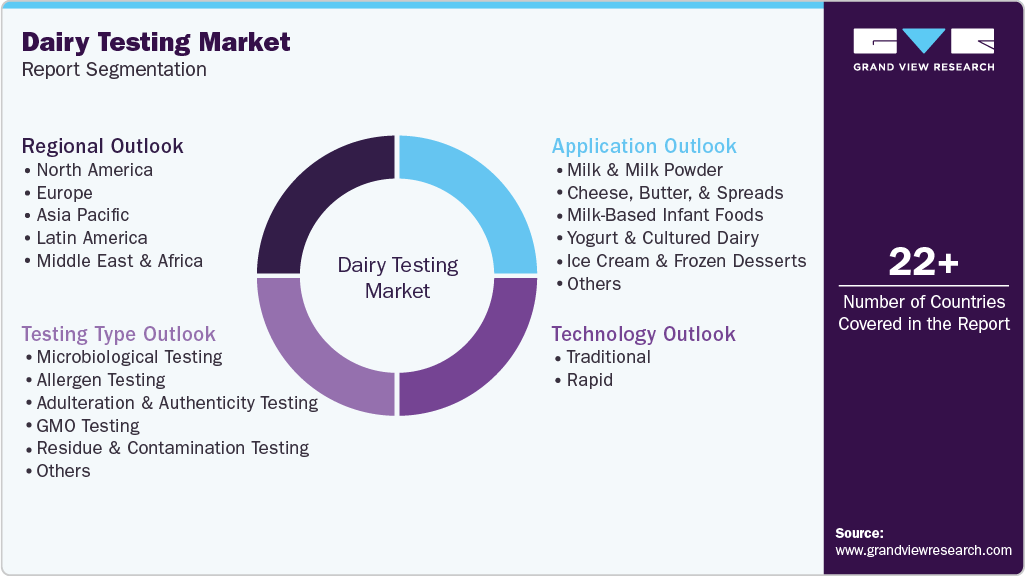
This report forecasts revenue growth at global, regional & country levels and provides an analysis on the industry trends in each of the sub-segments from 2021 to 2033. For this study, Grand View Research has segmented the dairy testing market based on testing type, technology, application, and region:
 To learn more about this report, Download Free Sample Report
-
Testing Type Outlook (Revenue, USD Billion, 2021 - 2033)
-
Microbiological Testing
-
Allergen Testing
-
Adulteration & Authenticity Testing
-
GMO Testing
-
Residue & Contamination Testing
-
Others
-
-
Technology Outlook (Revenue, USD Billion, 2021 - 2033)
-
Traditional
-
Rapid
-
Convenience Based
-
Polymerase Chain Reaction (PCR)
-
Immunoassay
-
Chromatography & Spectrometry
-
-
-
Application Outlook (Revenue, USD Billion, 2021 - 2033)
-
Milk & Milk Powder
-
Cheese, Butter, & Spreads
-
Milk-Based Infant Foods
-
Yogurt & Cultured Dairy
-
Ice Cream & Frozen Desserts
-
Others
-
-
Regional Outlook (Revenue, USD Billion, 2021 - 2033)
-
North America
-
U.S.
-
Canada
-
Mexico
-
-
Europe
-
Germany
-
France
-
UK
-
Spain
-
Italy
-
-
Asia Pacific
-
China
-
India
-
Japan
-
South Korea
-
Australia
-
-
Latin America
-
Brazil
-
Argentina
-
-
Middle East & Africa
-
Saudi Arabia
-
UAE
-
South Africa
-
-
Research Methodology
The dairy testing market figures in this report are based on a proven research process that combines executive interviews with secondary research from proprietary databases, company filings, and recognized regulatory and institutional sources. Market size is built through value-chain sizing-reconciling supply-side and demand-side estimates-and triangulated with bottom-up and top-down approaches. Every estimate passes multiple levels of expert validation before publication, with each dairy testing segment quantified using the revenue-capture definitions in the table below.
Segment Definition
Segment - Testing Type
Revenue Capture Definition
Microbiological Testing
Revenue captured from services detecting and quantifying microorganisms, pathogens, bacteria, yeast, and molds in milk and dairy products.
Allergen Testing
Revenue generated from analytical services identifying and quantifying allergenic substances in dairy products to verify labeling and safety requirements.
Adulteration & Authenticity Testing
Revenue captured from testing services detecting adulteration and verifying the authenticity, composition, origin, and purity of dairy products.
GMO Testing
Revenue generated from analytical services detecting genetically modified organisms or genetic material in milk, dairy ingredients, and processed dairy products.
Residue & Contamination Testing
Revenue captured from testing services identifying antibiotic residues, pesticides, veterinary drugs, heavy metals, toxins, and other contaminants in dairy products.
Others
Revenue generated from additional dairy testing services, including nutritional, chemical, compositional, shelf-life, and physical property testing of dairy products.
Segment -Technology
Revenue Capture Definition
Traditional
Revenue captured from conventional dairy testing methods using established laboratory procedures, culture techniques, chemical analysis, and manual or laboratory-based analytical methods.
Rapid
Revenue generated from dairy testing methods providing faster analytical results through rapid microbiological, molecular, immunological, and instrument-based testing technologies.
Segment -
Application
Revenue Capture Definition
Milk & Milk Powder
Revenue captured from dairy testing services conducted on raw milk, processed milk, condensed milk, and milk powder products.
Cheese, Butter, & Spreads
Revenue generated from testing cheese, butter, margarine, and dairy-based spreads for quality, safety, composition, and compliance.
Milk-Based Infant Foods
Revenue captured from testing infant formula and milk-based nutritional products for contaminants, composition, safety, and regulatory compliance.
Yogurt & Cultured Dairy
Revenue generated from testing yogurt, fermented milk products, probiotics, and cultured dairy products for quality and microbiological parameters.
Ice Cream & Frozen Desserts
Revenue captured from testing ice cream and frozen dairy desserts for composition, contaminants, microbiological quality, and labeling compliance.
Others
Revenue generated from testing additional dairy products, including cream, whey products, dairy ingredients, flavored milk, and specialty dairy formulations.
Estimation Model
Layer Name
Key Question
Description
Dairy Production & Testing Demand Layer
Which dairy products generate demand for testing?
The estimation begins by evaluating dairy production and processing volumes across milk, milk powder, cheese, butter, spreads, infant foods, yogurt, cultured dairy, ice cream, frozen desserts, and other products. Food safety requirements, regulatory standards, export requirements, and quality control practices establish the base demand for dairy testing services.
Testing Type & Technology Layer
Which testing types and technologies drive market demand?
This layer refines demand by assessing microbiological, allergen, adulteration and authenticity, GMO, residue and contamination, and other testing requirements. Demand is further evaluated across traditional and rapid testing technologies based on testing parameters, turnaround requirements, laboratory practices, and regulatory requirements.
Application & Laboratory Deployment Layer
What determines dairy testing service utilization?
Market demand is estimated through testing conducted across dairy product categories and stages of the value chain, including raw milk collection, processing, manufacturing, quality control, and finished-product testing. Testing frequency, production volumes, regulatory compliance, product safety requirements, and laboratory capacity influence service utilization.
Revenue Layer
How is total market revenue calculated?
Revenue is estimated by aggregating spending on dairy testing services across testing types, technologies, applications, and regional markets. Testing volumes, service pricing, laboratory revenues, regulatory testing requirements, product production levels, and frequency of testing are incorporated to validate the total market size.
Delivered Customizations
We have successfully delivered the following deep-dive customizations
Client Request
Customization Delivered
Value Adds
Regional Segmentation
Detailed regional analysis was conducted across North America, Europe, Asia Pacific, Latin America, and the Middle East & Africa, including country-level assessment for key markets such as the U.S., Germany, China, India, Brazil, and Saudi Arabia. The study evaluated dairy production volumes, milk processing activities, dairy product manufacturing, food safety regulations, testing requirements, and laboratory infrastructure influencing dairy testing demand across regional markets.
Helped identify regional differences in dairy testing requirements, country-specific demand patterns, and markets with increasing testing activity. The analysis also supported assessment of regulatory developments, dairy processing trends, and laboratory service requirements across major markets.
Competitive benchmarking
Comprehensive benchmarking was carried out for major dairy testing market participants based on testing service portfolios, analytical capabilities, laboratory infrastructure, accreditation, geographic presence, testing technologies, and service coverage. The assessment compared established testing laboratories and specialized dairy testing providers operating across key markets.
Assisted clients in understanding competitor positioning, testing capabilities, geographic coverage, and service gaps within the dairy testing market. The study supported competitor assessment, partnership evaluation, laboratory capability analysis, and identification of areas with changing testing requirements.
Opportunity assessment
In-depth opportunity assessment was conducted by analyzing dairy production, processed dairy consumption, food safety requirements, regulatory testing standards, and laboratory testing demand. The study evaluated opportunities related to microbiological testing, antibiotic residue testing, adulteration detection, nutritional analysis, pathogen testing, and milk and dairy product quality assessment.
Enabled clients to identify markets with increasing dairy testing requirements and evaluate demand across different testing categories. The analysis also supported assessment of laboratory expansion opportunities, testing technology adoption, regulatory compliance requirements, and future demand patterns within the dairy testing market.
Frequently Asked Questions About This Report
The global dairy testing market size was valued at USD 5.0 billion in 2025 and is expected to reach USD 5.4 billion in 2026.
The dairy testing market, in terms of revenue, is expected to grow at a compound annual growth rate of 7.8% from 2026 to 2033 to reach USD 9.1 billion by 2033.
The microbiological testing segment led the market and accounted for 34.2% market revenue share in 2025.
The traditional segment led the market and accounted for 58.9% market revenue share in 2025.
The milk & milk powder segment led the market and accounted for 30.9% market revenue share in 2025.
Some of the key players operating in the dairy testing include SGS SA, Eurofins Scientific SE, Intertek Group plc, Bureau Veritas, TÜV SÜD, Mérieux NutriSciences, ALS Limited, Neogen Corporation, TÜV NORD GROUP, AsureQuality, Romer Labs, Lactanet, Symbio Laboratories, Bio-Rad Laboratories, Microbac Laboratories.
Key factors driving the dairy testing market include stricter food safety regulations, increasing testing requirements for microbial contamination and residues, greater dairy production and processing volumes, concerns regarding adulteration and authenticity, and growing demand for quality verification across milk and processed dairy products.
The Europe led the market and accounted for 34.1% of the global market revenue share in 2025.
The Asia Pacific is expected to grow at fastest during forecast period accounting for 8.9% CAGR.
About the Author(s)
Advanced Interior Materials Research Team
Advanced Materials · Advanced Interior MaterialsThis report was authored by the advanced interior materials research team at Grand View Research - comprising two research analysts, one senior research analyst, and one industry expert - with specialized expertise in the advanced interior materials segment of the advanced materials industry. All findings are based on proprietary advanced materials databases, executive interviews, and regulatory analysis, subject to internal peer review prior to publication.
Last Updated:
Speak to Analyst

Customize this report to your needs - add regions, segments, or data points, with 20% free customization.
Or view our licence options:


ISO 9001:2015 & 27001:2022 Certified
We are GDPR and CCPA compliant! Your transaction & personal information is safe and secure. For more details, please read our privacy policy.


