
- Home
- »
- Communications Infrastructure
- »
-
Data Center Services Market Size & Share Report 2026-2033GVR Report cover

Data Center Services Market (2026 - 2033)
Size, Share, & Trends Analysis Report By Component (Installation & Integration Services, Training Services, Consulting Services), By Deployment Mode, By Tier Type, By Application, By End Use, By Region, And Segment Forecasts
Market Size, 2025
$26.5BMarket Estimate, 2026
$29.0BMarket Forecast, 2033
$55.1BCAGR, 2026–2033
9.7%Data Center Services Market Summary
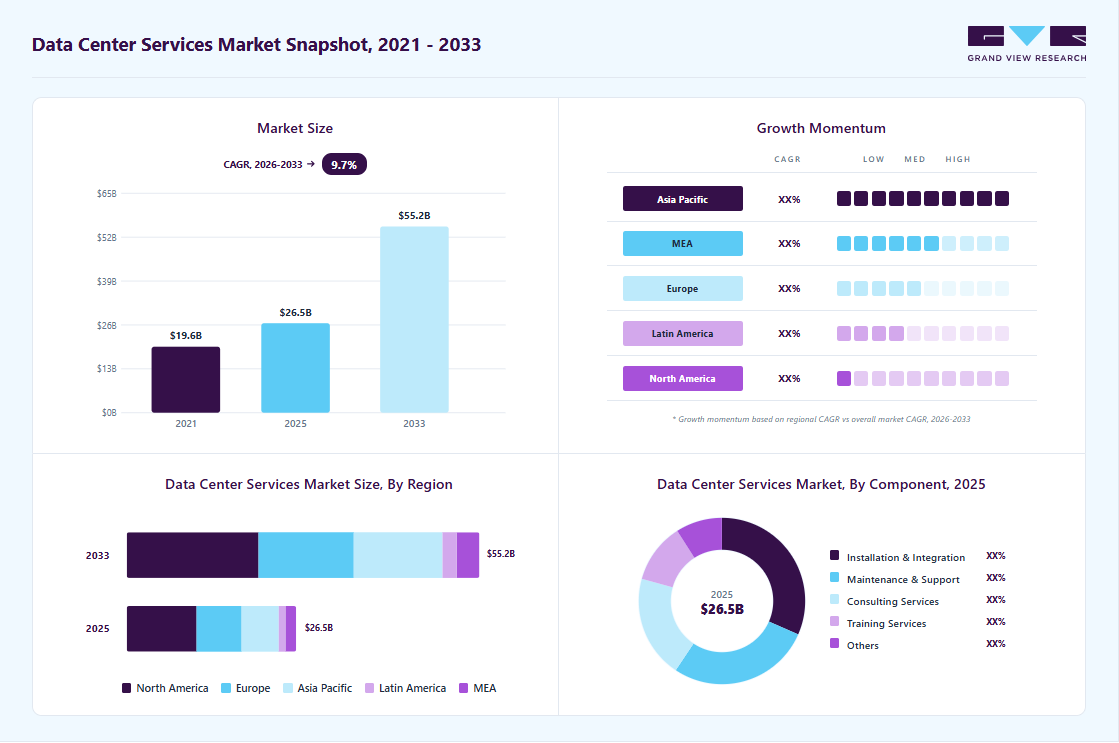
The global data center services market size was valued at USD 26.5 billion in 2025 and is projected to grow from USD 29.0 billion in 2026 to USD 55.1 billion by 2033, at a CAGR of 9.7% from 2026 to 2033. The North America market held the largest share of 41.1% of the global market in 2025. The rapid migration of enterprises to cloud and hybrid IT environments is a fundamental driver of data center services demand. Organizations are increasingly relying on colocation, managed hosting, and cloud interconnection services to balance scalability, cost efficiency, and control over sensitive workloads.
 Source: Grand View Research, IR Documents, Primary Interviews, Paid DatabasesTo learn more about this report,
 Download Free Sample Report
 Key Market Trends & Insights
- By component: The installation & integration services segment dominated the market and accounted for the revenue share of 31.5% in 2025.
- By deployment mode: The large data centers segment dominated the market and accounted for the largest revenue share in 2025.
- By tier type: The tier III segment dominated the market and accounted for the largest revenue share in 2025.
- By application: The hyperscale segment dominated the market and accounted for the largest revenue share in 2025.
- By end use: The IT and telecommunications segment dominated the market and accounted for the largest revenue share in 2025.
Regional Highlights
- Largest regional market: North America (41.1% revenue share, 2025)
- By country: The U.S. held the largest market share in 2025.
Market Size & Forecast
- Market size in 2025: USD 26.5 Billion
- Estimated market size in 2026: USD 29.0 Billion
- Projected market size by 2033: USD 55.1 Billion
- CAGR (2026-2033): 9.7%
Three ways to get this report
Buy it, customize it, or ask a question.Ask an Analyst
Analyst response in 1 business day
- AccessReport author, directly
- Reply timeWithin 1 working day
- No sales callDirect answer only
- FormatEmail reply
- CostFree, no cost
Get the Full Report
What the study covers
- FormatsPDF · Excel · Dashboard
- Timeline2026–2033 annual, 2025 base
- Coverage20+ countries, 5 regions
- Companies10+ key players profiled
Customize the Report
20% free customization
- IncludeCountries, segments, points
- TailorTo your product definition
- ExtendDeeper competitor detail
- OrA fully bespoke study
- Turnaround5–10 working days
The exponential growth of data generated by artificial intelligence (AI), machine learning (ML), big data analytics, IoT, and digital platforms is intensifying the need for high-performance data center infrastructure and associated services. Enterprises and hyperscalers require specialized services for GPU deployment, high-density computing, data storage optimization, and real-time processing. This shift toward compute-intensive workloads is driving demand for advanced consulting, integration, and operational support services within modern data centers. According to the Organisation for Economic Co-operation and Development (OECD), AI adoption among businesses with 10 or more employees has more than doubled over the past four years, rising from 5.6% in 2020 to 14% in 2024 across Member countries, alongside widespread use of cloud computing that now exceeds 50% penetration on average. The increase is being driven by greater availability of AI, particularly generative AI tools, which have lowered technical and cost barriers for firms, while all G7 economies are experiencing especially rapid acceleration in corporate AI uptake as digital transformation and data-driven operations become mainstream.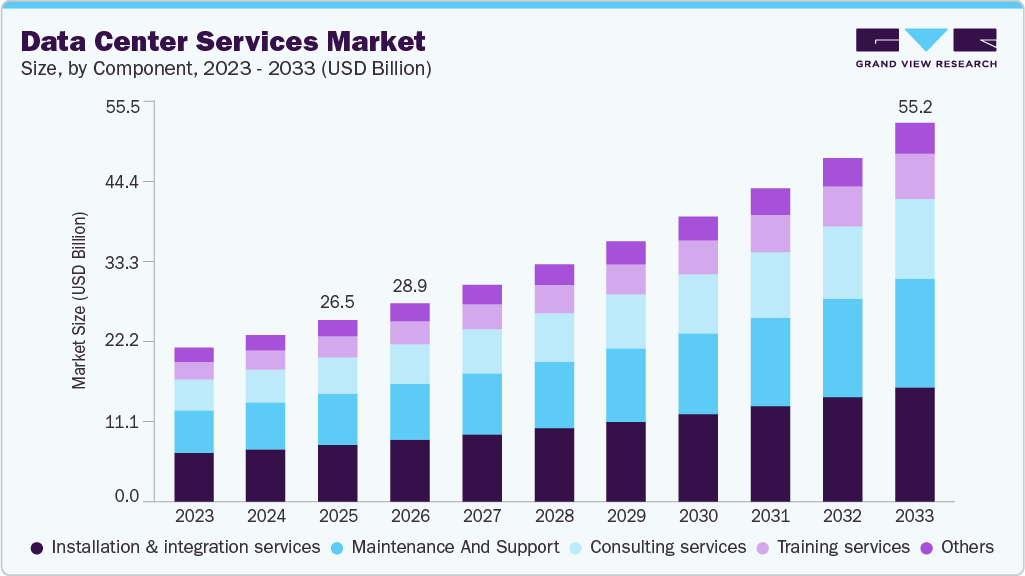 To learn more about this report, Download Free Sample Report
 The expansion of 5G networks, smart cities, autonomous systems, and real-time applications is pushing data processing closer to end users through edge data centers. This trend is creating strong demand for site planning, micro data center deployment, connectivity services, and remote monitoring solutions. Service providers are increasingly needed to design, implement, and maintain distributed data center ecosystems that can deliver ultra-low latency and reliable performance.
Growing environmental concerns and stricter regulations on carbon emissions are reshaping the data center services landscape. Operators are investing heavily in energy-efficient cooling systems, renewable power integration, liquid cooling technologies, and AI-driven energy management tools. Therefore, there is a growing demand for sustainability-focused consulting, infrastructure modernization services, and compliance advisory services to help data centers improve power usage effectiveness (PUE) and meet ESG targets.
The rising adoption of hybrid and multi-cloud environments refers to enterprises increasingly using a combination of on-premises infrastructure, private clouds, and multiple public cloud providers to run their workloads. This approach helps organizations avoid vendor lock-in, improve resilience, and optimize costs by selecting the most suitable cloud for each application. Hybrid cloud enables sensitive or regulated data to remain on-premises while leveraging public cloud scalability for analytics and AI workloads. Multi-cloud strategies further enhance flexibility by distributing workloads across providers like AWS, Microsoft Azure, and Google Cloud. Together, these models improve business continuity, performance optimization, and geographic redundancy, while also supporting digital transformation initiatives and increasing demand for advanced data center services and integration capabilities.
High capital investment and operational costs are major restraints in the data center services market, as establishing and maintaining modern data center infrastructure requires substantial financial resources. Service providers must invest heavily in land acquisition, construction, servers, networking equipment, backup power systems, advanced cooling technologies, and physical security infrastructure. Additionally, the rapid growth of AI, cloud computing, and high-density workloads has increased the need for energy-efficient systems and next-generation cooling solutions, further raising infrastructure expenses. Operational costs are also significant due to ongoing electricity consumption, equipment maintenance, software upgrades, and the need for a skilled workforce. Rising energy prices and sustainability compliance obligations add further pressure on profitability. Small and mid-sized providers often struggle to compete with hyperscale operators that benefit from economies of scale. These high investment and operating expenses can slow expansion plans and limit market entry for new participants.
The growing focus on green and sustainable data centers is set to bring major growth opportunities for the data center services market as organizations aim to reduce carbon emissions, energy consumption, and environmental impact. Data center operators are increasingly adopting renewable energy sources, energy-efficient cooling systems, advanced power management technologies, and sustainable building designs to meet ESG goals and regulatory requirements. The rapid expansion of AI and cloud workloads has significantly increased electricity demand, encouraging investments in liquid cooling, waste heat recovery, and low-carbon infrastructure. Companies are also prioritizing carbon-neutral and net-zero operations to strengthen brand reputation and attract environmentally conscious customers and investors. This shift is creating strong demand for sustainability consulting, energy optimization, and green infrastructure management services across global data center ecosystems.
Market Concentration & Characteristics
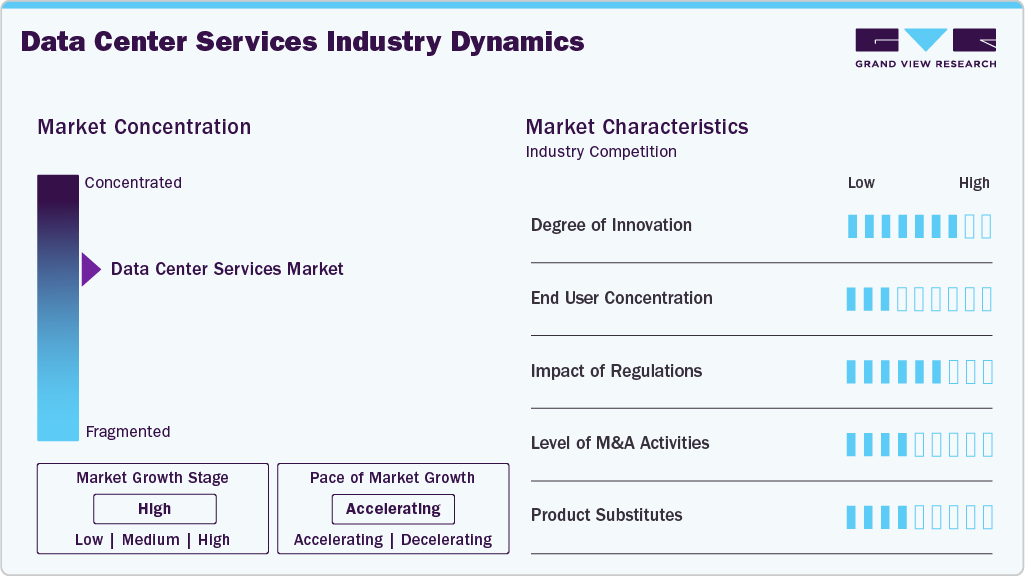
The data center services market is moderately concentrated, with a combination of global hyperscalers, colocation providers, IT service firms, and specialized infrastructure vendors. Large players such as Equinix, Digital Realty, IBM, NTT, Schneider Electric, Cisco, and Vertiv dominate enterprise-scale deployments due to their global presence, integrated service portfolios, and strong ecosystem partnerships. However, the market also includes numerous regional and niche providers, making the long tail relatively fragmented.
 To learn more about this report, Download Free Sample Report
 In terms of market characteristics, the industry has high capital intensity, strong technology dependence, and increasing consolidation driven by demand for AI infrastructure. Competition is largely based on energy efficiency, uptime reliability, automation capabilities, and hybrid cloud integration. Regulatory compliance, sustainability mandates, and edge expansion are also shaping differentiation. Overall, the market is evolving toward higher concentration as hyperscale and AI-driven workloads accelerate.
Component Insights
The installation & integration services segment dominated the market and accounted for the revenue share of 31.5% in 2025, driven by the accelerating pace of data center capacity expansions, technology refresh cycles, and the rising complexity of multi-vendor infrastructure environments. As operators deploy modular and prefabricated data center designs, high-density racks, advanced networking fabrics, and software-defined architectures, they increasingly rely on specialized system integrators to ensure seamless hardware deployment, interoperability, configuration, and testing.
The consulting services segment is anticipated to grow at the highest CAGR during the forecast period, owing to the skills shortages in data center design, networking architecture, and site planning, which are pushing organizations to rely on specialist consultants for feasibility studies, standards alignment, vendor selection, and risk management. Additionally, the growing emphasis on resilience, uptime assurance, and business continuity, particularly for critical industries such as BFSI, healthcare, and telecom, has supported demand for consulting-led assessments in reliability design, Tier certification readiness, and lifecycle modernization of aging facilities.
Deployment Mode Insights
The large data centers segment dominated the market and accounted for the largest revenue share in 2025, driven by enterprise consolidation of fragmented IT estates into centralized, highly resilient facilities that deliver superior reliability, security, and economies of scale. As organizations modernize legacy infrastructure, they increasingly prefer large-scale facilities that offer advanced redundancy (N+1, 2N, and 2N+1 designs), strong disaster recovery frameworks, and hardened physical security, reducing operational risk and downtime
The small data centers segment is anticipated to grow at the highest CAGR during the forecast period. The expansion of modular and prefabricated small data centers is a key driver for this segment, as enterprises and public institutions seek faster, lower-cost, and more flexible infrastructure than traditional large facilities. Many SMEs, regional businesses, and government agencies are opting for compact, containerized, or micro data center deployments that can be rapidly installed on-site, reduce upfront capital expenditure, and simplify operations through standardized designs.
Tier Type Insights
The tier III segment dominated the market and accounted for the largest revenue share in 2025, driven by enterprises and colocation users increasingly prioritize high availability with operational flexibility rather than hyperscale buildouts. Many mid-to-large organizations particularly in BFSI, healthcare, telecom, and government prefer Tier III facilities as they offer a balanced model of reliability, predictable operating costs, and easier maintenance compared to Tier IV.
The tier IV segment is expected to grow at a significant CAGR during the forecast period. With rising dependence on real-time transaction processing, digital payment systems, electronic health records, and continuous business applications, enterprises are favoring Tier IV facilities that offer 99.995% availability, full redundancy, and concurrent maintainability. Strengthening regulatory requirements around data continuity, disaster recovery, and risk mitigation are further pushing organizations toward Tier IV-certified infrastructure.
Application Insights
The hyperscale segment dominated the market and accounted for the largest revenue share in 2025 owing to the aggressive capacity expansion strategies of major cloud and digital platform providers seeking to support massive-scale enterprise digitization, SaaS delivery, and global digital services. Hyperscalers are increasingly building standardized, modular, and software-defined data center architectures that enable faster deployment cycles, lower unit costs, and seamless scalability across regions.
The colocation segment is expected to grow at a significant CAGR during the forecast period as enterprises prioritizing capital efficiency and operational flexibility by shifting from owning data centers to leasing space in carrier-neutral facilities. Organizations are increasingly using colocation to scale IT infrastructure without heavy upfront investments in real estate, power, and cooling, while gaining access to rich interconnection ecosystems, multiple network providers, and proximity to cloud on-ramps.
End Use Insights
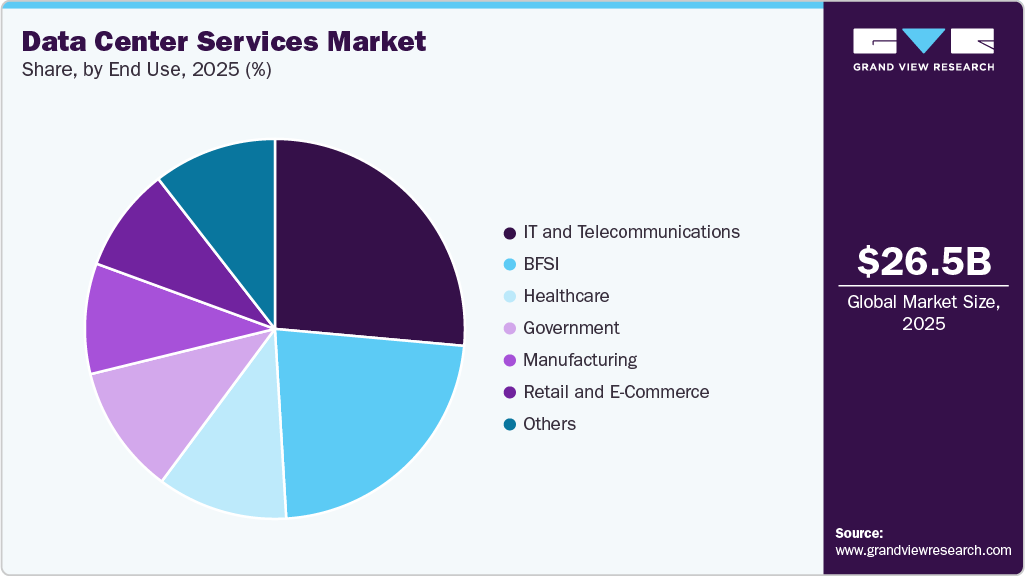
The IT and telecommunications segment dominated the market and accounted for the largest revenue share in 2025 due to the densification and modernization of network infrastructure as operators upgrade to support high-capacity digital traffic, private networks, and mission-critical connectivity. Telecom carriers and large IT service providers are investing heavily in next-generation core networks, software-defined networking (SDN), and network function virtualization (NFV), which require highly reliable, carrier-grade data center environments and specialized integration services.
 To learn more about this report, Download Free Sample Report
 The healthcare segment is expected to grow at a significant CAGR over the forecast period, driven by the increasing digitalization of medical records, telemedicine platforms, and data-intensive clinical applications that require highly secure, reliable, and compliant infrastructure. Hospitals, pharmaceutical companies, and research institutions are expanding their use of electronic health records (EHR), medical imaging systems, genomics data, and real-time patient monitoring solutions, all of which generate massive volumes of sensitive data that must be stored, processed, and protected.
Regional Insights
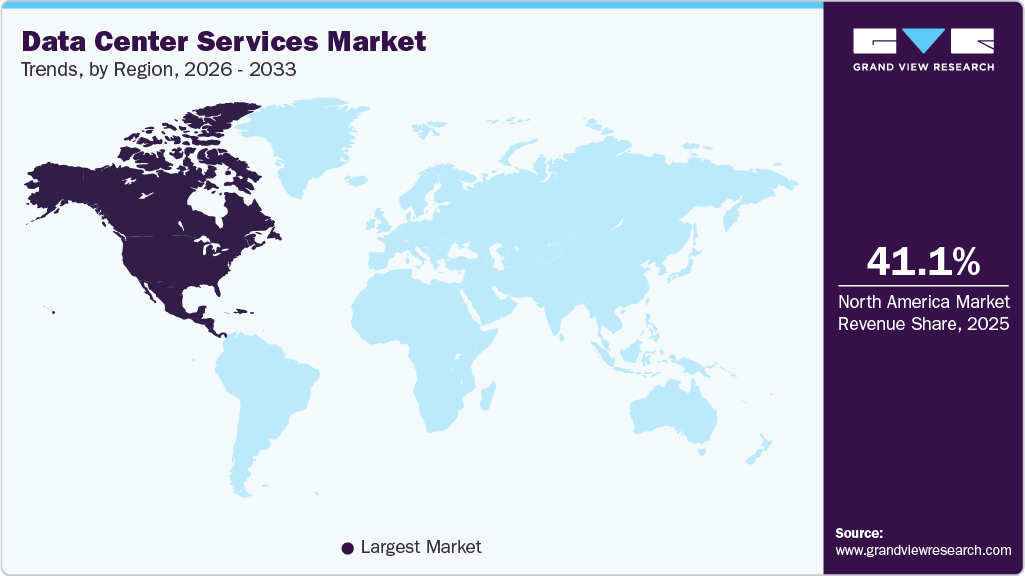
North America dominated the global market with the largest revenue share of 41.1% in 2025, driven by large-scale enterprise digital transformation across finance, retail, and government, which is increasing reliance on third-party data center services for modernization of legacy infrastructure. Many organizations are retiring on-prem facilities and moving toward professionally managed colocation and outsourcing models, creating sustained demand for migration services, facility retrofitting, and ongoing operational support.
 To learn more about this report, Download Free Sample Report
 U.S. Data Center Services Market Trends
The data center services market in the U.S. is expected to grow significantly at a CAGR of 8.1% from 2026 to 2033, due to rapid expansion of hyperscale campuses by cloud and technology giants is the primary catalyst for services demand, as each new facility requires extensive planning, construction oversight, commissioning, and continuous operations support.
Europe Data Center Services Market Trends
The data center services market in Europe is anticipated to register considerable growth from 2026 to 2033 due to stricter data sovereignty and localization requirements, which are compelling enterprises to distribute workloads across multiple national data centers rather than centralize them. Regional operators are increasingly turning to specialized service providers to ensure consistent performance while meeting diverse regulatory obligations.
The UK data center services market is expected to grow rapidly in the coming years. Banks, fintech firms, and government agencies are investing in professionally managed data center environments to strengthen reliability and disaster recovery readiness. This has expanded demand for assurance services, uptime optimization, and third-party facility monitoring.
The Germany data center services market held a substantial market share in 2025 due to the strong industrial and automotive base, where manufacturers are integrating data centers into smart factories, digital twins, and Industry 4.0 initiatives. These use cases require highly customized data center services tailored to industrial workloads, private connectivity, and secure edge integration.
Asia Pacific Data Center Services Market Trends
Asia Pacific data center services held a significant share in the global market in 2025, due to rapid urbanization and large-scale digital infrastructure programs are driving investment in regional data center networks beyond traditional hubs. Governments and private investors are expanding facilities in emerging markets, which increases the need for site development, power planning, and operational services in less mature ecosystems.
The Japan data center services market is expected to grow rapidly in the coming years, driven by aging population and digital transformation of public services, which require reliable, high-availability data center infrastructure. Public sector modernization and critical service digitization are pushing demand for professionally managed facilities with strong reliability and continuity standards.
The China data center services market held a substantial market share in 2025, due to digital economy development, including cloud industrial parks and large-scale government-backed data center clusters. State-led investments are expanding infrastructure in second- and third-tier cities, creating demand for professional construction supervision, operations standardization, and performance optimization services.
Data Center Services Company Insights
Key players operating in the data center services industry are Amazon Web Services (AWS), Microsoft Azure, Google Cloud Platform (GCP), and Oracle Cloud, Salesforce, Inc., Alibaba Cloud. The companies are focusing on various strategic initiatives, including new product development, partnerships & collaborations, and agreements to gain a competitive advantage over their rivals. The following are some instances of such initiatives.
-
In December 2025, Accenture announced its acquisition of a majority stake in DLB Associates, a U.S.-based engineering and consulting firm specializing in AI-ready data centers, along with its affiliated businesses. The deal is intended to strengthen Accenture’s full-stack data center design, build, and operations capabilities, enabling software, platform, and high-tech clients to deploy AI infrastructure faster, scale more effectively, and reduce time to market as demand for AI-enabled solutions continues to rise.
-
In October 2025, Microsoft entered into a strategic partnership with Thailand’s Gulf Development Public Company Limited (GULF) to support the expansion of cloud and AI infrastructure in the country and strengthen its position as a regional digital hub. Under the agreement, GULF subsidiary GSA Data Center 02 (GSA02) will provide data center services for Microsoft’s Thailand cloud region, delivering high-resilience, low-latency facilities built to Microsoft’s global standards while enabling in-country data processing and storage to comply with local data residency requirements and accelerate enterprise digital transformation.
-
In April 2025, Schneider Electric unveiled EcoConsult for Data Centers, a new advisory service aimed at helping data center and IT leaders optimize performance, reliability, and sustainability. The offering combines technical assessment, digital analytics, and operational best practices to enhance uptime, lower total cost of ownership, and align facility design and operations with decarbonization goals as operator’s face rising power demands and increasing efficiency requirements.
Data Center Services Companies:
The following key companies have been profiled for this study on the data center services market.
- Accenture
- Cisco Systems Inc.
- Digital Realty Trust Inc.
- DXN Technology
- Equinix Inc.
- HCL Tech
- Honeywell International Inc.
- ABB Ltd.
- JLL
- Johnson Controls
- Kyndryl
- Microsoft Corporation
- NTT Data
- Schneider Electric
- Vertiv
Competitive Benchmarking
Operating Strategies
Competitive Edge
Weakness
Mature Players: Equinix; Digital Realty; NTT Data; Schneider Electric; Vertiv; Kyndryl
- Expanding integrated service portfolios combining colocation, managed infrastructure, cloud connectivity, and consulting services
- Leveraging strategic partnerships with hyperscalers such as AWS, Microsoft Azure, and Google Cloud
- Offering long-term managed services contracts with strong SLA-backed operational support
- Expanding geographically through acquisitions, joint ventures, and regional facility development.
- Strong global infrastructure footprint with established enterprise customer relationships
- High operational expertise in mission-critical infrastructure management and uptime assurance
- Ability to deliver end-to-end solutions across consulting, deployment, monitoring, optimization, and maintenance
- Significant capital resources enabling rapid expansion and AI-ready infrastructure investments
- Strong brand credibility and compliance capabilities for regulated industries.
- High operational and energy costs impacting profitability
- Legacy infrastructure in older facilities may require expensive modernization upgrades
- Long deployment cycles and complex organizational structures can reduce agility
- Heavy dependence on large enterprise and hyperscaler contracts increases revenue concentration risk
- Sustainability compliance and power availability constraints can limit expansion in certain regions.
Emerging Players: Cyxtera Technologies; CtrlS Datacenters; EdgeConneX; Scala Data Centers
- Focusing on edge data center deployment and regional expansion in high-growth markets
- Offering flexible and scalable managed services tailored for SMEs and digital-native enterprises
- Investing in green data center infrastructure powered by renewable energy sources
- Building AI-ready and high-density colocation environments with modular infrastructure designs
- Using automation and AI-driven monitoring tools to improve operational efficiency.
- Faster innovation cycles and greater flexibility in adopting emerging technologies
- Strong positioning in regional and edge computing markets with lower latency capabilities
- Competitive pricing models and customized service offerings for mid-market customers
- Ability to address growing sustainability and ESG-focused customer requirements
- Agile operating models supporting rapid deployment and localized customer engagement.
- Limited global presence compared to large multinational competitors
- Smaller capital reserves can restrict hyperscale expansion capabilities
- Lower brand recognition among large enterprises and government clients
- Dependence on third-party cloud and connectivity partnerships for broader service delivery
- Increasing competition from hyperscalers entering managed infrastructure and colocation segments directly.
Data Center Services Market Report Scope
Report Attribute
Details
Market size in 2025
USD 26.5 Billion
Estimated market size in 2026
USD 29.0 billion
Projected market size by 2033
USD 55.1 billion
Growth rate
CAGR of 9.7% from 2026 to 2033
Actual data
2021 - 2025
Forecast period
2026 - 2033
Quantitative units
Revenue in USD billion and CAGR from 2026 to 2033
Report enterprise size
Revenue forecast, company share, competitive landscape, growth factors, and trends
Segments covered
Component, Deployment Mode, Tier Type, Application, End Use, and Region
Regional scope
North America; Europe; Asia Pacific; Latin America; Middle East & Africa
Country scope
U.S.; Canada; Mexico; UK; Germany; France; China; India; Japan; Australia; South Korea; Brazil; UAE; Kingdom of Saudi Arabia; South Africa
Key companies profiled
Accenture; Cisco Systems Inc.; Digital Realty Trust Inc.; DXN Technology; Equinix Inc.; HCL Tech; Honeywell Automation; ABB Ltd.; JLL; Johnson Controls; Kyndryl; Microsoft Corporation; NTT Data; Schneider Electric; Vertiv
Customization scope
Free report customization (equivalent to 8 analysts working days) with purchase. Addition or alteration to country, regional & segment scope.
Pricing and purchase options
Avail customized purchase options to meet your exact research needs. Explore purchase options
Global Data Center Services Market Report Segmentation
This report forecasts revenue growth at the global, regional, and country levels and provides an analysis of the latest industry trends in each of the sub-segments from 2021 to 2033. For this study, Grand View Research has segmented the data center services market report based on component, deployment mode, tier type, application, end use, and region:
-
Component Outlook (Revenue, USD Billion, 2021 - 2033)
-
Installation & integration services
-
Training services
-
Consulting services
-
Maintenance and support
-
Others
-
-
Deployment Mode Outlook (Revenue, USD Billion, 2021 - 2033)
-
Small data centers
-
Medium data centers
-
Large data centers
-
-
Tier Type Outlook (Revenue, USD Billion, 2021 - 2033)
-
Tier I and II
-
Tier III
-
Tier IV
-
-
Application Outlook (Revenue, USD Billion, 2021 - 2033)
-
Hyperscale
-
Colocation
-
Enterprise
-
-
End Use Outlook (Revenue, USD Billion, 2021 - 2033)
-
BFSI
-
Healthcare
-
IT and Telecommunications
-
Retail and E-Commerce
-
Manufacturing
-
Government
-
Others
-
-
Regional Outlook (Revenue, USD Billion, 2021 - 2033)
-
North America
-
U.S.
-
Canada
-
Mexico
-
-
Europe
-
UK
-
Germany
-
France
-
-
Asia Pacific
-
China
-
India
-
Japan
-
South Korea
-
Australia
-
-
Latin America
-
Brazil
-
-
Middle East & Africa
-
UAE
-
Saudi Arabia
-
South Africa
-
-
Delivered Customizations
This report has been delivered with the following In-depth customizations
Client Request
Customization Delivered
Value Adds
Data center managed services opportunity assessment for a cloud infrastructure provider
- Assessed demand trends for managed hosting, remote infrastructure management, colocation support, and hybrid cloud services
- Evaluated enterprise adoption across BFSI, healthcare, IT & telecom, retail, and government sectors
- Benchmarked key vendors based on service portfolios, SLA capabilities, pricing models, and regional presence
- Identified high-growth enterprise outsourcing opportunities
- Supported service portfolio expansion and positioning strategy
- Highlighted major demand drivers, operational challenges, and technology adoption trends
Customized cross-segmentation analysis for the Data Center Services Market by service type and enterprise size
- Conducted detailed segmentation analysis for installation & integration, consulting, maintenance & support, and managed services
- Evaluated adoption trends across SMEs and large enterprises
- Assessed workload migration trends for hybrid and multi-cloud environments
- Identified fastest-growing service segments and customer categories
- Supported strategic resource allocation and market prioritization
- Highlighted variations in adoption across enterprise sizes and industry verticals
Regional market entry and expansion assessment for a data center services provider
- Evaluated regional demand patterns across Middle East & Africa
- Assessed regulatory requirements, data sovereignty policies, and energy infrastructure readiness
- Analyzed competitive intensity and customer outsourcing preferences by region
- Identified attractive regional expansion opportunities
- Supported investment prioritization and localization strategy
- Enabled informed decision-making for regional partnerships and operational scaling
Frequently Asked Questions About This Report
The installation & integration services segment led with a 31.5% revenue share in 2025, while consulting services is the fastest-growing segment.
The large data centers segment held the highest market share in 2025, while small data centers is the fastest-growing segment.
The tier III segment held the highest market share in 2025. while tier IV is growing significantly.
The IT and telecommunications segment accounted for the largest share in 2025, while healthcare is growing significantly.
The global data center services market size was estimated at USD 26.5 billion in 2025 and is expected to reach USD 29.0 billion in 2026.
The global data center services market is expected to grow at a compound annual growth rate of 9.7% from 2026 to 2033 to reach USD 55.1 billion by 2033.
North America dominated with a 41.1% revenue share in 2025.
Some key players operating in the data center services market include Accenture, Cisco Systems Inc., Digital Realty Trust Inc., DXN Technology, Equinix Inc., HCL Tech, Honeywell Automation, IBM Corporation, JLL, Johnson Controls, Kyndryl, Microsoft Corporation, NTT Data, Schneider Electric, Vertiv
The global data center services market is driven by the rapid migration of enterprises to cloud and hybrid IT environments. Organizations are increasingly relying on colocation, managed hosting, and cloud interconnection services to balance scalability, cost efficiency, and control over sensitive workloads.
About the Author(s)
Communications Infrastructure Research Team
Technology · Communications InfrastructureThis report was authored by the communications infrastructure research team at Grand View Research - comprising two research analysts, one senior research analyst, and one industry expert - with specialized expertise in the communications infrastructure segment of the technology industry. All findings are based on proprietary technology databases, executive interviews, and regulatory analysis, subject to internal peer review prior to publication.
Last Updated:
Speak to Analyst

Customize this report to your needs - add regions, segments, or data points, with 20% free customization.
Or view our licence options:


ISO 9001:2015 & 27001:2022 Certified
We are GDPR and CCPA compliant! Your transaction & personal information is safe and secure. For more details, please read our privacy policy.


