
- Home
- »
- Next Generation Technologies
- »
-
Data Center SSD Market Size And Share Report, 2026-2033GVR Report cover

Data Center SSD Market (2026 - 2033)
Size, Share & Trends Analysis Report By Form Factor (2.5-inch (U.2/U.3, M.2, PCIe Add-in Card, EDSFF (E1.S / E1.L / E3)), By Interface, By NAND Technology, By Storage Capacity, By End User, By Region, And Segment Forecasts
Market Size, 2025
$18.5BMarket Estimate, 2026
$21.5BMarket Forecast, 2033
$66.3BCAGR, 2026–2033
17.4%Data Center SSD Market Summary
The global data center SSD market size was valued at USD 18.5 billion in 2025 and is projected to grow from USD 21.5 billion in 2026 to USD 66.3 billion by 2033, at a CAGR of 17.4% from 2026 to 2033. The North America held the largest share of 38.5% of the global market in 2025, due to the rapid expansion of data generation and processing requirements across industries. The continued growth of cloud computing serves as the key catalyst, as hyperscale cloud providers consistently invest in new data center facilities and upgrade their storage architectures to support artificial intelligence (AI), advanced analytics, and other high-performance workloads.
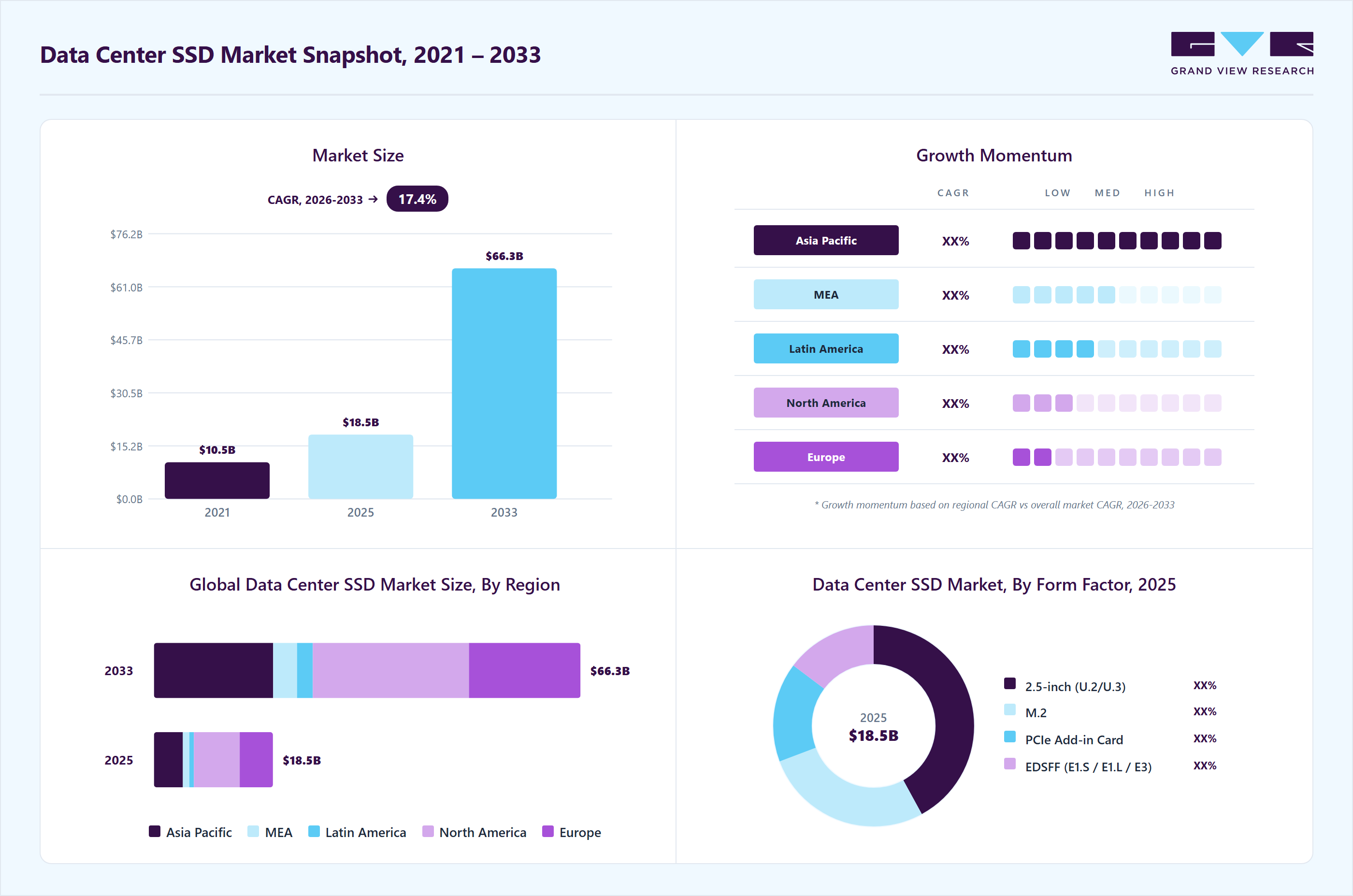 Source: Grand View Research, IR Documents, Primary Interviews, Paid DatabasesTo learn more about this report,
 Download Free Sample Report
 Key Market Trends & Insights
- By form factor: 2.5-inch (U.2/U.3) held the largest revenue share of 42.0% in 2025.
- By NAND technology: TLC segment accounted for the largest revenue share in 2025.
- By end user: Hyperscale cloud provider segment is expected to grow at the fastest CAGR from 2026 to 2033.
Regional Highlights
- Largest regional market: North America (38.5% revenue share, 2025)
- Fastest-growing regional market: Asia Pacific (highest CAGR, 2026-2033)
- By country: The U.S. led the North America market in 2025.
Market Size & Forecast
- Market size in 2025: USD 18.5 Billion
- Estimated market size in 2026: USD 21.5 Billion
- Projected market size by 2033: USD 66.3 Billion
- CAGR (2026-2033): 17.4%
Three ways to get this report
Buy it, customize it, or ask a question.Ask an Analyst
Analyst response in 1 business day
- AccessReport author, directly
- Reply timeWithin 1 working day
- No sales callDirect answer only
- FormatEmail reply
- CostFree, no cost
Get the Full Report
What the study covers
- FormatsPDF · Excel · Dashboard
- Timeline2026–2033 annual, 2025 base
- Coverage20+ countries, 5 regions
- Companies10+ key players profiled
Customize the Report
20% free customization
- IncludeCountries, segments, points
- TailorTo your product definition
- ExtendDeeper competitor detail
- OrA fully bespoke study
- Turnaround5–10 working days
The growth of edge computing is significantly accelerating the adoption of SSDs in modern data center architectures. Edge data centers operate in space-constrained and distributed environments, where compact form factors, low power consumption, and high reliability are essential. SSDs meet these requirements by offering faster data access, lower latency, and better durability compared to traditional HDDs. Furthermore, the rapid expansion of 5G networks and IoT ecosystems is increasing the volume of real-time data generated at the edge, necessitating high-performance local storage. As a result, organizations are deploying SSD-based storage in edge nodes to support real-time analytics, autonomous systems, and latency-sensitive applications efficiently.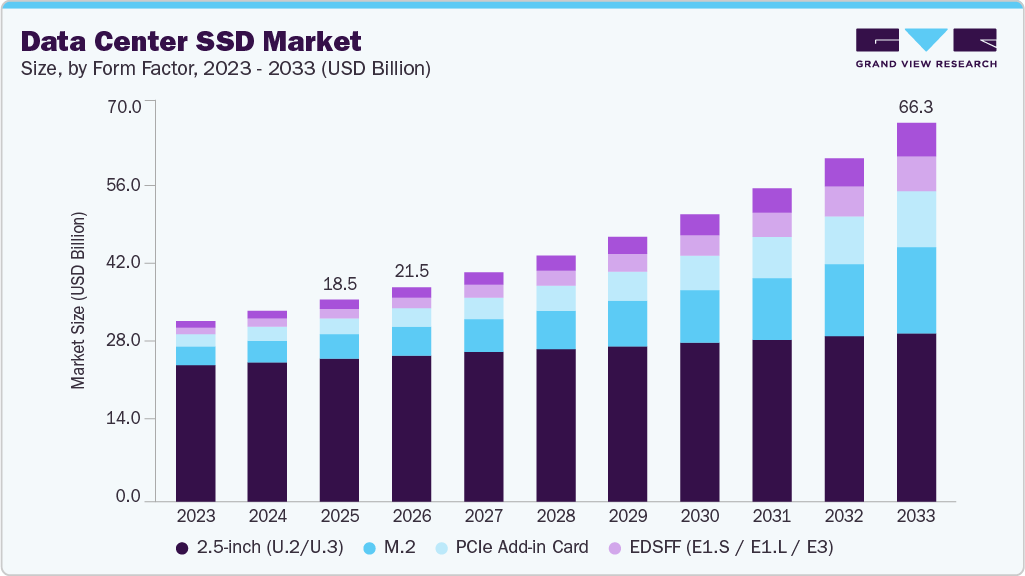 To learn more about this report, Download Free Sample Report
 Advancements in NAND technology, particularly the development of higher-layer 3D NAND and improved QLC architectures, are significantly enhancing SSD capacity and cost efficiency. Higher-layer stacking increases storage density per chip, allowing manufacturers to deliver larger-capacity drives at a lower cost per terabyte. At the same time, improvements in QLC endurance, controllers, and error correction technologies have made these drives more viable for enterprise and hyperscale environments. As a result, SSDs are increasingly being deployed across multiple storage tiers, including high-performance hot data, frequently accessed warm data, and large-capacity bulk storage use cases.
AI-driven infrastructure is expected to be a major transformative force in the Data Center SSD market. As AI training and inference workloads rely on massive and rapidly expanding datasets, there is a growing need for high-performance, low-latency storage systems. SSD clusters play a critical role in AI data pipelines by enabling faster data ingestion, processing, and retrieval. This surge in AI adoption will not only increase the overall volume demand for enterprise SSDs but also push vendors to develop drives with higher throughput, endurance, and advanced NVMe capabilities to meet evolving performance requirements.
India’s data center sector is experiencing a dramatic boom driven by exponential growth in digital data and artificial intelligence (AI) adoption. According to a CBRE report, investment commitments in India’s data center industry are projected to surpass USD 100 billion by 2027, reflecting both domestic and international interest in building robust digital infrastructure. This surge underscores the importance of AI, cloud computing, and edge processing in driving demand for storage, compute, and PCIe Add-in Card capacities.
Market Dynamics
The increasing deployment of artificial intelligence (AI), machine learning, cloud computing, and high-performance computing workloads is a major factor driving the growth of the Data Center SSD market. Enterprises and hyperscale cloud providers across industries including banking, healthcare, telecommunications, retail, media, and government are rapidly expanding data center infrastructure to support real-time analytics, generative AI applications, edge computing, and cloud-native services, creating strong demand for high-speed and low-latency storage solutions. The growing use of big data analytics, virtualization, containerized applications, and enterprise digital transformation initiatives has significantly accelerated the need for scalable, energy-efficient, and high-endurance SSDs capable of handling data-intensive workloads across modern data center environments.
In addition, several major semiconductor and storage technology providers are expanding investments in high-capacity NVMe SSDs, PCIe Gen5 and Gen6 technologies, computational storage, and AI-optimized flash memory architectures to improve storage performance and operational efficiency. For instance, in April 2026, Kingston Technology Corporation expanded its enterprise SSD portfolio by introducing a higher-capacity 30.72TB version of its DC3000ME Gen5 U.2 NVMe SSD designed for modern data center environments. The new solution was developed to support increasing storage density requirements, high-performance enterprise workloads, and growing demand from cloud computing and AI-driven infrastructure applications. Such developments highlight the increasing industry focus on high-performance storage infrastructure, scalable cloud architectures, and energy-efficient data processing capabilities, thereby supporting the growth of the Data Center SSD market.
The data center SSD market faces significant challenges due to high initial deployment costs, fluctuating NAND flash memory prices, and ongoing semiconductor supply chain disruptions. Enterprise-grade SSDs require advanced controller technologies, high-performance NAND architectures, and stringent reliability testing, resulting in higher procurement costs compared to traditional storage technologies.
The market is also affected by pricing volatility associated with NAND flash supply-demand imbalances, geopolitical trade restrictions, raw material shortages, and semiconductor manufacturing constraints. Concerns related to write endurance limitations, data retention reliability, firmware vulnerabilities, and cybersecurity risks associated with storage infrastructure further complicate enterprise deployment decisions. Moreover, integration challenges with legacy storage architectures, rising power consumption in high-density data centers, and the need for continuous technological upgrades to support next-generation workloads may restrain market adoption during the forecast period.
Market Concentration & Characteristics
The data center SSD market is moderately concentrated, with the presence of major global semiconductor manufacturers, storage solution providers, and memory technology companies alongside specialized enterprise storage vendors. Leading companies maintain strong market positions through advanced NAND flash technologies, large-scale manufacturing capabilities, strategic partnerships with hyperscale cloud providers, and long-term supply agreements with data center operators across sectors such as cloud computing, enterprise IT, telecommunications, financial services, healthcare, and artificial intelligence infrastructure. These players offer integrated storage solutions including NVMe SSDs, PCIe SSDs, SATA SSDs, high-performance enterprise flash storage, and AI-optimized storage architectures, creating high barriers to entry due to substantial capital investment requirements, technological complexity, intellectual property ownership, and advanced fabrication capabilities.
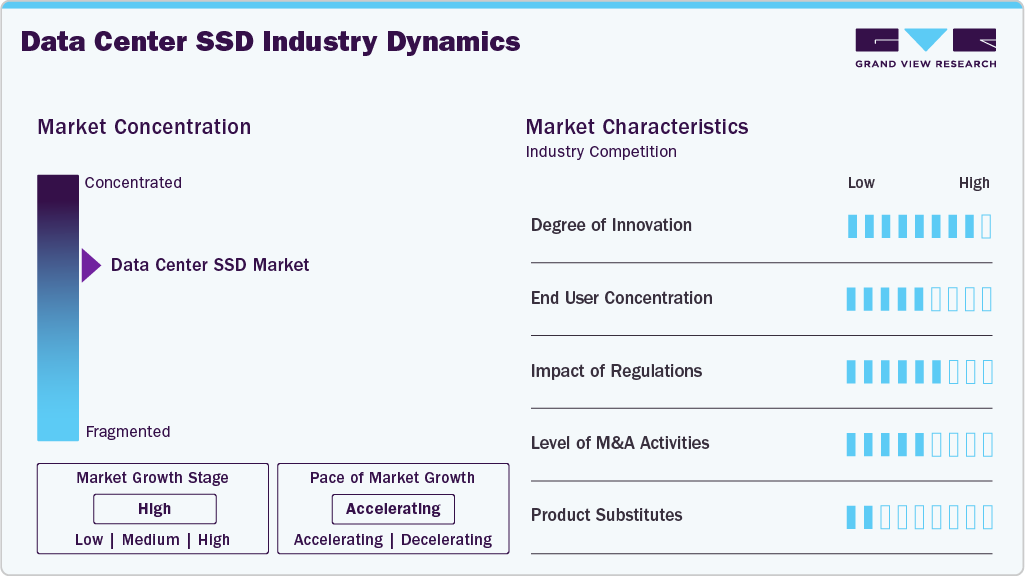 To learn more about this report, Download Free Sample Report
 In terms of market characteristics, the industry is highly technology-intensive and driven by continuous innovation in NAND flash scaling, PCIe Gen5 and Gen6 interfaces, computational storage, AI-driven workload optimization, and high-density storage architectures. Rising demand for hyperscale data centers, cloud-native applications, big data analytics, generative AI workloads, and edge computing infrastructure are major demand drivers. Additionally, the market is characterized by rapid product innovation cycles, strong pricing pressure, high performance and endurance requirements, and increasing adoption of energy-efficient storage technologies. Organizations increasingly prioritize low latency, high input/output performance, scalability, reliability, and power efficiency to support mission-critical enterprise applications, real-time analytics, and AI-intensive computing environments.
Form Factor Insights
The 2.5-inch (U.2/U.3) segment dominated the market and accounted for the revenue share of 42.0% in 2025. The 2.5-inch U.2/U.3 form factor is widely adopted because it integrates easily into existing enterprise and hyperscale server architectures. These drives use standard backplanes and hot-swappable bays, allowing data centers to upgrade storage without redesigning hardware. U.3 further enhances flexibility by supporting NVMe, SAS, and SATA protocols in a single slot, reducing system complexity and enabling seamless infrastructure modernization.
The EDSFF (E1.S / E1.L / E3) segment is anticipated to grow at the highest CAGR during the forecast period. EDSFF form factors are specifically designed for PCIe/NVMe interfaces, which are becoming the industry standard for high-performance data centers. Their architecture supports higher bandwidth, lower latency, and improved parallelism, making them ideal for AI training, real-time analytics, and high-performance computing workloads. As NVMe adoption accelerates, EDSFF SSDs are increasingly preferred over legacy form factors.
Interface Insights
The PCIe (NVMe) dominated the market and accounted for the largest revenue share in 2025. The rapid expansion of edge computing, supported by 5G networks and IoT ecosystems, is significantly increasing the demand for PCIe NVMe SSDs in distributed data centers. Edge facilities require ultra-low latency, high-speed data processing, and energy-efficient storage within compact infrastructures. NVMe SSDs provide superior throughput and faster response times, enabling real-time analytics, autonomous systems, and latency-sensitive applications, thereby strengthening their adoption across edge and micro data center environments.
The SAS (Serial Attached SCSI) is expected to grow at a significant CAGR during the forecast period. SAS SSDs are widely adopted in enterprise data centers due to their dual-port capability, which allows two independent data paths to the drive. This ensures continuous operation even if one path fails, enhancing system redundancy and fault tolerance. Such high availability is essential for mission-critical applications in sectors like banking, healthcare, and government, where uninterrupted data access, system uptime, and data integrity are crucial for operational continuity and regulatory compliance.
NAND Technology Insights
The TLC segment dominated the market and accounted for the largest revenue share in 2025. Triple-Level Cell (TLC) NAND delivers an optimal balance between cost, performance, and storage density, making it highly suitable for data center environments. Compared to MLC, TLC offers higher capacity and a lower cost per gigabyte, enabling large-scale deployments without significantly increasing infrastructure expenses. At the same time, it provides better endurance and performance consistency than QLC, making it reliable for mixed enterprise workloads. This balance allows hyperscale cloud providers and enterprises to efficiently manage performance-sensitive applications, virtualization, and analytics workloads while maintaining cost efficiency and scalable storage architecture.
The QLC segment is expected to grow at a significant CAGR during the forecast period. Quad-Level Cell (QLC) NAND provides exceptionally high storage density by storing four bits per cell, resulting in a significantly lower cost per terabyte compared to TLC and MLC technologies. This cost advantage makes QLC SSDs particularly attractive for hyperscale cloud providers and large data centers handling massive and growing datasets. As organizations prioritize cost-efficient scaling of storage infrastructure, QLC enables higher capacity deployments without proportional increases in capital expenditure. Consequently, it is increasingly adopted for bulk storage, data lakes, archives, and other capacity-driven workloads where affordability and scalability are more critical than high endurance.
Storage Capacity Insights
The ≥ 4 TB segment dominated the market and accounted for the largest revenue share in 2025. The rapid expansion of AI, big data analytics, IoT devices, and digital platforms is generating unprecedented volumes of structured and unstructured data. Organizations must store, process, and retrieve this information efficiently to support real-time insights and business operations. As datasets grow larger, enterprises and hyperscale cloud providers increasingly rely on high-capacity SSDs (≥ 4 TB) to consolidate storage, reduce infrastructure complexity, and improve performance. These drives enable efficient management of data lakes, backups, and long-term repositories, making them essential for scalable, data-intensive data center environments.
The 2-4 TB segment is expected to grow at a significant CAGR during the forecast period. The 2-4 TB SSD segment provides an effective balance between storage capacity, performance, and cost, making it well suited for mainstream enterprise environments. Many business applications, including virtualization platforms, relational databases, and enterprise resource planning systems, require consistent performance along with moderate-to-high storage capacity. SSDs in this range can support multiple virtual machines and high transaction volumes without excessive infrastructure investment. Their capacity is sufficient for handling active datasets while maintaining low latency and strong IOPS performance, making them a practical choice for organizations seeking scalable and cost-efficient storage solutions.
End User Insights
The hyperscale cloud providers segment dominated the market and accounted for the largest revenue share in 2025. The rapid growth of AI, machine learning, and big data analytics is significantly increasing storage performance requirements in hyperscale data centers. These workloads involve processing massive datasets that demand ultra-fast data access, high throughput, and low latency. To meet these needs, hyperscale cloud providers are increasingly deploying NVMe-based SSDs that can efficiently support AI training pipelines, real-time analytics, and large-scale data lakes. This shift toward data-intensive computing environments is driving higher SSD consumption, as traditional storage solutions cannot deliver the speed and scalability required for advanced digital workloads.
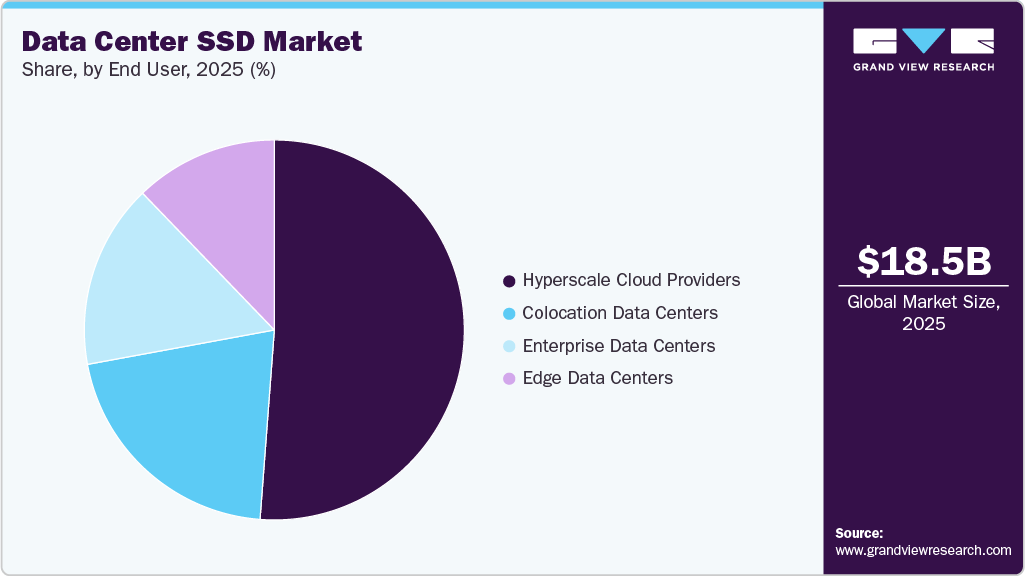 To learn more about this report, Download Free Sample Report
 The colocation data centers segment is expected to grow at a significant CAGR over the forecast period. The increasing adoption of hybrid and multi-cloud strategies is driving demand for high-performance storage in colocation data centers. Organizations use colocation facilities as interconnection hubs to link private infrastructure with multiple public cloud platforms, enabling flexible workload distribution and disaster recovery. These interconnected environments require fast, low-latency, and reliable storage to support real-time data transfer and application performance. Enterprise-grade SSDs are preferred in such setups as they ensure seamless data exchange, improved workload mobility, and consistent performance across distributed and cloud-integrated IT infrastructures.
Regional Insights
North America dominated the global market with the largest revenue share of 38.5% in 2025. North America hosts leading hyperscale cloud companies such as Amazon Web Services, Microsoft Azure, and Google Cloud, which continuously expand data center capacity. Their large-scale investments in AI-ready and high-performance infrastructure significantly drive demand for enterprise-grade SSDs, particularly NVMe-based solutions.
 To learn more about this report, Download Free Sample Report
 The Data Center SSD market in the U.S. is expected to grow significantly at a CAGR of 16.4% from 2026 to 2033. The region is at the forefront of AI, machine learning, and big data innovation. Technology firms, research institutions, and enterprises require high-speed storage to process massive datasets, boosting SSD deployment across hyperscale and enterprise data centers.
Europe Data Center SSD Market Trends
The Data Center SSD Market in Europe is anticipated to register considerable growth from 2026 to 2033. Europe is witnessing significant investments in hyperscale and cloud data center infrastructure, particularly in countries such as Germany, the UK, France, and the Nordics. Global cloud providers and regional operators are expanding capacity to support growing digital services, increasing the deployment of high-performance SSD storage.
The UK Data Center SSD market is expected to grow rapidly in the coming years. As a global financial center, the UK has strong demand for high-speed, low-latency storage in banking, trading platforms, and fintech applications. SSDs are essential for real-time transaction processing, fraud detection, and regulatory reporting systems.
The Germany Data Center SSD market held a substantial market share in 2025. Germany’s leadership in manufacturing and Industry 4.0 initiatives is accelerating demand for data analytics, IoT platforms, and smart factory solutions. These data-intensive applications require low-latency, high-reliability SSD storage infrastructure.
Asia Pacific Data Center SSD Market Trends
Asia Pacific Data Center SSD held a significant share in the global market in 2025. APAC is witnessing aggressive expansion of hyperscale data centers across China, India, Singapore, Japan, South Korea, and Australia. Global and regional cloud providers are investing heavily to meet rising digital demand, driving large-scale deployment of enterprise NVMe SSDs.
The Japan Data Center SSD market is expected to grow rapidly in the coming years. Japan is a major cloud hub in Asia, with hyperscale data center expansion in Tokyo and Osaka. Global and domestic cloud providers are investing in AI-ready and high-density infrastructure, driving strong demand for high-performance NVMe SSDs.
The China Data Center SSD market held a substantial market share in 2025, due to state-backed digital infrastructure programs and initiative aimed at redistributing computing workloads across regions. Large-scale construction of inland data center clusters is increasing demand for commissioning, grid integration testing, and high-voltage power system maintenance services.
Key Data Center SSD Company Insights
Key players operating in the Data Center SSD industry are ADATA Technology Co., Ltd., Intel Corporation, Kingston Technology Corporation, Micron Technology, Inc., Microsemi (Microchip Technology Inc.), SAMSUNG, Seagate Technology LLC, SK HYNIX INC, Western Digital Corporation, Toshiba Corporation and Kioxia Corporation. The companies are focusing on various strategic initiatives, including new product development, partnerships & collaborations, and agreements to gain a competitive advantage over their rivals. The following are some instances of such initiatives.
-
In March 2026, Seagate Technology LLC announced that it has qualified its new 40 TB HAMR (Heat-Assisted Magnetic Recording) hard drives with two major data center customers, marking a significant step in high-capacity HDD deployment. These drives offer massive storage density for cost-effective bulk capacity, helping data centers manage petabyte-scale workloads, cold/archival storage, and long-term data retention more efficiently
-
In July 2025, Micron Technology has introduced a new family of industry-first data center SSDs based on its next-generation G9 NAND, including the world’s first PCIe Gen6 SSD and high-capacity E3.S drives. These products deliver significantly higher performance, greater storage density, and improved efficiency to support demanding AI and data center workloads, reinforcing Micron’s leadership in high-end enterprise storage solutions.
Key Data Center SSD Companies:
The following key companies have been profiled for this study on the data center ssd market.
- ADATA Technology Co., Ltd.
- Intel Corporation
- Kingston Technology Corporation
- Micron Technology, Inc.
- Microsemi (Microchip Technology Inc.)
- SAMSUNG
- Seagate Technology LLC
- SK HYNIX INC
- Western Digital Corporation
- Toshiba Corporation
- Kioxia Corporation
Competitive Benchmarking
Operating Strategies
Competitive Edge
Weakness
Mature Players: SAMSUNG, SK HYNIX INC, Micron Technology, Inc., Kioxia Corporation, Western Digital Corporation
- Expanding high-capacity NVMe SSD portfolios, PCIe Gen5/Gen6 technologies, and AI-optimized storage solutions for hyperscale data centers.
- • Investing in advanced NAND flash technologies, computational storage, energy-efficient architectures, and enterprise SSD innovation.
- • Strengthening partnerships with hyperscale cloud providers, OEM server manufacturers, and AI infrastructure companies.
- • Enhancing SSD endurance, throughput, low-latency performance, and storage density to support AI, big data, and cloud-native workloads.
- Strong global semiconductor manufacturing capabilities and enterprise customer base.
- Broad enterprise storage portfolios covering NVMe, PCIe, QLC, TLC, and high-performance flash solutions.
- Strong brand recognition and long-term relationships with hyperscale cloud and enterprise infrastructure providers.
- High scalability, advanced R&D capabilities, and extensive supply chain networks supporting large-scale data center deployments
- High capital investment requirements and exposure to NAND flash pricing volatility.
- Supply chain disruptions and geopolitical trade restrictions may impact production stability.
- Legacy manufacturing processes may increase transition complexity toward next-generation storage technologies.
- Large organizational structures may slow rapid product customization and innovation cycles.
Emerging Players: ADATA Technology Co., Ltd., Microsemi (Microchip Technology Inc.), Kingston Technology Corporation
- Focusing on cost-effective enterprise SSD solutions, flexible deployment models, and specialized storage offerings for SMEs and mid-scale data centers.
- Developing high-capacity NVMe SSDs, energy-efficient storage solutions, and optimized SSD controllers for enterprise workloads.
- Expanding partnerships with system integrators, server vendors, and enterprise channel distributors.
- Targeting edge computing, enterprise backup storage, virtualization, and high-density storage applications.
- Faster innovation cycles and greater flexibility in addressing niche enterprise storage requirements.
- Strong specialization in SSD controller technologies, enterprise-grade reliability, and cost-optimized storage solutions.
- Easier deployment, competitive pricing, and simplified storage integration supporting mid-sized enterprise adoption.
- Strong focus on customized storage requirements and customer-centric product development.
- Limited global manufacturing scale and smaller enterprise support ecosystems compared to major NAND manufacturers.
- Lower brand recognition among hyperscale cloud and large enterprise customers.
- Dependence on third-party NAND suppliers and strategic partnerships for market expansion.
- Limited financial resources for large-scale fabrication investments and advanced semiconductor R&D initiatives.
Data Center SSD Market Report Scope
Report Attribute
Details
Market size in 2025
USD 18.5 billion
Estimated market size in 2026
USD 21.50 billion
Projected market size by 2033
USD 66.26 billion
Growth rate
CAGR of 17.4% from 2026 to 2033
Actual data
2021 - 2025
Forecast period
2026 - 2033
Quantitative units
Revenue in USD million/billion and CAGR from 2026 to 2033
Report enterprise size
Revenue forecast, company share, competitive landscape, growth factors, and trends
Segments covered
Form factor, interface, NAND technology, data center type, end user, region
Regional scope
North America; Europe; Asia Pacific; Latin America; MEA
Country scope
U.S.; Canada; Mexico; UK; Germany; France; China; India; Japan; Australia; South Korea; Brazil; UAE; Kingdom of Saudi Arabia; South Africa
Key companies profiled
ADATA Technology Co., Ltd.; Intel Corporation; Kingston Technology Corporation; Micron Technology, Inc.; Microsemi (Microchip Technology Inc.); SAMSUNG; Seagate Technology LLC; SK HYNIX INC; Western Digital Corporation; Toshiba Corporation; Kioxia Corporation
Customization scope
Free report customization (equivalent to 8 analysts working days) with purchase. Addition or alteration to country, regional & segment scope.
Pricing and purchase options
Avail customized purchase options to meet your exact research needs. Explore purchase options
Global Data Center SSD Market Segmentation
This report forecasts revenue growth at the global, regional, and country levels and provides an analysis of the latest industry trends in each of the sub-segments from 2021 to 2033. For this study, Grand View Research has segmented the data center SSD market report based on form factor, interface, NAND technology, data center type, end user, and region.
-
Form Factor Outlook (Revenue, USD Billion, 2021 - 2033)
-
2.5-inch (U.2/U.3)
-
M.2
-
PCIe Add-in Card
-
EDSFF (E1.S / E1.L / E3)
-
-
Interface Outlook (Revenue, USD Billion, 2021 - 2033)
-
PCIe (NVMe)
-
SAS (Serial Attached SCSI)
-
SATA
-
-
NAND Technology Outlook (Revenue, USD Billion, 2021 - 2033)
-
SLC
-
MLC
-
TLC
-
QLC
-
-
Storage Capacity Outlook (Revenue, USD Billion, 2021 - 2033)
-
≤ 1 TB
-
1-2 TB
-
2-4 TB
-
≥ 4 TB
-
-
End User Outlook (Revenue, USD Billion, 2021 - 2033)
-
Hyperscale Cloud Providers
-
Colocation Data Centers
-
Enterprise Data Centers
-
Edge Data Centers
-
-
Regional Outlook (Revenue, USD Billion, 2021 - 2033)
-
North America
-
U.S.
-
Canada
-
Mexico
-
-
Europe
-
UK
-
Germany
-
France
-
-
Asia Pacific
-
China
-
India
-
Japan
-
South Korea
-
Australia
-
-
Latin America
-
Brazil
-
-
Middle East & Africa
-
UAE
-
Saudi Arabia
-
South Africa
-
-
Delivered Customizations
This report has been delivered with the following In-depth customizations
Client Request
Customization Delivered
Value Adds
SSD technology benchmarking by interface and storage architecture
- Comparative analysis of SATA, SAS, NVMe, PCIe Gen4, PCIe Gen5, and PCIe Gen6 enterprise SSD technologies.
- Evaluation of performance metrics including latency, endurance, throughput, power efficiency, and storage density.
- Identified high-adoption SSD technologies and future transition trends.
- Supported product roadmap planning and technology positioning strategies.
- Highlighted performance advantages across enterprise workload environments.
Data center SSD opportunities in AI and generative AI infrastructure
- Assessment of SSD demand generated by AI training clusters, inference workloads, generative AI platforms, and GPU-accelerated computing environments.
- Analysis of enterprise storage requirements for large language models and AI data processing.
- Identified emerging opportunities in AI-driven storage infrastructure markets.
- Supported positioning in high-growth AI and accelerated computing ecosystems.
- Highlighted increasing demand for low-latency and high-throughput storage architectures.
Energy-efficient SSD and green data center assessment
- Analysis of enterprise demand for low-power SSDs, energy-efficient storage architectures, and sustainable data center initiatives.
- Evaluation of SSD contributions toward reducing cooling requirements and improving power usage effectiveness (PUE).
- Identified opportunities linked to green data center modernization initiatives.
- Supported sustainability-focused product positioning strategies.
- Highlighted enterprise priorities for energy-efficient infrastructure deployment.
Frequently Asked Questions About This Report
The 2.5-inch (U.2/U.3) segment led with a 42.0% revenue share in 2025, while EDSFF (E1.S / E1.L / e3) is the fastest-growing form factor.
The TLC segment segment dominated the market and accounted for the largest revenue share in 2025.
The hyperscale cloud providers segment held the largest revenue share in 2025.
PCIe (NVMe) segment led the market with the largest revenue share in 2025.
The ≥ 4 TB segment accounted for the largest revenue share in 2025.
The global data center SSD market size was valued at USD 18.5 billion in 2025 and is estimated at USD 21.5 billion for 2026.
The global data center SSD market is expected to grow at a CAGR of 17.4% from 2026 to 2033, reaching USD 66.3 billion by 2033.
North America dominated the global market with the largest revenue share of 38.5% in 2025. North America hosts leading hyperscale cloud companies such as Amazon Web Services, Microsoft Azure, and Google Cloud, which continuously expand data center capacity. Their large-scale investments in AI-ready and high-performance infrastructure significantly drive demand for enterprise-grade SSDs, particularly NVMe-based solutions.
Key players include ADATA Technology Co., Ltd.; Intel Corporation; Kingston Technology Corporation; Micron Technology, Inc.; Microsemi (Microchip Technology Inc.); SAMSUNG; Seagate Technology LLC; SK HYNIX INC; Western Digital Corporation; Toshiba Corporation; Kioxia Corporation.
The key factors for the growth of the market include the rapid expansion of data generation and processing requirements across industries. The continued growth of cloud computing serves as the key catalyst, as hyperscale cloud providers consistently invest in new data center facilities and upgrade their storage architectures to support artificial intelligence (AI), advanced analytics, and other high-performance workloads
About the Author(s)
Next Generation Technologies Research Team
Technology · Next Generation TechnologiesThis report was authored by the next generation technologies research team at Grand View Research - comprising two research analysts, one senior research analyst, and one industry expert - with specialized expertise in the next generation technologies segment of the technology industry. All findings are based on proprietary technology databases, executive interviews, and regulatory analysis, subject to internal peer review prior to publication.
Last Updated:
Speak to Analyst

Customize this report to your needs - add regions, segments, or data points, with 20% free customization.
Or view our licence options:


ISO 9001:2015 & 27001:2022 Certified
We are GDPR and CCPA compliant! Your transaction & personal information is safe and secure. For more details, please read our privacy policy.


