
- Home
- »
- Medical Devices
- »
-
Dental Splints Market Size And Share Report, 2026 - 2033GVR Report cover

Dental Splints Market (2026 - 2033)
Size, Share & Trends Analysis Report By Mobility Degree (Flexible, Semi-rigid, Rigid), By Distribution Channel (Online, Offline), By Region (North America, Europe, Asia Pacific, Latin America, MEA) And Segment Forecast
Market Size, 2025
$514.7MMarket Estimate, 2026
$544.2MMarket Forecast, 2033
$847.9MCAGR, 2026–2033
6.5%Dental Splints Market Summary
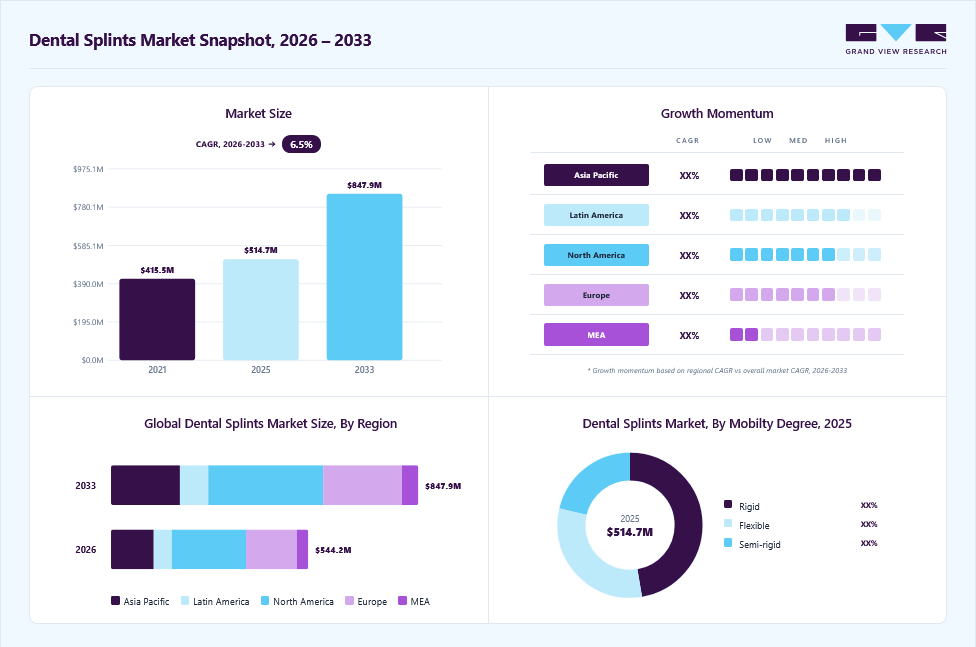
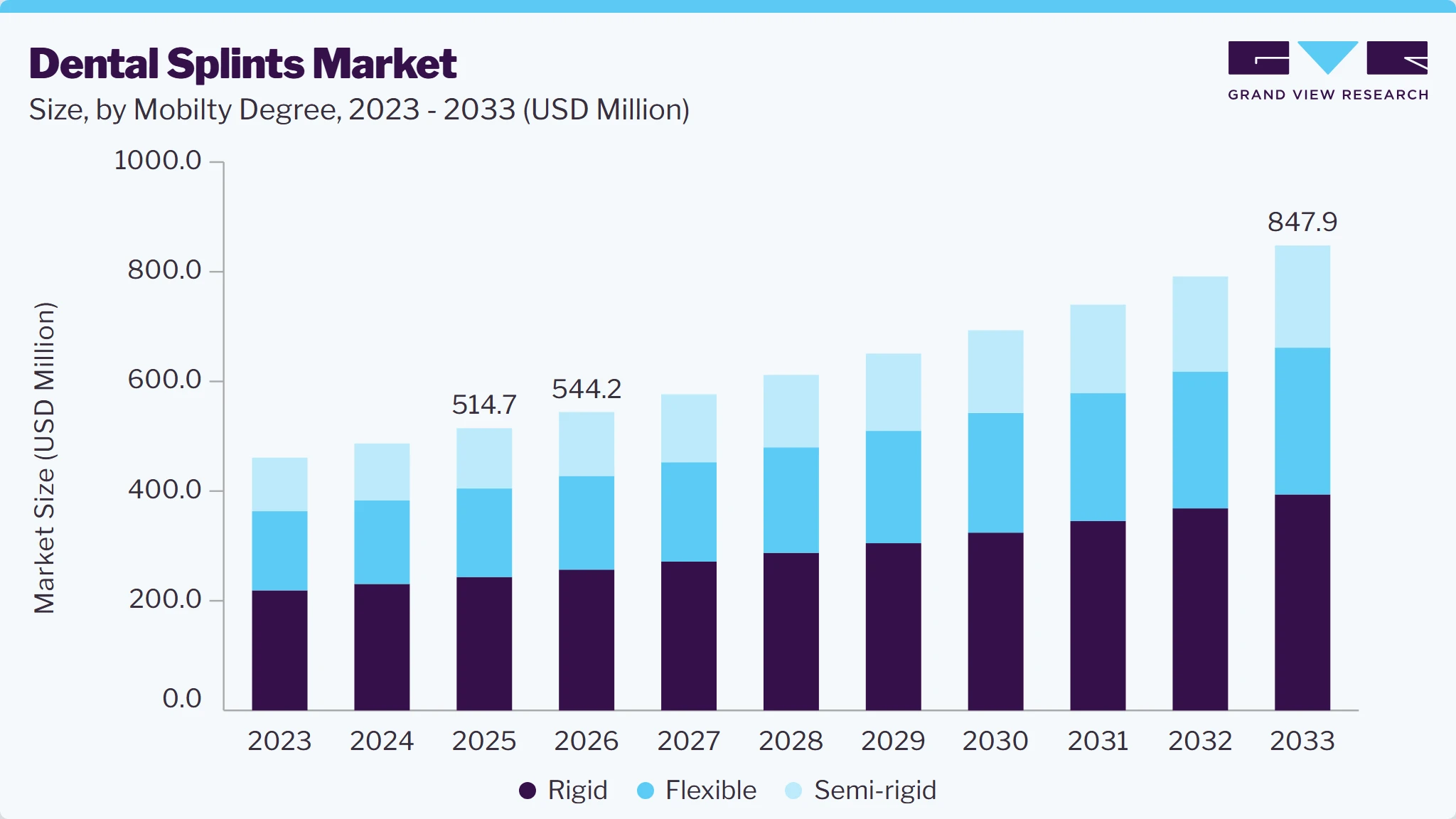
The global dental splints market size was valued at USD 514.7 million in 2025 and is projected to grow from USD 544.2 million in 2026 to USD 847.9 million by 2033, growing at a CAGR of 6.5% from 2026 to 2033. North America dominated the market, accounting for the largest global share of 37.7% in 2025. The increasing incidence of clenching & grinding of teeth among people and the growing incidence of dental disorders are anticipated to drive the market over the forecast period.
 Source: Grand View Research, IR Documents, Primary Interviews, Paid DatabasesTo learn more about this report,
 Download Free Sample Report
 Key Market Trends & Insights
- By mobility degree: Rigid segment led the market with the largest share of 47.3% in 2025.
- By distribution channel: Offline (through dental professional) segment led the market with the largest share of 58.5% in 2025
Regional Highlights
- Largest regional market: North America (37.7% revenue share, 2025)
- Fastest-growing regional market: Asia Pacific (fastest CAGR, 2026-2033)
- By country: The U.S. held the largest share of North America in 2025.
Market Size & Forecast
- Market size in 2025: USD 514.7 Million
- Estimated market size in 2026: USD 544.2 Million
- Projected market size by 2033: USD 847.9 Million
- CAGR (2026-2033): 6.5%
Three ways to get this report
Buy it, customize it, or ask a question.Ask an Analyst
A direct answer, usually in 1 working day
- AccessReport author, directly
- Reply timeWithin 1 working day
- No sales callDirect answer only
- FormatEmail reply
- CostFree, no cost
Get the Full Report
What the study covers
- FormatsPDF · Excel · Dashboard
- Timeline2026–2033 annual, 2025 base
- Coverage20+ countries, 5 regions
- Companies10+ key players profiled
Customize the Report
20% free customization
- IncludeCountries, segments, points
- TailorTo your product definition
- ExtendDeeper competitor detail
- OrA fully bespoke study
- Turnaround5–10 working days
The increasing incidence of clenching & grinding of teeth among people and the growing incidence of dental disorders are anticipated to drive the market over the forecast period. Dental splints are proven to be one of the most common and effective treatments for relieving TMJ disorder. Symptoms of this disorder occur in nearly 6% to 12% of the adult population, or around 10 million individuals in the U.S. It is estimated that 17,800,000 workdays are missed every year for every 100,000,000 full-time working individuals in the U.S. due to TMJ disorder. Furthermore, the rise in awareness about bruxism treatment among individuals is anticipated to boost market growth.
 To learn more about this report, Download Free Sample Report
 Dental clinics and hospitals are observing an increase in the number of patients with dental problems in recent years. This is due to a rise in awareness about the importance of oral & dental health, and the availability of different treatment options. In addition, governments are recognizing fields of scientific research and implementing programs or campaigns to improve the oral health of citizens. For instance, the CDC, through cooperative agreement programs, supports territorial & state health departments and national partner organizations. It funds 20 state health departments under the state actions to upgrade (DP-1810) Oral Health Outcomes, to aid their efforts to reduce dental caries, chronic disorders comorbid with poor oral health, and other dental health conditions.
Furthermore, dental care has grown more important as a result of rising disposable income and rising healthcare costs in developed and emerging economies. The use of new technology, such as 3D printing and dental lasers, has given the dental business a profitable chance for expansion. Growing demand for long-term alternatives to traditional operations has also led to an increase in research-related activities and a stronger uptake of new dental treatments.
The coronavirus outbreak has affected every industry, including the dentistry sector because strict restrictions were imposed by the authority bodies as a precaution. The supply-demand equilibrium across the whole medical equipment business has been severely disturbed by the pandemic. With the rise and spread of the coronavirus, dentistry experienced its darkest hour in 2020. Nationwide dental offices have been closed for several months. However, clinics began to open again in the middle of 2020 and 2021, and post-covid market demand rose. COVID-19 pandemic-driven stress is exhibited in individuals' mouths in a set of ways, including bruxism, where extreme teeth grinding leads to cracked and chipped teeth and temporomandibular joint disorder-related symptoms. As the temporomandibular joint disorder (TMD) cases rise, patients see symptoms in their TM joints, facial nerves, and jaw muscles that control jaw movement, this, in turn, led to an increase in the sale of the dental splint in 2021.
Market Dynamics
Dental splints are witnessing steady demand in the dental market due to their important role in managing TMJ disorders, bruxism (teeth grinding), obstructive sleep apnea (OSA), and other occlusal conditions. They are widely used to reduce jaw pain, protect teeth from excessive wear, improve jaw alignment, and enhance patient comfort through non-invasive treatment. Growing awareness of oral health, increasing diagnosis of TMJ disorders and sleep-related breathing disorders, and the rising adoption of preventive dental care are supporting market growth. In addition, the expanding elderly population, increasing stress-related bruxism, and growing demand for customized dental appliances are driving the need for advanced dental splints. Continuous advancements in digital dentistry, including CAD/CAM systems, intraoral scanning, and 3D printing, are improving the precision, fit, and manufacturing efficiency of dental splints, thereby contributing to their wider adoption across dental clinics, hospitals, and dental laboratories.
The increasing number of patients diagnosed with temporomandibular joint (TMJ) disorders is a key driver of the dental splints market. TMJ disorders cause pain and dysfunction in the jaw joint and surrounding muscles, leading to symptoms such as jaw pain, headaches, clicking sounds, limited jaw movement, and difficulty chewing. These conditions are becoming more common due to factors such as stress-related teeth grinding (bruxism), jaw injuries, arthritis, and poor bite alignment. Dental splints are widely recommended as a first-line, non-invasive treatment to reduce pressure on the jaw joint, stabilize the bite, minimize teeth grinding, and relieve pain. Increasing awareness among patients and dental professionals about early diagnosis and conservative treatment options is further supporting demand. In addition, the growing availability of CAD/CAM-designed splints and digital impression technologies has improved treatment accuracy and patient comfort, encouraging greater adoption worldwide across dental clinics and specialty practices.
The high cost of customized dental splints is a significant restraint for the dental splints market, particularly in price-sensitive regions. Unlike over-the-counter mouthguards, custom splints require multiple clinical steps, including dental examination, intraoral scanning or impressions, bite registration, laboratory fabrication, fitting, and follow-up adjustments. These additional procedures increase patients' overall treatment costs. Advanced manufacturing technologies such as CAD/CAM systems and 3D printing improve the precision and fit of splints but also increase production costs due to investments in specialized equipment, software, and high-quality biocompatible materials. In many countries, dental insurance provides limited or no reimbursement for splints prescribed for conditions such as bruxism or TMJ disorders, leaving patients to bear much of the cost.
The growing adoption of digital dentistry and 3D printing technologies presents a significant opportunity for the dental splints market. Dental clinics and laboratories are using intraoral scanners, CAD/CAM software, and 3D printers to design and manufacture highly accurate, patient-specific splints. Compared with conventional impression-based methods, digital workflows improve precision, reduce production time, and enhance patient comfort by eliminating the need for traditional impression materials. They also allow faster communication between dental clinics and laboratories, resulting in shorter treatment turnaround times and fewer remakes. Advances in biocompatible 3D printing materials are further improving the durability, fit, and clinical performance of dental splints used for bruxism, TMJ disorders, and sleep apnea.
Analyst Perspective
The dental splints market is growing steadily due to the rising prevalence of bruxism, TMJ disorders, and obstructive sleep apnea (OSA). Increased awareness of preventive oral healthcare and demand for customized dental appliances are driving adoption. Advances in digital dentistry, including CAD/CAM systems, intraoral scanners, and 3D printing, are improving fabrication efficiency and precision. Growing dental visits, an aging population, and higher sports participation further support market demand. Companies with broad product portfolios, digital manufacturing capabilities, and strong clinical partnerships are strengthening their competitive position. Future growth will be driven by personalized dental solutions, expanding diagnoses of sleep-related disorders, and continued innovation in digital workflows.
Mobility Degree Insights
Based on mobility degree, the rigid segment led the market with the largest revenue share of 47.3% in 2025 and is adopted by most individuals. The advantages of such splinting systems include low material cost, easy availability in dental clinics, and ease of modification. Splinting of teeth uses the principles of jaw bone fracture, enabling rigid immobilization for a few months.
The semi-rigid is expected to grow at the fastest CAGR over the forecast period. Therefore, where the support is obtained from neighbouring teeth, semi-rigid dental splints are employed to stabilize the repositioned tooth. Hence, for the semi-rigid segment, a sizable CAGR is anticipated during the forecast period.
Distribution Channel Insights
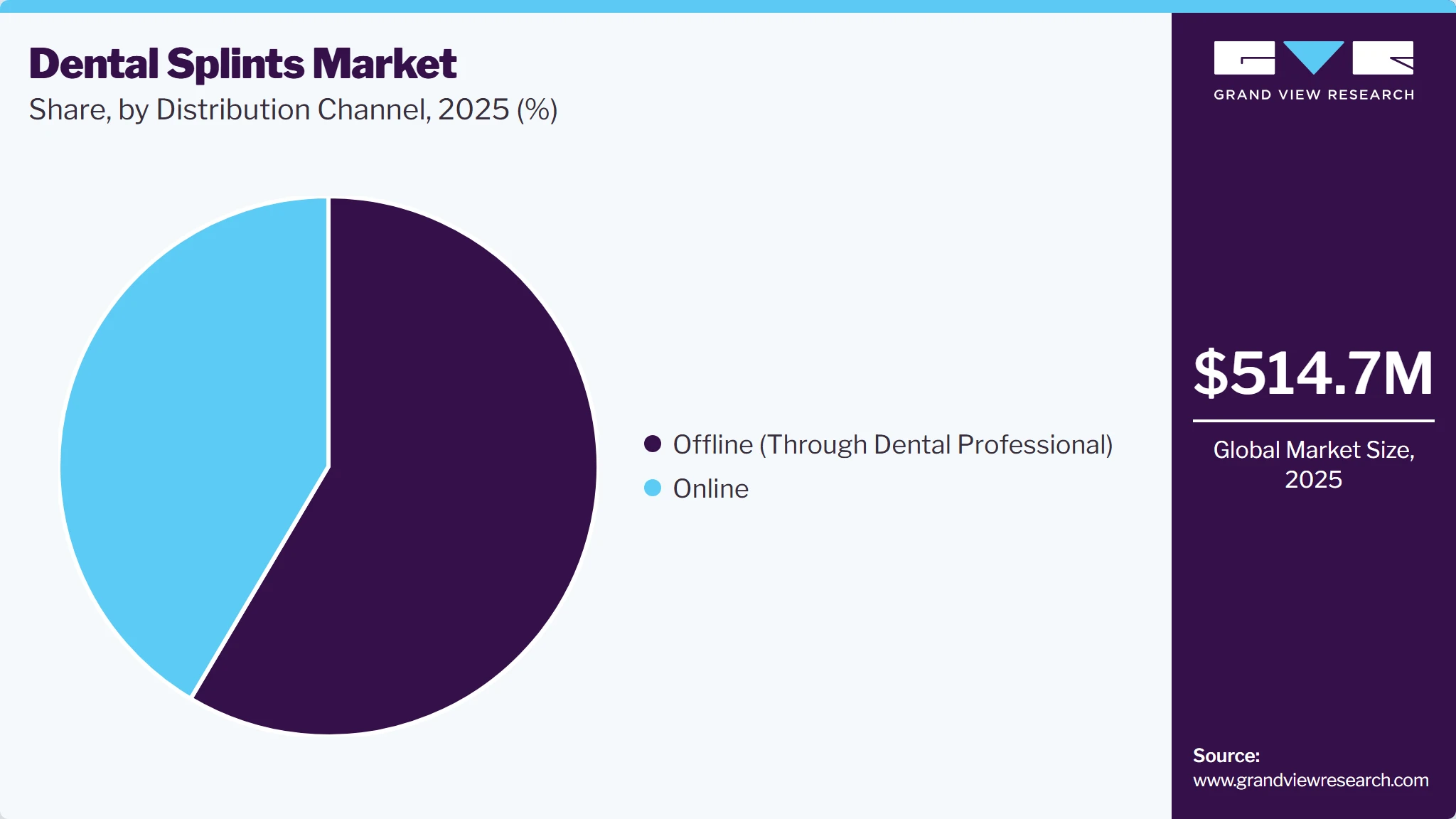
Based on distribution channel, the offline (through dental professional) segment led the market with the largest revenue share of 58.5% in 2025. In a competitive environment such as the oral care industry, market players need to upgrade their organizations as well as implement marketing strategies to meet the customer’s needs and strengthen their leadership. Players are following both online and offline mediums for the sale of their products. Due to a conventional marketing strategy that allows consumers to physically inspect products and receive advice before purchase, offline media still earns significant money.
 To learn more about this report, Download Free Sample Report
 The online is expected to grow at the fastest CAGR over the forecast period. In the dental industry, dentists are involved in buying and selling dental products. The dentist may charge more for directly providing the product and can provide the patient with a customized product as per the requirement. Furthermore, the offline mode of distribution includes important factors that directly influence the buyer’s behaviour. For instance, a consumer does not need to wait too long for product delivery as compared to online avenues. However, the dental splints provided by dentists are typically more expensive than the ones bought from online stores.
Regional Insights
North America dominated the dental splints market with the largest revenue share of 37.7% in 2025. The dental splints market in the U.S. held the largest share in the North America region in 2025. The United States is propelling market growth due to its growing population, advancements in dental technology, expanding insurance plan coverage, and presence of significant manufacturers. The utilisation of direct sales to its customers is another factor in the region.
 To learn more about this report, Download Free Sample Report
 Over the forecast period, the Asia Pacific region is expected to see the highest CAGR of 7.1%. Asia Pacific is expected to see significant growth because of the area's high population density, the severity of its dental problems, and the gradual adoption of dentistry. There has been gradual rise of the dental problems in some Asian countries for instance, over the past three decades; India's most common disease group has continued to be oral ailments. The issue has only gotten worse in recent years due to India being one of the nations that consume the most tobacco, a major cause of oral cancer.
Key Companies & Market Share Insights
There are only a few large companies and numerous small businesses in the dental splint market, making it incredibly competitive.In order to forge their industry position and seize a sizable share of the market, the major market participants have developed crucial business strategies, such as new product launches, product innovation, strategic partnerships & collaborations, joint ventures, advanced service launches, and contracts.
For instance, some manufacturers had still launched new products during the covid-19 to compete in the market, since it was observed that COVID-related stress led to increased cases of jaw clenching and grinding. In October 2020, Glidewell launched the Comfort3D Bite Splint. The product is likely to provide patients cost-efficient and reliable solution that will help in preventing teeth damage caused by clenching and bruxism.
Key Dental Splints Companies:
The following key companies have been profiled for this study on the dental splints market.
-
Aqualizer
-
Glidewell
-
Procter & Gamble
-
Dentek
-
Brux Night Guard
-
Sporting Smiles
-
Smile Brilliant
-
Chomper Labs
-
Sentinel Mouth Guards
Competitive Benchmarking
Category
Operating Strategies
Competitive Edge
Weakness
Established Players (Glidewell, Procter & Gamble, Dentek (Prestige Brands Holdings, Inc))
- Strengthen relationships with dentists, orthodontists, prosthodontists, and sleep medicine specialists through clinical education and training programs.
- Integrate splints into broader digital dentistry workflows using intraoral scanners, CAD/CAM systems, and in-house manufacturing capabilities.
- Established reputation and long-standing relationships with dental professionals.
- Broad product offerings that enable one-stop procurement for clinics and laboratories.
- Premium pricing can reduce competitiveness in price-sensitive regions.
- Large organizational structures may limit responsiveness to niche market demands.
Emerging Players (Brux Night Guard, Sporting Smiles, Smile Brilliant)
- Concentrate on specialized segments such as customized night guards, sports mouthguards, or TMJ splints.
- Adopt flexible manufacturing models, including 3D printing and outsourced production, to optimize costs.
- Faster decision-making and quicker implementation of new technologies and materials.
- High levels of customization tailored to individual patient requirements.
- Limited financial resources for large-scale expansion and extensive clinical studies.
- Lower brand recognition and reduced bargaining power with distributors.
Dental Splints Market Report Scope
Report Attribute
Details
Market size value in 2025
USD 514.7 million
Market size value in 2026
USD 544.2 million
Revenue forecast in 2033
USD 847.9 million
Growth rate
CAGR of 6.5% from 2026 to 2033
Base year for estimation
2025
Historical data
2021 - 2024
Forecast period
2026 - 2033
Quantitative units
Revenue in USD million/billion and CAGR from 2026 to 2033
Report coverage
Revenue forecast, company ranking, competitive landscape, growth factors, and trends
Segments covered
Mobility degree, distribution channel, region
Regional scope
North America; Europe; Asia Pacific; Latin America; MEA
Country scope
U.S.; Canada; Mexico; Germany; UK; France; Italy; Spain; Denmark, Sweden, Norway, China; Japan; India; Australia; Thailand; South Korea, Brazil; Argentina; South Africa; Saudi Arabia; UAE; Kuwait
Key companies profiled
Aqualizer, Glidewell, Procter & Gamble, Dentek (Prestige Brands Holdings, Inc.), Brux Night Guard, Sporting Smiles, Smile Brilliant, Chomper Labs, Sentinel Mouth Guards, Kulzer GmbH. (Mitsui Chemicals, Inc.), Modern Dental Laboratory Co., Ltd., SprintRay Inc.
Customization scope
Free report customization (equivalent up to 8 analysts' working days) with purchase. Addition or alteration to country, regional & segment scope.
Pricing and purchase options
Avail customized purchase options to meet your exact research needs. Explore purchase options
Global Dental Splints Market Report Segmentation
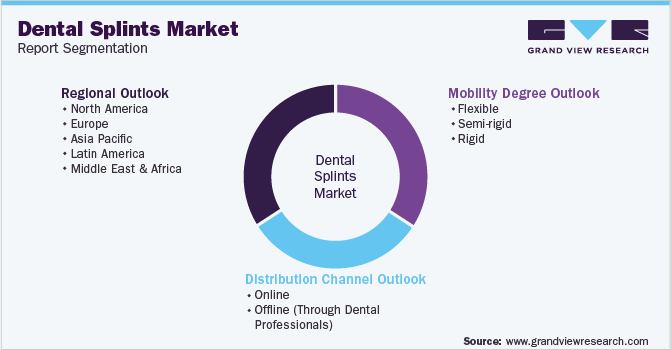
This report forecasts revenue growth at global, regional, and country levels and provides an analysis of latest industry trends in each of the sub-segments from 2021 to 2033. For the purpose of this study, Grand View Research has segmented the dental splints market report on the basis of mobility degree, distribution channel, and region:
 To learn more about this report, Download Free Sample Report
 -
Mobility Degree Outlook (Revenue, USD Million, 2021 - 2033)
-
Flexible
-
Semi-rigid
-
Rigid
-
-
Distribution Channel Outlook (Revenue, USD Million, 2021 - 2033)
-
Online
-
Offline (Through Dental Professionals)
-
-
Dental Splint Regional Outlook (Revenue, USD Million, 2021 - 2033)
-
North America
-
U.S.
-
Canada
-
-
Europe
-
U.K.
-
Germany
-
France
-
Italy
-
Spain
-
-
Asia Pacific
-
India
-
Japan
-
China
-
South Korea
-
Australia
-
-
Latin America
-
Brazil
-
Mexico
-
Argentina
-
-
Middle East & Africa
-
South Africa
-
Saudi Arabia
-
UAE
-
-
Research Methodology
The dental splints market figures in this report are based on a proven research process that combines executive interviews with secondary research from proprietary databases, company filings, and recognized regulatory and institutional sources. Market size is built through value-chain sizing - reconciling supply-side and demand-side estimates - and triangulated with bottom-up and top-down approaches. Every estimate passes multiple levels of expert validation before publication, with each dental splints segment quantified using the revenue-capture definitions in the table below.
Segment Definition
Segment - Mobility Degree
Revenue capture definition
Flexible
Revenue for the flexible segment includes sales of soft and flexible dental splints manufactured from elastic thermoplastic or silicone-based materials. These splints are primarily used for mild bruxism, patient comfort, short-term therapy, and protective applications such as sports dentistry.
Semi-rigid
Revenue for the semi-rigid segment includes sales of dental splints made from materials that provide a balance of flexibility and structural support. These splints are commonly used for moderate bruxism, TMJ disorders, occlusal stabilization, and mandibular repositioning, offering improved comfort while maintaining therapeutic effectiveness.
Rigid
Revenue for the rigid segment includes sales of hard dental splints fabricated from acrylic resin or other rigid materials. These splints are widely used for long-term management of severe bruxism, TMJ disorders, occlusal stabilization, and post-treatment protection due to their durability, precise fit, and ability to maintain jaw positioning.
Estimation Model
01
Bottom-Up Estimation02
Top-Down Approach03
Supply-Side AnalysisRevenue is estimated by aggregating dental splint sales across dental clinics, hospitals, orthodontic and prosthodontic practices, dental laboratories, and online/custom dental device providers.
The overall dental devices and oral care market is assessed first, followed by estimating the share attributable to dental splints using secondary research and expert validation.
This approach evaluates total production and sales of dental splints by manufacturers, dental laboratories, CAD/CAM milling centers, and digital dental solution providers.
Delivered Customizations
This report has been delivered with the following In-depth customizations
Client Request
Customization Delivered
Value Adds
Dental Splints Company Performance Overview: Revenue, Volume, Innovation Spend & Margin Profile
Developed a tailored competitive benchmarking assessment of the global dental splints market, evaluating leading manufacturers across product revenue, estimated unit shipments, R&D intensity, and gross margin performance. The analysis covered major manufacturers and dental solution providers including Glidewell, Keystone Industries, Scheu-Dental, Panthera Dental, Great Lakes Dental Technologies, and other market participants.
Enables stakeholders to benchmark competitive positioning, identify high-growth and high-margin manufacturers, assess pricing and shipment trends, and evaluate the commercial impact of digital dentistry, CAD/CAM workflows, 3D printing adoption, and customized splint manufacturing on long-term profitability and market share expansion.
R&D Details – Dental Splints Market
Delivered a comprehensive review of the dental splints industry's R&D landscape, including analysis of digital design capabilities, material science innovation, product development ecosystems, and manufacturing-linked R&D activities across North America, Europe, and Asia-Pacific. The study evaluated company-specific innovation capabilities for leading dental splint manufacturers, highlighting advancements in CAD/CAM-designed splints, 3D-printed splints, biocompatible resin materials, mandibular advancement devices for improved occlusal therapy designs, patient comfort optimization, and digital intraoral scanning integration.
Provides actionable insights into innovation intensity, regional R&D concentration, next-generation dental splint technologies, and commercialization capabilities, helping clients identify innovation leaders, evaluate strategic partnerships and acquisition opportunities, and understand future product differentiation driven by digital workflows, advanced materials, and personalized dental appliance development.
Dental Splints Manufacturing, Supply Chain & Cost Structure Analysis
Conducted a focused assessment of dental splint manufacturing footprints, raw material sourcing, dental laboratory production models, digital production workflows, and cost optimization strategies across leading global manufacturers. The analysis examined the impact of CAD/CAM milling, thermoforming systems, 3D printing technologies, laboratory automation, and vertically integrated manufacturing on production costs, product quality, turnaround time, and pricing competitiveness.
Supports strategic sourcing and investment decisions by identifying cost-efficient manufacturing models, scalable digital production ecosystems, and supply chain advantages across the dental splints industry. The assessment also helps stakeholders evaluate operational risks, manufacturing scalability, margin sustainability, and commercialization opportunities associated with customized dental splints, digital dentistry, and advanced appliance fabrication technologies.
Frequently Asked Questions About This Report
North America dominated with a 37.7% revenue share in 2025.
Asia Pacific is the fastest-growing region over the forecast period.
The rigid segment held the largest share of 47.3% in 2025, while semi-rigid is the fastest-growing segment over the forecast period.
The offline (through dental professional) held the largest share of 58.5% in 2025, while online is the fastest-growing segment over the forecast period.
The global dental splints market size was valued at USD 514.7 million in 2025 and is estimated at USD 544.2 million for 2026.
The global dental splints market is expected to grow at a CAGR of 6.5% from 2026 to 2033, reaching USD 847.9 million.
Key players include Aqualizer, Glidewell, Procter & Gamble, Dentek (Prestige Brands Holdings, Inc.), Brux Night Guard, Sporting Smiles, Smile Brilliant, Chomper Labs, Sentinel Mouth Guards, Kulzer GmbH. (Mitsui Chemicals, Inc.), Modern Dental Laboratory Co., Ltd., SprintRay Inc.
Key factors include the increasing incidence of clenching & grinding of teeth among people and the growing incidence of dental disorders, which are anticipated to drive the market over the forecast period.
About the Author(s)
Medical Devices Research Team
Healthcare · Medical DevicesThis report was authored by the medical devices research team at Grand View Research - comprising two research analysts, one senior research analyst, and one industry expert - with specialized expertise in the medical devices segment of the healthcare industry. All findings are based on proprietary healthcare databases, executive interviews, and regulatory analysis, subject to internal peer review prior to publication.
Last Updated:
Speak to Analyst

Customize this report to your needs - add regions, segments, or data points, with 20% free customization.
Or view our licence options:


ISO 9001:2015 & 27001:2022 Certified
We are GDPR and CCPA compliant! Your transaction & personal information is safe and secure. For more details, please read our privacy policy.


