
- Home
- »
- Water & Sludge Treatment
- »
-
Descaler Market Size, Share & Growth Report, 2026 - 2033GVR Report cover

Descaler Market (2026 - 2033) Size, Share & Trends Analysis Report By Product (Acid-based Descalers, Non-acid Descalers), By Form (Liquid, Powder, Tablet, Gel), By Application, By End-use, By Region, And Segment Forecasts
Market Size, 2025
$1.8BMarket Estimate, 2026
$1.9BMarket Forecast, 2033
$2.6BCAGR, 2026–2033
4.6%Descaler Market Summary
The global descaler market size was valued at USD 1.8 billion in 2025 and is projected to grow from USD 1.9 billion in 2026 to USD 2.6 billion by 2033, at a CAGR of 4.6% from 2026 to 2033. Asia Pacific dominated the descaler industry with the largest revenue share of 31.6% in 2025. The growing shift toward sustainable and environmentally friendly cleaning solutions presents a significant opportunity for the descaler industry.
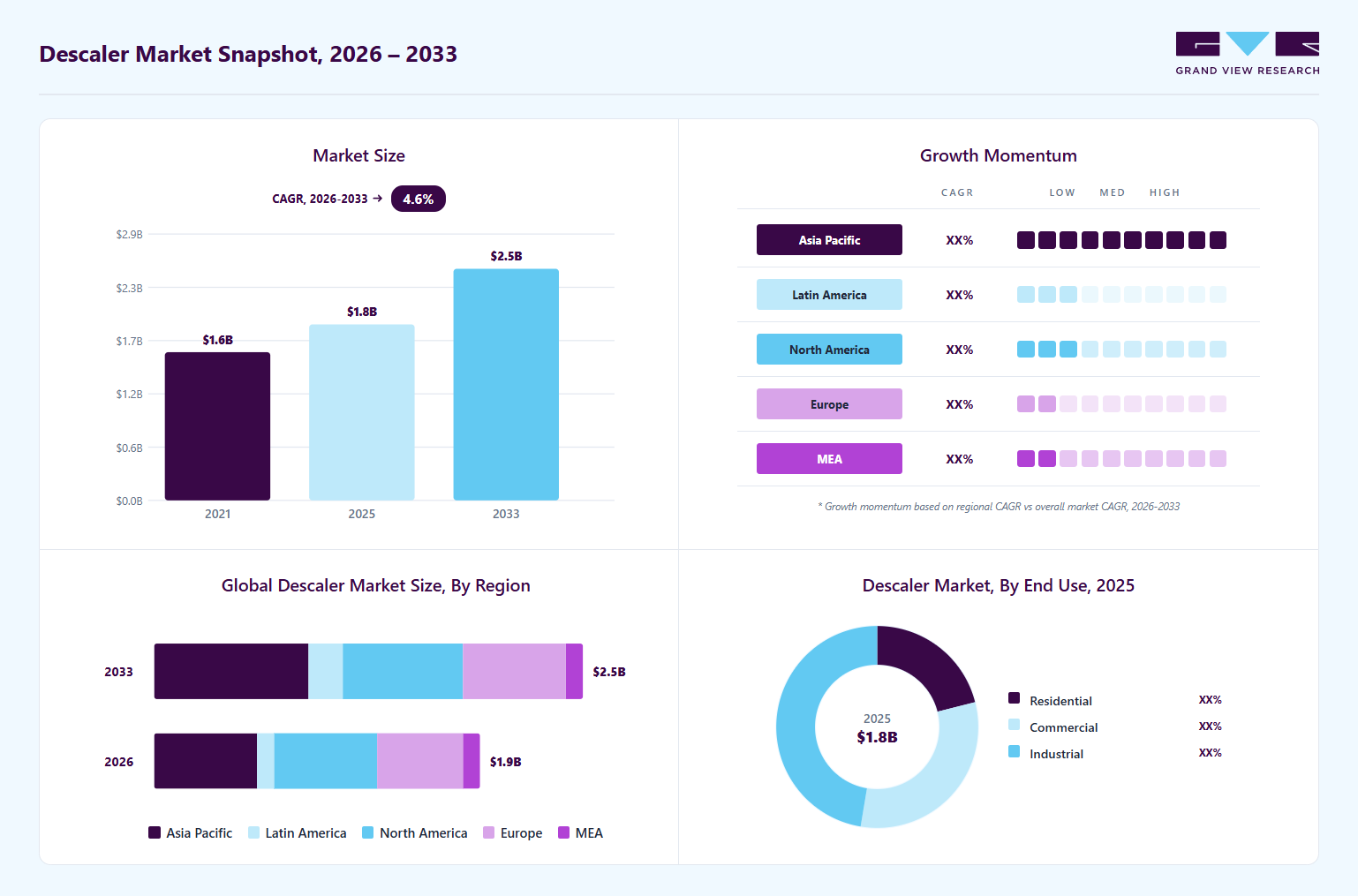 Source: Grand View Research, IR Documents, Primary Interviews, Paid DatabasesTo learn more about this report,
 Download Free Sample Report
 Key Market Trends & Insights
- The descaler market in China accounted for the largest market revenue share in the Asia Pacific in 2025.
- By product, the acid-based descalers segment led the market with the largest revenue share of 59.2% in 2025.
- By form, the tablet segment is expected to grow at the fastest CAGR of 5.5% during the forecast period.
- By application, the industrial equipment segment led the market with the largest revenue share of 29.5% in 2025.
- By end use, the commercial segment is projected to grow at the fastest CAGR of 4.9% during the forecast period.
Market Size & Forecast
- 2025 Market Size: USD 1.8 Billion
- 2033 Projected Market Size: USD 2.6 Billion
- CAGR (2026-2033): 4.6%
- Asia Pacific: Largest market in 2025
Three ways to get this report
Buy it, customize it, or ask a question.Ask an Analyst
A direct answer, usually in 1 working day
- AccessReport author, directly
- Reply timeWithin 1 working day
- No sales callDirect answer only
- FormatEmail reply
- CostFree, no cost
Get the Full Report
What the study covers
- FormatsPDF · Excel · Dashboard
- Timeline2026–2033 annual, 2025 base
- Coverage20+ countries, 5 regions
- Companies10+ key players profiled
Customize the Report
20% free customization
- IncludeCountries, segments, points
- TailorTo your product definition
- ExtendDeeper competitor detail
- OrA fully bespoke study
- Turnaround5–10 working days
Increasing regulatory pressure on hazardous chemicals, combined with rising consumer and industrial demand for biodegradable, low-corrosive formulations, is encouraging manufacturers to develop bio-based, non-toxic descaling products. Expanding demand from healthcare facilities, food processing industries, commercial establishments, and residential appliance maintenance is further creating opportunities for specialized and application-specific solutions.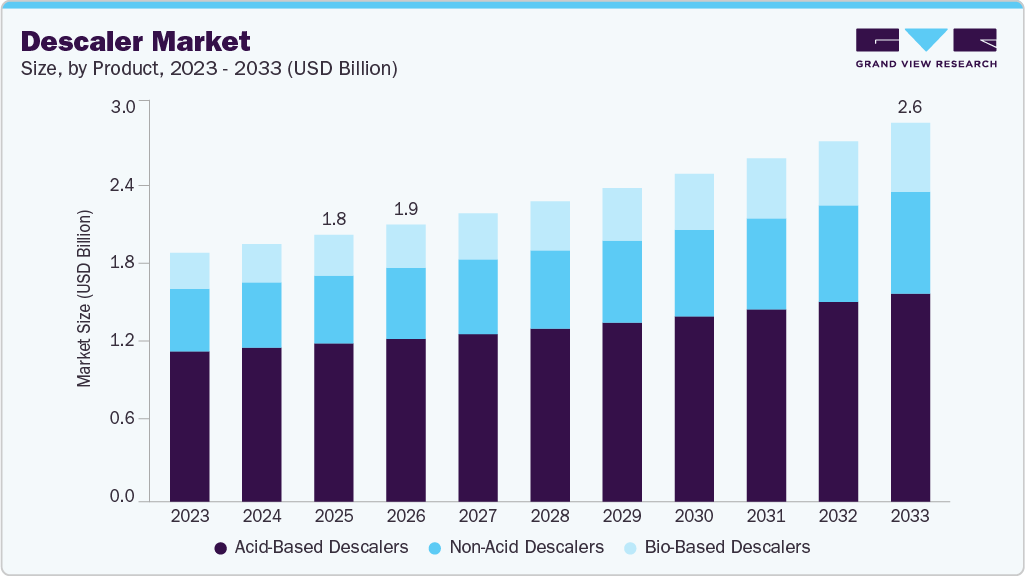 To learn more about this report, Download Free Sample Report
 In addition, rapid industrialization and infrastructure development in emerging economies are expected to increase the adoption of preventive maintenance chemicals, supporting long-term growth opportunities for manufacturers offering efficient, sustainable, and cost-effective descaling technologies.
Market Dynamics
The growing need for efficient maintenance and operational reliability across industrial and commercial facilities is significantly driving demand for descalers. Industries such as food & beverage processing, water treatment, HVAC, and manufacturing rely heavily on equipment that is continuously exposed to mineral deposits and scale formation. Accumulation of scale reduces heat transfer efficiency, increases energy consumption, and shortens equipment lifespan, encouraging end users to adopt regular descaling solutions as part of preventive maintenance strategies. In addition, the expansion of industrial infrastructure and rising awareness regarding equipment efficiency are supporting long-term market growth.
Increasing consumer adoption of household appliances such as coffee machines, washing machines, dishwashers, and water heaters is also contributing to market expansion. Consumers are becoming more aware of the importance of appliance maintenance for improving performance and extending product durability. Moreover, the growing preference for eco-friendly, low-corrosive cleaning formulations is accelerating the development of bio-based, non-acid descalers. Regulatory pressure on the use of harsh chemicals and the rising emphasis on sustainable cleaning solutions are further encouraging manufacturers to introduce environmentally responsible product portfolios.
The descaler industry faces challenges associated with the corrosive nature and handling risks of certain acid-based formulations. Strong chemical descalers may damage sensitive equipment surfaces, seals, and piping systems if used improperly, creating concerns among end users regarding operational safety and maintenance costs. In addition, strict environmental and occupational safety regulations related to chemical handling, storage, and disposal increase compliance requirements for manufacturers and industrial users, particularly in developed economies.
Another major restraint is the availability of alternative water treatment and anti-scaling technologies that reduce the frequency of descaling requirements. Technologies such as water-softening systems, filtration solutions, and anti-scale coatings are increasingly adopted across industrial and commercial facilities to proactively minimize scale buildup. Furthermore, price sensitivity in developing markets and limited consumer awareness of preventive appliance maintenance may limit the adoption of premium descaling products, especially bio-based formulations, which often carry higher production costs.
Market Concentration & Characteristics
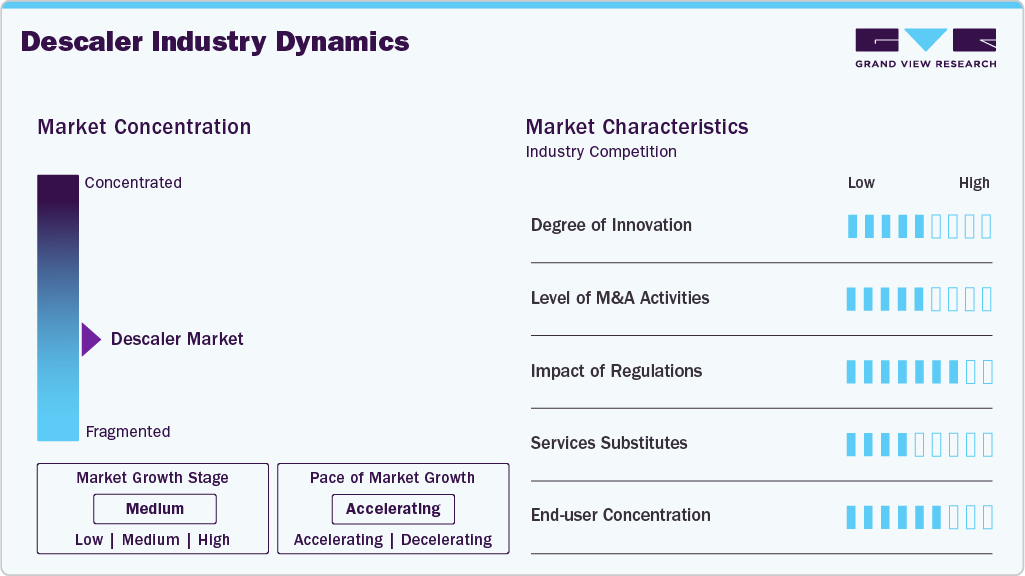
The descaler industry is moderately fragmented, with the presence of both multinational chemical manufacturers and specialized cleaning solution providers competing across industrial, commercial, and residential applications. Large companies benefit from extensive distribution networks, diversified product portfolios, strong research capabilities, and established relationships with industrial customers. At the same time, regional and niche manufacturers maintain competitiveness through customized formulations, application-specific products, and pricing flexibility tailored to local market requirements.
 To learn more about this report, Download Free Sample Report
 The descaler industry is characterized by steady, recurring demand driven by routine maintenance requirements across residential, commercial, and industrial sectors. Since scale formation is an unavoidable issue in systems exposed to hard water and mineral-rich environments, descaling products are considered essential maintenance chemicals rather than discretionary purchases. This creates stable consumption patterns and supports consistent replacement demand across multiple end-use industries. The market is also characterized by increasing product diversification across formulation types, environmental profiles, and application-specificities.
Product Insights
The acid-based descalers segment led the market with the largest revenue share of 59.2% in 2025. The dominance of this segment is primarily due to the high effectiveness of acid-based formulations in removing stubborn mineral deposits, rust, and scale from industrial and commercial equipment. These descalers are widely used in boilers, heat exchangers, pipelines, HVAC systems, and food processing equipment, where rapid, deep cleaning is essential. Their strong cleaning efficiency, cost-effectiveness, and broad applicability across heavy-duty maintenance operations continue to support segment leadership.
The non-acid descalers segment is projected to witness at the fastest CAGR during the forecast period. Growing environmental concerns, stricter chemical handling regulations, and rising demand for safer cleaning solutions are accelerating the adoption of non-acid formulations. These products are increasingly preferred in applications involving sensitive surfaces, healthcare equipment, and household appliances due to their lower corrosiveness and improved user safety profile. In addition, advancements in biodegradable and eco-friendly formulations are further strengthening demand for non-acid descaling products.
Form Insights
The liquid segment led the market with the largest revenue share of 58.5% in 2025. Liquid descalers are widely preferred for their ease of application, rapid dissolution, and ability to penetrate complex equipment systems effectively. They are widely used across industrial machinery, water treatment systems, coffee machines, and HVAC equipment, where quick cleaning cycles and operational efficiency are critical. The flexibility of liquid formulations for both manual and automated cleaning processes further strengthens their market position.
The tablet segment is projected to witness at the fastest CAGR during the forecast period. Increasing consumer preference for convenient, pre-measured, and easy-to-store cleaning solutions is driving the adoption of tablet-based descalers, particularly in household appliances and commercial coffee equipment. Tablets also minimize handling risks and reduce chemical wastage, making them attractive for both residential and institutional users. The growing popularity of compact and user-friendly appliance maintenance products is expected to continue supporting segment expansion.
Application Insights
The industrial equipment segment led the market with the largest revenue share of 29.5% in 2025. Industrial facilities require routine descaling to maintain operational efficiency, reduce downtime, and extend equipment lifespan. Industries such as manufacturing, power generation, food processing, and chemical production rely heavily on descalers to remove scale deposits from boilers, condensers, pipelines, and processing equipment. Rising industrialization and growing focus on preventive maintenance strategies continue to support strong demand from this segment.
The healthcare equipment segment is projected to witness at the fastest CAGR of 6.1% during the forecast period. The increasing use of sterilization systems, diagnostic equipment, and water-dependent medical devices in hospitals and healthcare facilities is driving demand for specialized descaling products. Healthcare providers are emphasizing equipment hygiene, operational reliability, and compliance with strict sanitation standards, thereby encouraging the use of low-corrosive, residue-free descaling solutions specifically designed for sensitive medical applications.
End Use Insights
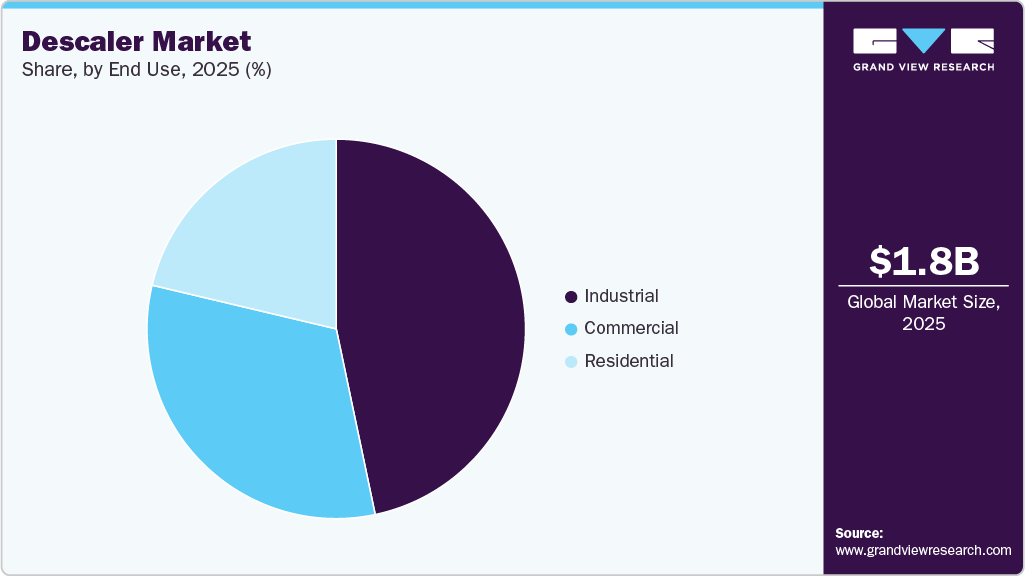
The industrial segment led the market with the largest revenue share of 46.7% in 2025. Growing investments in industrial infrastructure, coupled with increasing maintenance requirements for large-scale processing systems and machinery, are supporting demand for industrial descaling solutions. Industries are increasingly adopting scheduled equipment maintenance programs to minimize operational disruptions, optimize energy efficiency, and comply with equipment safety standards, which is expected to sustain steady market expansion.
 To learn more about this report, Download Free Sample Report
 The commercial segment is projected to register the fastest CAGR during the forecast period, driven by the growing need for efficient maintenance and equipment performance across restaurants, hotels, healthcare facilities, laundries, office buildings, and food service establishments. These facilities require regular descaling solutions to ensure the optimal operation of water systems, HVAC equipment, kitchen appliances, and cleaning machinery. The oil and gas descaler market is also contributing to growth, as descaling products are increasingly used to prevent scale buildup, improve equipment reliability, and enhance operational efficiency in upstream, midstream, and downstream oil and gas operations.
Regional Insights
The descaler market in North America holds a significant share of the global market in 2025, supported by a well-established industrial infrastructure and high adoption of advanced maintenance solutions. Strong demand from commercial facilities, healthcare institutions, food service operations, and industrial manufacturing plants continues to support market growth across the region. In addition, increasing emphasis on energy efficiency, operational reliability, and equipment lifespan optimization is driving the use of descaling products in HVAC systems, boilers, and water treatment applications. The market is also benefiting from rising demand for environmentally friendly and low-toxicity cleaning formulations.
U.S. Descaler Market Trends
The descaler market in the U.S. represents the largest market within North America in 2025, due to the strong presence of industrial manufacturing, commercial establishments, and institutional infrastructure. Growing maintenance requirements across healthcare facilities, the hospitality sector, and the food processing industry are driving steady demand for descaling solutions. Increasing consumer awareness regarding appliance maintenance and water quality management is supporting the adoption of residential descaling products. The country is also witnessing growing demand for sustainable and biodegradable cleaning formulations as environmental regulations continue to strengthen.
 To learn more about this report, Download Free Sample Report
 Asia Pacific Descaler Market Trends
Asia Pacific dominated the global descaler market with the largest revenue share of 31.6% in 2025 and is also expected to grow at the fastest CAGR during the forecast period. The region’s growth is primarily driven by rapid industrialization, expanding manufacturing activities, and increasing investments in commercial infrastructure across countries such as China, India, Japan, and Southeast Asian economies. Expanding adoption of household appliances, coupled with greater awareness of preventive maintenance practices, is further supporting market development by helping improve equipment efficiency and extend operational life. The cooling system descaler market is also gaining momentum as industries and commercial facilities increasingly utilize descaling solutions to maintain heat transfer efficiency, reduce energy consumption, and prevent scale-related equipment failures in cooling systems.
The descaler market in China accounted for the largest market revenue share in the Asia Pacific in 2025, due to its extensive industrial base and large-scale manufacturing operations. Strong demand from industries such as food & beverage processing, power generation, chemicals, and water treatment continues to drive the adoption of descaling solutions. The country’s focus on improving industrial efficiency, reducing energy losses, and strengthening maintenance practices is encouraging greater use of industrial cleaning chemicals. Increasing urbanization and rising ownership of residential appliances are supporting demand for household descaling products.
Europe Descaler Market Trends
The descaler market in Europe is experiencing stable growth due to stringent environmental regulations, advanced industrial maintenance practices, and strong demand for sustainable cleaning solutions. The region has a well-developed commercial and industrial sector that requires regular equipment maintenance to improve efficiency and comply with operational standards. The growing adoption of eco-friendly, biodegradable descalers, particularly across the food processing, healthcare, and hospitality industries, is supporting market growth. In addition, increasing focus on energy conservation and water system efficiency continues to encourage the use of descaling products across multiple applications.
The Germany descaler market is a major contributor to the European market in 2025, supported by its strong manufacturing sector and advanced industrial infrastructure. Industries such as automotive, engineering, food processing, and healthcare generate significant demand for industrial cleaning and maintenance chemicals. The country’s emphasis on operational efficiency, equipment reliability, and sustainability is accelerating the adoption of high-performance and environmentally responsible descaling solutions. Increasing investments in industrial automation and energy-efficient systems are contributing to long-term market growth.
Latin America Descaler Market Trends
The descaler market in Latin America is expected to grow at a significant CAGR of 4.0% during the forecast period. Market growth is supported by expanding industrial activity, improved commercial infrastructure, and rising investments in water treatment and food processing across countries such as Brazil and Mexico. Increasing awareness regarding equipment maintenance and operational efficiency is gradually strengthening demand for descaling solutions in both industrial and commercial applications. The region is also witnessing growing adoption of household appliances, which is contributing to increased demand for residential descaling products.
Middle East & Africa Descaler Market Trends
The descaler market in the Middle East & Africa is supported by rising investments in water treatment infrastructure, industrial development, and commercial construction activities. Growing dependence on desalination plants, HVAC systems, and large-scale industrial equipment is generating steady demand for descaling products across the region. In addition, harsh climatic conditions and high mineral content in water supplies increase the risk of scale formation, further driving the need for regular maintenance solutions. The expansion of healthcare infrastructure and the hospitality sector is also contributing to market growth across several countries in the region.
Key Descaler Company Insights
Some key players operating in the market include BASF SE, Dow, and Evonik Industries AG, among others.
-
BASF SE is a leading global chemical manufacturer with a strong presence in industrial cleaning, water treatment, and specialty chemical solutions supporting the descaler industry. The company benefits from its extensive product portfolio, advanced research and development capabilities, and broad global distribution network, enabling it to serve industrial, commercial, and institutional customers efficiently. BASF is increasingly focused on sustainable and high-performance chemical formulations, including environmentally responsible and low-corrosive cleaning solutions, which aligns with the growing market demand for eco-friendly descaling products.
-
Dow is a prominent player in the specialty chemicals industry, offering advanced material and chemical solutions used across industrial maintenance, water treatment, and equipment cleaning applications relevant to the descaler industry. The company leverages its strong manufacturing capabilities, technological expertise, and global customer base to support diverse end-use industries such as manufacturing, food processing, and infrastructure. Dow’s emphasis on sustainable chemistry, product innovation, and operational efficiency positions the company to capitalize on the increasing demand for effective and environmentally conscious descaling solutions worldwide.
Key Descaler Companies
The following key companies have been profiled for this study on the descaler market.
-
BASF SE
-
Dow
-
Evonik Industries AG
-
Ecolab Inc
-
Diversey Italy
-
NCH Asia
-
Urnex Brands, LLC
-
Düring AG
-
HG International
-
Precision Dynamics
Competitive Benchmarking
Operating Strategies
Competitive Edge
Weaknesses
Mature Players: BASF SE; Dow, Evonik Industries AG; Ecolab Inc.; Diversey Italy
- Focus on expanding industrial and institutional cleaning portfolios with environmentally friendly and high-performance descaling solutions.
- Investments in advanced chemical formulations, sustainable cleaning technologies, and water treatment applications.
- Strategic partnerships, distribution expansion, and acquisition activities to strengthen global market presence.
- Increasing emphasis on low-corrosive, biodegradable, and regulatory-compliant product development.
- Diversification across industrial equipment, healthcare, food processing, HVAC, and commercial cleaning applications to strengthen revenue streams.
- Strong global distribution networks and established relationships with industrial and commercial customers.
- Advanced research and development capabilities supporting continuous product innovation.
- Broad product portfolios and strong brand recognition across cleaning and maintenance industries.
- Financial strength enabling investments in sustainable technologies and large-scale manufacturing capabilities.
- Extensive operational expertise in specialty chemicals, industrial maintenance, and water treatment solutions.
- High operational and compliance costs associated with environmental and chemical safety regulations.
- Exposure to fluctuations in raw material prices and supply chain disruptions.
- Competitive pressure from regional manufacturers offering low-cost alternatives.
- Challenges associated with transitioning toward fully sustainable and non-hazardous chemical formulations.
- Dependence on industrial production cycles and commercial infrastructure investments affecting demand stability.
Emerging Players: NCH Asia; Urnex Brands, LLC; Düring AG; HG International; Precision Dynamics
- Focus on specialized descaling products for niche industrial, commercial, and household applications.
- Expansion through regional distribution partnerships and customized cleaning solutions.
- Increasing investments in eco-friendly, appliance-specific, and user-safe formulations.
- Emphasis on cost-effective manufacturing and flexible product development for targeted customer requirements.
- Strengthening presence in regional markets through e-commerce channels and application-focused branding strategies.
- Strong specialization in selected descaling and maintenance applications.
- Greater flexibility in responding to changing customer requirements and niche market trends.
- Competitive positioning in regional and application-specific markets.
- Ability to provide customized solutions for commercial appliances and specialized industrial systems.
- Faster adaptation to emerging trends related to sustainability and convenience-focused products.
- Limited global production and distribution capabilities compared to multinational competitors.
- Smaller financial resources are restricting large-scale expansion and research investments.
- Dependence on regional demand patterns and third-party distribution channels.
- Lower economies of scale affecting pricing competitiveness in global markets.
- Vulnerability to changing regulatory requirements and raw material cost volatility.
Recent Developments
-
In August 2025, Wyckomar launched the AquaFlow Descaler, a non-chemical and salt-free solution designed to reduce hard water scale buildup in residential, agricultural, and light industrial water systems. The product introduction reflects the growing market trend toward environmentally sustainable and low-maintenance descaling technologies that help protect plumbing infrastructure and appliances without relying on harsh chemicals. The development also highlights the industry's growing focus on eco-friendly water treatment solutions to improve equipment lifespan, operational efficiency, and user convenience across residential and commercial applications.
Descaler Market Report Scope
Report Attribute
Details
Market size value in 2025
USD 1.8 billion
Market size value in 2026
USD 1.9 billion
Revenue forecast in 2033
USD 2.6 billion
Growth rate
CAGR of 4.6% from 2026 to 2033
Base year for estimation
2025
Historical data
2021 - 2024
Forecast period
2026 - 2033
Quantitative units
Revenue in USD million/billion, and CAGR from 2026 to 2033
Report coverage
Revenue forecast, company ranking, competitive landscape, growth factors, and trends
Segments covered
Product, end use, region
Regional scope
North America; Europe; Asia Pacific; Latin America, and Middle East & Africa
Country scope
U.S.; Canada; Mexico; Germany; UK; France; Italy; Spain; China; India; Japan; South Korea; Brazil; Argentina; South Africa; Saudi Arabia
Key companies profiled
BASF SE; Dow; Evonik Industries AG; Ecolab Inc.; Diversey Italy; NCH Asia; Urnex Brands, LLC; Düring AG; HG International; Precision Dynamics
Customization scope
Free report customization (equivalent upto 8 analysts working days) with purchase. Addition or alteration to country, regional & segment scope.
Pricing and purchase options
Avail customized purchase options to meet your exact research needs. Explore purchase options
Global Descaler Market Report Segmentation
This report forecasts revenue growth at global, regional, and country levels and provides an analysis of the latest industry trends in each of the sub-segments from 2021 to 2033. For this study, Grand View Research has segmented the global descaler market report based on product, form, application, end use, and region:
-
Product Outlook (Revenue, USD Billion, 2021 - 2033)
-
Acid-based Descalers
-
Non-acid Descalers
-
Bio-Based Descalers
-
-
Form Outlook (Revenue, USD Billion, 2021 - 2033)
-
Liquid
-
Powder
-
Tablet
-
Gel
-
-
Application Outlook (Revenue, USD Billion, 2021 - 2033)
-
Household Appliance
-
Food & Beverage Equipment
-
Industrial Equipment
-
Water Treatment System
-
HVAC System
-
Healthcare Equipment
-
Automotive
-
Other Application
-
-
End Use Outlook (Revenue, USD Billion, 2021 - 2033)
-
Residential
-
Commercial
-
Industrial
-
-
Region Outlook (Revenue, USD Billion, 2021 - 2033)
-
North America
-
U.S.
-
Canada
-
Mexico
-
-
Europe
-
Germany
-
UK
-
France
-
Italy
-
Spain
-
-
Asia Pacific
-
China
-
India
-
Japan
-
South Korea
-
-
Latin America
-
Brazil
-
Argentina
-
-
Middle East & Africa
-
South Africa
-
Saudi Arabia
-
-
Delivered Customizations
This report has been delivered with the following In-depth customizations
Client Request
Customization Delivered
Value Adds
Cross-segmentation
Detailed cross-segment analysis of descaler product types in liquid, powder, tablet, and gel forms, along with application-wise demand assessment for household appliances, industrial equipment, HVAC systems, water treatment systems, food processing equipment, and healthcare equipment across residential, commercial, and industrial end-use sectors.
Support product development and portfolio optimization activities through improved understanding of form-specific demand patterns, application compatibility, usage preferences, and evolving cleaning requirements across multiple end-use industries.
Competitive Benchmarking
Comparative assessment of descaler manufacturers based on formulation expertise, product innovation capabilities, sustainability initiatives, industrial application specialization, manufacturing capabilities, and strategic product development activities across residential, commercial, and industrial cleaning applications.
Assist supplier assessment and competitive intelligence activities through enhanced visibility into manufacturer positioning, operational strengths, product differentiation strategies, and specialization across descaling solution categories.
Opportunity Assessment
Assessment of emerging opportunities associated with increasing preventive maintenance practices, rising adoption of eco-friendly descaling formulations, expansion of commercial food processing operations, growing HVAC maintenance requirements, and increasing demand for equipment efficiency improvement solutions.
Help identify future growth areas and high-potential application segments aligned with industrial equipment maintenance demand, sustainability preferences, operational efficiency requirements, and increasing adoption of advanced cleaning solutions.
Frequently Asked Questions About This Report
The global descaler market size was estimated at USD 1.8 billion in 2025 and is expected to reach USD 1.9 billion in 2026.
The acid-based descalers segment dominated the Descaler Market by product in 2025, accounting for a market share of 59.2%. The segment’s strong position is primarily attributed to the high effectiveness of acid-based formulations in removing heavy mineral deposits, rust, and scale buildup across industrial and commercial equipment. These descalers are extensively used in boilers, heat exchangers, pipelines, HVAC systems, and processing equipment where rapid and deep cleaning performance is essential.
Key players of the market include BASF SE, Dow, Evonik Industries AG, Ecolab Inc, Diversey Italy, NCH Asia, Urnex Brands, LLC, Düring AG, HG International, and Precision Dynamics.
The key factors driving the descaler market include the growing emphasis on preventive equipment maintenance and operational efficiency across industrial, commercial, and residential sectors. Scale accumulation in boilers, pipelines, HVAC systems, water treatment units, and household appliances reduces equipment performance, increases energy consumption, and shortens operational lifespan, creating strong demand for effective descaling solutions. Rapid industrialization, expanding manufacturing activities, and increasing investments in commercial infrastructure are further supporting market growth, particularly in industries such as food & beverage processing, healthcare, water treatment, and power generation.
The global descaler market is expected to grow at a compound annual growth rate of 4.6% from 2026 to 2033, reaching USD 2.6 billion by 2033.
About the Author(s)
Water & Sludge Treatment Research Team
Bulk Chemicals · Water & Sludge TreatmentThis report was authored by the water & sludge treatment research team at Grand View Research - comprising two research analysts, one senior research analyst, and one industry expert - with specialized expertise in the water & sludge treatment segment of the bulk chemicals industry. All findings are based on proprietary bulk chemicals databases, executive interviews, and regulatory analysis, subject to internal peer review prior to publication.
Last Updated:
Speak to Analyst

Customize this report to your needs - add regions, segments, or data points, with 20% free customization.
Or view our licence options:


ISO 9001:2015 & 27001:2022 Certified
We are GDPR and CCPA compliant! Your transaction & personal information is safe and secure. For more details, please read our privacy policy.


