
- Home
- »
- Advanced Interior Materials
- »
-
Digital Mining Market Size, Share & Growth Report, 2033GVR Report cover
![Digital Mining Market (2026 - 2033)Report]()
Digital Mining Market (2026 - 2033)
Size, Share & Trends Analysis Report By Technology (Automation & Robotics, Real-time Analytics), By Application (Iron & Ferro Alloys, Non-ferrous Metals), By Region, And Segment Forecasts
Market Size, 2025
$10.3BMarket Estimate, 2026
$11.3BMarket Forecast, 2033
$23.6BCAGR, 2026–2033
11.2%Digital Mining Market Summary
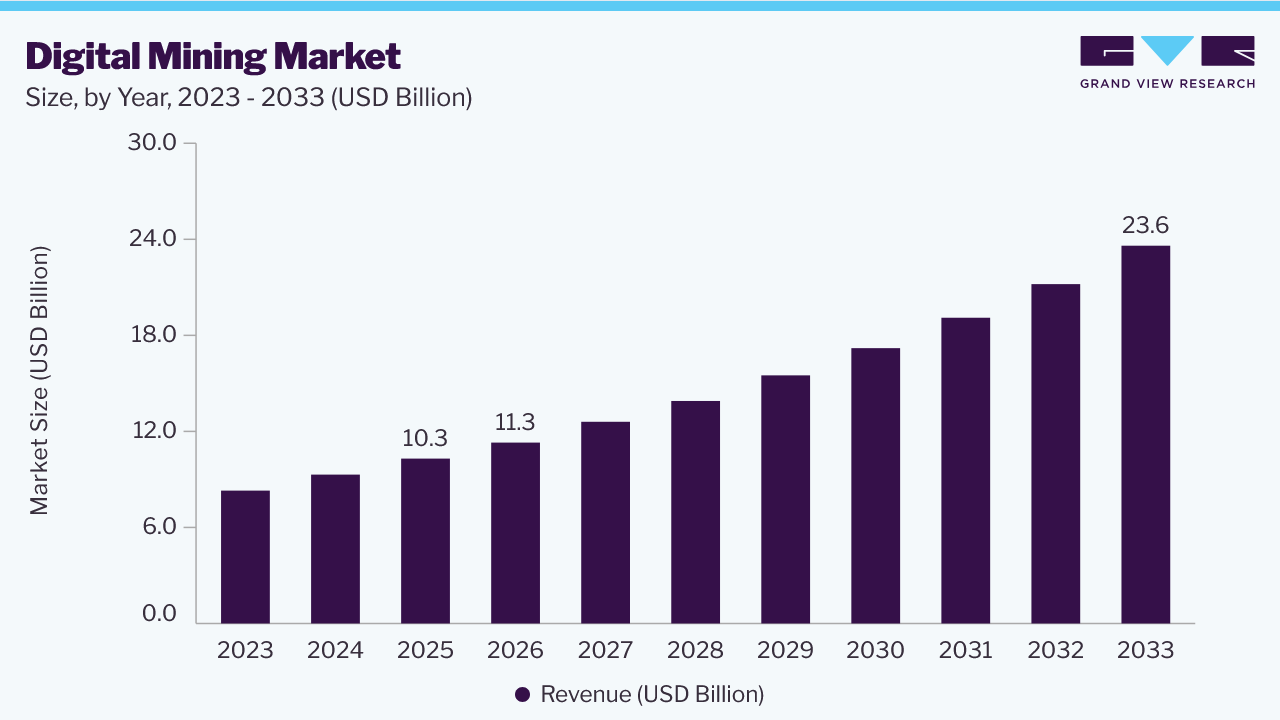
The global digital mining market size was valued at USD 10.3 billion in 2025 and is projected to grow from USD 11.3 billion in 2026 to USD 23.6 billion in 2033, at a CAGR of 11.2% from 2026 to 2033. Asia Pacific dominated the market, accounting for a revenue share of 40.0% in 2025. The growing need to ensure mine worker safety amid rising injuries in mining is a primary driver of the rising demand for digital mining solutions.
Key Market Trends & Insights
- By technology: The automation and robotics segment held the largest market share of around 45.0% in 2025.
- By application: The iron & ferroalloys segment held the largest market share of over 35.0% in 2025.
Regional Highlights
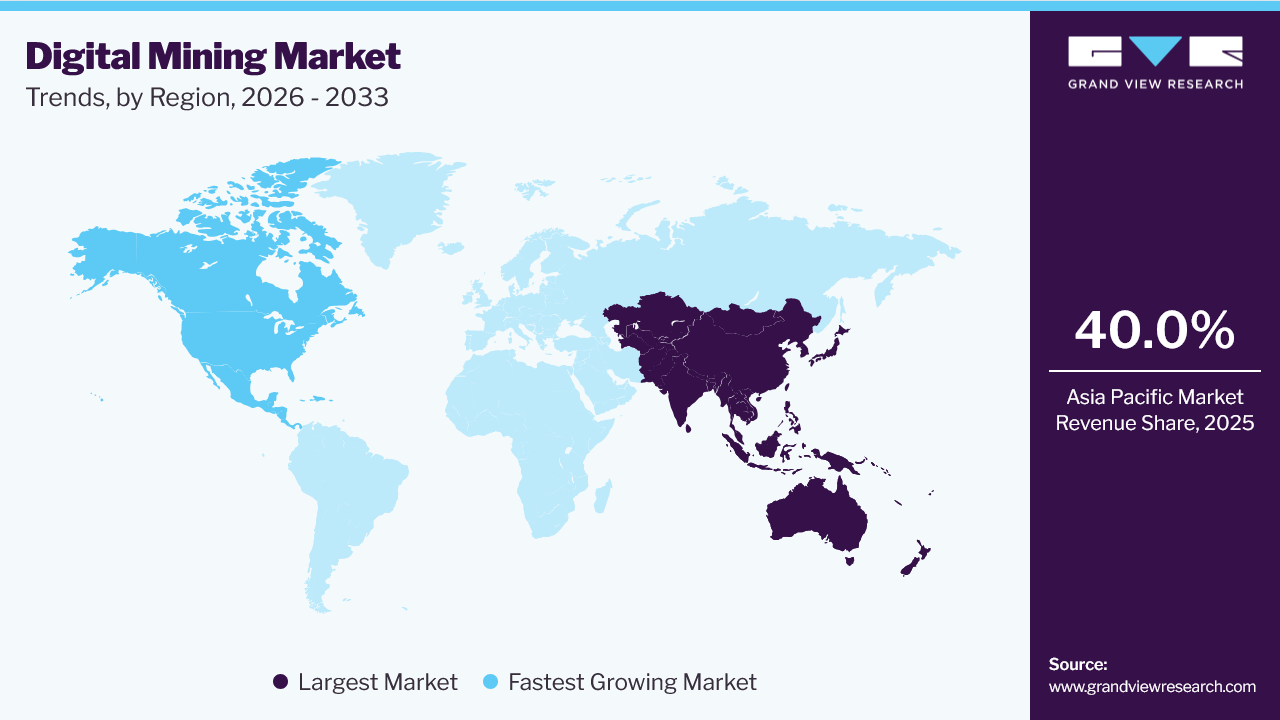
- Largest regional market: Asia Pacific (40.0% revenue share, 2025)
- Fastest-growing regional market: North America (highest CAGR, 2026-2033)
Market Size & Forecast
- Market size in 2025: USD 10.3 Billion
- Estimated market size in 2026: USD 11.3 Billion
- Projected market size by 2033: USD 23.6 Billion
- CAGR (2026-2033): 11.2%
Three ways to get this report
Buy it, customize it, or ask a question.Ask an Analyst
A direct answer, usually in 1 working day
- AccessReport author, directly
- Reply timeWithin 1 working day
- No sales callDirect answer only
- FormatEmail reply
- CostFree, no cost
Get the Full Report
What the study covers
- FormatsPDF · Excel · Dashboard
- Timeline2026–2033 annual, 2025 base
- Coverage20+ countries, 5 regions
- Companies10+ key players profiled
Customize the Report
20% free customization
- IncludeCountries, segments, points
- TailorTo your product definition
- ExtendDeeper competitor detail
- OrA fully bespoke study
- Turnaround5–10 working days
Traditional drilling and exploration techniques have led to several injuries in recent years. Digital mining solutions leverage deep learning algorithms without the need for scaling objects. In addition, particle-size analysis solutions use stereo imaging for continuous monitoring, helping minimize routine manual work. Advanced technologies, such as the Internet of Things (IoT), have the potential to reduce mining's environmental impact and enhance safety in mines. Furthermore, unmanned vehicles and remotely operated machines can improve safety in deep underground mining operations.
There is a pressing need to adopt cost-optimizing digital technologies across industries. For example, 3D modeling technology in digital mining can create diagrams of underground areas, facilitating more effective exploration. The ongoing digitization of the mining sector is expected to drive market growth in the coming years. Many U.S.-based mining companies have started automating their processes and operations to boost productivity and output, as the U.S. is one of the leading countries in mining.
In 2025, for instance, Newmont and Caterpillar continued to develop their strategic alliance to create a fully connected, automated, and zero-emission mining ecosystem. This initiative includes the planned introduction of battery-powered autonomous underground mining technology at Newmont's Tanami mine. It integrates automation, electrification, and Caterpillar's MineStar digital platform to enhance productivity, operational efficiency, and sustainability across underground mining operations.
Digital technology can be applied throughout the entire mining value chain, including exploration, mine development, mining operations, ore processing, logistics, and sales and marketing. Although sales and marketing channels have not been the primary adopters of digital technology, some companies are interested in implementing digitization in the later stages of the value chain. This approach can help balance supply and demand between mine operations and customers in end-use industries.
The increasing deployment of innovative digital technologies, such as drones, sensors, robotics, and integration techniques, is driving demand for automated solutions. For example, in May 2026, Epiroc launched a comprehensive suite of integrated digital mine-planning solutions as part of its Groundbreaking Intelligence portfolio. This offering combines planning, geology, surveying, and operational workflows into a connected digital platform, allowing mining companies to enhance productivity, interoperability, and data-driven decision-making throughout the mine lifecycle.
Analyst Perspective
The market is experiencing steady growth, driven by increasing adoption of automation technologies, rising demand for operational efficiency, and growing interest in data-driven mining operations. Mining companies are increasingly incorporating digital solutions such as artificial intelligence, IoT, cloud computing, and advanced analytics into exploration, production, and asset management due to their benefits in improving productivity, enhancing worker safety, and reducing operational costs. The expanding implementation of autonomous equipment, predictive maintenance, and real-time monitoring systems is further supporting market growth. As demand for smarter, safer, and more sustainable mining operations continues to rise, companies that focus on technological innovation, digital transformation, and diversified applications will be well-positioned to capitalize on long-term growth opportunities.
Technology Insights
Automation and robotics were the largest segment in 2025, accounting for over 45.0% of revenue. This is attributed to the increasing focus of market players on these technologies in digital mining. For instance, in May 2025, BHP announced the launch of its first Industry AI Hub in Singapore in partnership with AI Singapore and Enterprise Singapore. The hub is designed to accelerate the adoption of artificial intelligence across BHP's global mining operations by integrating data-driven decision-making, automation, and advanced analytics to improve operational safety, productivity, and efficiency. The need to protect data and safeguard companies from potential cyber threats drives the demand for cybersecurity in the digital mining sector. Analysis of real-time data involves remote operations and predictive maintenance and is the fastest way to resolve current operational issues.
BHP, an Australian mining giant, uses real-time analytics to resolve current issues at its iron ore operations in Western Australia. This ensures consistent operational flow from drill control to dispatch and logistics. Roy Hill, a mining company, uses digital boardroom techniques at its remote operations center to deliver real-time parameter data to its demand and supply chain teams.
The other technologies segment is likely to register the second-fastest CAGR from 2026 to 2033. The key factors driving segment growth include rising expenditure on these emerging technologies and high adoption in end-use industries. For instance, in April 2025, The Metals Company submitted the world's first commercial application for deep-seabed polymetallic nodule recovery under the U.S. Deep Seabed Hard Mineral Resources Act. The application leverages the company's digital mining platform, including advanced environmental monitoring, AI-enabled analytics, and data-driven operational systems to support transparent and responsible deep-sea mining operations.
Application Insights
The iron & ferroalloys segment accounted for over 35.0% of revenue in 2025. By application, the market has been further segmented into iron & ferroalloys, non-ferrous metals, and precious metals. The growing demand for steel and related alloys in the construction, transportation, heavy machinery, and consumer durable industries indirectly drives growth in the digital mining sector. To improve production output and utilize maximum capacity, companies such as Anglo American, Rio Tinto, BHP, and Vale SA deploy various digital technologies across their operations. The increasing demand for non-ferrous metals, such as aluminum, copper, and zinc, has driven the digitalization of operations to meet it.
The non-ferrous metals segment is projected to grow at a lucrative CAGR from 2026 to 2033. Precious metal companies, such as Newmont Mining Corp., Barrick Gold Corp., Newcrest Mining Ltd., and Goldcorp Inc., are among the early adopters of digital technologies in the market. For instance, Goldcorp Inc. developed a digital strategy to optimize its mine lifecycle through an autonomous fleet, advanced process control, smart mines, and advanced analytics.
Regional Insights
The Asia Pacific digital mining market held the largest share, at around 40.0%, in 2025 and is likely to maintain its position during the forecast period. Providers involved in the development and delivery of both hardware and software platforms for digital mining are expected to be offered ample opportunities. Regional market growth is driven by a consistent increase in mining output and the penetration of automation and robotics in the digital mining sector in China and Australia.
China Digital Mining Market Trends
The digital mining market in China is expected to see robust growth in the coming years. China is the leading producer of 28 mineral raw materials through mining. Thus, to improve mining operations and resource optimization, the penetration of digital technologies is expected to rise over the coming years.
North America Digital Mining Market Trends
The digital mining market in North America accounted for over 25.0% of the market in 2025. The market is expected to benefit from rising production by mining companies and their adoption of digital technologies to improve operations. Mining companies across the region are accelerating digital transformation initiatives to optimize resource utilization, enable predictive maintenance, and support real-time decision-making. The presence of leading technology providers and continued investments in connected mining infrastructure are further supporting regional growth. For instance, in May 2025, Caterpillar introduced Cat Command for hauling with expanded autonomous capabilities, enabling mining operators to improve productivity, enhance fleet management, and strengthen safety across large-scale mining operations. The continued deployment of autonomous and connected mining technologies is expected to accelerate the adoption of digital mining solutions throughout North America.
The U.S. digital mining market is expected to remain a key consumer of digital mining, as the country is an early adopter of the technology. Rising capital expenditure in mining, along with the presence of several digital technology providers, is likely to influence the domestic market in the U.S.
Key Digital Mining Company Insights
The digital mining industry features a range of global, regional, and local players, making it a competitive market. The world’s leading companies are using partnerships, collaborations, acquisitions, mergers, and agreements as strategies to withstand the intense competition and increase their market share. Digital mining product manufacturers are investing heavily in product enhancements and new product development.
Key Digital Mining Companies
The following key companies have been profiled for this study on the digital mining market:
-
Caterpillar Inc.
-
Sandvik AB
-
SAP SE
-
ABB Ltd
-
Rockwell Automation, Inc.
-
GE Vernova Inc.
-
Siemens AG
-
Komatsu Mining Corp.
-
IBM Corporation
-
Hexagon AB
Recent Developments
- In August 2025, Epiroc entered into a strategic partnership with Hindustan Zinc Limited to deploy its Collision Avoidance System across underground mining operations in India. The OEM-agnostic digital solution leverages real-time sensing, intelligent alerts, and autonomous vehicle intervention technologies to enhance worker safety, improve operational visibility, and advance digitally connected mining environments.
- In March 2025, Hexagon AB completed the acquisition of Septentrio, a provider of high-precision GNSS positioning technologies. The acquisition strengthened Hexagon’s autonomous solutions portfolio by enhancing positioning, navigation, and safety capabilities for digital mining operations, autonomous equipment, and other mission-critical industrial applications.
Digital Mining Market Report Scope
Report Attribute
Details
Market size in 2025
USD 10.3 billion
Estimated market size in 2026
USD 11.3 billion
Projected market size by 2033
USD 23.6 billion
Growth rate
CAGR of 11.2% from 2026 to 2033
Base year for estimation
2025
Historical data
2021 – 2024
Forecast period
2026 – 2033
Quantitative units
Revenue in USD billion, and CAGR from 2026 to 2033
Report coverage
Revenue forecast, company ranking, competitive landscape, growth factors, and trends
Segments covered
Technology, application, region
Regional Scope
North America; Europe; Asia Pacific; CSA; MEA
Country Scope
U.S.; Canada; Mexico; Russia; Turkey; China; Australia; India; Indonesia; Brazil; Chile; South Africa
Key companies profiled
Caterpillar Inc.; Sandvik AB; SAP SE; ABB Ltd; Rockwell Automation, Inc.; GE Vernova Inc.; Siemens AG; Komatsu Mining Corp.; IBM Corporation; Hexagon AB
Customization scope
Free report customization (equivalent up to 8 analysts working days) with purchase. Addition or alteration to country, regional & segment scope.
Pricing and purchase options
Avail of customized purchase options to meet your exact research needs. Explore purchase options
Global Digital Mining Market Report Segmentation
This report forecasts revenue growth at global, regional, and country levels and provides an analysis of the latest industry trends and opportunities in each of the sub-segments from 2021 to 2033. For this study, Grand View Research has segmented the global digital mining market report based on technology, application, and region:
-
Technology Outlook (Revenue, USD Million, 2021 - 2033)
-
Automation & Robotics
-
Real-time Analytics
-
Cybersecurity
-
Others
-
-
Application Outlook (Revenue, USD Million, 2021 - 2033)
-
Iron & Ferro Alloys
-
Non-ferrous Metals
-
Precious Metals
-
-
Regional Outlook (Revenue, USD Million, 2021 - 2033)
-
North America
-
U.S.
-
Canada
-
Mexico
-
-
Europe
-
Russia
-
Turkey
-
-
Asia Pacific
-
China
-
Australia
-
India
-
Indonesia
-
-
Central & South America
-
Brazil
-
Chile
-
-
Middle East and Africa
-
South Africa
-
-
Frequently Asked Questions About This Report
The global digital mining market size was valued at USD 10.3 billion in 2025 and is estimated at USD 11.3 billion for 2026.
The global digital mining market is expected to grow at a CAGR of 11.2% from 2026 to 2033, reaching USD 23.6 billion.
Asia Pacific dominated with an approximately 40.0% revenue share in 2025.
Key players in the market include Caterpillar Inc., Sandvik AB, SAP SE, ABB Ltd, Rockwell Automation, Inc., GE Vernova Inc., Siemens AG, Komatsu Mining Corp., IBM Corporation, Hexagon AB, and others.
The automation and robotics digital mining segment accounted for the largest revenue share of approximately 45.0% in 2025.
About the Author(s)
Advanced Interior Materials Research Team
Advanced Materials · Advanced Interior MaterialsThis report was authored by the advanced interior materials research team at Grand View Research - comprising two research analysts, one senior research analyst, and one industry expert - with specialized expertise in the advanced interior materials segment of the advanced materials industry. All findings are based on proprietary advanced materials databases, executive interviews, and regulatory analysis, subject to internal peer review prior to publication.
Last Updated:
Speak to Analyst


Customize this report to your needs - add regions, segments, or data points, with 20% free customization.
Or view our licence options:


ISO 9001:2015 & 27001:2022 Certified
We are GDPR and CCPA compliant! Your transaction & personal information is safe and secure. For more details, please read our privacy policy.


