
- Home
- »
- Next Generation Technologies
- »
-
Digital Trust Market Size & Share Report, 2025-2030GVR Report cover

Digital Trust Market (2025 - 2033)
Size, Share & Trends Analysis Report By Component (Solutions, Services), By Technology, By Enterprise Size (Large Enterprises, SMEs), By End Use, By Region, And Segment Forecasts
Market Size, 2024
$118.7BMarket Estimate, 2026
$149.6BMarket Forecast, 2033
$360.5BCAGR, 2025–2033
13.3%Digital Trust Market Summary
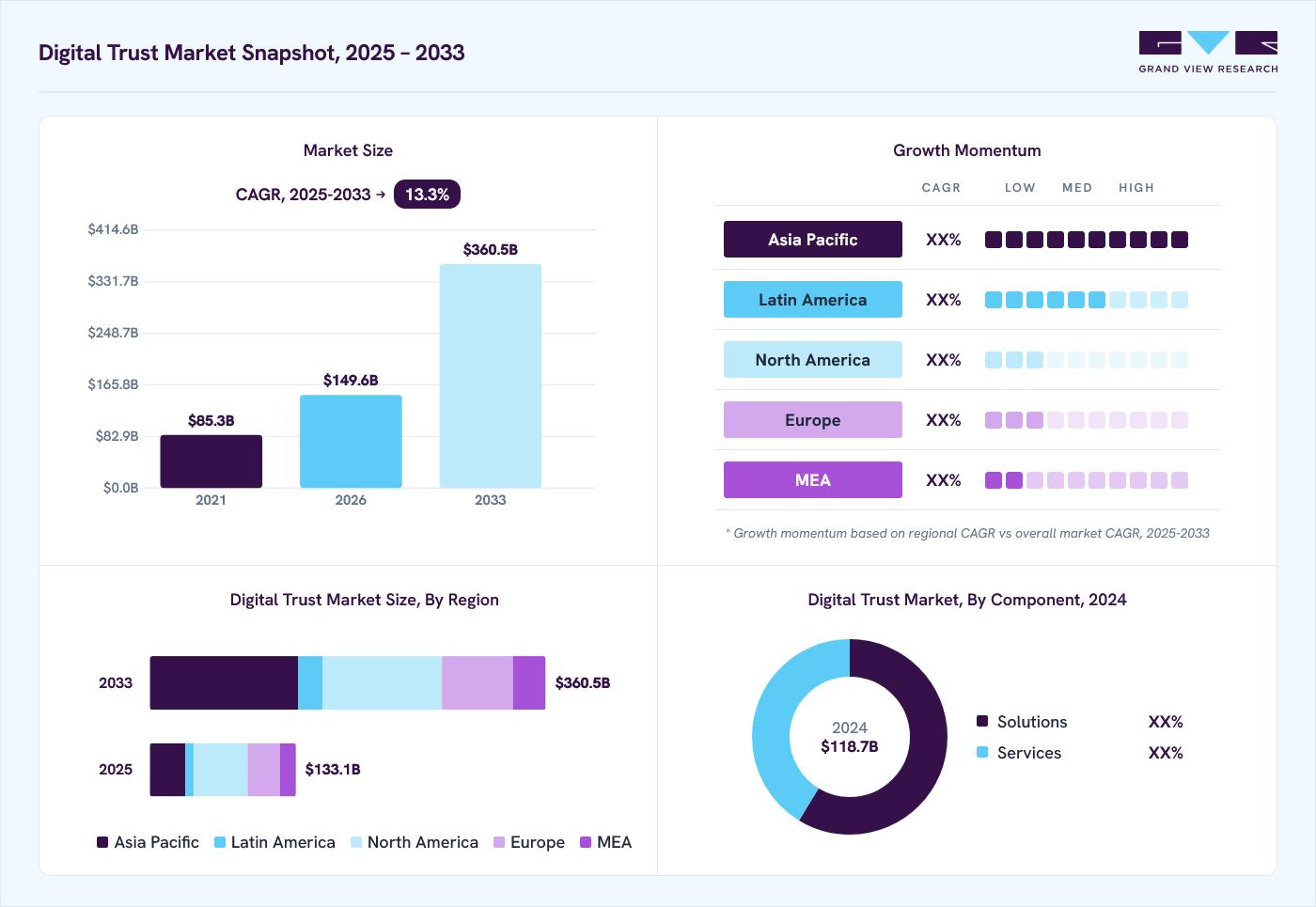
The global digital trust market size was valued at USD 118.7 billion in 2024 and is projected to grow from USD 149.6 billion in 2026 to USD 360.5 billion by 2030, at a CAGR of 13.3% from 2025 to 2030. North America dominated the market, accounting for a revenue share of 37.9% in 2024 The digital trust industry is growing rapidly, due to fast digital transformation across various sectors such as online banking, e-commerce, healthcare, and government services continue to grow, consumers are depending more on secure digital platforms.
 Source: Grand View Research, IR Documents, Primary Interviews, Paid DatabasesTo learn more about this report,
 Download Free Sample Report
 Key Market Trends & Insights
- The digital trust market in the U.S. accounted for the largest market revenue share in North America in 2024.
- By component, the solutions segment led the market with the largest revenue share of 58.6% in 2024.
- By technology, the AI & ML segment led the market with the largest revenue share of 27.9% in 2024.
- By end use, the healthcare and life sciences segment is expected to grow at the fastest CAGR of 14.2% from 2025 to 2033.
Market Size & Forecast
- 2024 Market Size: USD 118.7 Billion
- 2033 Projected Market Size: USD 360.5 Billion
- CAGR (2025-2033): 13.3%
- North America: Largest Market in 2024
Three ways to get this report
Buy it, customize it, or ask a question.Ask an Analyst
A direct answer, usually in 1 working day
- AccessReport author, directly
- Reply timeWithin 1 working day
- No sales callDirect answer only
- FormatEmail reply
- CostFree, no cost
Get the Full Report
What the study covers
- FormatsPDF · Excel · Dashboard
- Timeline2025–2033 annual, 2024 base
- Coverage20+ countries, 5 regions
- Companies10+ key players profiled
Customize the Report
20% free customization
- IncludeCountries, segments, points
- TailorTo your product definition
- ExtendDeeper competitor detail
- OrA fully bespoke study
- Turnaround5–10 working days
Due to this organization is significantly investing in advanced identity verification, user authentication, and cybersecurity measures to enable secure and smooth interactions, thereby, strengthening trust in digital ecosystems. The digital trust industry is gaining momentum due to strict regulatory frameworks that have played a major role in advancing digital trust. Legislation such as the GDPR in Europe and comparable data protection laws worldwide require organizations to focus on data privacy, transparency, and secure handling of personal information. Following these rules helps to minimize legal and reputational risks while assuring consumers that their data is treated responsibly and securely, thereby enhancing trust in digital services.Furthermore, technological advancements are prominently fueling the market expansion. Innovations in artificial intelligence, machine learning, block chain, biometrics, and the Internet of Things have introduced advanced methods for securing, verifying, and managing digital interactions. These innovations support safe data exchange, enable real-time threat detection, and provide tamper-resistant authentication, allowing organizations to stay ahead of evolving security threats and boost user confidence in the reliability of digital platforms.
 To learn more about this report, Download Free Sample Report
 Furthermore, increasing consumer awareness of cybersecurity and privacy concerns has forced organizations to implement clear and visible digital trust measures. As the frequency of cyberattacks, identity theft, and data breaches is increasing, the need for digital trust has also progressed from a technical requirement into a competitive advantage. Businesses that maintain transparency, implement strong privacy protections, and maintain strong security practices are more likely to earn customer trust, enhance their reputation, and achieve long-term growth.
Component Insights
The solutions segment led the market with the largest revenue share of 58.6% in 2024. The growth of the digital trust solution segment including data security & privacy, cybersecurity solutions, and identity & access management (IAM) is driven by the increasing volume and complexity of cyberattacks that are encouraging organizations to enhance their security strategies. Regulatory commands such as GDPR and CCPA are forcing the companies to invest in compliance-oriented technologies and the rapid adoption of advanced technologies and secure tools such as digital tools, IoT devices, and cloud services is extending the market. The demand for strong authentication and access controls is rising to address identity-related vulnerabilities. In addition, growing consumer expectations for data security, the need for strong operations, and the strategic value of digital trust as a market differentiator are motivating businesses to prioritize these solutions.
The services segment is predicted to foresee at the fastest CAGR during the forecast period as it includes support & maintenance, consulting, auditing, and risk advisory. To manage complex trust relationships effectively, organizations are adopting services such as proxy trust management, risk evaluations, audits, and managed support. Moreover, the rising frequency of data breaches and the growing focus on transparency are forcing companies to invest in consulting and risk advisory services to strengthen their digital trust strategies and sustain stakeholder trust. For instance, in February 2025, DEKRA launched the world’s first unified global Digital Trust Service, merging cybersecurity, functional safety, and AI validation into a single solution. This innovative offering allows companies to drive innovation while maintaining high standards of safety, transparency, and regulatory compliance. It helps organizations in addressing digital risks throughout the lifecycle of intelligent systems and products.
Technology Insights
The AI & ML segment accounted for the largest market revenue share in 2024. The AI & ML segment holds the largest market Revenue share due to its offering of advanced behavioral analytics and continuous authentication that improve identity verification and fraud detection, and they allow for real-time anomaly detection and dynamic risk assessment, minimizing false positives while enhancing user experience. This technology also simplifies threat prediction and automates incident response, boosting defenses against complex cyber threats and when integrated with zero-trust security models, they enable proactive and adaptive protection against emerging risks. Moreover, AI’s ability to manage and secure a growing number of human and machine identities at scale is essential to establishing reliable and trustworthy digital ecosystems.
The cloud computing segment is predicted to foresee at the fastest CAGR during the forecast period. Cloud computing plays a major role in the digital trust industry because it's become the backbone of how businesses operate in today’s digital landscape. As more organizations move their operations and data to the cloud, the need for reliable security, identity verification, and data protection increases. Cloud platforms make it easier to implement trust-focused tools like encryption, access control, and compliance tracking. They also integrate well with technologies like AI and privacy-enhancing tools, which are essential for building secure systems. With the growing popularity of SaaS and hybrid environments, companies are relying more on cloud providers to handle security and trust requirements. This shift is not just about convenience-it's also about staying competitive and protecting customer data. That’s why cloud computing commands such a strong presence in this space.
Enterprise Size Insights
The large enterprises’ segment accounted for the largest market revenue share in 2024. Large enterprises are a key force behind the market growth; major players are significantly investing budgets to address growing cybersecurity threats and complex attack vectors. The complexities of managing multi-cloud and hybrid IT infrastructures also demand advanced digital trust frameworks and regulatory compliance with strict data privacy laws adds further pressure. In addition, large enterprises are increasingly adopting AI-powered threat intelligence and zero-trust security models to protect extensive digital ecosystems, the growing integration of IoT and operational technologies further highlights the need for strong identity governance and ongoing auditing to sustain trust at scale.
The small & medium size segment is predicted to for esee at the fastest CAGR during the forecast period, driven by the need for affordable and easy to implement solutions which are subscription-based digital trust services and low-code organization tools that allow for quick deployment even with limited resources. As cyberattacks increasingly target smaller businesses, orders from governments, insurers, and industry bodies for basic security measures are boosting demand for automated compliance tools and shared threat intelligence. The shift from traditional to cloud-based systems and remote work environments further strengthens the need for scalable and streamlined trust services, and to support this, vendors offer personalized solution packages that simplify implementation, lower costs, and enhance resilience basically encouraging faster adoption of digital trust solutions among SMEs.
End Use Insights
The banking, financial services, and insurance (BFSI) segment accounted for the largest market revenue share in 2024. The drivers include the growing need for strong cybersecurity to fight against increasing threats and fraud, ensuring the security and integrity of financial transactions. Customers expect clear, transparent data privacy practices that guarantee ethical and secure handling of their personal and financial data and advanced technologies contribute to trust by delivering personalized banking experiences, real-time fraud detection, and dynamic security measures. Compliance with regulatory standards and data protection laws further strengthens user confidence in institutional accountability. In addition, smooth digital onboarding processes and hyper-automation enhance convenience and reduce friction, helping build lasting customer trust in digital financial services.
 To learn more about this report, Download Free Sample Report
 The healthcare and life sciences segment is projected to grow at the fastest CAGR over the forecast period, due to the fast speed of digital transformation, which necessitates secure and seamless access to sensitive health information, and the growing use of AI and machine learning supports early threat detection and enables personalized care solutions. Strong identity governance and zero-trust security frameworks are also essential to reducing insider threats. Furthermore, the rising concerns over patient privacy and the need to comply with healthcare regulations are encouraging the use of privacy-enhancing technologies and secure, interoperable data sharing systems. Ultimately, maintaining trust requires transparent, adaptive security models and continuous monitoring to ensure that innovation is balanced with effective protection in digital health environments.
Regional Insights
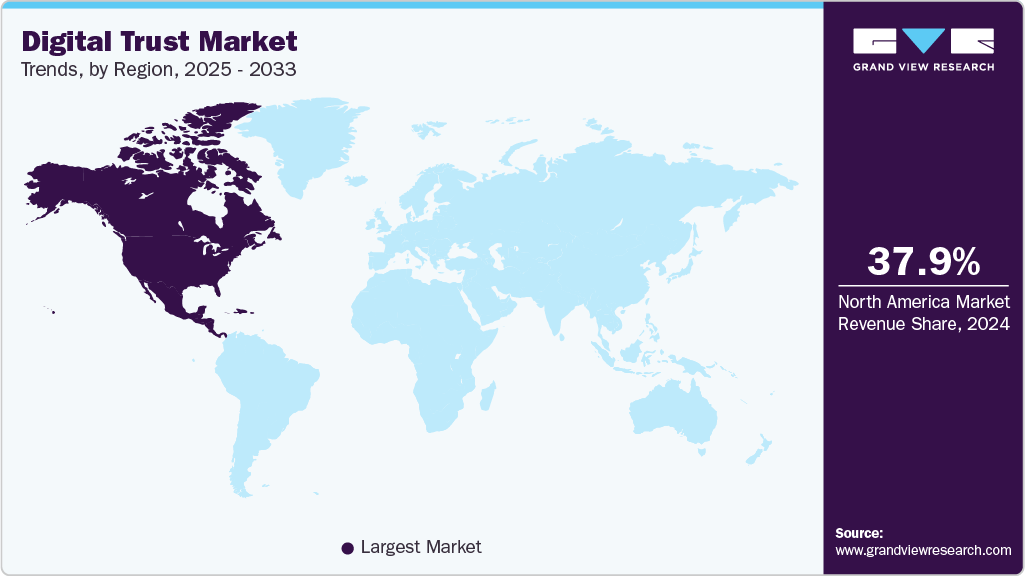
North America dominated the digital trust market with the largest revenue share of 37.9% in 2024 and is driven by its well-developed digital infrastructure and high internet penetration, which support broad adoption of digital trust solutions and a mature cybersecurity background, along with a strong presence of technology firms and financial institutions, further driving the demand for digital trust. The growing frequency of cyberattacks, particularly ransomware, is encouraging organizations to invest significantly in consulting, auditing, and risk advisory services to protect their digital assets. In addition, ongoing regulatory compliance requirements, such as data privacy laws, are driving consistent demand for support and maintenance within digital trust frameworks.
 To learn more about this report, Download Free Sample Report
 U.S. Digital Trust Market Trends
The digital trust market in the U.S. is being driven by the rapid digital transformation across industries such as healthcare, finance, and e-commerce. The rise of online banking and digital transactions has increased the demand for secure payment systems and identity verification, fueling the adoption of digital trust services. A surge in data breaches and cyberattacks targeting critical infrastructure has increased the need for risk advisory solutions. Moreover, advancements in AI-driven fraud detection are boosting the demand for consulting and services aimed at strengthening trust and ensuring regulatory compliance.
Europe Digital Trust Market Trends
The digital trust market in Europe is being driven by strict data privacy and protection regulations by the government, such as GDPR, which require ongoing compliance and secure digital operations. The growing adoption of decentralized digital identities and blockchain technologies is driving demand for digital trust services to support these emerging trust outlines. As cloud usage expands and zero-trust security models gain traction, organizations increasingly rely on managed support and risk advisory to manage complex security challenges. The region’s forward-thinking regulatory environment continues to boost growth across all segments of the digital trust services market.
Asia Pacific Digital Trust Market Trends
The digital trust market in Asia Pacific is anticipated to register at the fastest CAGR over the forecast period. The market is driven by fast and strong digitalization, booming e-commerce, and a rising population of tech-savvy users. Governments in countries such as China, India, and Singapore are making significant investments in digital infrastructure and promoting the adoption of digital trust technologies. The sharp increase in online transactions and escalating cybersecurity threats are driving strong demand for consulting services. Furthermore, advancements in biometric authentication and IoT security are opening up new opportunities for managed support and maintenance within the digital trust space.
Key Digital Trust Company Insights
Some key companies in the digital trust industry are DigiCert, Inc., IBM Corporation, Salesforce, Inc., and RSA Security USA LLC.
-
DigiCert operates in the digital trust industry, known for making digital security more accessible and user-friendly by prioritizing the human aspect of secure transactions. Established to eliminate the confusion and complexity often associated with certificate procurement, the company has consistently enhanced its solutions with a focus on simplicity and user experience. Its mission is to make security a source of confidence rather than concern, offering streamlined processes for acquiring certificates, trust services, and attempts to address practical challenges faced by both businesses and individuals.
-
IBM is dedicated to advancing digital trust through innovative security solutions that safeguard identities and combat fraud. Its IBM Verify Trust platform combines artificial intelligence, machine learning, and global threat intelligence to deliver secure, adaptive, and seamless user experiences across digital environments. As part of its trust portfolio, IBM Trusteer uses cloud-based intelligence to detect fraud while ensuring minimal disruption for users. Complementary solutions such as IBM MaaS360 for endpoint management and IBM Security Guardium for data protection further strengthen IBM’s end-to-end digital trust framework.
Key Digital Trust Companies:
The following are the leading companies in the global digital trust market. These companies collectively hold the largest market share and dictate industry trends.
- Amazon Web Services, Inc.
- Cisco Systems, Inc.
- DigiCert, Inc.
- IBM Corporation
- Microsoft Corporation
- Oracle
- OneTrust, LLC
- RSA Security USA LLC
- Salesforce, Inc.
- Symantec (by Broadcom)
Recent Developments
-
In June 2025, Oracle introduced the Oracle Defense Ecosystem, designed to revolutionize technology innovation in the defense and government sectors. It tackles key issues such as complicated procurement processes and restricted access to advanced tools by utilizing Oracle Cloud Infrastructure (OCI), which meets rigorous compliance standards. This program supports U.S. national security and that of its associates by offering defense innovators exceptional access to cloud and AI technologies.
-
In May 2025, Cisco and NVIDIA partnered to launch the Cisco Secure AI Factory, an innovative AI infrastructure architecture designed to implement security across every layer from applications to workloads and infrastructure, making enterprise AI adoption faster and more straightforward. This joint solution merges Cisco’s advanced networking and security capabilities with NVIDIA’s powerful AI computing technologies, offering flexible and scalable deployment models for building secure, customized AI data centers. Key components include Cisco’s Hybrid Mesh Firewall and AI Defense, which deliver end-to-end protection for AI workloads, along with NVIDIA’s AI Enterprise software suite, ensuring strong security and streamlined operations for digital trust solutions.
-
In June 2024, Salesforce introduced its public sector division in India to help government agencies and public organizations enhance citizen services through advanced digital trust technologies. It provides ready-to-use applications built on the Einstein 1 Platform, enabling faster, AI-powered digital service delivery while improving efficiency, security, data privacy and flexibility. These solutions operate on Hyperforce, Salesforce’s secure and compliant public cloud infrastructure, ensuring data privacy, control, and residency for government clients. In addition, Salesforce has launched Digital Lending for India, a platform aimed at helping banks and lenders simplify and speed up consumer lending processes, approvals, and security of financial data through digital solutions.
Digital Trust Market Report Scope
Report Attribute
Details
Market size in 2024
USD 118.7 billion
Estimated Market size in 2026
USD 149.6 billion
Projected Market size by 2030
USD 360.5 billion
Growth rate
CAGR of 13.3% from 2025 to 2033
Base year for estimation
2024
Historical data
2021 - 2023
Forecast period
2025 - 2033
Quantitative units
Revenue in USD million/billion and CAGR from 2025 to 2033
Report coverage
Revenue forecast, company ranking, competitive landscape, growth factors, and trends
Segments covered
Component, technology, enterprise size, end use, region
Regional scope
North America; Europe; Asia Pacific; Latin America; MEA
Country scope
U.S.; Canada; Mexico; UK; Germany; France; China; Japan; India; South Korea; Australia; Brazil; KSA; UAE; South Africa
Key companies profiled
Amazon Web Services, Inc.; Cisco Systems, Inc.; DigiCert, Inc.; IBM Corporation; Microsoft Corporation; Oracle; OneTrust, LLC; RSA Security USA LLC; Salesforce, Inc.; Symantec (by Broadcom)
Customization scope
Free report customization (equivalent up to 8 analysts working days) with purchase. Addition or alteration to country, regional & segment scope.
Pricing and purchase options
Avail customized purchase options to meet your exact research needs. Explore purchase options
Global Digital Trust Market Report Segmentation
This report forecasts revenue growth at the global, regional, and country levels and provides an analysis of the latest industry trends in each of the sub-segments from 2021 to 2033. For this study, Grand View Research has segmented the global digital trust market report based on component, technology, enterprise size, end use, and region:
-
Component Outlook (Revenue, USD Billion, 2021 - 2033)
-
Solution
-
Services
-
-
Technology Outlook (Revenue, USD Billion, 2021 - 2033)
-
AI & ML
-
Privacy Enhancing Technologies (PETs)
-
Cloud Computing
-
Multi-Factor Authentication (MFA)
-
Others
-
-
Enterprise Size Outlook (Revenue, USD Billion, 2021 - 2033)
-
Small & Medium size
-
Large Enterprises
-
-
End Use Outlook (Revenue, USD Billion, 2021 - 2033)
-
Banking, Financial Services, and Insurance (BFSI)
-
Healthcare and Life Sciences
-
Retail and E-commerce
-
IT and Telecommunications
-
Government Sector
-
Others
-
-
Regional Outlook (Revenue, USD Billion, 2021 - 2033)
-
North America
-
U.S.
-
Canada
-
Mexico
-
-
Europe
-
UK
-
Germany
-
France
-
-
Asia Pacific
-
China
-
Japan
-
India
-
South Korea
-
Australia
-
-
Latin America
-
Brazil
-
-
Middle East and Africa (MEA)
-
KSA
-
UAE
-
South Africa
-
-
Frequently Asked Questions About This Report
The global digital trust market size was valued at USD 118.7 billion in 2024 and is estimated at USD 149.6 billion for 2026.
Some key players operating in the digital trust market include Amazon Web Services, Inc.; Cisco Systems, Inc.; DigiCert, Inc.; IBM Corporation; Microsoft Corporation; Oracle; OneTrust, LLC; RSA Security USA LLC; Salesforce, Inc.; Symantec (by Broadcom)
North America dominated the digital trust market with a share of 37.9% in 2024. the market is driven by its well-developed digital infrastructure and high internet penetration, which support broad adoption of digital trust solutions and a mature cybersecurity background, along with a strong presence of technology firms and financial institutions, further rises the demand for digital trust.
Key factors that are driving the market growth include the digital trust market is gaining momentum due to strict regulatory frameworks that have played a major role in advancing digital trust. Legislation such as the GDPR in Europe and comparable data protection laws worldwide require organizations to focus on data privacy, transparency, and secure handling of personal information
The global digital trust market is expected to grow at a CAGR of 13.3% from 2025 to 2030, reaching USD 360.5 billion by 2030.
About the Author(s)
Next Generation Technologies Research Team
Technology · Next Generation TechnologiesThis report was authored by the next generation technologies research team at Grand View Research - comprising two research analysts, one senior research analyst, and one industry expert - with specialized expertise in the next generation technologies segment of the technology industry. All findings are based on proprietary technology databases, executive interviews, and regulatory analysis, subject to internal peer review prior to publication.
Last Updated:
Speak to Analyst

Customize this report to your needs - add regions, segments, or data points, with 20% free customization.
Or view our licence options:


ISO 9001:2015 & 27001:2022 Certified
We are GDPR and CCPA compliant! Your transaction & personal information is safe and secure. For more details, please read our privacy policy.


