
- Home
- »
- Next Generation Technologies
- »
-
Digital Twin In Marine Market Size, Industry Report, 2033GVR Report cover
![Digital Twin In Marine Market Size, Share & Trends Report]()
Digital Twin In Marine Market (2026 - 2033) Size, Share & Trends Analysis Report By Offering (Platform & Solutions, Services), By Deployment, By Application (Product Design & Development, Predictive Maintenance, Others), By End User, By Region, And Segment Forecasts
- Report ID: GVR-4-68040-901-3
- Number of Report Pages: 120
- Format: PDF
- Historical Range: 2021 - 2025
- Forecast Period: 2026 - 2033
- Industry: Technology
- Report Summary
- Table of Contents
- Segmentation
- Methodology
- Download FREE Sample
-
 Download Sample Report
Digital Twin In Marine Market Summary
The global digital twin in marine market size was estimated at USD 701.9 million in 2025 and is projected to reach USD 3,290.3 million by 2033, growing at a CAGR of 22.7% from 2026 to 2033. The growth is driven by the maritime industry’s accelerating shift toward data-driven operations and lifecycle optimization.
Key Market Trends & Insights
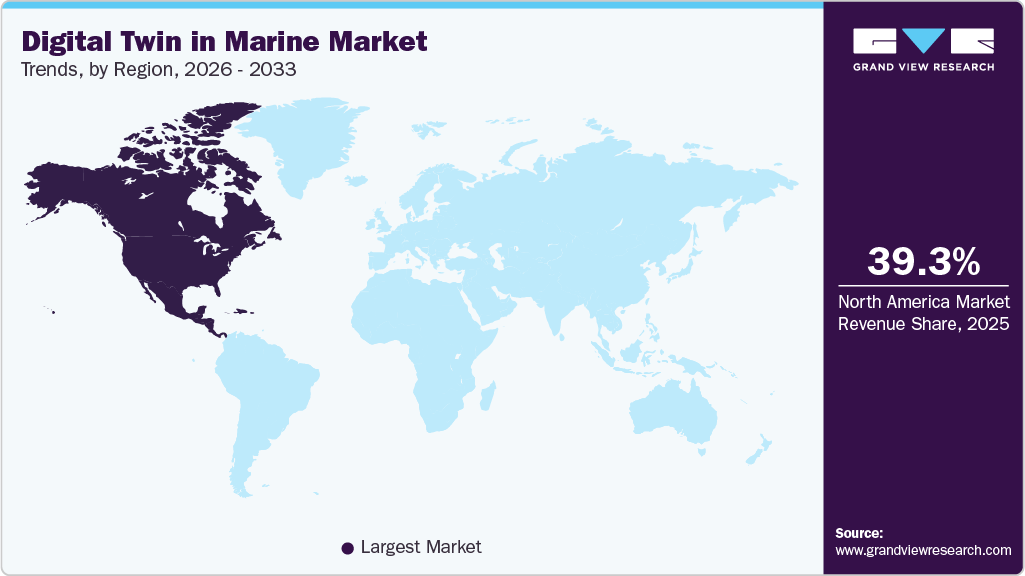
- The North America digital twin in marine held the largest global revenue share of 39.3% in 2025.
- The U.S. digital twin in marine industry is expected to grow significantly from 2026 to 2033.
- By offering, the platform & solutions segment held the largest revenue share of 68.3% in 2025.
- By deployment, the cloud segment held the largest revenue share in 2025.
- By end user, the port authorities segment is expected to grow at the fastest CAGR from 2026 to 2033.
Market Size & Forecast
- 2025 Market Size: USD 701.9 Million
- 2033 Projected Market Size: USD 3,290.3 Million
- CAGR (2026-2033): 22.7%
- North America: Largest market in 2025
Shipowners and operators are increasingly deploying digital twin models to simulate vessel performance, optimize fuel consumption, and enhance real-time voyage planning. The increasing emphasis on predictive maintenance and asset reliability contributes significantly to the digital twin in marine industry. Unplanned downtime in maritime operations leads to significant financial losses and operational disruptions. Digital twins enable continuous condition monitoring of critical components such as engines, propulsion systems, and hull structures, allowing operators to predict failures before they occur. This transition from reactive to predictive maintenance not only reduces maintenance costs but also extends asset lifespan and improves fleet availability, making it highly attractive for commercial shipping, offshore, and naval sectors.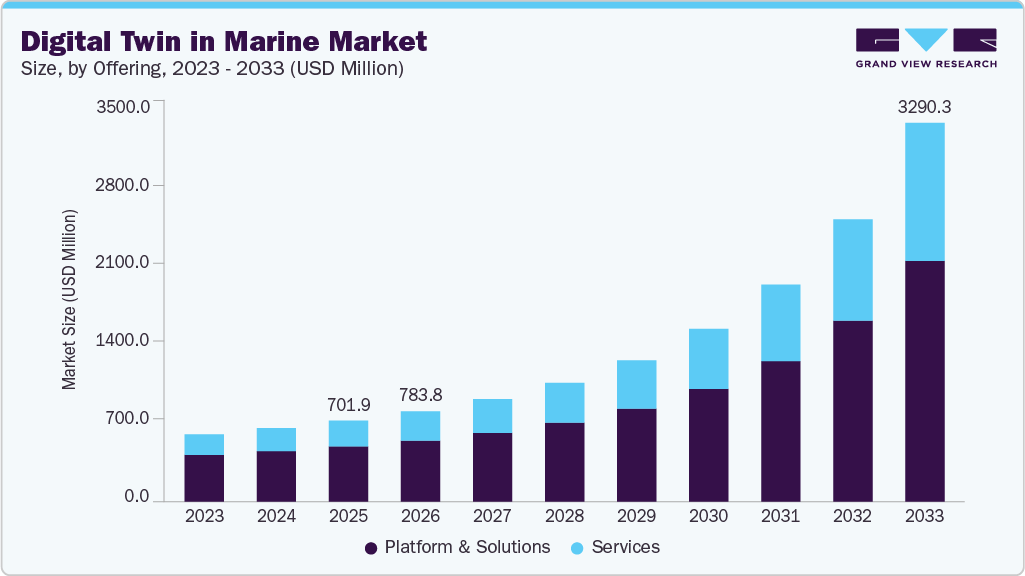
Stringent environmental regulations and decarbonization goals are also significantly driving the expansion of the digital twin market. Regulatory bodies such as the International Maritime Organization (IMO) are enforcing stricter emissions standards, including carbon intensity reduction targets. Digital twin solutions help organizations simulate emission scenarios, optimize fuel efficiency, and evaluate alternative fuels or propulsion technologies without physical trials. This capability is essential for compliance and supports broader sustainability initiatives, driving adoption across shipping companies and offshore operators.
In addition, increasing investments in smart ports and maritime digitalization initiatives are supporting the growth of the digital twin market in marine applications. Ports are leveraging digital twins to optimize traffic flow, berth allocation, cargo handling, and infrastructure maintenance. For instance, in June 2025, Yinson GreenTech signed a memorandum of understanding with the Maritime and Port Authority of Singapore to support the advancement of Singapore’s platform for the market. The collaboration integrates real-time operational data from Yinson GreenTech’s electric harbor craft fleet to enhance port modeling capabilities. Both parties aim to work together to develop digital workflows and solutions aimed at scaling electric harbor craft operations, reinforcing Singapore’s push toward smart and sustainable maritime innovation.
Offering Insights
The platform & solutions segment dominated the digital twin in marine market, accounting for the largest revenue share of 68.3% in 2025 due to the increasing need for interoperable, scalable, and standardized digital environments that can consolidate multi-source maritime data into a single operational framework. As fleets adopt heterogeneous systems across navigation, engineering, and cargo management, operators are prioritizing unified digital twin platforms that support seamless integration with legacy IT/OT infrastructure and third-party applications.
The services segment is anticipated to grow at the fastest CAGR during the forecast period, driven by the growing need for specialized expertise to design, customize, and operationalize digital twin ecosystems within highly complex marine environments. Maritime organizations often lack in-house capabilities to manage data modeling, simulation calibration, and system integration at scale, leading to increased reliance on consulting, implementation, and managed services providers.
Deployment Insights
The cloud segment dominated the digital twin in marine industry, accounting for the largest revenue share in 2025, driven by the maritime sector’s increasing need for globally synchronized, fleet-wide visibility and collaboration across geographically dispersed operations. Cloud-based digital twin environments enable centralized access to vessel data, allowing onshore teams, fleet managers, and stakeholders to interact with live models simultaneously without dependence on onboard infrastructure.
The on-premise segment is expected to grow at a significant CAGR during the forecast period, driven by the maritime industry’s requirement for high-assurance data governance, deterministic system performance, and operational continuity in environments with limited or unreliable connectivity. Naval operations, defense fleets, and sensitive offshore assets often require strict control over data residency and system access, making on-premises digital twin deployments preferable to maintain confidentiality and comply with internal security protocols.
Application Insights
The operational optimization segment dominated the market and accounted for the largest revenue share in 2025, driven by the increasing need for end-to-end voyage and fleet performance orchestration in a highly volatile maritime environment. Shipping companies are leveraging digital twins to dynamically optimize routing, speed profiles, fuel mix utilization, and cargo-handling efficiency in response to fluctuating factors such as weather patterns, port congestion, and chartering constraints. This capability enables continuous recalibration of operational strategies to maximize voyage profitability and asset utilization.
The predictive maintenance segment is expected to grow at a significant CAGR during the forecast period, driven by the increasing need to optimize spare parts logistics and maintenance planning across globally distributed fleets. Maritime operators are leveraging digital twins to forecast component wear cycles and align maintenance schedules with port calls, dry-docking windows, and supply chain availability, minimizing costly emergency repairs and inefficient inventory stocking.
End User Insights
The shipping companies segment dominated the digital twin in marine market, accounting for the largest revenue share in 2025, driven by the growing need to enhance commercial decision-making and revenue optimization in an increasingly competitive freight market. Operators are leveraging digital twins to gain deeper visibility into voyage economics, enabling more accurate chartering strategies, contract negotiations, and spot market participation. By simulating different trade routes, cargo loads, and pricing scenarios, shipping companies can optimize earnings per voyage and respond more effectively to demand fluctuations across global trade lanes.
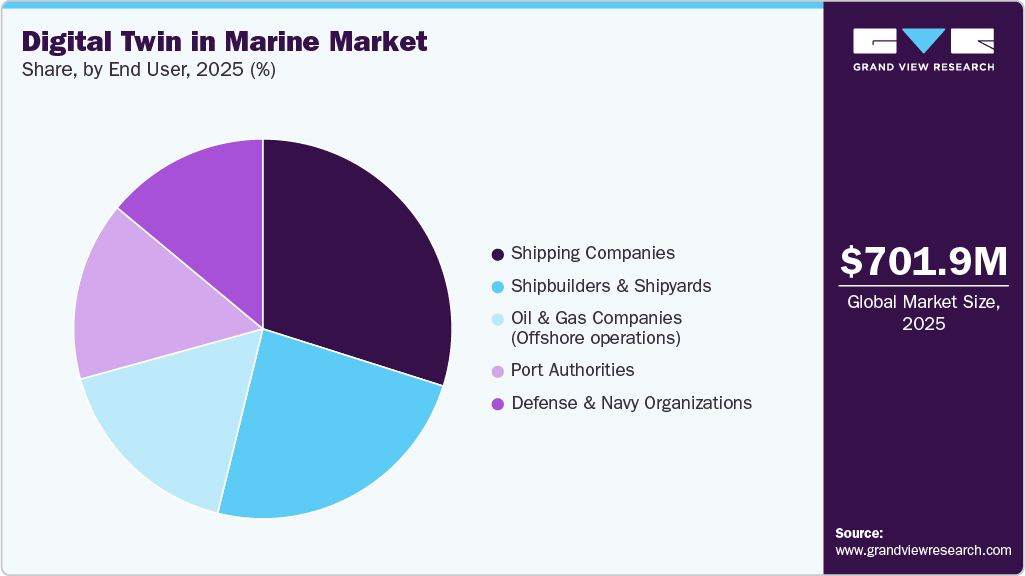
The oil & gas companies (offshore operations) segment is expected to grow at a significant CAGR over the forecast period, driven by the need to enhance subsurface-to-surface integration and optimize production efficiency across complex offshore assets. Digital twins are increasingly used to create unified models of offshore platforms, subsea systems, and reservoir behavior, enabling operators to simulate production scenarios, monitor flow assurance, and optimize extraction strategies in real time. This capability is critical for maximizing recovery rates from mature fields and improving output consistency in deep-water and ultra-deep-water environments.
Regional Insights
North America dominated the global digital twin in marine market, accounting for the largest revenue share of 39.3% in 2025, driven by strong collaboration between maritime operators and advanced technology providers, fostering rapid commercialization of digital twin solutions. The region benefits from a mature digital ecosystem, where partnerships between shipbuilders, software firms, and research institutions enable the development of high-fidelity simulation models and next-generation maritime applications.
U.S. Digital Twin In Marine Market Trends
The U.S. digital twin in marine industry is expected to grow significantly at a CAGR of 15.5% from 2026 to 2033, due to substantial defense and naval modernization programs that prioritize digital engineering and virtual prototyping. Government-backed initiatives are integrating digital twins into ship design, testing, and lifecycle management to reduce development timelines and costs while enhancing mission readiness.
Europe Digital Twin In Marine Market Trends
The digital twin in marine industry in Europe is anticipated to register considerable growth from 2026 to 2033, driven by cross-border maritime digitization initiatives and funding programs aimed at strengthening regional shipping competitiveness. The presence of integrated maritime clusters linking ports, shipyards, and logistics networks encourages the deployment of digital twins to improve coordination and efficiency across the broader marine value chain.
The UK digital twin in marine market is expected to grow rapidly in the coming years. Investments in pilot projects and real-world demonstrations, particularly around intelligent port operations and vessel traffic systems, are creating a strong foundation for digital twin deployment.
The digital twin in marine market in Germany held a substantial share in 2025 due to its advanced shipbuilding engineering capabilities and strong emphasis on Industry 4.0 integration in maritime manufacturing. Shipyards and marine equipment manufacturers are increasingly embedding digital twins into design and production workflows to enhance precision, reduce build times, and improve customization of complex vessels.
Asia Pacific Digital Twin In Marine Market Trends
The Asia Pacific digital twin in marine industry held a significant global share in 2025, driven by large-scale fleet expansion and infrastructure development across emerging maritime economies. Rapid growth in shipbuilding output and port capacity is creating a need for digital systems that can support scalable operations and infrastructure planning. Governments and private players are investing heavily in modernizing maritime assets, creating fertile ground for the adoption of digital twins at scale.
The Japan digital twin in marine market is expected to grow rapidly in the coming years, driven by its focus on operational excellence and continuous improvement methodologies within maritime operations. Shipping companies are integrating digital twins with advanced quality control and performance benchmarking practices to achieve incremental efficiency gains.
The digital twin in marine market in China held a substantial share in 2025, due to its strategic push toward maritime digital sovereignty and the development of indigenous technology ecosystems. Domestic players are investing in homegrown digital twin platforms to reduce reliance on foreign technologies while supporting the rapid expansion of its shipping and shipbuilding industries.
Key Digital Twin In Marine Company Insights
Key players operating in the digital twin in marine industry are Siemens, Dassault Systèmes, ABB, Wärtsilä, and Kongsberg Digital. The companies are focusing on various strategic initiatives, including new product development, partnerships & collaborations, and agreements to gain a competitive advantage over their rivals. The following are some instances of such initiatives.
-
In November 2025, Siemens and American Bureau of Shipping signed a memorandum of understanding to accelerate the digitalization of maritime classification processes across ship design and construction. The partnership will focus on advancing product lifecycle management technologies to improve efficiency, data integrity, and regulatory compliance throughout a vessel’s lifecycle. By integrating ABS’s Freedom platform with Siemens’ Xcelerator platform, the collaboration aims to strengthen digital twin and simulation capabilities, supporting more streamlined compliance and classification in the marine industry.
-
In October 2025, Kongsberg Digital partnered with Applied Computing to integrate the Orbital AI platform into its digital twin technology, enhancing real-time operational optimization across industrial environments. The collaboration brings together Kongsberg Digital’s Industrial Work Surface with Orbital’s multi-foundation AI capabilities to improve planning, maintenance, and operational efficiency in sectors such as oil and gas, chemicals, and process manufacturing. The integration is expected to drive reduced energy consumption and emissions while enabling more intelligent, data-driven decision-making across complex industrial assets.
Key Digital Twin In Marine Companies:
The following key companies have been profiled for this study on the digital twin in marine market.
- ABB
- AVEVA
- Bentley Systems
- BMT
- Cadmatic
- Dassault Systèmes
- Digital Twin Marine
- Hexagon AB
- Kongsberg Digital
- NAPA
- Prevu3D
- SailPlan
- Schneider Electric
- Siemens
- Wärtsilä
Digital Twin In Marine Market Report Scope
Report Attribute
Details
Market size in 2026
USD 783.8 million
Revenue forecast in 2033
USD 3,290.3 million
Growth rate
CAGR of 22.7% from 2026 to 2033
Actual data
2021 - 2025
Forecast period
2025 - 2033
Quantitative units
Revenue in USD million and CAGR from 2026 to 2033
Report enterprise size
Revenue forecast, company share, competitive landscape, growth factors, and trends
Segments covered
Offering, deployment, application, end user, region
Regional scope
North America; Europe; Asia Pacific; Latin America; MEA
Country scope
U.S.; Canada; Mexico; UK; Germany; France; China; India; Japan; Australia; South Korea; Brazil; UAE; Kingdom of Saudi Arabia; South Africa
Key companies profiled
ABB; AVEVA; Bentley Systems; BMT; Cadmatic; Dassault Systèmes; Digital Twin Marine; Hexagon AB; Kongsberg Digital; NAPA; Prevu3D; SailPlan; Schneider Electric; Siemens; Wärtsilä
Customization scope
Free report customization (equivalent to 8 analysts working days) with purchase. Addition or alteration to country, regional & segment scope.
Pricing and purchase options
Avail customized purchase options to meet your exact research needs. Explore purchase options
Global Digital Twin In Marine Market Report Segmentation
This report forecasts revenue growth at the global, regional, and country levels and provides an analysis of the latest industry trends in each of the sub-segments from 2021 to 2033. For this study, Grand View Research has segmented the digital twin in marine market report based on offering, deployment, application, end user, and region:
-
Offering Outlook (Revenue, USD Million, 2021 - 2033)
-
Platform & Solutions
-
Services
-
-
Deployment Outlook (Revenue, USD Million, 2021 - 2033)
-
Cloud
-
On-premise
-
-
Application Outlook (Revenue, USD Million, 2021 - 2033)
-
Product Design & Development
-
Predictive Maintenance
-
Operational Optimization
-
Asset Lifecycle Management
-
Others
-
-
End User Outlook (Revenue, USD Million, 2021 - 2033)
-
Shipbuilders & Shipyards
-
Shipping Companies
-
Port Authorities
-
Defense & Navy Organizations
-
Oil & Gas Companies
-
-
Regional Outlook (Revenue, USD Million, 2021 - 2033)
-
North America
-
U.S.
-
Canada
-
Mexico
-
-
Europe
-
UK
-
Germany
-
France
-
-
Asia Pacific
-
China
-
India
-
Japan
-
South Korea
-
Australia
-
-
Latin America
-
Brazil
-
-
Middle East & Africa
-
UAE
-
Saudi Arabia
-
South Africa
-
-
Frequently Asked Questions About This Report
b. The global digital twin in marine market size was estimated at USD 701.9 million in 2025 and is expected to reach USD 783.8 million in 2026.
b. The global digital twin in marine market is expected to grow at a compound annual growth rate of 22.7% from 2026 to 2033 to reach USD 3,290.3 million by 2033.
b. The platform & solutions segment dominated the market and accounted for the revenue share of 68.3% in 2025 due to the increasing need for interoperable, scalable, and standardized digital environments that can consolidate multi-source maritime data into a single operational framework.
b. Key players operating in the digital twin in marine industry are Siemens, Dassault Systèmes, ABB, Wärtsilä, and Kongsberg Digital.
b. The increasing emphasis on predictive maintenance and asset reliability contributes significantly to the digital twin in marine industry. Unplanned downtime in maritime operations leads to significant financial losses and operational disruptions. Digital twins enable continuous condition monitoring of critical components such as engines, propulsion systems, and hull structures, allowing operators to predict failures before they occur.


Share this report with your colleague or friend.
Need a Tailored Report?
Customize this report to your needs — add regions, segments, or data points, with 20% free customization.


ISO 9001:2015 & 27001:2022 Certified
We are GDPR and CCPA compliant! Your transaction & personal information is safe and secure. For more details, please read our privacy policy.
Trusted market insights - try a free sample
See how our reports are structured and why industry leaders rely on Grand View Research. Get a free sample or ask us to tailor this report to your needs.













