
- Home
- »
- Organic Chemicals
- »
-
Dimethyl Carbonate Market Size & Share Report, 2026-2033GVR Report cover

Dimethyl Carbonate Market (2026 - 2033)
Size, Share & Trends Analysis Report By Type (Battery, Pharmaceuticals) By Application (Battery Electrolyte, Polycarbonate Synthesis), By End-use (Plastics, Agrochemicals) By Region, And Segment Forecasts
Market Size, 2025
$1.3BMarket Estimate, 2026
$1.4BMarket Forecast, 2033
$2.5BCAGR, 2026–2033
7.9%Dimethyl Carbonate Market Summary
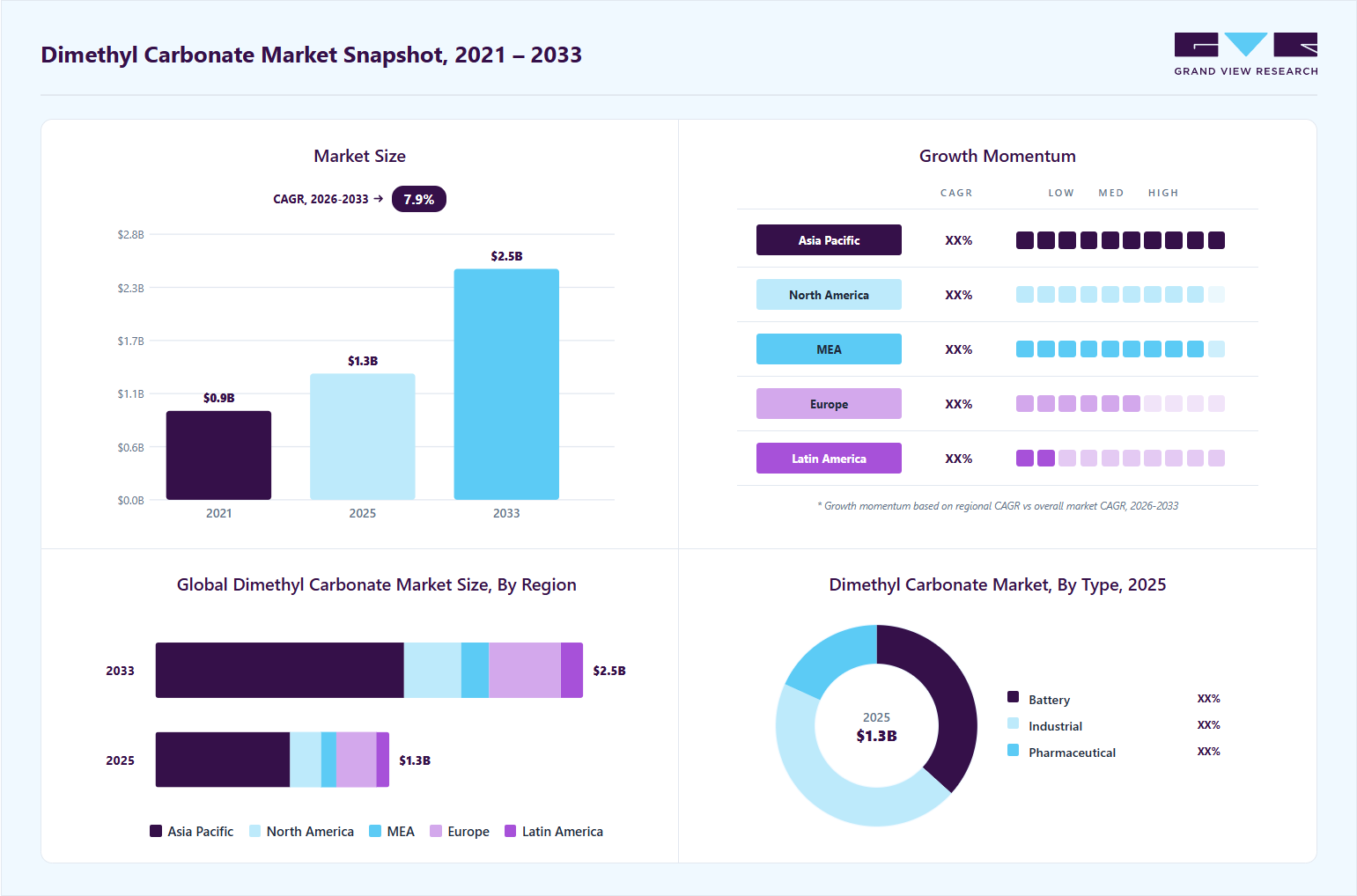
The global dimethyl carbonate market size was valued at USD 1.3 billion in 2025 and is projected to grow from USD 1.4 billion in 2026 to USD 2.5 billion by 2033, at a CAGR of 7.9% from 2026 to 2033. The market in Asia Pacific dominated with a revenue share of 57.5% in 2025. Rising demand from lithium-ion battery manufacturing, increasing electric vehicle adoption, and expanding use of environmentally friendly solvents across industrial applications.
 Source: Grand View Research, IR Documents, Primary Interviews, Paid DatabasesTo learn more about this report,
 Download Free Sample Report
Key Market Trends & Insights
- By type: Industrial segment held the largest market share of 45.1% in 2025.
- By application: Solvents and reagents segment held the largest market share of 41.1% in 2025.
- By end-use: Battery segment held the largest market share of 33.9% in 2025.
Regional Highlights
- Largest regional market: Asia Pacific (57.5% revenue share, 2025)
- By country: China held the largest market share in 2025
Market Size & Forecast
- Market size in 2025: USD 1.3 Billion
- Estimated market size in 2026: USD 1.4 Billion
- Projected market size by 2033: USD 2.5 Billion
- CAGR (2026-2033): 7.9%
Three ways to get this report
Buy it, customize it, or ask a question.Ask an Analyst
Analyst response in 1 business day
- AccessReport author, directly
- Reply timeWithin 1 working day
- No sales callDirect answer only
- FormatEmail reply
- CostFree, no cost
Get the Full Report
What the study covers
- FormatsPDF · Excel · Dashboard
- Timeline2026–2033 annual, 2025 base
- Coverage20+ countries, 5 regions
- Companies10+ key players profiled
Customize the Report
20% free customization
- IncludeCountries, segments, points
- TailorTo your product definition
- ExtendDeeper competitor detail
- OrA fully bespoke study
- Turnaround5–10 working days
Growing investments in sustainable production and advanced energy storage technologies are further supporting long-term market expansion. The dimethyl carbonate market is experiencing growth due to rising demand from the lithium-ion battery sector, particularly with the global increase in electric vehicle production and energy storage applications. Dimethyl carbonate is extensively utilized in battery electrolyte formulations because of its strong solvency characteristics, stability, and environmentally favorable profile. The market is also benefiting from increasing preference for sustainable and low-toxicity chemicals across industrial manufacturing processes. The expanding use of polycarbonate materials in automotive, consumer electronics, and construction industries is supporting product consumption, as dimethyl carbonate is an important raw material in polycarbonate manufacturing. Regulatory pressure to reduce the use of hazardous chemicals and promote cleaner production technologies is further encouraging adoption across multiple end use industries.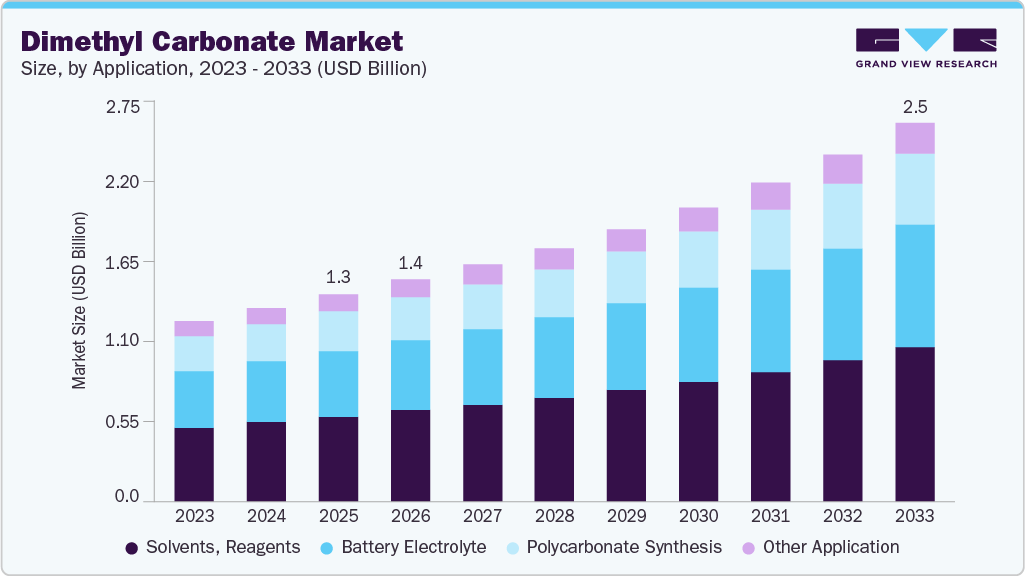 To learn more about this report, Download Free Sample Report
The market presents considerable opportunities driven by the accelerating transition toward electric mobility and large-scale battery manufacturing investments worldwide. The growing development of renewable energy infrastructure and advanced energy storage systems is expected to increase the requirement for high-purity dimethyl carbonate used in battery electrolytes. Rising awareness regarding green chemistry and environmentally responsible solvents is creating opportunities for broader adoption in pharmaceuticals, agrochemicals, paints & coatings, and specialty applications. Rapid industrial expansion in emerging economies such as China and India is also creating favorable conditions for new production facilities, supply chain development, and strategic collaborations among manufacturers.
Market Dynamics
The market drivers include the rapid expansion of electric vehicles and lithium-ion battery industries, where it is widely used as an electrolyte solvent. Rising consumption of polycarbonate materials in automotive, electronics, and construction applications is further contributing to product demand. The supportive environmental regulations promoting sustainable manufacturing practices and low VOC chemical usage are encouraging wider industrial adoption. Growing investments in renewable energy storage systems and advanced battery technologies are expected to strengthen long-term market expansion.
High capital investment requirements for establishing advanced and environmentally compliant manufacturing facilities may also limit market entry for smaller companies. The availability of alternative solvents and electrolyte materials creates competitive pressure for manufacturers operating in the market. Stringent environmental and safety regulations related to chemical production, storage, and transportation can further increase operational complexity and compliance costs. Market growth may also be impacted by economic slowdowns or reduced industrial activity in key end use sectors such as automotive, construction, and specialty chemicals.
Market Concentration & Characteristics
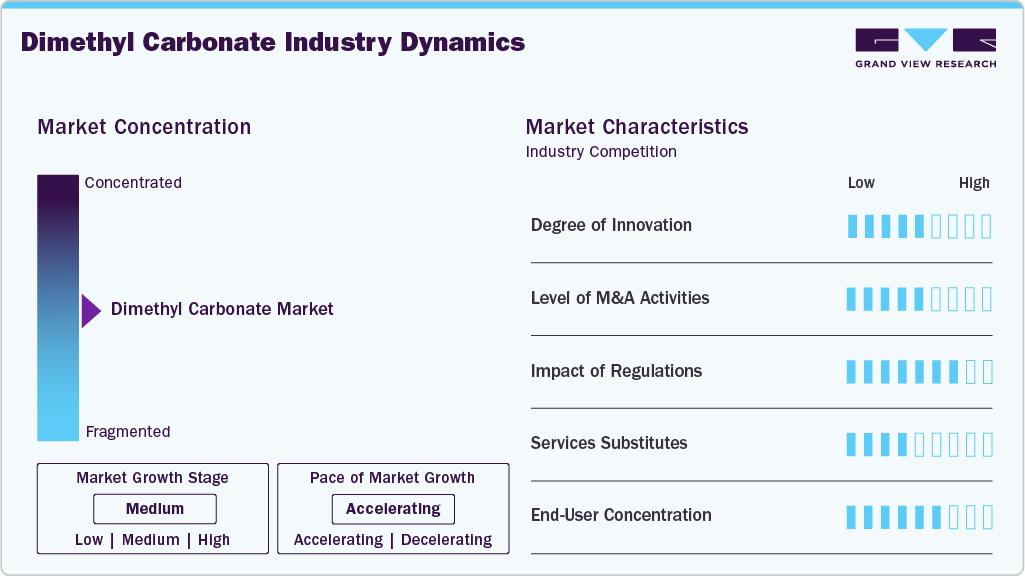
The dimethyl carbonate market is characterized by a competitive environment where manufacturers compete based on product quality, technological expertise, production efficiency, and global distribution capabilities. Major companies, including UBE Industries, Tokyo Chemical Industry Co., Ltd., KOWA American Corporation, and Shandong Haike Chemical Group Co., Ltd., are actively strengthening their market positions through capacity expansion and development of high-purity dimethyl carbonate products for battery and specialty chemical applications.
 To learn more about this report, Download Free Sample Report
Chinese manufacturers continue to play an important role in global supply because of their large-scale production capabilities and cost advantages. At the same time, international players are investing in advanced manufacturing technologies and environmentally sustainable production processes to meet evolving regulatory requirements and customer expectations. Strategic partnerships, long-term supply agreements, and expansion into emerging markets are also becoming important competitive strategies.
Type Insights
The industrial segment held the largest share of 45.1% in 2025, due to its extensive usage across chemical processing, coatings, adhesives, and specialty manufacturing applications. It is increasingly preferred as an environmentally friendly solvent and chemical intermediate because of its low toxicity and biodegradable characteristics. Rising industrial emphasis on sustainable production methods and compliance with stringent environmental regulations has further accelerated product adoption. The expanding demand for high-performance solvents in paints, coatings, and industrial cleaning applications continues to support segment growth. The strong presence of chemical manufacturing industries in the Asia Pacific and North America also contributes significantly to the segment’s market dominance.
The battery segment is growing the fastest with a CAGR of 8.3% during the forecast period, primarily driven by increasing production of electric vehicles and energy storage systems worldwide. It is widely utilized in lithium-ion battery electrolytes due to its excellent solvency, low viscosity, and favorable electrochemical properties. Rising investments in battery manufacturing facilities and government initiatives supporting the clean energy transition are expected to create substantial demand. Rapid technological advancements in battery chemistry and growing consumer adoption of electric mobility are further strengthening segment expansion. Increasing focus on renewable energy storage infrastructure is also contributing to long-term growth opportunities.
Application Insights
The solvents and reagents segment held a market share of 41.1% in 2025 due to the widespread use as a green solvent in chemical synthesis and industrial processing. Its low environmental impact and safer handling profile compared to conventional solvents have increased its adoption across pharmaceutical, agrochemical, and specialty chemical industries. The product is also extensively used as a methylating and carbonylating agent in organic synthesis applications. Growing regulatory pressure to reduce hazardous chemical emissions and volatile organic compounds (VOCs) is further supporting segment growth.
The polycarbonate synthesis segment is expected to grow significantly with a CAGR of 6.4%, due to increasing demand for lightweight and high-performance plastic materials across automotive, electronics, and construction industries. It serves as an important intermediate in the production of polycarbonate resins, which are widely valued for their durability, transparency, and heat resistance. Rising preference for lightweight automotive materials aimed at improving fuel efficiency and reducing emissions is supporting segment expansion. Growing consumption of consumer electronics and electrical components is increasing the demand for engineering plastics and polycarbonate materials.
End-use Insights
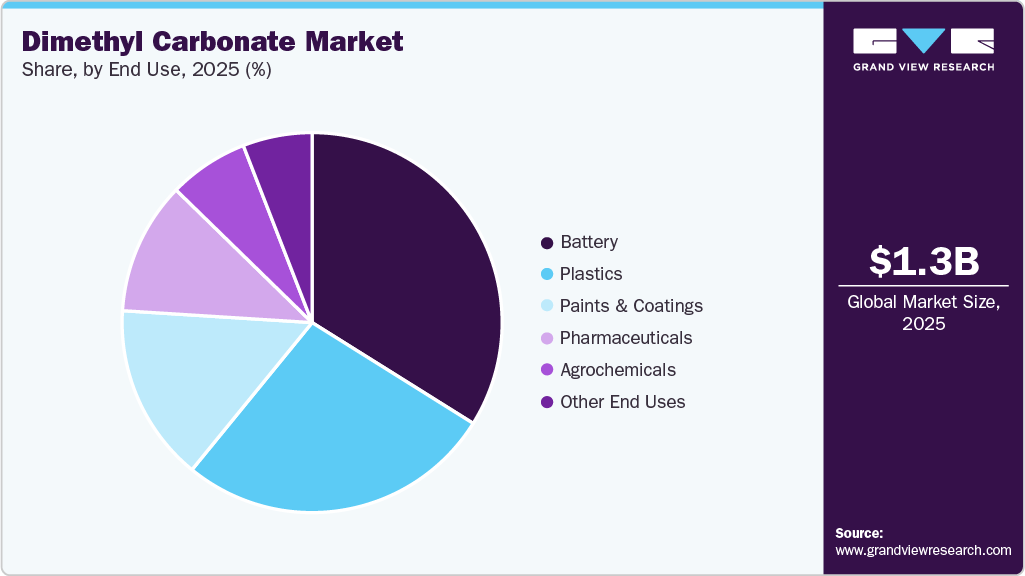
The battery end use segment held a major share of 33.9% in 2025 due to the rapid growth of lithium-ion battery production globally. Increasing adoption of electric vehicles, portable electronic devices, and renewable energy storage systems has significantly increased the requirement for high-purity electrolyte solvents. It is extensively used in battery formulations because of its high dielectric properties and compatibility with advanced battery chemistries. Strong investments in gigafactory projects and battery supply chain development across Asia Pacific, Europe, and North America are further supporting market growth. Government incentives promoting electric mobility and clean energy technologies continue to strengthen segment demand.
 To learn more about this report, Download Free Sample Report
The plastics segment is expected to grow at a significant CAGR of 7.8% during the forecast period, due to increasing demand for advanced polymer materials across multiple industries. It plays an important role in the production of polycarbonate plastics and specialty polymers used in automotive, electronics, packaging, and construction applications. Rising focus on lightweight and durable plastic materials to improve product performance and energy efficiency is driving segment expansion. Growing industrialization and infrastructure development in emerging economies are contributing to higher consumption of engineering plastics. Increasing investment in sustainable and recyclable plastic manufacturing technologies is also expected to support long-term market growth.
Regional Insights
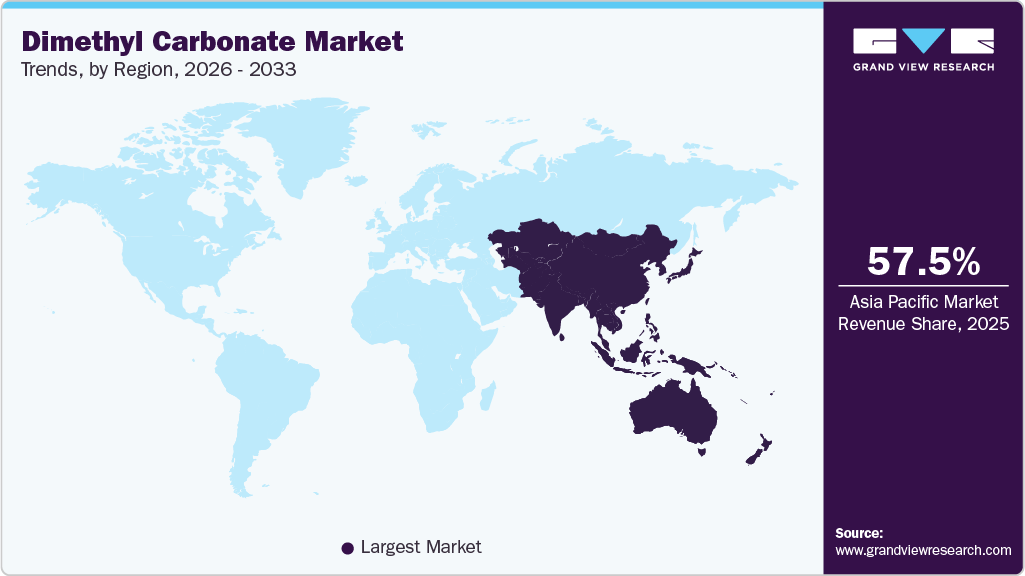
Asia Pacific dominated with a dimethyl carbonate market share of 57.5% in 2025, due to the strong presence of chemical manufacturing industries, large-scale lithium-ion battery production, and rapid industrialization across major economies such as China, Japan, South Korea, and India. The region benefits from robust electric vehicle manufacturing capacity, expanding electronics production, and increasing investments in renewable energy storage systems. In addition, favorable government policies supporting clean energy technologies and domestic battery supply chains are accelerating demand for battery-grade dimethyl carbonate. The availability of cost-competitive raw materials and established chemical processing infrastructure further strengthens the region’s leading market position.
 To learn more about this report, Download Free Sample Report
China represents the largest country-level market because of its dominant position in global lithium-ion battery manufacturing and electric vehicle production. The country has a highly integrated chemical supply chain supported by large-scale industrial production capabilities and significant investments in battery materials. Rising government initiatives promoting electric mobility, renewable energy storage, and sustainable industrial development continue to drive demand across batteries, plastics, and chemical processing applications.
Europe Dimethyl Carbonate Market Trends
Europe has increased its adoption of sustainable chemicals and has a strong regulatory emphasis on environmentally responsible manufacturing practices. The region is witnessing growing investments in electric vehicle production, battery manufacturing facilities, and renewable energy infrastructure, which are driving demand for high-purity dimethyl carbonate. The rising usage of advanced polycarbonate materials in the automotive and electronics industries is contributing to market expansion. Supportive government regulations aimed at reducing carbon emissions and promoting green chemistry further strengthen regional demand.
Germany plays a key role in Europe due to its strong automotive manufacturing base and growing focus on electric mobility. The country is investing heavily in battery production facilities and advanced materials research to support the transition toward sustainable transportation technologies. Increasing demand for lightweight engineering plastics and high-performance chemical intermediates across automotive and industrial sectors is further supporting market growth. Germany’s advanced chemical manufacturing capabilities and emphasis on innovation also contribute to the country’s strategic importance in the regional market.
North America Dimethyl Carbonate Market Trends
North America has rising investments in electric vehicle production, battery manufacturing, and clean energy technologies. The region is experiencing growing demand for environmentally friendly solvents and specialty chemicals across industrial and pharmaceutical applications. Government support for domestic battery supply chain development and increasing focus on reducing dependence on imported battery materials are encouraging regional market expansion. Technological advancements and strong research activities in advanced materials and sustainable chemical processing are supporting long-term growth.
U.S. Dimethyl Carbonate Market Trends
The US is a major contributor to North America because of its expanding electric vehicle manufacturing and increasing investments in lithium-ion battery production facilities. Rising focus on renewable energy storage systems and domestic battery material supply chains is driving demand for battery-grade dimethyl carbonate. The country also benefits from strong pharmaceutical, specialty chemicals, and advanced materials industries that utilize dimethyl carbonate in solvents and synthesis applications. Supportive federal initiatives promoting clean energy and industrial sustainability continue to create favorable market conditions.
Middle East & Africa Dimethyl Carbonate Market Trends
The Middle East & Africa are gradually expanding due to increasing industrial diversification and investments in chemical manufacturing infrastructure. The growing development of the automotive, construction, and industrial sectors is supporting demand for specialty chemicals and sustainable solvents. Several countries in the region are focusing on reducing dependence on oil-based revenues by expanding downstream petrochemical and specialty chemical industries.
Latin America Dimethyl Carbonate Market Trends
The growth in Latin America is driven by increasing industrialization and expanding demand from automotive, paint & coatings, and chemical processing industries. Countries such as Brazil and Mexico are experiencing rising adoption of sustainable industrial chemicals and specialty solvents across manufacturing sectors. Growing investments in industrial infrastructure and the gradual expansion of electric vehicle adoption are expected to create additional opportunities for market participants.
Key Dimethyl Carbonate Company Insights
Companies operating in the dimethyl carbonate market are increasingly focusing on production capacity expansion, technological advancements, and the development of high-purity battery-grade products to strengthen their competitive position. Many manufacturers are also forming strategic partnerships and long-term supply agreements with battery, pharmaceutical, and specialty chemical companies to secure stable demand and enhance market reach.
-
Tokyo Chemical Industry Co., Ltd. is a prominent specialty chemical manufacturer known for its extensive portfolio of high-purity chemical products used in research, pharmaceuticals, and industrial applications. In the dimethyl carbonate market, the company benefits from its strong expertise in fine chemicals and advanced synthesis technologies, enabling it to supply high-quality dimethyl carbonate for laboratory, pharmaceutical, and specialty industrial uses. Its global distribution network, consistent focus on product quality, and investment in research-driven innovation support its competitive position in the market.
-
KOWA American Corporation plays an important role in the dimethyl carbonate market through its diversified chemical distribution and supply capabilities across North America and international markets. The company serves multiple end use industries, including pharmaceuticals, coatings, plastics, and specialty chemicals, where dimethyl carbonate is increasingly utilized as a sustainable solvent and chemical intermediate. KOWA American Corporation leverages its strong supply chain infrastructure, technical expertise, and strategic partnerships to provide reliable chemical sourcing solutions to industrial customers.
Key Dimethyl Carbonate Companies:
The following are the leading companies in the dimethyl carbonate market.
-
UBE Industries
-
Qingdao Aspirant Chemicals Co.
-
KOWA American Corporation
-
Shandong Haike Chemical Group Co., Ltd.
-
Kingdun Chemical Co., Limited.
-
Tokyo Chemical Industry Co., Ltd.
-
Hefei TNJ Chemical Industry Co. Limited
-
Connect Chemicals
-
Aceto Corporation
-
Wego Chemical Group
Competitive Benchmarking
Operating Strategies
Competitive Edge
Weaknesses
Mature Players: UBE Industries; KOWA American Corporation; Tokyo Chemical Industry Co., Ltd.; Aceto Corporation; Connect Chemicals; Wego Chemical Group; Shandong Haike Chemical Group Co., Ltd.
- Focus on capacity expansion and sustainable production technologies.
- Strengthen strategic partnerships and global distribution networks.
- Strong brand recognition and established customer relationships.
- Advanced technological capabilities and diversified product portfolios.
- High operational and regulatory compliance costs.
- Lower flexibility due to large-scale organizational structures.
Emerging Players: Qingdao Aspirant Chemicals Co.; Kingdun Chemical Co., Limited.; Hefei TNJ Chemical Industry Co. Limited
- Emphasize export growth and regional market expansion.
- Compete through competitive pricing and niche product offerings.
- Cost-efficient manufacturing and flexible operations.
- Faster response to changing customer and market demands.
- Limited global visibility and smaller customer base.
- Dependence on third-party supply chains and distribution channels.
Recent Developments
-
In February 2025, UBE Industries announced plans to build a new chemical manufacturing facility in Waggaman, Louisiana, supported by an investment of nearly USD 500 million, to manufacture dimethyl carbonate (DMC) and ethyl methyl carbonate (EMC) used in lithium-ion battery electrolytes.
Dimethyl Carbonate Market Report Scope
Report Attribute
Details
Market size in 2025
USD 1.3 billion
Estimated market size in 2026
USD 1.4 billion
Projected market size by 2033
USD 2.5 billion
Growth rate
CAGR of 7.9% from 2026 to 2033
Base year for estimation
2025
Historical data
2021 - 2024
Forecast period
2026 - 2033
Quantitative units
Revenue in USD million/billion, volume in kilotons, and CAGR from 2026 to 2033
Report coverage
Revenue forecast, volume forecast, company ranking, competitive landscape, growth factors, and trends
Segments covered
Type, Application, end-use, region
Regional scope
North America; Europe; Asia Pacific; Middle East & Africa; Latin America
Country scope
U.S.; Canada; Mexico; Germany; UK; France; Italy; Spain; China; India; Japan; South Korea; Brazil; Argentina; South Africa; Saudi Arabia
Key companies profiled
UBE Industries; Qingdao Aspirant Chemicals Co.; KOWA American Corporation; Shandong Haike Chemical Group Co., Ltd.; Kingdun Chemical Co., Limited.; Tokyo Chemical Industry Co., Ltd.; Hefei TNJ Chemical Industry Co. Limited; Connect Chemicals; Aceto Corporation; Wego Chemical Group
Customization scope
Free report customization (equivalent up to 8 analysts’ working days) with purchase. Addition or alteration to country, regional & segment scope.
Pricing and purchase options
Avail customized purchase options to meet your exact research needs. Explore purchase options
Global Dimethyl Carbonate Market Report Segmentation
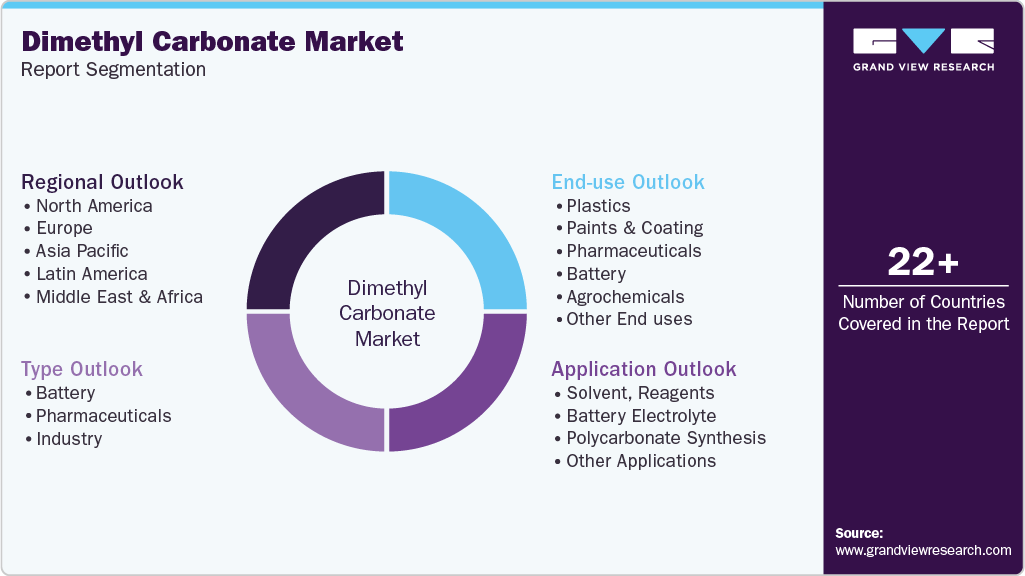
This report forecasts volume & revenue growth at global, regional, and country levels and provides an analysis of the latest industry trends in each of the sub-segments from 2021 to 2033. For this study, Grand View Research has segmented the global dimethyl carbonate market report based on type, application, end-use, and region:
 To learn more about this report, Download Free Sample Report
-
Type Outlook (Volume, Kilotons; Revenue, USD Million, 2021 - 2033)
-
Battery
-
Pharmaceuticals
-
Industry
-
-
Application Outlook (Volume, Kilotons; Revenue, USD Million, 2021 - 2033)
-
Solvent, Reagents
-
Battery Electrolyte
-
Polycarbonate Synthesis
-
Other Applications
-
-
End-use Outlook (Volume, Kilotons; Revenue, USD Million, 2021 - 2033)
-
Plastics
-
Paints & Coating
-
Pharmaceuticals
-
Battery
-
Agrochemicals
-
Other End uses
-
-
Regional Outlook (Volume, Kilotons; Revenue, USD Million, 2021 - 2033)
-
North America
-
U.S.
-
Canada
-
Mexico
-
-
Europe
-
Germany
-
UK
-
France
-
Italy
-
Spain
-
-
Asia Pacific
-
China
-
India
-
Japan
-
South Korea
-
-
Latin America
-
Brazil
-
Argentina
-
-
Middle East & Africa
-
Saudi Arabia
-
South Africa
-
-
Delivered Customizations
This report has been delivered with the following In-depth customizations
Client Request
Customization Delivered
Value Adds
Pricing Analysis
Comprehensive pricing analysis covering dimethyl carbonate (DMC) across production route, purity level, end use industry, and regional markets. The assessment includes feedstock cost trends for methanol, carbon monoxide, ethylene oxide, and urea-based routes; regional pricing variations; production cost structures associated with oxidative carbonylation, transesterification, and phosgene-free technologies; and pricing differentiation based on battery-grade, industrial-grade, and pharmaceutical-grade DMC. The analysis also evaluates supply-demand dynamics, raw material price volatility, energy cost impact, trade flow developments, transportation costs, and pricing trends across applications such as lithium-ion batteries, polycarbonate production, solvents, paints & coatings, pharmaceuticals, and agrochemicals
Support procurement optimization, pricing strategy development, and capacity investment planning through enhanced understanding of raw material economics, regional supply-demand balances, and production cost competitiveness. Help identify pricing volatility risks linked to methanol and energy markets, premium pricing opportunities in battery-grade DMC, and margin optimization strategies across high-growth end use industries such as EV batteries and specialty chemicals
Opportunity Assessment
Detailed evaluation of emerging growth opportunities across lithium-ion batteries, electrolyte solvents, polycarbonate intermediates, pharmaceuticals, paints & coatings, adhesives, and green chemical applications. The assessment includes analysis of electric vehicle adoption trends, battery manufacturing expansion, sustainability-driven solvent replacement trends, regulatory support for low-toxicity chemicals, and technological developments in phosgene-free chemical production. It also highlights high-growth regional markets, evolving downstream demand, investments in battery gigafactories, and opportunities associated with renewable chemicals and sustainable manufacturing initiatives
Enable prioritization of high-growth application areas and emerging investment opportunities across the dimethyl carbonate value chain. Support strategic planning, product diversification, sustainability positioning, and market entry initiatives through insights into EV battery ecosystem expansion, regulatory shifts toward environmentally friendly solvents, and future demand potential across advanced materials and specialty chemical applications
Competitive Benchmarking
Comparative assessment of key dimethyl carbonate manufacturers based on production technology, feedstock integration, manufacturing capacity, purity capabilities, regional footprint, product portfolio, downstream integration, sustainability initiatives, strategic partnerships, and expansion strategies. The analysis also evaluates competitive positioning across battery-grade, industrial-grade, and pharmaceutical-grade DMC segments, along with innovation activities related to electrolyte applications, green chemistry solutions, and low-emission production technologies. Benchmarking further includes analysis of supply agreements with battery manufacturers, export competitiveness, operational efficiencies, and capacity expansion activities across Asia Pacific, Europe, and North America
Support benchmarking against leading market participants and identify competitive gaps across production technology, battery-grade purity capabilities, regional integration, and sustainability positioning. Enable informed decision-making related to strategic partnerships, capacity expansion, product differentiation, localization strategies, and long-term competitive positioning within the rapidly evolving lithium-ion battery materials and green solvent ecosystem
Frequently Asked Questions About This Report
The industrial segment held the highest market share of 45.1% in 2025. while battery is the fastest-growing segment.
The solvents and reagents segment held the highest market share of 41.1% in 2025, while polycarbonate synthesis is growing significantly.
The battery segment accounted for the largest share of 33.9% in 2025, while plastics is growing significantly.
The global dimethyl carbonate market size was estimated at USD 1.3 billion in 2025 and is expected to reach USD 1.4 billion in 2026.
The global dimethyl carbonate market is expected to grow at a compound annual growth rate of 7.9% from 2026 to 2033 to reach USD 2.45 billion by 2033.
Asia Pacific dominated with a market share of 57.5% in 2025.
Some key players operating in the dimethyl carbonate market include UBE Industries; Qingdao Aspirant Chemicals Co.; KOWA American Corporation; Shandong Haike Chemical Group Co., Ltd.; Kingdun Chemical Co., Limited.; Tokyo Chemical Industry Co., Ltd.; Hefei TNJ Chemical Industry Co. Limited; Connect Chemicals; Aceto Corporation; Wego Chemical Group
Key factors include rising demand from lithium-ion battery manufacturing, increasing electric vehicle adoption, and expanding use of environmentally friendly solvents across industrial applications. Growing investments in sustainable production and advanced energy storage technologies are further supporting long-term market expansion.
About the Author(s)
Organic Chemicals Research Team
Bulk Chemicals · Organic ChemicalsThis report was authored by the organic chemicals research team at Grand View Research - comprising two research analysts, one senior research analyst, and one industry expert - with specialized expertise in the organic chemicals segment of the bulk chemicals industry. All findings are based on proprietary bulk chemicals databases, executive interviews, and regulatory analysis, subject to internal peer review prior to publication.
Last Updated:
Speak to Analyst

Customize this report to your needs - add regions, segments, or data points, with 20% free customization.
Or view our licence options:


ISO 9001:2015 & 27001:2022 Certified
We are GDPR and CCPA compliant! Your transaction & personal information is safe and secure. For more details, please read our privacy policy.


