
- Home
- »
- Advanced Interior Materials
- »
-
Dosing Systems Market Size & Share Report, 2026-2033GVR Report cover

Dosing Systems Market (2026 - 2033)
Size, Share & Trends Analysis Report By Type (Conventional, Digital/Smart), By Material (Plastic, Metal, FRP/Fiberglass-Reinforced Plastic), By Technology, By End Use, By Region And Segment Forecasts
Market Size, 2025
$6.7BMarket Estimate, 2026
$7.1BMarket Forecast, 2033
$10.9BCAGR, 2026–2033
6.3%Dosing Systems Market Summary
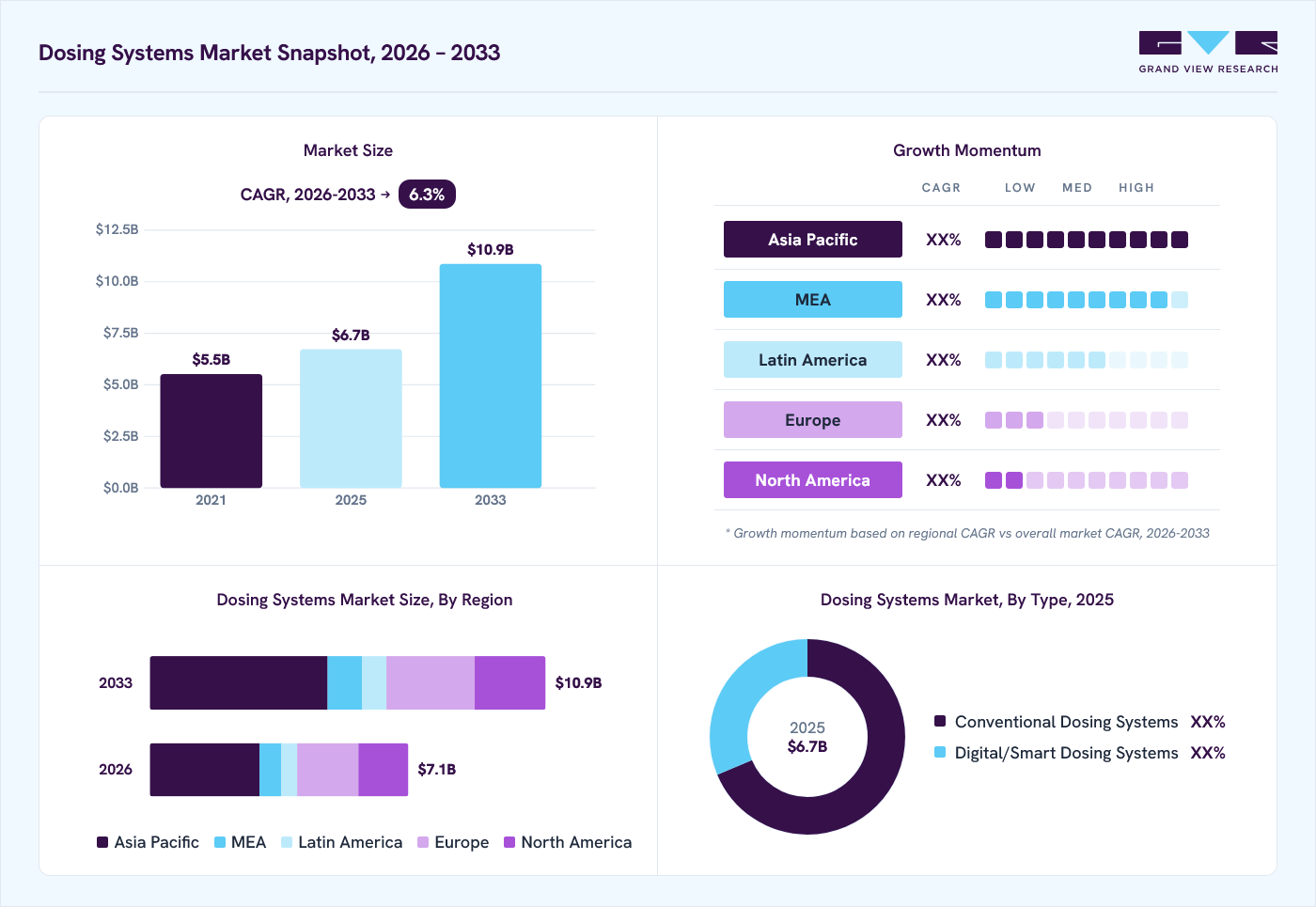
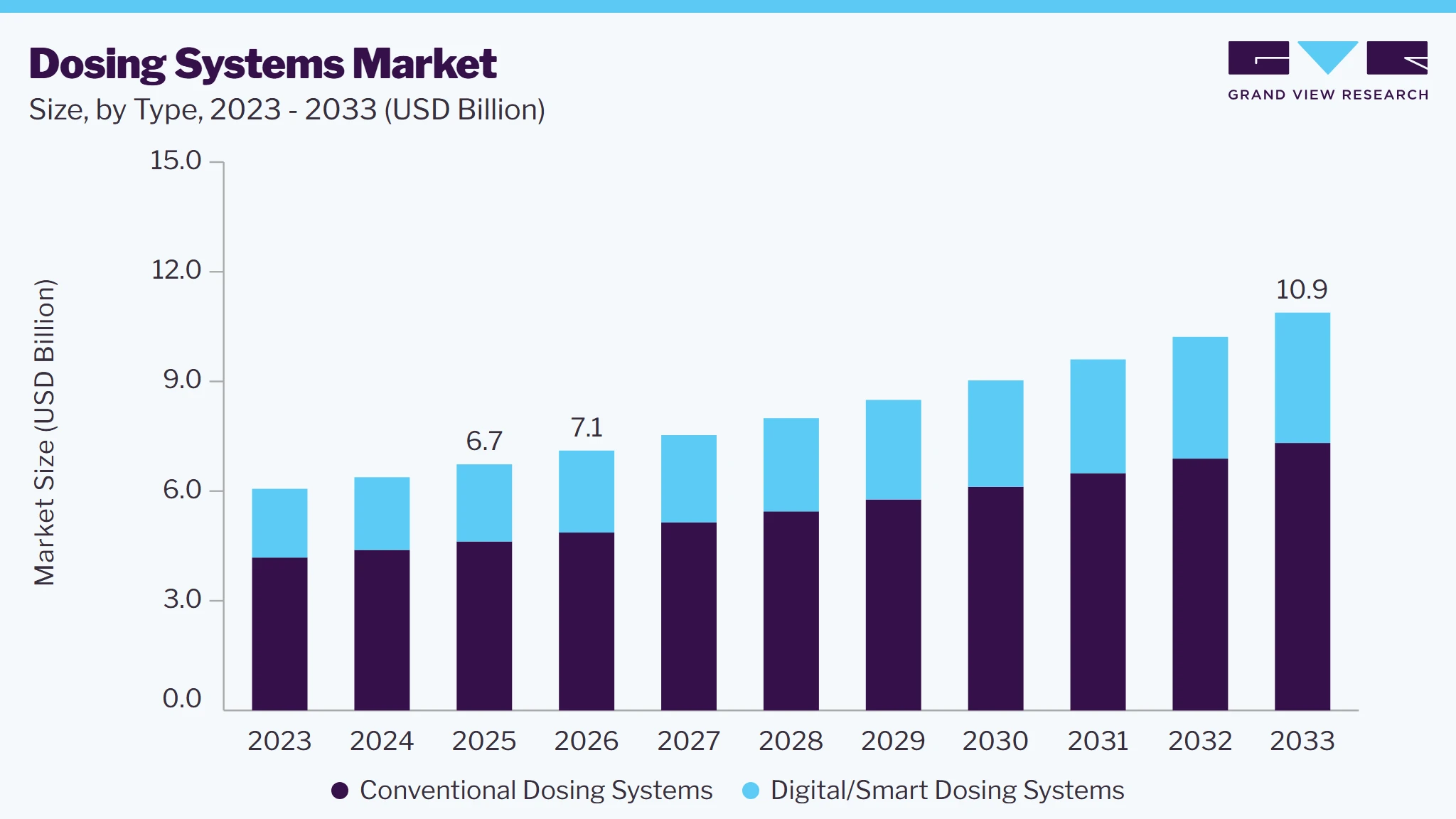
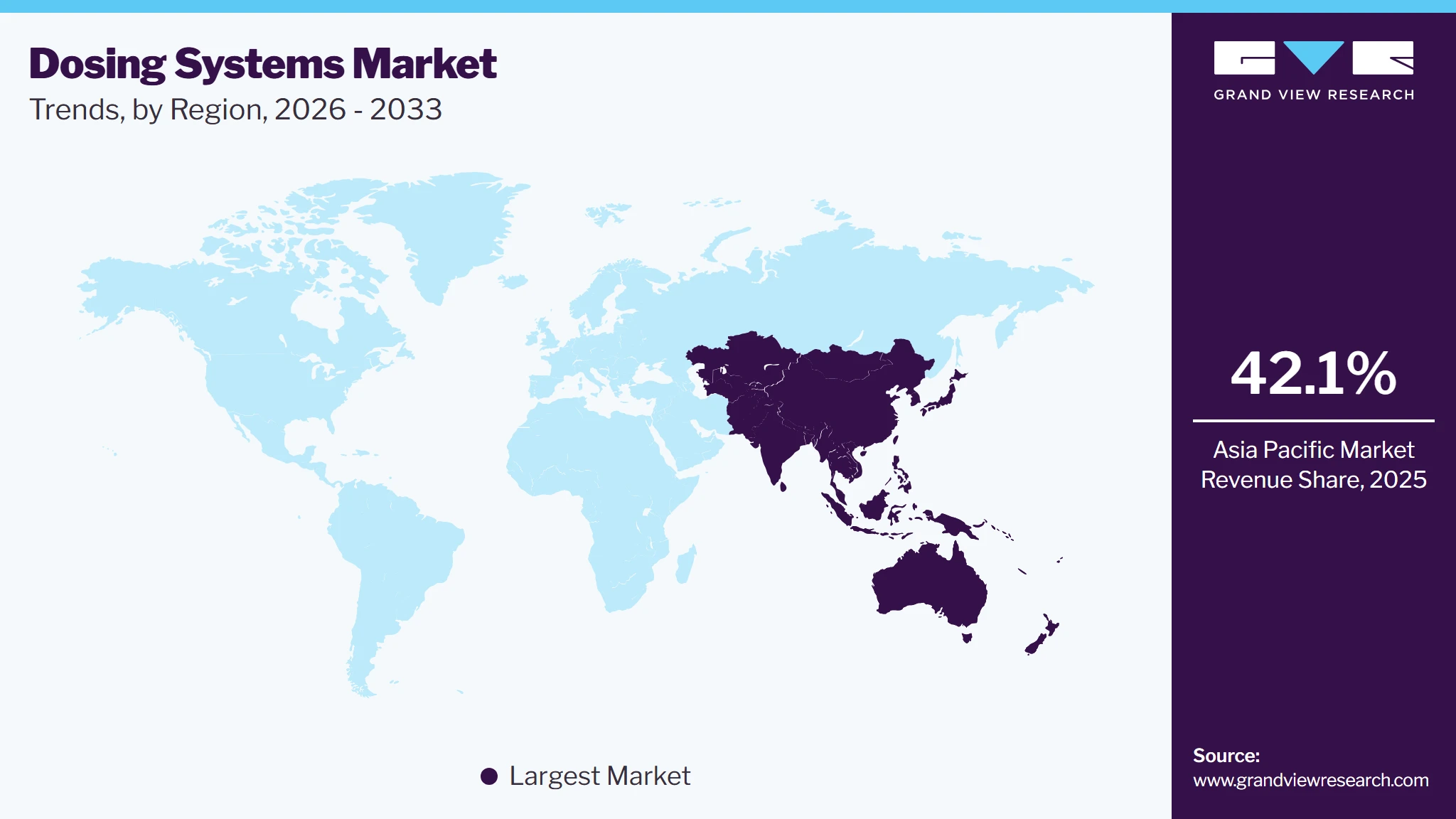
The global dosing systems market size was valued at USD 6.7 billion in 2025 and is projected to grow from USD 7.1 billion in 2026 to USD 10.9 billion by 2033, at a CAGR of 6.3% from 2026 to 2033. Asia Pacific dominated with the largest revenue share of 42.1% in 2025. The growing emphasis on accurate chemical and fluid management is a key factor supporting the market.
 Source: Grand View Research, IR Documents, Primary Interviews, Paid DatabasesTo learn more about this report,
 Download Free Sample Report
 Key Market Trends & Insights
- By type: The conventional dosing systems segment led the market with the largest revenue share of 68.6% in 2025.
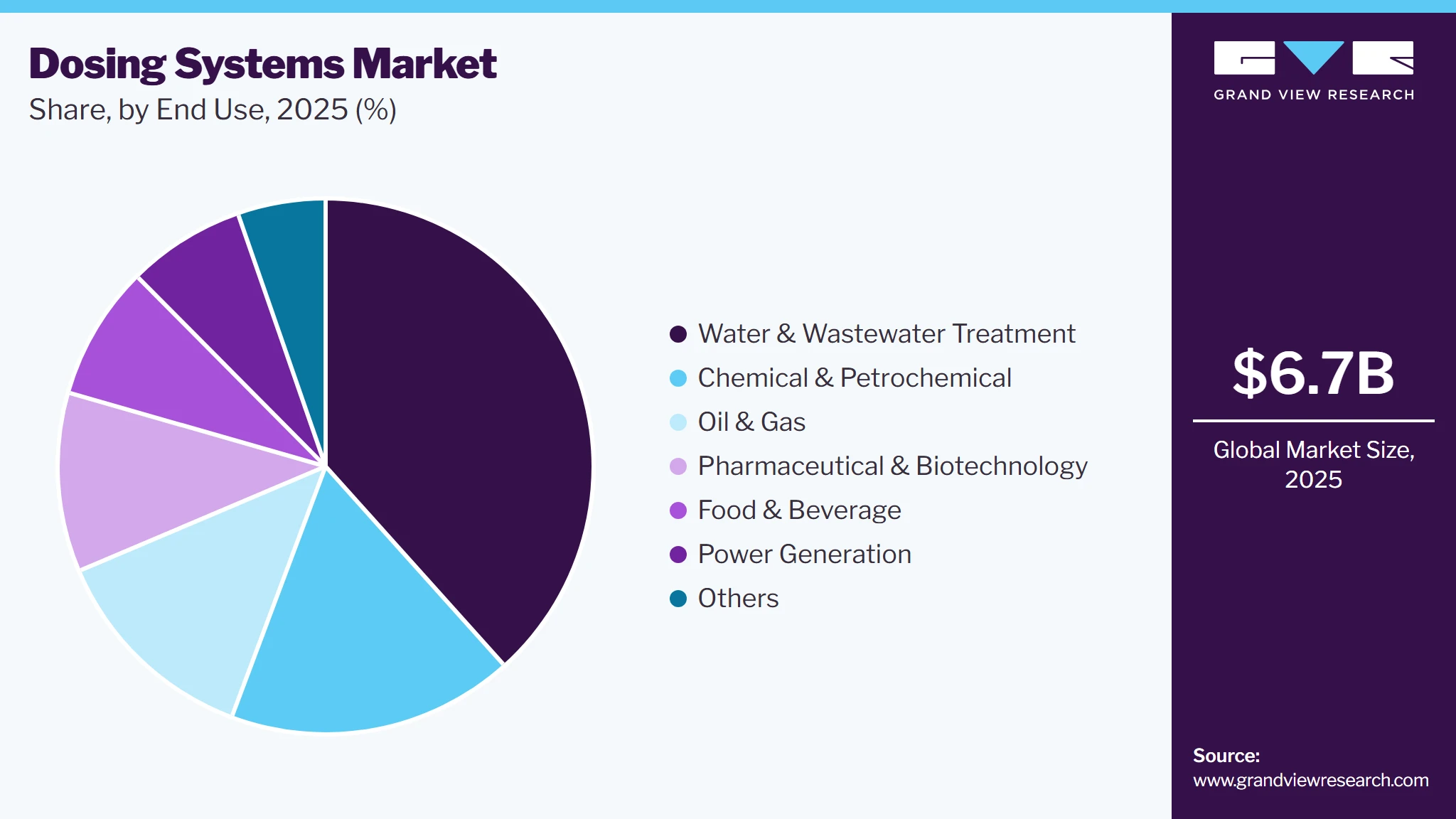
- By end use: The water & wastewater treatment segment led the market, with a revenue share of 38.4% in 2025.
- By technology: The pump-based dosing segment led the market with the largest revenue share of 62.8% in 2025.
- By material: The plastic segment led the market with the largest revenue share of 48.2% in 2025.
Regional Highlights
- Largest regional market: Asia Pacific (42.1% revenue share, 2025)
- Fastest-growing regional market: Asia Pacific (highest CAGR, 2026-2033)
- By country: China held the largest market share in 2025
Market Size & Forecast
- Market size in 2025: USD 6.7 Billion
- Estimated market size in 2026: USD 7.1 Billion
- Projected market size by 2033: USD 10.9 Billion
- CAGR (2026-2033): 6.3%
Three ways to get this report
Buy it, customize it, or ask a question.Ask an Analyst
A direct answer, usually in 1 working day
- AccessReport author, directly
- Reply timeWithin 1 working day
- No sales callDirect answer only
- FormatEmail reply
- CostFree, no cost
Get the Full Report
What the study covers
- FormatsPDF · Excel · Dashboard
- Timeline2026–2033 annual, 2025 base
- Coverage20+ countries, 5 regions
- Companies10+ key players profiled
Customize the Report
20% free customization
- IncludeCountries, segments, points
- TailorTo your product definition
- ExtendDeeper competitor detail
- OrA fully bespoke study
- Turnaround5–10 working days
Water and wastewater facilities, process plants, food and beverage production, pharmaceutical operations, and power facilities increasingly require controlled addition of chemicals to maintain consistent process conditions and meet quality requirements. Automated dosing equipment helps reduce manual intervention, limit chemical wastage, and maintain stable operating parameters, encouraging organizations to replace basic feeding arrangements with more precise metering solutions.
 To learn more about this report, Download Free Sample Report
 Rising industrial automation and adoption of smart process-control technologies are further strengthening demand for advanced dosing equipment. Modern systems increasingly integrate sensors, digital controllers, variable-speed drives, remote monitoring, and automated flow adjustment, allowing dosing rates to respond to changing process conditions. This capability is particularly valuable in applications where fluctuations in flow, concentration, pressure, or water quality can affect performance, creating opportunities for connected dosing solutions that improve operational efficiency and process consistency.
Market Dynamics
The market is shaped by the growing need for precise chemical and fluid delivery, increasing process automation, stricter quality requirements, and the expansion of treatment and processing facilities. Demand is shifting from basic manual or fixed-rate arrangements toward automated solutions that provide better control, repeatability, and resource efficiency. At the same time, equipment suppliers face challenges related to chemical compatibility, initial investment, system integration, and varying operating conditions across end-use sectors. The market is also gaining opportunities from connected equipment, customized dosing packages, and the replacement of conventional systems with digitally controlled alternatives.
The need to maintain consistent process conditions is encouraging facilities to adopt more accurate dosing equipment. In water treatment, pharmaceutical production, food processing, power facilities, and chemical operations, variations in chemical concentration can affect product quality, treatment performance, and operating costs. Metering-based systems enable controlled delivery and help minimize overdosing, underdosing, and unnecessary chemical consumption.
Automation is strengthening this trend by enabling dosing rates to respond to changes in flow, pressure, concentration, or quality parameters. Integration of sensors, programmable controllers, variable-speed drives, and remote monitoring reduces manual intervention and provides greater operational visibility. As facilities prioritize process consistency and resource optimization, demand is shifting toward intelligent dosing solutions that offer greater accuracy and control.
The relatively high upfront cost of advanced dosing systems can limit adoption, particularly among smaller facilities and users with straightforward dosing requirements. Smart systems may require additional pumps, sensors, controllers, communication interfaces, and specialized installation, increasing the overall project expenditure compared with conventional arrangements.
Integration can also become challenging when new equipment must operate alongside existing process-control infrastructure. Differences in communication protocols, plant layouts, chemical properties, and operating parameters may require customized engineering and commissioning. These requirements can extend implementation timelines and make customers more cautious about upgrading established systems.
The growing adoption of digital technologies creates opportunities for manufacturers to develop connected dosing platforms that combine metering equipment with sensors, automation, data analytics, and remote supervision. Such systems can identify dosing deviations, optimize feed rates, generate operational data, and support predictive equipment management. These capabilities can provide value beyond basic chemical delivery by improving process visibility and resource utilization.
There is also scope for suppliers to offer application-specific packages tailored to different operating conditions and chemical characteristics. Modular skids, integrated control panels, remote diagnostics, and cloud-enabled monitoring can help manufacturers differentiate their offerings while addressing the requirements of diverse processing facilities.
Market Concentration & Characteristics
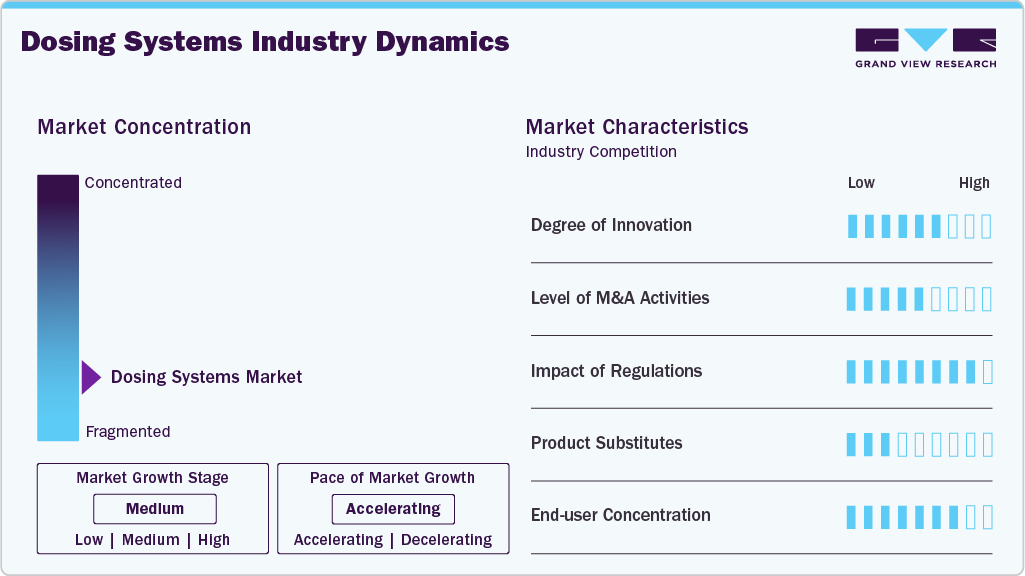
The dosing systems industry is fragmented, with a mix of global fluid-handling companies, specialized dosing technology providers, and regional manufacturers competing across different application areas. Leading participants such as Grundfos, ProMinent, IDEX, Dover, SEKO, Xylem, and Watson-Marlow offer broad product portfolios, while smaller suppliers often focus on customized systems, specific chemical-handling requirements, or regional customer bases. The diversity of end-use requirements, dosing technologies, materials, and system configurations limits market consolidation and allows specialized manufacturers to maintain a meaningful presence.
The dosing systems industry has a moderate to high degree of innovation, driven by the integration of digital controls, sensors, variable-speed drives, and automated dosing algorithms. Manufacturers are developing smart systems that can adjust feed rates based on real-time process conditions, while remote monitoring and connectivity are improving visibility into equipment performance. Innovation is also focused on improving metering accuracy, chemical compatibility, energy efficiency, and compact system design.
 To learn more about this report, Download Free Sample Report
 Regulatory requirements significantly influence the market, particularly in water quality, chemical handling, pharmaceutical production, food processing, and environmental protection. Tighter requirements for controlled chemical use, discharge quality, workplace safety, and process consistency encourage facilities to adopt reliable and accurately controlled dosing equipment. Compliance considerations also influence material selection, system design, monitoring capabilities, and documentation requirements.
End-user concentration is relatively low to moderate, as dosing systems serve a wide range of industries rather than depending on a single customer group. Water and wastewater facilities, chemical producers, food processors, pharmaceutical manufacturers, power plants, and energy-related operations generate demand with different technical requirements. This diversified customer base reduces dependence on any one industry, although suppliers with strong specialization in particular applications may experience greater exposure to sector-specific investment cycles.
Analyst Perspective
The market is evolving from conventional chemical-feed arrangements toward more accurate, automated, and application-specific solutions. Conventional systems continue to account for substantial demand due to their established installed base and relatively straightforward operation, while digital and smart configurations are gaining traction as end users seek tighter process control, lower chemical consumption, and greater operational visibility. Pump-based technology remains central to the market because of its flexibility and dosing precision, whereas pressure-based solutions are benefiting from increasing requirements in demanding process environments. From a materials perspective, plastic remains widely adopted, while FRP is gaining attention in applications where corrosion resistance and structural durability are important.
Type Insights
Conventional dosing systems accounted for the largest market share in 2025, supported by their established use in water treatment, industrial processing, and chemical handling. These systems offer straightforward operation, proven reliability, and relatively lower acquisition costs, making them suitable for facilities with stable dosing requirements. Their broad installed base and compatibility with existing process infrastructure continue to sustain demand, particularly among users that do not require advanced automation or real-time monitoring.
Digital/smart dosing systems are projected to register the fastest growth during the forecast period at a CAGR of 6.9%, driven by increasing adoption of automated process control and connected equipment. These solutions can incorporate sensors, digital controllers, variable-speed drives, and remote monitoring to adjust dosing rates according to changing operating conditions. The growing emphasis on dosing accuracy, reduced chemical consumption, process optimization, and limited manual intervention is encouraging end users to transition to intelligent dosing platforms.
Material Insights
Plastic accounted for the largest market share in 2025, owing to its strong corrosion resistance, lightweight construction, and cost advantages compared with many metal alternatives. Plastic components are well-suited for handling a wide range of treatment chemicals and corrosive fluids, making them widely used in tanks, piping, valves, and dosing equipment. Their ease of fabrication and relatively simple installation further support adoption across various process applications.
FRP/fiberglass-reinforced plastic is expected to register the fastest growth during the forecast period with a CAGR of 6.9%, supported by its combination of corrosion resistance, mechanical strength, and durability. FRP systems can withstand demanding chemical environments while offering greater structural performance than conventional plastics in many applications. Increasing deployment of chemical-intensive processes and the need for longer-lasting equipment in harsh operating conditions are expected to accelerate demand for FRP-based dosing systems.
Technology Insights
Pump-based dosing accounted for the largest market share in 2025, driven by its ability to deliver chemicals and process fluids at controlled and accurately measurable flow rates. These systems are suitable for applications requiring consistent feed volumes, including treatment processes and industrial operations where dosage precision directly affects process performance. Their wide availability, flexible operating ranges, and compatibility with different chemical formulations have supported extensive deployment across diverse facilities.
Pressure-based dosing is projected to grow the fastest during the forecast period, at a CAGR of 6.6%, driven by increasing demand for reliable chemical injection into pressurized process lines. These systems are particularly useful where dosing must be maintained against elevated system pressure or where process conditions fluctuate. Growing adoption of automated injection arrangements, improved pressure-control components, and the expansion of continuous industrial processes are expected to create additional demand for pressure-based solutions.
End Use Insights
Water & wastewater treatment accounted for the largest market share in 2025, supported by the extensive use of dosing systems for disinfection, pH adjustment, coagulation, flocculation, and other treatment processes. Growing requirements for consistent water quality and controlled chemical consumption are encouraging treatment facilities to use reliable metering and injection equipment. The need to maintain stable treatment performance across municipal and industrial facilities continues to generate substantial demand for dosing systems.
 To learn more about this report, Download Free Sample Report
 Pharmaceutical & biotechnology is expected to register the fastest growth during the forecast period at a CAGR of 6.9%, driven by the expansion of drug manufacturing, bioprocessing, and highly controlled production environments. These facilities require accurate and repeatable addition of process chemicals, buffers, active ingredients, and other fluids, creating demand for precision dosing technologies. Increasing automation, stringent process-quality requirements, and investments in advanced manufacturing capacity are further supporting adoption in this segment.
Regional Insights
Asia Pacific accounted for the largest market share in 2025 and is also expected to register the fastest growth during the forecast period. Strong industrialization, expansion of water and wastewater infrastructure, and rising investments in pharmaceutical, food processing, chemical, and power facilities are creating sustained demand for controlled chemical injection. China, India, Japan, and South Korea remain important markets, supported by new production capacity and increasing adoption of automated process equipment.
 To learn more about this report, Download Free Sample Report
 China Dosing Systems Market Trends
The dosing systems market in China dominated the Asia Pacific in 2025, supported by its extensive manufacturing base, large-scale infrastructure development, and significant activity across process industries. Continued expansion of industrial facilities, municipal treatment infrastructure, and automated production systems is sustaining demand for equipment used for controlled chemical and fluid delivery. The country’s broad manufacturing ecosystem also provides a large customer base for both conventional and digitally controlled dosing solutions.
India dosing systems market is expected to register strong growth during the forecast period, supported by expanding infrastructure and increasing investment in manufacturing and life science production. Under the Namami Gange Program, 4,263 MLD of sewage treatment capacity had been generated by June 2026, highlighting continued development of treatment infrastructure. India’s pharmaceutical sector also provides an important growth avenue: government data reports USD 568.7 billion in annual pharmaceutical turnover in FY2024-25, while the country has more than 3,000 pharmaceutical companies and 10,500 manufacturing units. These developments are supporting greater adoption of accurate and automated dosing equipment across treatment facilities and advanced manufacturing environments.
North America Dosing Systems Market Trends
The dosing systems market in North America is expected to maintain steady expansion, supported by upgrades to water infrastructure and continued investment across pharmaceutical, food processing, energy, and chemical facilities. The region also benefits from strong adoption of automation and connected equipment, encouraging the integration of sensors, electronic controllers, and remote monitoring into dosing arrangements. The U.S. remains the primary contributor, while Canada provides additional opportunities through industrial and infrastructure projects.
The U.S. dosing systems market dominated North America in 2025, supported by substantial investment in water infrastructure and a large industrial manufacturing base. According to the U.S. Environmental Protection Agency (EPA), the WIFIA program had issued 150 loans totaling more than USD 23 billion as of March 2026, helping finance nearly USD 50 billion in water infrastructure projects and improve infrastructure serving approximately 66 million people. In addition, the U.S. Census Bureau reported USD 918.2 billion in chemical manufacturing shipments in 2024, highlighting the scale of a major dosing-system end-use sector. These investments across water infrastructure and chemical manufacturing, together with demand for controlled chemical addition and process automation, support the country's leading position in the regional market.
Europe Dosing Systems Market Trends
The dosing systems market in Europe is mature, supported by established treatment infrastructure and stringent requirements governing water quality, chemical handling, and industrial processes. Demand is increasingly linked to the modernization of existing facilities, the replacement of conventional equipment, and the adoption of digitally controlled dosing solutions. Germany, the UK, France, Italy, and Spain provide significant opportunities due to their developed industrial base and emphasis on process efficiency.
Germany dosing systems marketdominated Europe in 2025, supported by its advanced engineering ecosystem, strong manufacturing base, and established process industries. Extensive use of controlled fluid-handling equipment across chemical production, food manufacturing, life sciences, energy facilities, and environmental infrastructure sustains demand for reliable dosing solutions. High levels of industrial automation and emphasis on precision further encourage the adoption of technologically advanced systems.
The dosing systems market in Spain is expected to grow steadily within Europe, driven by infrastructure modernization and investment across diverse processing activities. Demand is supported by food and beverage production, pharmaceutical manufacturing, chemical operations, and water-management facilities, where accurate fluid addition is required for consistent processes. The increasing adoption of automation and resource-efficient equipment is also creating opportunities for suppliers offering modern, electronically controlled dosing solutions.
Middle East & Africa Dosing Systems Market Trends
The dosing systems market in MEA is expected to continue to develop, supported by water scarcity, desalination projects, industrial diversification, and investments in energy and processing facilities. Gulf countries are generating demand through large-scale water infrastructure and industrial projects, while African markets offer longer-term potential as access to treated water and industrial capacity expands. Harsh operating conditions and the handling of corrosive chemicals also create demand for durable dosing equipment and corrosion-resistant materials.
Saudi Arabia dosing systems marketdominated MEA in 2025, supported by large-scale industrial development, water infrastructure projects, and expansion of processing capacity. The country's focus on economic diversification is encouraging investments across manufacturing, chemicals, utilities, and other process-intensive activities, creating demand for reliable chemical and fluid metering solutions. Ongoing development of desalination and water-management infrastructure, along with the modernization of industrial facilities, is also supporting the adoption of automated, corrosion-resistant dosing equipment.
Latin America Dosing Systems Market Trends
The dosing systems market in Latin America is poised for gradual growth as countries increase investment in water management infrastructure and expand processing industries. Brazil and Mexico represent key demand centers, with opportunities emerging from treatment-plant development, food and beverage production, chemical processing, and energy-related activities. Greater attention to efficient resource utilization and improved process control is also encouraging the replacement of basic chemical-feeding arrangements.
Brazil dosing systems market is a key for dosing systems in Latin America, supported by its large industrial base and expanding infrastructure requirements. Demand is generated across water-management facilities, food and beverage production, chemical processing, pharmaceutical manufacturing, and energy-related operations, where controlled addition of chemicals and process fluids is essential. Ongoing industrial modernization and investments in treatment infrastructure are also encouraging the adoption of automated, more precise dosing technologies, creating opportunities for both established suppliers and specialized equipment manufacturers.
Key Dosing Systems Company Insights
Some of the key players operating in the market include Grundfos Holding A/S, ProMinent GmbH, and IDEX Corporation.
-
Grundfos is a global water and fluid-handling technology company founded in 1945, with more than 20,000 employees worldwide. The company develops intelligent, sustainable, and energy-efficient solutions for moving and managing water and other liquids across buildings, industrial facilities, and utility applications. Its portfolio and operations are supported by a long-term ownership structure through the Grundfos Foundation, while its focus on water accessibility, energy efficiency, and innovation supports its position in advanced pumping and dosing-related applications.
-
IDEX Corporation is a global, innovation-driven industrial company that develops highly engineered components and applied solutions through more than 50 businesses worldwide. Its operations are organized across fluid & metering technologies, health & sciences technologies, and fire & safety/diversified products, serving applications that require precision fluid handling and specialized engineering. The Fluid & Metering Technologies segment is particularly relevant to dosing systems, with products including pumps, flow meters, injectors, and other fluid-handling solutions used across diverse industrial applications.
Key Dosing Systems Companies
The following key companies have been profiled for this study on the dosing systems market.
-
Grundfos Holding A/S
-
ProMinent GmbH
-
IDEX Corporation
-
Dover Corporation
-
SEKO S.p.A.
-
Xylem
-
Watson-Marlow Fluid Technology Solutions
-
Lutz-JESCO GmbH
-
Verder Liquids
-
NETZSCH Pumps & Systems
-
Blue-White
-
Iwaki Co., Ltd.
-
sera group
-
Wanner Engineering
-
Sulzer Ltd.
Competitive Benchmarking
Category
Operating Strategies
Competitive Edge
Weakness
Established Players (e.g., Grundfos Holding A/S; ProMinent GmbH; IDEX Corporation; Dover Corporation; Xylem)
- Expand smart dosing systems with automated controls, sensors, and remote monitoring capabilities.
- Strengthen global distribution networks and provide application-specific dosing packages.
- Invest in R&D to improve metering precision, energy efficiency, and system reliability.
- Broad portfolios covering pumps, controllers, sensors, and integrated dosing systems.
- Strong global presence with established relationships across industrial and infrastructure customers.
- Extensive engineering expertise and ability to provide customized, large-scale solutions.
- Higher acquisition costs can make their solutions less attractive for price-sensitive customers.
- Large-scale operations may result in longer decision-making and customization cycles.
- Broad product portfolios can expose these companies to slower-growth mature applications.
Emerging & Regional Players (e.g., SEKO S.p.A.; Watson-Marlow Fluid Technology Solutions; Lutz-JESCO GmbH; Verder Liquids; NETZSCH Pumps & Systems; Blue-White; Iwaki Co., Ltd.; sera group)
- Concentrate on specialized dosing applications and customized equipment configurations.
- Expand through regional distributors, partnerships, and targeted geographic penetration.
- Develop compact, efficient, and digitally enabled systems for specific customer requirements.
- Greater flexibility in tailoring equipment to individual process conditions.
- Strong expertise in selected dosing technologies and application niches.
- Ability to compete through responsive customer support and competitive pricing.
- Smaller international distribution networks compared with multinational competitors.
- More limited resources for large-scale R&D, acquisitions, and geographic expansion.
- Lower brand recognition in some overseas markets can restrict access to major projects.
Recent Developments
-
In April 2026, Grundfos strengthened its U.S. production footprint by adding dedicated dosing skid manufacturing capabilities at its Fresno, California, facility. The initiative brings the dosing skid assembly closer to its existing pump operations, enabling more streamlined production and supporting the supply of chemical dosing solutions for water and industrial applications across North America.
-
In March 2025, Grundfos introduced the DDA SMART Digital dosing pump, designed to deliver precise, reliable chemical dosing with enhanced digital control capabilities. The solution combines a stepper-motor drive with a wide turndown ratio and connectivity features, enabling accurate dosing across changing operating conditions while supporting greater process control and resource efficiency.
Dosing Systems Market Report Scope
Report Attribute
Details
Market size in 2025
USD 6.7 billion
Estimated market size in 2026
USD 7.1 billion
Projected market size by 2033
USD 10.9 billion
Growth rate
CAGR of 6.3% from 2026 to 2033
Historical data
2021 - 2025
Forecast period
2026 - 2033
Quantitative units
Revenue in USD billion and CAGR from 2026 to 2033
Report coverage
Revenue forecast, company ranking, competitive landscape, growth factors, and trends
Segments covered
Type, material, technology, end use, region
Regional scope
North America; Europe; Asia Pacific; Latin America; MEA
Country scope
U.S.; Canada; Mexico; UK; Germany; France; Spain; Italy; China; Japan; India; Australia; South Korea; Brazil; Argentina; Saudi Arabia; South Africa; UAE
Key companies profiled
Grundfos Holding A/S; ProMinent GmbH; IDEX Corporation; Dover Corporation; SEKO S.p.A.; Xylem; Watson-Marlow Fluid Technology Solutions; Lutz-JESCO GmbH; Verder Liquids; NETZSCH Pumps & Systems; Blue-White; Iwaki Co., Ltd.; sera group; Wanner Engineering; Sulzer Ltd.
Customization scope
Free report customization (equivalent up to 8 analysts working days) with purchase. Addition or alteration to country, regional & segment scope.
Pricing and purchase options
Avail customized purchase options to meet your exact research needs. Explore purchase options
Global Dosing Systems Market Report Segmentation
This report forecasts revenue growth at global, regional, and country levels and provides an analysis of the latest industry trends in each of the sub-segments from 2021 to 2033. For this study, Grand View Research has segmented the global dosing systems market report based on type, material, technology, end use, and region:
-
Type Outlook (Revenue, USD Billion, 2021 - 2033)
-
Conventional Dosing Systems
-
Digital/Smart Dosing Systems
-
-
Material Outlook (Revenue, USD Billion, 2021 - 2033)
-
Plastic
-
Metal
-
FRP/Fiberglass-Reinforced Plastic
-
Others
-
-
Technology Outlook (Revenue, USD Billion, 2021 - 2033)
-
Gravity-Based Dosing
-
Pressure-Based Dosing
-
Pump-Based Dosing
-
Others
-
-
End Use Outlook (Revenue, USD Billion, 2021 - 2033)
-
Water & Wastewater Treatment
-
Chemical & Petrochemical
-
Food & Beverage
-
Pharmaceutical & Biotechnology
-
Power Generation
-
Oil & Gas
-
Others
-
-
Regional Outlook (Revenue, USD Billion, 2021 - 2033)
-
North America
-
U.S.
-
Canada
-
Mexico
-
-
Europe
-
Germany
-
France
-
Italy
-
Spain
-
UK
-
-
Asia Pacific
-
China
-
India
-
Japan
-
South Korea
-
Australia
-
-
Latin America
-
Brazil
-
Argentina
-
-
Middle East and Africa
-
Saudi Arabia
-
South Africa
-
UAE
-
-
Research Methodology
The dosing systems market figures in this report are based on a proven research process that combines executive interviews with secondary research from proprietary databases, company filings, and recognized regulatory and institutional sources. Market size is built through value-chain sizing-reconciling supply-side and demand-side estimates-and triangulated with bottom-up and top-down approaches. Every estimate passes multiple levels of expert validation before publication, with each dosing systems segment quantified using the revenue-capture definitions in the table below.
Segment Definition
Material
Revenue Capture Definition
Plastic
Revenue generated from dosing systems and associated primary components manufactured predominantly from plastic materials, including chemical-resistant polymers used for tanks, housings, piping, and wetted parts.
Metal
Revenue generated from dosing systems primarily constructed using metals such as stainless steel, carbon steel, aluminum, or other metallic materials for structural or fluid-contact components.
FRP/Fiberglass-Reinforced Plastic
Revenue generated from dosing systems incorporating fiberglass-reinforced polymer materials, particularly for equipment requiring enhanced corrosion resistance and structural durability.
Others
Revenue generated from dosing systems using materials outside plastic, metal, and FRP, including specialized polymers, rubber-based materials, ceramics, and other application-specific construction materials.
Technology
Revenue Capture Definition
Gravity-Based Dosing
Revenue generated from dosing equipment that delivers chemicals or fluids primarily through gravitational force, typically using elevation differences and controlled flow arrangements.
Pressure-Based Dosing
Revenue generated from systems that introduce chemicals or fluids using pressure differentials or pressurized delivery arrangements to achieve controlled injection into a process stream.
Pump-Based Dosing
Revenue generated from dosing systems that use metering, diaphragm, peristaltic, piston, or other pumps to deliver predetermined quantities of chemicals or fluids at controlled flow rates.
Others
Revenue generated from dosing solutions using alternative delivery mechanisms that do not fall under gravity-, pressure-, or pump-based configurations.
Type
Revenue Capture Definition
Conventional Dosing Systems
Revenue generated from the sale of standard dosing systems that use conventional mechanical, electromechanical, or manually adjusted controls without advanced digital connectivity and intelligent process management.
Digital/Smart Dosing Systems
Revenue generated from dosing systems incorporating digital controllers, sensors, automated adjustment, connectivity, remote monitoring, or data-based process control capabilities.
End Use
Revenue Capture Definition
Water & Wastewater Treatment
Revenue generated from dosing systems installed in municipal and industrial facilities for controlled addition of treatment chemicals used in water purification, disinfection, pH control, coagulation, and related processes.
Chemical & Petrochemical
Revenue generated from dosing systems deployed in chemical and petrochemical facilities for controlled injection of process chemicals, additives, catalysts, inhibitors, and other fluids.
Food & Beverage
Revenue generated from dosing equipment used in food and beverage processing for controlled addition of ingredients, additives, processing agents, and cleaning or sanitizing chemicals.
Pharmaceutical & Biotechnology
Revenue generated from dosing systems used in pharmaceutical and biotechnology production for accurate delivery of process fluids, chemicals, buffers, ingredients, and other controlled inputs.
Power Generation
Revenue generated from dosing equipment used in power facilities for water chemistry management, corrosion control, conditioning agents, and other process-fluid applications.
Oil & Gas
Revenue generated from dosing systems used across petroleum and natural-gas operations for controlled injection of corrosion inhibitors, scale-control chemicals, demulsifiers, flow-assurance chemicals, and other additives.
Others
Revenue generated from dosing systems deployed in applications outside the specified end-use categories, including pulp and paper, textiles, agriculture, electronics, and other industrial processes.
Estimation Model
Layer Name
Key Question
Description
End-Use Demand Assessment
What creates the need for dosing systems?
Assess the number and scale of facilities across water management, chemical processing, food production, life sciences, energy generation, and hydrocarbon operations that require controlled chemical or fluid dosing.
System Volume Estimation
How many dosing systems are deployed?
Estimate the number of dosing systems installed or purchased across the identified applications by considering new facility additions, capacity expansions, system replacements, and technology upgrades.
System Value Assessment
What is the value generated per system?
Determine the monetary value of dosing systems based on system configuration, technology, material construction, capacity, automation level, and application requirements across different customer segments.
Market Revenue
What is the total market value?
Calculate the total market revenue by aggregating the value of systems sold across all technologies, materials, types, and end-use applications within the defined geographic scope and forecast period.
Customization Table
Client Request
Customization Delivered
Value Adds
Regional Segmentation
The report provides a detailed regional assessment covering North America, Europe, Asia Pacific, Latin America, and the Middle East & Africa, along with country-level analysis for key markets. Regional insights include market development patterns, leading and high-growth countries, industrial demand factors, infrastructure development, and technology adoption trends.
Enables the client to identify geographic demand centers, high-growth markets, and regional expansion opportunities. Country-level insights also support more targeted assessment of investment priorities and market-entry strategies.
Competitive Benchmarking
The study evaluates key participants, including Grundfos, ProMinent, IDEX, Dover, SEKO, Xylem, Watson-Marlow, Lutz-JESCO, Verder Liquids, NETZSCH, Blue-White, Iwaki, sera, Wanner Engineering, and Sulzer. The assessment covers product portfolios, strategic positioning, recent developments, operating approaches, competitive advantages, and potential limitations.
Provides a structured view of the competitive landscape and participant positioning, helping the client understand differentiation factors such as smart dosing capabilities, product breadth, customization, geographic reach, and application expertise.
Opportunity Assessment
The report identifies opportunities arising from smart and connected dosing technologies, automation, precision chemical delivery, infrastructure modernization, and growing demand from pharmaceutical and other process-intensive applications. Opportunities are assessed across technologies, materials, end-use industries, and regions.
Helps the client identify attractive areas for future growth and product development while linking emerging opportunities with specific market trends, customer requirements, and technology shifts.
About the Author(s)
Advanced Interior Materials Research Team
Advanced Materials · Advanced Interior MaterialsThis report was authored by the advanced interior materials research team at Grand View Research - comprising two research analysts, one senior research analyst, and one industry expert - with specialized expertise in the advanced interior materials segment of the advanced materials industry. All findings are based on proprietary advanced materials databases, executive interviews, and regulatory analysis, subject to internal peer review prior to publication.
Last Updated:
Speak to Analyst

Customize this report to your needs - add regions, segments, or data points, with 20% free customization.
Or view our licence options:


ISO 9001:2015 & 27001:2022 Certified
We are GDPR and CCPA compliant! Your transaction & personal information is safe and secure. For more details, please read our privacy policy.


