
- Home
- »
- Automotive & Transportation
- »
-
Driver Monitoring System Market Size & Share Report, 2025-2033GVR Report cover

Driver Monitoring System Market (2025 - 2033)
Size, Share & Trends Analysis Report By Component (Hardware, Software), By Technology (General Surgery,Plastic Surgery and Aesthetic Procedures) By Functionality, By Vehicle Type, By Region, And Segment Forecasts
Market Size, 2024
$3.0BMarket Estimate, 2026
$3.7BMarket Forecast, 2033
$8.1BCAGR, 2025–2033
11.7%Driver Monitoring System Market Summary
The global driver monitoring system market size was valued at USD 3.0 billion in 2024 and is projected to grow from USD 3.7 billion in 2026 to USD 8.1 billion by 2033, at a CAGR of 11.7% from 2025 to 2033. North America dominated the market, accounting for a revenue share of 34.2% in 2024. The market is gaining momentum, driven by stringent regulatory mandates from governments across the globe requiring driver monitoring system (DMS) installation in new vehicles.
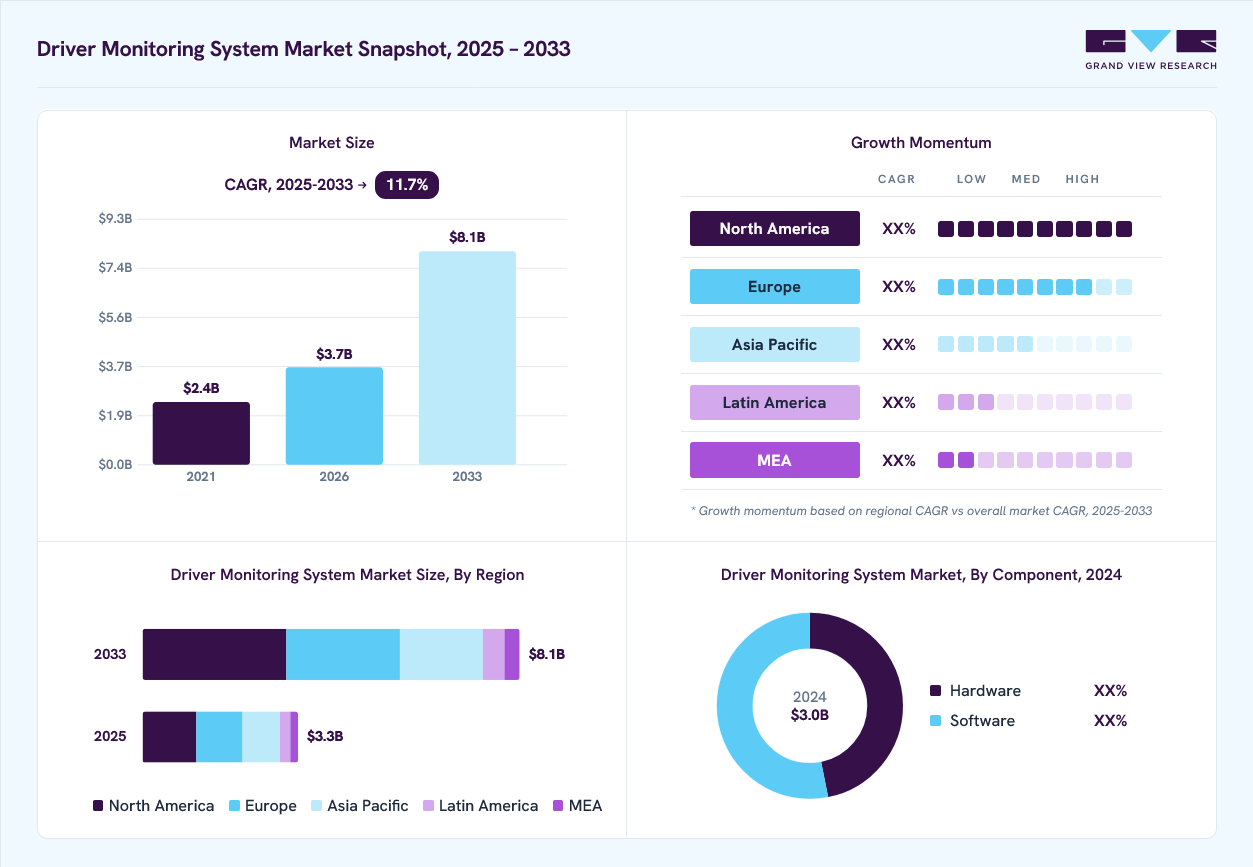 Source: Grand View Research, IR Documents, Primary Interviews, Paid DatabasesTo learn more about this report,
 Download Free Sample Report
 Key Market Trends & Insights
- The driver monitoring system industry in the U.S. held a dominant position in 2024.
- By component, the software segment accounted for the largest share of 53.2% in 2024.
- By technology, the camera-based DMS segment held the largest market share in 2024.
- By functionality, the driver state monitoring segment dominated the market in 2024.
Market Size & Forecast
- 2024 Market Size: USD 3.0 Billion
- 2033 Projected Market Size: USD 8.1 Billion
- CAGR (2025-2033): 11.7%
- North America: Largest market in 2024
Three ways to get this report
Buy it, customize it, or ask a question.Ask an Analyst
Analyst response in 1 business day
- AccessReport author, directly
- Reply timeWithin 1 working day
- No sales callDirect answer only
- FormatEmail reply
- CostFree, no cost
Get the Full Report
What the study covers
- FormatsPDF · Excel · Dashboard
- Timeline2025–2033 annual, 2024 base
- Coverage20+ countries, 5 regions
- Companies10+ key players profiled
Customize the Report
20% free customization
- IncludeCountries, segments, points
- TailorTo your product definition
- ExtendDeeper competitor detail
- OrA fully bespoke study
- Turnaround5–10 working days
The rising integration of DMS within advanced driver assistance systems (ADAS) across autonomy levels L1 to L3 is driving strong demand from OEMs, supporting safer and more automated driving experiences. Also, increasing consumer awareness around in-cabin safety and growing demand for personalized features in luxury and electric vehicles further accelerate market growth.Expansion into commercial fleets and public transit creates a major growth opportunity for players in the driver monitoring system (DMS) industry, driven by the need to enhance driver accountability, ensure passenger safety, and comply with fleet management regulations. However, high system costs, integration complexities, and concerns around data privacy and driver consent pose significant challenges that may hinder broader adoption, especially in cost-sensitive vehicle segments.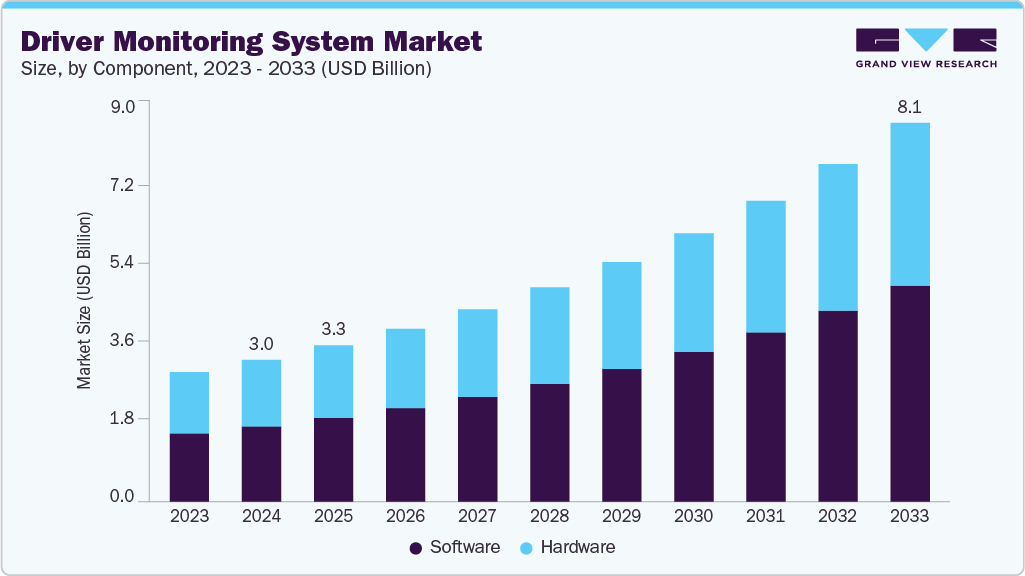 To learn more about this report, Download Free Sample Report
 Authorities in the EU, the U.S., and China have mandated DMS to reduce road accidents caused by drowsiness or distraction. In the EU, Regulation (EU) 2019/2144 requires all new vehicles of categories M and N to include advanced driver distraction warning (ADDW) systems from July 2026, capable of monitoring visual attention and issuing alerts when distraction is detected. In response, solution providers are accelerating product rollouts. For example, in February 2022, Cipia introduced its Driver Sense system, designed to track attention, drowsiness, and behaviors such as phone use or smoking. Aimed at both passenger and commercial fleets, it supports global regulatory compliance. These developments highlight how safety legislation is actively shaping DMS innovation and deployment.
As vehicles become increasingly semi-autonomous, ensuring continuous driver engagement and readiness becomes essential for safety compliance and accident prevention. DMS is being integrated into broader ADAS suites to deliver a holistic in-cabin safety ecosystem that includes lane-keeping, collision avoidance, and driver behavior analysis. For instance, in April 2023, AddSecure introduced an AI-powered video telematics solution that combines DMS and ADAS to monitor fatigue indicators such as yawning and head nodding, issuing real-time alerts to prevent drowsy driving incidents. The convergence of DMS with ADAS reflects an industry-wide trend toward system consolidation, where multi-function platforms enhance functionality, support regulatory standards, and reduce hardware redundancy in next-generation vehicles.
Expansion into commercial fleets and public transit represents a major growth opportunity in the driver monitoring system (DMS) market, as fleet operators seek to reduce liability, improve safety compliance, and meet regulatory mandates. DMS solutions provide real-time insights into driver behavior, enabling early detection of fatigue, distraction, or risky actions. These features are particularly critical in long-haul logistics and passenger transport operations, where driver attentiveness directly impacts operational safety and service reliability. For example, in March 2025, Mitsubishi Electric Automotive America partnered with Seeing Machines to promote the Guardian Generation 3 DMS across the Americas. The system targets commercial fleets, using AI-powered alerts and event-based video to detect distraction and drowsiness. Such integrations are gaining traction among fleet managers, who prioritize technologies that help prevent accidents, lower insurance costs, and ensure regulatory compliance across high-utilization vehicle networks.
Implementing advanced DMS solutions, especially those combining infrared cameras, AI processors, and real-time analytics, can add between USD 200 to USD 700 per vehicle, depending on system specifications and OEM customization requirements. These costs are compounded by the need for seamless integration into vehicle electronic architectures, infotainment platforms, and ADAS suites. Smaller automakers and fleet operators often face challenges related to calibration, software compatibility, and regulatory testing, which further increase deployment timelines and technical support needs. Also, Tier 1 suppliers must navigate hardware and software co-design complexities to meet Euro NCAP or GSR compliance. As a result, despite growing regulatory pressure, the high upfront investment and engineering overhead continue to slow DMS penetration in cost-sensitive markets.
Component Insights
The software segment accounted for the largest share of 53.2% in 2024, driven by rising demand for real-time in-cabin analytics, growing regulatory requirements for distraction detection, increasing software-defined vehicle architectures, and the scalability of AI-based driver monitoring platforms. Automakers and Tier 1 suppliers are prioritizing software-centric DMS to meet evolving safety mandates while enabling flexible over-the-air (OTA) updates and integration with cloud-based fleet management systems. For instance, in January 2025, Smart Eye partnered with risk analytics firm Greater Than to study the link between eye movements, distraction alerts, and crash risk. The collaboration leverages Smart Eye’s AIS DMS platform to collect behavioral data and enhance predictive safety algorithms for OEM and commercial fleet applications.This reinforces the growing importance of intelligent, software-based driver monitoring as a core enabler of vehicle safety, compliance, and predictive risk mitigation.
The hardware segment is expected to grow at the fastest CAGR from 2025 to 2033, driven by increasing demand for advanced image sensors, improvements in camera miniaturization, enhanced low-light performance, and rising adoption of NIR (near-infrared) technology in DMS applications. These advancements are critical for accurate and reliable driver monitoring under diverse lighting and environmental conditions. For instance, in April 2025, OMNIVISION introduced the OX01N1B image sensor designed specifically for in-cabin driver monitoring systems. The sensor offers high NIR quantum efficiency, low power consumption, and global shutter technology, enabling distortion-free imaging and superior performance in low-light scenarios.
Technology Insights
The camera-based DMS segment accounted for the largest share of the driver monitoring system industry in 2024, driven by advancements in computer vision technology, rising demand for non-intrusive monitoring solutions, increasing regulatory mandates globally, and enhanced AI capabilities for accurate real-time driver behavior analysis. These factors collectively fuel adoption as camera-based systems deliver detailed insights into driver attention, fatigue, and distraction without causing discomfort or requiring physical contact. Also, improvements in camera sensor quality and reductions in cost have made these systems more accessible for OEMs and aftermarket applications alike. The broad applicability across passenger and commercial vehicles also contributes to the segment’s strong growth.
The biometric DMS segment is expected to grow at a significant CAGR during the forecast period. Factors such as the increasing demand for enhanced driver identification and authentication, integration of biometric sensors such as fingerprint and facial recognition for personalized safety, rising focus on preventing unauthorized vehicle use, and advancements in AI-enabled biometric data processing support the segment growth.
Functionality Insights
The driver state monitoring segment accounted for the largest share of the driver monitoring system market in 2024, driven by increasing awareness of driver fatigue risks, stricter regulatory mandates on drowsiness detection, advancements in AI-powered sensor technologies, and a growing OEM focus on in-cabin safety features. According to the National Highway Traffic Safety Administration (NHTSA), vehicles traveling at 55 miles per hour can cover 100 yards during a driver's microsleep episode. Data from the Governors Highway Safety Association (GHSA) estimates that 10 to 20% of severe collisions result from driver drowsiness. For instance, in October 2024, Netradyne introduced an advanced DMS sensor capable of detecting both early and acute drowsiness stages in commercial drivers. The system uses AI-driven microbehavior analysis, such as blink rates and PERCLOS, and functions effectively in low light, offering real-time alerts and seamless Driver•i integration. This highlights the vital importance of driver state monitoring technology in improving commercial vehicle safety and reducing accident risks globally.
The driver identification & authentication segment is expected to register a notable CAGR from 2025 to 2033, driven by growing concerns over vehicle security, increasing adoption of biometric technologies such as facial recognition and fingerprint scanning, advancements in AI-enabled authentication methods, and rising demand for personalized in-cabin experiences. These factors are fueling the integration of secure and convenient driver verification systems in modern vehicles, helping prevent unauthorized use and enhancing overall safety.
Vehicle Type Insights
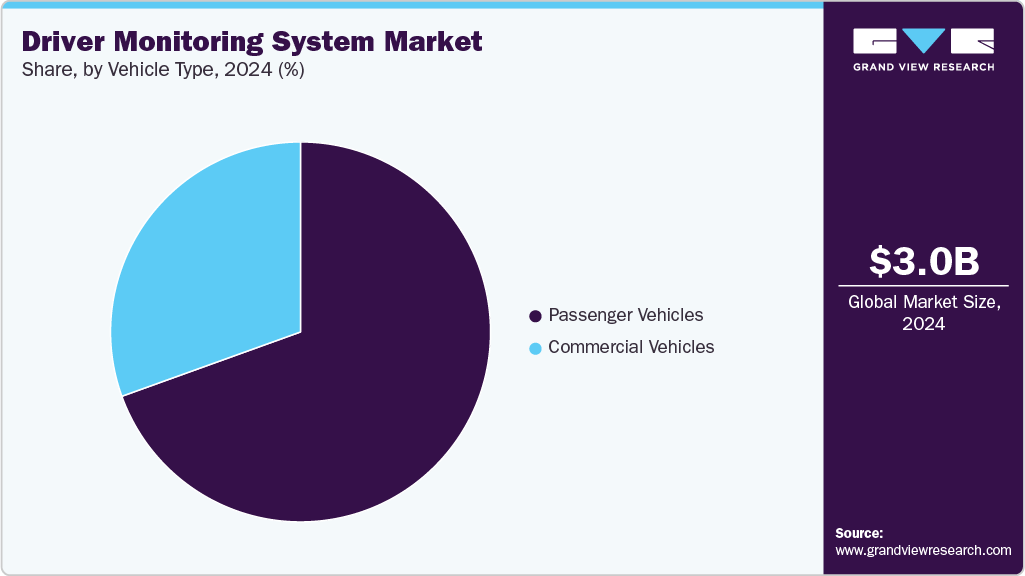
The passenger vehicles segment accounted for the largest share of the driver monitoring system industry in 2024, driven by increasing consumer demand for enhanced safety features, growing adoption of driver monitoring systems (DMS) in new vehicles, rising sales of electric and luxury passenger cars, and stringent regulatory mandates on vehicle safety. According to CEIC Data, the U.S. had approximately 283.2 million registered vehicles in 2022, with passenger car sales rising to 3.1 million units in December 2023, up from 2.86 million units in December 2022. This growth highlights the expanding market potential for advanced driver safety technologies within the passenger vehicle segment, reinforcing the critical role of DMS in enhancing road safety and compliance.
 To learn more about this report, Download Free Sample Report
 The commercial vehicles segment is expected to register a notable CAGR from 2025 to 2033, owing to its increasing focus on driver safety compliance, growing adoption of telematics and fleet management solutions, rising regulatory mandates for fatigue detection, and expanding demand for liability reduction in logistics and transportation industries. In February 2024, Rosmerta Technologies unveiled its AI-based driver monitoring and alert system at the Bharat Mobility Expo . Designed for fleet operators, the dual-camera DMS integrates IR blasters, GPS, and G-sensors to analyze driver behavior, detect violations, and enhance safety in non-ADAS commercial vehicles. Such development underscores the rising emphasis on safety and operational efficiency in commercial vehicle fleets, reinforcing the growth potential of DMS in this segment.
Regional Insights
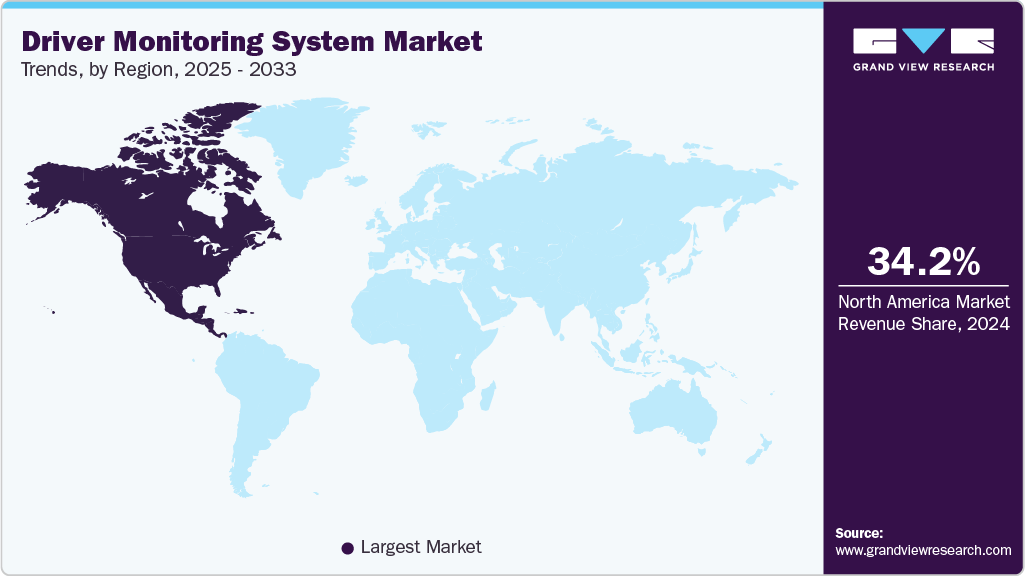
The North America driver monitoring systemmarket accounted for 34.2% of the global share in 2024, driven by increasing government regulations on driver safety, rising demand for advanced driver assistance systems (ADAS), growing investments in AI-powered fleet safety solutions, and expanding commercial vehicle fleets. Regulatory mandates, including the U.S. National Highway Traffic Safety Administration's focus on reducing driver distraction, have accelerated DMS adoption. Additionally, rising awareness about road safety and insurance benefits encourages fleet operators to implement DMS technologies. For instance, in December 2024, Roadzen Inc. partnered with Bosch to advance[ its AI-powered ADAS and DMS platform, drivebuddyAI. This collaboration integrates Roadzen’s AI expertise with Bosch’s automotive capabilities, expanding the platform’s reach and enhancing road safety for fleets and OEMs.
 To learn more about this report, Download Free Sample Report
 U.S. Driver Monitoring System Industry Trends
The U.S. driver monitoring system industry held a dominant position in 2024. The U.S. market is witnessing significant transformation, driven by increasing regulatory mandates, rising adoption of advanced safety technologies, growing focus on driver health and well-being, and strong investment by major automotive technology companies. The market is witnessing rapid innovation as OEMs and fleet operators prioritize reducing accidents caused by fatigue and distraction while enhancing overall in-cabin safety.
For instance, in January 2023 , Harman International, a Samsung subsidiary, enhanced its Ready Care driver-monitoring system by adding contactless measurement of heart rate, breathing rate, and interbeat levels. This upgrade uses in-cabin radar alongside infrared cameras to improve detection of driver well-being and child presence monitoring inside vehicles. Such advancement highlights the U.S. market’s commitment to integrating comprehensive safety and health monitoring features, reinforcing its leadership in the global driver monitoring system landscape.
The Canada driver monitoring system market is expected to grow, owing to the increasing government focus on road safety regulations, growing commercial vehicle fleets, and heightened consumer awareness of in-cabin safety features. The Canadian government has been actively promoting vehicle safety technologies to reduce road accidents, supporting the deployment of DMS across passenger and commercial vehicles. For example, Transport Canada has issued guidelines encouraging the integration of driver monitoring technologies in fleet vehicles to enhance safety compliance. This regulatory emphasis, combined with increasing insurance incentives, is accelerating market growth in the region.
The driver monitoring system market in Mexico is expected to grow, propelled by rapid urbanization and increasing traffic congestion, growing investments in smart city infrastructure, rising commercial vehicle modernization efforts, and emerging partnerships between local fleet operators and technology providers. Furthermore, Mexico’s increasing cross-border freight activities with the U.S. require enhanced driver safety compliance and monitoring.
Europe Driver Monitoring System Market Industry Trends
The Europe driver monitoring system industry was identified as a lucrative region in 2024. The market is witnessing significant transformation, driven by stringent regulatory mandates, increasing fleet safety initiatives, growing demand for AI-powered fatigue detection, and rising adoption of advanced camera-based monitoring technologies. These factors are accelerating market growth as governments and OEMs emphasize reducing road accidents and enhancing driver safety across the continent.
For instance, in October 2024, Smart Eye’s AIS CV Alert driver monitoring system achieved EU General Safety Regulation (GSR) homologation with Solaris buses. The AI-driven drowsiness detection system ensures regulatory compliance and advances road safety, marking Smart Eye’s second certification success in the European commercial vehicle sector. Also, in July 2024, Mitsubishi Motors Australia Limited enhanced the Driver Monitoring System in its All-New Triton pickup by reducing false alerts and improving sensitivity, thereby supporting the vehicle’s five-star ANCAP safety rating. These developments illustrate the region’s focus on regulatory adherence and technology refinement, reinforcing Europe’s position as a key growth market for driver monitoring systems.
The German driver monitoring system market is being shaped by increasing government regulations targeting road safety, growing investments in autonomous vehicle technologies, rising awareness of driver fatigue-related accidents, and expanding adoption of connected vehicle systems. The market growth is supported by regulations such as the German Road Traffic Act (StVO) updates and the implementation of EU Regulation 2019/2144 , which mandates advanced driver distraction warning systems in new vehicles.
The driver monitoring system market in the UK is influenced by stringent national safety regulations, increasing fleet safety programs in commercial transport, the growing integration of biometric authentication for vehicle access, and rising consumer preference for personalized in-cabin safety features. Market expansion is reinforced by the UK Department for Transport's initiatives on vehicle safety and compliance with UNECE Regulation 157 on driver monitoring systems for heavy vehicles.
Asia Pacific Driver Monitoring System Market Industry Trends
The Asia Pacific driver monitoring system industry was identified as a lucrative region in 2024. Factors such as the rapid automotive market expansion, rising regulatory mandates on vehicle safety, increasing adoption of advanced driver assistance technologies, and growing awareness of road accident prevention support market growth. The region’s growth is further supported by government policies such as China’s National New Energy Vehicle (NEV) mandate and India’s Motor Vehicles (Amendment) Act, which emphasize driver safety features.
Growing urbanization and expanding commercial vehicle fleets further fuel demand for real-time driver status solutions to enhance safety and reduce accidents. For instance, in May 2025, WPG Holdings’ subsidiary Youshang launched an automotive driver monitoring system solution leveraging the NXP i.MX 8M Plus processor and ON Semiconductor AR0144 image sensor. The solution enables real-time driver status detection and analysis, aiming to reduce fatigue and distracted driving risks.
The China driver monitoring system market held a substantial market share in 2024. The market is experiencing rapid growth, driven by increasing government regulations on vehicle safety, rising demand for commercial fleet monitoring, growing urban traffic challenges, and advancements in telematics technologies. The Chinese government’s stringent safety standards and smart city initiatives are accelerating the integration of advanced DMS solutions across passenger and commercial vehicles.
For instance, in April 2025, Queclink Wireless Solutions launched a compact window-mounted driver monitoring system camera, 50% smaller than its predecessor. Designed for discreet installation without impairing driver visibility, the device supports telematics-based safety by detecting risky behaviors like distraction and fatigue, delivering 720p HD real-time video.Such developments reflect China’s strong focus on enhancing road safety and leveraging compact, efficient technology solutions.
The driver monitoring system market in Japan held a significant share in 2024. According to the Ministry of Land, Infrastructure, Transport and Tourism (MLIT), Japan’s 11th Traffic Safety Basic Plan targets a reduction in annual traffic fatalities to 2,000 or fewer by 2025, down from 2,663 in 2024 and nearly one-sixth of the peak figure of 16,765. This strategic initiative reinforces the country’s push for enhanced road safety and accelerates the adoption of advanced in-cabin safety technologies. Under the Road Transport Vehicle Act, MLIT mandates the integration of driver assistance and monitoring systems in new vehicles, thereby supporting the widespread deployment of DMS across both passenger and commercial segments and contributing to Japan’s broader vision for connected and automated mobility.
Key Driver Monitoring System Company Insights
Some of the key players operating in the market include Valeo S.A., Denso Corporation, Bosch Mobility Solutions, and Seeing Machines Limited.
-
Founded in 1923 and headquartered in Paris, France, Valeo S.A. is a global automotive supplier specializing in driver monitoring systems and advanced mobility technologies. The company provides integrated hardware and software solutions for in-cabin monitoring, including cameras, ECUs, and AI-based algorithms. Its offerings support OEM compliance with global safety regulations and are used in passenger and commercial vehicles. Valeo operates a network of R&D centers and manufacturing sites across Europe, Asia, and the Americas, focusing on driver assistance, electrification, and vehicle automation.
-
Founded in 1949 and headquartered in Kariya, Japan, Denso Corporation is a prominent automotive components manufacturer and a major provider of driver monitoring system technologies. The company develops advanced in-cabin sensing systems that detect driver drowsiness, distraction, and health conditions, integrating them with ADAS platforms. Serving both global and domestic OEMs, Denso offers comprehensive hardware-software solutions tailored for passenger cars, trucks, and buses. It maintains a strong global presence with engineering centers and production plants across Japan, North America, Europe, and Asia.
Key Driver Monitoring System Companies:
The following are the leading companies in the driver monitoring system market. These companies collectively hold the largest market share and dictate industry trends.
- Valeo S.A.
- Denso Corporation
- Bosch Mobility Solutions (Robert Bosch GmbH)
- Seeing Machines Limited
- Continental AG
- Smart Eye AB
- Aptiv PLC
- Magna International Inc.
- Visteon Corporation
- Lytx Inc.
Recent Developments
-
In May 2025, Queclink Wireless Solutions launched a compact, window-mounted DMS camera for fleet vehicles. The 720p HD system monitors driver distraction behaviors such as smoking, phone use, and fatigue. With a rugged, discreet design, it enhances telematics-based safety and risk management for commercial fleets.
-
In April 2025, Seeing Machines partnered with Airy3D to launch 3D camera technology for in-cabin DMS. Integrating DepthIQ, the system captures 3D range data with 5MP RGB and IR images using a single sensor, enabling high-precision eye-tracking and advancing trust in vision-based cabin monitoring for safety integration.
-
In March 2025, Cipia collaborated with Arm to showcase its AI-powered Driver Sense Monitoring System running efficiently on Arm Cortex CPUs. The solution delivers high accuracy in detecting driver drowsiness and distraction while optimizing power consumption, enabling automakers to meet regulatory safety standards cost-effectively without additional hardware.
-
In January 2025, Novus Hi-Tech, in partnership with Eicher Trucks, launched an AI-powered driver monitoring system for mining trucks at the Bharat Mobility Global Expo. The DGMS-compliant solution tracks fatigue and distractions, enhancing safety and operational efficiency in commercial mining fleets.
-
In June 2023, Smart Eye introduced a new driver monitoring system metric at InCabin Brussels, enabling remote monitoring of heart and respiration rates. This AI-powered feature enhances the detection of sudden illnesses, improving driver safety and facilitating quicker emergency responses.
Driver Monitoring System Market Report Scope
Report Attribute
Details
Market size in 2024
USD 3.0 billion
Estimated Market size in 2026
USD 3.7 billion
Projected Market size by 2033
USD 8.1 billion
Growth rate
CAGR of 11.7% from 2025 to 2033
Base year for estimation
2024
Historical data
2020 - 2023
Forecast period
2025 - 2033
Quantitative units
Revenue in USD million/billion and CAGR from 2025 to 2033
Report coverage
Revenue forecast, company market share, competitive landscape, growth factors, and trends
Segments covered
Component, technology, functionality, vehicle type, and region
Regional scope
North America; Europe; Asia Pacific; Latin America; MEA
Country scope
U.S,; Canada; Mexico; UK; Germany; France; China; India; Japan; Australia; South Korea; Brazil; UAE; Kingdom of Saudi Arabia (KSA); South Africa
Key companies profiled
Valeo S.A.; Denso Corporation; Bosch Mobility Solutions; Seeing Machines Limited; Continental AG; Smart Eye AB; Aptiv PLC; Magna International Inc.; Visteon Corporation; Lytx Inc.
Customization scope
Free report customization (equivalent up to 8 analysts working days) with purchase. Addition or alteration to country, regional & segment scope.
Pricing and purchase options
Avail customized purchase options to meet your exact research needs. Explore purchase options
Global Driver Monitoring System Market Report Segmentation
This report forecasts revenue growth at the global, regional, and country levels and provides an analysis of the latest industry trends in each of the sub-segments from 2021 to 2033. For this study, Grand View Research has segmented the global driver monitoring system market report based on component, technology, functionality, vehicle type, and region:
-
Component Outlook (Revenue, USD Million, 2021- 2033)
-
Hardware
-
Software
-
-
Technology Outlook (Revenue, USD Million, 2021- 2033)
-
Camera-based DMS
-
Infrared LED-based DMS
-
Steering Angle Sensor-based DMS
-
Biometric DMS
-
-
Functionality Outlook (Revenue, USD Million, 2021- 2033)
-
Driver State Monitoring
-
Driver Identification & Authentication
-
Occupant Monitoring System (OMS)
-
Driver Behavior Analysis
-
-
Vehicle Type Outlook (Revenue, USD Million, 2021- 2033)
-
Passenger Vehicles
-
Commercial Vehicles
-
-
Regional Outlook (Revenue, USD Million, 2021- 2033)
-
North America
-
U.S.
-
Canada
-
Mexico
-
-
Europe
-
UK
-
Germany
-
France
-
-
Asia Pacific
-
China
-
India
-
Japan
-
Australia
-
South Korea
-
-
Latin America
-
Brazil
-
-
Middle East & Africa (MEA)
-
UAE
-
Kingdom of Saudi Arabia (KSA)
-
South Africa
-
-
Frequently Asked Questions About This Report
The global driver monitoring system market size was estimated at USD 3.03 billion in 2024 and is expected to reach USD 8.10 billion in 2033.
The global driver monitoring system market is expected to grow at a compound annual growth rate of 11.7% from 2025 to 2033 to reach USD 8.10 billion by 2033.
The North America driver monitoring system market accounted for 34.2% of the global share in 2024, driven by increasing government regulations on driver safety, rising demand for advanced driver assistance systems (ADAS), growing investments in AI-powered fleet safety solutions, and expanding commercial vehicle fleets.
Some key players operating in the driver monitoring system market include Valeo S.A., Denso Corporation, Bosch Mobility Solutions, Seeing Machines Limited, Continental AG, Smart Eye AB, Aptiv PLC, Magna International Inc., Visteon Corporation, Lytx Inc.
Key factors that are driving the market growth include stringent regulatory mandates from governments across the globe requiring DMS installation in new vehicles. The rising integration of DMS within advanced driver assistance systems (ADAS) across autonomy levels L1 to L3 is driving strong demand from OEMs, supporting safer and more automated driving experiences.
About the Author(s)
Automotive & Transportation Research Team
Technology · Automotive & TransportationThis report was authored by the automotive & transportation research team at Grand View Research - comprising two research analysts, one senior research analyst, and one industry expert - with specialized expertise in the automotive & transportation segment of the technology industry. All findings are based on proprietary technology databases, executive interviews, and regulatory analysis, subject to internal peer review prior to publication.
Last Updated:
Speak to Analyst

Customize this report to your needs - add regions, segments, or data points, with 20% free customization.
Or view our licence options:


ISO 9001:2015 & 27001:2022 Certified
We are GDPR and CCPA compliant! Your transaction & personal information is safe and secure. For more details, please read our privacy policy.


