
- Home
- »
- Advanced Interior Materials
- »
-
Dry Cooler Market Size, Share & Trends Report, 2026-2033GVR Report cover
![Dry Cooler Market (2026 - 2033)Report]()
Dry Cooler Market (2026 - 2033)
Size, Share & Trends Analysis Report By Technology (Standard Dry Coolers, Adiabatic Dry Coolers), By Product (V-Type Dry Coolers, Vertical Dry Coolers), By End-use (Data Centers, Food & Beverage), By Region, And Segment Forecasts
Market Size, 2025
$3.4BMarket Estimate, 2026
$3.6BMarket Forecast, 2033
$6.0BCAGR, 2026–2033
7.6%Dry Cooler Market Summary
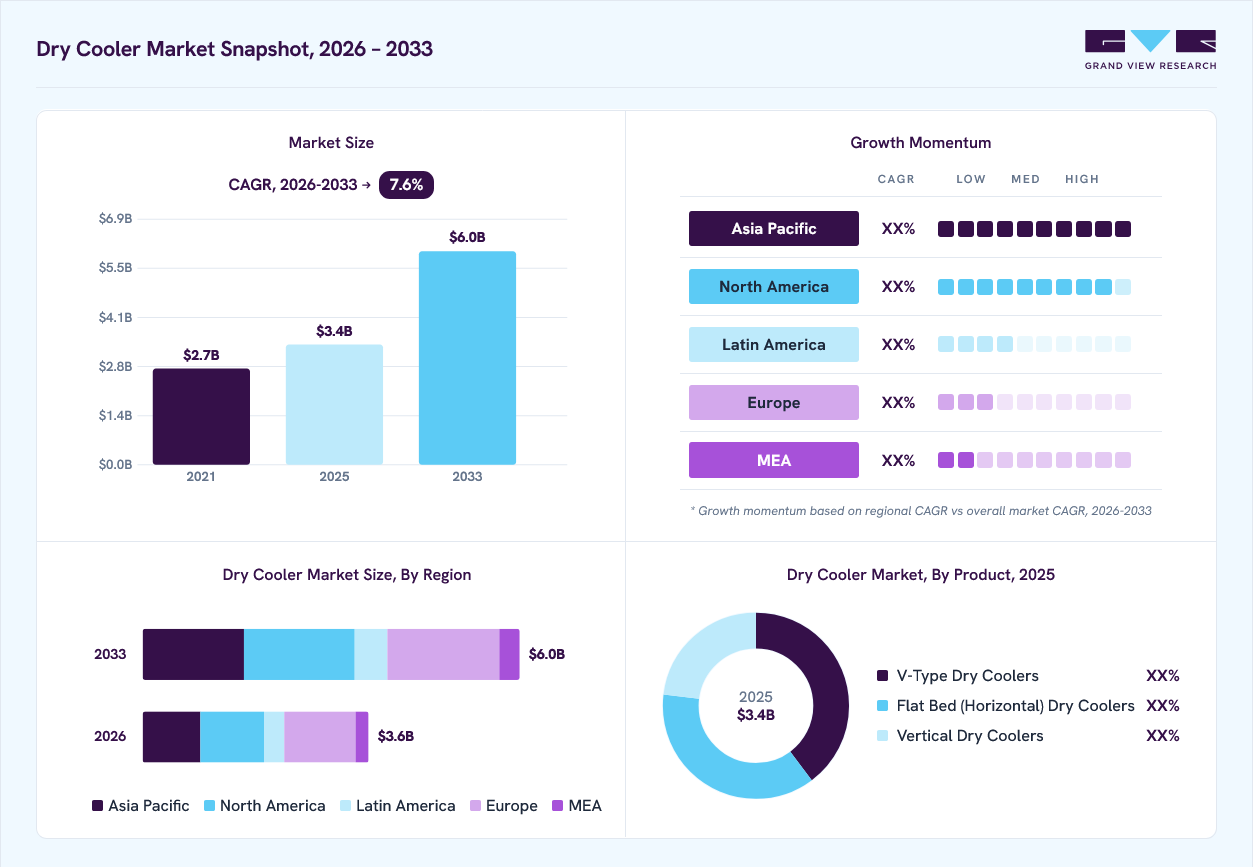
The global dry cooler market size was valued at USD 3.4 billion in 2025 and is projected to grow from USD 3.6 billion in 2026 to USD 6.0 billion by 2033, at a CAGR of 7.6% from 2026 to 2033. Europe dominated the market, accounting for the largest revenue share of 31.8% in 2025. The market is driven by growing water scarcity and increasing efforts to reduce water consumption across industrial and commercial operations.
Key Market Trends & Insights
- By technology: The standard dry coolers segment held the largest revenue share of 65.5% in 2025.
- By product: The V-type dry coolers segment dominated the market with revenue share of 39.7% in 2025.
- By end-use: The data centers segment held a growing revenue share of 18.1% in 2025.
Regional Highlights
- Largest regional market: Europe (31.8% revenue share, 2025)
- Fastest-growing regional market: Asia Pacific (highest CAGR, 2026-2033)
- By country: Germany held the largest market share in 2025.
Market Size & Forecast
- Market Size in 2025: USD 3.4 Billion
- Estimated Market Size in 2026: USD 3.6 Billion
- Projected Market Size by 2033: USD 6.0 Billion
- CAGR (2026-2033): 7.6%
Dry coolers use ambient air to dissipate heat without relying on evaporative water consumption, making them suitable for facilities operating in water-stressed regions. Stricter water management policies and sustainability targets are encouraging industries to adopt closed-loop cooling systems that can reduce freshwater dependence while maintaining reliable thermal performance.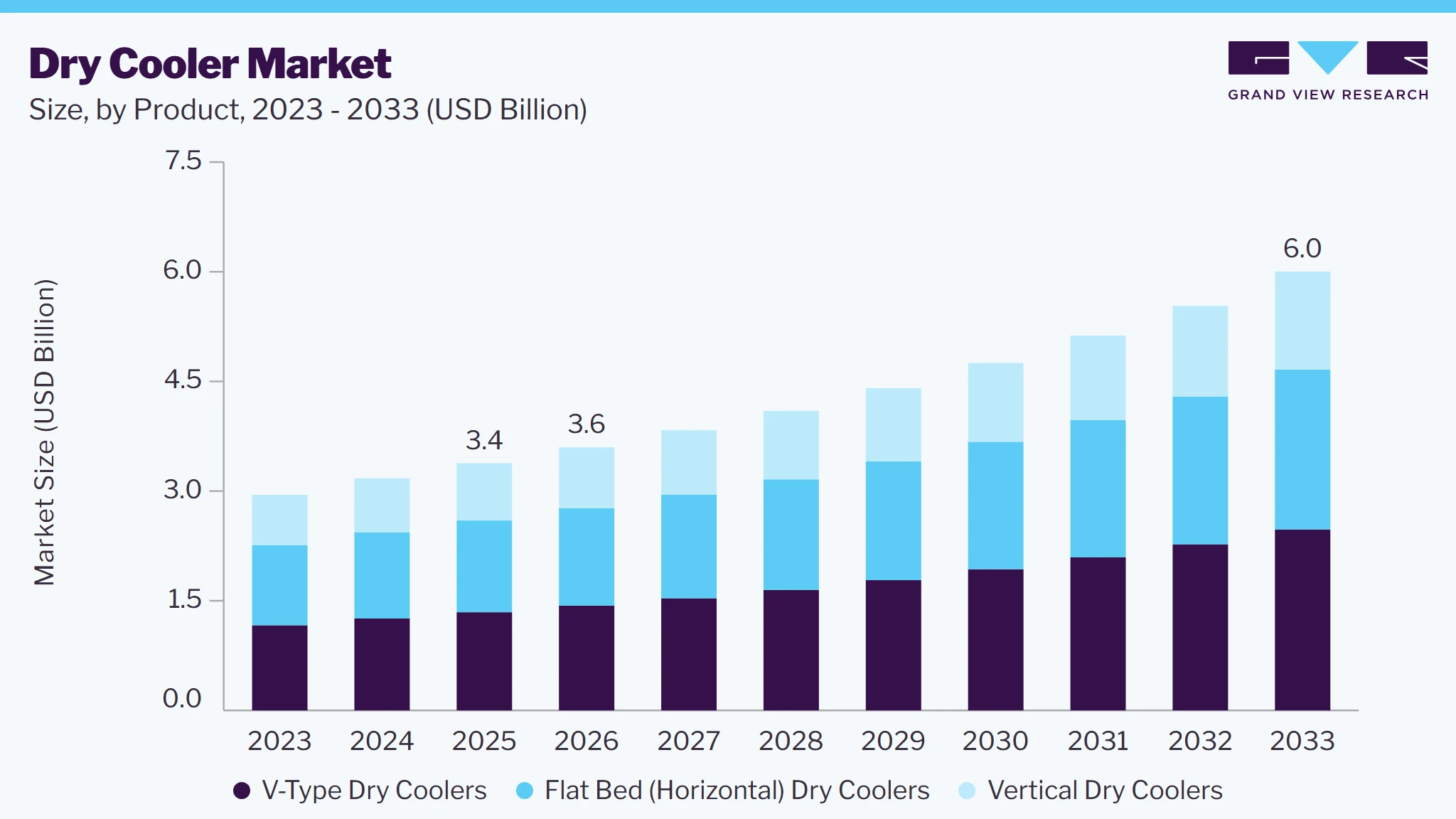
In addition, the expansion of data centers, high-density computing, power generation, and industrial processing is creating new demand for efficient heat-rejection equipment. The rapid development of AI and cloud infrastructure is increasing cooling requirements, while operators are placing greater emphasis on water-efficient and energy-conscious thermal management. Advances in EC fans, heat exchanger designs, and intelligent controls are further improving dry cooler efficiency and enabling their deployment across data centers, HVAC systems, power plants, petrochemical facilities, and manufacturing operations.
Market Dynamics
The global dry coolers market is shaped by increasing demand for heat rejection systems that minimize water consumption while maintaining reliable thermal management across industrial and commercial facilities. Dry coolers are gaining importance in applications where water availability, water treatment costs, and environmental regulations influence cooling-system selection. Market participants are focusing on higher-efficiency heat exchangers, variable-speed fans, optimized airflow designs, and compact configurations to improve thermal performance while reducing operating costs. Demand is also expanding across data centers, power generation, food and beverage processing, chemical manufacturing, and other industrial facilities that require dependable cooling without continuous water use.
Increasing pressure to conserve water is driving the adoption of dry coolers in regions facing water scarcity, high water-treatment costs, or restrictions on industrial water consumption. Unlike evaporative cooling systems, dry coolers transfer heat to ambient air without relying on continuous water evaporation, making them suitable for facilities seeking to reduce freshwater requirements and associated treatment and disposal costs. Growing investment in data centers, power infrastructure, manufacturing facilities, and process industries is creating additional demand for air-cooled heat rejection systems that can provide reliable cooling with limited water dependence.
Dry cooler performance is closely linked to ambient air temperature, which can limit heat rejection efficiency during periods of extreme heat. Higher outdoor temperatures reduce the temperature difference available for transferring heat from the circulating fluid to the surrounding air, potentially requiring larger heat exchanger surfaces, increased airflow, or supplementary cooling systems. These requirements can raise equipment size, energy consumption, and installation costs, particularly for facilities operating in hot climates with high and continuous cooling loads.
Advances in heat exchanger design, fan technology, controls, and system monitoring are creating opportunities for higher-performance dry coolers. Manufacturers are developing microchannel and enhanced-fin heat exchangers, electronically commutated fans, variable-speed drives, and intelligent control systems that adjust cooling output according to load and ambient conditions. Hybrid cooling configurations that combine dry cooling with limited evaporative or adiabatic assistance also offer opportunities to maintain performance during peak-temperature conditions while reducing overall water consumption.
Market Concentration & Characteristics
The global dry cooler market is moderately concentrated, with a group of established manufacturers holding a substantial share while specialized and regional suppliers serve specific customer requirements. Competitive intensity is shaped by manufacturing scale, engineering capabilities, product reliability, and the ability to meet customized thermal specifications. High technical expertise, capital requirements, established customer relationships, and project execution experience create meaningful barriers to entry.
The market is characterized by strong technological competition, particularly in heat exchanger design, fan efficiency, airflow management, noise reduction, and automated control systems. Manufacturers are also developing compact and modular configurations to address space constraints and varying capacity requirements across data centers, industrial facilities, HVAC installations, power plants, and process industries. Product differentiation therefore extends beyond equipment capacity to include operating efficiency, maintenance requirements, lifecycle performance, and integration with facility control systems.
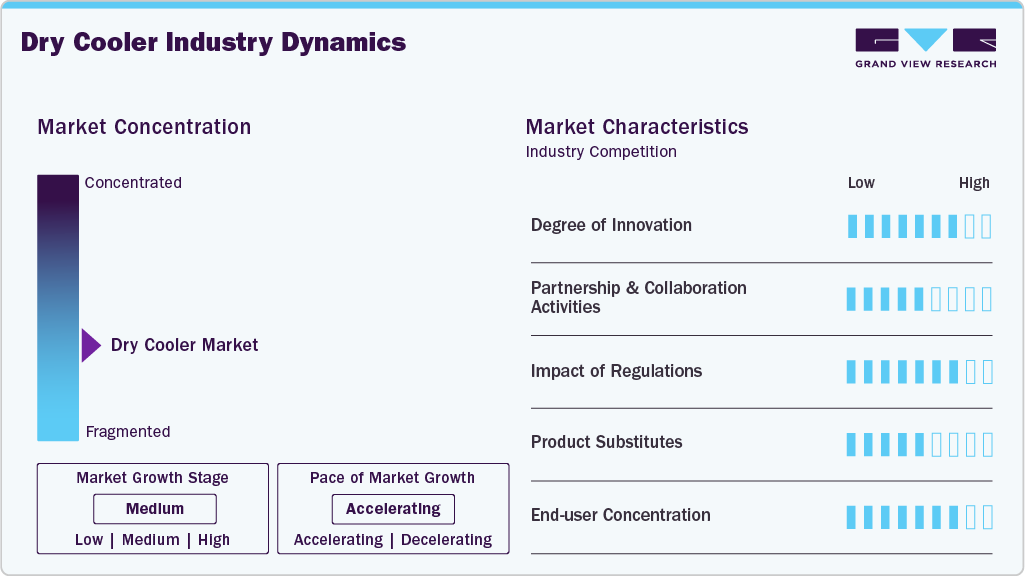
The market also faces competition from evaporative cooling systems, air-cooled condensers, and hybrid cooling technologies, with product selection depending on operating conditions, water availability, cooling requirements, and total system economics. Strategic partnerships, acquisitions, product portfolio expansion, and technological development remain important competitive strategies among larger participants. Manufacturers with established distribution networks, engineering capabilities, and after-sales services are positioned to strengthen customer retention and compete effectively across diverse applications.
Analyst Perspective
The global dry cooler market is positioned for sustained expansion as industries prioritize water conservation, energy efficiency, and reliable heat rejection across data centers, power generation, HVAC, and industrial processing applications. Data center development is emerging as a particularly important demand avenue, with AI-driven infrastructure expansion increasing cooling requirements while water stress is encouraging operators to consider air-based and dry cooling configurations. Dry coolers also offer advantages in regions facing water constraints because they can reject heat with minimal or no water consumption, although their energy performance remains dependent on ambient conditions, system configuration, and fan efficiency.
Technology Insights
The standard dry coolers segment held the largest revenue share of 65.5% in 2025, reflecting their established use across industrial, commercial, power generation, and process cooling applications. Their straightforward operating configuration, broad applicability, and ability to provide dependable heat rejection without continuous water consumption support their widespread deployment across facilities with diverse cooling requirements.
The adiabatic dry coolers segment is projected to register the fastest CAGR during the forecast period, supported by their ability to improve heat rejection performance under high ambient temperature conditions. By combining dry cooling with controlled adiabatic assistance, these systems can deliver enhanced thermal performance while limiting water consumption compared with conventional evaporative cooling technologies, making them increasingly attractive for water-sensitive and high-load applications.
Product Insights
The V-type dry coolers segment dominated the market in 2025, holding the largest revenue share of 39.7% among product configurations. Their compact arrangement and efficient use of heat exchanger surface area make them suitable for installations where cooling capacity, footprint, and airflow management need to be balanced. This configuration is widely applicable across industrial and commercial facilities with varying heat rejection requirements.
The flat bed (Horizontal) dry coolers segment is growing at a CAGR of 7.3% during the forecast period. Their horizontal configuration provides flexibility for installations with specific space, airflow, or equipment-layout requirements, supporting adoption across applications where system integration and accessible equipment placement are important considerations.
End-use Insights
The data centers segment led the global dry cooler market in 2025, accounting for 18.1% of total revenue, driven by the expansion of hyperscale and colocation facilities and the increasing cooling requirements of high-density computing infrastructure. Dry coolers are increasingly used in data centers as they enable efficient heat rejection with limited water consumption, while their compatibility with free-cooling and low-maintenance cooling configurations supports their adoption in large-scale facilities.
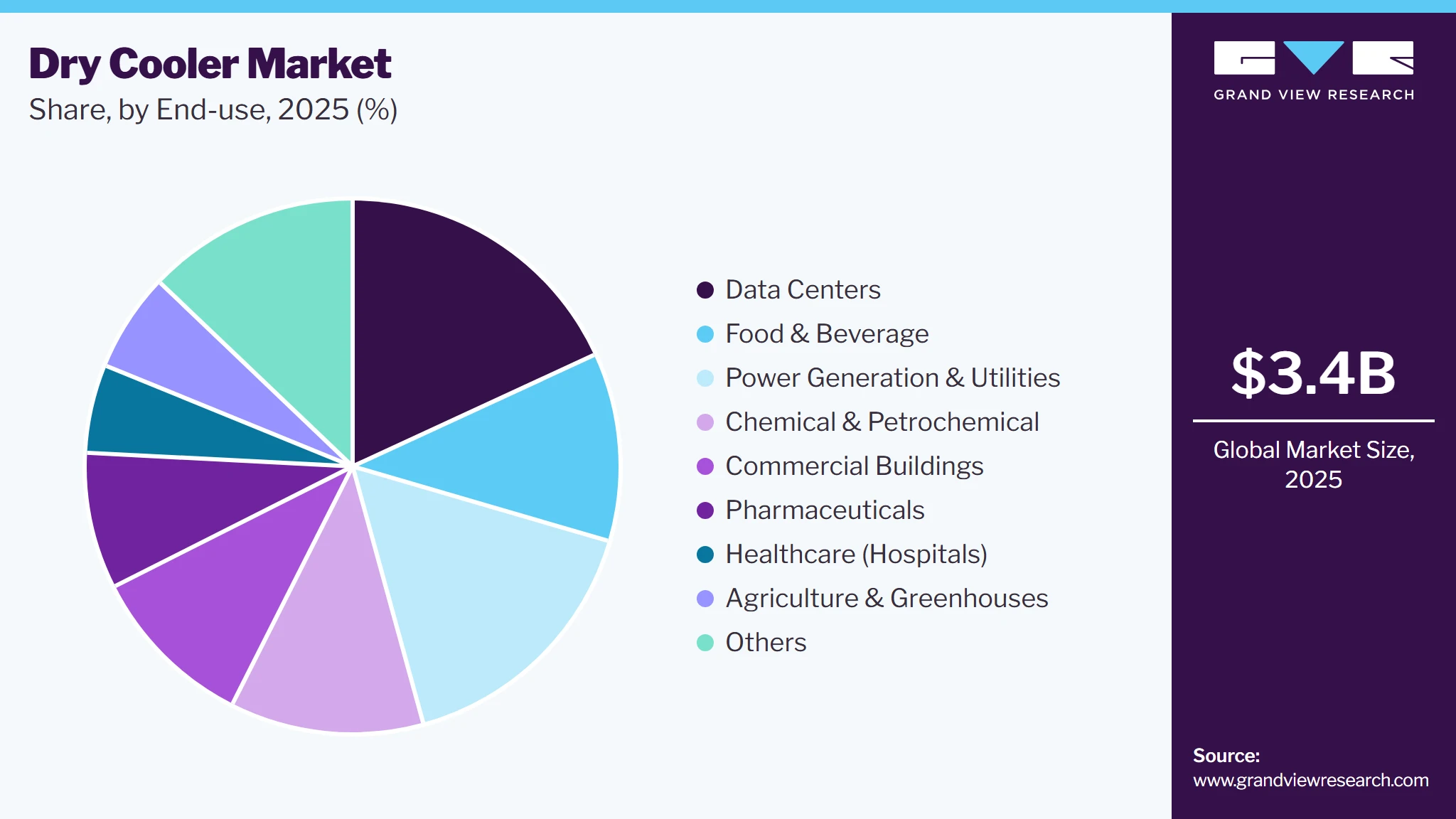
The power generation & utilities segment represents a significant end-use application and is projected to expand at a CAGR of 7.8% over the forecast period, driven by the need for reliable heat rejection in power plants, district energy systems, and utility-scale infrastructure. Growing investments in renewable power generation, battery energy storage, distributed generation, and modernization of existing utility infrastructure are expected to support demand for dry coolers as they provide reliable heat rejection in power plants, district energy systems, and utility-scale infrastructure.
Regional Insights
Europe dry cooler market held the largest revenue share of 31.8% in 2025, which represents a mature market for dry coolers, characterized by established industrial infrastructure, stringent environmental requirements, and growing attention to energy and water efficiency. Demand spans data centers, district energy, manufacturing, food processing, refrigeration, and commercial HVAC applications, with system selection increasingly influenced by lifecycle operating costs and environmental performance.

Germany Dry Cooler Market Trends
Germany dry cooler market is a prominent European market for dry coolers, supported by its strong manufacturing sector, engineering-intensive industries, data center development, and advanced HVAC infrastructure. Industrial operators are incorporating air-cooled heat rejection systems into production facilities and process applications where reliable temperature control and efficient resource utilization are important.
Dry cooler market in France offers substantial opportunities for dry cooler adoption across commercial buildings, data centers, industrial facilities, food processing, refrigeration, and energy-related applications. Increasing attention to energy consumption and water management is encouraging facility owners to consider air-cooled heat rejection solutions for new installations and system upgrades.
Asia Pacific Dry Cooler Market Trends
Asia Pacific is emerging as a fastest growing region for the global dry cooler market, driven by expanding data center capacity, industrial development, power generation projects, and increasing demand for water-efficient heat rejection systems. Rapid urbanization and the construction of large commercial and industrial facilities are creating opportunities for air-cooled heat dissipation technologies, particularly in locations where water availability and operating costs influence cooling-system selection.
Dry cooler market in China represents a substantial market for dry coolers, supported by its large industrial base, extensive manufacturing capacity, and continued development of data centers, power infrastructure, and commercial facilities. Demand is particularly relevant in industrial processing, electronics manufacturing, HVAC, and energy applications where operators seek alternatives to water-intensive cooling systems. Domestic manufacturing capabilities for heat exchangers, fans, and related thermal-management components also support the availability of competitively priced dry cooling equipment and facilitate its integration into large-scale projects.
India dry cooler market is gaining importance in the as investment in data centers, manufacturing facilities, commercial buildings, pharmaceuticals, food processing, and power infrastructure expands. Water conservation considerations are encouraging facility developers and industrial operators to evaluate air-cooled systems for applications where dependable heat rejection is required with limited water consumption.
North America Dry Cooler Market Trends
North America maintains a strong position in the global dry cooler market, supported by extensive data center development, industrial production, power generation, commercial HVAC installations, and growing emphasis on water-efficient cooling technologies. Facility operators are increasingly evaluating dry cooling configurations for applications where water availability, operating costs, and environmental considerations influence cooling-system design.
The U.S. represents the largest market in North America, with demand concentrated across data centers, power generation, manufacturing, commercial buildings, and process industries. Rapid expansion of digital infrastructure is creating substantial requirements for reliable heat rejection systems, particularly in regions where data center operators are seeking to manage water consumption alongside growing cooling loads.
Dry cooler market in Canada is experiencing continued demand for dry cooling systems across data centers, power generation, manufacturing, commercial facilities, and industrial applications. The country's diverse climatic conditions create opportunities for air-cooled systems that can operate effectively across seasonal temperature variations, while the availability of lower ambient temperatures in several regions can improve the efficiency of dry heat rejection.
Middle East & Africa Dry Cooler Market Trends
The Middle East & Africa market is gaining traction as investments in data centers, power generation, industrial facilities, commercial developments, and large-scale infrastructure projects increase. High ambient temperatures and water scarcity in several markets make water-efficient heat rejection technologies relevant for facilities with substantial cooling requirements.
Dry cooler market in Saudi Arabia represents a significant market for dry coolers in the Middle East & Africa region, supported by investments in data centers, tourism infrastructure, industrial facilities, power projects, and large-scale urban developments. Persistent water constraints and high ambient temperatures are strengthening the relevance of air-cooled thermal-management systems for applications requiring dependable heat rejection.
Latin America Dry Cooler Market Trends
Latin America is developing as an attractive market for dry coolers, supported by investment in industrial facilities, data centers, food and beverage processing, power infrastructure, commercial construction, and refrigeration. Cooling system selection is increasingly influenced by water availability, operating costs, and the need for dependable performance in warm climatic conditions.
Dry cooler market in Brazil represents the largest market for dry coolers in Latin America, supported by its diversified industrial base, expanding data center infrastructure, food and beverage production, commercial development, and power sector. The country's varied climatic conditions and water-resource considerations create opportunities for air-cooled heat rejection systems across industrial and commercial applications.
Key Dry Cooler Company Insights
Some of the key players operating in the market include Dry Coolers Inc., Baltimore Aircoil Company, Inc., among others.
-
Dry Coolers, Inc. is a U.S.-based manufacturer of industrial cooling systems, specializing in engineered fluid cooling solutions. The company designs and manufactures dry coolers, air-cooled heat exchangers, evaporative cooling systems, pump stations, and integrated process cooling systems. Its product portfolio includes V-bank dry coolers and hybrid cooling systems, with solutions ranging from standardized equipment to customized plant-wide cooling systems. The company serves industries including automotive, aerospace, energy, agriculture, metal treating, and data centers.
-
Baltimore Aircoil Company, Inc. (BAC) is a global manufacturer of heat-transfer and cooling equipment with a broad portfolio of dry, adiabatic, evaporative, and hybrid cooling solutions. The company offers the TrilliumSeries Dry Cooler, designed for high-capacity heat rejection with a compact footprint and dry operation. BAC serves data centers, industrial facilities, power and process industries, refrigeration, and commercial applications, with a focus on energy efficiency, water conservation, and reliable cooling performance.
Key Dry Cooler Companies:
The following key companies have been profiled for this study on the dry cooler market.
-
Dry Coolers, Inc.
-
Baltimore Aircoil Company, Inc.
-
Evapco Inc.
-
SPG Dry Cooling
-
MITA Cooling Technologies S.r.l.
-
Colmac Coil Manufacturing, Inc.
-
Güntner GmbH & Co. KG
-
Modine Manufacturing Company
-
SPX Cooling Tech, LLC
-
ALFA LAVAL
-
Kelvion Holding GmbH
-
ThermoKey S.p.A.
-
Frigel Firenze S.p.A.
-
LU-VE Group
-
Refteco S.r.l.
Competitive Benchmarking
Category
Operating Strategies
Competitive Edge
Weakness
Established Players (e.g., Dry Coolers, Inc.; Baltimore Aircoil Company, Inc.; EVAPCO Inc.; SPG Dry Cooling; MITA Cooling Technologies S.r.l.; Güntner GmbH & Co. KG; Modine Manufacturing Company; SPX Cooling Tech, LLC; ALFA LAVAL)
- Expand standard, adiabatic, and customized dry cooling portfolios across data centers, industrial, power, HVAC, and process applications.
- Strengthen manufacturing capacity, distribution networks, strategic partnerships, and application-specific engineering capabilities.
- Strong brand recognition, broad product portfolios, established customer networks, and extensive manufacturing and distribution infrastructure.
- Proven ability to execute large-scale and technically complex cooling projects across multiple regions and industries.
- High R&D, manufacturing, and engineering costs can increase operating expenses.
- Exposure to capital investment cycles in industrial, infrastructure, commercial, and data center projects can affect order volumes.
Emerging & Regional Players (e.g., Colmac Coil Manufacturing, Inc.; Kelvion Holding GmbH; ThermoKey S.p.A.; Frigel Firenze S.p.A.; LU-VE Group; Refteco S.r.l.))
- Focus on customized dry coolers, air-cooled heat exchangers, energy-efficient systems, and application-specific cooling configurations.
- Expand market access through regional distributors, engineering partnerships, and targeted industrial and commercial projects.
- Strong customization capabilities, specialized heat-transfer expertise, flexible engineering, and responsiveness to customer-specific requirements.
- Ability to address niche applications and regional demand with tailored cooling configurations.
- More limited geographic coverage and manufacturing scale than some multinational competitors.
- Lower brand visibility and smaller project portfolios may restrict access to certain large multinational or utility-scale contracts.
Recent Developments
-
In April 2026, SPX Cooling Tech launched the Marley OlympusMAX Fluid Cooler for data centers, industrial plants, and other high-density cooling applications. The product combines dry and adiabatic cooling configurations, providing flexibility for different operating requirements
-
In March 2026, Vertiv announced acquisition of ThermoKey which will expand its thermal management portfolio through ThermoKey’s dry coolers and microchannel heat-exchange technologies. These products complement Vertiv’s existing thermal solutions and provide customers with greater flexibility in selecting cooling systems based on performance requirements, site conditions, and future capacity needs, supporting demand for dry cooling applications
Dry Cooler Market Report Scope
Report Attribute
Details
Market size in 2025
USD 3.4 billion
Estimated market size in 2026
USD 3.6 billion
Projected market size by 2033
USD 6.0 billion
Growth rate
CAGR of 7.6% from 2026 to 2033
Base year for estimation
2025
Historical data
2021 - 2024
Forecast period
2026 - 2033
Quantitative units
Revenue in USD billion and CAGR from 2026 to 2033
Report coverage
Revenue forecast, company market position analysis, competitive landscape, growth factors, and trends
Segments covered
Technology, product, end-use, region
Regional scope
North America; Europe; Asia Pacific; Latin America; and Middle East & Africa
Country Scope
U.S.; Canada; Mexico; Germany; UK; Italy; Spain; France; China; Japan; India; Australia; South Korea; Brazil; Argentina; Saudi Arabia; UAE; South Africa
Key companies profiled
Dry Coolers, Inc.; Baltimore Aircoil Company, Inc.; Evapco Inc.; SPG Dry Cooling; MITA Cooling Technologies S.r.l.; Colmac Coil Manufacturing, Inc.; Güntner GmbH & Co. KG; Modine Manufacturing Company; SPX Cooling Tech, LLC; ALFA LAVAL; Kelvion Holding GmbH; ThermoKey S.p.A.; Frigel Firenze S.p.A.; LU-VE Group; Refteco S.r.l.
Customization scope
Free report customization (equivalent up to 8 analysts working days) with purchase. Addition or alteration to country, regional & segment scope.
Pricing and purchase options
Avail customized purchase options to meet your exact research needs. Explore purchase options
Global Dry Cooler Market Report Segmentation
This report forecasts revenue growth at global, regional & country levels and provides an analysis on the industry trends in each of the sub-segments from 2021 to 2033. For this study, Grand View Research has segmented the dry cooler market based on technology, product, end-use, and region:
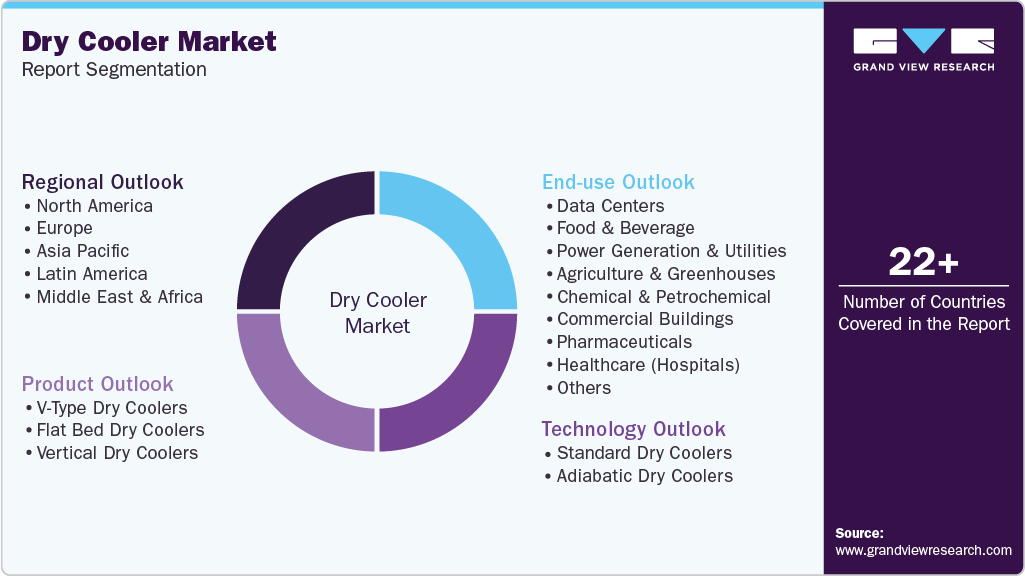
-
Technology Outlook (Revenue, USD Billion, 2021 - 2033)
-
Standard Dry Coolers
-
Adiabatic Dry Coolers
-
-
Product Outlook (Revenue, USD Billion, 2021 - 2033)
-
V-Type Dry Coolers
-
Vertical Dry Coolers
-
Flat Bed (Horizontal) Dry Coolers
-
-
End-use Outlook (Revenue, USD Billion, 2021 - 2033)
-
Data Centers
-
Food & Beverage
-
Power Generation & Utilities
-
Agriculture & Greenhouses
-
Chemical & Petrochemical
-
Commercial Buildings
-
Pharmaceuticals
-
Healthcare (Hospitals)
-
Others
-
-
Regional Outlook (Revenue, USD Billion, 2021 - 2033)
-
North America
-
U.S.
-
Canada
-
Mexico
-
-
Europe
-
Germany
-
France
-
UK
-
Spain
-
Italy
-
-
Asia Pacific
-
China
-
India
-
Japan
-
South Korea
-
Australia
-
-
Latin America
-
Brazil
-
Argentina
-
-
Middle East & Africa
-
Saudi Arabia
-
UAE
-
South Africa
-
-
Research Methodology
The dry cooler market figures in this report are based on a proven research process that combines executive interviews with secondary research from proprietary databases, company filings, and recognized regulatory and institutional sources. Market size is built through value-chain sizing-reconciling supply-side and demand-side estimates-and triangulated with bottom-up and top-down approaches. Every estimate passes multiple levels of expert validation before publication, with each dry cooler segment quantified using the revenue-capture definitions in the table below.
Segment Definition
Technology
Revenue Capture Definition
Standard Dry Coolers
Revenue is generated from the sale of conventional dry coolers that dissipate heat through ambient air without evaporative water consumption. Revenue includes equipment sales across industrial, commercial, power, refrigeration, and other cooling applications.
Adiabatic Dry Coolers
Revenue is generated from the sale of dry coolers equipped with adiabatic pre-cooling systems that lower incoming air temperature to improve heat rejection efficiency. Revenue includes equipment and integrated adiabatic cooling systems supplied for applications requiring enhanced cooling performance.
Product
Revenue Capture Definition
V-Type Dry Coolers
Revenue is generated from sales of V-shaped dry cooler units featuring angled coil arrangements that provide high heat-transfer capacity within a compact footprint. Revenue covers units supplied for data centers, industrial facilities, power plants, and other large-scale cooling installations.
Vertical Dry Coolers
Revenue is generated from vertically configured dry coolers designed to transfer heat through vertically arranged finned coils and airflow systems. Revenue includes sales for facilities with limited ground space and applications requiring efficient equipment placement.
Flat Bed (Horizontal) Dry Coolers
Revenue is generated from horizontal dry coolers featuring flat coil configurations that facilitate efficient airflow and straightforward installation. Revenue includes equipment supplied for commercial, industrial, refrigeration, and utility cooling requirements
End Use
Revenue Capture Definition
Data Centers
Revenue generated from the sale of dry cooler equipment to data center operators, developers, EPC contractors, and cooling-system integrators, based on equipment orders and project contracts.
Food & Beverage
Revenue generated from dry cooler equipment sales to food and beverage manufacturers, processors, and refrigeration-system providers, including standalone units and project-based orders.
Power Generation & Utilities
Revenue generated through the sale of dry coolers to power producers, utilities, EPC contractors, and engineering firms under equipment supply and project procurement contracts.
Agriculture & Greenhouses
Revenue generated from dry cooler sales to agricultural operators, greenhouse developers, and climate-control providers through equipment purchases and integrated system contracts.
Chemical & Petrochemical
Revenue generated from dry cooler sales to chemical and petrochemical companies, EPC contractors, and engineering firms through direct orders and large-scale project contracts.
Commercial Buildings
Revenue generated from dry cooler sales to commercial building owners, developers, HVAC contractors, and system integrators through new installations, upgrades, and replacement projects.
Pharmaceuticals
Revenue generated from dry cooler equipment supplied to pharmaceutical companies, engineering contractors, and facility developers through direct sales and project-based procurement.
Healthcare (Hospitals)
Revenue generated from dry cooler sales to hospitals, healthcare developers, HVAC contractors, and facility engineering companies for new, replacement, and expansion projects.
Others
Revenue generated from dry cooler sales across other industrial and commercial applications through standalone equipment orders, customized systems, replacement units, and project contracts.
Estimation Model
Layer Name
Key Question
Description
Cooling Demand Layer
Where are dry coolers required?
Assess cooling requirements across data centers, HVAC systems, power generation, industrial manufacturing, food & beverage, chemical & petrochemical, refrigeration, and other applications. Evaluate heat loads, process-fluid cooling requirements, ambient conditions, water availability, and demand for closed-loop heat rejection to establish the addressable market. Dry coolers transfer heat from circulating fluids to ambient air through finned heat exchangers without direct evaporative water use.
Infrastructure & Capacity Expansion Layer
Where is new equipment demand being created?
Analyze investments in data centers, manufacturing facilities, power plants, commercial buildings, industrial processing plants, and refrigeration infrastructure. Assess new facility construction, capacity additions, cooling-system upgrades, replacement of aging equipment, and water-conservation initiatives that generate demand for new dry cooler installations.
Product Adoption Layer
Which dry cooler solutions are being deployed?
Evaluate adoption by product configuration, cooling method, capacity, application, and end-use industry. Adoption rates are assessed based on required heat rejection capacity, ambient temperature, process-fluid temperature, airflow, energy efficiency, available installation space, noise requirements, and water-consumption considerations. Increasing use of EC fans, variable-speed controls, advanced heat exchangers, and adiabatic assistance is incorporated into technology adoption estimates.
Revenue Generation Layer
How much market revenue is generated?
Estimate annual shipments and revenues for new dry cooler units by product type, capacity, application, end-use industry, and region. Revenue is calculated using manufacturer pricing, project-level equipment values, capacity specifications, and regional price variations. The market scope captures revenue from the sale of new dry cooler equipment and excludes installation, commissioning, maintenance, spare parts, and other aftermarket services.
Delivered Customizations
This report has been delivered with the following In-depth customizations
Client Request
Customization Delivered
Value Adds
Competitive Benchmarking
A comprehensive competitive benchmarking analysis was conducted for leading global dry cooler manufacturers based on product portfolio, technology configuration, cooling capacity, heat-transfer efficiency, energy performance, manufacturing capabilities, application coverage, distribution network, pricing strategy, strategic initiatives, and geographic presence.
Enabled stakeholders to compare competitive strengths, identify product and technology differentiation, evaluate supplier capabilities, monitor innovation trends, and develop effective product positioning and market expansion strategies.
Regional Segmentation
A detailed regional assessment was conducted across North America, Europe, Asia Pacific, Latin America, and the Middle East & Africa, analyzing dry cooler demand across data centers, food & beverage, power generation & utilities, agriculture & greenhouses, chemical & petrochemical, commercial buildings, pharmaceuticals, healthcare, and other applications. The assessment incorporated industrial activity, data center development, power infrastructure investments, climatic conditions, construction activity, and cooling-system adoption trends.
The regional assessment helped stakeholders identify high-potential markets, understand regional demand drivers, optimize distribution strategies, prioritize expansion opportunities, and allocate investments based on market development and end-use demand.
Opportunity Assessment
A detailed opportunity assessment was conducted by evaluating data center expansion, industrial capacity additions, power generation investments, commercial infrastructure development, pharmaceutical and food processing facilities, and demand for energy-efficient and water-conscious cooling solutions. The assessment identified opportunities across standard and adiabatic technologies, compact system designs, high-efficiency heat exchangers, and application-specific dry cooler solutions.
The assessment enabled stakeholders to identify emerging revenue opportunities, prioritize high-growth applications, support investment planning, strengthen product development strategies, and align business initiatives with evolving cooling requirements and energy-efficiency objectives.
Frequently Asked Questions About This Report
Europe dominated the market, accounting for the largest revenue share of 31.8% in 2025.
The global dry cooler market size was valued at USD 3.4 billion in 2025 and is estimated at USD 3.6 billion in 2026
The global dry cooler market is expected to grow at a CAGR of 7.6% from 2026 to 2033 to reach USD 6.0 billion by 2033.
Key factors include increasing demand for energy-efficient cooling, growing data center infrastructure, rising industrial process cooling requirements, water conservation initiatives, and replacement of conventional cooling systems with dry and adiabatic technologies.
The standard dry coolers segment held the largest revenue share of 65.5% in 2025, while adiabatic dry coolers segment is fastest growing technology.
The data centers segment led the global dry cooler market in 2025, while power generation & utilities segment is fastest growing end-use.
Asia Pacific is the fastest-growing region over the forecast period.
Key players include Dry Coolers, Inc., Baltimore Aircoil Company, Inc., EVAPCO Inc., SPG Dry Cooling, MITA Cooling Technologies S.r.l., Colmac Coil Manufacturing, Inc., Güntner GmbH & Co. KG, Modine Manufacturing Company, SPX Cooling Tech, LLC, ALFA LAVAL, Kelvion Holding GmbH, ThermoKey S.p.A., Frigel Firenze S.p.A., LU-VE Group, and Refteco S.r.l.
The V-type dry coolers segment dominated the market in 2025, while the flat bed (Horizontal) dry coolers segment is fastest growing product.
About the Author(s)
Advanced Interior Materials Research Team
Advanced Materials · Advanced Interior MaterialsThis report was authored by the advanced interior materials research team at Grand View Research - comprising two research analysts, one senior research analyst, and one industry expert - with specialized expertise in the advanced interior materials segment of the advanced materials industry. All findings are based on proprietary advanced materials databases, executive interviews, and regulatory analysis, subject to internal peer review prior to publication.
Last Updated:
Speak to Analyst


Customize this report to your needs — add regions, segments, or data points, with 20% free customization.
Or view our licence options:


ISO 9001:2015 & 27001:2022 Certified
We are GDPR and CCPA compliant! Your transaction & personal information is safe and secure. For more details, please read our privacy policy.


