
- Home
- »
- Advanced Interior Materials
- »
-
Ductile Iron Casting Market Size & Share Report, 2026-2033GVR Report cover

Ductile Iron Casting Market (2026 - 2033)
Size, Share & Trends Analysis Report By Application (Automotive, Machinery & Tools, Pipes & Fittings, Railways, Power Generation), By Region (North America, Europe, Asia Pacific, Latin America, Middle East & Africa), And Segment Forecasts
Market Size, 2025
$42.0BMarket Estimate, 2026
$44.7BMarket Forecast, 2033
$65.3BCAGR, 2026–2033
5.6%Ductile Iron Casting Market Summary
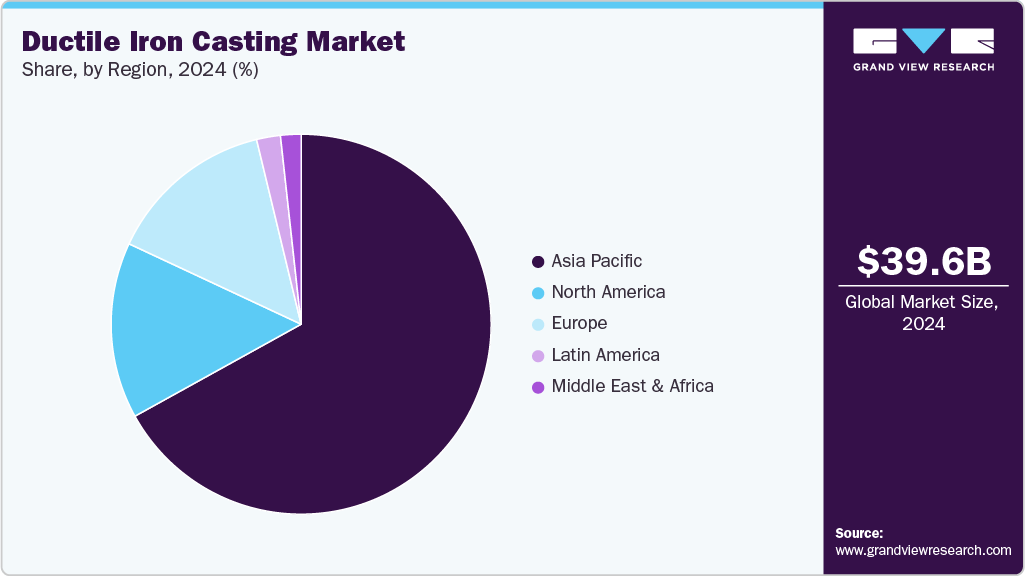
The global ductile iron casting market size was valued at USD 42.0 billion in 2025 and is projected to grow from USD 44.7 billion in 2026 to USD 65.3 billion by 2033, at a CAGR of 5.6% from 2026 to 2033. The market in Asia Pacific dominated with a revenue share of 67.3% in 2025. The industry is driven by the growing demand from the automotive and industrial machinery sectors, where ductile iron is valued for its high strength, durability, and cost-effectiveness compared to steel.
 Source: Grand View Research, IR Documents, Primary Interviews, Paid DatabasesTo learn more about this report,
 Download Free Sample Report
Key Market Trends & Insights
- By application: Automotive segment held the largest market share of 29.4% in 2025.
Regional Highlights
- Largest regional market: Asia Pacific (67.3% revenue share, 2025)
- By country: China held the largest market share in 2025.
Market Size & Forecast
- Market size in 2025: USD 42.0 Billion
- Estimated market size in 2026: USD 44.7 Billion
- Projected market size by 2033: USD 65.3 Billion
- CAGR (2026-2033): 5.6%
Prism AI by Grand View Research Free to tryAsk a question about the ductile iron casting marketTry asking✓Every figure cited from GVR research Prefer the report? Download free sample →
The industry is increasingly aligning with global sustainability goals as manufacturers adopt eco-friendly production methods to minimize energy consumption and carbon emissions. The material’s recyclability and long service life make it a preferred choice in circular economy models, reducing the need for virgin raw materials. Additionally, the use of energy-efficient melting furnaces and optimized foundry operations helps reduce waste and promote resource conservation, positioning ductile iron as a sustainable solution for modern infrastructure and industrial applications. With the rising focus on green manufacturing, companies are investing in renewable energy-powered foundries and low-emission melting technologies. This shift not only enhances environmental compliance but also strengthens brand value among environmentally conscious end users.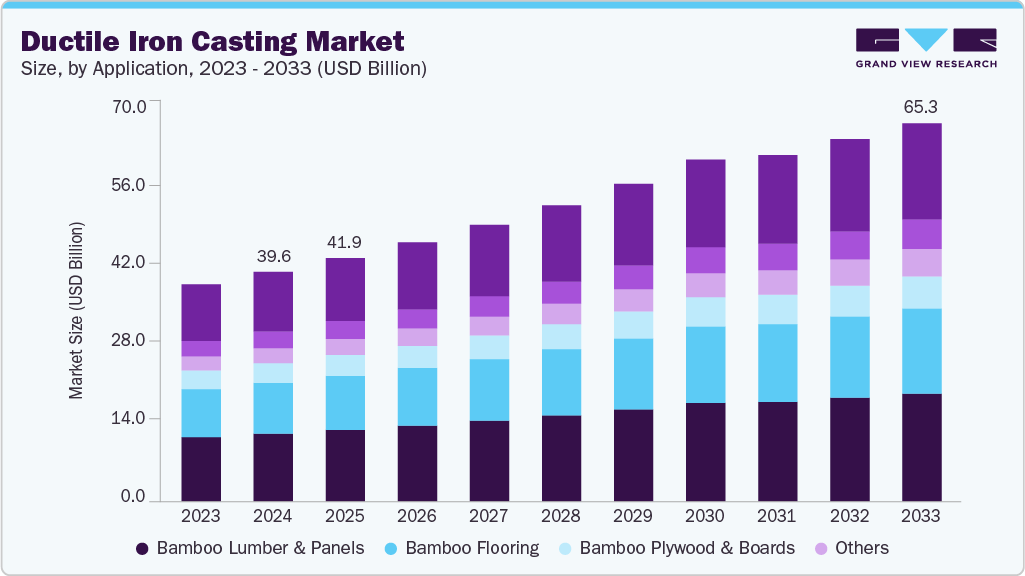 To learn more about this report, Download Free Sample Report
Technological advancements are transforming the ductile iron casting industry, enhancing both efficiency and quality. The integration of computer-aided design (CAD), simulation software, and automation in foundries has improved precision, reduced defects, and shortened production cycles. Furthermore, innovations such as 3D sand printing, advanced molding systems, and real-time process monitoring are enabling manufacturers to produce complex geometries with higher consistency. The adoption of Industry 4.0 technologies, including Internet of Things (IoT) and AI-based predictive maintenance, is further streamlining operations and optimizing resource utilization. As a result, these innovations are improving cost efficiency, expanding design flexibility, and enabling faster response to evolving customer requirements.
Market Dynamics
The ductile iron casting market is witnessing steady growth due to increasing demand from the automotive, industrial machinery, construction equipment, water infrastructure, and renewable energy sectors. Ductile iron castings offer an excellent combination of high strength, toughness, wear resistance, and cost-effectiveness, making them a preferred material for manufacturing engine components, transmission housings, pumps, valves, pipes, fittings, wind turbine components, and heavy machinery parts. Rising infrastructure investments, expansion of water and wastewater networks, and increasing production of commercial vehicles and off-highway equipment are supporting market growth. Furthermore, advancements in foundry automation, simulation software, and casting technologies are improving product quality, production efficiency, and dimensional accuracy, further driving market expansion.
Increasing production of passenger vehicles, commercial vehicles, agricultural machinery, and construction equipment is a major driver of the ductile iron casting market. Ductile iron provides superior mechanical strength, fatigue resistance, and vibration damping while remaining more economical than forged steel and many non-ferrous alternatives. It is extensively used in crankshafts, axle housings, differential carriers, steering knuckles, suspension components, brake parts, pumps, and valve bodies.
In addition, rapid investments in water supply, wastewater treatment, and municipal infrastructure projects are driving demand for ductile iron pipes, fittings, valves, hydrants, and manhole covers. Growing urbanization, industrialization, and government spending on infrastructure modernization across emerging economies are expected to sustain demand for ductile iron castings throughout the forecast period.
Fluctuations in the prices of pig iron, steel scrap, ferroalloys, magnesium, and foundry coke remain a significant challenge for ductile iron casting manufacturers. Since raw materials and energy account for a substantial share of production costs, price volatility directly impacts profit margins and pricing strategies. In addition, increasing electricity and natural gas costs, coupled with stringent environmental regulations governing foundry emissions and waste management, raise operating expenses. Supply chain disruptions affecting the availability of raw materials further add to production uncertainties, particularly for foundries operating on long-term supply contracts.
The global expansion of renewable energy installations and investments in water infrastructure is creating significant growth opportunities for the ductile iron casting market. Wind turbines require large ductile iron castings for hubs, bearing housings, and structural components due to their excellent fatigue, strength, and durability. Similarly, governments across developed and emerging economies are investing heavily in water transmission, wastewater treatment, irrigation, and smart city projects, increasing demand for ductile iron pipes, fittings, valves, and municipal castings.
Analyst Perspective
The ductile iron casting market is positioned for steady growth, supported by increasing demand from the automotive, industrial machinery, water infrastructure, railway, power generation, and construction equipment sectors. Ductile iron continues to be a preferred engineering material due to its excellent combination of high tensile strength, ductility, fatigue resistance, wear resistance, and cost-effectiveness compared to conventional cast iron and forged steel. Growing investments in infrastructure development, municipal water distribution networks, renewable energy projects, and industrial automation are further strengthening demand for high-performance ductile iron cast components across developed and emerging economies.
Application Insights & Trends
Based on application, the automotive segment led the market with the largest revenue share of 29.4% in 2025. The automotive segment dominates the global industry, accounting for a significant share of overall demand. Ductile iron’s high tensile strength, impact resistance, and vibration-damping properties make it an ideal material for critical components such as engine blocks, crankshafts, suspension systems, and steering knuckles. Its superior machinability and cost-effectiveness compared to steel further enhance its adoption among OEMs and Tier-1 suppliers. The rapid shift toward electric and hybrid vehicles is also influencing casting designs, as manufacturers develop lightweight yet durable components to improve efficiency. In June 2025, several automotive foundries in Germany and the U.S. announced expansions in ductile iron casting capacity to meet rising demand from electric vehicle (EV) and commercial vehicle manufacturers, reinforcing the segment’s leadership in the market.
Beyond the automotive sector, ductile iron castings play a vital role across various industrial and infrastructure sectors. In machinery and tools, ductile iron is valued for its dimensional stability and wear resistance, ensuring long service life in pumps, compressors, and gear housings. The pipes and fittings segment continues to expand, driven by growing investments in water distribution and wastewater treatment projects, particularly in developing economies. Additionally, railways and power generation utilize ductile iron components due to their ability to withstand dynamic loads and thermal stress, thereby ensuring operational reliability. With increasing focus on sustainable infrastructure, ductile iron’s recyclability and low maintenance costs make it a preferred choice in construction, energy, and municipal applications worldwide.
Regional Insights
The ductile iron casting market in North America is witnessing steady growth, supported by increasing demand from the automotive, oil & gas, and construction sectors. The region’s emphasis on modernizing infrastructure, including water and sewage systems, continues to drive casting applications in pipes and fittings. Foundries are also focusing on sustainability using energy-efficient furnaces and recycling initiatives. In April 2025, several North American foundries began integrating smart manufacturing technologies to enhance operational efficiency and reduce emissions, marking a shift toward digital and environmentally friendly production practices.
 To learn more about this report, Download Free Sample Report
U.S. Ductile Iron Casting Market Trends
The ductile iron casting market in the U.S. is propelled by the resurgence of domestic manufacturing and robust investments in transportation, defense, and renewable energy infrastructure. The country’s strong automotive and heavy machinery industries contribute significantly to ductile iron demand. The Infrastructure Investment and Jobs Act (IIJA) continues to drive upgrades in public utilities and road networks, fueling the demand for ductile iron pipes and cast components. In June 2025, U.S.-based foundries reported capacity expansions and new contract awards for water infrastructure projects, underlining the sector’s positive momentum driven by government spending and private investment.
Asia Pacific Ductile Iron Casting Market Trends
Asia Pacific dominated the ductile iron casting market with the largest revenue share of 67.3% in 2025. The ductile iron casting market in Asia Pacific is driven by rapid industrialization, infrastructure expansion, and increasing automotive production in countries such as China, India, and Japan. The region benefits from lower manufacturing costs and increasing foreign investments in foundry modernization. Governments are also emphasizing green manufacturing to reduce emissions and energy consumption. For instance, in August 2025, China announced a large-scale modernization of its foundry sector as part of a national sustainability initiative, aiming to digitalize production and enhance energy efficiency across industrial facilities.
China dominated the Asia Pacific market with a revenue share of 57.3% in 2025. China’s ductile iron casting market is supported by the country’s large manufacturing base, extensive infrastructure development, and strong demand from water and wastewater networks, automotive components, machinery, and industrial equipment. Water infrastructure remains a key application, with ductile iron pipes, fittings, valves, and related cast components widely used for municipal water supply and sewage systems. The automotive and machinery industries further contribute to demand for ductile iron castings used in components requiring high strength, wear resistance, and dimensional stability. China’s established foundry ecosystem, availability of raw materials, large-scale production capabilities, and integrated supply chains also support domestic consumption and exports.
Europe Ductile Iron Casting Market Trends
Stringent environmental regulations and a strong focus on circular economy practices shape the European ductile iron casting market. Demand remains high in automotive, energy, and water infrastructure sectors, with a particular emphasis on low-carbon materials. Manufacturers are investing heavily in decarbonization technologies and renewable-powered melting systems to meet EU climate goals. On May 19, 2025, several European foundries upgraded to energy-efficient furnaces as part of EU-funded decarbonization programs, reflecting the region’s leadership in sustainable and high-performance casting production.
Key Ductile Iron Casting Company Insights
Key players operating in the ductile iron casting market are undertaking various initiatives to strengthen their presence and increase the reach of their products and services. Strategies such as expansion activities and partnerships are key in propelling the market growth. Some of the key players operating in the market include Aisin Corporation, Crescent Foundry, Waupaca Foundry, Inc., and others.
-
Aisin Corporation, founded in 1949 and headquartered in Kariya, Japan, manufactures automotive components and metal casting products. The company produces ductile iron cast parts, including engine blocks, brake components, and transmission housings, for global automakers. Its operations emphasize precision engineering, production efficiency, and environmentally conscious manufacturing. Aisin continues to invest in research and development to support improvements in casting technology and material performance.
-
Crescent Foundry, established in 1982 and based in Kolkata, India, produces ductile and gray iron castings for infrastructure, construction, and industrial applications. Its product range includes municipal castings, manhole covers, gratings, and engineered components. The company operates automated molding lines and induction melting systems supported by quality-control procedures. Crescent Foundry exports to several international markets and focuses on maintaining efficient and sustainable manufacturing practices.
-
Waupaca Foundry, Inc., founded in 1955 and headquartered in Waupaca, Wisconsin, U.S., produces gray and ductile iron castings for automotive, commercial vehicle, and industrial uses. It operates multiple foundries in the United States that incorporate automation and environmentally responsible production methods. The company’s products include brake rotors, hubs, differential carriers, and components for heavy machinery, with a focus on maintaining consistent quality and operational efficiency.
Key Ductile Iron Casting Companies
The following key companies have been profiled for this study on the ductile iron casting market.
-
Aisin Corporation
-
Brakes India Pvt. Ltd.
-
Calmet Group
-
Crescent Foundry
-
Dandong Foundry
-
Hitachi Metals Ltd.
-
Kobe Steel Ltd.
-
Metal Technologies, Inc.
-
Neenah Foundry Company
Competitive Benchmarking
Category
Operating Strategies
Competitive Edge
Weakness
Established Players (e.g., Aisin Corporation, Brakes India Pvt. Ltd., Hitachi Metals, Ltd., Kobe Steel, Ltd., Metal Technologies, Inc., Neenah Foundry Company, Waupaca Foundry, Inc.)
- Operate large-scale integrated foundries producing ductile iron castings for automotive, industrial machinery, water infrastructure, railways, and energy applications.
- Focus on expanding melting capacity, foundry automation, precision machining, and quality assurance capabilities to strengthen market position.
- Invest in advanced casting technologies, simulation software, automated molding lines, and environmentally efficient melting systems to improve productivity and casting quality.
- Maintain long-term supply agreements with automotive OEMs, industrial equipment manufacturers, municipal utilities, and infrastructure contractors while expanding global manufacturing footprints.
- Extensive foundry capacity and strong technical expertise in producing complex, high-performance ductile iron castings.
- Well-established relationships with global OEMs and industrial customers supported by integrated machining and finishing capabilities.
- Strong quality certifications, metallurgical expertise, and economies of scale that enable cost-efficient, high-volume production.
- Diversified customer base across multiple-use industries reduces dependence on a single market segment.
- High capital investment requirements for melting furnaces, molding lines, machining equipment, and environmental compliance.
- Exposure to fluctuations in pig iron, steel scrap, ferroalloy, magnesium, and energy prices.
- Stringent environmental regulations increase compliance and operating costs.
- Production is closely tied to industrial output, infrastructure investments, and automotive manufacturing cycles.
Emerging & Regional Players (e.g., Calmet Group, Crescent Foundry, Dandong Foundry)
- Focus on regional markets and customized ductile iron casting solutions for industrial equipment, water infrastructure, agriculture, mining, and municipal applications.
- Emphasize flexible production, shorter lead times, customer-specific castings, and cost-competitive manufacturing.
- Expand export business through contract manufacturing and OEM partnerships while investing selectively in machining and quality improvement.
- Develop niche capabilities in medium-volume and specialized cast components to address regional infrastructure and industrial demand.
- Greater operational flexibility and faster response to customized customer requirements.
- Competitive manufacturing costs, particularly in Asia-Pacific markets.
- Ability to supply low- to medium-volume specialized castings with shorter development cycles.
- Strong regional distribution networks and close customer relationships in domestic markets.
- Smaller production capacities and limited global presence compared with multinational foundries.
- Lower bargaining power in procuring raw materials and production equipment.
- Limited financial resources may constrain investments in automation, advanced foundry technologies, and capacity expansion.
- Higher dependence on regional economic conditions and infrastructure spending, increasing business volatility.
Recent Developments
-
Waupaca Foundry, Inc., in June 2025, announced an investment of USD 50 million to upgrade its Etowah, Tennessee, facility with automated casting and melting systems. The expansion is designed to enhance production capacity for ductile iron components used in automotive and heavy machinery applications, while improving energy efficiency and reducing CO₂ emissions. This initiative supports the company’s ongoing efforts to enhance operational performance and environmental sustainability.
-
Crescent Foundry, in April 2025, announced plans to set up a new foundry in Gujarat, India, featuring Industry 4.0 automation, IoT-based quality monitoring, and energy-efficient induction furnaces. The facility is designed to increase the production of ductile iron products for water infrastructure and municipal applications while reducing energy consumption. The project aims to address growing international demand and strengthen the company’s export network in Europe, the Middle East, and North America.
-
Aisin Corporation, in May 2025, introduced a new range of lightweight ductile iron components for electric and hybrid vehicles developed through casting process optimization and material engineering. The development focuses on improving vehicle efficiency and supporting emission reduction targets in line with the transition toward electric mobility. The company also expanded research partnerships with automotive manufacturers to promote the wider use of sustainable casting materials in future vehicle platforms.
Ductile Iron Casting Market Report Scope
Report Attribute
Details
Market definition
The market size represents the apparent demand value of ductile iron casting in different applications, including automotive, machinery & tools, pipes & fittings, railways, power generation, and other applications.
Market size in 2025
USD 42.0 billion
Estimated market size in 2026
USD 44.7 billion
Projected market size by 2033
USD 65.3 billion
Growth rate
CAGR of 5.6% from 2026 to 2033
Base year for estimation
2025
Historical data
2021 - 2024
Forecast period
2026 - 2033
Quantitative units
Revenue in USD million, Volume in Kilotons, and CAGR from 2026 to 2033
Report coverage
Revenue forecast, volume forecast, company ranking, competitive landscape, growth factors, and trends
Segments covered
Application, region
Regional scope
North America; Europe; Asia Pacific; Latin America; Middle East & Africa
Country scope
U.S.; Canada; Mexico; Germany; UK; France; Italy; Russia, Türkiye, China; India; Japan; South Korea; Indonesia; Brazil; Argentina; South Africa
Key companies profiled
Aisin Corporation; Brakes India Pvt. Ltd.; Calmet Group; Crescent Foundry; Dandong Foundry; Hitachi Metals, Ltd.; Kobe Steel, Ltd.; Metal Technologies, Inc.; Neenah Foundry Company; Waupaca Foundry, Inc.
Customization scope
Free report customization (equivalent up to 8 analysts' working days) with purchase addition or alteration to country, regional & segment scope.
Pricing and purchase options
Avail customized purchase options to meet your exact research needs. Explore purchase options
Global Ductile Iron Casting Market Report Segmentation
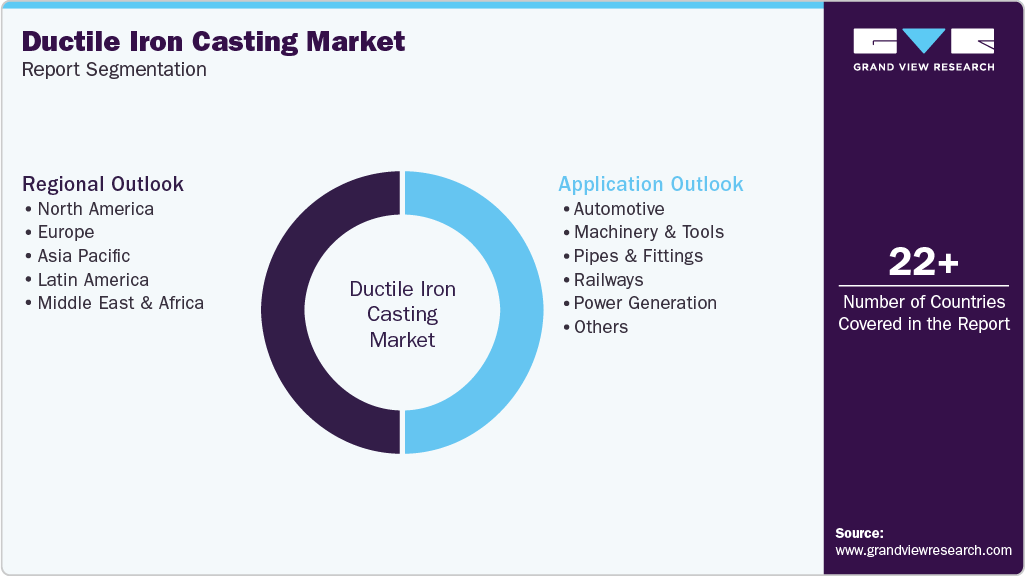
This report forecasts volume & revenue growth at the global, regional, and country levels, providing an analysis of the latest trends in each sub-segment from 2021 to 2033. For this study, Grand View Research has segmented the global ductile iron casting market report based on application and region.
 To learn more about this report, Download Free Sample Report
-
Application Outlook (Volume, Kilotons; Revenue, USD Million, 2021 - 2033)
-
Automotive
-
Machinery & Tools
-
Pipes & Fittings
-
Railways
-
Power Generation
-
Others
-
-
Regional Outlook (Volume, Kilotons; Revenue, USD Million, 2021 - 2033)
-
North America
-
U.S.
-
Canada
-
Mexico
-
-
Europe
-
Germany
-
France
-
Italy
-
UK
-
Russia
-
Türkiye
-
-
Asia Pacific
-
China
-
India
-
Japan
-
South Korea
-
Indonesia
-
-
Latin America
-
Brazil
-
Argentina
-
-
Middle East & Africa
-
South Africa
-
-
Research Methodology
The ductile oron casting market figures in this report are based on a proven research process that combines executive interviews with secondary research from proprietary databases, company filings, and recognized regulatory and institutional sources. Market size is built through value-chain sizing - reconciling supply-side and demand-side estimates - and triangulated with bottom-up and top-down approaches. Every estimate passes multiple levels of expert validation before publication, with each ductile iron casting segment quantified using the revenue-capture definitions in the table below.
Segment Definition
Application
Revenue Capture Definition
Automotive
This segment includes ductile iron cast components manufactured for passenger cars, commercial vehicles, and electric vehicles. Revenue is generated from the sale of engine blocks, crankshafts, camshafts, axle housing, differential carriers, steering knuckles, suspension components, brake parts, wheel hubs, transmission housing, and other structural and powertrain castings supplied to OEMs and Tier-1 automotive suppliers.
Machinery & tools
This segment comprises ductile iron castings used in industrial machinery, machine tools, compressors, hydraulic equipment, agricultural machinery, and manufacturing equipment. Revenue is derived from the sale of machine bases, gear housings, bearing housings, pump casings, hydraulic components, rollers, frames, and other heavy-duty mechanical components requiring high strength, wear resistance, and dimensional stability.
Pipes & fittings
This segment includes ductile iron pipes, pipe fittings, valves, hydrants, couplings, flanges, and pressure pipeline components used in potable water distribution, wastewater systems, irrigation networks, industrial fluid handling, and municipal infrastructure. Revenue is generated from the sale of these cast products to utility companies, municipalities, infrastructure contractors, and industrial end users.
Railways
This segment consists of ductile iron castings used in railway infrastructure and rolling stock. Revenue is generated from the sale of brake system components, axle bearing housings, couplers, suspension components, track fastening systems, bogie parts, and other railway castings designed to withstand high mechanical loads, vibration, and long service life.
Power Generation
This segment includes ductile iron cast components used in conventional and renewable power generation equipment. Revenue is derived from the sale of wind turbine hubs, bearing housings, gearbox casings, pump bodies, valve bodies, turbine components, generator housings, and other cast parts used in thermal, hydroelectric, wind, and industrial power generation facilities.
Others
This segment includes ductile iron castings used in construction equipment, mining machinery, marine applications, municipal castings (such as manhole covers and gratings), oil & gas equipment, defense, and general engineering applications. Revenue is generated from the sale of heavy-duty cast components requiring high mechanical strength, impact resistance, and durability under demanding operating conditions.
Estimation Model
Layer Name
Key Question
Description
End-use Industry Demand Base Layer
What forms the demand base?
Identify ductile iron casting demand generated from key end-use industries, including automotive, machinery & tools, pipes & fittings, railways, power generation, construction equipment, mining, and other industrial applications. Assess demand for components such as engine and transmission parts, axle housings, machine bases, pump and valve bodies, ductile iron pipes, railway components, wind turbine hubs, and municipal castings. Analyze the impact of industrial production, infrastructure development, urbanization, vehicle manufacturing, renewable energy expansion, and capital investments on the overall demand for ductile iron castings.
Raw Material Supply & Foundry Manufacturing Layer
Where are ductile iron castings produced and supplied from?
Estimate the global supply of ductile iron castings based on the availability of pig iron, steel scrap, foundry returns, ferroalloys, magnesium treatment alloys, and other foundry inputs. Analyze regional foundry capacities, casting production volumes, nodular iron manufacturing capabilities, machining facilities, import-export activities, and supply chain networks. Evaluate the role of integrated foundries, captive foundries, independent casting manufacturers, and OEM suppliers in producing and supplying ductile iron castings across global markets.
Application Consumption Intensity Layer
How much ductile iron casting is consumed?
Analyze ductile iron casting consumption intensity across automotive, machinery & tools, pipes & fittings, railways, power generation, and other applications. Evaluate casting weight per finished product, replacement trends, production volumes, infrastructure investments, equipment manufacturing output, and product design requirements. Consumption intensity varies depending on mechanical performance requirements, component complexity, service life, industry standards, and regional manufacturing activities.
Revenue Layer
How is market revenue generated?
Market revenue is quantified through the production and sale of finished ductile iron castings supplied to OEMs, infrastructure projects, industrial equipment manufacturers, distributors, and replacement markets. Revenue generation is influenced by casting weight, component complexity, machining requirements, alloy composition, production technology, foundry operating costs, raw material prices, and end-use demand. Growth in automotive production, industrial machinery manufacturing, water infrastructure development, renewable energy projects, and railway investments drives the overall market value.
Delivered Customizations
This report has been delivered with the following In-depth customizations
Client Request
Customization Delivered
Value Adds
Foundry Capacity & Manufacturing Benchmarking
Assessment of global foundry capacities, production technologies, automation levels, machining capabilities, utilization rates, and planned capacity expansions by leading manufacturers.
Supported manufacturing investment decisions, capacity optimization, and competitive benchmarking.
Trade Flow & Supply Chain Mapping
Analysis of country-wise imports, exports, production hubs, trade flows, and regional supply-demand balance for ductile iron castings.
Assisted in market entry planning, export strategy development, and supply chain optimization.
Cost Structure & Margin Analysis
Detailed breakdown of manufacturing costs, including raw materials, energy, labor, molding, machining, finishing, logistics, and overheads across major producing regions.
Enabled profitability analysis, pricing strategy development, and operational cost optimization.
Frequently Asked Questions About This Report
Based on applications, the automotive segment led the market with the largest revenue share of 29.4% in 2025.
Asia Pacific dominated the ductile iron casting market with the largest revenue share of 67.3% in 2025.
China dominated the Asia Pacific market with a revenue share of 57.3% in 2025.
The Asia Pacific is expected to register the fastest CAGR of 6.1% over the forecast period.
The railways segment is expected to grow at the fastest CAGR over the forecast period.
Some of the key vendors in the global ductile iron casting market are Aisin Corporation, Brakes India Pvt. Ltd.; Calmet Group; Crescent Foundry; Dandong Foundry; Hitachi Metals, Ltd.; Kobe Steel, Ltd.; Metal Technologies, Inc.; Neenah Foundry Company; Waupaca Foundry, Inc., among others.
The ductile iron casting market is driven by increasing demand from the automotive, industrial machinery, water infrastructure, railway, and power generation sectors, supported by rising infrastructure investments and the need for high-strength, durable, and cost-effective cast components.
The global ductile iron casting market size was valued at USD 42.0 billion in 2025 and is estimated at USD 44.7 billion for 2026.
The global ductile iron casting market is expected to grow at a CAGR of 5.6% from 2026 to 2033, reaching USD 65.3 billion by 2033.
About the Author(s)
Advanced Interior Materials Research Team
Advanced Materials · Advanced Interior MaterialsThis report was authored by the advanced interior materials research team at Grand View Research - comprising two research analysts, one senior research analyst, and one industry expert - with specialized expertise in the advanced interior materials segment of the advanced materials industry. All findings are based on proprietary advanced materials databases, executive interviews, and regulatory analysis, subject to internal peer review prior to publication.
Last Updated:
Speak to Analyst

Customize this report to your needs - add regions, segments, or data points, with 20% free customization.
Or view our licence options:


ISO 9001:2015 & 27001:2022 Certified
We are GDPR and CCPA compliant! Your transaction & personal information is safe and secure. For more details, please read our privacy policy.


