
- Home
- »
- Advanced Interior Materials
- »
-
Ductile Iron Pipes Market Size & Share Report, 2026-2033GVR Report cover

Ductile Iron Pipes Market (2026 - 2033)
Size, Share & Trends Analysis Report By Application (Water Distribution, Sewage & Wastewater Systems, Irrigation Systems), By Region (North America, Europe), And Segment Forecasts
Market Size, 2025
$17.3BMarket Estimate, 2026
$18.4BMarket Forecast, 2033
$28.2BCAGR, 2026–2033
8.9%Ductile Iron Pipes Market Summary
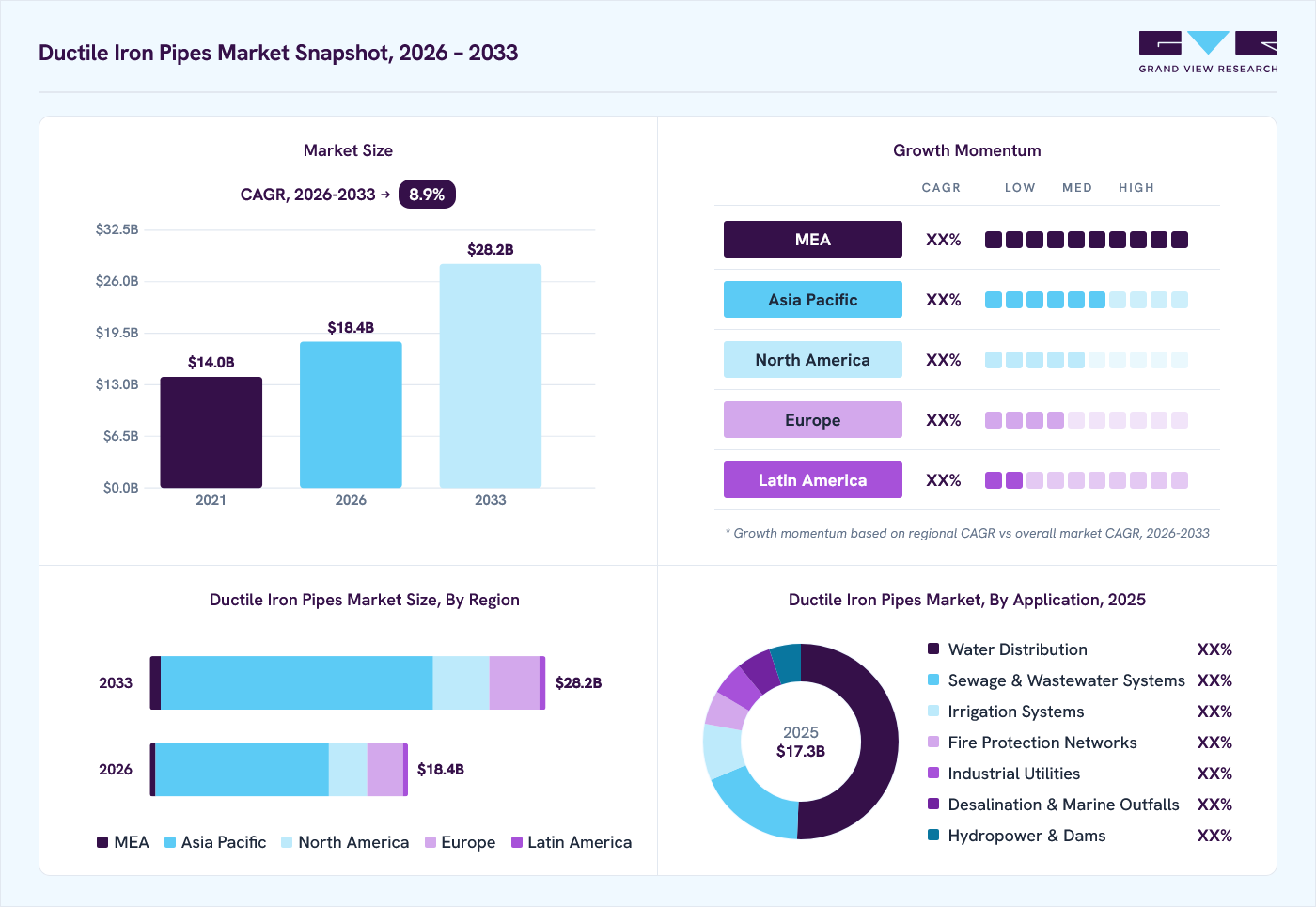
The global ductile iron pipes market size was valued at USD 17.3 billion in 2025 and is projected to grow from USD 18.4 billion in 2026 to USD 28.2 billion by 2033, at a CAGR of 8.9% from 2026 to 2033. The market in Asia Pacific dominated with a revenue share of 66.9% in 2025. The market is witnessing strong growth due to the rising demand for efficient water supply and wastewater management infrastructure.
 Source: Grand View Research, IR Documents, Primary Interviews, Paid DatabasesTo learn more about this report,
 Download Free Sample Report
Key Market Trends & Insights
- By application: Water distribution segment held the largest market share of 50.6% in 2025.
Regional Highlights
- Largest regional market: Asia Pacific (66.9% revenue share, 2025)
- By country: China held the largest market share in 2025
Market Size & Forecast
- Market size in 2025: USD 17.3 Billion
- Estimated market size in 2026: USD 18.4 Billion
- Projected market size by 2033: USD 28.2 Billion
- CAGR (2026-2033): 8.9%
Three ways to get this report
Buy it, customize it, or ask a question.Ask an Analyst
Analyst response in 1 business day
- AccessReport author, directly
- Reply timeWithin 1 working day
- No sales callDirect answer only
- FormatEmail reply
- CostFree, no cost
Get the Full Report
What the study covers
- FormatsPDF · Excel · Dashboard
- Timeline2026–2033 annual, 2025 base
- Coverage20+ countries, 5 regions
- Companies10+ key players profiled
Customize the Report
20% free customization
- IncludeCountries, segments, points
- TailorTo your product definition
- ExtendDeeper competitor detail
- OrA fully bespoke study
- Turnaround5–10 working days
As urban populations expand rapidly, particularly in Asia Pacific, there is increasing pressure on governments and utilities to ensure clean, safe, and continuous water distribution. These pipes are preferred in municipal water systems because of their durability, strength, and high resistance to internal pressure and corrosion, making them ideal for transporting potable water over long distances.In countries like the U.S., Germany, and Japan, much of the underground pipeline network is decades old and increasingly prone to leakage and failure. DI pipes are being deployed as a reliable solution in replacement projects due to their longer service life and lower lifetime cost than other materials. Their ability to withstand ground movement and pressure surges has made them a preferred material in regions vulnerable to seismic activity or soil instability. For instance, the U.S. Environmental Protection Agency (EPA) has funded several state-level Drinking Water State Revolving Fund (DWSRF) programs, under which ductile iron pipes are used to upgrade outdated municipal water systems.
 To learn more about this report, Download Free Sample Report
Industrialization is also significantly contributing to the ductile iron pipe market. Power generation, chemical processing, and oil & gas require robust piping systems for transporting fluids under high pressure and temperature. These pipes meet these criteria while offering additional benefits such as easy installation and compatibility with various jointing systems. The ongoing expansion of industrial facilities in developing economies like India, Vietnam, and Brazil is expected to create additional demand in the coming years. In Vietnam, for example, the Nhon Trach 3 and 4 power plant projects and associated water infrastructure upgrades utilize ductile iron pipelines for cooling and processing water transport.
Environmental regulations and the push for sustainable infrastructure have further supported market growth. Ductile iron pipes are made from recycled materials and are fully recyclable, aligning well with green building standards and circular economy initiatives. Their low maintenance requirements and long operational life contribute to lower environmental footprints over time. As more countries enforce regulations around leakage control, water conservation, and energy-efficient infrastructure, demand for high-integrity piping systems such as ductile iron is expected to remain strong, for instance, in France, where regulatory pressure from the Agence de l’Eau has replaced aging pipelines with ductile iron pipes that offer better water tightness and environmental performance.
Market Dynamics
The ductile iron pipes market is witnessing steady growth due to increasing investments in water supply infrastructure, wastewater management systems, irrigation networks, and urban development projects. Governments and municipalities worldwide are focusing on upgrading aging pipeline infrastructure to reduce water losses and improve the efficiency of water distribution systems. Ductile iron pipes are widely preferred because of their high strength, durability, corrosion resistance, and long service life. Rising urbanization, population growth, and expanding industrial activities are further supporting market demand.
Rising investments in water supply and wastewater management infrastructure are a key factor driving the growth of the ductile iron pipes market. Governments and municipal authorities across developed and developing economies are undertaking large-scale projects to expand drinking water access, improve sanitation systems, and replace aging pipeline networks. Rapid urbanization, population growth, and increasing water demand are placing significant pressure on existing infrastructure, creating the need for durable and high-capacity piping solutions. Ductile iron pipes are widely preferred for these applications due to their superior strength, long service life, and ability to withstand high operating pressures.
In addition, growing concerns over water losses, leakage reduction, and efficient water resource management are accelerating investments in modern transmission and distribution networks. Major infrastructure programs focused on smart water management, rural water connectivity, irrigation expansion, and wastewater treatment facilities are further supporting demand for ductile iron pipes. Their corrosion resistance, reliability, and low maintenance requirements make them a cost-effective solution for long-term municipal and industrial water transportation projects, contributing to sustained market growth.
The market faces challenges from the relatively high installation and transportation costs associated with ductile iron pipes due to their weight. In addition, alternative piping materials such as PVC, HDPE, and fiberglass-reinforced plastic pipes are gaining traction in certain applications because of their lower cost, lighter weight, and ease of installation. These alternatives can limit the adoption of ductile iron pipes, particularly in cost-sensitive infrastructure projects and smaller-scale water distribution systems.
The increasing development of smart cities, urban infrastructure projects, and advanced water management systems presents significant growth opportunities for the ductile iron pipes market. Governments are investing in modern pipeline networks equipped with leak detection, monitoring, and asset management technologies to improve water distribution efficiency. Furthermore, rising investments in desalination plants, industrial water treatment facilities, irrigation projects, and cross-country water transmission networks are creating new demand for durable and reliable piping solutions. As infrastructure modernization and water security initiatives continue to gain momentum globally, the demand for ductile iron pipes is expected to grow substantially during the forecast period.
Analyst Perspective
The ductile iron pipes market is poised for sustained growth, supported by rising investments in water supply infrastructure, wastewater management systems, irrigation networks, and urban development projects worldwide. Increasing efforts by governments and utilities to replace aging pipeline networks, reduce water losses, and improve access to clean water are driving demand for durable and high-performance piping solutions. Ductile iron pipes continue to be preferred for critical water transmission and distribution applications due to their superior strength, long service life, and ability to withstand high operating pressures. Although the market faces challenges from fluctuating raw material costs and competition from alternative pipe materials such as PVC and HDPE, ongoing infrastructure modernization, smart water management initiatives, desalination projects, and expanding industrial water networks are expected to support long-term market growth.
Drivers, Opportunities & Restraints
The increasing investment in water infrastructure development, particularly in emerging economies, is proliferating the market. Rapid urbanization, rising population, and growing demand for reliable drinking water and wastewater systems have accelerated the use of ductile iron pipes in municipal and industrial sectors. Their superior mechanical properties, such as high tensile strength, impact, and corrosion resistance, make them ideal for long-term infrastructure projects. Government programs such as India’s Jal Jeevan Mission and Africa’s urban water supply projects are boosting demand for these durable, cost-effective pipe systems.
Technological innovation presents significant growth opportunities in the ductile iron pipes industry. The development of advanced coatings and linings, such as ceramic epoxy and zinc-aluminum alloys, enhances corrosion resistance and extends the life of the pipes even in aggressive soil and water conditions. Additionally, the increasing adoption of trenchless installation techniques in urban and congested areas allows for faster deployment with reduced environmental impact. Growing emphasis on circular economy practices and the recyclability of ductile iron also align with global sustainability goals, positioning ductile iron pipes as a favorable choice in green infrastructure initiatives.
Despite their advantages, ductile iron pipes face restraints such as high installation and transportation costs due to their weight. Lighter alternatives like PVC or HDPE may be preferred in remote or difficult-to-access locations to ease handling and lower logistics expenses. Moreover, in highly corrosive environments or areas with extreme soil acidity, ductile iron pipes require additional protective coatings, which can increase overall project costs.
Application Insights
Based on application, the water distribution segment led the market with the largest revenue share of 50.6% in 2025. The water distribution segment is a key application driving growth in the ductile iron pipes industry due to the increasing global focus on improving access to clean and reliable drinking water. Governments and municipalities across developing countries are undertaking extensive projects to expand and modernize water supply infrastructure, particularly in urban and semi-urban regions. Ductile iron pipes are widely preferred in these projects because of their strength, long service life, and ability to withstand internal pressure and external load conditions.
The sewage & wastewater systems segment is anticipated to register the fastest CAGR over the forecast period. As cities grow and generate more wastewater, municipalities must upgrade or build new sewer networks that can handle large effluent volumes without failure or leakage. Ductile iron pipes are ideal for such applications due to their superior strength, corrosion resistance, and ability to withstand external ground loads and internal pressures. Their durability makes them preferred in gravity sewers and pressurized wastewater systems, especially in dense urban environments where long-term performance and low maintenance are critical.
Regional Insights
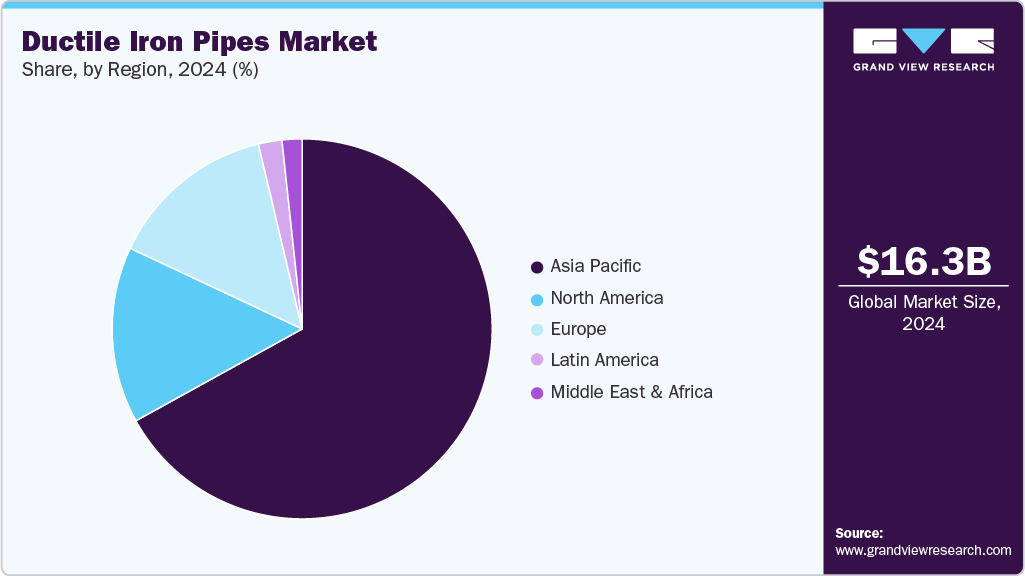
Asia Pacific dominated the ductile iron pipes market with the largest revenue share of 66.9% in 2025. Rapid urbanization and industrialization in countries such as China, India, and Southeast Asia significantly increase the demand for durable and efficient water infrastructure. Ductile iron pipes are favoured for their strength, longevity, and resistance to corrosion, making them ideal for large-scale water distribution and sewage systems. Government initiatives to improve water supply and sanitation, such as India's Smart Cities Mission and China's urban development programs, further propel the market forward. These initiatives often involve substantial investments in infrastructure, where ductile iron pipes play a crucial role due to their reliability and cost-effectiveness over time.
 To learn more about this report, Download Free Sample Report
North America Ductile Iron Pipes Market Trends
The North American ductile iron pipes market is experiencing steady growth, primarily driven by substantial investments in infrastructure development and the pressing need to replace aging water and wastewater systems. In the U.S., a significant portion of the water infrastructure is over 50 years old, leading to frequent failures and inefficiencies. Government initiatives, such as the Bipartisan Infrastructure Law, have allocated substantial funding to modernize water systems, increasing the demand for durable materials like ductile iron pipes. These pipes are favored for their strength, longevity, and resistance to corrosion, making them ideal for large-scale water distribution and sewage projects.
Environmental regulations and technological advancements are crucial in driving the U.S. ductile iron pipes market. Government initiatives like the Bipartisan Infrastructure Law have allocated substantial funding to modernize water systems, increasing the demand for durable materials like ductile iron pipes. Additionally, urbanization and population growth in major cities necessitate expanding and upgrading water infrastructure, further propelling the market.
Europe Ductile Iron Pipes Market Trends
Europe's ductile iron pipes market is witnessing steady growth, primarily driven by infrastructure modernization efforts and a strong regulatory focus on sustainable water management. Many countries face the challenge of aging water supply and wastewater networks, prompting widespread replacement initiatives. Governments and municipalities in countries like Germany, France, and the UK are prioritizing resilient pipeline systems that can support reliable water distribution and sewerage networks.
Latin America Ductile Iron Pipes Market Trends
The ductile iron pipes market in Latin America is experiencing significant growth, driven by the urgent need to upgrade the region's aging water and wastewater infrastructure. Rapid urbanization and population growth in Brazil, Mexico, Argentina, Chile, and Peru have intensified the demand for reliable water distribution and sewage systems. Ductile iron pipes are increasingly favored for these applications due to their strength, durability, and corrosion resistance, making them ideal for the diverse terrains and challenging environmental conditions in Latin America. Additionally, compliance with international and local standards for water infrastructure is bolstering their adoption.
Middle East & Africa Ductile Iron Pipes Market Trends
The ductile iron pipes market in the Middle East and Africa (MEA) continues to expand as countries prioritize long-term infrastructure planning to address water scarcity and sanitation gaps. The arid climate and growing urban populations across the region demand high-performance pipeline systems capable of transporting water over long distances with minimal leakage or maintenance. Ductile iron pipes offer a reliable solution due to their pressure-bearing capacity and resistance to corrosion, especially in harsh desert conditions and saline soil environments common in the Gulf and North African countries.
Key Ductile Iron Pipes Company Insights
Some of the key players operating in the market include KUBOTA Corporation, thyssenkrupp, and others
-
Kubota Corporation, established in 1890 and headquartered in Osaka, Japan, is a global leader in manufacturing industrial and agricultural machinery and water infrastructure products. The company offers a comprehensive range of products designed to meet diverse infrastructure needs. Their ductile iron pipes are known for their exceptional strength, durability, and corrosion resistance, making them suitable for various applications, including water supply, sewage, and industrial systems.
-
Jindal SAW Limited is a prominent manufacturer and supplier of iron and steel pipe products. Its portfolio includes submerged arc welded (SAW) pipes, seamless pipes and tubes, carbon, alloy, and stainless steel pipes, and pellets. These products serve various sectors, including oil and gas exploration, transportation, power generation, and water supply for drinking, drainage, and irrigation purposes. The company operates an integrated greenfield project in Mundra, Gujarat, which includes a DI pipe manufacturing facility and a pig iron unit. This plant, commissioned in 2005, boasts the largest capacity for DI pipes manufactured at a single location in India.
Key Ductile Iron Pipes Companies
The following key companies have been profiled for this study on the ductile iron pipes market.
-
Aliaxis SA
-
American Cast Iron Pipe Company
-
CNBM INTERNATIONAL CORPORATION
-
Electrotherm
-
Jindal SAW Limited
-
KUBOTA Corporation
-
Saint-Gobain PAM Canalisation
-
Supra Group
-
Tata Metaliks Limited
-
U.S. Pipe
Competitive Benchmarking
Operating Strategies
Competitive Edge
Weaknesses
Established Players (American Cast Iron Pipe Company (ACIPCO), Jindal SAW Limited, KUBOTA Corporation, Saint-Gobain PAM Canalisation, U.S. Pipe, Xinxing Ductile Iron Pipes Co., Ltd.)
- Operate large-scale ductile iron pipe manufacturing facilities serving municipal water, wastewater, irrigation, and industrial infrastructure projects worldwide.
- Focus on capacity expansion, product quality enhancement, and compliance with international water infrastructure standards.
- Participate in large government-funded pipeline replacement and water transmission projects.
- Strengthening market presence through extensive distribution networks, EPC partnerships, and long-term utility contracts.
- Strong brand recognition and established relationships with water utilities, municipalities, and infrastructure developers.
- Large production capacities enabling supply of high-volume projects and large-diameter pipes.
- Broad geographic reach and diversified end-market exposure.
- Advanced manufacturing capabilities and technical expertise in pressure pipe systems.
- High dependence on public infrastructure spending and government budgets.
- Exposure to fluctuations in iron ore, pig iron, energy, and freight costs.
- Significant capital requirements for foundries, casting facilities, and environmental compliance.
- Vulnerability to delays in large infrastructure and utility projects.
Emerging & Regional Players (Electrosteel Castings Limited, Tata Metaliks Limited, McWane Ductile, Benxi Beitai Ductile Cast Iron Pipes Co., Ltd.)
- Primarily focus on regional water infrastructure projects and selected export markets.
- Emphasize cost competitiveness, operational efficiency, and localized customer support.
- Target municipal water supply, irrigation, wastewater, and industrial pipeline projects within core operating regions.
- Expand market share through strategic partnerships with contractors, distributors, and local governments.
- Strong understanding of regional regulatory requirements and procurement processes.
- Competitive pricing and shorter delivery timelines for local projects.
- Ability to adapt product offerings to specific project requirements and customer needs.
- Established presence in rapidly developing infrastructure markets.
- Limited international footprint compared to global leaders.
- Greater dependence on regional economic conditions and infrastructure spending cycles.
- Lower bargaining power in raw material procurement and logistics.
- Resource constraints may limit expansion into new geographies and large-scale projects.
Recent Developments
-
In May 2025, China’s Xinxing invested approximately USD 150 million to establish a ductile iron pipe manufacturing plant in Egypt’s Suez Canal Economic Zone, specifically within the TEDA-Egypt industrial zone. The facility covers 270,500 square meters and has an annual production capacity of 250,000 tonnes of ductile iron pipes, with diameters up to 2,600 mm, designed to meet the specifications of various national infrastructure projects.
-
In January 2025, Rungta Steel, a prominent integrated steel and TMT bar manufacturer in India, expanded its footprint in the infrastructure sector by launching the production of Ductile Iron (DI) Pipes at its Chaliyama Steel Plant in Chaibasa, Jharkhand. This new product complements its portfolio, including TMT Bars, Wire Rods, and Fly Ash Bricks. Ductile Iron Pipes, known for their enhanced strength, flexibility, and durability due to magnesium treatment, are crucial for high-pressure applications such as water supply, sewerage, and industrial projects.
Ductile Iron Pipes Market Report Scope
Report Attribute
Details
Market definition
The market size represents the revenue generated from the sale of ductile iron pipes used for water transmission and distribution, wastewater management, irrigation, fire protection, industrial utilities, desalination, and hydropower infrastructure applications.
Market size in 2025
USD 17.3 billion
Estimated market size in 2026
USD 18.4 billion
Projected market size by 2033
USD 28.2 billion
Growth rate
CAGR of 8.9% from 2026 to 2033
Base year for estimation
2025
Historical data
2021 - 2024
Forecast period
2026 - 2033
Quantitative units
Revenue in USD million, Volume in Kilotons, and CAGR from 2026 to 2033
Report coverage
Revenue forecast, volume forecast, company ranking, competitive landscape, growth factors, and trends
Segments covered
Application, region
Regional scope
North America; Europe; Asia Pacific; Latin America; Middle East & Africa
Country scope
U.S.; Canada; Mexico; Germany; France; Italy; UK; China; India; Japan; Brazil
Key companies profiled
American Cast Iron Pipe Company (ACIPCO), Electrosteel Castings Limited, Jindal SAW Limited, KUBOTA Corporation, McWane Ductile, Saint-Gobain PAM Canalisation, Tata Metaliks Limited, U.S. Pipe, Xinxing Ductile Iron Pipes Co., Ltd., and Benxi Beitai Ductile Cast Iron Pipes Co., Ltd.
Customization scope
Free report customization (equivalent up to 8 analysts' working days) with purchase addition or alteration to country, regional & segment scope.
Pricing and purchase options
Avail customized purchase options to meet your exact research needs. Explore purchase options
Global Ductile Iron Pipes Market Report Segmentation
This report forecasts revenue and volume growth at global, regional, and country levels and provides an analysis of the latest industry trends in each of the sub-segments from 2033 to 2033. For the purpose of this study, Grand View Research has segmented the global ductile iron pipes market report on the basis of application, and region:
 To learn more about this report, Download Free Sample Report
-
Application Outlook (Volume, Kilotons; Revenue, USD Million; 2021 - 2033)
-
Water Distribution
-
Sewage & Wastewater Systems
-
Irrigation Systems
-
Fire Protection Networks
-
Industrial Utilities
-
Desalination & Marine Outfalls
-
Hydropower & Dams
-
-
Regional Outlook (Volume, Kilotons; Revenue, USD Million; 2021 - 2033)
-
North America
-
U.S.
-
Canada
-
Mexico
-
-
Europe
-
Germany
-
France
-
UK
-
Italy
-
-
Asia Pacific
-
China
-
India
-
Japan
-
-
Latin America
-
Brazil
-
-
Middle East & Africa
-
Research Methodology
The ductile iron pipes market figures in this report are based on a proven research process that combines executive interviews with secondary research from proprietary databases, company filings, and recognized regulatory and institutional sources. Market size is built through value-chain sizing-reconciling supply-side and demand-side estimates-and triangulated with bottom-up and top-down approaches. Every estimate passes multiple levels of expert validation before publication, with each ductile iron pipes segment quantified using the revenue-capture definitions in the table below.
Segment Definition
Application
Revenue Capture Definition
Water Distribution
This segment includes ductile iron pipes used for potable water transmission and distribution networks. Revenue is generated from the sale of pipes, fittings, and accessories supplied for municipal water supply systems, urban infrastructure projects, rural water schemes, and water utility networks.
Sewage & Wastewater Systems
This segment comprises ductile iron pipes utilized in sewage collection, wastewater conveyance, drainage systems, and wastewater treatment infrastructure. Revenue is derived from the sale of piping systems designed to transport sewage and treated wastewater under gravity and pressure conditions.
Irrigation Systems
This segment includes ductile iron pipes used in agricultural irrigation networks, canal distribution systems, and water transportation infrastructure for farming activities. Revenue is generated from the sale of pipes supplied for large-scale irrigation projects and water resource management programs.
Fire Protection Networks
This segment consists of ductile iron pipes installed in fire water supply and firefighting systems across industrial facilities, commercial buildings, airports, ports, and municipal infrastructure. Revenue is generated from the sale of pipes used in high-pressure fire protection and emergency water distribution networks.
Industrial Utilities
This segment includes ductile iron pipes used for industrial water supply, processing water transportation, cooling water systems, and utility infrastructure in industries such as power generation, mining, oil & gas, and manufacturing. Revenue is derived from the sale of pipes for industrial fluid conveyance applications.
Desalination & Marine Outfalls
This segment comprises ductile iron pipes used in desalination plants, seawater intake systems, marine outfall pipelines, and coastal water infrastructure projects. Revenue is generated from the sale of corrosion-resistant piping solutions designed for water transportation in marine and desalination environments.
Hydropower & Dams
This segment includes ductile iron pipes used in hydropower plants, dam infrastructure, raw water conveyance systems, penstocks, and associated water transmission networks. Revenue is generated from the sale of pipes utilized for water transportation and hydraulic infrastructure applications.
Estimation Model
Layer Name
Key Question
Description
Water Infrastructure Demand Base Layer
What forms the demand base?
Identify ductile iron pipe demand generated from municipal water distribution networks, wastewater and sewage systems, irrigation projects, industrial utilities, fire protection systems, desalination facilities, and hydropower infrastructure. Analyze the impact of urbanization, population growth, water infrastructure investments, sanitation initiatives, and replacement of aging pipeline networks on overall market demand. This layer establishes the total addressable demand for ductile iron pipes globally.
Raw Material Supply & Manufacturing Layer
Where are ductile iron pipes produced and supplied from?
Estimate the supply of ductile iron pipes based on the availability of pig iron, scrap iron, ferroalloys, and other raw materials used in ductile iron production. Analyze regional manufacturing capacities, foundries, pipe production facilities, distribution networks, import-export activities, and supply chain dynamics. Evaluate the role of pipe manufacturers, distributors, EPC contractors, and utilities in supplying ductile iron pipe systems globally.
Application Consumption Intensity Layer
How much ductile iron pipe is consumed?
Analyze ductile iron pipe consumption intensity across water transmission, water distribution, sewage and wastewater networks, irrigation systems, industrial utilities, desalination projects, fire protection systems, and hydropower infrastructure. Evaluate pipe usage based on project size, pipeline length, diameter specifications, pressure requirements, infrastructure investments, and replacement cycles. Consumption intensity varies by application, regional infrastructure development, and regulatory standards.
Revenue Layer
How is market revenue generated?
Market revenue is quantified through the sale of ductile iron pipes, fittings, joints, and related accessories supplied to municipal, industrial, agricultural, and infrastructure projects. Revenue generation is influenced by pipe diameter, pressure class, raw material costs, project scale, installation requirements, and regional demand. Growth in water infrastructure investments, urban development, wastewater treatment projects, irrigation expansion, and smart water management initiatives drives overall market value.
Delivered Customizations
This report has been delivered with the following In-depth customizations
Client Request
Customization Delivered
Value Adds
Tender & Procurement Landscape Analysis
Comprehensive assessment of procurement frameworks, utility tendering processes, contractor participation, public-private partnership (PPP) models, bid qualification criteria, and purchasing practices across major water infrastructure markets.
Enabled a better understanding of project award mechanisms, procurement trends, and strategies to improve success rates in infrastructure tenders.
Trade and Pricing Analysis
Detailed evaluation of global import-export flows, key exporting and importing countries, regional pricing trends, raw material cost impacts, freight dynamics, and competitive pricing benchmarks across the ductile iron pipes value chain.
Supported pricing strategy development, identification of supply-demand gaps, and assessment of regional competitiveness and trade opportunities.
Opportunity Assessment
Identification of growth opportunities across water transmission projects, wastewater infrastructure, irrigation modernization, desalination plants, smart water management systems, pipeline replacement programs, and emerging infrastructure investments.
Assisted in prioritizing high-growth segments, evaluating future revenue pockets, and aligning expansion strategies with evolving infrastructure development trends.
Frequently Asked Questions About This Report
Asia Pacific dominated the ductile iron pipes market with the largest revenue share of 66.9% in 2025.
China dominated the Asia Pacific market with a revenue share of 57.3% in 2025.
The Middle East & Africa are expected to register the fastest CAGR of 13.6% over the forecast period.
The sewage & wastewater systems segment is expected to grow at the fastest CAGR over the forecast period.
The global ductile iron pipes market size was valued at USD 17.3 billion in 2025 and is estimated at USD 18.4 billion for 2026.
Based on application, the water distribution segment led the market with the largest revenue share of 50.6% in 2025.
Some of the key vendors in the global ductile iron pipes market are American Cast Iron Pipe Company (ACIPCO), Electrosteel Castings Limited, Jindal SAW Limited, KUBOTA Corporation, McWane Ductile, Saint-Gobain PAM Canalisation, Tata Metaliks Limited, U.S. Pipe, Xinxing Ductile Iron Pipes Co., Ltd., and Benxi Beitai Ductile Cast Iron Pipes Co., Ltd., among others.
The ductile iron pipes market is driven by increasing investments in water supply and wastewater infrastructure, replacement of aging pipeline networks, and growing urbanization across developing and developed economies.
The global ductile iron pipes market is expected to grow at a CAGR of 8.9% from 2026 to 2033, reaching USD 28.2 billion by 2033.
About the Author(s)
Advanced Interior Materials Research Team
Advanced Materials · Advanced Interior MaterialsThis report was authored by the advanced interior materials research team at Grand View Research - comprising two research analysts, one senior research analyst, and one industry expert - with specialized expertise in the advanced interior materials segment of the advanced materials industry. All findings are based on proprietary advanced materials databases, executive interviews, and regulatory analysis, subject to internal peer review prior to publication.
Last Updated:
Speak to Analyst

Customize this report to your needs - add regions, segments, or data points, with 20% free customization.
Or view our licence options:


ISO 9001:2015 & 27001:2022 Certified
We are GDPR and CCPA compliant! Your transaction & personal information is safe and secure. For more details, please read our privacy policy.


